
Patterns in Life: Diversity and Classification | CBSE Class 9 Science Notes
On this page
This note covers the variety of living organisms, their grouping and naming, the major plant and animal groups, changes in life over time, and the protection of living diversity.
What is biodiversity, and why is India rich in it?
Definition: Biodiversity is the immense variety of living organisms. A habitat is the place or environment in which an organism lives.
Life ranges from microscopic organisms, too small to see with the naked eye, to giant trees. Living forms occupy very different habitats, including the Himalayas and the coral reefs of the Andaman Sea. This diversity supports the functioning of nature.
How do organisms support one another?
An ecosystem consists of organisms interacting with one another and their surroundings. Microscopic algae in oceans release most of the oxygen we breathe. Plants capture sunlight to prepare food that supports nearly all life on Earth.
Fungi and bacteria break down fallen leaves and convert waste into manure, helping soil fertility. Birds, bees and bats pollinate flowers: they help transfer pollen between the reproductive parts of flowers. These different activities connect organisms within ecosystems.
People depend on biodiversity for food, shelter, medicines and livelihoods. Farmers have conserved crop varieties that tolerate drought, resist pests or grow in nutrient-poor soils. Such diversity reduces the risk of crop failure and strengthens food security.
What are endemic species and biodiversity hotspots?
A species is a group of similar individuals capable of interbreeding and producing offspring. Endemic species occur naturally in a particular region and nowhere else. Indian examples include Nilgiri tahr, Lion-tailed macaque, the pitcher plant Nepenthes khasiana and Neelakurinji.
India has mountains, deserts, rainforests, plateaus and long coastlines. Differences in soil, temperature and rainfall provide varied habitats. Biodiversity hotspots support many endemic species and have undergone significant habitat loss. Both features matter when identifying such regions.
The Western Ghats, Indo-Burma including North East India, the Himalayas, and Sundaland including the Nicobar Islands are examples of global biodiversity hotspots. Protecting them helps maintain food webs, the interconnected feeding relationships among organisms, and healthy ecosystems.
Why do we classify organisms, and which features do we use?
Biological classification is the systematic grouping of organisms using similarities and differences. It organises information, reveals relationships, helps identify and name newly discovered organisms, and supports conservation, the protection of biodiversity. A common system also allows scientists worldwide to discuss the same organisms.
Which terms describe the main classification criteria?
Unicellular organisms consist of one cell; multicellular organisms consist of many cells. Prokaryotes lack a membrane-bound nucleus, whereas eukaryotes possess one. The nucleus is the cell structure containing genetic material, which carries instructions for growth and function.
Autotrophic nutrition means making one's own food; heterotrophic nutrition means depending on other organisms for food. Photosynthesis is food preparation using sunlight. Producers make food, consumers obtain food from other organisms, and decomposers break down dead organic matter into simpler substances.
Scientists compare external shape and size, internal structures, cell type, number of cells and the presence of a cell wall, a covering outside the cell membrane, the thin boundary surrounding the cell. They also examine reproduction, ecological roles and similarities in inherited features.
Tissues are groups of cells working together for particular functions; organs are body parts with specific functions. Their presence and arrangement help describe body organisation. Genetic similarity concerns inherited features studied using DNA, the genetic material carrying cellular instructions.
How can observations lead to useful groups?
- Identify the organisms being compared and record where each is seen, such as a tree, water or the forest floor.
- Record whether each appears active during the day, at night, or whether its activity period is uncertain.
- Record visible features, then choose a clear grouping criterion such as feeding habits or body structure.
- Regroup the same organisms using another criterion and compare the resulting groups. The same organism can belong to different groups under different criteria.
For example, an owl can be recorded on a tree, active at night, with feathers. Eagle, tiger and leopard can be grouped as carnivores, animals that eat other animals. A grouping becomes understandable when its deciding criterion is stated.
What does the Pakke example show?
Pakke Tiger Reserve in Arunachal Pradesh has nearly 300 recorded bird species, while India has about 1,300. Its four hornbill species are Rufous-necked Hornbill, Oriental Pied Hornbill, Great Hornbill and Wreathed Hornbill.
These hornbills nest only in large, old trees with suitable cavities and feed on specific fruits. Their distribution varies with tree size and fruit availability. Classification helps connect the identity of each species with its requirements and its place in the forest.
How did classification develop into the five kingdom system?
A kingdom is a broad group in biological classification. Classification systems changed as scientists acquired better evidence about organisms. Grouping solely by visible appearance or habitat could not adequately account for differences in cells and nutrition.
Chitin is the material making up fungal cell walls. Cellulose is the principal material in plant cell walls and is also present in the walls of some protists. Wall composition can therefore distinguish organisms that otherwise share a cell type.
What problems led to successive changes?
- Habitat-based grouping: Around the fourth century before the Common Era, Aristotle grouped animals by land, water and air, and by external appearance. Reliance on easily visible features limited this system.
- Two kingdoms: In the eighteenth century, organisms were divided into Plantae and Animalia. The distinction associated plants with making food and remaining in place, and animals with movement and dependence on others for food.
- Three kingdoms: Amoeba and Paramecium moved and were heterotrophic, yet were unicellular. Adding Protista provided a group for microscopic, unicellular organisms that did not fit comfortably alongside multicellular plants and animals.
- Four kingdoms: Improved microscopes revealed a true nucleus in Amoeba but no true nucleus in bacteria. Monera separated bacteria from the eukaryotic organisms in Protista.
- Five kingdoms: Fungi differed from plants because they absorbed food instead of making it. Their separation produced Monera, Protista, Fungi, Plantae and Animalia.
Robert H. Whittaker's five kingdom system dates to 1969. Its main criteria are cell type, cell wall, level of organisation and mode of nutrition. Ecological roles also help explain the differences among the groups.
| Kingdom | Cell type and organisation | Distinguishing feature |
|---|---|---|
| Monera | Unicellular prokaryotes | No membrane-bound nucleus |
| Protista | Mostly unicellular eukaryotes | May or may not have a cell wall |
| Fungi | Mostly multicellular eukaryotes | Chitin cell walls and absorption of nutrients |
| Plantae | Multicellular eukaryotes | Autotrophic; cell walls primarily made of cellulose |
| Animalia | Multicellular eukaryotes | Heterotrophic; cells lack cell walls |
What the figure shows
Five kingdom classification
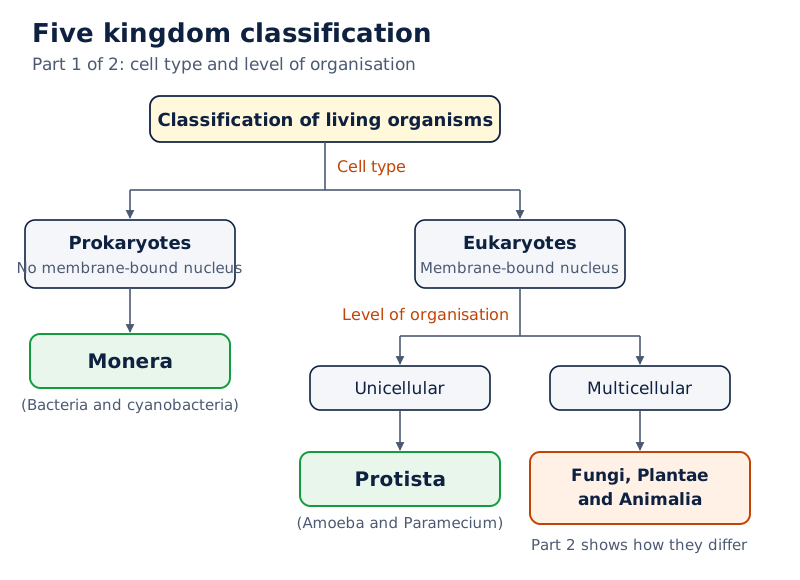
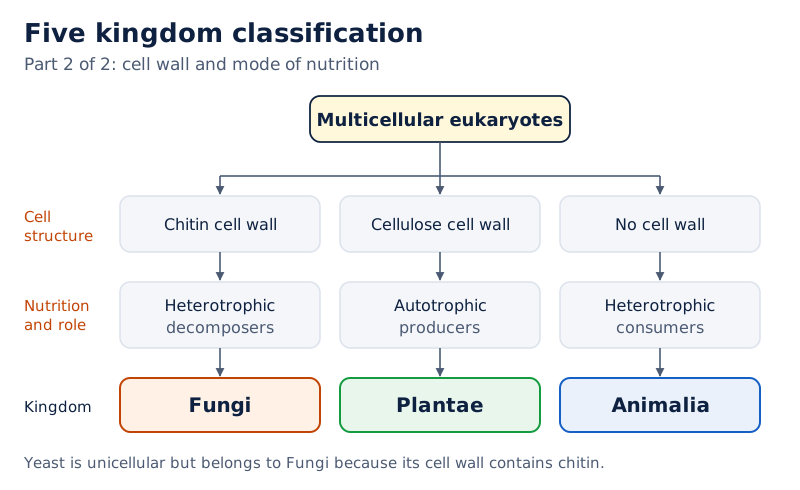
The branching chart first separates prokaryotes from eukaryotes. Further branches use organisation, cell walls and nutrition. It includes illustrations and photographs of examples, including yeast under Fungi.
Drawn by One Young India. See Fig. 12.5 in your NCERT textbook
Note: Fungi include both multicellular and unicellular organisms. Yeast is unicellular, although fungi are mostly multicellular. Cell number alone does not decide its kingdom.
How do Monera and Protista differ?
What characterises Monera?
Monera includes bacteria and cyanobacteria, which are single-celled prokaryotes. Their cells lack a membrane-bound nucleus. Bacteria occur in soil, water, air, hot springs, extreme environments and within human bodies. They can live where most organisms cannot survive.
Some bacteria are pathogens, organisms that cause disease, but many are useful. Lactobacillus and Rhizobium are examples of useful bacteria.
Cyanobacteria, also called blue-green algae, were among the first organisms to produce oxygen through photosynthesis. About 2.5 billion years ago, oxygen accumulated in the atmosphere and made Earth suitable for other forms of life.
Ancient cyanobacterial fossils occur in structures called stromatolites. Fossils are preserved remains of past organisms. Stromatolites found in Rajasthan and Madhya Pradesh provide some of the earliest evidence of life on Earth.
Bacteria also contribute to nutrient cycling, the recycling of nutrients in the environment. Some break down pollutants such as oil, pesticides and sewage. Their ecological importance therefore extends beyond their small size or their capacity to cause disease.
What characterises Protista?
Protista includes mostly unicellular organisms with a true nucleus. They may lack a cell wall or have one made of cellulose. Amoeba, Paramecium, Chlamydomonas and Euglena are examples. Protists live in water or moist places.
Some protists are autotrophic and others heterotrophic. They form important links in aquatic food chains, the feeding sequences in water. Some produce oxygen, others serve as food for small animals, and some act as decomposers that help recycle nutrients.
The decisive comparison between Amoeba and bacteria is nuclear organisation, not simply cell number. Both are unicellular, but Amoeba is eukaryotic and bacteria are prokaryotic. Placing every unicellular organism together would hide this fundamental difference.
How do fungi obtain food, and what are lichens?
What makes fungi a separate kingdom?
Fungi are mostly multicellular, heterotrophic eukaryotes with chitin cell walls. They do not make their own food. Fine filaments can form a network called a mycelium, through which nutrients from dead or decaying matter are absorbed.
Most fungi are saprophytes, organisms feeding on dead organic matter. They break complex material from fallen leaves, twigs and dead organisms into simpler substances. Minerals become available in the soil, supporting nutrient recycling and soil fertility.
Some fungi form mutualistic relationships, associations in which both partners benefit. Others are parasites, obtaining nutrients from another living organism, called the host, and can cause disease in plants and animals. Fungal nutrition is therefore not restricted to dead material.
Fungi reproduce sexually and asexually, often by forming spores, reproductive units that can develop into new organisms. Sexual reproduction involves the joining of reproductive cells; asexual reproduction does not. Fungi grow best in warm, moist conditions.
Yeast is a unicellular exception placed in Fungi because its cell wall contains chitin. Mushrooms are visible, macroscopic fungi and reproduce through spores. Aspergillus is another example of a fungus.
How do lichen partners help each other?
Lichens are symbiotic associations between an autotrophic alga and a heterotrophic fungus. Symbiosis here means a mutual association of two organisms. The fungal partner provides protection, while the algal partner photosynthesises and supplies food.
Lichens can change colour in response to air pollutants. They act as bioindicators, living indicators used to assess environmental conditions, including air quality. Their colour helps researchers assess pollutant concentration.
Some lichens are used as spices, medicines or sources of dyes. Some are poisonous, making correct identification important. Traditional knowledge also distinguishes edible from poisonous wild mushrooms, linking classification with the use and conservation of forest resources.
How do the five plant groups differ?
Plantae contains multicellular, autotrophic eukaryotes. Plant cell walls are primarily cellulose and provide support and protection. Plants form the base of most food chains and release oxygen. Their groups show different ways of meeting the demands of growth, transport and reproduction.
How do simpler plants depend on water?
Thallophyta includes simple plants such as Spirogyra. Their body is a thallus, an undifferentiated structure that exchanges gases, water and nutrients directly with its surroundings. Thallophytes are mostly found in water or moist environments.
Bryophyta includes mosses and liverworts such as Marchantia. Their bodies show more differentiation than thallophytes. They have rhizoids, root-like structures, and may possess simple stem-like and leaf-like structures. These are not true roots, stems and leaves.
Bryophytes lack vascular tissues, the tissues that transport water and food through a plant. They grow in moist, shady places and require water for reproduction because male reproductive cells must swim to female cells. They are called the amphibians of the plant kingdom.
What changes occur in ferns and seed plants?
Pteridophyta, including ferns, has true roots, stems and leaves. The vascular tissues are xylem, transporting water, and phloem, transporting food. Pteridophytes still require aquatic conditions for reproduction and do not produce seeds.
What the figure shows
Fern and stem cross section
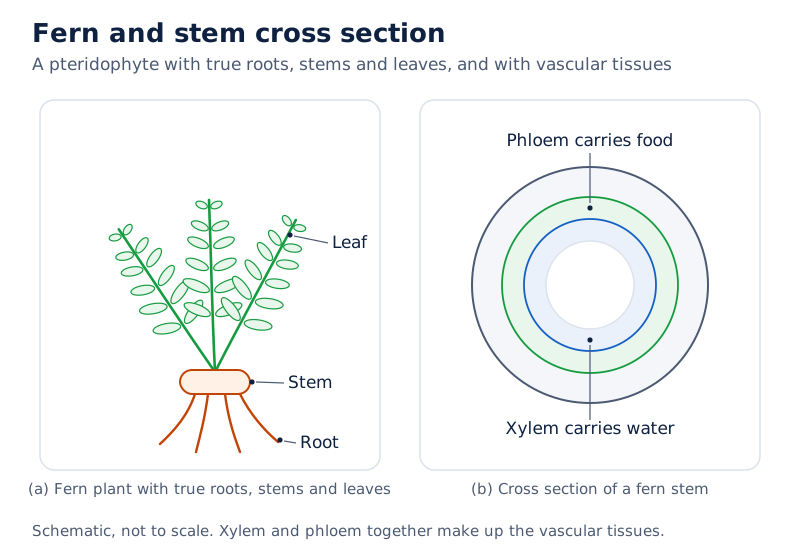
Panel (a) is a photograph of a fern. Panel (b) shows a cross section through a fern stem, with arrows labelling xylem and phloem.
Drawn by One Young India. See Fig. 12.11 in your NCERT textbook
Gymnosperms, including pines and cycads, produce seeds not enclosed in fruits. Seeds protect the developing embryo, the young developing organism, and contain stored food. Their seeds are often exposed on cones.
Gymnosperms are well-adapted to cold and dry regions. Needle-like or scale-like leaves reduce water loss. They do not require aquatic conditions for fertilisation, the joining of male and female reproductive cells. This reduces dependence on water during reproduction.
Angiosperms are flowering plants with seeds enclosed in fruits. Flowers attract pollinators, organisms that help transfer pollen, and fruits help spread seeds to new locations. Their well-developed roots, stems and leaves support complex body organisation. They occupy varied environments and are the most diverse plant group.
| Plant group | Body or transport feature | Reproduction or survival feature |
|---|---|---|
| Thallophyta | Thallus directly exchanges materials with its surroundings | Mostly occurs in water or moist environments |
| Bryophyta | Rhizoids; lacks vascular tissues | Requires water for reproduction |
| Pteridophyta | True roots, stems and leaves; xylem and phloem | Requires aquatic conditions for reproduction; no seeds |
| Gymnosperms | Needle-like or scale-like leaves reduce water loss | Seeds not enclosed in fruits; no aquatic conditions needed for fertilisation |
| Angiosperms | Well-developed roots, stems and leaves | Flowers and fruits; seeds enclosed within fruits |
How do animal body plans differ from sponges to roundworms?
Animalia includes multicellular, heterotrophic eukaryotes without cell walls. Most animals show locomotion, movement from place to place, rapid responses to stimuli, and coordinated behaviour. Stimuli are changes that produce a response. These abilities support feeding, avoiding predators and interaction with surroundings.
A major classification feature is the notochord, a flexible rod-shaped supporting structure. Non-chordates lack a notochord. Chordates possess it at some stage of life; in some chordates it is a precursor to the vertebral column, or backbone.
How do Porifera and Cnidaria feed?
Porifera, the pore-bearers, includes sponges. They are multicellular but lack tissue and organ organisation. Water flows through numerous pores, carrying food and oxygen to cells and removing waste. Sponges remain fixed in one place in aquatic environments.
Cnidaria includes Hydra, jellyfish and corals. Their tissue-level organisation allows specialised functions. Tentacles, projecting structures used to catch prey, support active feeding. A single opening serves both food intake and waste removal.
What the figure shows
Tissue-level organisation in Hydra
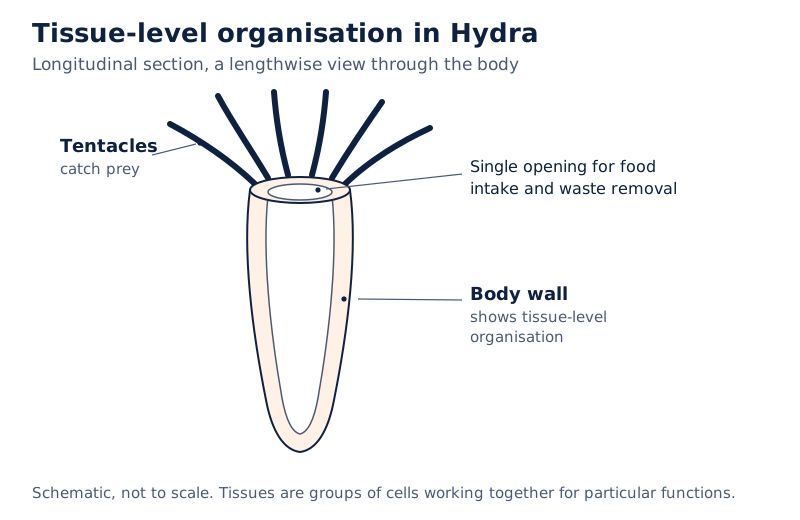
The longitudinal section, a lengthwise view through the body, shows the body wall and projecting tentacles. A line labels the opening at the upper end.
Drawn by One Young India. See Fig. 12.14 in your NCERT textbook
How do flatworms and roundworms compare?
Platyhelminthes are flatworms. Their bilateral symmetry means the body can be divided into two matching halves along one plane. Distinct head-tail and front-back regions support coordinated, directional movement. The flattened body permits gas exchange by diffusion, movement of particles from higher to lower concentration, without specialised respiratory organs.
Many flatworms have a parasitic lifestyle. Parasitic forms possess hooks and suckers that attach them to host tissues for obtaining nutrients.
Nematoda are roundworms with elongated, cylindrical bodies. They move through soil, water or host tissues. Unlike flatworms, which have a single opening for both food intake and waste elimination, roundworms have a mouth and an anus, the opening for waste removal.
Roundworms have organ-system organisation, in which organs work together in functional systems. The progression from sponge cells to tissues and organ systems highlights structural differences useful in classification. Similar habitats alone do not reveal these internal differences.
What distinguishes the remaining animal groups and vertebrates?
How do segmentation and skeletons help animals?
Annelida includes earthworms. Their cylindrical bodies are divided into segments, repeated body sections. Segmentation increases flexibility and allows more precise control of movement. Annelids have organ-system organisation and a body cavity, an internal space within the body.
Muscles support earthworm locomotion and a nerve cord helps control and coordination. Arthropoda, including insects, crabs and spiders, also has segmented bodies, but its defining features include jointed appendages, movable body projections such as legs, and a hard external skeleton.
An exoskeleton is a rigid external covering. In arthropods it protects the body, reduces water loss and supports powerful muscles. Different body segments perform different functions. These features help arthropods survive in dry and exposed environments.
Mollusca includes snails, squids and octopuses. Molluscs have soft bodies and organ-system organisation. In many molluscs, a shell protects the soft body. The same broad group therefore contains different modifications of a basic body plan.
Echinodermata includes starfish and sea urchins. They lack a notochord but possess a hard internal skeleton made of calcium carbonate. An endoskeleton is an internal supporting skeleton. In echinoderms it provides protection and controlled movement.
What separates protochordates from vertebrates?
Protochordates, such as Amphioxus, possess a notochord at least once during life. It supplies internal support without restricting movement. These primitive chordates help explain how animals with a notochord may have arisen from simpler forms.
Vertebrates possess a backbone. Their internal skeleton supports the body and protects vital organs such as the brain and spinal cord. It allows larger body size, efficient movement and complex organ systems. They show advanced sensory abilities and coordinated behaviour.
The five vertebrate groups are fish, amphibians, reptiles, birds and mammals. Their classification considers broad patterns of habitat use, body covering and reproduction. Fins and gills allow fish to move and breathe in water; feathers and hollow bones make flight possible in birds.
Fat storage in camels and thick fur in polar bears illustrate features supporting survival in extreme conditions. Mammary glands, the milk-producing glands of mammals, improve the survival of young ones. Such adaptations are features that support survival under particular environmental conditions.
How does the classification hierarchy organise organisms?
A hierarchy is an arrangement of groups at successive levels. Biological classification moves from broad groups towards smaller, more specific groups. Each lower group belongs within the group above it, and its members share more features.
What is the order of the levels?
The sequence is kingdom, phylum, class, order, family, genus, species. A phylum is a subdivision of a kingdom; a class is a subdivision of a phylum. Orders divide classes, and families divide orders. A genus groups closely related species sharing common features.
A sub-phylum is an additional level below a phylum and above a class. The tiger's classification includes Vertebrata at this level. The hierarchy works like an address: progressively narrower groups help locate and identify an organism accurately.
In P. tigris, the abbreviation P. stands for Panthera. In P. sativum, it stands for Pisum. The abbreviation must be understood from the organism and genus being discussed.
| Level | Tiger | Pea |
|---|---|---|
| Kingdom | Animalia | Plantae |
| Phylum | Chordata | Magnoliophyta |
| Class | Mammalia | Magnoliopsida |
| Order | Carnivora | Fabales |
| Family | Felidae | Fabaceae |
| Genus | Panthera | Pisum |
| Species | P. tigris | P. sativum |
What the figure shows
Classification of tiger and pea
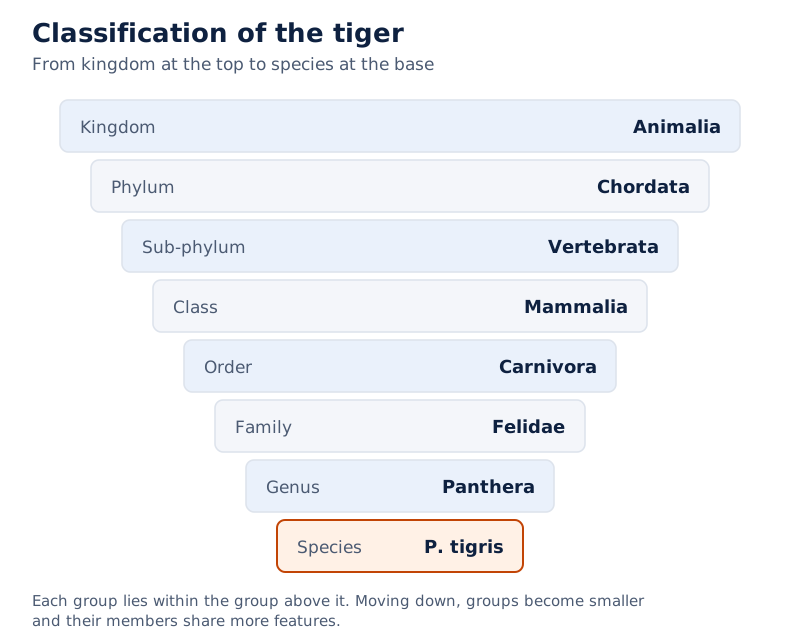
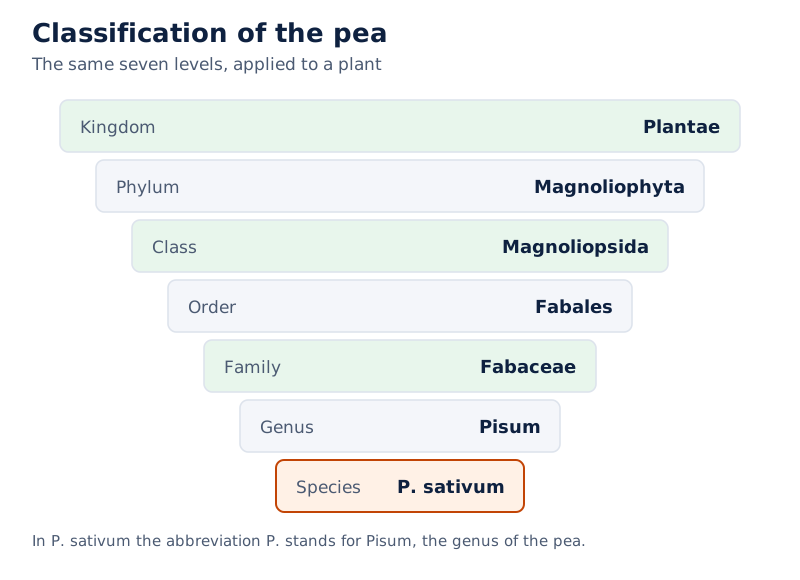
Two fan-shaped diagrams show successive classification levels with animal and plant pictures. Beside them, tables list the tiger and pea classifications; the tiger sequence includes the sub-phylum Vertebrata.
Drawn by One Young India. See Fig. 12.17 in your NCERT textbook
Compared with a class, a genus contains fewer members with more features in common. Moving down the hierarchy increases specificity. Moving upwards places the organism within progressively broader groups, helping compare both close similarities and wider relationships.
How are scientific names written in the binomial system?
Binomial nomenclature is the universal system of giving organisms two-part scientific names. Carolus Linnaeus introduced it in the eighteenth century. Names are written in Latin or a Latinised form, making communication possible across languages and regions.
Why are common names insufficient?
A tiger is called bagh in Hindi, puli in Tamil, tiger in English and tigre in French. Different local names can cause confusion when people discuss an organism. A scientific name identifies the same organism worldwide.
The first word is the genus name; the second is the species name. Together they form the unique scientific name. Tiger is Panthera tigris and mango is Mangifera indica. Panthera and Mangifera are the respective genera.
Which writing rules must be followed?
- Write both parts of the name, placing the genus first and the species second.
- Begin the genus name with a capital letter, as in Panthera or Mangifera.
- Write the species name in lower-case letters, as in tigris or indica.
- Use italics when printing the scientific name, or underline it when writing by hand.
Tiger, Panthera tigris, and lion, Panthera leo, share the genus Panthera. They have common features such as similar skull structure and the ability to roar. Sharing a genus indicates close similarity while their different species names distinguish them.
Naming and classification work together. The hierarchy places an organism among related groups, while its two-part scientific name provides a shared means of identification. Correct capitalisation and presentation make the two parts clear.
How do fossils and genetic evidence explain changing diversity?
How can small differences accumulate?
Evolution involves changes in living forms over many generations. Small differences among individuals affected their chances of survival and reproduction in changed conditions. As such differences accumulated over a vast span of time, new forms of life arose.
Present biodiversity reflects interactions between organisms and their surroundings over time. Similar features suggest common ancestry, descent from shared ancestors. Classification provides a systematic framework for investigating these relationships instead of treating every organism as an unrelated form.
Fossils in layers of rock, sand and mud preserve evidence of past life. Generally, older layers contain simpler organisms, while newer layers show more complex forms. Fossils provide natural records of changes over millions of years.
Birbal Sahni studied fossil plants and founded the Birbal Sahni Institute of Palaeosciences in Lucknow. His work linked present-day plants with their ancestors and contributed to understanding past environments and the long, connected history of life.
Why do classification systems continue changing?
Improved microscopes revealed previously unknown microorganisms. Genetic studies allowed comparison at the level of DNA. Organisms with similar DNA are considered to have common ancestry. Such evidence can reveal differences that external appearance does not show.
A domain is a broad grouping used in the three domain system. Based on genetic data, Carl Woese proposed this system in 1977. Its domains are Bacteria, Archaea and Eukarya. It revealed greater diversity among microscopic life forms than previously recognised.
Viruses illustrate another classification difficulty. They contain genetic material but are acellular, meaning they lack cellular organisation, and remain inactive outside a host cell. The five kingdom system uses cellular characteristics, so viruses do not fit within it.
Revising a classification system reflects new evidence and better explanations. Five kingdoms provide a useful framework, while genetic discoveries and acellular entities show why a single framework may not fully explain all living diversity.
Why is biodiversity threatened, and how does classification support conservation?
Pollution, deforestation, meaning the removal of forests, overuse of resources and climate change reduce biodiversity. Species are connected through feeding, reproduction and nutrient cycling. Losing one species can therefore affect organisms that depend on it.
Why can the loss of one species affect others?
Plants provide food and oxygen. Animals pollinate flowers and disperse seeds, moving them to new places. Microorganisms recycle nutrients. When a species disappears, dependent species may decline and eventually disappear too. This is a possible chain of consequences, not an inevitable outcome in every case.
Classification helps recognise which organisms are present, how they differ and which face extinction, the complete disappearance of a species. This supports protection of species and the habitats that meet their needs, as illustrated by hornbills and their nesting trees.
What do Indian examples reveal?
After the 1999 super cyclone in Orissa, villages with more mangroves experienced less destruction. Diverse microorganisms in forest soils and plant roots absorb, transform or break down pollutants. Mangrove soils trap sediments and heavy metals, limiting the spread of pollution.
Phumdis are floating beds of soil with rooted vegetation and rich organic matter in Loktak lake, Manipur. They support the endangered Sangai deer, which is endemic to Manipur. Endangered means facing a threat to continued survival.
The Sangai spends considerable time on phumdis within this small area. Degeneration of these habitats threatens the deer population. Identifying the deer and understanding its restricted habitat links classification with practical conservation.
The Purple Frog, Nasikabatrachus sahyadrensis, lives underground for most of the year and emerges only during the monsoon to breed. Its discovery in 2003 highlighted conservation needs in the Western Ghats and helped explain ancient amphibian groups.
Glossary
- Biodiversity — The immense variety of living organisms found on Earth across different habitats.
- Endemic species — A species naturally restricted to a particular region and found nowhere else.
- Biodiversity hotspot — A region supporting many endemic species that has undergone significant habitat loss.
- Biological classification — Systematic grouping of living organisms according to their similarities and differences.
- Prokaryote — An organism whose cell lacks a true nucleus enclosed by a membrane.
- Eukaryote — An organism whose cells contain a true nucleus enclosed by a membrane.
- Autotrophic nutrition — A mode of nutrition in which organisms make their own food.
- Mycelium — A network of fine fungal filaments involved in absorbing nutrients.
- Rhizoids — Root-like structures found in bryophytes, distinct from the true roots of other plants.
- Vascular tissues — Specialised plant tissues, xylem and phloem, that transport water and food respectively.
- Notochord — A flexible rod-shaped structure that provides internal support in chordate animals.
- Genus — A classification group containing closely related species that share common features.
- Binomial nomenclature — The universal naming system using two parts, the genus and species names.
- Fossils — Preserved remains of past plants and animals found in rock, sand or mud layers.
- Acellular — Lacking cellular organisation, a feature that prevents viruses fitting the five kingdom framework.
Common errors and misconceptions
- Misconception: All single-celled organisms belong to Monera. Correct: Monera is prokaryotic; Protista is eukaryotic, and unicellular yeast belongs to Fungi because of its chitin wall.
- Misconception: All fungi are multicellular and feed on dead matter. Correct: Fungi are mostly multicellular; yeast is unicellular. Some fungi are mutualistic or parasitic rather than saprophytic.
- Misconception: Bryophyte rhizoids are true roots. Correct: Rhizoids are root-like structures. Bryophytes lack true roots, stems and leaves and lack vascular tissues.
- Misconception: Ferns produce seeds because they have vascular tissues. Correct: Pteridophytes possess xylem and phloem but do not produce seeds and still require water for reproduction.
- Misconception: Every animal moves from place to place. Correct: Most animals show locomotion, but sponges remain fixed in one place and feed through water flowing through their pores.
- Misconception: Every internal skeleton indicates a backbone. Correct: Echinoderms have a hard internal skeleton but lack a notochord. Vertebrates possess a vertebral column.
- Misconception: Both words in a scientific name begin with capitals. Correct: Only the genus begins with a capital; the species name is lower-case. Printed scientific names are italicised.
- Misconception: Every region with many species is a biodiversity hotspot. Correct: A hotspot supports many endemic species and has undergone significant habitat loss.
Exam-style questions with model answers
Q1. A bacterium and an Amoeba each consist of one cell. The bacterium lacks a membrane-bound nucleus, while Amoeba has one. Assign each to a kingdom and justify each placement. [2 marks]
- The bacterium belongs to Monera because it is a unicellular prokaryote lacking a membrane-bound nucleus.
- Amoeba belongs to Protista because it is a unicellular eukaryote with a membrane-bound nucleus.
Q2. Yeast is unicellular, has a true nucleus and a chitin cell wall, and absorbs food instead of making it. Fungi are mostly multicellular eukaryotes with chitin walls and absorptive nutrition. Explain yeast's classification in three points. [3 marks]
- Yeast belongs to Fungi: its chitin cell wall matches the distinguishing wall material of that kingdom, despite its being unicellular.
- Its true nucleus makes it eukaryotic, and its absorption of food agrees with the fungal mode of heterotrophic nutrition.
- “Mostly multicellular” allows exceptions. Cell number must therefore be considered alongside wall composition, cell type and nutrition instead of being used alone.
Q3. Bryophytes have rhizoids, lack true roots, stems and leaves, lack vascular tissues, and need water for reproduction. Ferns have true roots, stems and leaves, xylem transporting water and phloem transporting food, need aquatic conditions for reproduction, and produce no seeds. Bryophytes have no flowers or seeds, and ferns have no flowers. Compare them in four points. [4 marks]
- Bryophytes have root-like rhizoids and lack true roots, stems and leaves, whereas ferns have these differentiated plant parts.
- Bryophytes lack vascular tissues, while ferns possess xylem for water transport and phloem for food transport throughout the plant.
- Both retain a reproductive dependence on water: bryophytes need water and ferns require aquatic conditions for reproduction.
- Both bryophytes and ferns lack flowers and seeds, despite ferns having true roots, stems, leaves and vascular tissues.
Q4. Sponges lack tissues and feed through water flowing through pores. Hydra has tissues and tentacles for catching prey. Flatworms have flattened bodies and bilateral symmetry. Roundworms have cylindrical bodies with mouth and anus. Earthworms have segmented bodies. Explain one structural significance for each animal in five separate points. [5 marks]
- Sponges have a simple cellular organisation without tissues. Water flowing through their pores brings food to the cells, linking their body structure directly with feeding.
- Hydra has tissue-level organisation and tentacles that capture prey. Its structure therefore supports active feeding through specialised body parts rather than pore-based feeding.
- Flatworms have bilateral symmetry, with distinct head-tail and front-back regions. This organisation enables better coordination of movement and directional activity.
- Roundworms have cylindrical bodies and two separate openings, the mouth and anus. The separate openings distinguish food entry from waste exit.
- Earthworms have segmented bodies, meaning their bodies are divided into repeated sections. Segmentation allows greater flexibility and more precise control of movement.
Q5. The tiger's genus is Panthera and its species name is tigris. Scientific names place the genus first, capitalise its first letter, use a lower-case species name, and are italicised in print or underlined by hand. Names such as bagh, puli and tiger vary by language. Apply these facts in five points. [5 marks]
- The tiger's complete scientific name is Panthera tigris. It contains both parts and follows the required order of genus before species.
- Panthera begins with a capital P because it is the genus name. The capital is used at the beginning of this first word.
- The second word, tigris, is written in lower case because it is the species name, rather than being capitalised like the genus.
- In printed work, Panthera tigris is italicised. When the same scientific name is written by hand, it is underlined instead.
- A shared scientific name avoids confusion between local names such as bagh, puli and tiger, allowing people using different languages to identify the same animal.
Q6. The hierarchy runs kingdom, phylum, class, order, family, genus, species. Each lower group is smaller, lies within the group above and contains members with more common features. Compare class with genus and explain the hierarchy in three points. [3 marks]
- Genus lies below class, with order and family between them. It is therefore the smaller, more specific grouping in the hierarchy.
- Members of a genus have more features in common than the wider set of organisms grouped within a class.
- The hierarchy is nested: the genus belongs within a family, the family within an order, and the order within a class, allowing progressively more precise identification.
Q7. A virus contains genetic material but lacks cellular organisation and remains inactive outside a host cell. The five kingdom system groups organisms using cellular features. Give two points explaining why the virus does not fit that system. [2 marks]
- The virus is acellular, so it lacks the cellular organisation on which the five kingdom criteria depend.
- Having genetic material does not overcome that mismatch; it also remains inactive outside a host cell.
Q8. Pakke Tiger Reserve has nearly 300 recorded bird species, including four hornbill species. These hornbills nest only in large, old trees with suitable cavities and eat specific fruits. Their distribution depends on tree size and fruit availability. Use these observations to explain four ways classification assists their study and protection. [4 marks]
- Classification organises records of nearly 300 bird species, making the reserve's bird diversity easier to study systematically.
- Distinguishing the four hornbill species allows observations to be linked to the appropriate species instead of treating all hornbills as one undifferentiated group.
- Species records can be compared with tree size and fruit availability to investigate the distribution of the hornbill species within the forest.
- Linking identified hornbills with their nesting requirements shows why protecting large, old trees with suitable cavities matters for their conservation.
Key takeaways
- Biodiversity supports food production, oxygen supply, decomposition and livelihoods through the interactions of many different organisms.
- Biological classification uses several features together, including cell type, organisation, nutrition, body structure and ecological role.
- Monera contains prokaryotes; Protista contains mostly unicellular eukaryotes; fungi are mostly multicellular, with unicellular yeast as an exception.
- Plant groups differ in body differentiation, transport tissues, dependence on water for reproduction, seeds, flowers and fruits.
- Animal classification examines body organisation, symmetry, segmentation, supporting skeletons and the presence or absence of a notochord.
- The classification hierarchy moves from kingdom to species, with each lower group sharing more common features.
- Scientific names contain genus and species, with a capitalised genus, lower-case species and italics in print.
- Fossils and genetic evidence help explain changing diversity, while classification supports the identification and conservation of threatened organisms.
Test yourself
What two features define a biodiversity hotspot?
It supports many endemic species and has undergone significant habitat loss.
Why is cell number insufficient to separate Amoeba from bacteria?
Both are unicellular, but Amoeba has a membrane-bound nucleus while bacteria lack one.
How do the two partners in a lichen cooperate?
The fungal partner provides protection, while the algal partner photosynthesises and provides food.
Why are bryophytes called amphibians of the plant kingdom?
They grow on moist land but still require water for reproduction.
What reproductive dependence remains in pteridophytes despite their vascular tissues?
They still require aquatic conditions for reproduction and do not produce seeds.
How does an arthropod's exoskeleton help it survive?
It protects the body, reduces water loss and supports powerful muscles.
How do protochordates demonstrate the importance of a notochord?
They possess a notochord at least once during life, providing internal support without restricting movement.
Why do we say that older rock layers generally, rather than always, contain simpler organisms than newer layers?
It describes a broad pattern, rather than claiming that every older layer contains only simpler organisms.
Write about it
Turn a question from this chapter into a paper.
The Writing Studio has a structure guide, a rubric and citation tools for 15 formats, from essays to research papers. Drafting is free with an account. Learnacy Essential adds feedback from an AI writing coach and submission to The OYI Review.
Learnacy Essential is ₹1,499 for the year. Publication depends on review and is not guaranteed.