
Atomic Foundations of Matter | CBSE Class 9 Science Notes
On this page

This note covers conservation of mass, constant proportions, Dalton’s atomic theory, molecules, electron sharing and transfer, covalent and ionic bonds, compound names, chemical formulae, properties of compounds, molecular mass and formula unit mass.
How can physical and chemical changes conserve mass?
What changes when a compound forms?
An atom is a tiny particle of matter that participates in chemical reactions. An element contains one kind of atom; a compound contains different elements chemically combined. A physical change retains chemical identity; a chemical change, or reaction, forms new substances.
Hydrogen burns, and oxygen supports burning. Both are gases, but the water they form is liquid at ordinary temperatures. Water neither burns nor helps burning; it extinguishes fire. Nevertheless, its mass equals the combined masses of the hydrogen and oxygen used.
Definition: The law of conservation of mass states that matter can neither be created nor destroyed in a chemical reaction. Antoine Lavoisier proposed this law in 1789.
Reactants are the starting substances in a reaction; products are the substances formed. To check conservation, compare the total masses of all reactants and all products. Material escaping from the apparatus still belongs in that comparison.
What do the weighing activities show?
In a physical change such as dissolving common salt in water, the solution has the combined mass of the water and salt. There is practically no change in mass. Tearing a piece of paper and weighing all its pieces offers another physical-change check.
- Place a clean, dry 100 mL beaker on a digital balance. Here mL means millilitre, a unit of volume.
- Use the tare or reset button to set the reading to zero.
- Add about 50 mL of water and a spatula full of common salt, then record the mass.
- Swirl until the salt dissolves and record the reading again.
For a chemical change, vinegar and baking soda, also called sodium hydrogencarbonate, produce carbon dioxide and other substances. The effervescence, or bubbling as gas forms, accompanies the reaction. In an open flask, carbon dioxide escapes, so the final balance reading is lower.
Attach a balloon to the flask before mixing. The gas inflates the balloon and stays within the weighed apparatus. The final reading matches the initial reading because the gas is included. Keep the balloon on the balance in both measurements, including any baking soda remaining inside it.
What the figure shows
Collecting a reaction gas
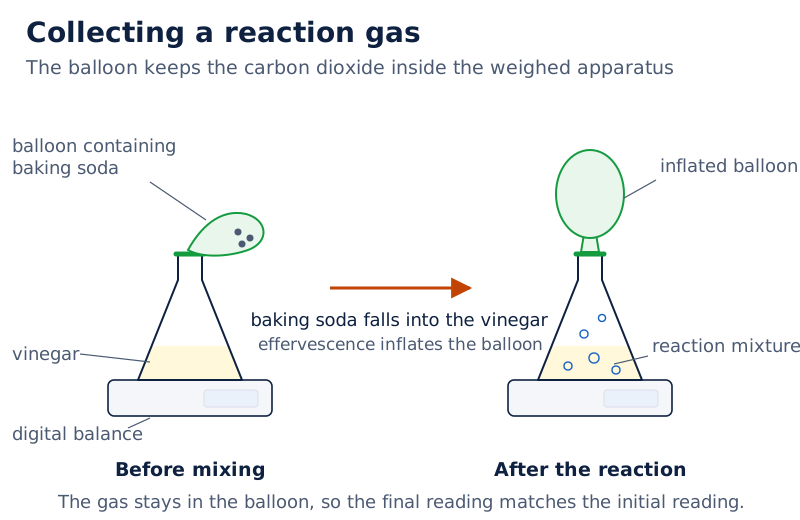
The drawings show a balloon attached to a vinegar-containing conical flask, baking soda entering the flask, and an inflated balloon above the final reaction mixture. A digital balance supports the apparatus.
Drawn by One Young India. See Fig. 9.3 in your NCERT textbook
Note: Usually, a measurement has uncertainty of ±1 in its last digit, where ± means plus or minus. A variation within experimental error can therefore be treated as a constant reading.
How do you check conservation of mass numerically?
Which masses must be included?
Use the same unit for every mass. The symbol g means gram, a unit of mass. Add all starting masses, then add all product masses. Include any escaping gas. In calculations, = means equals, + means addition, × means multiplication and ÷ means division.
Total reactant mass = total product mass
This equality expresses conservation for the complete chemical reaction. A balance measures the material placed on it. A lower final reading from an open apparatus therefore does not, by itself, show that matter has been destroyed.
Worked example 1. In a closed container, 4.0 g of calcium carbonate reacts with 2.92 g of hydrochloric acid. The products are 1.76 g of carbon dioxide, 0.72 g of water and 4.44 g of calcium chloride. Check conservation.
Formula: Reactant mass = sum of starting masses. Product mass = sum of final masses.
Substitute: Reactant mass = 4.0 g + 2.92 g. Product mass = 1.76 g + 0.72 g + 4.44 g.
Answer: Both totals are 6.92 g. The equal masses verify conservation of mass.
Worked example 2. If 12 g of carbon combines with 32 g of oxygen to form 44 g of carbon dioxide, how much carbon dioxide forms from 2.4 g of carbon reacting completely?
Answer: Carbon dioxide mass = (44 ÷ 12) × 2.4 g. This gives 8.8 g of carbon dioxide. The given carbon-to-product relationship is scaled to the smaller starting mass.
Worked example 3. A reaction uses 20 g of hydrogen and 160 g of oxygen completely. What mass of water forms?
Answer: Water mass = 20 g + 160 g. The mass of water is 180 g because both reactants are included in the total.
Worked example 4. Sodium carbonate, 5.3 g, reacts with 6.0 g of acetic acid. Products are 2.2 g of carbon dioxide, 0.9 g of water and 8.2 g of sodium acetate. Check the mass totals.
Formula: Reactant mass = sum of reactant masses. Product mass = sum of product masses.
Substitute: Reactant mass = 5.3 g + 6.0 g. Product mass = 2.2 g + 0.9 g + 8.2 g.
Answer: Each total is 11.3 g, so the data obey conservation of mass.
Can an open apparatus still be useful?
Mixing sodium sulfate solution with barium chloride solution forms a white precipitate, an insoluble solid formed in a solution. The products are barium sulfate and sodium chloride. This experiment can use an open system because no gas forms.
Weigh both flasks before mixing and again afterwards. Retaining both flasks includes solution that may remain on the walls of the pouring flask. Otherwise, material left behind could make the comparison misleading.
What does the law of constant proportions tell us?
Definition: The law of constant proportions states that the elements in a compound combine in a fixed ratio by mass, irrespective of its source. It is also called the law of definite proportions or Proust’s law.
Joseph Proust showed that compounds have definite composition. For water, the mass ratio of hydrogen to oxygen is 1:8. The colon expresses a ratio: one mass part of hydrogen accompanies eight mass parts of oxygen.
Water collected from rivers, borewells or the ocean must be purified before this comparison. Decomposing 9 g of purified water gives 1 g of hydrogen and 8 g of oxygen. Different sources do not change the composition of the purified compound.
How does a fixed ratio help in calculations?
First identify which element corresponds to each side of the mass ratio. Then scale the required mass in the same proportion. A mass ratio compares masses, not atom numbers. A molecule is an electrically neutral entity of more than one atom that can exist independently and shows the substance’s properties.
Worked example 5. Sodium chloride contains sodium and chlorine in the mass ratio 23:35.5. How much chlorine is needed when 46 g of sodium reacts completely?
Answer: Chlorine mass = (35.5 ÷ 23) × 46 g. Therefore, 71 g of chlorine is required. The order sodium:chlorine is retained throughout.
Worked example 6. A compound contains 40% sulfur and 60% oxygen by mass. What mass of oxygen accompanies 20 g of sulfur in the same compound? The symbol % means per hundred.
Answer: Oxygen mass = (60 ÷ 40) × 20 g. The required oxygen mass is 30 g. Both samples have the same sulfur-to-oxygen mass ratio.
How are the two laws different?
| Law | What is compared? | Central conclusion |
|---|---|---|
| Conservation of mass | Total masses before and after a chemical reaction | Total mass remains the same when all substances are included. |
| Constant proportions | Masses of constituent elements in a compound | The ratio remains fixed irrespective of the compound’s source. |
A mixture combines substances without requiring the fixed composition of a compound. Thus, definite proportions apply to compounds, not mixtures. Distinguish purified water from a water sample containing dissolved materials when applying this law.
How does Dalton’s atomic theory explain the laws?
John Dalton presented his atomic theory in 1808. It connected experimental observations about mass and composition with the idea of atoms. A postulate is a basic assumption accepted without formal proof from which further ideas are developed.
What were the six postulates?
- All matter consists of very tiny particles called atoms, which participate in chemical reactions.
- Atoms are indivisible particles and cannot be created or destroyed in a chemical reaction.
- Atoms belonging to a given element have identical masses and chemical properties.
- Atoms of different elements differ in mass and chemical properties.
- Atoms combine in simple whole-number ratios to form compounds.
- The relative numbers and kinds of atoms remain constant in a given compound.
These statements describe Dalton’s postulates. Keep that historical setting when explaining them. In chemical reactions, atoms rearrange; the theory connects this rearrangement with the absence of a loss or gain in total mass.
How do the postulates connect with observations?
If atoms are neither created nor destroyed during a chemical reaction, their total mass is retained. This provides an atomic explanation for conservation of mass. Hydrogen and oxygen atoms combine in water without being destroyed or changed into something else.
If a compound has a constant relative number and kind of atoms, its constituent elements occur in a definite mass proportion. Thus, the fixed composition of compounds connects with the law of constant proportions.
When magnesium burns in air, a white powder of magnesium oxide forms. Magnesium atoms have combined with oxygen atoms. The new substance has formed through combination, while the atomic explanation still accounts for the material involved.
Note: “Simple whole-number ratio” describes the numbers of combining atoms. It does not mean that every mass ratio must consist of simple whole numbers.
Why do atoms combine to form molecules?
Definition: A molecule is an electrically neutral entity containing more than one atom. It can exist independently and shows the properties of the substance.
A molecule of an element contains atoms of that element. A molecule of a compound contains atoms of different elements. A hydrogen molecule has two hydrogen atoms, whereas hydrogen chloride contains one hydrogen atom and one chlorine atom.
The symbol H represents hydrogen and Cl represents chlorine. Their molecular formulae are H₂ and HCl. A chemical formula uses element symbols and numbers to represent composition. A subscript, the small number below the line, counts the atoms; an unwritten subscript means one.
What makes an electron arrangement stable?
An electron is a negatively charged particle in an atom. Electric charge is a property responsible for electrical attraction or repulsion; electrically neutral means having no net charge. Its outermost electron shell is the valence shell, and electrons there are valence electrons. The electronic configuration describes the arrangement of electrons in shells.
An octet is a set of eight valence electrons. A duplet is a set of two electrons in the first shell, called the K-shell. Atoms with eight outermost electrons are stable; when the K-shell is outermost, two provide stability.
Atoms with fewer than eight valence electrons may share, gain or lose electrons to complete their valence shell. Some elements, such as helium, exist only as atoms because their atoms are stable. It is therefore incorrect to require every element to exist as molecules.
What is a chemical bond?
A chemical bond is the force holding atoms together. When atoms combine, the total energy becomes lower than the sum of the energies of the separate atoms. The resulting arrangement is more stable.
Combination generally involves electron sharing or electron transfer. Sharing produces covalent bonding. Transfer forms charged particles whose attraction produces ionic bonding. In both cases, follow what happens to the outer electrons before writing the resulting formula.
How does sharing electrons produce covalent bonds?
A covalent bond involves atoms sharing electron pairs. The shared electrons attract both atomic nuclei. A nucleus is the central part of an atom. Sharing can produce molecules of an element or of a compound.
How do hydrogen, chlorine and oxygen molecules form?
Each hydrogen atom has one electron in its K-shell and needs one more for stability. Two hydrogen atoms contribute one electron each to a shared pair. The resulting H₂ molecule has a single bond, meaning one shared electron pair.
What the figure shows
Hydrogen sharing electrons
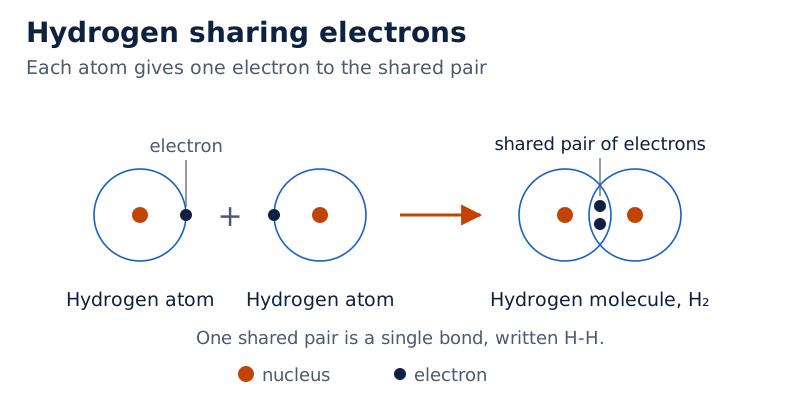
Two separate hydrogen atoms are drawn with one electron each. The product drawing has overlapping shells, with two electrons in the overlap between the nuclei.
Drawn by One Young India. See Fig. 9.6 in your NCERT textbook
Each chlorine atom has seven valence electrons. Two chlorine atoms share one electron each, forming one shared pair and a single bond. The molecule is Cl₂. One line between atom symbols can represent a single bond, as in H-H or Cl-Cl.
The symbol O represents oxygen. An oxygen atom has six valence electrons and needs two more to complete its octet. Two oxygen atoms therefore share two electrons each, producing two shared pairs. This is a double bond.
What the figure shows
Oxygen sharing two pairs
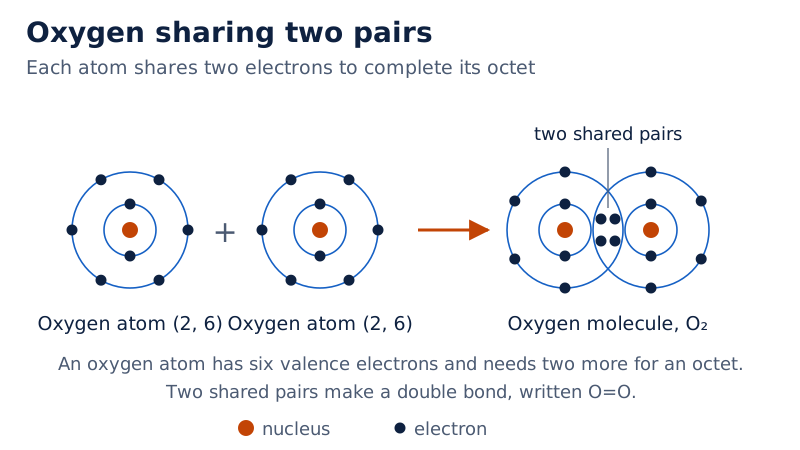
Separate oxygen atoms appear before the arrow. The oxygen molecule after the arrow has overlapping outer shells containing four shared electrons between the nuclei. Its bond representation is O=O.
Drawn by One Young India. See Fig. 9.8 in your NCERT textbook
How do hydrogen chloride and water form?
Hydrogen needs one more electron for a duplet, while chlorine needs one for an octet. Each contributes one electron to a shared pair. Thus HCl has a single covalent bond between different kinds of atoms.
In water, oxygen needs two more electrons, but each hydrogen needs only one. Oxygen shares with two hydrogen atoms, forming a separate shared pair with each. The formula H₂O therefore represents two hydrogen atoms and one oxygen atom.
What the figure shows
Forming water
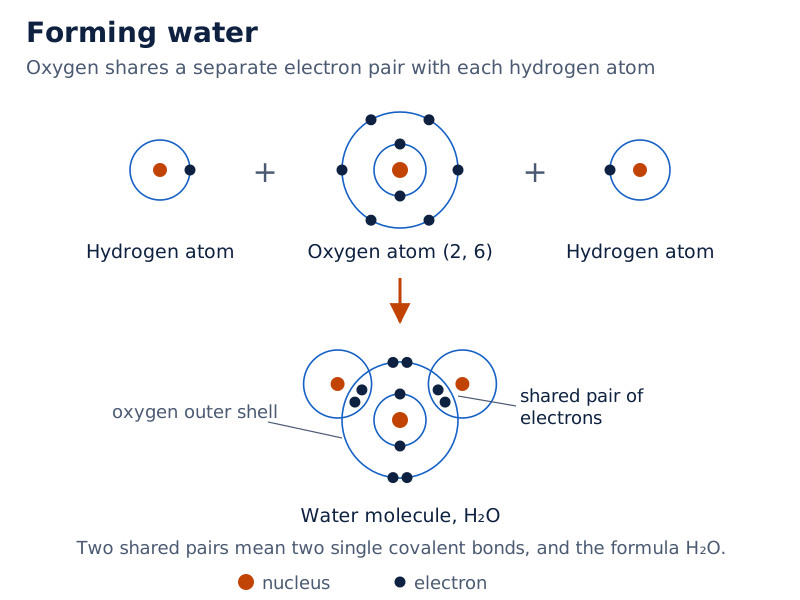
An oxygen atom is drawn between two separate hydrogen atoms. The water drawing shows the oxygen outer shell overlapping with each hydrogen shell, with a shared electron pair in each overlap.
Drawn by One Young India. See Fig. 9.10 in your NCERT textbook
Count shared pairs to explain bonds and count atoms to explain the formula. Each hydrogen in water shares with oxygen.
How are covalent compounds named?
Names of covalent compounds indicate their constituent elements and atom numbers. The first element keeps its regular name. The second element has an -ide ending. A prefix, a word part placed before a name, indicates how many atoms are present.
Which prefixes indicate atom numbers?
| Prefix | Number of atoms |
|---|---|
| mono- | 1 |
| di- | 2 |
| tri- | 3 |
| tetra- | 4 |
| penta- | 5 |
| hexa- | 6 |
Mono- is usually omitted for the first element but is used for the second. If a prefix ends in “o” or “a” before an element name beginning with a vowel, drop that last vowel. This gives monoxide, tetroxide and pentoxide.
If the prefix ends in “i”, retain it, as in dioxide and trioxide. The chemical symbols used below are C for carbon, S for sulfur, P for phosphorus, F for fluorine and N for nitrogen.
| Formula | Name | What the name identifies |
|---|---|---|
| CO | Carbon monoxide | One oxygen atom with carbon |
| CO₂ | Carbon dioxide | Two oxygen atoms with carbon |
| CS₂ | Carbon disulfide | Two sulfur atoms with carbon |
| PCl₃ | Phosphorus trichloride | Three chlorine atoms with phosphorus |
| SF₆ | Sulfur hexafluoride | Six fluorine atoms with sulfur |
| N₂O₄ | Dinitrogen tetroxide | Two nitrogen atoms and four oxygen atoms |
| N₂O₅ | Dinitrogen pentoxide | Two nitrogen atoms and five oxygen atoms |
Which naming exceptions should be remembered?
When hydrogen is the first element in the formula, no prefix is placed before hydrogen, irrespective of its atom number. Thus H₂S is hydrogen sulfide. Its subscript still records two hydrogen atoms even though the name does not use dihydrogen.
Some binary compounds, containing two elements, are known by common names. H₂O is water, and NH₃ is ammonia. A familiar common name and the formula describe the same substance, so the formula remains essential for counting atoms.
How does electron transfer produce ionic bonding?
Atoms with fewer than four valence electrons would generally donate them to reach a stable electronic configuration. Atoms with more than four valence electrons usually gain or share electrons to complete an octet. These statements are tendencies, not unqualified rules.
How are positive and negative ions formed?
An ion is an electrically charged atom or group of atoms. A positively charged ion is a cation; a negatively charged ion is an anion. A proton is a positively charged particle in the nucleus.
Sodium, symbol Na, has atomic number 11. The atomic number is the number of protons in an atom. Sodium has one valence electron. Losing it produces Na⁺, with 11 protons but only 10 electrons, so the ion has one positive charge.
A chlorine atom has seven valence electrons. It gains one electron to attain a stable arrangement and becomes the chloride ion, Cl⁻. The superscript, the small raised sign or number, records charge. Thus ⁺ means one positive charge and ⁻ means one negative charge.
Definition: An ionic bond is the electrostatic force of attraction between oppositely charged ions. “Electrostatic” here describes the attraction arising from their electric charges.
What the figure shows
Electron transfer in sodium chloride
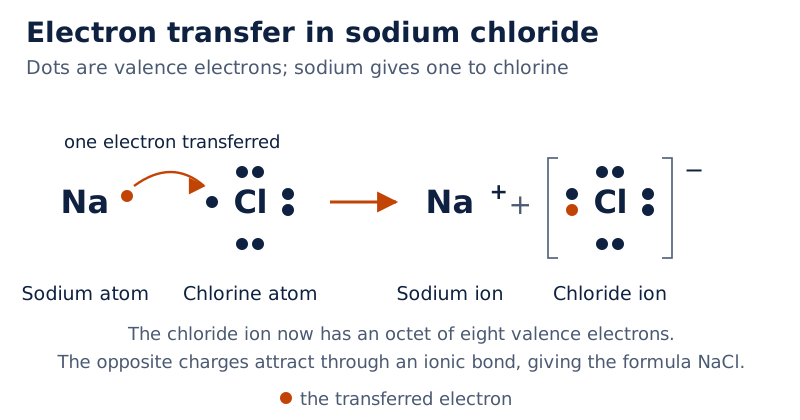
The electron-dot drawing shows sodium contributing its outer electron to chlorine. Sodium and chloride ions appear after transfer, followed by the formula NaCl.
Drawn by One Young India. See Fig. 9.13 in your NCERT textbook
Why is sodium chloride represented by an ion ratio?
Ionic compounds usually do not remain as single units. They form three-dimensional crystals with repeating arrangements of ions. In sodium chloride, each sodium ion is surrounded by six chloride ions, and each chloride ion by six sodium ions.
This regular arrangement is a crystal structure. A crystal lattice represents its arrangement using points or dots for ions. The formula NaCl gives the simplest ratio of sodium to chloride ions, rather than describing a separate molecule.
Sulfur has six outer electrons and can gain two to complete its octet. Its sulfide ion is S²⁻: the raised 2 and minus sign indicate two negative charges. Electron transfer changes charge, while the element symbol continues to identify the element.
Which ions and naming rules help you write compounds?
In naming an ionic compound, put the cation name first and the anion name second. Simple anion names end in -ide. Generally, metals form cations and non-metals form anions; ionic compounds are typically formed when metals combine with non-metals.
A monoatomic ion consists of one charged atom. A polyatomic ion contains a group of atoms; the ions below combine atoms of two or more elements. Names of polyatomic ions generally do not end with -ide, with hydroxide providing an example to remember.
Valency is combining capacity. For the ions in these tables, it equals the numerical magnitude of the charge, without its sign. Every formula is paired with its ion name, so both the element symbols and the charges can be identified.
What are the common monoatomic ions?
| Name of ion | Formula | Valency |
|---|---|---|
| Sodium | Na⁺ | 1 |
| Lithium | Li⁺ | 1 |
| Potassium | K⁺ | 1 |
| Silver | Ag⁺ | 1 |
| Calcium | Ca²⁺ | 2 |
| Barium | Ba²⁺ | 2 |
| Iron (Ferrous) | Fe²⁺ | 2 |
| Iron (Ferric) | Fe³⁺ | 3 |
| Copper (Cuprous) | Cu⁺ | 1 |
| Copper (Cupric) | Cu²⁺ | 2 |
| Magnesium | Mg²⁺ | 2 |
| Zinc | Zn²⁺ | 2 |
| Aluminium | Al³⁺ | 3 |
| Fluoride | F⁻ | 1 |
| Chloride | Cl⁻ | 1 |
| Bromide | Br⁻ | 1 |
| Iodide | I⁻ | 1 |
| Oxide | O²⁻ | 2 |
| Sulfide | S²⁻ | 2 |
What are the common polyatomic ions?
| Name of ion | Formula | Valency |
|---|---|---|
| Hydroxide | OH⁻ | 1 |
| Nitrate | NO₃⁻ | 1 |
| Hydrogencarbonate | HCO₃⁻ | 1 |
| Carbonate | CO₃²⁻ | 2 |
| Sulfate | SO₄²⁻ | 2 |
| Ammonium | NH₄⁺ | 1 |
Distinguish the two iron ions and the two copper ions. Ferrous means Fe²⁺, while ferric means Fe³⁺. Cuprous means Cu⁺, while cupric means Cu²⁺. Their different charges affect the proportions required in a neutral compound.
How are chemical formulae constructed from valencies and charges?
How does the crossover method work?
For covalent compounds, write the constituent element symbols and their valencies. Then cross over the valencies, placing each as the subscript of the other element. Do not write a subscript of one. Check the resulting composition against the combining capacities.
Hydrogen and chlorine each have valency one, giving HCl. Hydrogen has valency one and sulfur two, giving H₂S. Carbon has valency four and chlorine one, giving carbon tetrachloride, CCl₄. These examples connect valencies with the numbers shown in a formula.
For ionic compounds, use ion charges and ensure that the total positive and negative charges balance. The final compound is electrically neutral. Charges help construct the formula, but the charges on individual ions are not written in the compound’s formula.
- Write the cation symbol first, followed by the anion symbol.
- Write their charges beneath the symbols to organise the calculation.
- Cross over the numerical charge magnitudes to obtain subscripts.
- Divide the subscripts by a common factor, if any, to obtain the simplest ratio.
Calcium chloride combines Ca²⁺ and Cl⁻ as CaCl₂. One calcium ion needs two chloride ions to balance charge. Aluminium oxide combines Al³⁺ and O²⁻ as Al₂O₃. Magnesium oxide reduces from the crossover result Mg₂O₂ to MgO.
When are brackets needed?
Keep a polyatomic ion together as a group. When two or more copies of that ion occur, place brackets around its formula and put the number outside. The external subscript multiplies the whole group, not just its last element.
| Compound | Combining ions | Formula |
|---|---|---|
| Calcium carbonate | Ca²⁺ and CO₃²⁻ | CaCO₃ |
| Magnesium hydroxide | Mg²⁺ and OH⁻ | Mg(OH)₂ |
| Aluminium hydroxide | Al³⁺ and OH⁻ | Al(OH)₃ |
| Aluminium sulfate | Al³⁺ and SO₄²⁻ | Al₂(SO₄)₃ |
In Mg(OH)₂, two hydroxide ions balance one magnesium ion. In Al(OH)₃, three hydroxide ions balance one aluminium ion. Calcium carbonate needs one carbonate ion per calcium ion, so its formula requires no brackets.
Note: Aluminium hydroxide is Al(OH)₃, not AlOH₃. The brackets preserve the hydroxide group. Reducing a ratio must not change the internal formula of a polyatomic ion.
How do ionic and covalent compounds differ in properties?
Solubility describes whether a substance dissolves in a given liquid. A solvent is the dissolving medium. Electrical conductivity describes the ability to conduct electricity. For the solutions considered here, the movement of ions explains conduction.
What patterns should be compared?
| Property | Ionic compounds | Covalent compounds |
|---|---|---|
| Solubility in water | Generally soluble, as with sodium chloride and copper sulfate | Most are insoluble, as with camphor and naphthalene; some, such as sugar, dissolve. |
| Solubility in kerosene and petrol | Sodium chloride and copper sulfate are insoluble. | Camphor and naphthalene dissolve. |
| Electrical conductivity | Solid ions are fixed; dissolved ions can move and conduct. | Sugar solution does not provide ions; camphor and naphthalene also do not conduct. |
| Melting and boiling points | Generally high because of strong attractions between ions | Usually low |
Melting changes a solid into a liquid; boiling changes liquid into gas at its boiling point. The molten state means the melted state. Keep “generally”, “most” and “usually” when describing property patterns, since the distinctions are not all absolute.
Solid ionic compounds do not conduct electricity because strong forces hold the ions in fixed positions. Dissolving sodium chloride or copper sulfate in water allows ions to move. Sugar can dissolve without providing ions, so dissolving alone does not guarantee conductivity.
How can conductivity be tested?
Compare camphor, sodium chloride, copper sulfate, sugar and naphthalene. Test their solid samples and their water mixtures. Use electrodes, conducting pieces that connect the sample to a circuit, and observe whether the bulb glows.
What the figure shows
Testing a solution
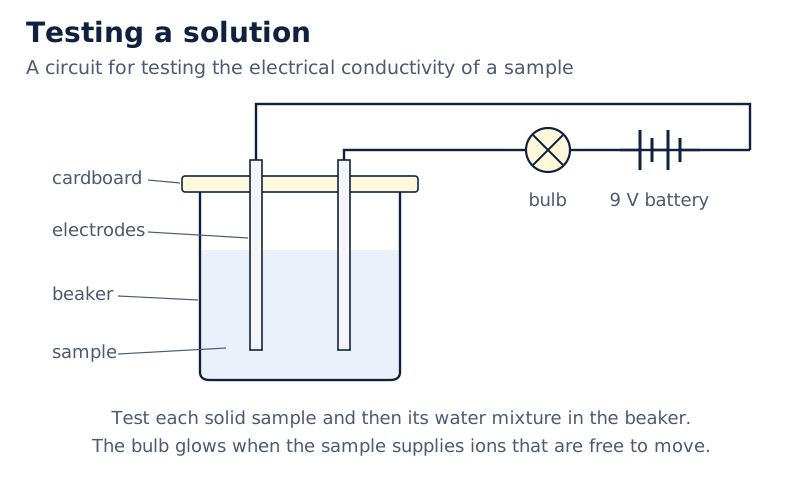
Two electrodes pass through cardboard into a sample in a beaker. Wires connect them to a bulb and a battery labelled 9 V. V means volt, the unit of potential difference, or electrical energy transferred per unit charge between two points.
Drawn by One Young India. See Fig. 9.15 in your NCERT textbook
Use the low-voltage battery specified for the activity and do not touch connected electrodes. Petrol and kerosene are flammable liquids, so handle them carefully during solubility work.
How are molecular mass and formula unit mass calculated?
Atomic mass is the mass assigned to an atom. Here it is expressed in u, the unified atomic mass unit used for atomic-scale masses. Use the atomic masses supplied with a calculation and count every atom represented by its formula.
Molecular mass is the sum of the atomic masses of all atoms in a molecule. Multiply each atomic mass by the corresponding atom count, then add the contributions. The result uses u, the same unit as the supplied atomic masses.
How do molecule calculations work?
Worked example 7. Find the molecular mass of water, H₂O, using hydrogen = 1 u and oxygen = 16 u.
Answer: Water molecular mass = (1 × 2) u + (16 × 1) u. Two hydrogen atoms contribute 2 u and one oxygen atom contributes 16 u, giving 18 u.
Worked example 8. Find the molecular mass of carbon dioxide, CO₂, using carbon = 12 u and oxygen = 16 u.
Answer: CO₂ molecular mass = (12 × 1) u + (16 × 2) u. One carbon atom and two oxygen atoms give a total of 44 u.
The subscript belongs to the symbol immediately before it. In H₂O, the 2 counts hydrogen atoms, while the unwritten subscript of oxygen means one. In CO₂, carbon has an unwritten one and oxygen has a written two.
Why do ionic compounds use formula unit mass?
A formula unit represents the simplest whole-number ratio of ions in an ionic compound. Its mass is the formula unit mass. Ionic compounds form three-dimensional structures, so a formula unit gives the ratio used for calculation without requiring separate molecules.
Worked example 9. Find the formula unit mass of sodium oxide, Na₂O, using sodium = 23 u and oxygen = 16 u.
Answer: Na₂O formula unit mass = (23 × 2) u + (16 × 1) u. Two sodium contributions and one oxygen contribution give 62 u.
Worked example 10. Find the formula unit mass of calcium nitrate, Ca(NO₃)₂, using calcium = 40 u, nitrogen = 14 u and oxygen = 16 u.
Answer: Ca(NO₃)₂ formula unit mass = 40 u + 2 × (14 + 3 × 16) u. Include one calcium and two complete nitrate groups. The total is 164 u.
Brackets matter in the last calculation: the outer 2 multiplies nitrogen and all three oxygen atoms within the group. Multiplying only the oxygen contribution would omit part of the formula. Count the complete groups before adding masses.
The arithmetic method is similar for molecular mass and formula unit mass. The distinction lies in what the formula represents: a molecule for a covalent substance, or the simplest ion ratio for an ionic compound.
Glossary
- Conservation of mass — The principle that matter is neither created nor destroyed during a chemical reaction.
- Constant proportions — The fixed mass ratio of constituent elements in a compound, irrespective of its source.
- Postulate — A fundamental assumption accepted without formal proof and used to develop further ideas.
- Molecule — An electrically neutral entity of more than one atom that exists independently and shows the substance’s properties.
- Valence shell — The outermost electron shell of an atom, containing its valence electrons.
- Octet — A set of eight electrons in the outermost shell, associated with a stable arrangement.
- Covalent bond — A bond in which atoms are held together through shared pairs of electrons.
- Cation — A positively charged ion, such as sodium after losing its valence electron.
- Anion — A negatively charged ion, such as chloride formed when chlorine gains an electron.
- Ionic bond — The electrostatic force of attraction holding oppositely charged ions together.
- Polyatomic ion — A charged group of atoms, such as hydroxide, nitrate, sulfate or ammonium.
- Valency — Combining capacity, used to determine the proportions in which atoms or ions combine.
- Molecular mass — The sum of the atomic masses of all atoms constituting one molecule.
- Formula unit — A representation of the simplest whole-number ratio of ions in an ionic compound.
- Formula unit mass — The sum of atomic masses represented by one formula unit of an ionic compound.
Common errors and misconceptions
- Misconception: A falling balance reading proves that mass was destroyed. Correct: Gas may have escaped from an open apparatus. Include every product when checking conservation.
- Misconception: Every water sample has no substances besides hydrogen and oxygen. Correct: The 1:8 ratio applies to purified water; dissolved materials must not be included as part of the compound.
- Misconception: Dalton’s whole-number rule describes masses. Correct: It describes numbers of combining atoms. Do not substitute a mass ratio for an atom ratio.
- Misconception: Chlorine and chloride have the same electron count. Correct: A chloride ion has gained one electron compared with the chlorine atom.
- Misconception: NaCl identifies a separate sodium chloride molecule. Correct: It identifies the simplest ion ratio in an ionic structure.
- Misconception: AlOH₃ and Al(OH)₃ mean the same thing. Correct: Aluminium hydroxide requires brackets to show three complete hydroxide groups.
- Misconception: Every water-soluble compound conducts electricity in solution. Correct: Sugar dissolves without providing ions, so its solution does not conduct electricity.
- Misconception: Covalent compounds are all insoluble in water. Correct: Most are insoluble, but some, including sugar, are soluble.
Exam-style questions with model answers
Q1. State the law of constant proportions and illustrate it using purified water, whose hydrogen:oxygen mass ratio is 1:8. [2 marks]
- A compound contains its constituent elements in a fixed ratio by mass, irrespective of its source.
- Purified water therefore contains one mass part of hydrogen for every eight mass parts of oxygen, whatever its source.
Q2. In a closed container, 4.0 g calcium carbonate and 2.92 g hydrochloric acid give 1.76 g carbon dioxide, 0.72 g water and 4.44 g calcium chloride. Verify conservation of mass in three steps. [3 marks]
- Add the masses of both reactants: 4.0 g + 2.92 g = 6.92 g. This is the total mass present before the chemical reaction.
- Add all product masses, including the gas: 1.76 g + 0.72 g + 4.44 g = 6.92 g.
- The totals are equal. The closed container retains the products, and the given measurements therefore obey the law of conservation of mass.
Q3. Sodium chloride has a sodium:chlorine mass ratio of 23:35.5. Calculate the chlorine needed for 46 g sodium reacting completely, and explain the law used. [3 marks]
- The law of constant proportions requires the same sodium-to-chlorine mass ratio in every sample of sodium chloride, irrespective of its source.
- Use the given ratio in the correct order: chlorine mass = (35.5 ÷ 23) × 46 g = 71 g.
- Thus 71 g of chlorine is required for complete combination with 46 g of sodium. Both masses scale together while their ratio remains unchanged.
Q4. A neutral sodium atom has 11 protons and 11 electrons, including one valence electron. A chlorine atom has seven valence electrons and needs one more for an octet. Explain sodium chloride formation in five points, including the resulting ions and bond. [5 marks]
- The sodium atom loses its one valence electron to obtain a stable electron arrangement. This transfer changes its electron count, while its given proton count remains 11.
- Sodium then has 11 protons and 10 electrons, leaving one positive charge. The positively charged sodium cation is written Na⁺.
- Chlorine gains the transferred electron. Its seven valence electrons become an octet, and it forms the negatively charged chloride anion, Cl⁻.
- The oppositely charged sodium and chloride ions attract through electrostatic force. The attraction holding these ions together is an ionic bond.
- One sodium ion balances one chloride ion, giving the formula NaCl. This states the simplest ion ratio in the ionic structure.
Q5. Each hydrogen atom has one electron and needs two in its first shell for stability. An oxygen atom has six valence electrons and needs eight. Explain water formation by sharing and give its formula. [4 marks]
- Each hydrogen atom needs one additional electron to complete a duplet, while oxygen needs two additional electrons to complete its octet.
- Two hydrogen atoms each share one electron with the oxygen atom. Oxygen also contributes electrons to the shared pairs.
- Two shared electron pairs result, one between oxygen and each hydrogen. Each pair forms a single covalent bond.
- The molecule contains two hydrogen atoms and one oxygen atom, so its chemical formula is H₂O.
Q6. Given Mg²⁺, O²⁻, Al³⁺ and OH⁻, write the formulae of magnesium oxide and aluminium hydroxide. Explain simplification and brackets. [4 marks]
- For magnesium oxide, the charge magnitudes cross over to give Mg₂O₂ before simplification. The two ions have equal and opposite charges.
- Divide both subscripts by two to obtain the simplest ion ratio. The formula of magnesium oxide is therefore MgO.
- One aluminium ion carries three positive charges, so three hydroxide ions, each carrying one negative charge, are required for neutrality.
- Write Al(OH)₃. Brackets ensure that the subscript three applies to the complete hydroxide group; AlOH₃ does not represent that grouping.
Q7. Find the formula unit mass of calcium nitrate, Ca(NO₃)₂. Use atomic masses Ca = 40 u, N = 14 u and O = 16 u, where u is the unified atomic mass unit. Show the atom counts and calculation. [3 marks]
- The formula contains one calcium atom and two nitrate groups. Each nitrate group contains one nitrogen atom and three oxygen atoms.
- The mass contribution of one nitrate group is 14 u + (3 × 16 u) = 62 u. The outer subscript requires two such groups.
- Adding calcium gives 40 u + (2 × 62 u) = 164 u. This is the formula unit mass of calcium nitrate.
Q8. Sodium chloride has ions fixed in position when solid and mobile when dissolved in water. Sugar dissolves without providing ions. Explain why solid salt does not conduct, salt solution conducts, and sugar solution does not conduct electricity. [3 marks]
- In solid sodium chloride, strong forces hold the ions in fixed positions. They cannot move through the solid to conduct electricity.
- When sodium chloride dissolves in water, its ions become free to move. Their movement allows the solution to conduct electricity.
- Sugar solution does not supply ions even though the sugar dissolves. Solubility alone therefore does not make its solution electrically conducting.
Key takeaways
- Total mass is conserved in a chemical reaction when every reactant and product, including escaping gases, is accounted for.
- A compound has a fixed mass ratio of constituent elements; purified water has a hydrogen-to-oxygen mass ratio of 1:8.
- Dalton’s postulates link atomic rearrangement with conservation of mass and fixed atomic composition with definite proportions.
- Covalent bonds involve shared electron pairs, while ionic bonds hold oppositely charged ions together through electrostatic attraction.
- Chemical formulae must respect valencies, balance ionic charges and preserve complete polyatomic groups with brackets where needed.
- Ionic compounds generally dissolve in water and conduct when dissolved because their ions become free to move.
- Most covalent compounds are insoluble in water, but sugar is a soluble exception that does not provide conducting ions.
- Molecular and formula unit masses both require counting all represented atoms, multiplying their atomic masses and adding the contributions.
Test yourself
Why is a balloon useful when testing vinegar and baking soda for conservation of mass?
It retains the carbon dioxide, allowing the gas to remain part of the weighed apparatus.
What does oxygen’s symbol O mean, and how does it differ from O₂?
O represents an oxygen atom; O₂ represents an oxygen molecule containing two oxygen atoms.
How many electron pairs are shared in a single bond and a double bond?
A single bond contains one shared pair, while a double bond contains two shared pairs.
Why must the generalisation about covalent compounds and water include “most”?
Some covalent compounds, such as sugar, dissolve in water, so universal insolubility would be incorrect.
What is the difference between ferrous and ferric ions?
Ferrous is Fe²⁺ with two positive charges; ferric is Fe³⁺ with three positive charges.
Why are brackets used in Mg(OH)₂ but not in CaCO₃?
Magnesium hydroxide contains two hydroxide groups per magnesium ion. Calcium carbonate contains one carbonate group per calcium ion.
Calculate the molecular mass of methane, CH₄, using carbon = 12 u and hydrogen = 1 u.
One carbon atom and four hydrogen atoms contribute 12 u + (4 × 1 u) = 16 u.
Why is formula unit mass used for ionic compounds?
Their formulae represent the simplest ion ratios in extended structures, rather than separate molecules.
Write about it
Turn a question from this chapter into a paper.
The Writing Studio has a structure guide, a rubric and citation tools for 15 formats, from essays to research papers. Drafting is free with an account. Learnacy Essential adds feedback from an AI writing coach and submission to The OYI Review.
Learnacy Essential is ₹1,499 for the year. Publication depends on review and is not guaranteed.