
Exploring Mixtures and their Separation | CBSE Class 9 Science Notes
On this page

This note covers types of mixtures, solutions and concentration, solubility, crystallisation, distillation, paper chromatography, separation of immiscible liquids, sublimation, suspensions, centrifugation, coagulation, colloids, the Tyndall effect, and applications of separation.
How are mixtures classified?
A mixture contains different substances together. Its components are the substances present in it. Mixtures can be classified by whether their composition is uniform throughout, and by the size and behaviour of their particles.
Definition: A homogeneous mixture has a uniform composition throughout. A heterogeneous mixture has a non-uniform composition.
A well-stirred sugar solution is equally sweet in the first and last sip because sugar is distributed uniformly. A solution is a homogeneous mixture and always remains homogeneous. Vinegar, containing acetic acid in water, and soda, containing carbon dioxide in water, are other examples.
Sand and water form a heterogeneous mixture. Sand particles are visible and settle with time. Oil and water also form a non-uniform mixture. The substances present, their distribution and their behaviour help distinguish these mixtures.
Can mixtures contain gases or solids?
Gas particles move freely in all directions and mix easily and uniformly with other gases. Most mixtures of gases are homogeneous. Smoke contains solid particles suspended in air, while fog contains tiny liquid water droplets in air. These are heterogeneous mixtures.
Most solid-solid mixtures are heterogeneous. Iron filings and sulfur are an example. However, an alloy is a homogeneous mixture of two or more metals, or a metal and a non-metal. Brass and bronze are examples.
Metals do not dissolve into one another at room temperature. When melted at high temperatures, they can mix to form a solution. On cooling, the mixture solidifies into a material that appears to be a single metal. Physical methods cannot separate an alloy's components.
| Mixture | Classification | Reason or composition |
|---|---|---|
| Sugar and water | Homogeneous | Uniform composition throughout |
| Sand and water | Heterogeneous | Visible sand particles settle with time |
| Smoke | Heterogeneous | Solid particles suspended in air |
| Brass | Homogeneous alloy | A mixture of copper and zinc |
What are solutions, solutes and concentration?
A solute is the substance that gets dissolved. A solvent is the substance that dissolves the solute. In sugar solution, sugar is the solute and water is the solvent. The solution includes both substances.
Definition: Concentration is the amount of solute dissolved in a given amount of solvent or solution.
Oral Rehydration Solution (ORS) requires specified amounts of salt and sugar in a fixed amount of water. Changing these proportions produces a salt-and-sugar solution, but it is not ORS. Not all sugary drinks prepared at home or sold commercially are ORS.
Concentration also matters when pesticides are mixed with water for crops. Too little pesticide may not protect crops, while too much can damage crops, soil and the environment. A solution's usefulness therefore depends on the proportions of its components.
What do the percentage symbols mean?
A percentage, written %, expresses an amount per hundred. The three concentration forms use mass, volume, or both. In their labels, m means mass and v means volume; w means weight in the alternative industrial labels.
The unit g means gram, used for mass; mL means millilitre, used for volume. In calculations, × means multiplication and / means division. A percentage label must identify the quantities compared, because 5% m/m and 5% m/v describe different measurements.
| Expression | Meaning per 100 units of mixture or solution | Example of use |
|---|---|---|
| Mass by mass, % m/m or % w/w | Grams of solute per 100 grams of total solution | Packaged-food composition |
| Mass by volume, % m/v or % w/v | Grams of solute per 100 millilitres of solution | Glucose solution |
| Volume by volume, % v/v | Millilitres of solute per 100 millilitres of solution | Vinegar and liquid pesticide mixtures |
How are mass by mass percentages calculated?
Mass by mass percentage compares the mass of the solute with the mass of the whole solution. It is commonly used for homogeneous mixtures, but it also describes heterogeneous mixtures such as milk powder and spice mixtures.
The mass of a solution is the sum of the masses of its solute and solvent. Dividing by the solvent's mass alone answers a different question and gives an incorrect mass percentage for the solution.
How do the supplied masses enter the calculation?
For the examples below, M denotes total solution mass, mₛ denotes solute mass, mᵥ denotes solvent mass, and C denotes mass by mass percentage. The subscripts distinguish the two component masses.
Worked example 1. Find the concentration when 10 g of salt dissolves in 90 g of water. Formula: ; . Substitute: .
Answer: m/m, meaning 10 g salt per 100 g solution.
Worked example 2. A student dissolves 20 g of sugar in 80 g of water. Find the mass percentage. Formula: ; . Substitute: .
Answer: m/m, meaning 20 g sugar per 100 g solution.
Worked example 3. Talcum powder contains 4% m/m zinc oxide. Find its zinc oxide content in 300 g of powder. Formula: . Substitute: .
Answer: The powder contains 12 g of zinc oxide.
Note: Weight by weight percentage, % w/w, is commonly used in industries because weight and mass are generally used interchangeably. Numerically, % m/m and % w/w are equal.
Use the mass of the complete mixture when applying a mass percentage to a packaged product. The zinc oxide example concerns a component of a powder, so the relevant denominator is total powder mass, not water mass.
How are mass by volume and volume by volume percentages calculated?
Mass by volume percentage gives the grams of solute in 100 mL of solution. It is useful when measuring the volume of a liquid is easier than weighing it, including in medicines and laboratories.
Worked example 4. Dissolve 5 g of glucose in water to make 100 mL of solution. Formula: . Substitute: .
Answer: The concentration is m/v, meaning 5 g glucose per 100 mL solution.
The final solution volume is 100 mL. This wording does not mean adding glucose to 100 mL of water. A saline drip is usually 0.9% m/v sodium chloride, meaning 0.9 g of common salt in 100 mL of solution.
When is volume by volume percentage useful?
Miscible liquids mix together to form a homogeneous mixture. Volume by volume percentage is used when two miscible liquids are mixed, as in perfumes, cosmetics and vinegar. It expresses millilitres of solute per 100 mL of solution.
Worked example 5. A liquid pesticide measuring 1 mL is mixed with sufficient water to make 100 mL of spray for a rice crop. Formula: . Substitute: .
Answer: The concentration is v/v, meaning 1 mL pesticide per 100 mL spray, or 1 per cent by volume.
Worked example 6. Two tablespoons of orange juice concentrate, each measuring 15 mL, make 150 mL of juice after mixing with water. Formula: . Substitute: .
Answer: v/v, meaning 20 mL concentrate per 100 mL juice, or 20 per cent by volume.
Both volume measurements in a volume by volume calculation must use the same unit. Identify the solute volume and the final solution volume before substituting values. This prevents confusion between the amount of water added and the amount of mixture obtained.
How does temperature affect solubility?
Definition: Solubility is the maximum amount of solute that dissolves in a fixed quantity of solvent, 100 mL or 100 g, at a given temperature.
A saturated solution cannot dissolve any more solute at that temperature. Temperature is part of this definition because changing it can change how much solute dissolves. The symbol °C means degrees Celsius, the temperature unit used here.
The solubility of a solid solute in a liquid solvent generally increases with temperature. For gases dissolved in liquids, solubility generally decreases as temperature increases. These are general trends, not claims that every substance changes identically.
What can a solubility curve show?
A solubility curve is a graph of solubility against temperature. Its horizontal axis gives temperature, and its vertical axis gives solubility. Compare the substances at the same temperature and for the same quantity of solvent.
What the figure shows
Solubility curves
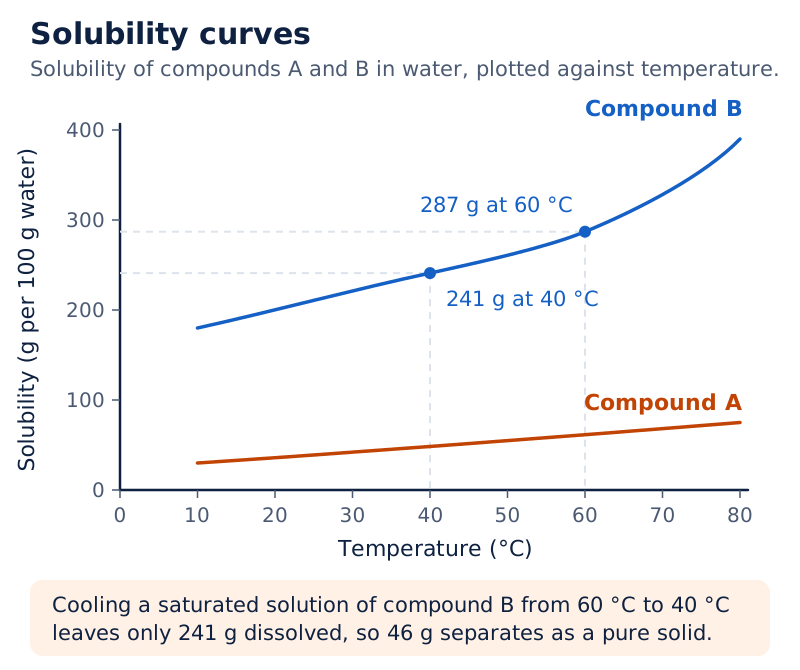
The horizontal x-axis shows temperature in °C; the vertical y-axis shows grams of solute per 100 g water. Compound B has a higher blue curve that rises more steeply than the lower red curve for compound A.
Drawn by One Young India. See Fig. 5.6 in your NCERT textbook
The following values give solubility in g per 100 g of water. Each entry is the mass of salt that dissolves in that fixed mass of water at the temperature in its column.
| Salt | 10 °C | 20 °C | 30 °C | 40 °C | 60 °C | 80 °C |
|---|---|---|---|---|---|---|
| Potassium nitrate | 21 | 32 | 45 | 62 | 106 | 167 |
| Sodium chloride | 36 | 36 | 36.3 | 36.5 | 37 | 37 |
| Potassium chloride | 35 | 35 | 37.4 | 40 | 46 | 54 |
| Ammonium chloride | 24 | 37 | 41 | 41 | 55 | 66 |
Across 10 °C to 80 °C, potassium nitrate shows the largest increase among these salts, while sodium chloride changes least. Equal values in some adjacent columns show why a general increase should not be rewritten as an increase at every listed interval.
For compound B, 287 g dissolves in 100 g water at 60 °C, but only 241 g remains dissolved at 40 °C. Cooling this saturated solution separates the remaining solid, often as crystals.
How does crystallisation separate a pure solid?
A crystal is a solid whose particles have a regular geometric arrangement. Rock salt, candy sugar and frost provide examples. Crystallisation is the formation of crystals from a saturated solution.
Purification by crystallisation uses a substance's different solubilities at different temperatures. A hot saturated solution can hold more of many solid solutes. As it cools, some dissolved solid separates, often as crystals.
The method can separate two solids when one is present in a small quantity and both dissolve in the same solvent. It also helps remove unwanted impurities from newly prepared substances.
How are copper sulfate crystals prepared?
Copper sulfate, also called blue vitriol, is the blue solid used in this activity. Filtration passes a mixture through a filter to separate retained solid from liquid. The liquid collected is the filtrate; the retained material is the residue.
- Place 1 g of copper sulfate in a 100 mL beaker. Add 25 mL water and a drop of dilute sulfuric acid. Gently heat in a water bath while stirring constantly.
- Add more copper sulfate gradually until the solution becomes saturated.
- Filter the hot solution to remove insoluble impurities. Collect the filtrate in a clean beaker and cover it with a watch glass.
- Let it cool slowly without disturbance. This gives particles time to form larger, shiny, well-shaped blue crystals.
- Filter out the crystals, rinse them with cold water and dry them on a watch glass.
Note: Copper sulfate is toxic: use adult supervision and avoid bare-hand contact. The teacher should add the sulfuric acid and handle it carefully. Sulfuric acid prevents unwanted reactions here; it is required for crystallisation of only some salts.
What the figure shows
Preparing copper sulfate crystals
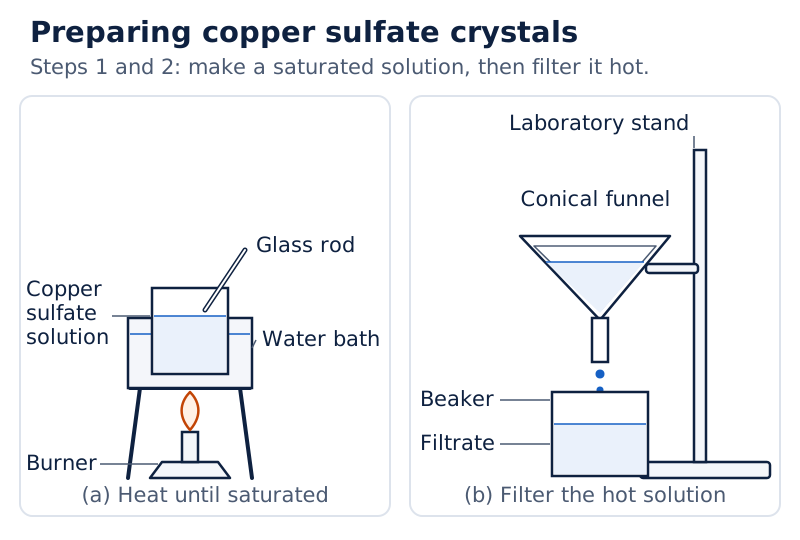
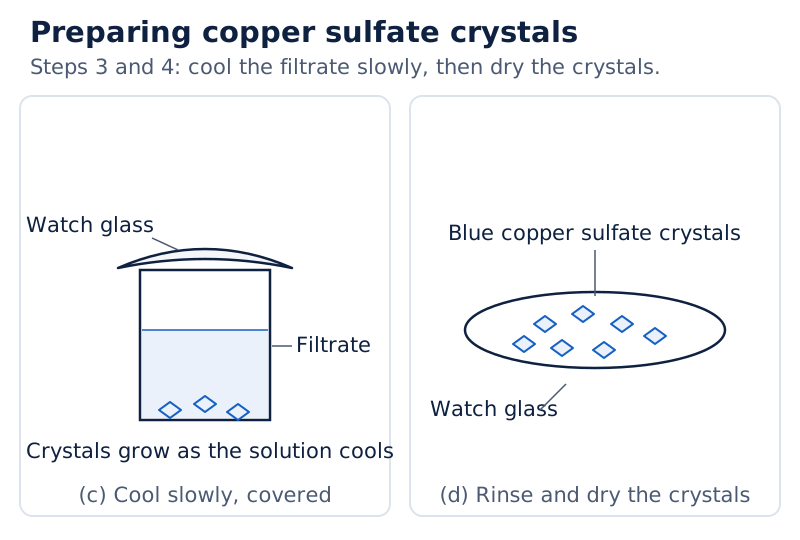
Four drawings show a beaker heated in a water bath, hot solution filtered through a conical funnel, filtrate cooling beneath a watch glass, and blue copper sulfate crystals on a watch glass.
Drawn by One Young India. See Fig. 5.8 in your NCERT textbook
Evaporation removes solvent as vapour to leave solute behind. Crystallisation focuses on obtaining a pure solid as crystals. These are different processes, even though removing solvent can help a solution reach saturation.
How does distillation recover a liquid?
Distillation separates a liquid by heating it to form vapour and then cooling the vapour back into liquid. This cooling change is condensation. The collected liquid is the distillate.
A liquid's boiling point is the temperature at which it boils. Distillation can separate miscible liquids whose boiling points differ by at least about 25 °C. It also recovers liquid from a solution containing dissolved solids.
Why can acetone be separated from water?
Acetone, a liquid that mixes with water, boils at about 56 °C; water boils at 100 °C. This difference allows acetone to vaporise before water vapour forms in significant amount. Do not interpret this as saying that no water vapour exists.
- Heat the mixture in a distillation flask, the vessel holding the mixture during separation.
- The liquid with the lower boiling point vaporises.
- Pass the vapour through a condenser, an apparatus that cools vapour, usually using circulating water or air.
- Collect the condensed liquid in a separate vessel. The solid or other liquid remains in the distillation flask.
What the figure shows
Distillation apparatus
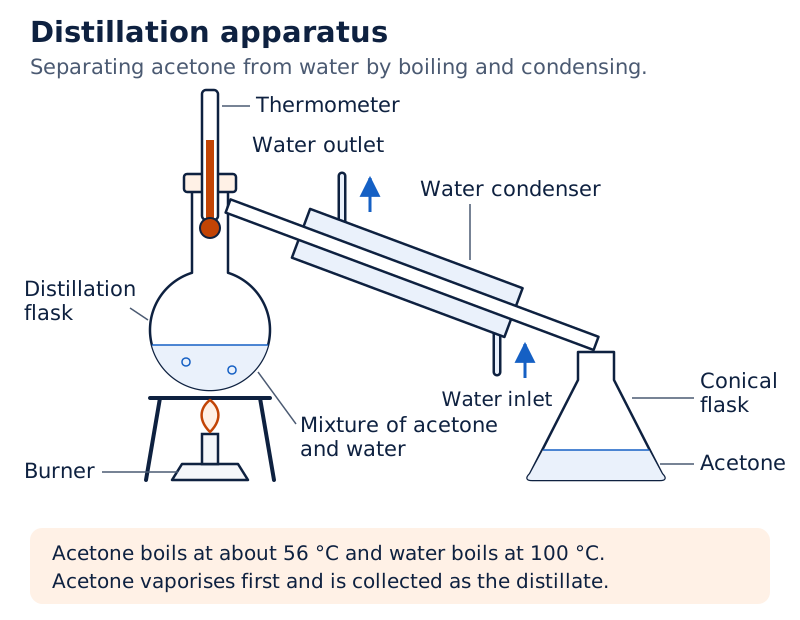
A thermometer enters the distillation flask containing acetone and water. A sloping water condenser connects the flask to a conical collecting flask labelled acetone. The condenser has labelled water inlet and outlet connections.
Drawn by One Young India. See Fig. 5.12 in your NCERT textbook
Fractional distillation separates components with relatively small boiling-point differences, less than 25 °C. A petroleum refinery uses it to separate crude petroleum into fractions, meaning separated portions such as petroleum gas, petrol, kerosene and diesel.
| Method | What happens? | When is it useful? |
|---|---|---|
| Evaporation | Solvent escapes as vapour | Obtaining salt from salt solution |
| Crystallisation | Pure solid forms as crystals from saturated solution | Purifying a solid such as copper sulfate |
| Distillation | Vapour is cooled and collected as liquid | Recovering solvent or separating liquids with sufficiently different boiling points |
How does paper chromatography separate colours?
Paper chromatography separates mixture components because they interact differently with a solvent and paper. The solvent carries substances along the paper. Different rates of movement allow components to separate.
A black sketch-pen mark can contain different colours. As water rises through paper carrying the ink, separate coloured spots appear. This shows that a single-looking colour can be a mixture of coloured components.
How should the experiment be arranged?
The unit cm means centimetre, used to measure the paper strip and the position of the starting line.
- Take a 3 cm wide strip of chromatographic paper, or use filter paper. Draw a horizontal pencil line 2 cm from its bottom.
- Place a black sketch-pen spot at the centre of that line.
- Add a thin layer of water to a gas jar, measuring cylinder or beaker.
- Place the paper vertically with its lower end dipping in water. Keep the water level below the ink spot.
- Observe the rising water and the separation of the ink into different coloured spots.
What the figure shows
Paper chromatography arrangement
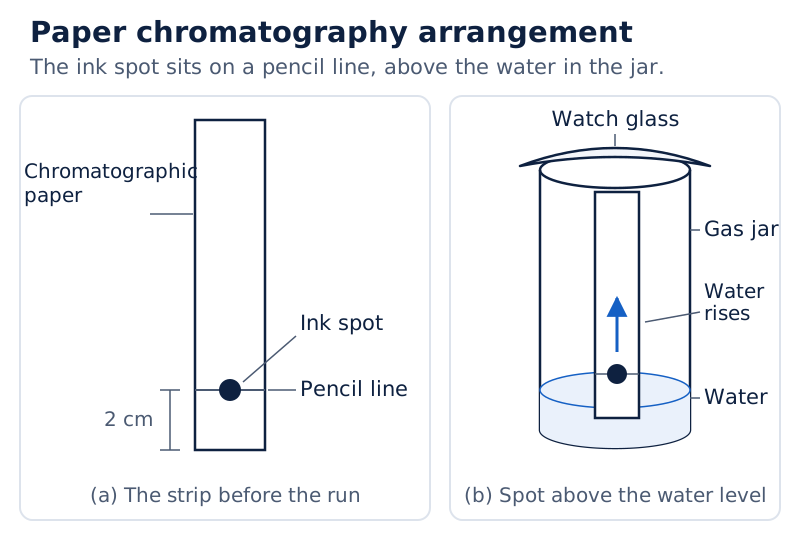
The drawings show a pencil line near the bottom of a paper strip, an ink spot on that line, and the strip standing in a gas jar with water at its base. A watch glass covers the jar.
Drawn by One Young India. See Fig. 5.15 in your NCERT textbook
Green food colour can also be investigated, using 2% m/v salt solution as solvent. Pigments are coloured substances; pigments in spinach-leaf extract or flower petals can be separated by this method.
Water does not work as the solvent in every case. In some cases, alcohol or a mixture of solvents may be needed. The important principle is different movement caused by interactions with both the solvent and paper, not simply that every mixture contains visible colours.
How does a separating funnel separate immiscible liquids?
Immiscible liquids do not mix and form separate layers. Mustard oil and water provide an example. A separating funnel is a vessel with a stopcock, a tap that controls liquid flowing from its lower end.
The method uses differences in density, meaning mass per unit volume. Mustard oil forms the upper layer and water the lower layer. Letting the mixture stand undisturbed allows the layers to form before draining begins.
What is the correct collection sequence?
- Pour 5 mL mustard oil and 20 mL water into a 50 mL separating funnel.
- Leave it undisturbed until two layers form, with yellow mustard oil above water.
- Open the stopcock slowly and collect the lower water layer carefully in a container.
- Close the stopcock when the water is almost fully drained.
- Collect and discard the next small portion, which may contain both liquids.
- Open the stopcock again and collect the oil separately.
What the figure shows
Separating mustard oil and water
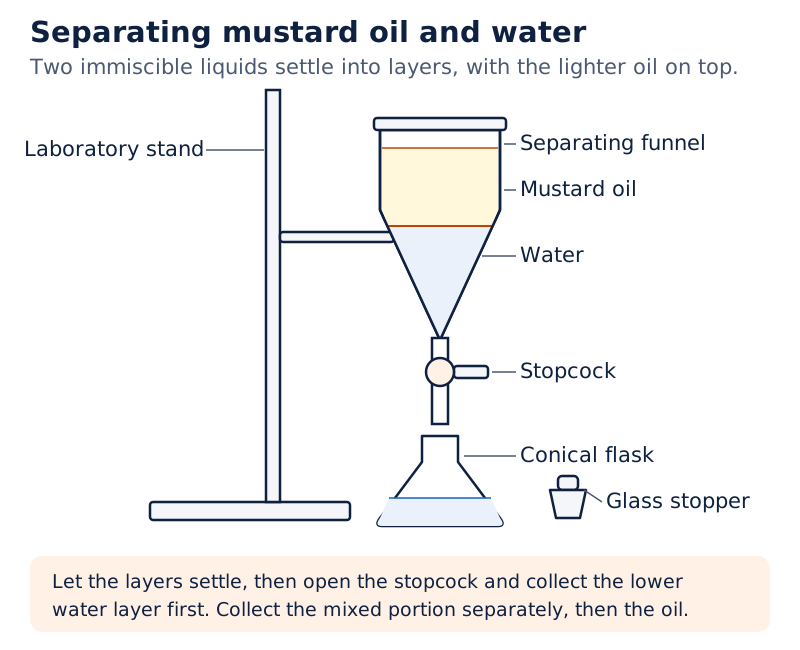
A separating funnel is supported by a laboratory stand. The yellow mustard-oil layer is drawn above the water layer. A stopcock leads to a conical flask below; the glass stopper is shown beside the flask.
Drawn by One Young India. See Fig. 5.16 in your NCERT textbook
The mixed portion at the boundary is collected separately because it may contain both liquids. Draining everything into one vessel would bring the separated components together again. The collection sequence is therefore part of the method.
This arrangement is appropriate for immiscible layers. Acetone and water form a homogeneous mixture, so their separation depends instead on their boiling-point difference and distillation.
How do sublimation and deposition separate solids?
Definition: Sublimation is the direct change from solid to vapour, below the solid's melting point, without passing through the liquid state.
The melting point is the temperature at which a solid melts. In sublimation the solid bypasses the liquid state. Deposition is the reverse change: vapour cools into solid without becoming liquid.
Camphor can be separated from sand because camphor sublimes while sand does not sublime on heating. The separation therefore depends on a difference in the components' physical behaviour.
How is the camphor-and-sand apparatus used?
- Place a spatulaful of crushed camphor mixed with sand in a clean, dry china dish on wire gauze over a tripod stand.
- Take a clean, dry glass funnel and plug its nozzle with cotton.
- Invert the funnel over the china dish and gently heat the dish with a burner for a few minutes.
- Observe the inner funnel wall. You may find white solid camphor deposits there, while sand remains in the dish.
What the figure shows
Sublimation apparatus
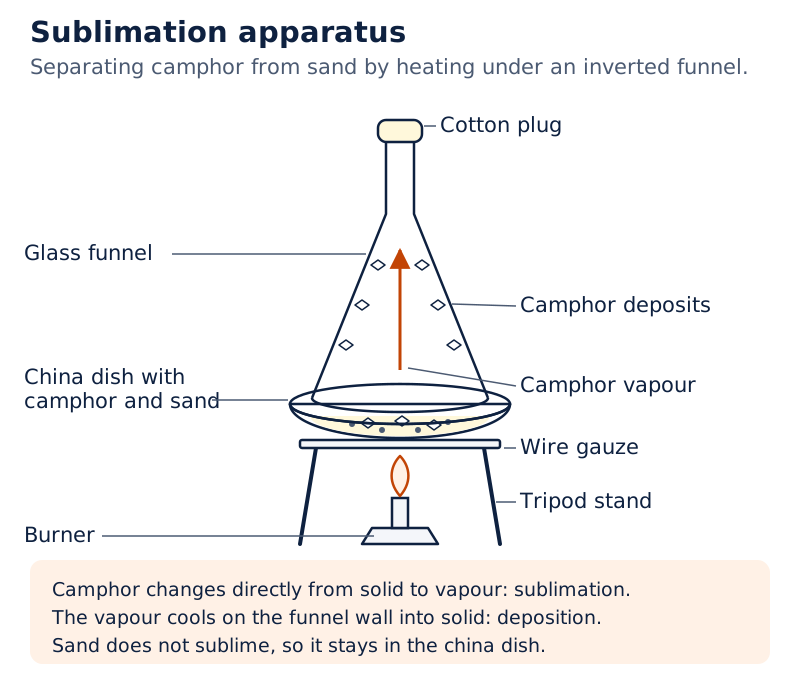
An inverted glass funnel with a cotton plug covers the china dish containing camphor and sand. The dish rests on wire gauze and a tripod above a burner. Solid deposits are drawn on the inner funnel wall.
Drawn by One Young India. See Fig. 5.17 in your NCERT textbook
The heating step causes sublimation; the cooling of vapour on the funnel causes deposition. Naming both changes explains how the camphor leaves the mixture and is recovered as a solid.
Naphthalene can replace camphor as another sublimable substance. Dry ice is solid carbon dioxide and also undergoes sublimation. Evaporation differs because its starting substance is a liquid, whereas sublimation starts with a solid.
How are suspensions separated by centrifugation and coagulation?
A suspension is a heterogeneous mixture in which undissolved solid particles remain suspended throughout the medium, the substance surrounding them. Its particles are visible to the naked eye. Sand, sawdust or tea leaves in water provide examples.
In undisturbed muddy water, heavier mud particles settle, but the water may still look cloudy. Cotton cloth or filter paper removes some larger particles, yet the water often remains cloudy. Filtration is not always enough to remove tiny particles.
How does centrifugation work?
Centrifugation spins a mixture rapidly in a tube. As the tubes become horizontal, the centrifugal force, the outward force acting on a body moving in circular motion, moves heavier particles outwards. They settle at the tube's bottom, leaving lighter liquid above.
Laboratories use centrifugation to separate blood components such as red blood cells and plasma, the liquid component of blood. A paperfuge is a hand-powered device that performs centrifugation without electricity. It can help detect diseases such as malaria and anaemia in remote areas.
How does coagulation help fine particles settle?
Coagulation makes fine suspended particles clump together. A coagulant is the added substance that causes this clumping. Powdered alum, also called fitkari, acts as a coagulant in muddy water.
- Add powdered alum to muddy water.
- The fine suspended particles clump together into larger groups.
- The clumps settle under gravity. This settling is called sedimentation.
- Separate the water by decantation, meaning pouring off liquid above settled material, or by filtration.
Paneer formation also involves coagulation. Acid supplied by lemon juice or vinegar acts as a coagulant and causes milk proteins to coagulate, forming cheese.
Where else does separation matter?
Sewage treatment includes sedimentation, coagulation and filtration. Water cleaned this way can be reused for flushing toilets or watering plants. Sorting dry waste allows plastic, paper, glass and metal to be recycled; wet food scraps and vegetable peels can be composted.
These applications use differences in properties such as size, density and solubility. Separation is not always simple: a mixture may require more than one technique, chosen according to its components.
How do colloids differ from solutions and suspensions?
A colloid contains particles larger than those in a solution but smaller than those in a suspension. Milk, blood, tomato sauce and ice cream are examples. Colloidal particles remain uniformly dispersed and do not settle over time.
The dispersed phase consists of the solute-like dispersed particles. The dispersion medium is the component in which those particles are suspended. A colloid may appear homogeneous, but it is classified as a heterogeneous mixture.
How does particle size affect the comparison?
The symbol nm means nanometre, a unit for very small lengths. Here particle sizes refer to diameter. A transparent solution has particles smaller than 1 nm; colloids have particles from 1 to 1000 nm; suspension particles exceed 1000 nm.
| Property | Solution | Suspension | Colloid |
|---|---|---|---|
| Nature | Homogeneous | Heterogeneous | Heterogeneous |
| Particle diameter | Less than 1 nm | More than 1000 nm | 1 to 1000 nm |
| Individual particles visible to the naked eye | No | Yes | No |
| Settling when undisturbed | Does not settle | Settles | Does not settle |
| Separation by ordinary filtration | Cannot be separated | Can be separated | Cannot be separated |
| Light scattering | No Tyndall effect | Shows Tyndall effect | Shows Tyndall effect |
The filtration comparison concerns the suspension particles that a filter can retain. It does not mean that filtering muddy water necessarily removes every fine particle or makes the water completely clear.
What is the Tyndall effect?
The Tyndall effect is scattering, or spreading, of light by particles. A colloid or suspension scatters light and makes its path visible. A transparent solution does not show this effect.
Compare salt solution, chalk powder in water, and diluted milk. Light's path is not visible in the salt solution, but is visible in the chalk suspension and milk colloid. Never look directly into a laser beam: it can cause irreversible eye damage.
Emulsions are colloids with liquid dispersed phase and liquid dispersion medium. Milk is an oil-in-water emulsion; butter is a water-in-oil emulsion. Emulsifying agents stabilise emulsions. Proteins act as emulsifying agents in milk and butter.
Glossary
- Homogeneous mixture — A mixture whose composition is uniform throughout, such as sugar dissolved in water.
- Heterogeneous mixture — A mixture with non-uniform composition, such as a mixture of sand and water.
- Solute — The substance that gets dissolved in a solvent to produce a solution.
- Solvent — The substance that dissolves the solute, such as water in sugar solution.
- Concentration — The amount of solute dissolved in a given amount of solvent or solution.
- Solubility — The maximum amount of solute dissolving in a fixed quantity of solvent at a given temperature.
- Saturated solution — A solution that cannot dissolve any more solute at the specified temperature.
- Crystallisation — The process of forming crystals from a saturated solution, used to obtain pure solids.
- Distillation — A separation process involving vaporisation of a liquid followed by cooling and collection of the condensed liquid.
- Paper chromatography — Separation through differences in component interactions with paper and solvent, producing different rates of movement.
- Sublimation — The direct change from solid to vapour below its melting point, without passing through the liquid state.
- Centrifugation — Separation by rapid spinning, moving heavier particles outwards while lighter liquid remains above them.
- Coagulation — Clumping of fine suspended particles following the addition of a substance called a coagulant.
- Colloid — A mixture with particles larger than solution particles that remain dispersed without settling over time.
- Tyndall effect — The scattering of light by particles, making a beam's path visible in colloids and suspensions.
Common errors and misconceptions
- Misconception: Mass percentage uses only solvent mass in the denominator. Correct: Use total solution mass, which includes both solute and solvent.
- Misconception: Making 100 mL of solution means starting with 100 mL of water. Correct: The specified volume is the final solution volume, including the dissolved substance.
- Misconception: Every solute becomes more soluble on heating. Correct: Solid solubility in liquids generally increases with temperature, whereas gas solubility generally decreases.
- Misconception: Distillation separates any two liquids equally well. Correct: Separation of miscible liquids by this method requires a boiling-point difference of at least about 25 °C.
- Misconception: The chromatography spot should start below the water level. Correct: Keep the spot above the water, with only the lower paper end dipping into it.
- Misconception: Camphor deposition and sublimation are the same change. Correct: Sublimation changes solid into vapour; deposition changes vapour directly into solid.
- Misconception: A uniform-looking liquid must be a solution. Correct: Milk is a colloid. Its dispersed particles scatter light, though the mixture appears homogeneous.
- Misconception: Filtration makes all muddy water completely clear. Correct: Some larger particles are removed, but water often remains cloudy; centrifugation and/or coagulation may be used.
Exam-style questions with model answers
Q1. Distinguish a homogeneous mixture from a heterogeneous mixture, using sugar solution and sand in water as examples. [2 marks]
- A homogeneous mixture has uniform composition throughout. Sugar solution is equally sweet throughout because dissolved sugar is uniformly distributed.
- A heterogeneous mixture has non-uniform composition. Sand in water contains visible particles that settle with time.
Q2. A student dissolves 10 g salt in 90 g water. Calculate the mass by mass percentage and explain the denominator used. [3 marks]
- The total solution mass is the mass of solute plus the mass of solvent. Here, salt and water together have a mass of 10 g + 90 g = 100 g.
- Mass by mass percentage = (Mass of solute / Mass of solution) × 100 = (10 / 100) × 100 = 10% m/m.
- The denominator is 100 g because concentration refers to the complete solution. Using 90 g would compare salt with solvent alone.
Q3. Two tablespoons of orange juice concentrate, each measuring 15 mL, are mixed with water to make 150 mL of juice. Calculate the volume by volume percentage. [3 marks]
- The total volume of concentrate is 2 × 15 mL = 30 mL. This is the solute volume required in the numerator.
- Volume by volume percentage = (Volume of solute / Volume of solution) × 100. The denominator is the final juice volume, 150 mL.
- Substitution gives (30 / 150) × 100 = 20% v/v. Thus the concentrate accounts for 20 mL per 100 mL of the prepared juice.
Q4. Compound B has solubilities of 287 g per 100 g water at 60 °C and 241 g per 100 g water at 40 °C. A saturated solution containing 100 g water is cooled from 60 °C to 40 °C without loss of water. Explain what separates and calculate its mass. [4 marks]
- At 60 °C, the saturated solution contains 287 g of dissolved compound B in the supplied 100 g of water.
- At 40 °C, only 241 g of compound B can remain dissolved in that same amount of water.
- The mass separating is the difference between these dissolved amounts: 287 g minus 241 g = 46 g.
- The excess separates as a pure solid, often as crystals. Cooling reduces the amount that can remain dissolved in this example.
Q5. Describe five stages for preparing copper sulfate crystals, starting with 1 g copper sulfate, 25 mL water and a drop of dilute sulfuric acid in a 100 mL beaker. Include the precautions for the chemicals. [5 marks]
- Gently heat the starting mixture in a water bath while stirring constantly. Copper sulfate is toxic, so use adult supervision and avoid bare-hand contact. The teacher should add the acid carefully.
- Gradually add more copper sulfate until the heated solution becomes saturated, meaning it cannot dissolve further solute at that temperature.
- Filter the hot saturated solution to remove insoluble impurities. Collect the liquid in a clean beaker and cover it with a watch glass.
- Allow the covered solution to cool slowly without disturbance. This gives particles time to form larger, shiny, well-shaped blue crystals.
- Separate the crystals by filtration, rinse them with cold water, and leave them to dry on a watch glass.
Q6. Acetone and water are miscible liquids. Acetone boils at about 56 °C and water at 100 °C. Explain how distillation separates them and why their boiling points make the method suitable. [4 marks]
- The boiling-point difference is about 44 °C. This meets the condition of at least about 25 °C for separation by distillation.
- Heat the mixture in a distillation flask. Acetone vaporises before water vapour forms in significant amount because acetone has the lower boiling point.
- Pass the vapour through a condenser. Cooling, usually by circulating water or air, changes the vapour back into liquid.
- Collect the condensed acetone in a separate vessel while water remains in the distillation flask.
Q7. A black sketch-pen spot is placed on paper above water, with the lower paper end dipping into the water. Explain the separation, its principle, and whether water works for every sample. [3 marks]
- As water rises through the paper, it carries ink components with it. The ink separates into different coloured spots by paper chromatography.
- Components interact differently with the solvent and the paper. These differences cause them to move at different rates and separate along the strip.
- Water does not work as a solvent in every case. Some samples may require alcohol or a mixture of solvents instead.
Q8. Muddy water remains cloudy after standing and filtration. Explain why filtration may be insufficient and describe four stages of treatment with powdered alum. [5 marks]
- Standing allows heavier mud particles to settle, and filtration removes some larger particles. Fine particles can remain, so the water often stays cloudy despite these treatments.
- Add powdered alum to the muddy water. Alum acts as a coagulant, meaning an added substance that causes fine suspended particles to clump together.
- The fine suspended particles gather into larger clumps. This clumping process is called coagulation and changes how the particles can be separated.
- Allow the larger clumps to settle under gravity. This settling process is sedimentation and leaves the settled material at the bottom.
- Separate water from the settled material by decantation or filtration. Decantation pours off the liquid above the sediment, while filtration retains solid material.
Key takeaways
- Homogeneous mixtures have uniform composition; heterogeneous mixtures have non-uniform composition, even when they may appear uniform to the eye.
- Identify solute, solvent and total solution before calculating concentration, and state the correct percentage type.
- Solubility depends on temperature; solid solubility generally rises on heating, whereas gas solubility generally falls.
- Crystallisation obtains pure solid crystals from saturated solutions; slow cooling helps copper sulfate form larger, well-shaped crystals.
- Distillation recovers condensed liquid and separates miscible liquids whose boiling points differ by at least about 25 °C.
- Paper chromatography separates components through their different interactions with the solvent and paper, producing different movement rates.
- Separating funnels, sublimation, centrifugation and coagulation use different physical properties to separate heterogeneous mixtures.
- Colloids and suspensions scatter light, producing the Tyndall effect, while transparent solutions do not.
Test yourself
What does 5% m/v glucose solution mean?
It contains 5 g of glucose in each 100 mL of final solution.
Why must a solubility value specify temperature?
The maximum amount that dissolves can change with temperature, so solubility refers to a particular temperature.
Which component is recovered by condensing vapour in distillation?
The vaporised liquid is recovered as the distillate after cooling in the condenser.
Where should the chromatography sample spot begin relative to the solvent?
The spot should be above the solvent level, while the lower end of the paper dips into it.
What remains in the china dish when camphor separates from sand?
Sand remains in the dish because it does not sublime on heating.
What role does alum play in muddy water?
Alum acts as a coagulant, causing fine suspended particles to form larger clumps that settle.
Why does a visible light path not distinguish a colloid from a suspension?
Both colloids and suspensions scatter light and can make its path visible through the Tyndall effect.
What are the dispersed phase and dispersion medium?
The dispersed phase consists of the colloid's particles; the dispersion medium is the component surrounding and suspending them.
Write about it
Turn a question from this chapter into a paper.
The Writing Studio has a structure guide, a rubric and citation tools for 15 formats, from essays to research papers. Drafting is free with an account. Learnacy Essential adds feedback from an AI writing coach and submission to The OYI Review.
Learnacy Essential is ₹1,499 for the year. Publication depends on review and is not guaranteed.