
Sound Waves: Characteristics and Applications | CBSE Class 9 Science Notes
On this page

This note covers sound production, propagation through materials, sound waves and their graphs, wavelength, frequency, time period, amplitude, intensity, speed, human hearing, musical sounds, reflection, echoes, reverberation, echolocation and applications of ultrasonic and infrasonic waves.
How do vibrating objects produce sound?
Sound is a form of energy produced by vibrating objects. A vibration, or oscillation, is a periodic to and fro movement. The object producing the sound is its source. Pulling a stretched string or striking a metal object makes it vibrate and produce sound.
What does the rubber-band activity show?
- Stretch a rubber band across the open side of a cardboard box and hold the box steady.
- Pluck the band and watch its movement while listening to the sound.
- Allow the band to stop vibrating and check whether the sound continues.
- Change the tension by stretching the band more or loosening it slightly, then pluck it again and compare the sounds.
Sound continues while the stretched band vibrates and stops when its vibrations stop. Vibrating strings, membranes and air columns can produce sound. A membrane is a thin sheet, while an air column is air enclosed within a hollow space, as in a flute.
Blowing into a bansuri makes the air inside its hollow pipe vibrate. In most musical instruments, more than one vibrating part contributes to sound production. The common feature is vibration, even though different instruments have different vibrating parts.
How can a tuning fork demonstrate vibration?
A tuning fork is a U-shaped metal bar with a stem, usually made of steel or aluminium. Its two sides are called prongs or tines. Hold its stem and gently strike a prong against a soft rubber pad, taking care not to use a hard surface.
The vibrating fork produces sound near the ear. When a vibrating prong gently touches water, waves appear on the surface. These observations support the connection between vibration and sound.
In humans and some other animals, sound comes from vibrating vocal cords, tightly stretched muscular flaps inside the larynx or voice box. The tongue, lips, mouth and nasal cavity help turn human sound into speech or music. Grasshoppers and crickets produce sound by rubbing wings or legs.
Why does sound need a material medium?
Propagation means the travel of sound away from its source. A medium is the material through which sound propagates. Sound travels through solids, liquids and gases. A vacuum is a space without matter, so it contains no material medium for sound.
How can we show that solids and liquids transmit sound?
Listen to a gentle knock or scratch on a desk, first with the ear in air and then with the ear against the desk while closing the other ear. Hearing through the desk demonstrates that a solid can transmit sound.
Tap two metal spoons together in air, then repeat with both spoons submerged in water without touching the container's sides or bottom. The underwater sound reaches the listener after travelling through water and air. This demonstrates transmission through a liquid.
What happens in the vacuum bell jar experiment?
- Switch on an electric bell inside a bell jar and note the sound.
- Remove air from the jar with a vacuum pump. The sound becomes fainter.
- At a near vacuum, almost no sound is heard, although the bell can still be seen ringing.
- Let air back into the jar. The sound returns and gradually becomes as loud as before.
What the figure shows
Vacuum bell jar
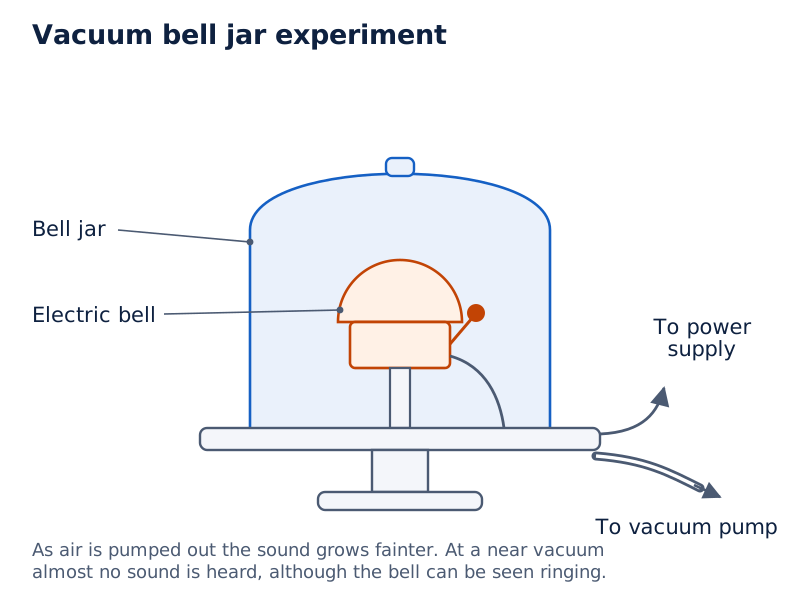
The illustration shows an electric bell enclosed by a bell jar. Labels identify the bell, jar, connection to the power supply and connection to the vacuum pump.
Drawn by One Young India. See Fig. 10.7 in your NCERT textbook
The experiment shows that sound cannot propagate in a vacuum. Producing vibrations and transmitting them to a listener are different requirements: the bell continues to vibrate when the air carrying its sound has largely been removed.
Outer space is a near vacuum. Astronauts on spacewalks cannot directly hear one another speaking or metal objects clanking together. They communicate using special devices fitted into their spacesuits.
How do compressions and rarefactions carry sound?
A slinky is a long, flexible spring toy. Push and pull one end while the other end is held fixed. Closely spaced and more spread-out regions move along it. A marked turn moves back and forth about its position rather than travelling along with the disturbance.
This models sound travelling through air. In the particle model, density describes how closely particles are packed. The average density is the uniform density before the sound disturbance. Each particle oscillates about a mean position, its central position in this oscillation.
What happens when a piston moves in an air-filled tube?
A piston is a movable part that pushes the air inside the tube. Its forward movement brings nearby particles closer together. The resulting region with density above the average is a compression, labelled C.
As the piston moves backwards, the nearby air becomes less dense. This region below the average density is a rarefaction, labelled R. Particle collisions pass these disturbances onwards while the particles themselves continue oscillating about their mean positions.
What the figure shows
Air density in a piston tube
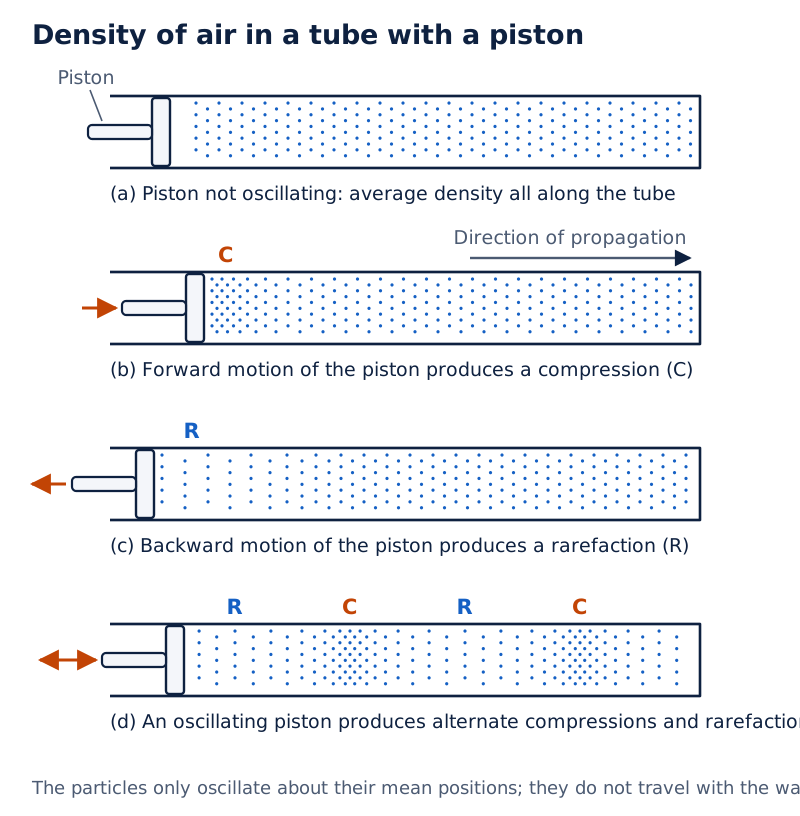
Four drawings show uniformly distributed dots, a compression after forward piston motion, a rarefaction after backward motion, and alternating regions labelled C and R during repeated oscillation.
Drawn by One Young India. See Fig. 10.9 in your NCERT textbook
Definition: A sound wave is a travelling disturbance consisting of alternating compressions and rarefactions in a medium, without an actual flow of the medium's particles along with the wave.
Why is sound a longitudinal mechanical wave?
The direction of propagation is the direction in which the wave travels. In a longitudinal wave, particle vibrations are parallel to this direction. In a transverse wave, particle vibrations are perpendicular to it. Sound is a longitudinal wave.
Mechanical waves require a material medium, so sound is also mechanical. The wave transfers energy through particle vibrations and collisions; particles near the source do not travel all the way to the listener.
Note: Sound can propagate in multiple directions. In general, the directions may depend on the source's shape. A one-direction tube model simplifies the explanation; it does not mean that all sound travels in just one direction.
How should a sound-wave graph be read?
A density-distance graph records how the medium's density changes with distance at a particular instant. The horizontal axis represents distance, and the vertical axis represents density. A horizontal dashed line marks the average density.
Where density rises above the average, the medium is compressed. Where it falls below the average, the medium is rarefied. The curve therefore describes changing density along the medium, rather than the physical shape of a stream of air.
What do crests and troughs represent?
A crest is the graph's highest point and represents maximum density in a compression. A trough is its lowest point and represents minimum density in a rarefaction. Successive crests and troughs show the repeating pattern of density variations.
What the figure shows
Density variation with distance
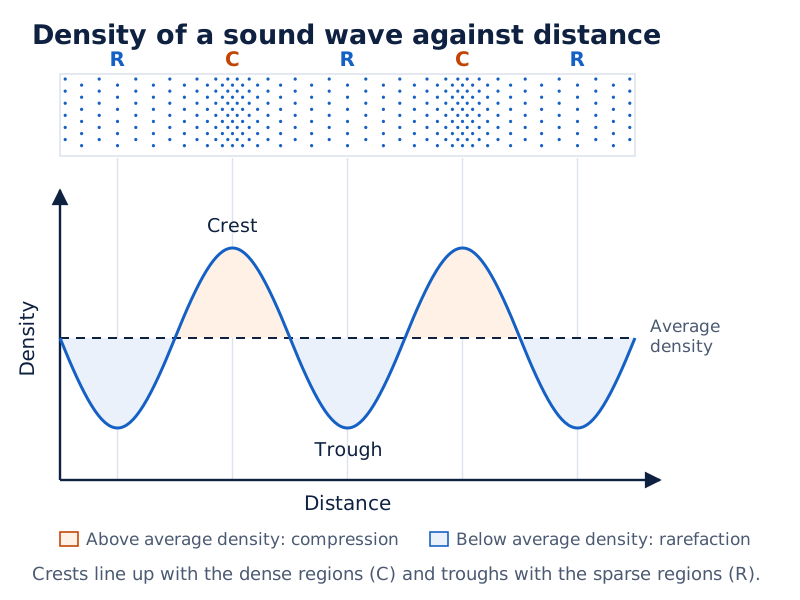
Bands of dots labelled C and R appear above a density-distance curve. Crests align with dense bands and troughs with sparse bands. A dashed average-density line separates the above-average and below-average regions.
Drawn by One Young India. See Fig. 10.16 in your NCERT textbook
| Graph feature | Physical meaning |
|---|---|
| Region above the average-density line | Compression, with density greater than average |
| Region below the average-density line | Rarefaction, with density lower than average |
| Crest | Maximum density |
| Trough | Minimum density |
A different graph can show density against time at one fixed location. Read the horizontal axis before interpreting a wave graph: distance separates positions at one instant, whereas time follows changes at one position. A curved density graph does not make sound a transverse wave.
How are wavelength, frequency and time period related?
Wavelength, represented by λ, the Greek letter lambda, is the distance between consecutive crests or consecutive troughs. The SI unit of wavelength is the metre (m). SI refers to the International System of Units.
At a fixed position, density changes from maximum to minimum and back to maximum, or from minimum to maximum and back to minimum. This is one complete density oscillation.
Frequency, represented by ν, the Greek letter nu, is the number of complete density oscillations at a fixed point per unit time. The SI unit of frequency is the hertz (Hz), also written as per second, s⁻¹. Thus, 1 Hz = 1 s⁻¹.
Time period, represented by T, is the time for one complete density oscillation at a fixed position. The SI unit of time period is the second (s). Frequency and time period are inversely related: a higher frequency means a shorter time period.
ν = 1/T and T = 1/ν.
How do we calculate these quantities from an oscillation count?
Let N be the number of complete density oscillations and t be the total time taken. Then ν = N/t and T = t/N. Count complete oscillations, and express the measured time in seconds to obtain frequency in hertz.
Worked example 1. At a fixed position, 10 density oscillations occur in 2 seconds. Calculate frequency and time period.
Formula: ν = N/t; T = t/N.
Substitute: ν = 10/2; T = 2/10.
Answer: The frequency is 5 Hz and the time period is 0.2 s. The first calculation counts oscillations per second; the second gives seconds per oscillation.
Everyday sounds usually contain a mixture of many frequencies. Striking a tuning fork or whistling can produce nearly single-frequency sounds. These qualifications matter because a real sound need not consist of exactly one frequency.
How do amplitude and intensity describe sound energy?
Amplitude here means the maximum change in air density in a compression or rarefaction compared with the average density. A larger departure from average density gives a larger amplitude. On a density graph, measure this change from the average line to a crest or trough.
A wave with greater amplitude carries more energy than one with smaller amplitude. Amplitude describes the size of a density variation; it is different from the distance between crests and from the number of oscillations each second.
What the figure shows
Low and high amplitude
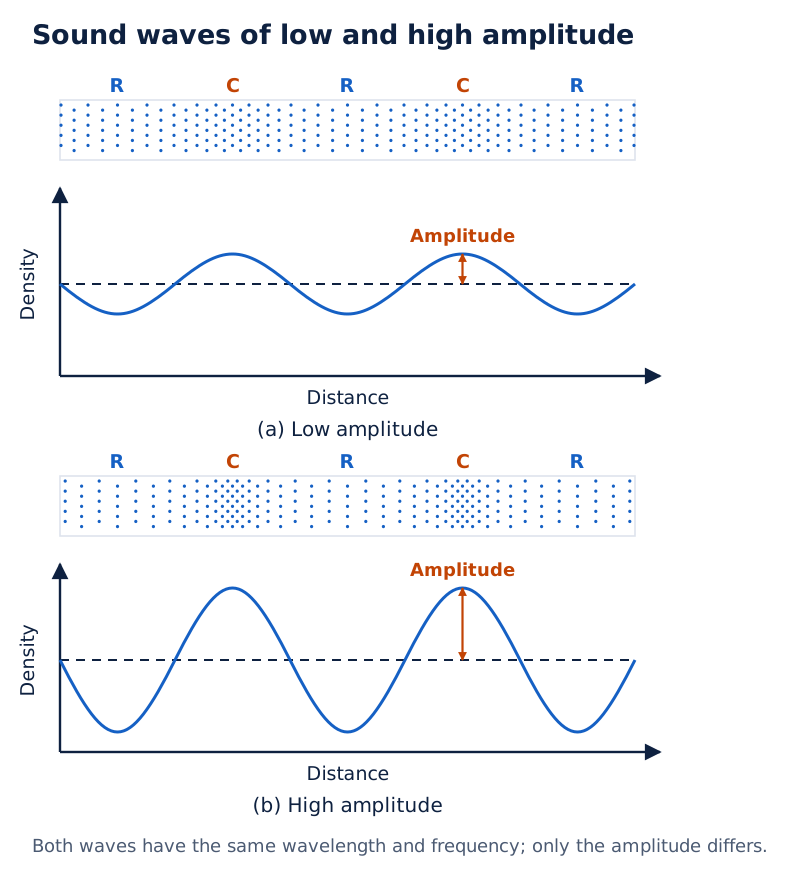
Two density-distance graphs are paired with particle diagrams. The low-amplitude curve has smaller vertical departures from the dashed average line; the high-amplitude curve has larger departures. Vertical arrows mark amplitude.
Drawn by One Young India. See Fig. 10.20 in your NCERT textbook
How can moving grains show energy transfer?
- Stretch a rubber or cellophane sheet tightly over a wide-mouthed container.
- Spread grains such as rice, semolina or salt over the sheet without clumping them.
- Produce a loud sound nearby using a metal plate and beater, without touching the container.
- Observe the grains moving as sound makes the sheet vibrate. Compare the movement when the plate is struck harder.
A harder strike transfers more energy to the surrounding particles. Their larger displacements make the sheet move further, so the grains jump higher. The source need not touch the grains: sound carries energy through the intervening air.
Why does intensity decrease with distance?
Intensity is the sound energy passing in unit time through a unit area perpendicular to the direction of propagation. It is a measurable physical quantity. As sound spreads away from a source, its energy is distributed over a larger area.
The energy available over each unit area therefore decreases with distance. A sound starting with larger amplitude carries more energy and can travel further before its intensity falls away. This connects the wave's amplitude, energy transfer and weakening as it spreads.
What determines the speed of sound?
Speed of sound, represented by v, is the distance travelled in unit time by a point on the wave, such as a crest or trough. The SI unit of speed is the metre per second (m s⁻¹). This is the speed of the disturbance through the medium.
If d represents distance travelled and t represents travel time, v = d/t and d = vt. Here t measures the whole journey; the symbol T remains reserved for the time period of one oscillation.
Derivation: How does speed depend on wavelength and frequency?
- The distance between consecutive crests is one wavelength, λ.
- The disturbance travels this distance during one time period, T, giving v = λ/T.
- Since ν = 1/T, replace 1/T by ν in the speed expression.
v = λν. Equivalently, v = λ/T and λ = v/ν.
How do medium and temperature affect speed?
Sound travels fastest in solids, slower in liquids and slowest in gases. It travels about 4 to 5 times faster in water and typically 15 to 20 times faster in solids than in air. The following approximate values apply at 15 °C, where °C denotes degrees Celsius, and at atmospheric pressure, the pressure exerted by the surrounding air.
| State | Substance or medium | Approximate speed |
|---|---|---|
| Solid | Steel | 5000 m s⁻¹ |
| Liquid | Water | 1500 m s⁻¹ |
| Gas | Air | 340 m s⁻¹ |
The speed in air increases with temperature or humidity, the moisture in the air. In dry air it is about 331 m s⁻¹ at 0 °C and nearly 344 m s⁻¹ at 22 °C.
Note: In most media, such as air, speed depends on the medium rather than the source or frequency. When frequency changes while the medium's conditions remain the same, wavelength changes and speed remains constant. Some special materials, including porous foams or engineered structures, can behave differently.
How do we apply the speed relations?
Worked example 2. Human hearing roughly spans 20 Hz to 20 kHz, where kHz means kilohertz and 20 kHz equals 20,000 Hz. Find the wavelengths at these frequencies using a sound speed of 344 m s⁻¹.
Formula: λ = v/ν.
Substitute: At 20 Hz, λ = 344/20. At 20,000 Hz, λ = 344/20,000.
Answer: The wavelengths are 17.2 m and 0.0172 m respectively. The latter is 1.72 cm, where cm means centimetres.
Worked example 3. Thunder is heard 5 s after lightning is seen. Estimate the distance using sound speed 340 m s⁻¹. Assume light, travelling at 300,000 km s⁻¹, arrives almost instantaneously; km denotes kilometres.
Formula: d = vt.
Substitute: d = 340 × 5.
Answer: The lightning struck about 1700 m, or 1.7 km, away. Sound takes appreciably longer than light to cover this distance.
Worked example 4. A sound wave in steel has wavelength 50 m, read between consecutive crests on its density-distance graph, and speed 5000 m s⁻¹. Find frequency and time period.
Formula: v = λν; T = 1/ν.
Substitute: ν = 5000/50 = 100 Hz; T = 1/100.
Answer: The frequency is 100 Hz and the time period is 0.01 s.
How do humans perceive pitch and loudness?
Pitch is the human perception of frequency. Shrill sounds, such as whistles or sirens, have high pitch; deep sounds, such as thunder or an aircraft rumble, have low pitch. In general, higher pitch corresponds to higher frequency, although the exact mathematical relation is complicated.
Loudness is how humans perceive a sound wave's amplitude. Larger amplitudes are heard as louder sounds and smaller amplitudes as softer sounds. Loudness decreases as the listener moves further from the source, but it also depends on the listener's hearing ability.
| Distinction | Meaning |
|---|---|
| Frequency and pitch | Frequency is measurable; pitch describes how frequency is perceived. |
| Amplitude and loudness | Amplitude describes density variation; loudness describes the listener's experience. |
| Intensity and loudness | Intensity measures energy transmission; loudness depends on the listener's hearing ability. |
What is the human audible range?
The audible range is the range of sound frequencies humans can hear, from 20 Hz to 20,000 Hz. However, this range varies from person to person and decreases with age. It should not be treated as an identical range for every listener.
Infrasonic waves have frequencies below 20 Hz; ultrasonic waves have frequencies above 20 kHz. Humans cannot hear these waves. Dogs, cats, bats and dolphins can detect ultrasound, while elephants can detect infrasound.
How does the ear detect sound?
The eardrum, a thin membrane in the ear, vibrates when sound enters. Tiny bones amplify, or increase, these vibrations. The cochlea is the ear structure that converts them into electrical signals, which reach the brain and are perceived as sound.
Noise is unwanted or harmful sound. Prolonged exposure to loud sound can cause hearing loss. Hearing aids help people with hearing loss communicate: they contain a microphone to receive sound, an amplifier to increase the signal and a speaker to produce sound.
Why do voices and musical instruments sound different?
A tone is a single-frequency sound, such as the sound represented by a tuning fork or oral whistling. Actual tuning-fork sounds and careful whistling can be nearly single-frequency sounds. Everyday sounds usually contain several frequencies rather than just one.
A musical note, such as a plucked tanpura string or a singing voice, combines a lowest frequency, the fundamental, with higher frequencies called overtones. Together these frequencies create a rich, pleasant sound. Instruments such as the sarangi, sitar and veena often use extra strings to enrich this combination.
What is timbre?
Timbre is the quality that makes instruments sound different even when they play the same note at the same loudness. An instrument's shape, material and construction determine the pattern and intensity of its overtones, giving its sound a distinctive character.
An octave is the interval between notes whose fundamental frequencies differ by a factor of two. For example, 200 Hz and 400 Hz are an octave apart. This comparison concerns fundamental frequency, rather than loudness.
Voices differ through both frequency and the shaping of sound by the throat, mouth and nasal cavities. During adolescence, boys' vocal cords lengthen and thicken, vibrate less frequently and deepen the voice.
The black central patch on the membrane of a tabla or mridangam is called the syaahi. It changes the membrane's vibration and helps produce varied sounds. Sir C. V. Raman studied Indian percussion instruments, including the tabla and mridangam, to understand their sounds.
How does reflection produce an echo?
Reflection of sound is the bouncing back of sound waves from obstacles such as solids or liquids. The approaching sound is the incident sound; the returning sound is the reflected sound. The normal is a line perpendicular to the reflecting surface at the point where sound strikes it.
The incident and reflected directions make equal angles with the normal, and all three lie in the same plane. These are the laws of reflection applied to sound. The angles are measured from the normal, rather than along the reflecting surface.
When is a reflected sound heard separately?
An echo is a reflected sound heard again after a delay. Shouting near a mountain, cliff or long corridor may produce an echo. Two sounds can be heard separately when the interval between their arrival is at least 0.1 s.
In a small room, reflections can arrive too quickly to be distinguished from the original sound. Hard, smooth surfaces produce stronger echoes. Soft surfaces such as curtains tend to absorb sound, while rough surfaces scatter it in different directions, making echoes less clear.
Derivation: How is the reflector's distance calculated?
For this return journey, d means the one-way distance to the reflector, v is sound speed and t is the interval between emission and return.
- Sound travels distance d from its source to the reflecting surface.
- It travels the same distance back, so its total journey is 2d.
- Using distance = speed × time gives 2d = vt. Dividing by two gives the one-way distance.
d = vt/2. Rearranging gives t = 2d/v.
At 340 m s⁻¹, sound travels 34.0 m in 0.1 s. This is the outward and return journey together. The minimum reflector distance is therefore 17 m for this speed. The speed and the required delay must both be considered when calculating an echo distance.
Worked example 5. A clap in an empty corridor returns as an echo after 0.5 s. Find the wall's distance if sound travels at 340 m s⁻¹.
Formula: d = vt/2.
Substitute: d = (340 × 0.5)/2.
Answer: The wall is 85 m away. Multiplying speed by the full echo time gives the complete return journey, so division by two is essential.
What is reverberation and how is it controlled?
Reverberation is the persistence of sound after its source stops, caused by multiple reflections. In a large hall or auditorium, sound may reflect repeatedly from walls and other surfaces. These reflected sounds keep arriving after the original emission has ended.
Reverberation occurs when reflected sounds arrive with a time difference less than 0.05 s. The requirement for clearly separate sounds is an interval of at least 0.1 s. Keep these two statements distinct when explaining reverberation and echoes.
Why do halls use sound-absorbing materials?
Modern auditoriums and concert halls are designed to have desirable reverberations, allowing people throughout the space to hear speech and music clearly. Unwanted reverberation can make sound garbled, with successive sounds becoming difficult to distinguish.
Sound absorption reduces reflected sound. Absorbing panels, upholstered chairs, curtains and other soft, porous surfaces help reduce unwanted reverberations. Controlling repeated reflections therefore matters as well as producing a sufficiently strong original sound.
The Whispering Gallery of Gol Gumbaz in Bijapur, Karnataka, demonstrates the use of acoustic design, meaning design concerned with sound. Its large dome allows even a faint whisper to be heard multiple times across the space.
How are ultrasound, infrasound and echolocation used?
Sounds outside the human audible range remain useful even though humans cannot hear them. Infrasonic waves can travel long distances through air and the Earth. They are used to detect earthquakes, volcanic eruptions and severe storms.
What are the applications of ultrasound?
| Application | Use of ultrasonic waves |
|---|---|
| Ultrasonography | Producing images of internal organs without surgery |
| Kidney-stone treatment | Breaking stones into smaller pieces that can pass out of the body |
| Industrial joining and cleaning | Ultrasonic welding, or joining materials, and cleaning delicate machine parts |
| Inspection of metals | Detecting defects inside metal blocks during construction and industrial testing |
| Locating objects | Using sound reflected from objects to find their positions |
How do animals locate objects using sound?
Echolocation is locating objects by reflected sound. Most bats emit short bursts of ultrasonic waves and detect their echoes from nearby objects. This helps them locate obstacles and prey in darkness. Dolphins, whales and some birds also use echolocation for navigation and hunting.
What the figure shows
Echolocation by bats
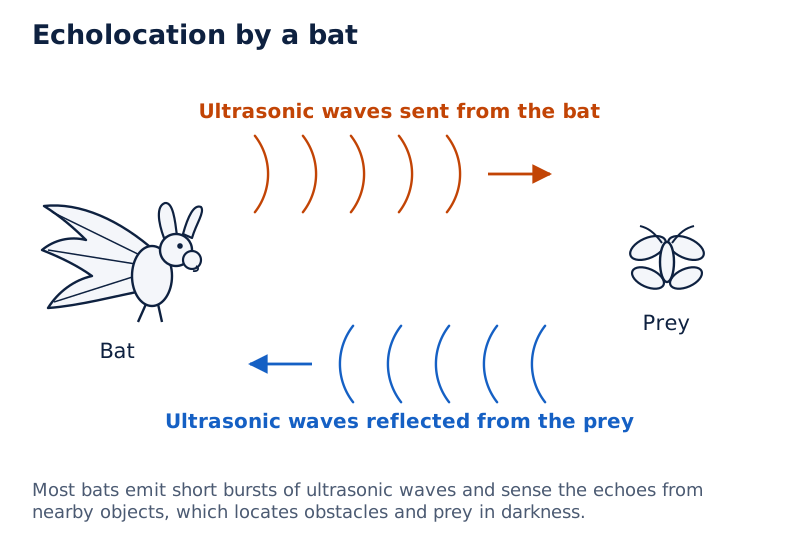
The drawing shows a bat facing its prey. Separate labelled wave paths represent ultrasonic waves sent from the bat and ultrasonic waves reflected from the prey.
Drawn by One Young India. See Fig. 10.27 in your NCERT textbook
Sonar means sound navigation and ranging. It sends ultrasonic waves into water and analyses reflections to determine the distance, direction and speed of underwater objects such as submarines or shipwrecks.
What the figure shows
Functioning of sonar
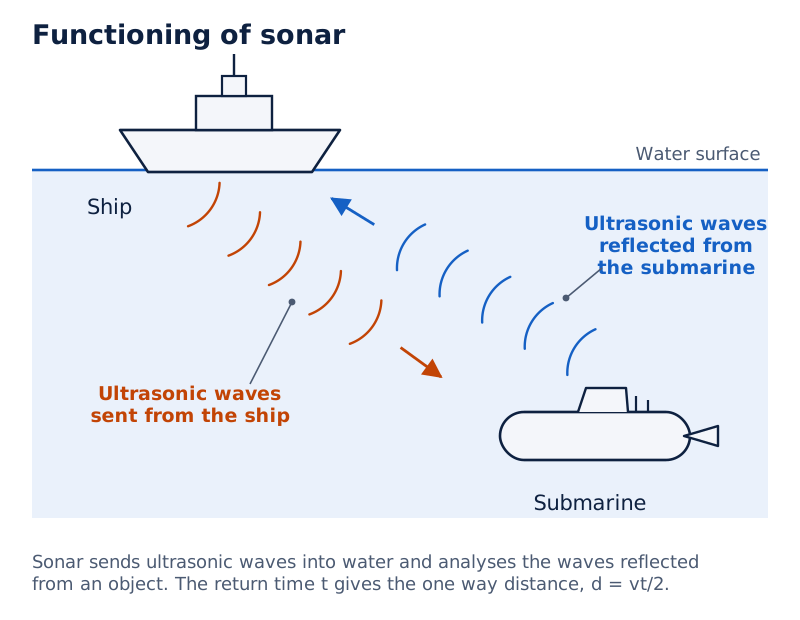
The illustration shows a surface ship and a submerged submarine. Labelled paths show ultrasonic waves sent from the ship and waves reflected from the submarine back towards the ship.
Drawn by One Young India. See Fig. 10.28 in your NCERT textbook
How does the return time give the object's distance?
Worked example 6. A naval sonar signal returns after 0.90 s. Find the object's distance if sound speed in seawater is 1530 m s⁻¹. Let t₁ represent one-way travel time; t is the full return time and d is one-way distance.
Formula: t₁ = t/2; d = vt₁.
Substitute: t₁ = 0.90/2 = 0.45 s; d = 1530 × 0.45.
Answer: The object is 688.5 m away. The given 0.90 s includes both the outward and returning parts of the signal's journey.
Audio surveillance uses sound detection to monitor an area. Sensitive sound sensors can detect the characteristic low-frequency humming of drone motors and aircraft engines, helping monitor airspace even when the objects are difficult to see.
Glossary
- Vibration — A periodic to and fro movement of an object about its position.
- Medium — The material through which sound propagates, such as a solid, liquid or gas.
- Compression — A region of a sound wave where density exceeds the medium's average density.
- Rarefaction — A region of a sound wave where density falls below the medium's average density.
- Longitudinal wave — A wave whose particles vibrate parallel to the direction of wave propagation.
- Wavelength — The distance separating consecutive crests or consecutive troughs of a wave.
- Frequency — The number of complete density oscillations at a fixed point per unit time.
- Time period — The time required for one complete density oscillation at a fixed position.
- Amplitude — The maximum change in air density from the average during a sound wave.
- Intensity — Sound energy passing per unit time through unit area perpendicular to propagation.
- Pitch — Human perception of frequency, associated with the shrillness or depth of sound.
- Loudness — Human perception of sound amplitude, which also depends on the listener's hearing ability.
- Timbre — The quality distinguishing sounds of instruments playing the same note at the same loudness.
- Reverberation — Persistence of sound after its source stops, resulting from multiple reflections.
- Echolocation — The ability to locate objects by detecting sound reflected from them.
Common errors and misconceptions
- Misconception: A vibrating object can be heard through a vacuum. Correct: Sound needs a material medium; a bell can keep vibrating while almost no sound is heard from a near-vacuum jar.
- Misconception: Air particles travel from the sound source to the ear. Correct: Particles oscillate about their mean positions while the disturbance and its energy propagate.
- Misconception: A curved density graph means sound is transverse. Correct: The graph represents density changes. Sound's particles vibrate parallel to propagation, making it longitudinal.
- Misconception: Higher frequency means greater speed in air. Correct: With the medium's conditions unchanged, speed remains constant and wavelength changes as frequency changes.
- Misconception: Pitch and loudness describe the same property. Correct: Pitch concerns perceived frequency; loudness concerns perceived amplitude and depends on hearing ability.
- Misconception: The distance to an echoing wall equals speed multiplied by echo time. Correct: That calculation gives the outward and return distance. Divide it by two to find the wall's distance.
- Misconception: Every human hears exactly the same frequency range. Correct: The stated range is 20 Hz to 20 kHz, but it varies between people and decreases with age.
- Misconception: All bats emit ultrasonic bursts for echolocation. Correct: Most bats do so; the claim should not be extended to every bat.
Exam-style questions with model answers
Q1. What is a vibration, and what observation from a plucked rubber band links vibration to sound? [2 marks]
- A vibration is a periodic to and fro movement of an object.
- A stretched rubber band produces sound while vibrating; when its vibration stops, its sound also stops.
Q2. Describe the vacuum bell jar experiment and state what it demonstrates about sound. Include what happens when air is removed and restored. [3 marks]
- An electric bell is switched on inside a bell jar. Its sound is heard while air remains in the jar.
- Removing air makes the sound fainter. At a near vacuum, almost no sound is heard, although the bell is visibly ringing.
- Admitting air restores the sound. The experiment demonstrates that sound requires a material medium and cannot propagate through a vacuum.
Q3. Explain in five points how an oscillating piston produces and propagates a longitudinal sound wave through an air-filled tube. Include both piston directions, particle motion and energy transfer. [5 marks]
- When the piston moves forwards, it pushes nearby particles closer together. This creates a compression, a region with density above the average density of the air.
- When the piston moves backwards, nearby air becomes less dense. This creates a rarefaction, a region with density below the average density.
- Repeated piston oscillations produce alternating compressions and rarefactions. Collisions between neighbouring particles pass these disturbances onwards through the air along the tube.
- The air particles oscillate about their mean positions, parallel to the direction of propagation. Their motion makes the wave longitudinal; they do not travel along with it.
- The disturbance transfers energy through the medium by vibrations and collisions. The propagating sound carries energy rather than a continuous flow of particles from the source.
Q4. At a fixed point, 10 complete density oscillations occur in 2 s. Define frequency and time period, then calculate both values. [4 marks]
- Frequency, ν, is the number of complete density oscillations at a fixed position per unit time.
- The count is 10 oscillations in 2 s, so ν = 10/2 = 5 Hz.
- Time period, T, is the time taken for one complete density oscillation at the fixed position.
- Divide the total time by the oscillation count: T = 2/10 = 0.2 s.
Q5. A sound wave in steel has wavelength 50 m and speed 5000 m s⁻¹. Calculate its frequency and time period, showing the relationship and calculation for each. [4 marks]
- Using v for speed, λ for wavelength and ν for frequency, the relation v = λν gives ν = v/λ.
- Substitution gives ν = 5000/50 = 100 Hz, so the wave has a frequency of 100 hertz.
- The time period T is the reciprocal of frequency: T = 1/ν.
- Substitution gives T = 1/100 = 0.01 s for each complete density oscillation at a fixed point.
Q6. A clap returns from a corridor wall after 0.5 s. The speed of sound is 340 m s⁻¹. Calculate the wall's distance, explaining the journey used. [3 marks]
- The 0.5 s is the time for sound to travel from the source to the wall and return, covering twice the wall's distance.
- The total distance travelled is speed multiplied by time: 340 × 0.5 = 170 m.
- The one-way distance is half of this complete journey, so the wall is 170/2 = 85 m from the source.
Q7. A naval sonar signal returns after 0.90 s. Its speed in seawater is 1530 m s⁻¹. Explain sonar, calculate the one-way travel time, and find the object's distance. [3 marks]
- Sonar, meaning sound navigation and ranging, sends ultrasonic waves into water and analyses the waves reflected from underwater objects.
- The return time includes two equal journeys. The time taken to reach the object is therefore 0.90/2 = 0.45 s.
- Distance equals speed multiplied by the one-way travel time. The object is 1530 × 0.45 = 688.5 m away.
Q8. State five applications of ultrasonic waves, with one distinct use in each point. [5 marks]
- Ultrasonography uses ultrasound to produce images of internal organs without surgery. It is an application of sound waves outside the human audible range.
- Ultrasonic waves can break kidney stones into smaller pieces. The smaller pieces can then pass out of the body.
- Ultrasound is used to clean delicate machine parts in industries. This is one industrial use of waves above the human audible range.
- Ultrasonic waves help detect defects inside metal blocks during construction and industrial testing, allowing internal faults to be identified.
- Reflected ultrasonic waves can locate objects. In sonar, analysing these reflections helps determine the distance, direction and speed of underwater objects.
Key takeaways
- Vibrating objects produce sound, which requires a material medium and can propagate through solids, liquids and gases.
- Sound carries energy through alternating compressions and rarefactions; the medium's particles oscillate rather than travelling with the wave.
- Frequency counts density oscillations per unit time, while time period measures the duration of one complete oscillation.
- Wave speed equals wavelength multiplied by frequency; in most media, changing frequency changes wavelength while speed stays constant under unchanged conditions.
- Greater amplitude means more wave energy; pitch concerns perceived frequency, whereas loudness concerns perceived amplitude and the listener's hearing ability.
- Echo calculations use the outward and return journey, so the distance to a reflector is half the total distance travelled.
- Reverberation results from repeated reflections that keep sound present after its source stops; absorbing materials reduce unwanted reverberation.
- Most bats use ultrasonic echoes to locate objects, while sonar applies reflected ultrasound to locating objects underwater.
Test yourself
Why can a visibly ringing bell become almost inaudible in a near-vacuum jar?
Most of the transmitting air has been removed, so almost no sound reaches the listener even though the bell still vibrates.
What does a crest represent on a density-distance graph?
It represents maximum density in a compression, above the medium's average density.
If 10 density oscillations occur in 2 s, what are the frequency and period?
The frequency is 10/2 = 5 Hz, and the time period is 2/10 = 0.2 s.
Why is sound longitudinal even when its density graph looks like an up-and-down curve?
The curve shows density, while the actual particle vibrations are parallel to the direction of propagation.
What makes a flute and tabla sound different at the same note and loudness?
Their timbre differs because their construction produces different patterns and intensities of overtones.
Why is an echo's measured return time divided by two for a one-way journey?
The measured time includes travel to the reflecting object and travel back to the source.
How do soft curtains help control reverberation?
They tend to absorb sound, reducing unwanted reflected sound that would otherwise persist in the room.
What are the frequency limits defining infrasound and ultrasound?
Infrasound has frequency below 20 Hz, while ultrasound has frequency above 20 kHz.
Write about it
Turn a question from this chapter into a paper.
The Writing Studio has a structure guide, a rubric and citation tools for 15 formats, from essays to research papers. Drafting is free with an account. Learnacy Essential adds feedback from an AI writing coach and submission to The OYI Review.
Publication depends on review and is not guaranteed.