
Acids, Bases and Salts | CBSE Class 10 Science Notes
On this page
Watch & explore
Start with a few high-quality watches, then dive into the notes below.
Learnacy Labs Try it hands-on: open the Acids & Bases lab
This note covers acid-base indicators, reactions with metals and carbonates, neutralisation, ions in aqueous solutions, dilution, the pH scale, everyday applications of pH, salt families, chemicals obtained from common salt, water of crystallisation and Plaster of Paris.
How can indicators distinguish acids from bases?
Acids taste sour and turn blue litmus red. Bases taste bitter and turn red litmus blue. Indicators allow these substances to be identified through observable changes without tasting them. Laboratory acids and bases must not be tasted or touched.
What do colour indicators show?
Litmus is a natural indicator extracted from lichen. Its solution is purple when neither acidic nor basic. Turmeric, red cabbage leaves and coloured petals of Hydrangea, Petunia and Geranium can also indicate acidic or basic conditions.
| Indicator | In an acidic medium | In a basic medium |
|---|---|---|
| Blue litmus | Turns red | Remains blue |
| Red litmus | Remains red | Turns blue |
| Phenolphthalein | Colourless | Pink |
Phenolphthalein and methyl orange are synthetic indicators. Phenolphthalein makes sodium hydroxide solution pink; adding enough hydrochloric acid removes this colour. Adding sodium hydroxide again can restore the pink colour.
A curry stain becomes reddish-brown when scrubbed with basic soap because it contains turmeric. Washing with plenty of water makes it yellow again. This familiar colour change illustrates the use of a natural indicator.
How are smell and plant extracts used?
Definition: Olfactory indicators are substances whose odour changes in acidic or basic media.
Onion, vanilla essence and clove oil are tested by comparing their odours in acidic and basic conditions. Onion-scented cloth can be prepared by leaving clean cloth strips with chopped onions overnight in a tightly closed plastic bag in the fridge.
The strips are treated separately with dilute hydrochloric acid and sodium hydroxide solution, rinsed and checked for changes in odour. Separate samples of vanilla essence and clove oil can similarly be compared before and after treatment.
To prepare a plant indicator, crush beetroot, add water and filter the extract. Compare its action on lemon juice, soda-water, vinegar and baking soda solution. Record observed colours rather than treating every natural indicator as if it had the same colour changes as litmus.
What happens when acids and bases react with metals?
When an acid reacts with a suitable metal, the metal displaces hydrogen from the acid. A salt and hydrogen gas form. The general pattern is acid + metal → salt + hydrogen gas. The arrow means “produces”.
For zinc, represented by Zn, and dilute sulphuric acid, represented by H₂SO₄, the salt is zinc sulphate, ZnSO₄. Hydrogen gas is written as H₂.
Zn + H₂SO₄ → ZnSO₄ + H₂
How is the evolved gas tested?
- In a supervised laboratory demonstration, place a few zinc granules in about 5 mL of dilute sulphuric acid. Here mL means millilitre.
- Observe bubbles of gas forming on the surface of the zinc granules.
- Pass this gas through soap solution so that gas-filled soap bubbles form.
- Bring a burning candle near a gas-filled bubble. Hydrogen burns with a characteristic pop sound.
What the figure shows
Testing hydrogen from zinc and acid
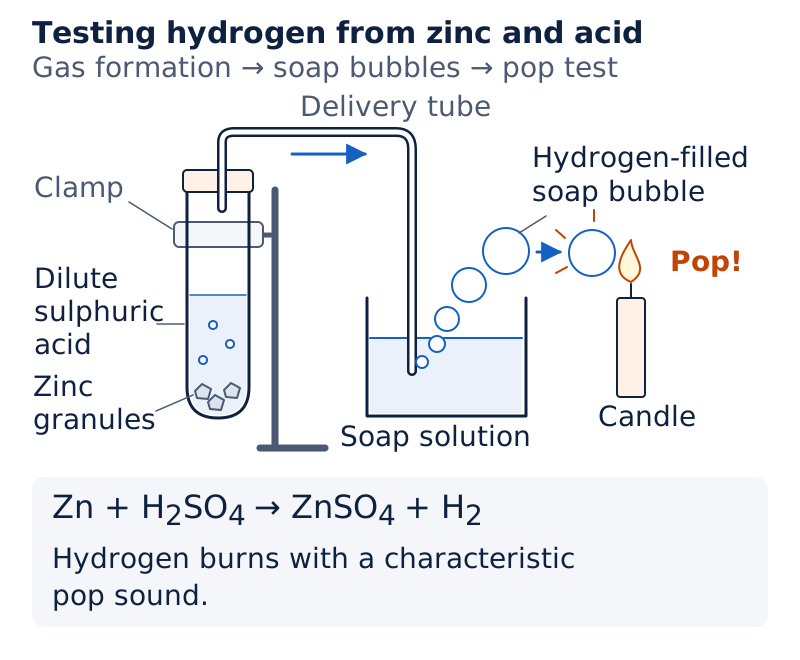
A clamped test tube contains zinc granules and dilute sulphuric acid. A delivery tube leads into soap solution. The labelled gas bubbles contain hydrogen, and a candle is shown testing a soap bubble with a pop sound.
Drawn by One Young India. See Fig. 2.1 in your NCERT textbook
Can a base also release hydrogen from a metal?
Zinc reacts with warmed sodium hydroxide solution. Sodium hydroxide is NaOH, and the salt formed is sodium zincate, Na₂ZnO₂. Hydrogen is again released, but this reaction with a base does not occur with all metals.
In equations, (s) means solid, (l) means liquid, (g) means gas and (aq) means dissolved in water. These state symbols describe the physical form of each substance.
2NaOH(aq) + Zn(s) → Na₂ZnO₂(s) + H₂(g)
Note: Use the metal and reagent actually specified. The observed reaction of zinc with sodium hydroxide is not evidence that every metal reacts with every base.
How do acids react with carbonates and hydrogencarbonates?
Metal carbonates and metal hydrogencarbonates react with acids to produce a salt, carbon dioxide and water. The release of gas causes effervescence. Both classes give the same types of products, although their balanced equations differ.
Sodium carbonate is Na₂CO₃; sodium hydrogencarbonate is NaHCO₃. With hydrochloric acid, HCl, both form sodium chloride, NaCl, water, H₂O, and carbon dioxide, CO₂.
Na₂CO₃(s) + 2HCl(aq) → 2NaCl(aq) + H₂O(l) + CO₂(g)
NaHCO₃(s) + HCl(aq) → NaCl(aq) + H₂O(l) + CO₂(g)
How does lime water identify carbon dioxide?
Lime water is calcium hydroxide solution, written as Ca(OH)₂. Passing carbon dioxide through it forms insoluble calcium carbonate, CaCO₃. This white precipitate makes the liquid look milky.
Ca(OH)₂(aq) + CO₂(g) → CaCO₃(s) + H₂O(l)
Passing excess carbon dioxide converts the precipitate into soluble calcium hydrogencarbonate, Ca(HCO₃)₂. The milkiness therefore disappears. A test description should distinguish initial carbon dioxide passage from continued passage in excess.
CaCO₃(s) + H₂O(l) + CO₂(g) → Ca(HCO₃)₂(aq)
What the figure shows
Passing carbon dioxide through lime water
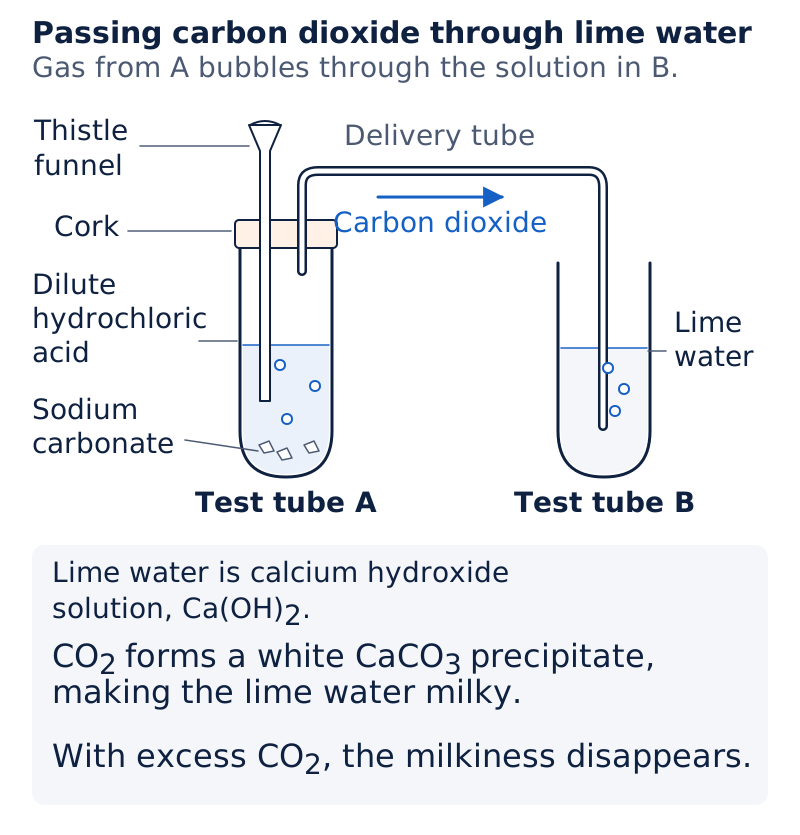
Test tube A contains sodium carbonate and dilute hydrochloric acid. A thistle funnel enters through the cork. A delivery tube carries the carbon dioxide to calcium hydroxide solution in test tube B.
Drawn by One Young India. See Fig. 2.2 in your NCERT textbook
Limestone, chalk and marble are forms of calcium carbonate. Their reaction with acids follows the carbonate pattern. The salt depends on the acid and metal compound used; carbon dioxide and water are the other products.
The carbon dioxide-producing reaction of an acid with a hydrogencarbonate also underlies a soda-acid fire extinguisher. Dilute sulphuric acid and sodium hydrogencarbonate solution are kept separate until mixing produces a discharge through the nozzle.
How do neutralisation and oxide reactions work?
Definition: Neutralisation is the reaction of an acid with a base to form a salt and water.
Acids and bases can cancel each other’s effects. For hydrochloric acid and sodium hydroxide, the products are sodium chloride and water. The word equation is base + acid → salt + water.
NaOH(aq) + HCl(aq) → NaCl(aq) + H₂O(l)
What does the phenolphthalein experiment demonstrate?
- Take about 2 mL of dilute sodium hydroxide solution in a test tube.
- Add two drops of phenolphthalein. The basic solution becomes pink.
- Add dilute hydrochloric acid drop by drop. The colour disappears as the base’s effect is neutralised.
- Add a few drops of sodium hydroxide again. Reappearance of pink shows that the solution has become basic again.
The indicator makes the change in the reaction mixture visible. Its colour is evidence about the mixture’s acidic or basic nature, while the chemical equation identifies the substances consumed and formed.
How do metal and non-metal oxides compare?
Copper oxide, CuO, dissolves when dilute hydrochloric acid is added with stirring. The solution becomes blue-green because copper(II) chloride, CuCl₂, forms. Water is the other product.
Derivation: How is the copper oxide reaction balanced?
- Write the reactants and products: . Copper already has one atom on each side.
- The product contains two chlorine atoms, so place a coefficient of 2 before .
- The two units supply two hydrogen atoms for one molecule. The single oxygen atom in also matches that in water, so all atoms are balanced.
Balanced equation: .
This follows metal oxide + acid → salt + water. Because the reaction resembles the reaction of a base with an acid, metallic oxides are generally described as basic oxides.
Carbon dioxide reacts with calcium hydroxide to form calcium carbonate and water. Here a non-metal oxide reacts with a base in a way similar to an acid. Non-metallic oxides are generally described as acidic oxides.
| Reaction | Example | Products |
|---|---|---|
| Acid with base | Hydrochloric acid with sodium hydroxide | Sodium chloride and water |
| Acid with metal oxide | Hydrochloric acid with copper oxide | Copper(II) chloride and water |
| Base with non-metal oxide | Calcium hydroxide with carbon dioxide | Calcium carbonate and water |
Why is water essential for acidic and basic behaviour?
Acids produce hydrogen ions, represented by H⁺(aq), in water. The superscript plus indicates positive charge. These ions account for acidic properties. The presence of hydrogen in a compound alone does not make that compound an acid.
What does an electrical conductivity test show?
Glucose and alcohol contain hydrogen, yet their solutions do not conduct electricity in the conductivity experiment. Dilute hydrochloric acid and sulphuric acid do conduct electricity. Their solutions contain ions that carry the current.
What the figure shows
Electrical conduction through an acid solution
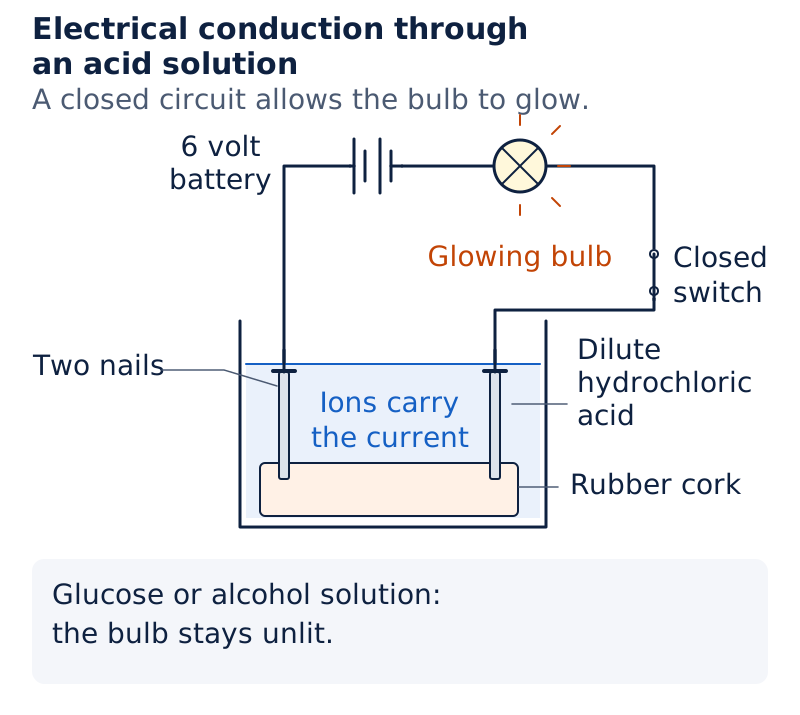
Two nails fixed in a rubber cork stand in dilute hydrochloric acid in a beaker. Wires connect them to a 6 volt battery, a bulb and a switch. The bulb is shown glowing.
Drawn by One Young India. See Fig. 2.3 in your NCERT textbook
Repeating the circuit test with glucose or alcohol solution leaves the bulb unlit. The comparison links conduction to ions in solution, rather than merely to hydrogen being present in the chemical substance.
What are hydronium and hydroxide ions?
Hydrogen ions combine with water molecules to form hydronium ions, H₃O⁺. Hydrogen chloride in water produces these ions together with chloride ions, Cl⁻. The superscript minus indicates negative charge.
HCl + H₂O → H₃O⁺ + Cl⁻
Dry hydrogen chloride gas does not change dry blue litmus. It turns moist blue litmus red because water allows the formation of ions responsible for acidity. This distinguishes dry gas from its aqueous solution.
Bases produce hydroxide ions, OH⁻, in water. Dissolved sodium hydroxide gives sodium ions, Na⁺, and hydroxide ions: NaOH(s) → Na⁺(aq) + OH⁻(aq), in the presence of water.
An alkali is a base soluble in water. All bases do not dissolve in water, so the terms base and alkali are not interchangeable. At the ionic level, neutralisation combines hydrogen and hydroxide ions to form water.
H⁺(aq) + OH⁻(aq) → H₂O(l)
What changes when an acid or base is diluted?
Dilution means mixing an acid or base with water, reducing the concentration of its ions per unit volume. For an acid, hydronium ion concentration falls. For a base, hydroxide ion concentration falls.
Concentration describes the amount present in a given volume. Adding water spreads the ions through a larger volume. Diluting an acid therefore decreases hydronium ion concentration; it does not mean that the acid has been neutralised by a base.
Why does the order of mixing matter?
Dissolving an acid or base in water is highly exothermic, meaning that heat is released. Adding concentrated sulphuric acid to water makes the container warmer. Dissolving sodium hydroxide pellets also releases heat.
Note: Add concentrated acid slowly to water with constant stirring. Adding water to concentrated acid can cause intense local heating, splashing and burns, and may break the glass container.
The mixing precaution follows directly from the heat produced. Slow addition with stirring is especially important for concentrated nitric acid and sulphuric acid. Concentrated acids and bases carry a warning sign because of their corrosive action.
How is dilution different from acid strength?
To compare strong and weak acids, compare solutions of the same concentration. Hydrochloric acid and acetic acid at equal concentration produce different amounts of hydrogen ions. An acid producing more hydrogen ions is stronger than one producing fewer under this comparison.
Thus concentration and the extent of ion production must not be confused. Water addition changes concentration. The strong-acid versus weak-acid comparison asks how much hydrogen ion each acid produces when their concentrations are the same.
How does the pH scale describe a solution?
The pH scale measures hydrogen ion concentration and indicates whether a solution is acidic, neutral or basic. The letter p refers to the German word “potenz”, meaning power. The scale generally extends from 0, very acidic, to 14, very alkaline.
A universal indicator is a mixture of several indicators. It shows different colours at different hydrogen ion concentrations. Paper impregnated with universal indicator is commonly used to estimate pH by comparison with a colour scale.
| pH value | Nature of solution | Interpretation |
|---|---|---|
| Less than 7 | Acidic | Lower pH indicates higher hydronium ion concentration |
| Exactly 7 | Neutral | Neither acidic nor basic |
| More than 7 | Basic | Increasing pH towards 14 indicates increasing hydroxide ion concentration |
How should pH values be compared?
Higher hydronium ion concentration corresponds to a lower pH. Therefore, arranging solutions in increasing pH places them in decreasing hydrogen ion concentration. A basic solution can contain hydrogen ions; its basic character is associated with a higher concentration of hydroxide ions.
What the figure shows
Ion concentrations across the pH scale
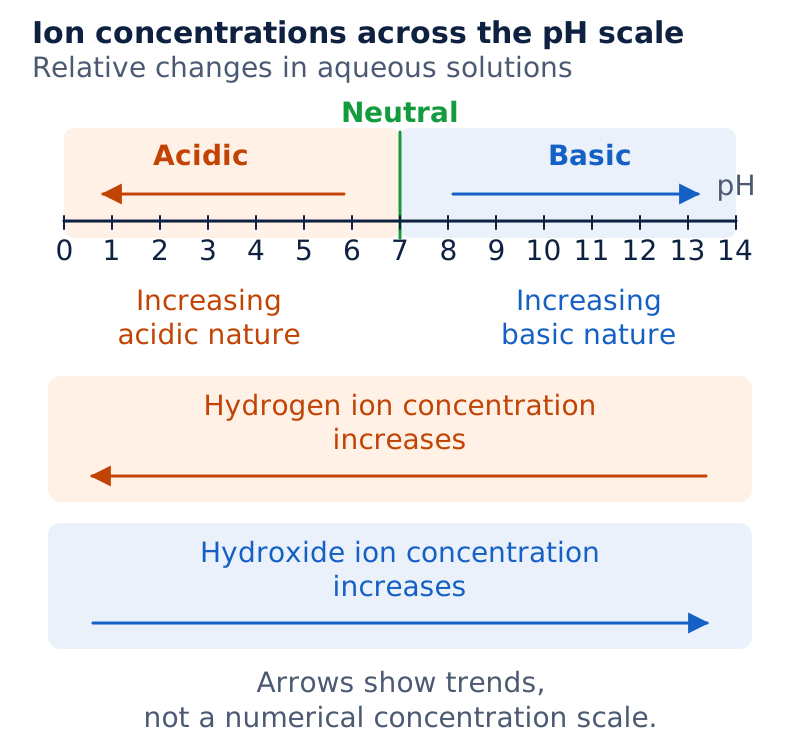
A horizontal scale runs from 0 to 14, with 7 marked neutral. Arrows show increasing acidic nature towards the left and increasing basic nature towards the right. Hydrogen and hydroxide ion regions indicate their changing relative concentrations.
Drawn by One Young India. See Fig. 2.6 in your NCERT textbook
Worked example 1. Two solutions are labelled A and B. A has pH 6 and B has pH 8. Identify their nature and compare hydrogen ion concentration.
Answer: A is acidic because 6 is below 7. B is basic because 8 is above 7. A has the higher hydrogen ion concentration because its pH is lower.
Universal indicator gives more information than a simple litmus test. Litmus identifies acidic or basic behaviour, whereas the pH colour comparison places the solution approximately along a scale. The colour guide should be used as an approximate comparison.
Why does pH matter in everyday life?
Living organisms function within a narrow range of pH change. The human body works within the pH range 7.0 to 7.8. Changes in environmental pH can also affect the survival of organisms.
How do rain and soil pH affect life?
Rain with a pH below 5.6 is called acid rain. When it enters rivers, it lowers their pH and makes survival difficult for aquatic life. Plants also need a suitable soil pH range for healthy growth.
- Place about 2 g of soil in a test tube; g means gram.
- Add 5 mL of water and shake the contents.
- Filter the mixture and collect the filtrate in another test tube.
- Test the filtrate with universal indicator paper and compare soils from places where different plants grow.
How are acidity and tooth decay related to pH?
The stomach produces hydrochloric acid, which helps digestion. Excess acid during indigestion can cause pain and irritation. Antacids are bases that neutralise this excess acid. Magnesium hydroxide, also called milk of magnesia, is a mild base used for this purpose.
Tooth decay starts when mouth pH falls below 5.5. Tooth enamel contains calcium hydroxyapatite, a crystalline form of calcium phosphate. It does not dissolve in water but is corroded under these acidic conditions.
Bacteria degrade sugars and food particles left in the mouth, producing acids. Cleaning the mouth after eating helps prevent this problem. Toothpastes are generally basic and help neutralise excess acid.
Which natural sources contain acids?
| Natural source | Acid present |
|---|---|
| Vinegar | Acetic acid |
| Orange and lemon | Citric acid |
| Tamarind | Tartaric acid |
| Tomato | Oxalic acid |
| Sour milk or curd | Lactic acid |
| Ant sting and nettle sting | Methanoic acid |
A bee sting leaves an acid that causes irritation; a mild base such as baking soda can give relief. Nettle stinging hairs inject methanoic acid. Rubbing the affected area with dock leaves is described as a traditional remedy.
Acids also occur beyond Earth. Venus has thick white and yellowish clouds of sulphuric acid. This example connects the presence of acids with the question of whether an environment can support life.
How are salt families and the pH of salts classified?
Salts having the same positive or negative radicals belong to a family of salts. Sodium chloride and sodium sulphate belong to the sodium family because they share the sodium component. Sodium sulphate is represented by Na₂SO₄.
Sodium chloride and potassium chloride belong to the chloride family. Potassium chloride is represented by KCl. A salt can therefore be grouped through either its positive or its negative component, depending on which family is being considered.
Are all salt solutions neutral?
The acidic or basic nature of a salt solution depends on the acid and base from which the salt is formed. Calling a substance a salt does not, by itself, mean that its aqueous solution has pH 7.
| Acid and base forming the salt | Nature of salt solution | pH |
|---|---|---|
| Strong acid and strong base | Neutral | 7 |
| Strong acid and weak base | Acidic | Below 7 |
| Strong base and weak acid | Basic | Above 7 |
To investigate salts, first check whether the samples dissolve in distilled water. Test the resulting solutions with litmus and pH paper. Relate the results to the acid and base involved in forming each salt.
Where does common salt come from?
Common salt is sodium chloride, formed by hydrochloric acid and sodium hydroxide. It is a neutral salt used in food. Seawater contains several dissolved salts, from which sodium chloride can be separated.
Solid deposits also occur as rock salt. The large crystals are often brown because of impurities. Rock-salt beds formed when ancient seas dried up, and the deposits are mined like coal.
Common salt also had symbolic importance in India’s freedom struggle through Mahatma Gandhi’s Dandi March. Chemically, it is a raw material for sodium hydroxide, bleaching powder, baking soda and washing soda, linking a familiar food ingredient to industrial manufacture.
How are sodium hydroxide and bleaching powder prepared?
Brine is an aqueous solution of sodium chloride. Passing electricity through it produces sodium hydroxide, chlorine gas and hydrogen gas. Chlorine gas is written as Cl₂.
2NaCl(aq) + 2H₂O(l) → 2NaOH(aq) + Cl₂(g) + H₂(g)
What happens in the chlor-alkali process?
The name chlor-alkali process refers to chlorine and the alkali sodium hydroxide. Chlorine is released at the anode, the positive electrode shown in the cell. Hydrogen is released at the cathode, the negative electrode. Sodium hydroxide solution forms near the cathode.
What the figure shows
Products of the chlor-alkali process
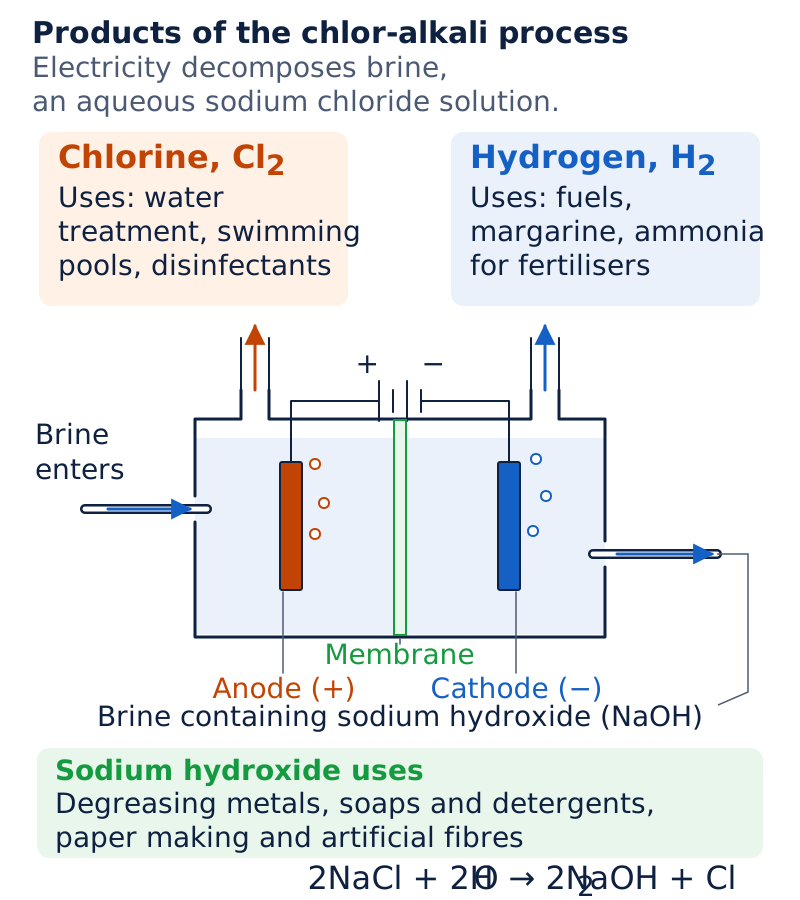
The cell shows brine entering on the left, a membrane between two electrodes, chlorine leaving above the anode and hydrogen above the cathode. Brine containing sodium hydroxide leaves on the right. Uses of the products are listed beside the outlets.
Drawn by One Young India. See Fig. 2.8 in your NCERT textbook
| Product | Uses |
|---|---|
| Chlorine | Water treatment, swimming pools, PVC, disinfectants, CFCs and pesticides |
| Hydrogen | Fuels, margarine and ammonia for fertilisers |
| Sodium hydroxide | Degreasing metals, soaps and detergents, paper making and artificial fibres |
How is bleaching powder made and used?
Chlorine reacts with dry slaked lime, calcium hydroxide, to produce bleaching powder. It is represented as Ca(ClO)₂, although its actual composition is complex. Calcium chloride, CaCl₂, and water also appear in the preparation equation.
2Ca(OH)₂ + 2Cl₂ → Ca(ClO)₂ + CaCl₂ + 2H₂O
Bleaching powder bleaches cotton and linen in the textile industry, wood pulp in paper factories and washed clothes in laundries. It is also an oxidising agent in chemical industries and is used to make drinking water free from germs.
The connection between these preparations is chlorine: the gas produced from brine becomes a reagent for making bleaching powder. Sodium hydroxide, hydrogen and chlorine are all useful products of the original process.
How do baking soda and washing soda differ?
Baking soda is sodium hydrogencarbonate. It is a mild, non-corrosive basic salt used for making crispy pakoras and sometimes for faster cooking. Sodium chloride is one of the raw materials used in its preparation.
How is baking soda prepared and used?
Its preparation uses sodium chloride, water, carbon dioxide and ammonia. Ammonia is NH₃, and ammonium chloride, NH₄Cl, is the other product.
NaCl + H₂O + CO₂ + NH₃ → NH₄Cl + NaHCO₃
Heating sodium hydrogencarbonate produces sodium carbonate, water and carbon dioxide. The condition of heating must accompany the equation.
2NaHCO₃ → Na₂CO₃ + H₂O + CO₂ (on heating)
Baking powder is a mixture of baking soda and tartaric acid, a weak edible acid. When heated or mixed with water, the acid reacts with sodium hydrogencarbonate and releases carbon dioxide. This makes bread and cakes rise and become soft and spongy.
Baking soda is also an ingredient in antacids because it neutralises excess stomach acid. Its reaction with acids is used in soda-acid fire extinguishers, where the generation of carbon dioxide is the useful chemical change.
How is washing soda obtained?
Washing soda is sodium carbonate with ten water molecules of crystallisation per formula unit, written Na₂CO₃·10H₂O. The centred dot joins the salt formula to its water of crystallisation. Recrystallising sodium carbonate gives washing soda.
Na₂CO₃ + 10H₂O → Na₂CO₃·10H₂O
Washing soda is a basic salt used in glass, soap and paper industries. It is used to manufacture sodium compounds such as borax, as a domestic cleaning agent and for removing permanent hardness of water.
| Substance | Composition | Distinctive use |
|---|---|---|
| Baking soda | Sodium hydrogencarbonate | Antacids and soda-acid fire extinguishers |
| Baking powder | Baking soda mixed with tartaric acid | Making bread and cakes rise |
| Washing soda | Sodium carbonate with water of crystallisation | Removing permanent hardness of water |
What are water of crystallisation and Plaster of Paris?
Definition: Water of crystallisation is the fixed number of water molecules present in one formula unit of a salt.
A crystal can seem dry while containing water as part of its crystalline composition. This is different from liquid water simply wetting its surface. The water written in a hydrated salt’s formula has a definite numerical relationship to the salt.
What happens when hydrated copper sulphate is heated?
Hydrated copper sulphate, CuSO₄·5H₂O, contains five water molecules per formula unit. Heating its blue crystals removes this water and turns the salt white. Water droplets appear in the boiling tube.
Adding a few drops of water to the heated sample restores the blue colour. The observations connect water loss with the colour change and show why a dry-looking crystal need not be free of water.
What the figure shows
Removing water of crystallisation
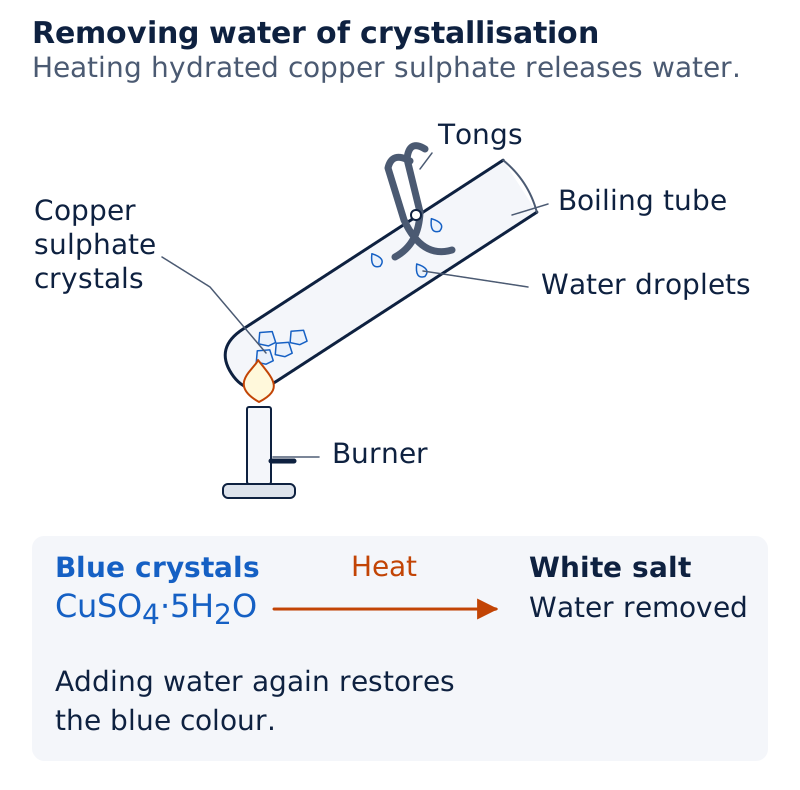
Tongs hold a sloping boiling tube above a burner. Copper sulphate crystals are labelled near the heated end, and water droplets are labelled farther up the tube.
Drawn by One Young India. See Fig. 2.9 in your NCERT textbook
How does gypsum form Plaster of Paris?
Gypsum, CaSO₄·2H₂O, has two water molecules per formula unit. Heating gypsum at 373 K, where K means kelvin, removes some of this water and produces calcium sulphate hemihydrate, CaSO₄·½H₂O, called Plaster of Paris.
The fraction ½ indicates that two formula units of calcium sulphate share one water molecule. It does not mean that an individual water molecule has been divided into halves. The fraction describes the ratio within the compound.
Plaster of Paris is a white powder. Mixing it with water reforms gypsum as a hard solid mass. Its setting reaction is:
Derivation: How much water is needed for Plaster of Paris to set?
- Gypsum has two water molecules per formula unit of calcium sulphate: .
- Plaster of Paris has half a water molecule per calcium sulphate formula unit, written . Here means one water molecule shared by two calcium sulphate formula units.
- To restore gypsum, the additional water per calcium sulphate formula unit is . Thus the coefficient of added water is .
Setting reaction: .
Doctors use it to support fractured bones in the correct position. Other uses include toys, decorative materials and smoothing surfaces. Because it reacts with water to set, it should be kept in a moisture-proof container before use.
Glossary
- Acid — A substance that produces hydrogen ions in aqueous solution and turns blue litmus red.
- Base — A substance that produces hydroxide ions in water and can neutralise an acid.
- Indicator — A substance whose observable change helps identify whether a solution is acidic or basic.
- Olfactory indicator — A substance whose odour changes when exposed to acidic or basic media.
- Alkali — A base that dissolves in water and produces hydroxide ions in the resulting solution.
- Hydronium ion — The positively charged ion formed when a hydrogen ion combines with a water molecule.
- Neutralisation — A reaction between an acid and a base that produces salt and water.
- Dilution — Mixing an acid or base with water to decrease ion concentration per unit volume.
- Universal indicator — A mixture of indicators showing different colours at different hydrogen ion concentrations.
- pH scale — A scale indicating hydrogen ion concentration and the acidic or basic nature of a solution.
- Brine — An aqueous sodium chloride solution used to produce sodium hydroxide, chlorine and hydrogen by electrolysis.
- Water of crystallisation — The fixed number of water molecules present in one formula unit of a salt.
Common errors and misconceptions
- Misconception: Every compound containing hydrogen is an acid. Correct: Glucose and alcohol contain hydrogen but do not produce the hydrogen ions responsible for acidic behaviour in water.
- Misconception: Dry hydrogen chloride must turn dry blue litmus red. Correct: Water is needed for the formation of ions; moist blue litmus turns red.
- Misconception: A higher pH means more hydrogen ions. Correct: Higher hydrogen ion concentration means lower pH. A neutral solution has pH 7.
- Misconception: All bases are alkalis. Correct: Alkalis are bases soluble in water; all bases do not dissolve in water.
- Misconception: All salts have neutral solutions. Correct: Salt solutions may be acidic, basic or neutral, depending on the acid and base from which they form.
- Misconception: Baking soda, baking powder and washing soda are the same material. Correct: Baking soda is sodium hydrogencarbonate; baking powder includes tartaric acid; washing soda is hydrated sodium carbonate.
- Misconception: A dry-looking salt crystal cannot contain water. Correct: Hydrated copper sulphate contains five water molecules per formula unit, even though its crystals appear dry.
- Misconception: Water may be poured into concentrated acid during dilution. Correct: Add acid slowly to water with constant stirring because the released heat can cause splashing and breakage.
Exam-style questions with model answers
Q1. A 10 mL sample of sodium hydroxide solution is completely neutralised by 8 mL of hydrochloric acid solution. What volume of the same acid solution will neutralise 20 mL of the same sodium hydroxide solution? Show your calculation. [2 marks]
- The sodium hydroxide volume doubles while both solution concentrations remain unchanged, so the required acid volume also doubles.
- Required hydrochloric acid volume = 8 mL × (20 mL ÷ 10 mL) = 16 mL.
Q2. Dilute hydrochloric acid is added to solid sodium carbonate. Name all products, write the balanced equation and explain both the initial and excess-carbon-dioxide stages when the gas is passed through lime water. [3 marks]
- The products are sodium chloride, water and carbon dioxide: Na₂CO₃ + 2HCl → 2NaCl + H₂O + CO₂.
- Initially, carbon dioxide turns lime water milky because insoluble calcium carbonate forms: Ca(OH)₂ + CO₂ → CaCO₃ + H₂O. The white precipitate causes the milkiness.
- With excess carbon dioxide, soluble calcium hydrogencarbonate forms and the milkiness disappears: CaCO₃ + H₂O + CO₂ → Ca(HCO₃)₂.
Q3. In a circuit containing two nails, a battery, a bulb and a switch, dilute hydrochloric acid makes the bulb glow, but glucose and alcohol solutions do not. Explain the observations and predict how dry hydrogen chloride affects dry and moist blue litmus. [4 marks]
- The glowing bulb shows that dilute hydrochloric acid conducts electricity. Ions present in its aqueous solution carry electric current.
- Glucose and alcohol dissolve in water as molecules rather than ionising to supply mobile ions, so their solutions do not conduct electricity in this experiment. Although they contain hydrogen, they do not release the hydrogen ions responsible for acidic behaviour.
- Dry hydrogen chloride does not change dry blue litmus because water is needed for formation of the ions responsible for acidity.
- Moist blue litmus turns red. Hydrogen chloride combines with water to form hydronium and chloride ions: HCl + H₂O → H₃O⁺ + Cl⁻.
Q4. Five solutions A, B, C, D and E have pH values 4, 1, 11, 7 and 9 respectively. Identify the neutral, strongly alkaline, strongly acidic, weakly acidic and weakly alkaline solutions, then arrange all five in increasing hydrogen ion concentration. [3 marks]
- D is neutral because its pH is 7. C, at pH 11, is strongly alkaline, while E, at pH 9, is weakly alkaline in this comparison.
- B, at pH 1, is strongly acidic, while A, at pH 4, is weakly acidic in this comparison.
- Increasing hydrogen ion concentration corresponds to decreasing pH. The required order is C, E, D, A, B, corresponding to pH 11, 9, 7, 4, 1.
Q5. Explain the electrolysis of brine. Give its balanced equation, identify the product at each electrode and the location of sodium hydroxide formation, state one use of each product, and give the equation for preparing bleaching powder from chlorine and dry slaked lime. [5 marks]
- Brine is aqueous sodium chloride. Passing electricity through it forms sodium hydroxide, chlorine and hydrogen: 2NaCl(aq) + 2H₂O(l) → 2NaOH(aq) + Cl₂(g) + H₂(g).
- Chlorine is released at the anode and hydrogen at the cathode. Sodium hydroxide solution forms near the cathode.
- The process is called chlor-alkali because its products include chlorine and the alkali sodium hydroxide.
- Chlorine is used in water treatment, hydrogen in making ammonia for fertilisers, and sodium hydroxide in making soaps and detergents.
- Chlorine reacts with dry slaked lime to produce bleaching powder, represented as Ca(ClO)₂: 2Ca(OH)₂ + 2Cl₂ → Ca(ClO)₂ + CaCl₂ + 2H₂O. Its actual composition is complex.
Q6. Distinguish baking soda, baking powder and washing soda by composition. Explain how baking powder makes cakes rise, show how washing soda is obtained from baking soda, and give two uses each of baking soda and washing soda. [5 marks]
- Baking soda is sodium hydrogencarbonate, NaHCO₃. Baking powder is a mixture of baking soda and tartaric acid, a weak edible acid. Washing soda is hydrated sodium carbonate, Na₂CO₃·10H₂O.
- When baking powder is heated or mixed with water, its acid reacts with sodium hydrogencarbonate to release carbon dioxide. The gas makes cakes rise and become soft and spongy.
- Heating baking soda gives sodium carbonate: 2NaHCO₃ → Na₂CO₃ + H₂O + CO₂. Recrystallisation gives washing soda: Na₂CO₃ + 10H₂O → Na₂CO₃·10H₂O.
- Baking soda is used in antacids and soda-acid fire extinguishers.
- Washing soda is used as a domestic cleaning agent and to remove permanent hardness of water.
Q7. Gypsum is CaSO₄·2H₂O. Name the product formed on heating it at 373 K, explain the half-water notation in that product, and write its reaction with water. Why should it be stored in a moisture-proof container? [3 marks]
- Heating gypsum at 373 K forms calcium sulphate hemihydrate, CaSO₄·½H₂O, called Plaster of Paris.
- The half-water notation means that two formula units of calcium sulphate share one water molecule. It does not represent a broken water molecule.
- It sets to hard gypsum on adding water: CaSO₄·½H₂O + 1½H₂O → CaSO₄·2H₂O. A moisture-proof container prevents this reaction and hardening before the powder is needed.
Q8. State how hydronium ion concentration changes when an acid is diluted, and explain the correct order of mixing concentrated acid and water. [2 marks]
- Dilution decreases hydronium ion concentration per unit volume.
- Add acid slowly to water with constant stirring. The process releases much heat; adding water to concentrated acid can cause splashing, burns and breakage of the glass container.
Key takeaways
- Indicators distinguish acidic and basic conditions through colour or odour changes, allowing substances to be tested without tasting them.
- Acids reacting with suitable metals release hydrogen; reactions with metal carbonates or hydrogencarbonates release carbon dioxide and form salt and water.
- Acids produce hydrogen ions in water, bases produce hydroxide ions, and their neutralisation forms salt and water.
- Lower pH means higher hydrogen ion concentration; neutral solutions have pH 7, while basic solutions have pH above 7.
- Everyday pH effects include indigestion, tooth decay, plant growth and the difficulty aquatic life faces when acid rain lowers river pH.
- Brine electrolysis produces chlorine, hydrogen and sodium hydroxide; chlorine then reacts with dry slaked lime to prepare bleaching powder.
- Baking soda is sodium hydrogencarbonate, baking powder contains an edible acid, and washing soda is hydrated sodium carbonate.
- Water of crystallisation belongs to the salt’s formula; Plaster of Paris sets by combining with water to reform gypsum.
Test yourself
What is the difference between a base and an alkali?
An alkali is a base soluble in water. All bases do not dissolve in water, so every base is not an alkali.
What observation identifies hydrogen in the zinc and dilute sulphuric acid experiment?
Hydrogen-filled soap bubbles burn with a pop sound when a burning candle is brought near them.
Why does lime water first turn milky when carbon dioxide passes through it?
Carbon dioxide reacts with calcium hydroxide to produce a white precipitate of calcium carbonate, causing milkiness.
What does a pH below 7 tell you about a solution?
The solution is acidic. Lower pH corresponds to a higher concentration of hydrogen ions.
At what mouth pH does tooth decay begin, and why are toothpastes generally basic?
Tooth decay starts below pH 5.5. Basic toothpastes help neutralise acids produced by bacteria acting on food residues.
Which chlor-alkali product is released at the anode, and which at the cathode?
Chlorine is released at the anode and hydrogen at the cathode. Sodium hydroxide solution forms near the cathode.
Why do blue copper sulphate crystals become white on heating?
Heating removes their water of crystallisation. Adding water again restores the blue colour of the hydrated crystals.
What does the formula CaSO₄·½H₂O mean?
It represents calcium sulphate hemihydrate, or Plaster of Paris. Two formula units of calcium sulphate share one water molecule.