
How do Organisms Reproduce? | CBSE Class 10 Science Notes
On this page
Watch & explore
Start with a few high-quality watches, then dive into the notes below.
This note covers reproduction and variation, DNA copying, asexual modes of reproduction, sexual reproduction, reproductive structures in flowers, pollination and seed formation, puberty, human reproductive systems, fertilisation, development, menstruation and reproductive health.
Why does reproduction involve DNA copying and variation?
Reproduction is the process through which organisms produce new individuals of their kind. It is not necessary for maintaining an individual organism's life, although producing new individuals requires energy. Reproduction is linked to the stability of populations of species.
How is body design passed on?
DNA, or deoxyribonucleic acid, is the molecule carrying information for inheritance of features. Chromosomes in the cell nucleus contain this DNA. The nucleus is the cellular structure containing these chromosomes, and its DNA provides information for making proteins.
Similar body designs depend on similar information. If the information changes, different proteins will be made, eventually altering body design. Creating a DNA copy is therefore a basic event in reproduction, but the copy also needs the cellular structures that maintain life processes.
- A reproducing cell uses chemical reactions to make a copy of its DNA.
- Two DNA copies are present, and the cell also creates additional cellular apparatus, meaning the organised structures needed to maintain life processes.
- The DNA copies separate, each with its own cellular apparatus.
- The cell effectively divides into two cells, which are similar but may not be identical.
Why are the copies not necessarily identical?
Variation means differences among individuals. Biochemical copying reactions are not absolutely reliable, so DNA copying produces some variations. Some changes might be so drastic that the new DNA cannot work with its cellular apparatus and the new cell dies.
Other changes do not have such drastic effects. Surviving cells are therefore similar but subtly different. This tendency towards variation during reproduction provides the basis for evolution, the change in forms of life over generations.
Note: Copying DNA and producing additional cellular apparatus are connected requirements. Pushing a DNA copy out of a cell without the structures needed for life would not create a functioning new cell.
How does variation help a species survive?
A population is a group of organisms of the same species living in a particular area at a given time. Populations occupy particular places, or niches, within their environment. Reproduction helps populations continue to occupy these niches.
Reliable DNA copying maintains the body features that enable organisms to use a particular niche. This continuity explains why offspring resemble their parents and why reproduction contributes to population stability. However, the environment itself need not remain unchanged.
What happens when conditions change?
Temperatures can rise or fall, water levels can change, and meteorites can strike. A population suited to one set of conditions could be wiped out if its niche changes drastically. Variations in a few individuals give them some chance of surviving.
Consider bacteria living in temperate waters. If global warming increases the water temperature, most of these bacteria would die. However, the few variants resistant to heat would survive and grow further. The existing difference in heat resistance matters when the conditions change.
This example does not mean that all variations protect an organism. It shows why differences within a population can help a species survive over time. Variation is beneficial to the species but not necessarily to every individual carrying a difference.
How are continuity and variation connected?
Reproduction preserves an overall body design while introducing differences through imperfect copying. Making DNA copying much less accurate would not simply produce more useful variations: many resulting copies would fail to work with the cellular apparatus.
The important relationship is between enough copying accuracy to maintain a functioning body and enough variation to create differences within a population. Sexual reproduction, in which reproductive cells combine, provides a way of bringing together variations already present in different individuals.
How do fission, fragmentation, regeneration and budding differ?
Asexual reproduction produces a new generation from a single individual. Its different forms depend on body design. A unicellular organism consists of one cell, while a multicellular organism consists of many cells. Cell division can itself create new individuals in unicellular organisms.
What happens during fission and fragmentation?
Fission is division of a unicellular organism into new individuals. Many bacteria and protozoa split into two equal halves. This is binary fission. In Amoeba, division can occur in any plane, meaning any orientation through the cell.
Leishmania, which causes kala-azar, has a whip-like structure at one end. Its binary fission occurs in a definite orientation relative to that structure. In multiple fission, as in the malarial parasite Plasmodium, many daughter cells form simultaneously.
Fragmentation occurs when a relatively simple multicellular organism breaks into pieces that grow into new individuals. Spirogyra breaks into smaller fragments on maturation. Many more complex organisms cannot reproduce through simple cell-by-cell division because their tissues and organs occupy definite positions.
What happens during regeneration and budding?
Regeneration is the development of complete organisms from body parts in organisms capable of doing this, such as Hydra and Planaria. Specialised cells multiply, then change into different cell types and tissues in an organised sequence called development.
In budding, a new individual develops as an outgrowth. In Hydra, repeated cell division at one site produces a bud. It grows into a tiny individual and detaches when fully mature. Yeast can also produce small buds that separate and grow further.
| Process | What happens? | Example |
|---|---|---|
| Binary fission | One cell divides into two new individuals. | Amoeba and Leishmania |
| Multiple fission | Many daughter cells are produced simultaneously. | Plasmodium |
| Fragmentation | A mature body breaks into fragments that grow further. | Spirogyra |
| Regeneration | Specialised cells rebuild a complete organism from a body piece. | Planaria and Hydra |
| Budding | An outgrowth develops and separates as a new individual. | Hydra and yeast |
What the figure shows
Regeneration and budding
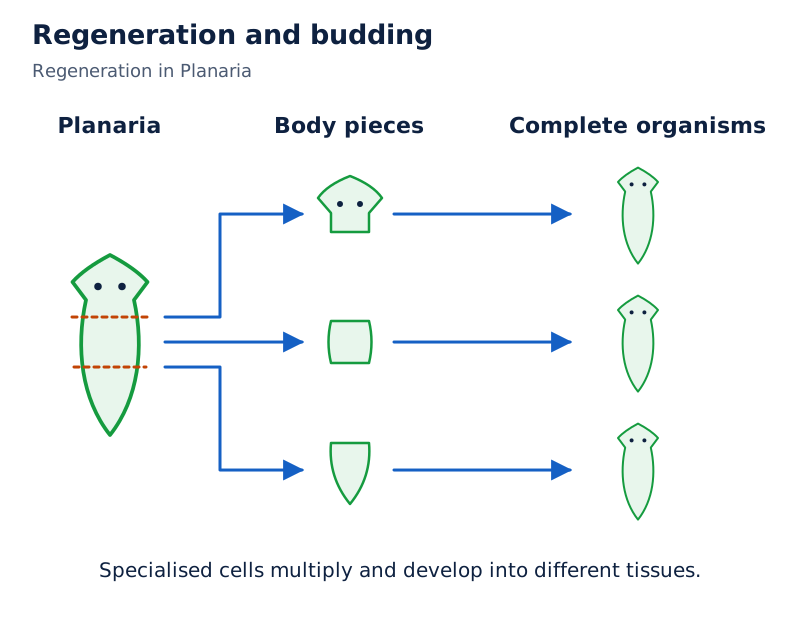
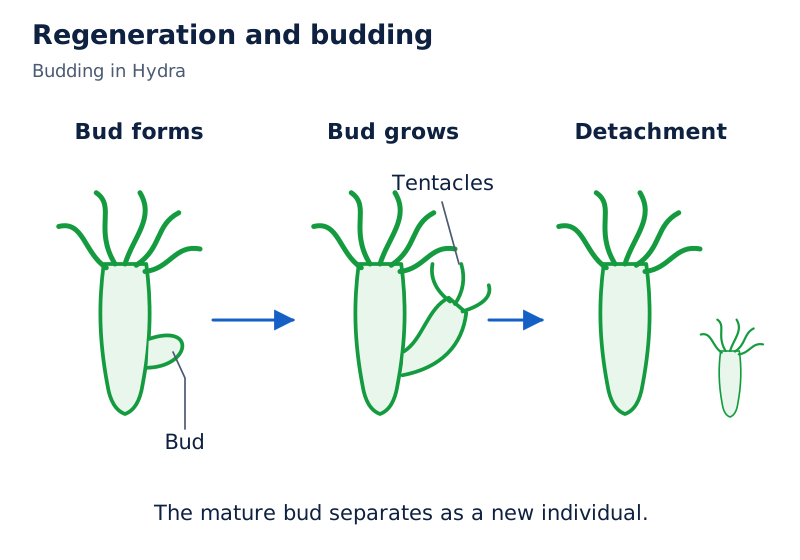
The Planaria sequence shows a body divided into pieces, with arrows leading from the pieces to complete organisms. The Hydra drawings show a side bud developing tentacles; the labels identify the bud and tentacles.
Drawn by One Young India. See Figs. 7.3 and 7.4 in your NCERT textbook
Note: Regeneration is not the same as reproduction. Most organisms would not normally depend on being cut up to reproduce. The ability to rebuild from a piece should not be confused with the usual reproductive process.
How do vegetative propagation, tissue culture and spores produce new organisms?
Vegetative propagation is reproduction in which roots, stems or leaves develop into new plants under appropriate conditions. Layering and grafting are methods using this capacity. Plants grown for agricultural purposes using vegetative propagation include sugarcane, roses and grapes.
What are the advantages of vegetative propagation?
Plants raised this way can flower and bear fruit earlier than plants grown from seeds. The method also permits propagation of plants such as banana, orange, rose and jasmine that have lost the capacity to produce seeds.
The new plants are genetically similar enough to the parent to have all its characteristics. This wording does not require every DNA copy to be absolutely identical. In Bryophyllum, buds in notches along the leaf margin fall on soil and develop into new plants.
A potato investigation compares pieces with and without a notch or bud on moist cotton. A money-plant investigation compares pieces containing at least one leaf with portions cut between leaves. These comparisons focus attention on the plant parts from which new growth develops.
How does tissue culture work?
Tissue culture grows new plants from tissue or cells taken from a plant's growing tip. It allows many plants to be raised from one parent in disease-free conditions and is commonly used for ornamental plants.
- Remove tissue or separate cells from the growing tip of a plant.
- Place them in an artificial medium, where rapid division forms a small group of cells called a callus.
- Transfer the callus to another medium containing hormones, regulators supporting growth and differentiation. Differentiation means the development of specialised cell types.
- Place the resulting young plants, or plantlets, in soil so they can grow into mature plants.
How does Rhizopus reproduce?
In the bread mould Rhizopus, the thread-like structures are hyphae; these are not its reproductive parts. The tiny rounded structures on stalks are sporangia, which contain reproductive cells called spores. Spores can develop into new Rhizopus individuals.
Thick walls protect the spores until they contact another moist surface and begin to grow. Keeping wet bread in a cool, moist, dark place and recording changes for a week allows the growth of bread mould to be observed.
What the figure shows
Leaf buds and spore formation
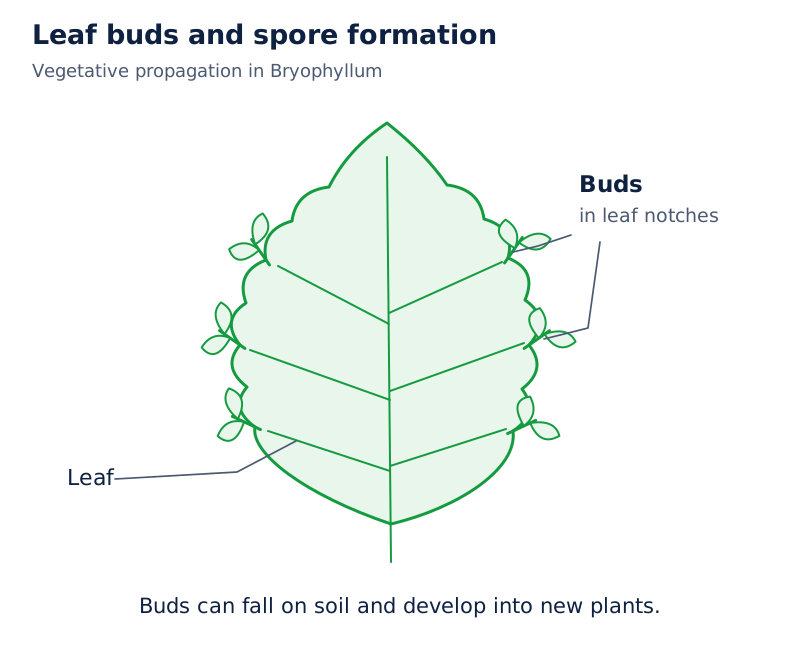
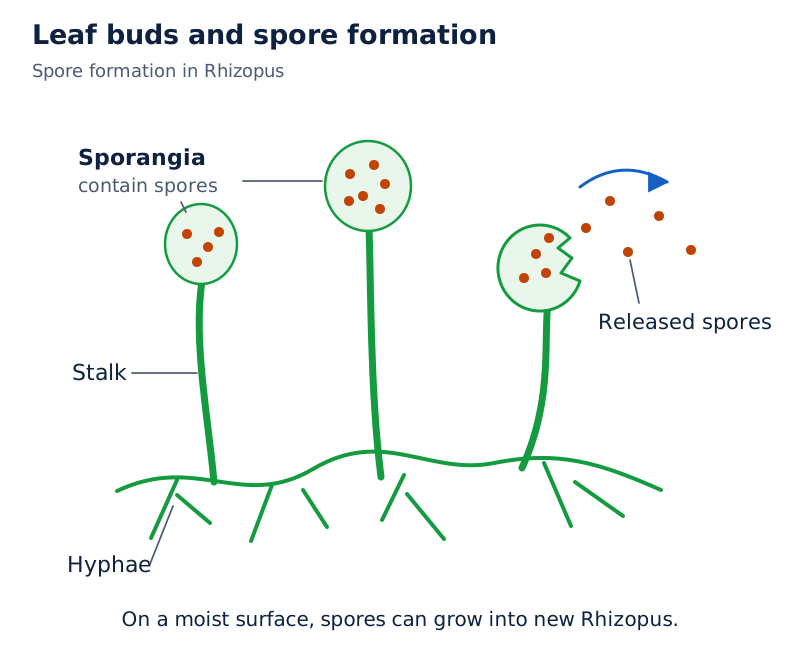
The Bryophyllum drawing shows small buds along the leaf edge, with a label pointing to buds. The Rhizopus drawing shows stalks with rounded tips and a label pointing to spores released near a tip.
Drawn by One Young India. See Figs. 7.5 and 7.6 in your NCERT textbook
Why does sexual reproduction involve specialised germ-cells?
Sexual reproduction combines DNA from two different individuals. The reproductive cells that take part are called germ-cells or gametes. Their fusion, called fertilisation, produces a zygote, the cell from which the new individual develops.
How does combining DNA increase variation?
Each individual carries variations accumulated through earlier generations. Different individuals have different patterns of these variations. Combining their DNA creates new combinations, allowing more variation to arise than through DNA-copying errors alone.
Copying is precise enough that new variation from copying errors appears fairly slowly. Sexual reproduction brings existing variations together without depending on a large increase in copying errors. It does not guarantee protection for every individual, but variation helps species survive over time.
How is repeated doubling of DNA avoided?
If two complete sets of body-cell DNA combined in each generation, the DNA amount would double repeatedly. In many multicellular organisms, specialised cell lineages produce germ-cells containing half the chromosome number and half the DNA amount of non-reproductive body cells.
The cell division that achieves this reduction is called meiosis. When germ-cells combine, the chromosome number and DNA content are re-established in the new generation. Reduction before fusion therefore balances the combination of genetic material during fertilisation.
In very simple organisms, the two germ-cells may be similar. With increasingly complex body designs, they specialise. One is large and stores food; the other is smaller and likely to be motile, meaning able to move.
Conventionally, the motile germ-cell is the male gamete and the food-storing germ-cell is the female gamete. Energy reserves help the zygote develop into an organism with specialised tissues and organs. These different roles are associated with differences in reproductive organs.
Which flower parts take part in sexual reproduction?
Angiosperms are flowering plants whose reproductive parts occur in flowers. A flower includes sepals, petals, stamens and a pistil. Sepals and petals are the flower parts surrounding the reproductive structures. The stamens and pistil contain the germ-cells involved in reproduction.
How do stamens and the pistil differ?
The stamen is the male reproductive part. It includes the anther, which contains pollen grains, and the supporting filament. Pollen grains are yellowish structures that produce male germ-cells. Their powder often sticks to a hand touching the stamen.
The pistil is the female reproductive part in the centre of the flower. Its swollen base is the ovary, its elongated middle part is the style, and its terminal part is the stigma, which may be sticky.
The ovary contains ovules, structures each containing an egg cell, or female gamete. Pollen must reach the stigma before the male germ-cell can reach the female germ-cell within the ovule. Pollen transfer and germ-cell fusion are distinct events.
| Structure | Position or identity | Reproductive connection |
|---|---|---|
| Stamen | Male reproductive part of a flower | Produces pollen grains |
| Anther | Part of the stamen | Contains pollen grains |
| Stigma | Terminal part of the pistil | Receives transferred pollen |
| Style | Elongated middle of the pistil | A pollen tube passes through it |
| Ovary | Swollen base of the pistil | Contains ovules |
| Ovule | Structure inside the ovary | Contains an egg cell |
What are unisexual and bisexual flowers?
A unisexual flower contains either stamens or a pistil; papaya and watermelon provide examples. A bisexual flower contains both stamens and a pistil, as in Hibiscus and mustard. These terms describe the reproductive parts present within a flower.
What the figure shows
Longitudinal section of a flower
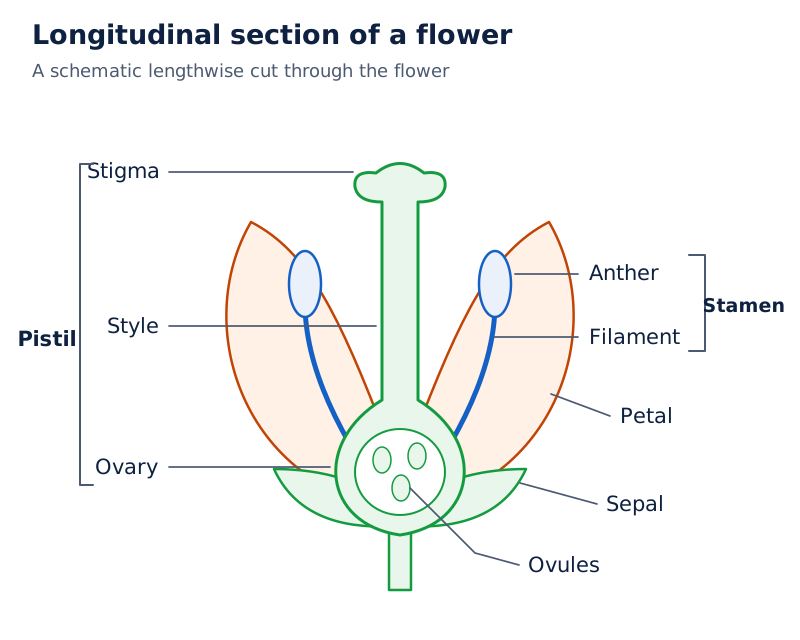
The lengthwise cut shows the pistil centrally, with stigma, style and ovary labelled. Anther and filament are grouped as a stamen. Petal and sepal are also labelled around the reproductive parts.
Drawn by One Young India. See Fig. 7.7 in your NCERT textbook
How do pollination and fertilisation lead to seeds and fruits?
Pollination is the transfer of pollen from the anther to the stigma. Transfer within the same flower is called self-pollination. Transfer from one flower to another is called cross-pollination and is achieved by agents such as wind, water or animals.
Fertilisation is the fusion of male and female germ-cells to produce a zygote. Pollination brings pollen to the stigma, but the female germ-cell lies within an ovule inside the ovary. A further connection is therefore needed.
What is the sequence after pollen reaches the stigma?
- Pollen lands on a suitable stigma, and a pollen tube, a tubular outgrowth from the pollen grain, begins to grow.
- The tube travels through the style to reach the ovary, enabling the male germ-cell to reach the female germ-cell.
- The male germ-cell fuses with the female gamete within the ovule, forming a zygote.
- The zygote divides repeatedly to form an embryo, the developing future plant, within the ovule.
- The ovule develops a tough coat and gradually becomes a seed, while the ovary grows rapidly and ripens into a fruit.
Petals, sepals, stamens, style and stigma may shrivel and fall off. The word “may” matters: flower parts can persist in a fruit. The transformations to remember are ovule into seed and ovary into fruit, rather than the reverse.
What the figure shows
Germination of pollen on the stigma
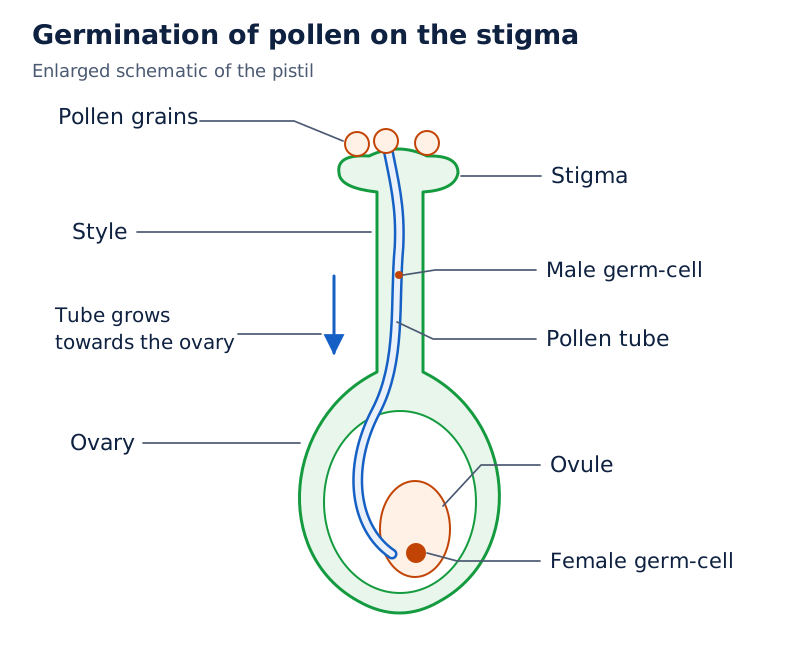
Pollen grains are shown on the stigma. A pollen tube extends down towards the ovary. Labels identify the male germ-cell within the tube and the female germ-cell inside the ovary.
Drawn by One Young India. See Fig. 7.8 in your NCERT textbook
What happens during seed germination?
Germination is the development of the embryo within a seed into a seedling under appropriate conditions. In a Bengal gram seed, the cotyledons provide food stores; the plumule is the future shoot and the radicle is the future root.
To examine these parts, soak Bengal gram seeds overnight, drain excess water and cover the seeds with a wet cloth for a day. Keep them from drying out, then carefully open them and identify the parts of the developing plant.
What the figure shows
Germinating seed
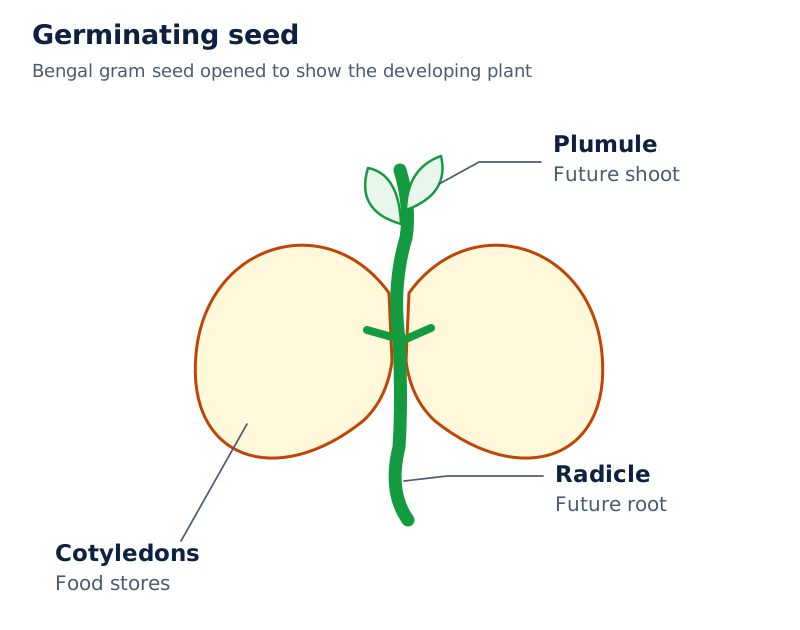
The opened seed shows cotyledons labelled as food stores. The growing axis is labelled with the plumule as the future shoot and the radicle as the future root.
Drawn by One Young India. See Fig. 7.9 in your NCERT textbook
What changes occur during puberty?
Puberty is the period during adolescence when reproductive tissues begin to mature. Adolescence is the stage of growing towards adulthood. Sexual maturation involves changes in body appearance and reproductive function, rather than merely an increase in overall size.
Which changes are shared, and which differ?
Thick hair appears in the armpits and genital region, the area between the thighs, which can also become darker. Thinner hair can appear on the arms, legs and face. Skin frequently becomes oily, and pimples might develop.
In girls, breasts begin to increase in size and the skin of the nipples darkens. Menstruation begins around this time. It is the periodic discharge of the lining of the uterus, or womb, as blood and mucus through the vagina, the passage leading from the uterus to the outside.
In boys, new thick facial hair begins to grow and voices begin to crack. The penis, the organ involved in transferring male germ-cells, occasionally becomes enlarged and erect during daydreams or at night.
Why does the timing vary?
These changes take place slowly over months and years. They do not occur together in one person or at an exact age. Their timing and rate differ between people, as do hair patterns and the size and shape of breasts or the penis.
During earlier growth, resources are mainly directed towards reaching adult size. As general growth slows, reproductive tissues begin to mature. Many visible changes, such as new hair-growth patterns, signal that sexual maturation is taking place.
Note: Some degree of sexual maturation does not necessarily mean that the body or mind is ready for sexual acts or for having and bringing up children. Maturation is gradual while general growth is still continuing.
How does the male reproductive system produce and transport sperms?
Sperms are male germ-cells produced in the testes. The testes lie in the scrotum, outside the abdominal cavity, because sperm formation requires a temperature lower than normal body temperature. The system has parts for both producing and delivering sperms.
What are the functions of the testes?
Besides producing sperms, the testes secrete testosterone, a hormone that regulates sperm formation and brings about changes in boys' appearance at puberty. Sperm production and hormonal regulation are separate but related functions of the testes.
A sperm consists mainly of genetic material and a long tail. The tail helps it move towards the female germ-cell. Its small, motile form is related to the role of the male gamete in reaching and combining with the female gamete.
Which structures transport and support sperms?
The vas deferens is the tube carrying sperms from the testes. It joins a tube coming from the urinary bladder, the organ storing urine. The urethra consequently forms a common passage for sperms and urine.
The prostate gland and seminal vesicles are glands that add secretions along the sperm transport route. These secretions form a fluid that makes transport easier and provides nutrition. Producing sperm cells and adding supporting fluid are different functions.
For revision, connect each structure with its contribution: testes produce sperms, the vas deferens transports them, glandular secretions support their movement and nutrition, and the urethra provides a passage through the penis. The penis participates in the internal transfer of germ-cells.
What the figure shows
Human male reproductive system
The side-view drawing labels a testis within the scrotum, the vas deferens, seminal vesicle, prostate gland, penis and urethra. The bladder is shown above the prostate, with the sperm-carrying tube curving towards this region.
See Fig. 7.10 in your NCERT textbook
How do fertilisation and development occur in the female reproductive system?
The ovaries make female germ-cells, or eggs, and produce some hormones. At birth, they already contain thousands of immature eggs. Some begin maturing at puberty. One egg is produced every month by one of the ovaries.
What are the main organs?
An oviduct, also called a fallopian tube, is a thin tube carrying the egg towards the uterus, or womb. The uterus is an elastic, bag-like structure where the embryo develops. Its opening into the vagina, the passage receiving sperms, is the cervix.
The two oviducts unite with the uterus. During sexual intercourse, sperms enter through the vaginal passage and travel upwards to the oviduct. They may encounter an egg there. Fertilisation takes place in the fallopian tube; embryo development continues in the uterus.
- Sperms enter the vagina during sexual intercourse and move towards the oviduct.
- If a sperm and egg fuse, fertilisation produces a zygote.
- The zygote begins dividing to produce a ball of cells, or embryo.
- The embryo becomes embedded in the uterine lining, a process called implantation.
- The embryo continues growing and developing organs to become a foetus, the developing child at this later stage.
How does the mother support development?
The uterus prepares each month for an embryo. Its lining thickens and becomes richly supplied with blood. A special tissue called the placenta provides the connection through which the embryo obtains nutrition from the mother's blood.
The placenta is a disc embedded in the uterine wall. On the embryo's side it has villi, projections surrounded by maternal blood spaces. These provide a large surface area for glucose, a sugar providing nutrition, and oxygen to pass to the embryo.
Waste substances produced by the embryo pass through the placenta into the mother's blood for removal. Development inside the mother's body takes approximately nine months. Rhythmic contractions of the uterine muscles bring about the child's birth.
What the figure shows
Human female reproductive system
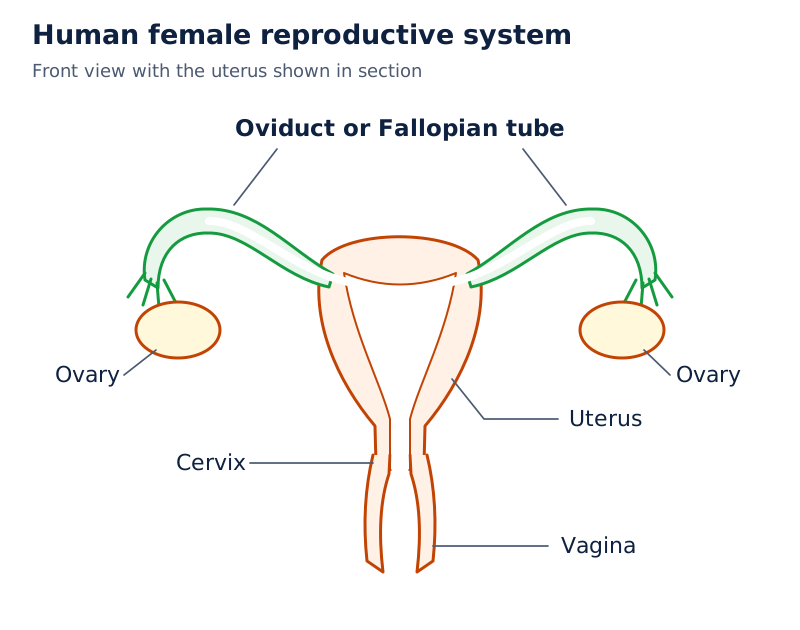
Two ovaries lie on either side of the central uterus. Curving oviducts, labelled “Oviduct or Fallopian tube”, lead towards the uterus. The cervix and vagina are labelled below it.
Drawn by One Young India. See Fig. 7.11 in your NCERT textbook
Why does menstruation occur when an egg is not fertilised?
The uterus prepares every month to receive a fertilised egg. Its lining becomes thick and spongy to support and nourish an embryo if fertilisation occurs. This preparation happens before it is known whether an embryo will develop.
What happens to the egg and uterine lining?
If an egg is not fertilised, it lives for about one day. The prepared lining is then no longer needed for an embryo. It slowly breaks down and leaves the body through the vagina as blood and mucus.
This cycle occurs roughly every month and is called menstruation. It usually lasts for about two to eight days. These approximate expressions describe the timing without suggesting that every person has an identical cycle or duration.
Menstruation is therefore connected to the repeated preparation and breakdown of the uterine lining. The blood flow should not be explained as simply the removal of an unfertilised egg: the substantial change is in the lining that was prepared to nourish an embryo.
How does this differ from pregnancy?
After fertilisation, the zygote divides and the embryo implants in the uterine lining. The lining then supports growth, with the placenta enabling exchange of nutrients, oxygen and wastes. When fertilisation does not occur, that prepared lining is shed instead.
The distinction links the egg's fate with the uterus's role. Fertilisation occurs in the oviduct, implantation occurs in the uterus, and menstrual material passes through the vagina. Confusing these sites makes the sequence of events difficult to explain correctly.
What does reproductive health involve?
Reproductive health involves health and informed choices connected with sexual activity, pregnancy and reproduction. Friends, families and government agencies can create different pressures about sex and having children. Decisions also need to consider readiness for the physical and mental demands of pregnancy.
How are infection and pregnancy prevention different?
Sexually transmitted infections are infections passed between people through sexual contact. Examples include the bacterial infections gonorrhoea and syphilis, and the viral infections warts and HIV-AIDS. HIV means human immunodeficiency virus; AIDS means acquired immunodeficiency syndrome. These are examples of health risks associated with intimate bodily contact.
A condom is a covering placed over the penis during sex. It helps prevent transmission of many of these infections to some extent. This qualified protection should not be replaced with a claim that condoms prevent every infection completely.
Contraception means preventing pregnancy. Different contraceptive methods act in different ways. A method that prevents pregnancy should not automatically be assumed to protect against sexually transmitted infections. The purpose and mechanism of each method need to be distinguished.
| Method | How it acts | Relevant qualification |
|---|---|---|
| Mechanical barriers | Condoms or similar vaginal coverings prevent sperms from reaching the egg. | A condom also helps reduce transmission of many infections to some extent. |
| Oral pills | Change hormonal balance so that eggs are not released and fertilisation cannot occur. | They can cause side effects because they change hormonal balance. |
| Loop or copper-T | Devices placed within the uterus prevent pregnancy. | They can cause side effects through irritation of the uterus. |
| Blocking the vas deferens | A surgical block prevents sperm transfer, preventing fertilisation. | Improperly performed surgery can cause infection and other problems. |
| Blocking the fallopian tube | A surgical block stops the egg reaching the uterus; fertilisation does not take place. | Surgical methods are safe in the long run, but the procedure must be performed properly. |
How are reproductive choices connected with society?
Removal of unwanted pregnancies can be misused for illegal sex-selective abortion of female foetuses. Prenatal sex determination, meaning determining a child's sex before birth, is prohibited by law. A healthy society needs to maintain the female-male sex ratio, the relative numbers of females and males.
The rates of birth and death determine population size. Population growth can make improvements in everybody's living standards harder. However, if inequality is the main reason for poor living standards, population size is relatively unimportant. Population size alone does not settle this question.
Glossary
- DNA — Deoxyribonucleic acid, the molecule carrying inherited information and providing instructions for making proteins in cells.
- Variation — Differences between individuals that arise through reproduction and can matter when environmental conditions change.
- Asexual reproduction — Reproduction in which a single individual gives rise to a new generation of organisms.
- Binary fission — Division of a unicellular organism into two daughter cells that become new individuals.
- Regeneration — Development of complete organisms from body pieces through the activity of specialised cells.
- Vegetative propagation — Formation of new plants from roots, stems or leaves under conditions suitable for growth.
- Spore — A reproductive cell that can develop into a new individual, protected by a thick wall in Rhizopus.
- Meiosis — Cell division producing germ-cells with half the chromosome number and DNA amount of non-reproductive body cells.
- Pollination — Transfer of pollen grains from an anther to the stigma of a flower.
- Fertilisation — Fusion of male and female germ-cells to form a zygote capable of further development.
- Germination — Development of the embryo inside a seed into a seedling under appropriate conditions.
- Puberty — The period during adolescence when reproductive tissues mature and signs of sexual maturation appear.
- Placenta — Tissue embedded in the uterine wall that enables exchange between the mother and developing embryo.
- Menstruation — Periodic breakdown and discharge of the uterine lining through the vagina as blood and mucus.
- Contraception — Prevention of pregnancy through methods such as barriers, oral pills, uterine devices or surgical blocks.
Common errors and misconceptions
- Misconception: Reproduction is essential for an individual to remain alive. Correct: It is not necessary for individual survival; it is linked to population continuity and stability.
- Misconception: Asexual offspring must have perfectly identical DNA. Correct: DNA copying introduces variations, so the resulting cells may not be identical.
- Misconception: Regeneration and normal reproduction mean the same thing. Correct: Most organisms would not normally depend on being cut into pieces to reproduce.
- Misconception: Pollination is the fusion of gametes. Correct: Pollination transfers pollen to the stigma; fertilisation fuses the male and female germ-cells.
- Misconception: The ovary becomes the seed and the ovule becomes the fruit. Correct: The ovule becomes a seed, while the ovary develops into a fruit.
- Misconception: Human fertilisation occurs in the uterus. Correct: It occurs in the fallopian tube; the developing embryo subsequently implants in the uterine lining.
- Misconception: Puberty proves complete readiness for parenthood. Correct: Some sexual maturation does not necessarily establish physical or mental readiness for sexual acts or raising children.
- Misconception: Every contraceptive method protects against sexually transmitted infections. Correct: Pregnancy prevention and infection protection are different; condoms help prevent many infections to some extent.
Exam-style questions with model answers
Q1. Distinguish binary fission from multiple fission, giving one organism for each. [2 marks]
- Binary fission divides a unicellular organism into two daughter cells, as in Amoeba.
- Multiple fission produces many daughter cells simultaneously, as in the malarial parasite Plasmodium.
Q2. A bacterial population lives in temperate water. Global warming raises the water temperature; a few existing variants resist heat. Explain the likely outcome and its significance for variation. [3 marks]
- Most bacteria would die when the temperature rises because the conditions of the niche to which the population was suited have changed.
- The few heat-resistant variants would survive and grow further, allowing some members of the population to continue under the altered conditions.
- This shows how variation helps a species survive over time, although it does not necessarily protect every individual organism in the population.
Q3. Explain four stages in producing new plants by tissue culture, from collecting cells to planting in soil. (Formative practice only, not for the year-end examination.) [4 marks]
- Tissue is removed, or cells are separated, from the growing tip of a parent plant to begin the process.
- The cells are placed in an artificial medium, where rapid division produces a small group of cells called a callus.
- The callus is moved to another medium containing hormones that support growth and differentiation into specialised cell types.
- The plantlets are transferred to soil, where they can grow into mature plants. Many plants can thus be raised from one parent in disease-free conditions.
Q4. A pollen grain lands on a suitable stigma. Explain five stages leading from this event to seed and fruit formation. [5 marks]
- The pollen grain develops a pollen tube, which grows through the style towards the ovary, connecting the pollen with the region containing the female germ-cell.
- The male germ-cell produced by the pollen grain fuses with the female gamete within the ovule. This event is fertilisation and produces a zygote.
- The zygote divides several times to form an embryo, the developing future plant, inside the ovule.
- The ovule develops a tough coat and is gradually converted into a seed containing the embryo.
- The ovary grows rapidly and ripens into a fruit. Other flower parts, including petals, sepals, stamens, style and stigma, may shrivel and fall off.
Q5. Explain how the placenta supports an embryo, covering its location, structure, useful-material transfer and waste removal in five points. [5 marks]
- The placenta is a special disc-shaped tissue embedded in the uterine wall. It helps the embryo obtain nutrition from the mother's blood.
- On the embryo's side, the placenta contains villi, which are projections of the tissue involved in exchange.
- Blood spaces on the mother's side surround the villi. This arrangement provides a large surface area for materials to pass between mother and embryo.
- Glucose and oxygen pass from the mother to the embryo across this large exchange surface, supporting the developing embryo.
- Waste substances generated by the embryo are transferred through the placenta into the mother's blood, allowing them to be removed.
Q6. Explain why menstruation occurs if an egg is not fertilised, including the approximate cycle and usual duration of bleeding. [3 marks]
- The uterus prepares monthly for a fertilised egg by forming a thick, spongy lining that could nourish an embryo.
- An unfertilised egg lives for about one day. The unneeded uterine lining slowly breaks down and leaves through the vagina as blood and mucus.
- This process is menstruation. It occurs roughly every month and usually lasts for about two to eight days, rather than having an identical duration for everyone.
Q7. Explain how a condom, an oral contraceptive pill and a surgical block of the vas deferens prevent pregnancy, and state where a copper-T is placed. Give one relevant qualification for each of these four methods. [4 marks]
- A condom creates a barrier preventing sperms from reaching the egg. It also helps prevent transmission of many sexually transmitted infections to some extent.
- Oral pills change hormonal balance so that eggs are not released. These hormonal changes can also cause side effects.
- A copper-T is placed in the uterus to prevent pregnancy. It can cause side effects through irritation of the uterus.
- A surgical block of the vas deferens prevents sperm transfer and fertilisation. Surgery can cause infections and other problems if not performed properly.
Key takeaways
- Reproduction involves DNA copying and additional cellular apparatus, producing individuals that resemble their parents while retaining some variation.
- Variation can help a species survive environmental changes, although it does not necessarily protect every individual in a population.
- Asexual reproduction includes fission, budding, fragmentation, vegetative propagation and spore formation, with the mode related to body organisation.
- Sexual reproduction combines variations from different individuals; meiosis halves chromosome number before germ-cell fusion restores it.
- Pollination transfers pollen to a stigma, while fertilisation fuses germ-cells; ovules become seeds and ovaries become fruits.
- In humans, fertilisation occurs in the fallopian tube, implantation occurs in the uterus, and the placenta supports exchange.
- Without fertilisation, the prepared uterine lining breaks down during menstruation, which usually lasts for about two to eight days.
- Reproductive health involves readiness, informed choices, pregnancy prevention and attention to infection risks; contraceptive methods have different actions and limitations.
Test yourself
Why must a DNA copy receive cellular apparatus?
DNA alone cannot maintain life processes. Each copy needs organised cellular structures for the resulting cell to function.
Why does Leishmania divide in a definite orientation?
Its body has a whip-like structure at one end, and binary fission is oriented in relation to that structure.
What distinguishes Rhizopus hyphae from its sporangia?
Hyphae are thread-like structures and are not reproductive parts. Sporangia are the rounded structures containing reproductive spores.
Why does meiosis matter before germ-cell fusion?
It halves the chromosome number and DNA amount, allowing fusion to restore them instead of repeatedly doubling them.
Where are eggs located inside a flower?
Each ovule contains an egg cell, and the ovules are contained within the ovary at the base of the pistil.
Why are the testes located outside the abdominal cavity?
They lie in the scrotum because sperm formation requires a temperature lower than normal body temperature.
What do the prostate gland and seminal vesicles contribute?
Their secretions provide a fluid that makes sperm transport easier and supplies nutrition to the sperms.
How long does development inside the mother's body take, and what causes birth?
Development takes approximately nine months. The child is born through rhythmic contractions of the muscles of the uterus.