Is Matter Around Us Pure? | CBSE Class 9 Science Notes
13 min read
On this page ↓
A route into the idea
From 'mixture = mixed things' to 'particle property difference decides the separation'
Identify the mixture type
Name the differing physical property
Select the matching technique
State what the method cannot separate
Separation is not magic — it exploits a specific physical property difference: particle size (filtration), boiling point (distillation), density (separating funnel, centrifugation), solubility/adsorption (chromatography), sublimation tendency, or crystallisation behaviour. The art is choosing the property with the largest difference.
Try an idea before you read. Explore the particle-level difference between pure substances and mixtures. Make a prediction before opening each section. Explore the discovery →
Introduction
How do we define pure?
The use of word ‘Pure’ in science means that all the constituent particles of a substance are the same in their chemical nature. That is it is made up of same type of particles and is hence pure.
A pure substance therefore has same chemical properties for all its constituents.
A pure substance consists of only one type of atom, molecule, or compound.
Example: Diamond, Sulphur, Tin, Crystals of Salt or any other substance that is consistent in its structure.
But this is subjective.
All elements are pure substances.
Crystals of compounds like Salt, Sugar, Copper Sulphate etc. even though compounds are pure substances.
A mixture which is consistent in its constituents i.e. if it is homogenous mixture even then it may be referred to as a pure substance. (Pure Oil, Pure Honey or Air are pure substances as the composition of these substances is uniform)
What is a mixture?
Most of the things around us exist as mixtures. Mixtures are made up of more than one kind of pure substances present in any fixed proportion.
Types of Mixtures
1. Homogenous Mixture:
It is a mixture that has no visible boundaries i.e. you cannot distinguish between the components just by looking.
For example: Air is a mixture of several gases but it cannot be separated into its components as it is uniform in its composition.
Similarly, a mixture of salt and water is uniform throughout and hence is a homogenous mixture.
2. Heterogeneous Mixture:
It is a mixture that has visible boundaries. For example, a mixture of sand and sugar can be visually distinguished into its components.
Similarly, a mixture of oil and water is visually distinguishable as oil floats over water.
What is a Solution?
A solution is a homogeneous mixture of two or more substances.
It has two components:
Solvent: It is the part of the mixture in which the other component is dissolved. It is usually present in larger quantity.
Solute : It is the part of the mixture that is dissolved. It is usually present in lesser quantity.
For example : In a Sugar Solution; Sugar is the Solute and Water is the Solvent.
Does a solution necessarily have to be liquid?
No, solutions can be solids, liquids as well as in gaseous state.
Alloys
A Solid Solution: An alloy is a homogenous mixture of two or more metals or a metal and a non-metal and they cannot be separated by physical methods.
A mixture of 30% Zinc and 70% copper is called as Brass. The proportions of metals can be varied to achieve varying mechanical and electrical properties.
Air is also a solution in gaseous form as it’s a homogenous mixture of different gases.
“Tincture of Iodine” is a solution of solid iodine in liquid alcohol. -
Properties of Solution:
1. They are homogenous mixtures.
2. The size of the particles is generally very small; usually smaller than 1nm. (10-9 m)- Therefore not visible by naked eye.
3. Since the particles are very small, they do scatter a beam of light (Tyndall Effect). That is the path of light is not visible in the solution.
4. The solute and solvent cannot be separated by filtration or by sedimentation as they do not settle.
Tyndall Effect: The Tyndall effect is light scattering by particles in a colloid or in a very fine suspension.
True Solution
Colloidal Solution
Suspension
Size of solute is generally smaller than 10-9 m
Size of the solute particles lies between 10-6 to 10-9m.
Size of the solute particles is generally greater than 10-6m
The particles cannot be seen by naked eye
Particles cannot be seen by naked eye
Particles can be seen be naked eye.
It is a homogenous mixture
Seems homogenous but is actually heterogeneous
It is a heterogeneous mixture
It is transparent
It is translucent
It is opaque
It does not scatter light: i.e does not show Tyndall Effect
It shows Tyndall effect
It may or may not show Tyndall effect
They are stable
They are stable
They are unstable
The solute and solvent cannot be separated by process of filtration or sedimentation.
The solute particles pass through filter paper but not through parchment paper
The solute particles do not pass through filter or parchment paper
Common Examples of Colloids
Dispersing Phase
Dispersing Medium
Type
Example
Liquid
Gas
Aerosol
Fog, Clouds, Mist
Solid
Gas
Aerosol
Smoke, Automobile Exhaust
Gas
Liquid
Foam
Shaving Cream
Liquid
Liquid
Emulsion
Milk, Face Cream
Solid
Liquid
Sol
Milk of Magnesia, Mud
Gas
Solid
Foam
Foam, Rubber, Sponge, Pumice
Liquid
Solid
Gel
Jelly, Cheese, Butter
Solid
Solid
Solid Sol
Colored Gemstone, Milky Glass
Gas in Gas is not a colloid but a mixture!!
Measuring Concentration of Solution:
Depending upon the amount of solute present in the solution, the solution can be called : Dilute, Concentrated or Saturated.
These terms dilute and concentrated are comparative., A sugar solution containing 100gms of Sugar in 100ml of solution will be called concentrated in relation to a sugar solution containing 80gms of Sugar in 100 ml of solution .
What is a saturated solution?
A solution in which no more than solute can be dissolved at the given temperature is called a saturated solution. If you wish to dissolve more solute, then increasing the temperature will allow more solute to be to be dissolved.
If the amount of solute contained in a solution is less than the saturation level, it is called an unsaturated solution.
What is Solubility?
The amount of the solute present in the saturated solution at this temperature is called its solubility.
What would happen if you were to take a saturated solution at a certain temperature and cool it slowly?
The solubility of such a solution will reduce and crystals would form. Upon heating again, the crystals would dissolve and the solution will become saturated again.
There are 3 methods of measuring concentration of solution
3. Volume by Percentage = Volume of Solute / Volume of Solution x 100
Example: 10 ml of iodine dissolved in 90ml of water
Total Volume of Solute = 10ml
Total volume of solution = 10ml + 90ml = 100ml
Therefore, mass by volume percentage of solution = 10/100 x 100 = 10%
Methods of Separation of Mixtures
(1) Evaporation
Basic principle: Out of the two components of a mixture one having lower boiling point can evaporate and other having higher boiling point will remain in liquid state.
Therefore, a mixture of volatile and non-volatile components can be separated by evaporation.
What is a volatile substance?
A volatile substance is one which evaporates readily on its own. Acetone, Alcohol Based Solutions are volatile substances.
(2) Centrifugation
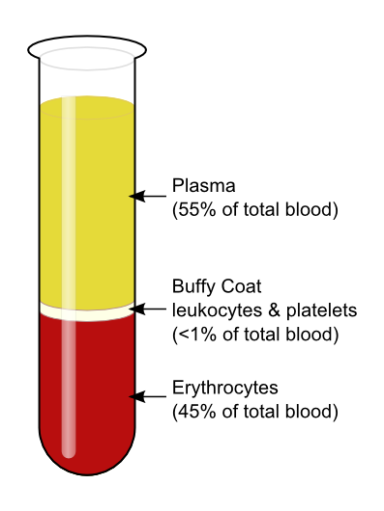
Basic principle: Based on varying density of solute and solvent; the process allows separation of materials based on their density when rotated very fast.
The heavier material gets settled at the bottom and the lighter one floats. The process is used in separating the components of blood into its constituents such as Plasma and Erythrocytes.
Applications:
Used in diagnostic labs for blood and urine test.
Used to separate cream and butter from milk
Used in drying out clothes in a dryer as it squeezes out the water due to acceleration of the circular motion.
Toned and Double-Toned varieties of milk contain different amounts of fat which is obtained by churning fat from the full cream milk.
A centrifuge is a machine that is used to spin the test tubes/material rapidly.
(3) Separating Funnel
Basic Principle: Immiscible liquids (which do not dissolve) can be separated out in layers depending on their densities.
The stop cock then be used to extract the fluid having greater density at the bottom.
Applications
Used for separating oil from water
Used in extraction of lighter slag during the process of extraction of molten iron from iron ore.
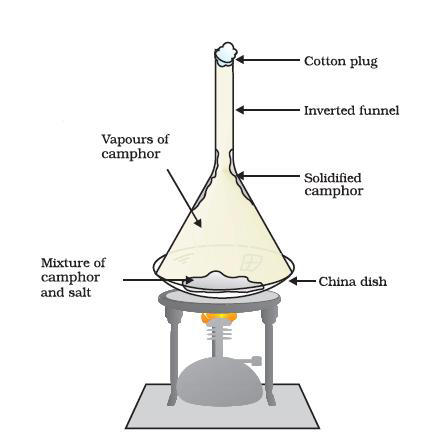
(4) Sublimation
Basic Principle: Separation is based on the property of sublimation. Of the components, the one which is volatile and sublime gets converted directly into gas and can then be solidified later.
Ammonium chloride, naphthalene, camphor and anthracene are some materials which are sublime.
(5) Chromatography
Basic principle: Coloured components of a mixture can be separated by using an absorbent on which they are absorbed at different rates.
The process of separation of components of a mixture is known as chromatography.
Origin of Word: Kroma in Greek means colour. This technique was first used for separation of colors, so this name was given. Chromatography is the technique used for separation of those solutes that dissolve in the same solvent.
As the water rises on the filter paper it takes along with it the dye particles. Usually, a dye is a mixture of two or more colors. The coloured component that is more soluble in water, rises faster and in this way the colors get separated.
Applications:
a) To separate colours of a dye.
b) To separate pigments from natural colours like chlorophyll.
c) To separate drugs from blood.
(6) Distillation
Basic Principle: Two miscible liquids having sufficient difference (atleast 25K) in their boiling points. The liquids should not decompose on heating.
In there are more than 2 liquids or liquids having a difference of boiling point less than 25K, the process of fractional distillation should be used.
A simple fractionating column is a tube packed with glass beads. The beads provide surface for the vapors to cool and condense repeatedly
When mixture of acetone and water is heated, acetone having lesser boiling point, boils and moves to delivery tube, within which it condenses back to liquid with the help of a condenser clamped to it.
Thus, acetone is separated out in a beaker and water is left in the distillation flask.
(7) Fractional Distillation of Gases
Air is a homogeneous mixture and can be separated into its components by fractional distillation.
The air is compressed by increasing the pressure and is then cooled by decreasing the temperature to get liquid air. This liquid air is allowed to warm-up slowly in a fractional distillation column, where gases get separated at different heights depending upon their boiling points.
Simple Fractional Distillation
(8) Crystallization
Crystallization is a process that separates a pure solid in the form of its crystals from a solution.
Basic principle: To remove impurities from a mixture by first dissolving in a suitable solvent and then crystallizing out one component.
Why is Crystallization better than Evaporation?
- Some solids decompose or some, like sugar, may get charred on heating to dryness.
- Some impurities may remain dissolved in the solution even after filtration. On evaporation these contaminate the solid.
Process
1. Impure Copper sulphate crystals are first dissolved in sulphuric acid and then heated to saturated solution.
2. Now, this solution is left overnight. So, only pure copper sulphate crystals are formed whereas impurities are left behind in the solution.
3. This solution can be thus filtered so as to get pure copper sulphate crystals on filter paper.
Applications
- Purification of salt from sea water.
- Separation of crystals [e.g., alum (phitkari, copper sulphate)] from their impure crystals.
Water purification in water treatment plantsDifference between Physical and Chemical Changes
Chemical Changes
Physical Changes
They are generally non-reversible
They are easily reversible
New Products are formed
No New Products are Formed
Reactants are used up
There is often just a change in the state
Heat/Light/Sound is produces or Gas is released
Such changes may or may not occur
Types of Pure Substances
1. Elements 2. Compounds
1. Elements: The term was first used by Robert Boyle.
Definition of element as per Antoine Laurent Lavoisier
“Element is a basic form of matter that cannot be broken down into simpler substances by chemical reactions."
- Majority of the elements are solid.
- The number of elements known at present are more than 100.Ninety-two elements are naturally occurring and the rest are manmade.
Elements can be classified into Metals, Non-Metals and Metalloids
Some elements have intermediate properties between those of metals and non-metals, they are called metalloids; examples are boron, silicon, germanium etc.
Metals
Non-Metals
Metals in their pure state have shiny surface. This property is called metallic lustre.
Non-Metals are generally non-lustrous. Except Iodine - Which is lustrous.
They are generally hard. The hardness varies from metal to metal. They are generally solids. (Except Mercury which is liquid at room temperature). Also, Akali metals are soft solids and can be cut down with a knife.
They are generally soft but carbon - a non metal can exist in various allotropes such as 'Diamond' which is the hardest known substance.
They generally have high melting points. Except 'Gallium' and 'Caesium' which have low melting points and can meant on your palm.
They generally have low melting points. Except Diamond
Some metal can be beaten in sheets, this property is called malleability. e.g. Gold and Silver.
They are non-malleable
They can be drawn into this wires. This property is called ductility. e.g Gold.
They are non-ductile.
Metals are good conductor of heat and electricity. Silver and copper are best conductors. Mercury and lead are poor conductors
Non-metals are generally bad conductors of heat and electricity. Except allotrope of carbon; 'Graphite' which is a good conductor of electricity.
They are sonorous, as they produce sound after striking them.
They are non sonorous.
2. Compounds: Compound is a substance composed of two or more elements, chemically combined with one another in a fixed proportion.
Mixtures
Compounds
Elements or compounds just mix and no new compound is formed.
Elements react to form new compounds. Together to form a mixture
A mixture has a variable composition
The composition of each new substance is always fixed.
A mixture shows the properties of the constituent substances.
The new substance has totally different properties
The constituents can be separated easily by physical methods
The constituents cannot be separated by physical methods.
Key takeaways
In chemistry, a pure substance consists of only one type of particle (elements or compounds) and has a fixed chemical composition.
Compounds have entirely different physical and chemical properties than the individual elements that form them.
Mixtures are physical combinations of two or more substances that retain their individual properties and can be separated by physical means.
Homogeneous mixtures (solutions) have a uniform composition, while heterogeneous mixtures have distinct, visible phases.
Mixtures are classified by particle size into solutions (smallest particles), colloids (medium particles that scatter light), and suspensions (large particles that settle).
Test yourself
What is the primary difference between an element and a compound?
An element is the simplest form of matter made of one type of atom, while a compound is made of two or more elements chemically bonded in a fixed ratio.
Why is an alloy like brass considered a homogeneous mixture rather than a compound?
Because the metals in brass are physically mixed, not chemically bonded, and they retain their individual properties while having a uniform composition.
What is the Tyndall effect and what type of mixture does it help identify?
The Tyndall effect is the scattering of a light beam by suspended particles, and it is used to identify colloids.
Play with the idea
Is matter around us pure? Test the mixture claim, choose the separation, name the change
These scenarios explore the classification of mixtures (solutions, suspensions, colloids), separation techniques, and the physical vs. chemical change distinction. Each question uses fictional but structurally accurate experimental evidence. The test is whether you can match the evidence to the correct particle-level explanation.
Situation 1
Explore the reasoning for every approach
Correct — Tyndall effect is the defining test for colloids; solutions and suspensions do not show it.
Partially correct. Tyndall effect is characteristic of colloids, but suspensions can also scatter light (though usually less clearly). The stronger evidence for Sample 2 being a colloid is the combination: Tyndall effect + does not settle quickly + passes filter paper. Sample 1 (no Tyndall, no settling) is a solution. Sample 3 (settles quickly, opaque) is a suspension.
Incomplete — Tyndall effect alone cannot distinguish colloids from suspensions; settling time and filtration are needed.
Yes. A suspension with fine particles can show a weak Tyndall beam. The complete classification uses: (1) Tyndall effect — colloids and fine suspensions yes, solutions no; (2) Settling — suspensions settle rapidly, colloids slowly/do not settle, solutions never settle; (3) Filtration — suspensions retained, colloids and solutions pass; (4) Particle size — colloids 1–1000 nm, suspensions >1000 nm, solutions <1 nm. Sample 2 fits colloid on all four criteria.
Wrong — only solutions show Tyndall effect because their particles are smallest.
Incorrect. Solutions have particles < 1 nm (ions, small molecules), far smaller than light wavelength (~400–700 nm). They cannot scatter light. Colloids (1–1000 nm) are comparable to light wavelength and scatter strongly. Suspensions (>1000 nm) can also scatter but often appear opaque rather than showing a clear beam.
Situation 2
Explore the reasoning for every approach
Filtration → Evaporation: filter out sand, then evaporate water to get salt.
This gives pure salt but loses the water. The question asks for pure salt AND pure water. Evaporation destroys the water (it escapes as vapour). To recover both, you need distillation after filtration.
Filtration → Distillation: filter out sand, then distil the salt water to collect pure water (distillate) and leave pure salt (residue).
Yes. Filtration removes the insoluble sand (suspension separation). The filtrate is a salt solution. Distillation exploits the boiling point difference: water boils at 100 °C, salt does not boil. Water vapour condenses as pure distillate; salt remains as residue. Both products are recovered.
Distillation first → Filtration: distil the whole mixture, then filter the residue.
Distilling a mixture with sand risks bumping (violent boiling) and contaminates the apparatus. Sand can also scratch the distillation flask. Always remove insoluble solids by filtration/centrifugation before distillation. The correct order is filtration first.
Situation 3
Explore the reasoning for every approach
Correct — colour change indicates chemical change; the blue and white forms are different substances.
Incorrect. The colour change is due to loss of water of crystallisation (CuSO₄·5H₂O → CuSO₄ + 5H₂O). The white powder is anhydrous copper sulphate; adding water reforms the hydrate. No new chemical species forms — the copper, sulphur, oxygen atoms remain in the same arrangement. This is a physical change (dehydration/hydration).
Incorrect — the change is reversible (water restores blue colour), no new substance forms, so it is physical.
Yes. Key evidence: (1) Reversible by adding water; (2) Water droplets collected are pure H₂O (condensed vapour); (3) The white powder is anhydrous CuSO₄, same chemical formula minus water. Heating drove off water of crystallisation — a physical process. Contrast with heating copper carbonate (green) → copper oxide (black) + CO₂ — irreversible, new substances: chemical change.
Cannot determine — need to test the products' chemical composition.
The evidence given is sufficient. The reversibility by simple water addition, the collection of pure water, and the known chemistry of hydrates all confirm this is dehydration, a physical change. No composition analysis needed for this well-understood system.
Investigate before you memorise
Is matter around us pure? Mixtures, solutions, and how to separate them
Explore the particle-level difference between pure substances and mixtures. Make a prediction before opening each section.
Open the mixture classification lab
Solution, suspension, colloid — what the particle size decides
A mixture's behaviour (settling, filtration, Tyndall effect) follows directly from the size of its dispersed particles.
Type
Particle Size
Appearance
Stability
Filtration
Tyndall Effect
Examples
Solution (homogeneous)
< 1 nm
Transparent
Stable, no settling
Passes through filter paper
No
Salt water, sugar water, air, alloys
Suspension (heterogeneous)
> 1000 nm
Opaque, visible particles
Unstable, settles on standing
Retained by filter paper
Yes (may scatter)
Sand in water, chalk in water, muddy water
Colloid (heterogeneous)
1–1000 nm
Translucent/opalescent
Stable, does not settle quickly
Passes filter, retained by ultrafilter
Yes (strong)
Milk, fog, smoke, jelly, blood, ink
Why does milk show Tyndall effect but salt water does not?
Milk is a colloid (fat/protein globules ~100–1000 nm). These particles are large enough to scatter visible light (Tyndall effect). Salt water is a true solution: Na⁺ and Cl⁻ ions are < 1 nm, far smaller than the wavelength of light (~400–700 nm), so they do not scatter light. The beam is invisible in salt water but visible in milk.
Open the separation methods toolkit
Nine separation techniques — match the method to the mixture
Each technique exploits a specific physical property difference. Choose the property that differs most between the components.
Denser particles forced to bottom by centrifugal force
Fine suspended particles, colloidal particles
Cream from milk, blood cells from plasma
Chromatography
Different solubility/adsorption; components move at different rates
Coloured components of a mixture (dyes, pigments)
Ink dyes, chlorophyll pigments, amino acids
Sublimation
One component sublimes (solid → gas), other does not
Sublimable solid from non-sublimable solid
Ammonium chloride from salt, iodine from sand
Crystallisation
Saturated solution cooled; pure solid crystallises
Pure solid from impure sample
Copper sulphate crystals, alum crystals
When would you use fractional distillation instead of simple distillation?
When the boiling point difference is less than ~25 °C. Simple distillation gives poor separation for close-boiling liquids because both vapours rise together. A fractionating column provides repeated vaporisation-condensation cycles (theoretical plates), enriching the vapour in the lower-boiling component at each stage. Petroleum refining and air separation (O₂ bp −183 °C, N₂ bp −196 °C) require fractional distillation.
Open the physical vs. chemical change test
Physical or chemical? The evidence checklist
Look for new substance formation. Reversibility, energy change, and composition change are clues, but the definitive test is: are the product particles chemically different from the reactant particles?
Is dissolving salt in water a physical or chemical change?
Physical. NaCl(s) → Na⁺(aq) + Cl⁻(aq). The ions are still sodium and chloride; no new chemical species forms. It is reversible by evaporation. Contrast with dissolving sodium metal in water: 2Na + 2H₂O → 2NaOH + H₂↑ — new substances (NaOH, H₂) form; this is chemical.
Open the concentration calculator
Four ways to express concentration — pick the right one
Concentration units must match the measurement context. Mass % for solids, volume % for liquids, ppm for trace pollutants.
Term
Formula
Typical Use
Mass by mass %
(Mass of solute / Mass of solution) × 100
Solid in solid, or when masses are convenient
Mass by volume %
(Mass of solute / Volume of solution) × 100
Solid in liquid, medical/pharma (e.g., 0.9% saline)
Volume by volume %
(Volume of solute / Volume of solution) × 100
Liquid in liquid (e.g., 40% v/v alcohol)
Parts per million (ppm)
(Mass of solute / Mass of solution) × 10⁶
Very dilute solutions, pollutants in water/air
A solution contains 20 g salt in 180 g water. What is the mass by mass %?
Mass of solution = 20 g + 180 g = 200 g. Mass % = (20 / 200) × 100 = 10%. Common error: using mass of solvent (180 g) instead of mass of solution (200 g). Always check: denominator is total solution, not solvent.
Open the mixture identification game
Identify the mixture type and choose the separation
Sample A: Transparent, no Tyndall beam, does not settle, passes filter paper. Prediction: Solution. Separation: Evaporation or distillation.
Sample B: Opaque, particles visible, settles in 5 minutes, retained by filter. Prediction: Suspension. Separation: Filtration or centrifugation.
Sample C: Translucent, shows Tyndall beam, does not settle for days, passes filter. Prediction: Colloid. Separation: Centrifugation or ultrafiltration.
Sample D: Two clear layers, top layer less dense. Prediction: Immiscible liquids. Separation: Separating funnel.
Sample E: Clear liquid, two components with boiling points 78 °C and 100 °C. Prediction: Miscible liquids. Separation: Fractional distillation.
Sample F: Green ink spot on filter paper separates into blue and yellow bands with water. Prediction: Mixture of dyes. Separation: Chromatography.
Why can't you separate colloids by ordinary filtration?
Colloid particles (1–1000 nm) are smaller than the pores of ordinary filter paper (~1000–10000 nm). They pass through. Ultrafiltration membranes with nm-scale pores can retain colloids. Centrifugation at high speed forces colloids to sediment (used to separate cream from milk, plasma from blood cells).
Test your understanding of pure substances and mixtures with this interactive exercise.
1Sodium is a highly reactive metal, and chlorine is a toxic green gas. Yet when chemically bonded, they form sodium chloride—ordinary table salt. What does this demonstrate about compounds?
The text shows compounds can form from metals (sodium, a metal) and non-metals (chlorine), so this is incorrect.
The text explicitly states: 'a fascinating characteristic of compounds is that their properties are entirely different from the elements that form them.' Sodium chloride has entirely different properties than sodium or chlorine.
The text states the opposite: 'Pure substances cannot be separated into other kinds of matter by any physical process.'
2A liquid is left undisturbed for several hours. No particles settle to the bottom, and when a beam of light passes through, the light path becomes visible. What type of mixture is this?
In a solution, particles are less than 1 nanometer—too small to scatter light. The text says light scattering 'does not happen in a true solution because the particles are too small.'
In suspensions, large particles do settle at the bottom over time. The text states 'gravity will cause these large particles to settle out.' Here, nothing settles.
The text describes colloids as having particles 'small enough that they remain suspended indefinitely and do not settle.' The visible light beam demonstrates the Tyndall effect, which the text says occurs when 'the suspended particles are large enough to scatter the light.'
Great work! You've demonstrated understanding of how compounds differ from their elements, and how to identify colloids using the Tyndall effect.