
Structure of the Atom | CBSE Class 9 Science Notes
On this page
Watch & explore
Start with a few high-quality watches, then dive into the notes below.
Try an idea before you read. Test your understanding of atomic structure with this interactive quiz. Explore →

Learnacy Labs Try it hands-on: open the The Atom lab
These notes cover early atomic ideas, electrons, protons and neutrons, Thomson’s, Rutherford’s and Bohr’s models, element symbols, atomic number, mass number, electronic configuration, valency, isotopes, average atomic mass and isobars.
How did the idea of the atom develop?
Atoms are the tiny building blocks of matter. Living beings and non-living objects are ultimately composed of atoms. They are too small to be seen with the naked eye. Understanding their internal structure required scientists to move beyond the idea that atoms were indivisible.
Early ideas about indivisible particles
More than 2,000 years ago, Acharya Kanada in India considered what would happen if matter, or dravya, were divided repeatedly. He proposed that this process would eventually reach particles that could no longer be divided, which he called parmanus.
His ideas are recorded in the Sanskrit text Vaisesika Sutras. A parmanu was described as infinitely small and beyond perception by the senses. Combinations formed dyads, groups of two parmanus, and triads, groups of three, from which material things were formed.
This description did not specify the proportions in which parmanus combined to form different substances. In Greece, Leucippus and Democritus proposed a similar idea and used the word atomos, meaning indivisible. These early ideas were imaginative explanations rather than results of experimental observations.
How did Dalton change the approach?
In 1808, John Dalton proposed an atomic theory based on the scientific experiments of his time. He regarded atoms as indivisible particles that formed all matter. His theory provided the first scientific description of how matter is made and a starting point for understanding atomic structure.
Later experiments revealed smaller particles inside atoms. A subatomic particle is a component smaller than the atom itself. Discovering such components challenged indivisibility and raised new questions about their arrangement, their charges and the differences between atoms of different elements.
Atomic models changed as new evidence appeared. An early model can therefore be an important scientific step even when later experiments show that it is not fully correct.
How did electrons lead to Thomson’s atomic model?
Radioactivity is the emission of invisible energy and particles, called radiation, by certain elements. Its discovery helped show that atoms had smaller components. The discovery of the electron provided further evidence that an atom was not indivisible.
The cathode ray experiment
In 1897, J. J. Thomson studied electric current through gases at very low pressure. He used a glass tube with two electrodes and applied a high voltage. The cathode was the negative electrode; the anode was the positive electrode.
Rays travelled from the cathode towards the anode. Studying these cathode rays in electric and magnetic fields showed that they were streams of negatively charged particles with masses much smaller than those of atoms. These particles became known as electrons.
The nature of cathode rays did not depend on the cathode material or the gas in the tube. This supported the conclusion that electrons are components of all atoms. An electron’s charge is −1.602 × 10⁻¹⁹ coulomb, where C is the symbol for the charge unit coulomb; its relative charge is taken as −1.
The plum pudding model
Thomson proposed a sphere of positive charge with electrons distributed throughout it. This plum pudding model balanced the positive and negative charges to explain why an atom is electrically neutral, meaning that its total positive and negative charges balance.
A watermelon offers a comparison: its red pulp represents the positive matter and its seeds represent electrons. The comparison describes the distribution of charge in the model; it does not mean that an atom actually resembles coloured fruit.
What the figure shows
Thomson’s model
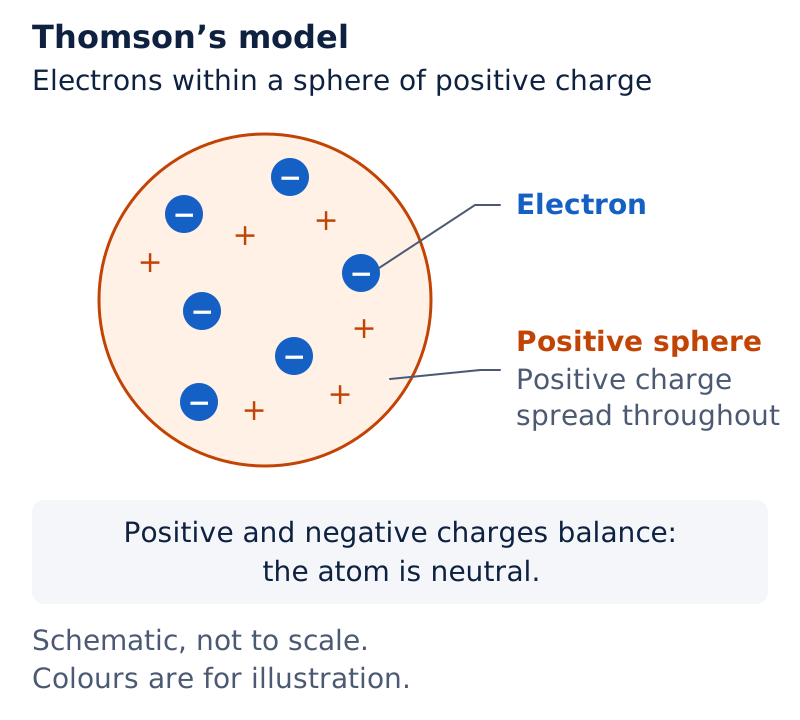
A coloured circular representation of a positive sphere contains several small electron symbols distributed through it. Labels identify an electron and the positive sphere.
Drawn by One Young India. See Fig. 8.2 in your NCERT textbook
Note: Atoms do not show any colour. Colours in atomic diagrams are used for illustration.
Thomson received the 1906 Nobel Prize in Physics for studies of the electrical conductivity of gases. His model was later replaced because it could not explain the results of the gold foil experiment.
What did Rutherford’s gold foil experiment reveal?
In 1911, Geiger and Marsden, working under Ernest Rutherford, tested Thomson’s model. They directed a narrow beam of alpha particles at an extremely thin sheet of gold foil. Alpha particles, represented by α, are tiny positively charged particles emitted by certain radioactive elements.
An alpha particle is a helium nucleus containing two positively charged protons and two electrically neutral neutrons. A nucleus is the extremely small central region of an atom. The gold foil experiment provided evidence for this concentrated centre.
Observations and conclusions
Thomson’s evenly spread positive charge suggested that alpha particles would pass straight through or be deflected only slightly. Instead, most passed through undeflected, some were sharply deflected, and a few bounced back. Deviation from a straight path is called scattering.
| Observation | Conclusion |
|---|---|
| Most alpha particles passed through undeflected. | Most of an atom is empty space. |
| Some alpha particles were sharply deflected and a few bounced back. | Positive charge and most of the mass are concentrated in an extremely small, dense nucleus. |
What the figure shows
Gold foil scattering
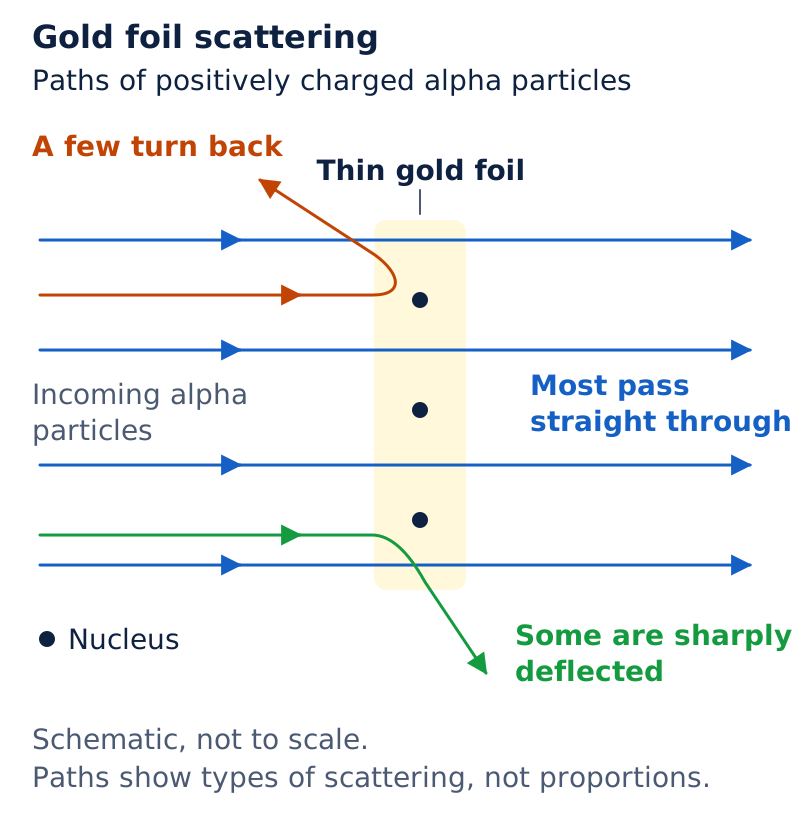
Parallel incoming arrows represent the beam of alpha particles. They approach a layer labelled thin gold foil, drawn as circles with central dots. Many paths continue straight; others turn sharply or return towards the incoming side.
Drawn by One Young India. See Fig. 8.4 in your NCERT textbook
In Rutherford’s planetary model, electrons revolve around the nucleus, somewhat like planets orbiting the Sun. The nucleus contains all the positive charge and most of the mass. These findings replaced Thomson’s picture of positive charge spread throughout the atom.
How small is the nucleus?
The estimated atomic diameter is about 10⁻¹⁰ metre, while the nuclear diameter is about 10⁻¹⁵ metre. The symbol m means metre. The nucleus is therefore about 10⁵, or one lakh, times smaller in diameter than the atom.
Worked example 1. A sheet of paper is 0.1 millimetre thick, equivalent to 10⁻⁴ m. The symbol mm means millimetre. Estimate the number of atoms stacked across its thickness if one atom has a diameter of about 10⁻¹⁰ m. The symbol ≈ means approximately equal to.
Answer: Number of atoms ≈ thickness ÷ atomic diameter = 10⁻⁴ m ÷ 10⁻¹⁰ m = 10⁶. About one million atoms would need to be stacked together.
Rutherford received the 1908 Nobel Prize in Chemistry for explaining how some elements naturally break down. He proposed his nuclear model in 1911, but this model still could not explain why atoms remain stable.
How did Bohr explain the stability of atoms?
Why was Rutherford’s model incomplete?
An electron moving in a circular path continually changes direction and is therefore accelerating. Under the reasoning applied to Rutherford’s model, an accelerating charged electron should lose energy, spiral inward and eventually fall into the positively charged nucleus.
If this happened, the atom would collapse. Matter remains intact because atoms are stable, so the model needed a new explanation. Niels Bohr addressed this difficulty by proposing a new atomic model in 1913.
Stationary states and energy levels
In Bohr’s model, electrons follow allowed circular paths called stationary states, orbits or shells. Each shell corresponds to a definite electron energy, so shells are also called energy levels. An electron does not lose energy while moving in an allowed shell.
The shell labels are K, L, M and N, corresponding to shell numbers 1, 2, 3 and 4. Here n denotes the shell number. Thus, n = 1 identifies the K-shell, which is closest to the nucleus and has the least energy.
- Electrons occupy allowed shells rather than arbitrary positions between them in this model.
- The energy of an electron remains constant while it moves within a stationary state.
- Shell energy increases with distance from the nucleus; the L-shell has more energy than the K-shell.
- An electron changes shells by absorbing or releasing a fixed amount of energy equal to the difference between the two levels.
What the figure shows
Energy levels
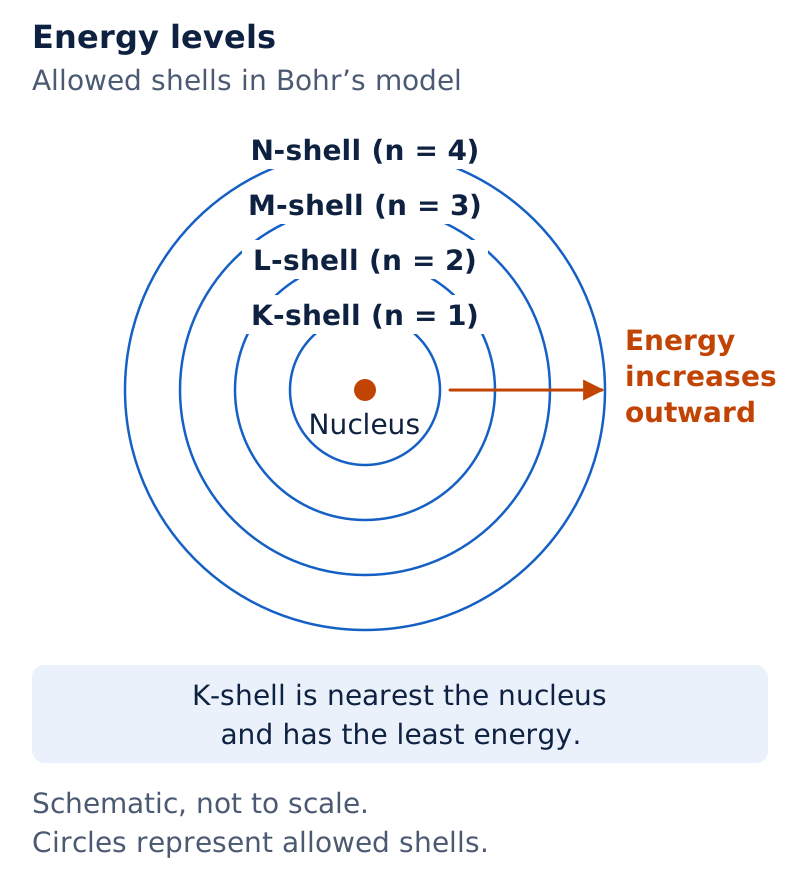
A central dot labelled nucleus is surrounded by four concentric circles. From the inside outward, the circles are labelled K-shell (n = 1), L-shell (n = 2), M-shell (n = 3) and N-shell (n = 4).
Drawn by One Young India. See Fig. 8.7 in your NCERT textbook
Bohr introduced stationary states as a postulate, an assumption used to build the model. This allowed the model to explain atomic stability and many experimental observations. He received the Nobel Prize in 1922 for his work on atomic structure.
The shell letters came from Charles Barkla’s early X-ray studies. He named the first observed series K to leave room for possible earlier series, although none were found. Bohr adopted this notation. His model was a major advance, but later work also revealed its limitations.
How do electrons, protons and neutrons differ?
An atom contains three kinds of subatomic particles: electrons, protons and neutrons. Their relative charges compare their charges using the magnitude of an electron’s charge as one unit. Protons and electrons have charges equal in magnitude but opposite in sign.
| Particle and symbol | Relative charge | Position and mass comparison |
|---|---|---|
| Electron, e⁻ | −1 | Outside the nucleus; its mass is almost negligible compared with nuclear particles. |
| Proton, p⁺ | +1 | Inside the nucleus; much heavier than an electron. |
| Neutron, n⁰ | 0 | Inside the nucleus; its mass is nearly equal to a proton’s mass. |
Why was a neutron needed?
Hydrogen has one proton, while helium has two. Yet a helium atom has about four times the mass of a hydrogen atom, rather than twice its mass. Protons alone could not account for the extra mass without also adding extra positive charge.
In 1932, James Chadwick discovered the neutron, a particle with no electrical charge and a mass nearly equal to that of a proton. He received the 1935 Nobel Prize in Physics. Neutrons account for mass in the nucleus without increasing its positive charge.
Forms of one element with the same proton count but different neutron counts are called isotopes. The hydrogen isotope protium has no neutron. Other hydrogen isotopes contain neutrons. Most atomic mass comes from the protons and neutrons packed into the nucleus; the electron’s mass can be ignored in these calculations.
How does an atom remain neutral?
In a neutral atom, number of protons = number of electrons. A helium atom has two of each, and a sodium atom has eleven of each. The positive and negative charges balance even though the particles have very different masses.
Lighter atoms often have equal numbers of protons and neutrons, as in the carbon example with six of each and oxygen with eight of each. Heavier examples include iron with 26 protons and 30 neutrons, and uranium with 92 protons and 146 neutrons.
How are elements represented by chemical symbols?
A chemical symbol is the short, internationally recognised representation of an element. Common symbols make it possible for scientists to communicate clearly without repeatedly writing the full name of every element or relying on the same spoken language.
From pictures to letters
Dalton introduced pictorial symbols for known elements in 1803. In 1813, Berzelius suggested deriving element symbols from Latin names. Alphabetic symbols replaced the need for a separate pictorial design for each element.
The International Union of Pure and Applied Chemistry, abbreviated IUPAC, approves element names and symbols. By 1869, about 69 elements were known, most found naturally on Earth. About 118 unique elements are now known; some are artificially made.
Which writing rules matter?
- Many symbols use the first letter or first two letters of an element’s name.
- The first letter is always uppercase, and a second letter, when present, is lowercase.
- Some symbols use the first letter and another letter that is not the second letter of the name.
- Some symbols derive from Latin, Greek or German names rather than English names.
| Element | Symbol | Point illustrated |
|---|---|---|
| Hydrogen | H | A single capital letter. |
| Aluminium | Al | A capital followed by a lowercase letter, not AL. |
| Cobalt | Co | The second letter is lowercase, not CO. |
| Chlorine | Cl | The second symbol letter is not the second letter of the name. |
| Zinc | Zn | The symbol uses the first letter and another letter. |
| Iron | Fe | Derived from the Latin name ferrum. |
| Mercury | Hg | Derived from the Greek name hydrargyros. |
| Tungsten | W | Derived from the German name wolfram. |
Other examples include sodium, Na, from natrium; potassium, K, from kalium; copper, Cu, from cuprum; and gold, Au, from aurum. Letter case is part of the agreed notation, so copying a symbol correctly is essential when representing an element.
How do atomic number and mass number describe an atom?
Definition: Atomic number, represented by Z, is the number of protons in an atom’s nucleus. Mass number, represented by A, is the total number of protons and neutrons in that nucleus.
Atomic number identifies the element. Hydrogen has atomic number 1, while helium has atomic number 2. Since a neutral atom has equal numbers of protons and electrons, its atomic number also tells us its electron count.
Protons and neutrons are collectively called nucleons. Mass number counts these nuclear particles. It is not a count of electrons, and it is not the same quantity as an element’s average atomic mass.
Relations used in calculations
Z = number of protons. For a neutral atom, number of electrons = Z. Since A = number of protons + number of neutrons, the neutron count follows from number of neutrons = A − Z.
| Atom in the example | Protons | Neutrons | Mass number |
|---|---|---|---|
| Hydrogen | 1 | 0 | 1 |
| Helium | 2 | 2 | 4 |
| Lithium | 3 | 4 | 7 |
In atom notation, the mass number is placed to the upper left of the element symbol and the atomic number to the lower left. Thus, ¹²₆C means carbon, symbol C, with mass number 12 and atomic number 6. Here C denotes carbon, rather than the charge unit coulomb.
Worked particle counts
Worked example 2. A neutral atom has atomic number 26 and 56 nucleons. Find its protons, electrons and neutrons.
Answer: Z = 26 and A = 56. It has 26 protons and 26 electrons. Number of neutrons = 56 − 26 = 30. Its proton and neutron counts together recover the given 56 nucleons.
Worked example 3. A neutral atom has 18 neutrons and atomic number 17. Find its mass number.
Answer: The atomic number gives 17 protons. Mass number = 17 + 18 = 35. Electron count does not enter this addition because mass number counts nucleons.
Worked example 4. A neutral atom has mass number 23 and 11 electrons. Find its neutron count.
Answer: Neutrality gives 11 protons. Number of neutrons = 23 − 11 = 12. The proton count is obtained from neutrality before using the mass number.
These calculations distinguish three separate ideas: the proton count identifies the element, the neutron count contributes to its mass number, and equality of proton and electron counts makes the atom neutral.
How are electrons distributed among shells?
Electronic configuration means the distribution of an atom’s electrons among its shells. Bohr and Bury suggested rules for this distribution. The arrangement starts with the shell nearest the nucleus and proceeds outward through K, L, M and N.
Shell capacity and the outermost-shell rule
The maximum capacity of a shell is given by maximum electrons in a shell = 2n², where n is the shell number. Squaring means multiplying the number by itself. For the K-shell, 2 × 1² = 2; for L, 2 × 2² = 8; for M, 2 × 3² = 18.
The outermost shell can accommodate at most eight electrons, except that the first shell can accommodate at most two. Shells fill stepwise from the inside outward. The L-shell begins filling after the K-shell is complete.
Note: The capacity of the M-shell is 18, but the outermost-shell rule still matters. In the first eighteen elements, argon has the arrangement 2, 8, 8. Do not put all eighteen electrons into a single shell.
The first eighteen elements
In the following configurations, successive numbers give the electron counts in occupied K, L and M shells. Thus, 2, 8, 1 means two electrons in K, eight in L and one in M. The counts must add up to the neutral atom’s atomic number.
| Element | Symbol | Atomic number | Electronic configuration |
|---|---|---|---|
| Hydrogen | H | 1 | 1 |
| Helium | He | 2 | 2 |
| Lithium | Li | 3 | 2, 1 |
| Beryllium | Be | 4 | 2, 2 |
| Boron | B | 5 | 2, 3 |
| Carbon | C | 6 | 2, 4 |
| Nitrogen | N | 7 | 2, 5 |
| Oxygen | O | 8 | 2, 6 |
| Fluorine | F | 9 | 2, 7 |
| Neon | Ne | 10 | 2, 8 |
| Sodium | Na | 11 | 2, 8, 1 |
| Magnesium | Mg | 12 | 2, 8, 2 |
| Aluminium | Al | 13 | 2, 8, 3 |
| Silicon | Si | 14 | 2, 8, 4 |
| Phosphorus | P | 15 | 2, 8, 5 |
| Sulphur | S | 16 | 2, 8, 6 |
| Chlorine | Cl | 17 | 2, 8, 7 |
| Argon | Ar | 18 | 2, 8, 8 |
What the figure shows
Electron arrangements
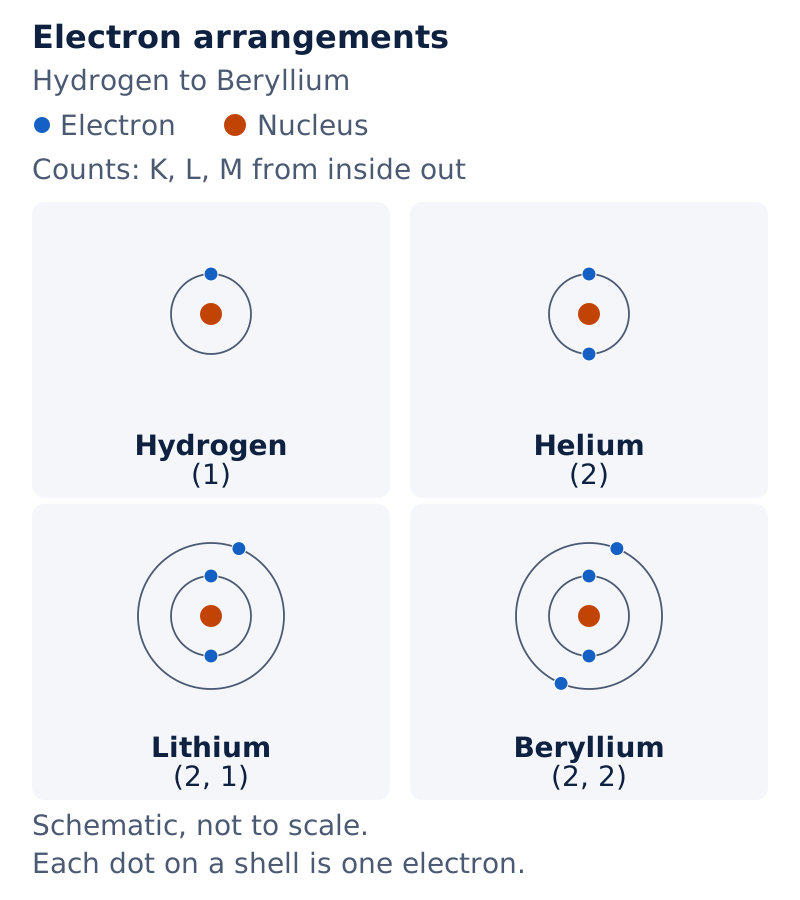
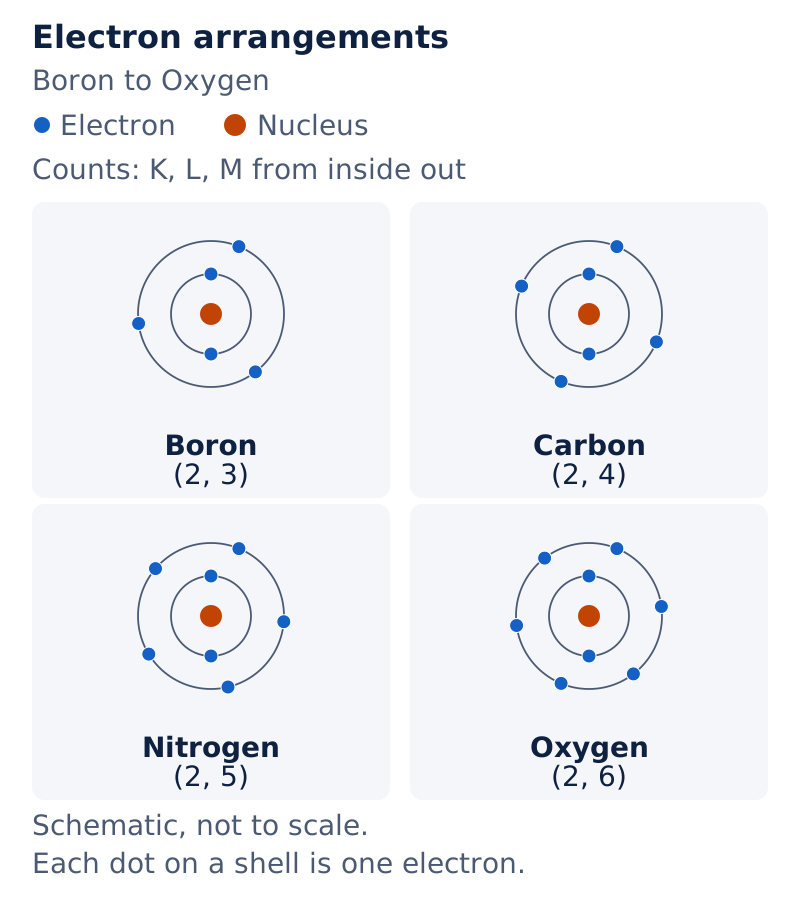
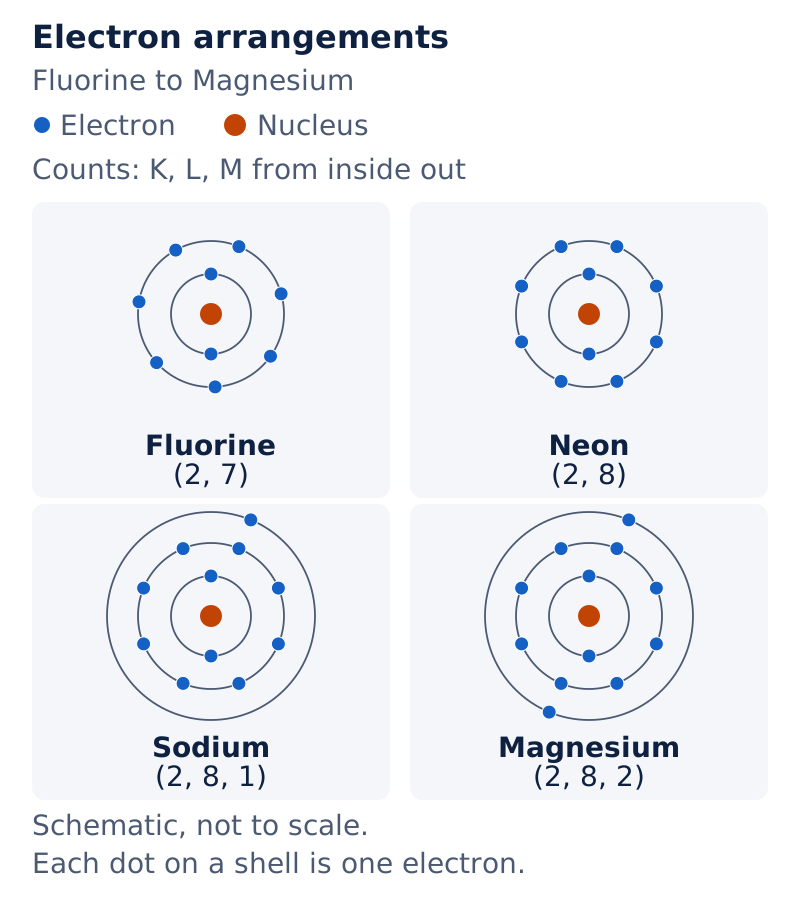
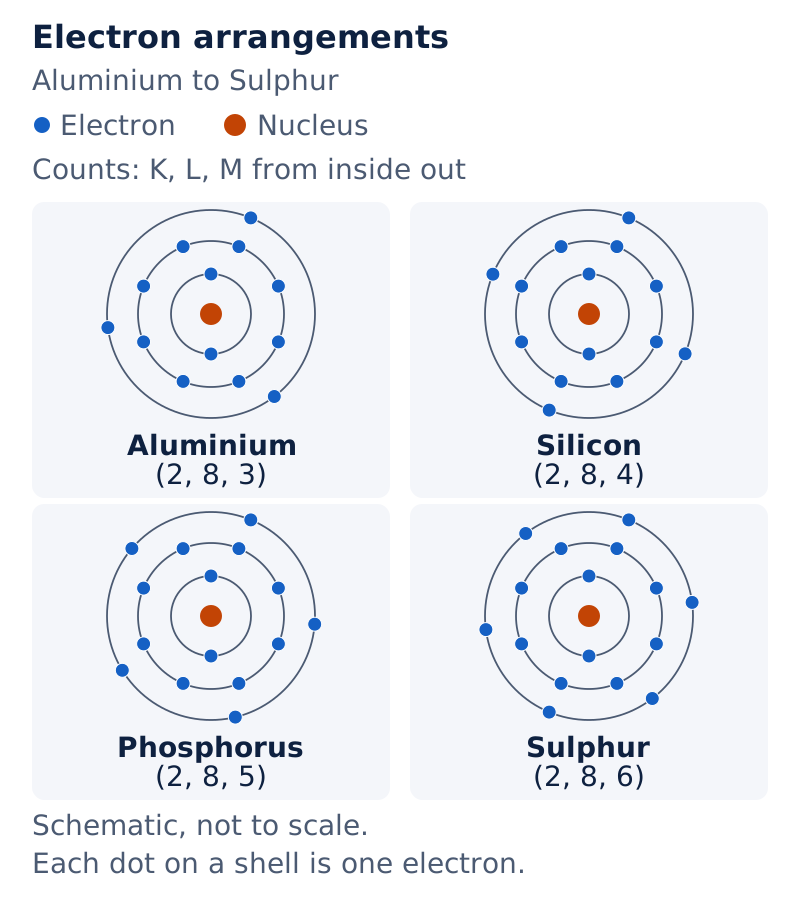
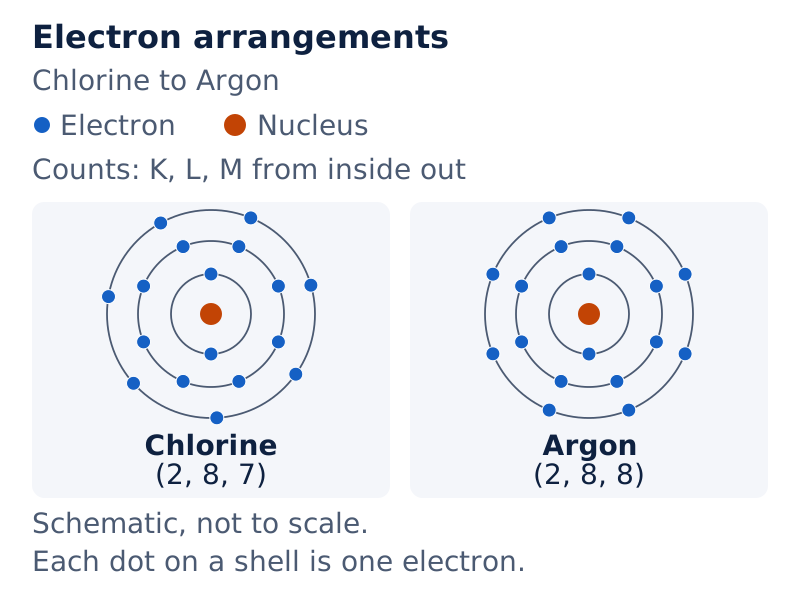
Eighteen labelled shell diagrams show hydrogen and helium with one shell, lithium through neon with two shells, and sodium through argon with three. Electron dots occupy circular shells around central dots.
Drawn by One Young India. See Fig. 8.11 in your NCERT textbook
Worked example 5. A neutral magnesium atom has atomic number 12 and mass number 24. Find its particle counts and electron arrangement.
Answer: Protons = 12; electrons = 12; neutrons = 24 − 12 = 12. Put two electrons in K, eight in L and the remaining two in M. The configuration is 2, 8, 2, whose entries total 12.
How does electronic configuration determine valency?
Combining capacity describes how many hydrogen or chlorine atoms combine with one atom of another element to form a compound. Hydrogen and chlorine each have combining capacity one. This gives a way to compare the combining capacities of other elements.
In water, H₂O, one oxygen atom combines with two hydrogen atoms, so oxygen has combining capacity two. The small lower number records the number of atoms of the preceding element. Ammonia, NH₃, contains one nitrogen and three hydrogen atoms; magnesium chloride, MgCl₂, contains one magnesium and two chlorine atoms.
Valence shell, valence electrons and octet
The valence shell is the outermost shell containing electrons. Its electrons are called valence electrons. Eight electrons in this shell form an octet. Atoms with a complete octet, or two electrons in helium’s shell, are largely unreactive, meaning they have little tendency to react chemically, and are more stable.
Atoms with incomplete valence shells are usually more reactive. They lose, gain or share electrons to complete an octet. Valency is the number of electrons gained, lost or shared to obtain this stable configuration.
Generally, an element with fewer than four valence electrons tends to lose electrons, while one with more than four tends to gain them. These are tendencies, not rules that every compound follows. Some compounds appear to violate the usual valency rule.
Applying the idea to three examples
| Element | Configuration | Route to an octet | Valency |
|---|---|---|---|
| Sodium | 2, 8, 1 | Can lose one electron, leaving a complete outer shell. | 1 |
| Oxygen | 2, 6 | Can gain two electrons to complete its octet. | 2 |
| Carbon | 2, 4 | Can share four electrons; it cannot easily gain or lose four. | 4 |
The number of valence electrons is therefore not automatically the valency. Oxygen has six valence electrons but valency two. Sodium has one valence electron and valency one. Identify the electron arrangement first, then consider how the outer shell can become complete.
What are isotopes, and why are they useful?
Isotopes are atoms of the same element with the same atomic number but different mass numbers. They have equal proton counts but different neutron counts. Their existence showed that Dalton’s idea of identical masses for all atoms of an element needed revision.
Hydrogen and carbon isotopes
| Hydrogen isotope | Notation | Protons | Neutrons | Natural occurrence |
|---|---|---|---|---|
| Protium | ¹₁H | 1 | 0 | About 99.98%. |
| Deuterium | ²₁H | 1 | 1 | About 0.015%. |
| Tritium | ³₁H | 1 | 2 | Present in traces. |
Each neutral hydrogen isotope has one electron. The proton count fixes the element as hydrogen, while changes in neutron count produce mass numbers 1, 2 and 3. A different mass number does not, by itself, mean a different element.
Carbon has isotopes ¹²₆C, ¹³₆C and ¹⁴₆C. Each has six protons and six electrons, but their neutron counts are six, seven and eight respectively. Carbon-12 is the most abundant carbon isotope in nature.
What the figure shows
Hydrogen isotopes
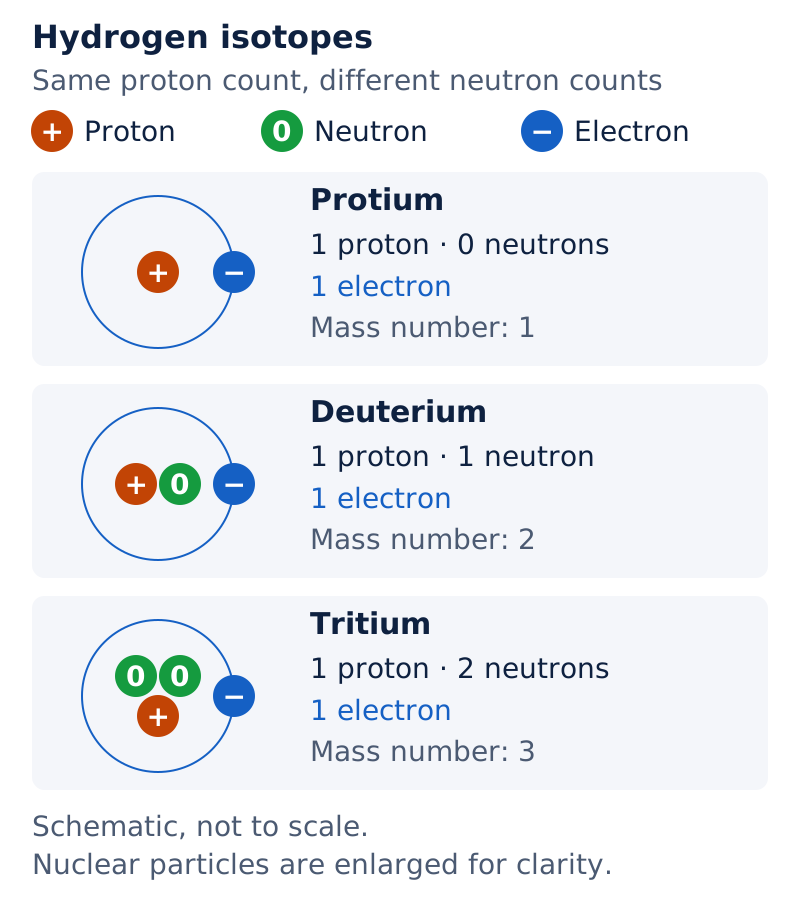
Three circular shell drawings labelled protium, deuterium and tritium each show one electron. Their central clusters contain one, two and three coloured nuclear particles respectively.
Drawn by One Young India. See Fig. 8.12 in your NCERT textbook
Isotopes have similar chemical properties because they have the same electronic configuration, and chemical properties depend mainly on valence electrons. They differ in physical properties, such as melting and boiling points. Nuclear composition and electron arrangement answer different questions about an atom.
Applications and Indian contributions
| Isotope | Application |
|---|---|
| Uranium-235, ²³⁵₉₂U; U means uranium. | Fuel in nuclear reactors that generate electricity in nuclear power plants. |
| Cobalt-60, ⁶⁰₂₇Co. | Radiation treatment for cancer. |
| Iodine-131, ¹³¹₅₃I; I means iodine. | Treatment of goitre, an enlargement of the thyroid gland, and thyroid cancer. |
| Carbon-14, ¹⁴₆C. | Determining the ages of ancient fossils and artefacts in archaeology and geology. |
Homi Jehangir Bhabha, known as the father of the Indian nuclear programme, contributed to atomic energy development in India. His institution-building supported peaceful uses of atomic energy, including electricity generation, agriculture and advanced medical treatments.
The Bhabha Atomic Research Centre, abbreviated BARC, in Mumbai conducts advanced neutron-scattering experiments using reactors such as Dhruva. These studies provide insights into materials, supporting work on medicines, energy storage and industrial alloys, which are mixtures containing metals.
How is average atomic mass calculated?
The unified atomic mass unit, written u, is a unit used to express the extremely small masses of atoms. Earlier, the abbreviation amu was used for atomic mass unit. Atomic masses are not conveniently expressed using everyday-sized masses in grams or kilograms.
Relative abundance describes the proportion of each isotope present in a natural sample. An element’s average atomic mass must account for both isotope masses and their abundances. An isotope that is more common contributes more strongly to this average.
Why does chlorine need a weighted average?
Natural chlorine has isotopes with masses 35 u and 37 u in a ratio of 3:1. Chlorine-35 contributes about 75% and chlorine-37 about 25%. A simple arithmetic mean gives equal weight to the two masses and would produce (35 + 37) ÷ 2 = 36 u.
That calculation ignores their unequal abundances. A weighted average multiplies each mass by the fraction of atoms having that mass, then adds the contributions. A percentage is converted to a fraction by dividing by 100.
Worked example 6. Calculate the weighted average atomic mass of chlorine using isotope masses 35 u and 37 u, with abundances 75% and 25% respectively.
Answer: Average atomic mass is .
This does not mean that an individual chlorine atom has a fractional mass of 35.5 u. In the example of one million chlorine atoms, 7.5 lakh are chlorine-35 and 2.5 lakh are chlorine-37. Their weighted average is 35.5 u.
Applying the calculation to bromine
Worked example 7. Bromine, symbol Br, is given as two isotopes, ⁷⁹₃₅Br at 49.7% and ⁸¹₃₅Br at 50.3%. Use their mass-number values as isotope masses in u to calculate the average atomic mass.
Answer: Average atomic mass is .
The chlorine and bromine calculations use the same method: pair each isotope with its own abundance, convert the percentage to a fraction, calculate each contribution and add them. The average represents the sample’s mixture of isotopes, rather than a new isotope.
How do isobars differ from isotopes, and where do atomic models lead?
Isobars are atoms of different elements with the same mass number but different atomic numbers. They have equal total nucleon counts, although the numbers of protons and neutrons making up those totals differ.
Calcium, symbol Ca, has atomic number 20; potassium, K, has atomic number 19; and argon, Ar, has atomic number 18. Their atoms with mass number 40 are isobars. The shared mass number does not erase the difference in their proton counts or elemental identities.
| Comparison | Isotopes | Isobars |
|---|---|---|
| Elements involved | Atoms of the same element. | Atoms of different elements. |
| Atomic number | The same. | Different. |
| Mass number | Different. | The same. |
| Example | Carbon-12 and carbon-14. | Calcium-40, potassium-40 and argon-40. |
How should atomic models be compared?
Dalton treated atoms as indivisible particles. Thomson introduced electrons within a positive sphere. Rutherford concentrated positive charge and most mass in a nucleus. Bohr added definite energy levels to explain stability. Each step responded to a question or limitation left by an earlier account.
Bohr’s picture is not the final description. In the quantum mechanical model, electrons do not follow well-defined paths like fixed Bohr orbits. They are described through electron clouds, regions around the nucleus where electrons are most likely to be found, rather than exact paths.
This distinction keeps a model’s usefulness separate from its limitations. Shell diagrams help represent electronic configurations, but their neat circles do not provide a complete modern picture of electron behaviour. The exploration of atomic structure continues as new evidence and explanations develop.
Glossary
- Atom — A tiny building block of matter containing subatomic components, rather than an indivisible particle.
- Electron — A negatively charged subatomic particle present outside the nucleus, with very small mass.
- Proton — A positively charged nuclear particle, much heavier than an electron.
- Neutron — An electrically neutral nuclear particle with mass nearly equal to a proton’s mass.
- Nucleus — The extremely small, dense central region containing positive charge and most atomic mass.
- Stationary state — An allowed state in Bohr’s model in which an electron moves without losing energy.
- Electronic configuration — The distribution of an atom’s electrons among its different shells.
- Atomic number — The number of protons in the nucleus, identifying the element.
- Mass number — The total number of protons and neutrons in an atom’s nucleus.
- Nucleons — The protons and neutrons that together form the atomic nucleus.
- Valence electrons — The electrons in the outermost occupied shell of an atom.
- Valency — The number of electrons gained, lost or shared to attain a stable electronic configuration.
- Isotopes — Atoms of one element with the same atomic number but different mass numbers.
- Isobars — Atoms of different elements with the same mass number but different atomic numbers.
- Weighted average atomic mass — An average that accounts for isotope masses and their relative abundances in nature.
Common errors and misconceptions
- Misconception: Rutherford found that atoms are mostly solid matter. Correct: Most alpha particles passed through undeflected, supporting the conclusion that most atomic space is empty.
- Misconception: Rutherford’s model explained atomic stability completely. Correct: It could not explain why orbiting electrons would avoid losing energy and falling into the nucleus.
- Misconception: Neutrons give the nucleus its positive charge. Correct: Protons carry positive charge; neutrons add mass without adding electrical charge.
- Misconception: The M-shell’s capacity of 18 means argon has all 18 electrons there. Correct: Argon’s configuration is 2, 8, 8, respecting inner-shell filling and the outermost-shell rule.
- Misconception: Valency always equals the number of valence electrons. Correct: Oxygen has six valence electrons but valency two because it can gain two electrons to complete its octet.
- Misconception: Isotopes are different elements. Correct: Their atomic numbers are equal, so they are the same element; different neutron counts produce different mass numbers.
- Misconception: Every chlorine atom has mass 35.5 u. Correct: This value is the weighted average for a mixture of chlorine isotopes, accounting for their relative abundances.
- Misconception: Complete outer shells make atoms absolutely unreactive. Correct: Atoms with a complete octet, or two electrons in helium, are largely unreactive and more stable.
Exam-style questions with model answers
Q1. Define atomic number and mass number. [2 marks]
- Atomic number, Z, is the number of protons in an atom’s nucleus and identifies its element.
- Mass number, A, is the total number of protons and neutrons in that nucleus.
Q2. In the gold foil experiment, most alpha particles passed through undeflected, some were sharply deflected, and a few bounced back. Give three conclusions about atomic structure. [3 marks]
- Most of the atom is empty space, explaining why most alpha particles passed through the thin foil without changing direction.
- The atom’s positive charge is concentrated in a very small nucleus, rather than being spread throughout a positive sphere.
- The nucleus is dense and contains most of the atom’s mass, accounting for the strong deflections and backward scattering of some particles.
Q3. Explain the stability problem in Rutherford’s model and Bohr’s response, using four points. [4 marks]
- In Rutherford’s model, an orbiting electron continually changes its direction of motion, which means that it is accelerating.
- An accelerating charged electron should lose energy, spiral towards the positive nucleus and eventually make the atom collapse, contrary to atomic stability.
- Bohr proposed allowed shells or stationary states, each with a definite energy, in which an electron moves without losing energy.
- An electron changes levels by absorbing or releasing a fixed amount of energy equal to the difference between their energies.
Q4. A neutral magnesium atom has atomic number 12 and mass number 24. Find its protons, neutrons, electrons, electronic configuration and number of valence electrons. [5 marks]
- The number of protons is 12 because atomic number is defined as the number of protons in the nucleus.
- The number of neutrons is mass number minus atomic number: 24 − 12 = 12. Together, the protons and neutrons make 24 nucleons.
- The atom has 12 electrons because it is neutral, so its electron count must equal its proton count.
- Its electronic configuration is 2, 8, 2: two electrons occupy K, eight occupy L, and the remaining two occupy M.
- It has two valence electrons because the M-shell is its outermost occupied shell and contains two electrons.
Q5. Neutral carbon atoms have atomic number 6 and mass numbers 12, 13 and 14. Explain their isotope relationship, neutron counts and similarity in chemical properties. [3 marks]
- They are isotopes because all have the same atomic number, 6, but their mass numbers are different.
- Subtracting atomic number from each mass number gives neutron counts of 12 − 6 = 6, 13 − 6 = 7 and 14 − 6 = 8.
- Each neutral atom has six electrons and the same electronic configuration. Their chemical properties are similar because these depend mainly on valence electrons.
Q6. A chlorine sample contains isotopes of masses 35 u and 37 u in proportions 75% and 25%. Calculate its weighted average atomic mass, compare it with the simple mean, and explain what the average represents. [5 marks]
- The 35 u isotope contributes 35 × 75 ÷ 100 = 26.25 u to the weighted average, accounting for its greater abundance.
- The 37 u isotope contributes 37 × 25 ÷ 100 = 9.25 u, since it makes up one quarter of the sample.
- Adding the contributions gives an average atomic mass of 26.25 + 9.25 = 35.5 u for the supplied isotope mixture.
- The simple arithmetic mean is (35 + 37) ÷ 2 = 36 u. It is unsuitable here because the isotopes are not equally abundant.
- The value 35.5 u describes the sample’s weighted average. It does not mean that an individual chlorine atom has that fractional mass.
Q7. Sodium, oxygen and carbon have electronic configurations 2, 8, 1; 2, 6; and 2, 4 respectively. Explain the valency of each. [3 marks]
- Sodium has one valence electron. It can lose that electron to leave a complete outer shell, giving it valency one.
- Oxygen has six valence electrons. It can gain two electrons to complete its octet, giving it valency two.
- Carbon has four valence electrons and cannot easily gain or lose four. It can share four electrons to complete its octet, giving it valency four.
Q8. Calcium, potassium and argon atoms have atomic numbers 20, 19 and 18 respectively, but each has mass number 40. What relationship do they show, and how does it differ from isotopy? [2 marks]
- These atoms are isobars: different elements with the same mass number but different atomic numbers.
- Isotopes instead belong to the same element and have equal atomic numbers but different mass numbers.
Key takeaways
- Discoveries of subatomic particles replaced the idea of indivisible atoms with models containing electrons and a nucleus.
- Rutherford’s scattering experiment showed that most atomic space is empty and positive charge is concentrated in a tiny nucleus.
- Bohr proposed stationary states with definite energies, allowing electrons to move in shells without losing energy.
- Atomic number counts protons; mass number counts protons plus neutrons; a neutral atom has equal proton and electron counts.
- Electronic configurations distribute electrons across shells, using shell capacities together with the limit on outermost-shell electrons.
- Valency depends on electrons gained, lost or shared, so it need not equal the number of valence electrons.
- Isotopes have equal atomic numbers and different mass numbers; isobars have equal mass numbers and different atomic numbers.
- Average atomic mass accounts for isotope abundances and does not imply that every individual atom has the average mass.
Test yourself
Why did Thomson conclude that electrons occur in all atoms?
Cathode rays had the same nature regardless of the cathode material or the gas in the tube, indicating a common atomic component.
What was the unexpected result of the gold foil experiment?
Although most alpha particles passed undeflected, some were sharply deflected and a few even bounced back.
Which Bohr shell has the least energy?
The K-shell, with shell number one, is nearest the nucleus and has the least energy.
A nucleus has 20 protons and mass number 41. How many neutrons does it contain?
It contains 41 − 20 = 21 neutrons, because mass number counts protons and neutrons together.
What is the electronic configuration of a neutral atom with atomic number 16?
It is 2, 8, 6: two electrons in K, eight in L and six in M.
Why is helium stable with only two electrons?
Its single K-shell is complete with two electrons, making helium largely unreactive and more stable.
Do protium, deuterium and tritium have different proton counts?
No. Each has one proton; their neutron counts are zero, one and two respectively.
Why does the simple mean of chlorine isotope masses give the wrong natural average?
It gives equal weight to the isotope masses, ignoring that chlorine-35 is more abundant than chlorine-37.
Try it
Structure of Atoms - Class 9 Science Notes
Test your understanding of atomic structure with this interactive quiz.
1Rutherford described his gold foil experiment result as 'almost as incredible as if you fired a 15-inch shell at a piece of tissue paper and it came back and hit you.' Why was this result so surprising?
This is incorrect. The surprising result was that MOST particles did pass through, but a SMALL FRACTION bounced almost straight back - this is what Thomson's model could NOT explain.
Correct! According to the text, 'this astonishing result led to the Nuclear Model: the atom consists of a tiny, incredibly dense, positively charged center (the nucleus) surrounded by a vast emptiness.' The deflection proved the positive charge was concentrated, not spread out.
Incorrect. The thickness wasn't the key insight - it was the PATTERN of deflection. Based on Thomson's model, even heavy alpha particles should have passed through with only minor deflections.
2Carbon-12 has 6 protons and 6 neutrons. Carbon-14 (used in radiocarbon dating) also has 6 protons but 8 neutrons. Based on the text, what term best describes the relationship between these two atoms?
Incorrect. Isobars are atoms of DIFFERENT elements with the same mass number. The text states: 'Isobars are atoms of different elements that happen to have the same mass number.' Carbon-12 and Carbon-14 are both carbon atoms.
Correct! The text defines isotopes as 'atoms of the same element (having the same atomic number) that possess different mass numbers due to a varying number of neutrons.' Both Carbon-12 and Carbon-14 have 6 protons (atomic number 6), making them isotopes of carbon.
Incorrect. Both have exactly 6 protons, which defines carbon's identity. The text states: 'The fundamental identity of an atom is dictated entirely by its proton count' - so both are carbon atoms.
You've completed the quiz! Review the feedback to reinforce your understanding of atomic structure concepts.