
Language of Chemistry | ICSE Class 8 Chemistry Notes
On this page
This note covers chemical symbols, valency, ions and radicals, writing and reading chemical formulae, word equations, balanced chemical equations, conservation of mass, physical state symbols, and the information and limitations of chemical equations.
How do symbols form the language of chemistry?
An atom is a tiny building block of matter. An element contains one kind of atom. A compound contains different elements chemically combined. A chemical symbol is the short notation used to represent an element.
Symbols make it possible to replace long names with short, internationally recognised forms. Scientists can use the same symbols when communicating in different languages. A symbol must therefore be written accurately: the size and order of its letters matter.
What are the rules for writing symbols?
Many symbols use the first letter or the first two letters of an element's name. The first letter is always a capital letter. The second letter, if present, is a small letter. Thus hydrogen is H and aluminium is Al, not AL.
Some symbols use the first letter and another letter from the name. Chlorine is Cl and zinc is Zn. Others come from names in other languages: sodium, Na, comes from natrium; potassium, K, from kalium; and iron, Fe, from ferrum.
The following table gives the symbols of the first twenty elements. Read each complete symbol as one element. For instance, the two letters in Mg together represent magnesium; they are not two separate element symbols.
| Element | Symbol | Element | Symbol |
|---|---|---|---|
| Hydrogen | H | Sodium | Na |
| Helium | He | Magnesium | Mg |
| Lithium | Li | Aluminium | Al |
| Beryllium | Be | Silicon | Si |
| Boron | B | Phosphorus | P |
| Carbon | C | Sulphur | S |
| Nitrogen | N | Chlorine | Cl |
| Oxygen | O | Argon | Ar |
| Fluorine | F | Potassium | K |
| Neon | Ne | Calcium | Ca |
Note: Co is the symbol of cobalt. CO is the formula of carbon monoxide, containing carbon and oxygen. The small o in Co and the capital O in CO carry different meanings.
What does valency tell us about combining atoms?
Definition: Valency is the combining capacity of an atom. It helps determine the numbers of atoms that combine when a compound forms.
Hydrogen and chlorine each have a combining capacity of one. The number of hydrogen or chlorine atoms that combine with one atom of another element can therefore indicate that element's valency. Valency is a number, not the chemical symbol of the element.
In water, written H₂O, one oxygen atom combines with two hydrogen atoms. Oxygen therefore has valency two in water. The small lower number is a subscript: it gives the number of atoms of the preceding element in the formula.
How can we use known formulae to recognise valency?
A molecule is an electrically neutral entity of more than one atom that can exist independently and shows the substance's properties. Ammonia has the formula NH₃. Its molecule contains one nitrogen atom and three hydrogen atoms, so nitrogen has valency three in this compound.
Magnesium chloride has the formula MgCl₂. Since chlorine has valency one, the two chlorine atoms associated with each magnesium atom show that magnesium has valency two. Carbon has valency four, as used when writing the formula of carbon tetrachloride, CCl₄.
| Element | Valency used here | Illustrating formula |
|---|---|---|
| Hydrogen | 1 | H₂O |
| Chlorine | 1 | MgCl₂ |
| Oxygen | 2 | H₂O |
| Magnesium | 2 | MgCl₂ |
| Nitrogen | 3 | NH₃ |
| Carbon | 4 | CCl₄ |
Do not confuse valency with a subscript copied from a formula. Oxygen has no written subscript in H₂O, but its valency is two. The formula shows how many atoms combine; valency explains their combining capacities. Use the appropriate valency when constructing a new formula.
What are ions and radicals in formula writing?
An ion is an atom or group of atoms carrying an electric charge. A cation carries a positive charge; an anion carries a negative charge. In this formula-writing context, a compound radical means a charged group of atoms acting as a unit.
A charged group containing atoms of more than one element is called a polyatomic ion. Hydroxide, written OH⁻, contains oxygen and hydrogen and carries one negative charge. The raised minus sign shows charge; it does not count the atoms in the group.
Sodium ion is Na⁺, with one positive charge. Magnesium ion is Mg²⁺, with two positive charges. Chloride ion is Cl⁻, with one negative charge. Oxide ion is O²⁻, with two negative charges. A raised number gives the size of the charge.
Which groups should stay together?
| Polyatomic ion | Formula with charge | Valency |
|---|---|---|
| Hydroxide | OH⁻ | 1 |
| Nitrate | NO₃⁻ | 1 |
| Hydrogencarbonate | HCO₃⁻ | 1 |
| Carbonate | CO₃²⁻ | 2 |
| Sulphate | SO₄²⁻ | 2 |
| Ammonium | NH₄⁺ | 1 |
For these ions, the valency is the numerical magnitude of the charge. Sulphate has valency two although its formula contains four oxygen atoms. Ammonium has valency one although its formula contains four hydrogen atoms. Atom counts and charges answer different questions.
Some elements form ions with different charges. Iron forms ferrous ion, Fe²⁺, and ferric ion, Fe³⁺. Copper, whose symbol is Cu, forms cuprous ion, Cu⁺, and cupric ion, Cu²⁺. The name or given charge identifies which valency to use.
An ionic compound contains oppositely charged ions held together by electrical attraction. Its formula must represent an electrically neutral combination. Charges help us work out the formula, but the charges of the separate ions are not written in the finished compound formula.
How are simple chemical formulae constructed?
A chemical formula uses symbols and subscripts to show a substance's composition. For a molecular compound it identifies the elements and the number of atoms of each element in a molecule. For an ionic compound it gives the simplest whole-number ratio of its constituent ions.
In the criss-cross method, the numerical valencies or charge magnitudes become subscripts for the other combining part. A subscript of one is omitted. In ionic formulae, reduce the subscripts by a common factor where necessary to obtain the simplest ratio.
What steps keep the method accurate?
- Write the correct symbols or ion formulae. For an ionic compound, put the cation first and the anion second.
- Write the appropriate valencies or charge magnitudes underneath the two combining parts.
- Cross the numbers to become subscripts of the opposite parts, without carrying over the positive or negative signs.
- For an ionic formula, simplify the ratio if needed, omit subscripts of one, and check that positive and negative charges balance.
Derivation: How is the formula of calcium chloride obtained?
Worked example 1. Write calcium chloride using calcium ion and chloride ion .
- Write calcium first and chloride second. Their charge magnitudes are two and one respectively.
- Cross the charge magnitudes to obtain one calcium ion for two chloride ions. Omit the subscript one.
- Check electrical neutrality: . The positive and negative charges balance.
Answer: . The ion ratio is one calcium ion to two chloride ions.
Derivation: How is the formula of aluminium oxide obtained?
Worked example 2. Write aluminium oxide using aluminium ion and oxide ion .
- Write aluminium first and oxygen second. Their charge magnitudes are three and two respectively.
- Cross the charge magnitudes to obtain two aluminium ions for three oxide ions. The subscripts have no common factor greater than one.
- Check electrical neutrality: . Two aluminium ions supply six positive charges and three oxide ions supply six negative charges.
Answer: . The overall combination is neutral.
Diagram
Criss-crossing calcium and chloride charges
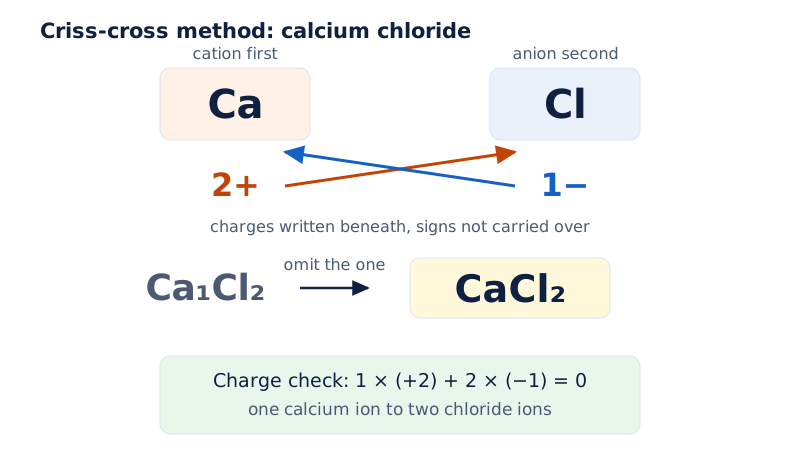
Write Ca and Cl across the top, with 2+ and 1− below them. Draw crossing arrows from the charge numbers towards the opposite symbols. Write CaCl₂ underneath, omitting the subscript one.
Drawn by One Young India.
For hydrogen sulphide, hydrogen has valency one and sulphur has valency two. Crossing these values gives H₂S. For carbon tetrachloride, crossing carbon's valency four with chlorine's valency one gives CCl₄. Check the identity of each symbol before deciding where a subscript belongs.
When are brackets and simplification needed in formulae?
Brackets keep a polyatomic ion together when more than one such group is required. The subscript outside the brackets applies to every atom inside them. It does not change the composition of the individual ion.
Worked example 3. Write magnesium hydroxide using Mg²⁺ and OH⁻. Answer: one magnesium ion needs two hydroxide ions to balance its charge. Write Mg(OH)₂. The brackets show that the whole hydroxide group occurs twice, giving two oxygen atoms and two hydrogen atoms.
How do we count repeated groups?
Aluminium hydroxide is Al(OH)₃. Aluminium has charge three positive, while each hydroxide ion has charge one negative. Three hydroxide ions are needed for each aluminium ion. Writing AlOH₃ would incorrectly put the subscript three after hydrogen alone.
Aluminium sulphate is Al₂(SO₄)₃. The formula contains two aluminium ions and three sulphate ions. Each sulphate group contains one sulphur atom and four oxygen atoms. Thus the formula represents two aluminium atoms, three sulphur atoms and twelve oxygen atoms.
Diagram
Keeping the sulphate group together
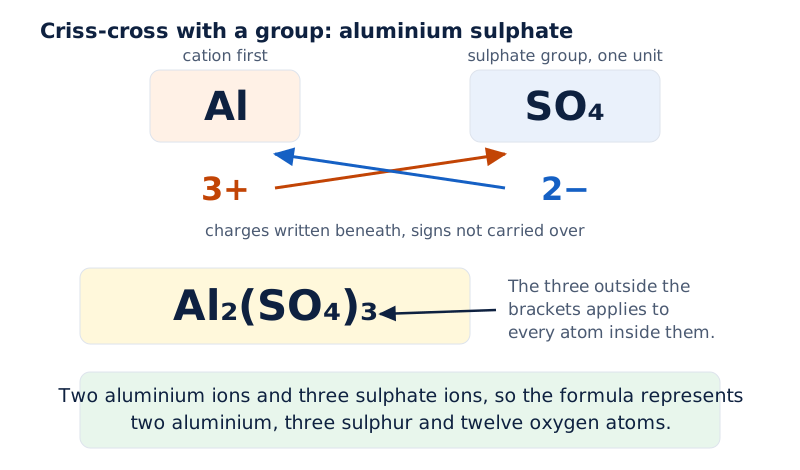
Write Al and SO₄, with charges 3+ and 2− beneath them. Cross the charge numbers and write Al₂(SO₄)₃ below. Enclose SO₄ in brackets so that the outside three refers to the whole group.
Drawn by One Young India.
Why must some crossed numbers be simplified?
For magnesium oxide, Mg²⁺ and O²⁻ first give the crossed form Mg₂O₂. Both subscripts have a common factor of two, so the simplest formula is MgO. Equal positive and negative charge magnitudes mean the ions combine in a one-to-one ratio.
Calcium carbonate behaves similarly in formula writing. Calcium ion is Ca²⁺ and carbonate ion is CO₃²⁻. Their charges balance in a one-to-one ratio, giving CaCO₃. Only one carbonate group is needed, so brackets are unnecessary. The three inside CO₃ remains unchanged.
How can a formula be read without confusing its numbers?
Read a formula in stages: identify its element symbols, inspect their subscripts, and then check for brackets. Where no subscript is written, count one atom of that element or one occurrence of that group. A chemical formula is not a list of valencies.
O represents an oxygen atom, whereas O₂ represents an oxygen molecule containing two oxygen atoms. H₂ similarly represents a hydrogen molecule containing two hydrogen atoms. Cl₂ represents a chlorine molecule containing two chlorine atoms. These molecules contain atoms of the same element.
What is the difference between a subscript and a coefficient?
A coefficient is a number placed before a symbol or formula in an equation. It multiplies the whole following formula. In 4H₂O, the coefficient four means four water molecules. Each molecule still contains two hydrogen atoms and one oxygen atom.
Consequently, 4H₂O represents eight hydrogen atoms and four oxygen atoms in total. The multiplication sign × means “multiplied by”: the hydrogen count is 4 × 2, while the oxygen count is 4 × 1. The formula H₂O itself has not changed.
| Notation | Meaning | Atom count represented |
|---|---|---|
| H₂O | One water molecule | Two hydrogen; one oxygen |
| 4H₂O | Four water molecules | Eight hydrogen; four oxygen |
| Mg(OH)₂ | One magnesium ion for two hydroxide ions | One magnesium; two oxygen; two hydrogen |
| Al₂(SO₄)₃ | Two aluminium ions for three sulphate ions | Two aluminium; three sulphur; twelve oxygen |
For an ionic substance, use the term formula unit for the simplest whole-number ratio of ions. Ionic compounds usually do not remain as single units; their ions form repeating three-dimensional arrangements. Avoid describing every ionic formula as a separate molecule.
Note: A coefficient changes the quantity represented. A subscript is part of the substance's formula. Balancing a reaction changes coefficients while keeping the correct formulae intact.
How is a word equation converted into a chemical equation?
A chemical reaction changes starting substances into new substances. The starting substances that undergo change are the reactants. The new substances formed are the products. A word equation writes their names on opposite sides of an arrow.
Write reactants on the left and products on the right. The arrow → means “forms” or “produces” and points towards the products. The plus sign + separates substances on the same side. It does not mean that their names should be combined into one substance.
When magnesium burns in oxygen, magnesium oxide forms. The word equation is: Magnesium + Oxygen → Magnesium oxide. Magnesium and oxygen are reactants, while magnesium oxide is the product. The burning magnesium gives a dazzling white flame and leaves white magnesium oxide powder.
What changes when formulae replace words?
A chemical equation represents the reaction using symbols and formulae. Magnesium is Mg, oxygen gas is O₂, and magnesium oxide is MgO. Replacing the names gives Mg + O₂ → MgO. This correctly identifies the substances but is not yet balanced.
A skeletal equation records the reacting substances and products before the atom counts have been balanced. In this example, the left side has two oxygen atoms but the right side has one. Correct formulae are necessary, but they do not automatically produce balanced counts.
- Identify all the reactants and products from the reaction description.
- Write their names as a word equation with the arrow pointing towards the products.
- Replace each name with its correct symbol or formula, retaining the same sides of the arrow.
- Count each element's atoms on both sides and adjust coefficients if the counts differ.
The conversion must preserve the identity of the substances. Oxygen gas is written O₂ in this reaction, not O. Magnesium oxide remains MgO during balancing. The next task is to find coefficients that account for every atom in the reaction.
Why must chemical equations obey conservation of mass?
Definition: The law of conservation of mass states that mass can neither be created nor destroyed in a chemical reaction. The total mass of the reactants equals the total mass of the products.
During a chemical reaction, atoms of one element do not change into atoms of another element. Atoms are rearranged into new substances. Therefore, the number of atoms of each element remains the same before and after the reaction.
A balanced chemical equation has equal numbers of each kind of atom on both sides. Equal total numbers of atoms alone are insufficient: hydrogen, oxygen and every other element must each be checked separately. Balancing expresses conservation through the symbols and formulae.
Why can measured mass appear to decrease?
If a reaction produces gas that escapes from the weighed container, the final reading leaves out some product. This does not show that matter was destroyed. A closed system keeps the reacting materials and products, including the gas, within the measured system.
For example, vinegar and baking soda react and produce carbon dioxide gas along with other substances. The mass reading changes when the gas escapes. When a balloon is attached to retain the gas, the final reading matches the initial reading.
Worked example 4. In a closed container, 4.0 g of calcium carbonate reacts with 2.92 g of hydrochloric acid. The products have masses 1.76 g of carbon dioxide, 0.72 g of water and 4.44 g of calcium chloride. Here g means gram, a unit of mass.
Formula: Let and be the total reactant and product masses. ; , where the numbered masses refer to the substances in the order given.
Substitute: . .
Answer: both totals are 6.92 g, so mass is conserved. The equals sign means that the quantities on its two sides are equal.
The totals match, so these measurements obey conservation of mass. Include every reactant and every product when making this comparison. A comparison that omits an escaping gas or another product does not compare the complete masses before and after the reaction.
How can other reaction masses be checked?
Worked example 5. When 20 g of hydrogen reacts completely with 160 g of oxygen, calculate the mass of water formed.
By conservation of mass, the mass of water equals the sum of the two reactant masses: .
Answer: 180 g of water forms.
Worked example 6. Sodium carbonate, 5.3 g, reacts with 6.0 g of acetic acid. The products are 2.2 g of carbon dioxide, 0.9 g of water and 8.2 g of sodium acetate. Verify conservation of mass.
Formula: Let and be the total reactant and product masses. ; , where and are the reactant masses and , and are the product masses, in the order given.
Substitute: . .
Answer: both totals are 11.3 g. Including all three products verifies conservation of mass.
How are simple chemical equations balanced?
Begin with correct formulae and keep them fixed. Use whole-number coefficients in front of the formulae to make each element's atom count equal on both sides. The hit-and-trial method adjusts these coefficients through successive checks until the equation balances.
How is magnesium burning balanced?
The starting equation is Mg + O₂ → MgO. Oxygen occurs as two atoms on the left but one on the right. Put two before MgO to obtain Mg + O₂ → 2MgO. This balances oxygen but leaves two magnesium atoms on the right.
Put two before Mg on the left. The balanced equation is 2Mg + O₂ → 2MgO. It represents two magnesium atoms reacting with one oxygen molecule to form magnesium oxide in the ratio shown. Both sides now contain two magnesium atoms and two oxygen atoms.
How is iron reacting with steam balanced?
Use the skeletal equation Fe + H₂O → Fe₃O₄ + H₂. Fe₃O₄ is the iron oxide formed in this reaction. Steam is water in the gaseous state. The starting atom counts are shown below.
| Element | Atoms in reactants | Atoms in products |
|---|---|---|
| Iron, Fe | 1 | 3 |
| Hydrogen, H | 2 | 2 |
| Oxygen, O | 1 | 4 |
- Keep Fe, H₂O, Fe₃O₄ and H₂ unchanged. It is often convenient to start with the compound containing the maximum number of atoms.
- Balance oxygen by putting four before H₂O. This supplies four oxygen atoms to match those in Fe₃O₄.
- Balance hydrogen by putting four before H₂. The four water molecules now supply eight hydrogen atoms.
- Balance iron by putting three before Fe, then recount every element on both sides.
The final equation is 3Fe + 4H₂O → Fe₃O₄ + 4H₂. Each side has three iron atoms, eight hydrogen atoms and four oxygen atoms. The coefficients give the smallest whole-number set for this equation.
Diagram
Protecting formulae during balancing
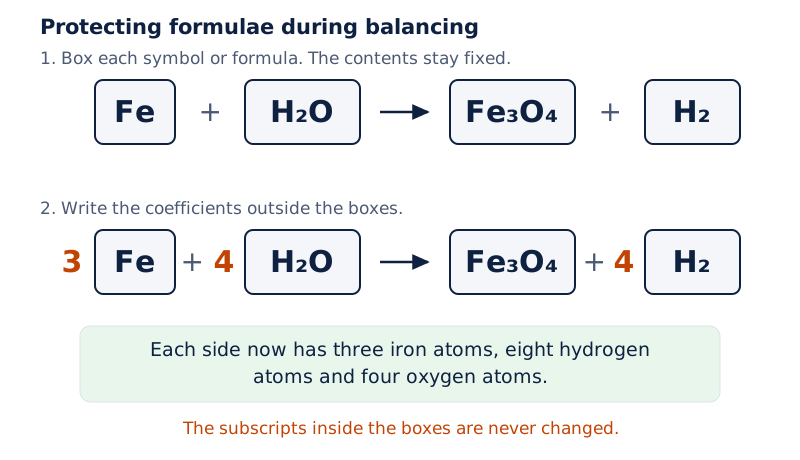
Write Fe + H₂O → Fe₃O₄ + H₂ and draw a box around each separate symbol or formula. Keep the contents fixed. Add the required coefficients outside the boxes to obtain the balanced equation.
Drawn by One Young India.
What information can a balanced equation provide?
A balanced equation identifies the reactants and products and shows their proportions through coefficients. It also permits an atom-by-atom check. Read the equation as a complete statement: recognise each substance before interpreting the numbers placed in front of it.
Consider zinc reacting with sulphuric acid. Zinc is Zn; sulphuric acid is H₂SO₄; zinc sulphate is ZnSO₄; and hydrogen gas is H₂. The equation is Zn + H₂SO₄ → ZnSO₄ + H₂. Every unwritten coefficient is one.
How can we check an equation that needs no added coefficients?
| Element | Atoms in reactants | Atoms in products |
|---|---|---|
| Zinc, Zn | 1 | 1 |
| Hydrogen, H | 2 | 2 |
| Sulphur, S | 1 | 1 |
| Oxygen, O | 4 | 4 |
All four elements have equal counts on the two sides, so the equation is balanced as written. A balanced equation does not need visibly large coefficients. A coefficient of one is just as meaningful as any other coefficient, although it is normally omitted.
In the magnesium equation, the coefficients give a ratio of two magnesium atoms to one oxygen molecule. In the iron and steam equation, they give three iron atoms to four water molecules. These are particle-number relationships; they are not ratios of masses in grams.
To compare masses, further mass information must be supplied. The equation's symbols and coefficients alone should not be read as measured masses. In the closed-container example, conservation could be verified numerically because the mass of every reactant and product was given.
How are given mass ratios used in calculations?
The law of constant proportions states that elements in a compound combine in a fixed ratio by mass. Use a supplied mass ratio when calculating reacting masses. This ratio is distinct from the particle-number ratio expressed by the coefficients of an equation.
Worked example 7. A reaction combines 12 g of carbon with 32 g of oxygen to produce 44 g of carbon dioxide. How much carbon dioxide forms when 2.4 g of carbon reacts completely?
For each gram of carbon, the carbon dioxide produced is . Multiply this amount by 2.4: .
Answer: 8.8 g of carbon dioxide forms.
Worked example 8. Sodium chloride contains sodium and chlorine in the mass ratio 23:35.5. Calculate the chlorine required when 46 g of sodium reacts completely.
The mass of sodium is twice 23 g: . Multiply the corresponding chlorine mass by the same factor: .
Answer: 71 g of chlorine is required.
Worked example 9. Carbon monoxide contains carbon and oxygen in the mass ratio 3:4. Calculate the oxygen that combines with 9 g of carbon.
The carbon mass is three times 3 g: . Multiply the corresponding oxygen mass by three: .
Answer: 12 g of oxygen combines with 9 g of carbon.
Finally, being balanced does not supply every detail of a reaction. The plain zinc equation does not label physical states, for example. Distinguish information encoded in the notation from information that must be added in words or with further symbols.
What are the limitations of an equation, and how are details added?
A plain chemical equation gives identities and proportions, but it does not automatically state physical conditions or observations. State symbols add the physical states of substances. Reaction conditions may be written near the arrow to make the representation more informative.
What do the state symbols mean?
| Notation | Meaning |
|---|---|
| (s) | Solid |
| (l) | Liquid |
| (g) | Gas |
| (aq) | Aqueous: present as a solution in water |
These symbols follow the relevant formula. The iron and steam equation becomes 3Fe(s) + 4H₂O(g) → Fe₃O₄(s) + 4H₂(g). The (g) after H₂O specifies steam in this reaction. It would be incorrect to replace it with (l) merely because water is familiar as a liquid.
Aqueous does not simply mean liquid. It specifies a solution in water. The labels (l) and (aq) therefore convey different information. Usually physical states are not included in a chemical equation unless it is necessary to specify them.
Which other details may be missing?
A catalyst is a substance that causes a reaction to occur or proceed at a different rate. A bare equation need not identify a catalyst or state the temperature or pressure required. Sometimes these reaction conditions are indicated above or below the arrow.
The nature of a reaction, including whether heat is released, also needs additional information. Calcium oxide, CaO, reacts with water to form calcium hydroxide, Ca(OH)₂, releasing a large amount of heat. Writing “+ Heat” on the product side explicitly records this release.
Thus a complete description may combine an equation with state symbols, conditions and observations. Do not infer omitted details from coefficients. First balance the formulae correctly, then add the known states and conditions without changing the identities or proportions of the substances.
Glossary
- Chemical symbol — A short, internationally recognised notation used to represent a particular chemical element.
- Valency — The combining capacity of an atom, used when working out compound formulae.
- Ion — An atom or group of atoms that carries an electric charge.
- Cation — An ion carrying a positive charge, such as the sodium ion Na⁺.
- Anion — An ion carrying a negative charge, such as the chloride ion Cl⁻.
- Polyatomic ion — A charged group containing atoms of more than one element and acting as a unit.
- Chemical formula — A representation using element symbols and subscripts to show a substance's composition.
- Subscript — A lower number showing how many atoms or bracketed groups a formula contains.
- Coefficient — A number before a symbol or formula that multiplies the whole following expression.
- Reactant — A starting substance that undergoes chemical change during a chemical reaction.
- Product — A new substance formed from reactants during a chemical reaction.
- Balanced equation — A chemical equation having equal numbers of each element's atoms on both sides.
- Conservation of mass — The principle that mass is neither created nor destroyed during a chemical reaction.
- Formula unit — The simplest whole-number ratio of ions represented by an ionic compound's formula.
- Aqueous — Present as a solution in water, indicated by the notation (aq).
Common errors and misconceptions
- Misconception: Capital letters can be used for both letters of every symbol. Correct: The first letter is capital and the second, if present, is small. Aluminium is Al.
- Misconception: The subscript in an ion gives its valency. Correct: Sulphate, SO₄²⁻, contains four oxygen atoms but has valency two, corresponding to its charge magnitude.
- Misconception: Criss-crossing is the final step for every ionic formula. Correct: Reduce a common factor where needed. Magnesium oxide is MgO, after simplifying the crossed form Mg₂O₂.
- Misconception: Aluminium hydroxide can be written AlOH₃. Correct: It is Al(OH)₃, with the outside three multiplying the whole hydroxide group.
- Misconception: Subscripts may be changed to balance an equation. Correct: Keep correct formulae fixed and change coefficients placed in front of them.
- Misconception: Equal total atom counts guarantee a balanced equation. Correct: Count each element separately and ensure its own total matches on both sides.
- Misconception: Escaping gas shows that mass has been destroyed. Correct: The gas is a product omitted from the final measurement unless it is retained or accounted for.
- Misconception: The symbols (l) and (aq) mean the same thing. Correct: The first means liquid; the second specifically means a solution in water.
Exam-style questions with model answers
Q1. Hydrogen is represented by H and aluminium by Al. State the two rules for letter case illustrated by these symbols. [2 marks]
- The first letter of an element's symbol is capital, as shown by H and the A in Al.
- A second letter, when present, is small, as shown by the l in Al.
Q2. Calcium ion is Ca²⁺ and chloride ion is Cl⁻. Derive the formula of calcium chloride in three steps, including a charge check. [3 marks]
- Write calcium first and chloride second. Their charge magnitudes are two and one respectively, so one calcium ion cannot be balanced by just one chloride ion.
- Use two chloride ions for each calcium ion. This gives the formula CaCl₂, with the subscript one after calcium omitted.
- The calcium ion supplies two positive charges and the two chloride ions supply two negative charges. The total charge is zero.
Q3. Aluminium ion is Al³⁺ and hydroxide ion is OH⁻. Derive aluminium hydroxide's formula, explain its brackets, and state its oxygen and hydrogen counts. [4 marks]
- One aluminium ion has three positive charges, so three hydroxide ions, each with one negative charge, are needed to make a neutral combination.
- The formula is Al(OH)₃. Brackets keep the hydroxide group together, and the outside subscript shows that the entire group occurs three times.
- Each hydroxide group contains one oxygen atom, so three hydroxide groups contribute a total of three oxygen atoms.
- Each hydroxide group also contains one hydrogen atom, so the same three groups contribute a total of three hydrogen atoms.
Q4. Balance Mg + O₂ → MgO, representing magnesium reacting with oxygen to form magnesium oxide. Give the oxygen adjustment, the magnesium adjustment, and a final check. [3 marks]
- The left side has two oxygen atoms, while the right side initially has one. Put two before MgO, giving Mg + O₂ → 2MgO.
- There are now two magnesium atoms on the right. Put two before Mg on the left to obtain 2Mg + O₂ → 2MgO.
- Check each element separately: both sides contain two magnesium atoms and two oxygen atoms. The equation is balanced, and none of the original formulae has been changed.
Q5. Iron reacts with steam to form iron oxide, Fe₃O₄, and hydrogen. Starting from Fe + H₂O → Fe₃O₄ + H₂, show the balancing steps, verify all atom counts, and connect the result to conservation of mass. [5 marks]
- Keep all four formulae unchanged. The product Fe₃O₄ contains four oxygen atoms, whereas each water molecule supplies one, so put four before H₂O.
- Four water molecules contain eight hydrogen atoms. Put four before H₂ on the product side to provide the same number of hydrogen atoms.
- The product contains three iron atoms. Put three before Fe to obtain the balanced equation 3Fe + 4H₂O → Fe₃O₄ + 4H₂.
- Recount the elements independently: each side has three iron atoms, eight hydrogen atoms and four oxygen atoms. All three element counts match.
- The matching counts show that atoms are rearranged without being lost or created, consistent with the law that mass is conserved during a chemical reaction.
Q6. In a closed container, 4.0 g of calcium carbonate reacts with 2.92 g of hydrochloric acid. Products are 1.76 g of carbon dioxide, 0.72 g of water and 4.44 g of calcium chloride. Calculate both total masses and decide whether conservation of mass is obeyed. [3 marks]
- Add the masses of both reactants: 4.0 g + 2.92 g = 6.92 g. This is the total mass present before the reaction.
- Add all three product masses: 1.76 g + 0.72 g + 4.44 g = 6.92 g. The carbon dioxide is included because the container is closed.
- The two totals are equal. Conservation of mass is obeyed: the reaction changes the substances present without changing their complete combined mass.
Q7. Interpret the symbols (s), (g), (l) and (aq). In 3Fe(s) + 4H₂O(g) → Fe₃O₄(s) + 4H₂(g), explain why water has (g) rather than (l). [5 marks]
- The symbol (s) means solid. In the given equation, both iron, Fe, and the iron oxide product, Fe₃O₄, are identified as solids.
- The symbol (g) means gas. Here it follows both H₂O and H₂, identifying the water reactant and hydrogen product as gaseous substances.
- The symbol (l) means liquid. It is a physical state label and would indicate water in the liquid state if written after H₂O.
- The symbol (aq) means aqueous: a substance is present as a solution in water. It therefore provides different information from the simple liquid label.
- Water carries (g) because the iron reacts with steam, which is gaseous water. Substituting (l) would misdescribe the physical state used in this reaction.
Q8. A chemical equation shows the correct formulae and balanced coefficients but gives no states or conditions. State two kinds of information that cannot be read from this bare equation. [2 marks]
- The physical states of the reactants and products cannot be read without state symbols or accompanying information.
- Required reaction conditions, such as temperature, pressure or the presence of a catalyst, have not been specified.
Key takeaways
- Chemical symbols begin with a capital letter; any second letter is small and remains part of the same symbol.
- Valency expresses combining capacity, while subscripts in a formula count atoms or whole bracketed groups.
- Use ion charge magnitudes to construct neutral ionic formulae, then simplify the ratio where a common factor occurs.
- Put brackets around a polyatomic ion when more than one such group is required in the formula.
- Write reactants before the arrow and products after it, first using names and then their correct symbols and formulae.
- Balance an equation by adjusting coefficients, checking each element separately and preserving the correct formulae throughout.
- Conservation of mass includes every product, including gases that may otherwise escape from the container being weighed.
- State symbols and reaction conditions add information that a plain equation of formulae and coefficients does not provide.
Test yourself
Why are Co and CO different?
Co represents cobalt. CO represents carbon monoxide, a compound containing carbon and oxygen.
In SO₄²⁻, what do the lower four and raised 2− mean?
The four counts oxygen atoms in the sulphate group. The raised 2− gives the group's two negative charges.
What formula follows from Mg²⁺ and O²⁻?
MgO: equal charge magnitudes balance in a one-to-one ratio, so the crossed form Mg₂O₂ is simplified.
How many oxygen and hydrogen atoms are represented in Mg(OH)₂?
There are two oxygen atoms and two hydrogen atoms because the whole hydroxide group occurs twice.
What atom counts are represented by 4H₂O?
Four water molecules contain eight hydrogen atoms and four oxygen atoms in total.
Why must the formulae stay unchanged during balancing?
Formulae identify the substances. Balancing adjusts their relative quantities through coefficients while retaining those identities.
Why might a gas-producing reaction show a lower final mass reading?
Gas may escape from the weighed container, so the final measurement no longer includes every product.
What does H₂O(g) specify in the iron and steam reaction?
It specifies that water participates as steam, in the gaseous state rather than the liquid state.
Write about it
Turn a question from this chapter into a paper.
The Writing Studio has a structure guide, a rubric and citation tools for 15 formats, from essays to research papers. Drafting is free with an account. Learnacy Essential adds feedback from an AI writing coach and submission to The OYI Review.
Learnacy Essential is ₹1,499 for the year. Publication depends on review and is not guaranteed.