
Constitution as a Living Document | CBSE Class 11 Political Science Notes
On this page

This note covers constitutional continuity and change, amendment procedures, parliamentary majorities, State consent, technical amendments, political consensus and controversy, judicial interpretation, basic structure, and the contribution of political leadership to a living Constitution.
Why does a constitution need to change while remaining a lasting framework?
A constitution provides the framework within which government operates and expresses a society's dreams and aspirations. It must address problems present when it is written while also guiding government in circumstances that its makers cannot fully predict.
The Constitution of India was adopted on 26 November 1949. Its implementation formally began on 26 January 1950. The same Constitution has continued to provide the framework of government, although society and political life have changed.
This continuity does not mean that every future situation was foreseen. The basic framework is well suited to India, and its makers provided solutions for many future situations. Nevertheless, no constitution can provide for all eventualities or remain entirely free from the need for change.
What do other countries' experiences show?
The Soviet Union had four constitutions during its life of 74 years, in 1918, 1924, 1936 and 1977. Communist Party rule ended in 1991, and the Soviet federation soon disintegrated. The newly formed Russian federation adopted a constitution in 1993.
France also experienced repeated constitutional change after its revolution and during the Napoleonic period. The sequence of French republics illustrates how political developments can be associated with new constitutional arrangements.
| French republic | Constitutional date |
|---|---|
| First republic, post-revolution constitution | 1793 |
| Second republic | 1848 |
| Third republic | 1875 |
| Fourth republic | 1946 |
| Fifth republic | 1958 |
India's continuity rests partly on accepting modifications and partly on flexibility in interpretation. Judicial interpretation means the meaning courts give constitutional provisions. Political practice and judicial rulings have shown maturity and flexibility in applying the Constitution to changing situations.
Definition: A living document responds to changing situations and experience while continuing to provide an enduring framework for democratic government.
How does the Constitution balance flexibility and rigidity?
Flexibility means openness to change; rigidity means resistance to change. A constitution that can be changed very easily is often called flexible. One that is very difficult to amend is described as rigid. The Indian Constitution combines both characteristics.
A constitutional amendment is an alteration to the Constitution. Its makers recognised that errors might become visible in practice. They wanted such mistakes to be corrected. Some provisions were temporary and could be changed after the election of the new Parliament.
At the same time, the Constitution establishes a federal polity, an arrangement in which powers are distributed between the central government and the States. State rights and powers therefore needed protection against changes made without State consent.
Why is neither extreme sufficient?
Treating the Constitution as wholly unalterable would prevent necessary adjustments. Treating it exactly like ordinary legislation would expose its central principles to unnecessary and frequent changes. The makers placed it above ordinary law while recognising that future generations might need to modify it.
Differences of opinion existed even during constitution-making. Whenever society moved towards a particular opinion, a corresponding change in constitutional provisions would be required. Respect for the Constitution therefore does not require rejection of every proposal to amend it.
| Reason for flexibility | Reason for rigidity |
|---|---|
| Correct errors revealed by experience. | Protect features central to the Constitution's spirit. |
| Alter provisions intended to be temporary. | Protect the rights and powers of States. |
| Respond to changing social needs and opinions. | Prevent unnecessary and frequent constitutional changes. |
The result is a balance: an authoritative document that can develop with society. Its amendment arrangements give different provisions different degrees of protection.
What are the different routes for changing constitutional provisions?
An Article is a numbered constitutional provision. Some Articles permit Parliament, the national legislature, to make changes by ordinary law. For remaining provisions, Article 368 provides the constitutional amendment procedure and gives Parliament power to add, vary or repeal provisions through that procedure.
The expression constituent power in Article 368 refers to this power to amend the Constitution. It is exercised through prescribed rules, rather than simply through the procedure used for all ordinary legislation.
Which changes use an ordinary law?
Article 2 allows Parliament to admit new States into the Union by law. Article 3 includes the power to increase a State's area by law. The wording “by law” permits these changes without using the special procedure in Article 368.
A simple majority is the support of more than half the members voting. In the provisions allowing change through ordinary law, no special amendment procedure is required. These parts of the Constitution are very flexible.
A special majority imposes stronger numerical requirements than an ordinary majority. For amendment bills under Article 368, it combines a requirement based on total House strength with one based on members actually voting.
| Route | Required approval | Scope |
|---|---|---|
| Ordinary legislative route | Simple majority in Parliament | Changes permitted by specified Articles, including the examples in Articles 2 and 3 |
| First Article 368 route | Special majority in each House separately | Provisions covered by Article 368 that do not additionally require State consent |
| Second Article 368 route | Special majority in each House and consent of half the State legislatures | Specified provisions involving federal powers or representation |
What the figure shows
Three amendment routes
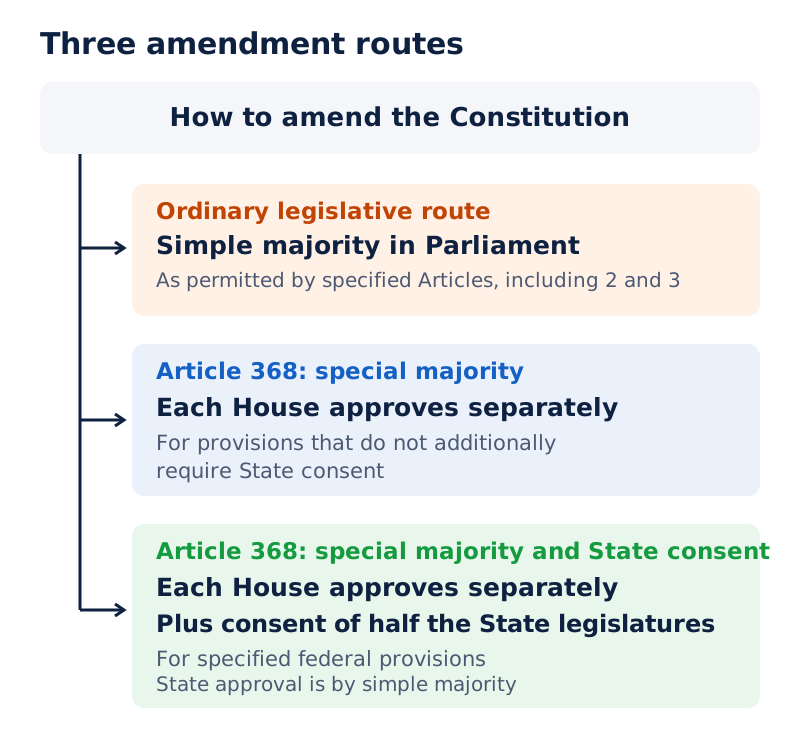
A box headed “How to amend the Constitution” branches into three boxes: simple majority as mentioned in some Articles; special majority in both Houses separately under Article 368; and special majority plus the legislatures of half the States under Article 368.
Drawn by One Young India. Reference: NCERT Class 11, p. 200
How is a special majority calculated in the worked examples?
For an Article 368 amendment, supporters must satisfy both numerical conditions: they must constitute more than half the total membership of the House and at least two-thirds of the members present and voting. Passing one condition alone is insufficient.
Both Houses of Parliament must approve the amendment separately in this manner. There is no provision for a joint session, meaning a combined sitting of both Houses, to pass the amendment instead of obtaining separate approval.
How does an ordinary bill differ?
Worked example 1. Suppose 247 members are present and all vote on an ordinary bill requiring a simple majority. How many votes in favour are needed?
Answer: Half of 247 is 123.5. The smallest whole number greater than this is 124, so at least 124 votes in favour pass the bill.
What happens when 300 or 400 members vote?
Worked example 2. Take a House with a total strength of 545 members and a minimum total-strength requirement of 273 supporters. If 300 members are present and vote on an amendment, calculate the support needed under both conditions.
Answer: Two-thirds of 300 is 200. However, 200 falls below the separate minimum of 273. The amendment therefore requires 273 supporters among the 300 voting members.
Worked example 3. Keep the same total House strength of 545 and the same minimum of 273 supporters. Now suppose 400 members vote on the amendment. How many must support it?
Answer: Two-thirds of 400 is 266⅔. Since votes are counted as whole numbers, at least 267 would satisfy that condition. The total-strength requirement remains 273. Therefore, the bill still needs 273 votes in favour.
Note: The 545-member House is the given basis of these worked examples. Do not replace total membership with the number present, or treat the two-thirds condition as the only test.
Consensus means broad agreement. A government with a very thin majority may pass ordinary legislation and its budget, but constitutional amendment requires wider support. It would need to take at least some opposition parties into confidence.
On 25 November 1949, Dr Ambedkar connected the two-thirds requirement with whether dissatisfaction with the Constitution was shared by the general public. The underlying principle is public opinion and broad political support, not merely numerical calculation.
How do Parliament, the President and the States participate in amendment?
Ratification means formal approval. State ratification is needed for specified changes concerning the distribution of powers between the Centre and States or representation. It prevents State powers from being left at the mercy of the central government.
For these amendments, the legislatures of half the States must give consent. A simple majority in each participating State legislature is sufficient. Requiring only half the States maintains some flexibility even in the more demanding route.
What is the sequence under Article 368?
- Initiation: An amendment bill, a proposal to change the Constitution, is initiated in Parliament. Constitutional amendments are initiated only there.
- Parliamentary approval: Each House passes the bill separately with the required special majority. Approval by one House cannot replace approval by the other.
- State approval where required: For the specified federal provisions, legislatures of half the States approve the amendment by simple majority.
- Presidential assent: The bill goes to the President for assent, or formal approval. The President cannot return an amendment bill for reconsideration.
No separate constitutional commission or outside body is required to carry out the amendment. Nor is a referendum, a direct vote by the people on a proposal, required to ratify it after legislative passage.
These arrangements emphasise decisions by elected representatives. Parliamentary sovereignty, in this discussion, refers to the authority of elected representatives in deciding amendments. It must be understood alongside the constitutional limits on the amending power.
State participation is therefore real but limited. States consent to particular kinds of amendment, while initiation remains with Parliament. The procedure combines large-scale political agreement with protection against easy tampering.
Other constitutions use different combinations. The United States employs a two-thirds principle; South Africa and Russia require three-fourths for some amendments. People can initiate amendments in Switzerland, while Russia and Italy also illustrate popular initiation or approval.
Why does a large number of amendments not prove constitutional failure?
On 26 January 2024, the Constitution completed 74 years of existence and had been amended 106 times. Given the relatively difficult procedure, that number appears quite high. Its significance depends on the substance and circumstances of the changes.
The decades from 1970 to 1990 saw a large number of amendments. Ten amendments were made during 1974 to 1976, and another ten during 2001 to 2003. The political conditions in these two short periods were remarkably different.
What does comparing the two periods reveal?
During 1974 to 1976, Congress dominated politics, with 352 Lok Sabha seats and a majority in most State Assemblies. The Lok Sabha is one of Parliament's two Houses. During 2001 to 2003, coalition politics and different parties governing different States formed the background.
Coalition politics involves parties sharing government. The later period also saw bitter rivalry between the Bharatiya Janata Party, abbreviated as BJP, and its opponents. Nevertheless, ten amendments were passed. The incidence of amendments therefore does not depend merely on the ruling party's majority.
What the figure shows
Amendments per decade
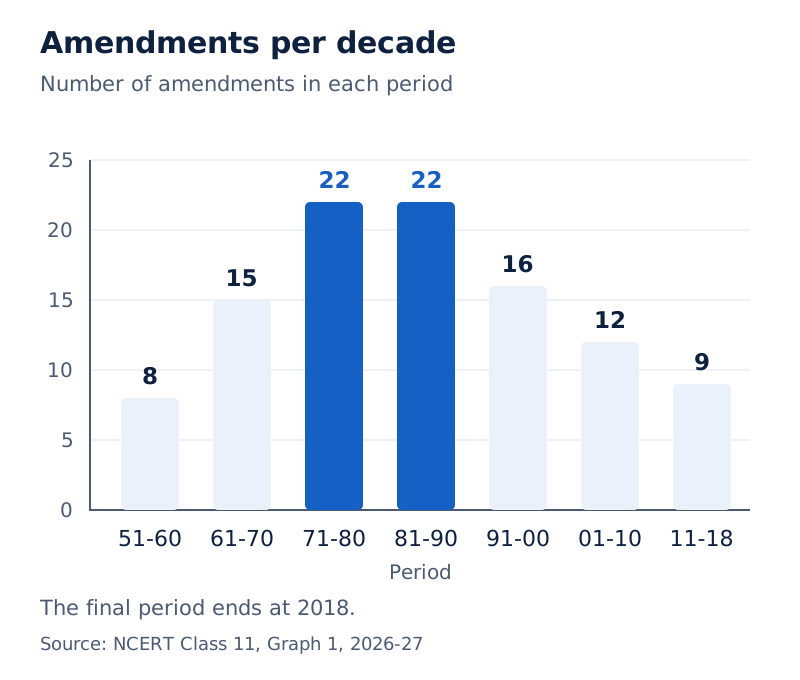
The vertical bars compare periods labelled 51-60, 61-70, 71-80, 81-90, 91-00, 01-10 and 11-18. The bars for 71-80 and 81-90 are the tallest. The last label ends at 2018.
Drawn by One Young India. Reference: NCERT Class 11 Graph 1
What the figure shows
Years taken for every ten amendments
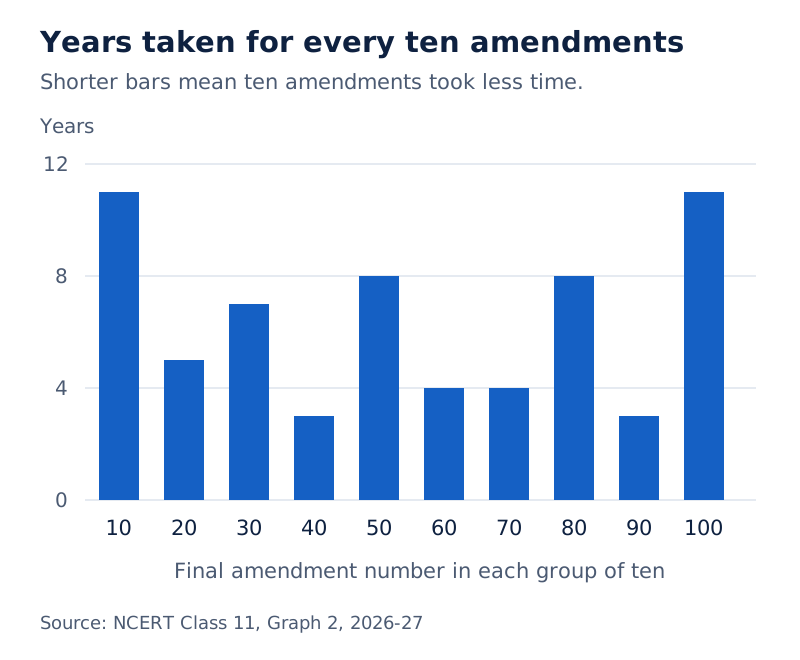
The horizontal labels run from 10 to 100 in steps of ten. Bar heights show years taken for successive groups of ten amendments. Shorter bars indicate that a group of ten amendments took less time.
Drawn by One Young India. Reference: NCERT Class 11 Graph 2
Barring the first decade after commencement, every decade witnessed a steady stream of amendments. Changes were required irrespective of the party in power. Their frequency alone cannot show that the original Constitution was inadequate or excessively flexible.
Which amendments mainly clarify or adjust existing provisions?
Technical or administrative amendments provide clarifications, explanations or minor modifications to existing arrangements. They change the Constitution in the legal sense but make no substantial difference to the underlying provisions.
This category helps explain why counting amendments can be misleading. Extending an existing arrangement, adjusting an administrative detail and changing a fundamental constitutional relationship are different kinds of action, even though each may involve a formal amendment.
What are the main examples?
The Council of Ministers is the body of ministers advising the President. Its relationship with the President provides one example of a constitutional clarification.
| Provision or amendment | Change or clarification |
|---|---|
| 15th Amendment | Increased the retirement age of High Court judges from 60 to 62 years. |
| 54th Amendment | Increased the salaries of judges of High Courts and the Supreme Court. |
| Reserved legislative seats | Extended the duration of reservations for Scheduled Castes and Scheduled Tribes to maintain fair representation. |
| Article 74(1) | Clarified that the advice of the Council of Ministers is binding on the President. |
Reservation here means setting aside legislative seats for specified sections of society. The original provision for Scheduled Castes and Scheduled Tribes covered ten years. Extensions by another ten years maintained its purpose of fair representation rather than replacing it with a different principle.
Article 74(1) concerns presidential action on ministerial advice. In the original constitutional arrangement, the President was assumed normally to follow this advice.
The amendment made the binding character of the advice explicit. In practice, it explained what had already been happening. The example distinguishes a textual clarification from a substantial change in how an institution functions.
Note: Judge an amendment by what it changes. A formal alteration may clarify an existing practice or continue an existing arrangement rather than introduce a new constitutional direction.
Why did differing interpretations produce constitutional amendments?
A written Constitution does not eliminate disagreements about meaning. The judiciary, the courts interpreting the Constitution, and Parliament may understand a provision differently, especially when considering the scope of their own powers.
When an interpretation upheld by the courts conflicted with the government's view, Parliament sometimes inserted an amendment to establish a particular interpretation. During 1970 to 1975, Parliament repeatedly used amendments to overcome adverse judicial interpretations.
What issues produced disagreement?
- The relationship between Fundamental Rights, constitutionally protected rights, and Directive Principles, constitutional directions guiding State policy.
- The scope of the right to private property, concerning protection of an individual's property.
- The extent of Parliament's amending power, including whether constitutional amendment itself faced limits.
These were not merely disputes about isolated words. They concerned institutions, public purposes and the distribution of authority. Political events unfolding during the same period also shaped the constitutional controversy.
Parliament considered that it had the power and responsibility to legislate and amend for the poor, backward and needy. The judiciary insisted that such action remain within the constitutional framework and follow legal procedures.
The judicial concern was that bypassing laws even for good purposes could give power holders an excuse for arbitrary action. Arbitrary power means power exercised without the restraints of legal procedures. Democracy requires checks on such power as well as concern for people's well-being.
Disagreement therefore does not by itself prove that one institution has no democratic role. It shows the need to reconcile social improvement, representative authority and constitutional limits. The later basic-structure doctrine, the principle that amendments cannot violate the essential constitutional framework, offered a way of balancing these claims.
How did political consensus make amendments possible?
A third large group of amendments resulted from agreement among political parties. Such agreement made changes possible that reflected prevailing political aspirations. Many amendments after 1984 illustrate this trend, including changes adopted during coalition governments and political turbulence.
Agreement on a particular constitutional change does not require agreement on every political question. Rival parties may still reach a common position on one issue. This explains how amendments can pass even when the government does not enjoy single-party dominance.
Which amendments illustrate this agreement?
| Amendment | Area of agreement |
|---|---|
| 52nd Amendment and 91st Amendment | Anti-defection measures, directed against legislators changing political allegiance |
| 61st Amendment | Reduction of the minimum voting age from 21 to 18 years |
| 73rd Amendment and 74th Amendment | Constitutional changes concerning local governments |
| 77th Amendment, 81st Amendment and 82nd Amendment | Measures clarifying and expanding the scope of reservations in jobs and admissions |
Anti-defection measures address changes of political allegiance by legislators. The sequence beginning with the 52nd Amendment is an example of constitutional action continuing despite wider political instability.
After 1992 to 1993, an overall consensus emerged about the reservation measures discussed here. Consequently, the 77th, 81st and 82nd Amendments were passed without much difficulty. Reservations in this context concern access to jobs and educational admissions.
The voting-age change provides a clear example of an amendment with a direct consequence for political participation. The 61st Amendment brought down the minimum age from 21 to 18 years. Its significance lies in changing eligibility to vote, rather than merely correcting wording.
Consensus does not mean that constitutional politics becomes free of conflict. It means that sufficient agreement exists for particular changes. Other amendments, especially in the 1970s, generated intense controversy.
Why were the Emergency amendments controversial?
Amendments during 1970 to 1980 generated considerable legal and political controversy. Parties in opposition during 1971 to 1976 saw many amendments as attempts by the ruling party to subvert the Constitution.
The internal Emergency, an exceptional constitutional situation declared from June 1975, formed the background to the 38th, 39th and 42nd Amendments. These sought basic changes in crucial parts of the Constitution and became particularly controversial.
How extensive was the 42nd Amendment?
The 42nd Amendment affected large parts of the Constitution and attempted to override the Supreme Court's ruling in the Kesavananda case. The Supreme Court is the court whose constitutional rulings figure centrally in this controversy.
- It extended the duration of the Lok Sabha from five to six years.
- It inserted Fundamental Duties, duties set out in the Constitution.
- It restricted the judiciary's review powers, its powers to examine constitutional validity.
- It changed the Preamble, the Constitution's introductory statement, the Seventh Schedule, a numbered part of the Constitution, and 53 Articles.
The amendment was seen as so wide-ranging that it was described at the time as practically rewriting many parts of the original Constitution. Many Members of Parliament belonging to opposition parties were in jail when it passed.
What happened after the 1977 election?
Congress was defeated in the 1977 elections. The new government reconsidered the controversial changes. Through the 43rd and 44th Amendments, it cancelled most of the changes introduced by the 38th, 39th and 42nd Amendments.
The distinction between most and all matters: the reversal should not be described as complete cancellation of every earlier provision. These later amendments restored constitutional balance while demonstrating that amendment could also correct an earlier direction of change.
How did the basic-structure doctrine limit Parliament and shape interpretation?
The basic structure refers to the essential constitutional framework without which the Constitution cannot be imagined. A doctrine is a guiding principle of interpretation. The Supreme Court advanced the basic-structure doctrine in the Kesavananda Bharati case in 1973.
The ruling reconciled the need for constitutional change with limits on the amending power. It did not remove Parliament's authority to amend. Instead, it placed a boundary around the exercise of that authority.
What were the ruling's main consequences?
- A limit on amendment: No constitutional amendment can violate the basic structure.
- A continuing power: Parliament can amend any and all parts of the Constitution within that limitation.
- A judicial decision: The judiciary has final authority to decide whether an amendment violates the basic structure.
- An evolving interpretation: The judiciary decides what constitutes basic structure, and subsequent cases have elaborated the doctrine.
The Constitution's text does not mention this theory. It emerged through judicial interpretation rather than through a formal amendment inserting those words. This makes the doctrine itself an example of a living Constitution.
It combines rigidity and flexibility. Essential constitutional features receive protection, while changes to other provisions remain possible. Later decisions have given instances of basic structure; the doctrine should not be reduced to a final, exhaustive list written into the original Constitution.
How else did judicial interpretation influence constitutional development?
In decisions on reservations, the Supreme Court had held that reservations in jobs and educational institutions could not exceed 50 per cent of total seats. The case concerning other backward classes, a socially and educationally backward category, introduced the creamy layer, its relatively better-off section. The Court excluded the creamy layer from reservation benefits.
The creamy-layer ruling distinguished eligibility within a category covered by reservations. These examples concern judicial interpretation of reservation rules, rather than a new amendment bill passed through Parliament.
The judiciary also interpreted provisions concerning the right to education, life and liberty, and the right to form and manage minority educational institutions. Such rulings can produce informal constitutional change by developing the meaning of existing provisions.
How do judicial interpretation, political maturity and public aspirations sustain a living Constitution?
A living Constitution responds to experience while protecting democracy. Democracy includes representation through votes, but also the rule of law, the principle that power must operate within legal rules, and institutions that remain responsible to people and balanced against one another.
Parliament represents the people, yet its supremacy operates within a Constitution that also gives powers to other institutions. The executive, which carries out government, and the judiciary therefore have roles that parliamentary authority cannot simply disregard.
How do the letter and spirit work together?
The letter of the Constitution is its wording; its spirit is the intent and aspirations behind it. In the Kesavananda ruling, the Court looked beyond literal wording to the circumstances and purposes that produced the constitutional framework.
Following fierce controversy during 1967 to 1973, attempts were made to have the Court reconsider its position. When these failed, the 42nd Amendment asserted parliamentary supremacy. The Court repeated its earlier stand in the Minerva Mills case in 1980.
Political parties, leaders, government and Parliament came to accept an inviolable basic structure. In 2000, the Government of India appointed a commission to review the Constitution's working, chaired by retired Chief Justice Justice Venkatachaliah.
Opposition parties and many organisations boycotted the commission. Despite the controversy, it remained within the basic-structure framework and proposed no measures endangering it. This illustrated the doctrine's importance in constitutional practice.
Why does a shared vision matter?
The founding vision included individual dignity and freedom, social and economic equality, everyone's well-being and unity based on national integrity. Nehru expressed this vision at independence through the idea of a tryst with destiny, an appointment with the country's future.
Not everyone predicted success. In the Constituent Assembly, the body that framed the Constitution, Lakshminarayan Sahu on 17 November 1949 argued that the draft did not suit India's fundamental spirit and would break down soon after implementation.
Constitutional experience instead shows the importance of debate, compromise and moderation. Differences about basic structure can continue. Institutions may compete over authority and welfare, but the final authority lies with the people. Their freedoms and well-being remain democracy's purpose.
Glossary
- Living document — A document that responds to changing circumstances and experience while retaining its continuing authority and purpose.
- Constitutional amendment — An alteration that adds to, varies or repeals a constitutional provision through the applicable procedure.
- Flexibility — Openness to constitutional change, allowing provisions to respond to errors, experience and changing social needs.
- Rigidity — Resistance to constitutional change, protecting important provisions against unnecessary or excessively easy alteration.
- Simple majority — Support from more than half the members actually voting on a proposal in the legislature.
- Special majority — For Article 368 amendments, support satisfying both the total-strength requirement and the two-thirds requirement among members voting.
- Ratification — Formal approval; specified constitutional amendments require approval by the legislatures of half the States.
- Federalism — A constitutional distribution of powers in which State powers must not be at the central government's mercy.
- Consensus — Broad agreement among political participants that enables decisions despite differences on other issues.
- Judicial interpretation — The meaning courts give constitutional provisions when deciding disputes about their scope and application.
- Basic structure — The essential constitutional framework that Parliament cannot violate through amendment, as determined by the judiciary.
- Rule of law — The principle that governmental action must follow legal rules and procedures rather than arbitrary power.
- Constitutional spirit — The purposes, social aspirations and underlying intent that give meaning to the Constitution's written text.
- Technical amendment — A clarification, explanation or minor adjustment that does not substantially change the underlying constitutional arrangement.
Common errors and misconceptions
- Misconception: Respect for the Constitution rules out changing it. Correct: Its authority coexists with provisions for amendment, allowing necessary adjustments while protecting it against easy tampering.
- Misconception: Every constitutional change requires the same Article 368 procedure. Correct: Some provisions permit changes through ordinary law; Article 368 provides two routes for the remaining provisions.
- Misconception: Two-thirds of those voting is the only numerical condition. Correct: The total-strength requirement must also be met, and both Houses must approve separately.
- Misconception: Every amendment needs every State's consent. Correct: Specified amendments require approval by half the State legislatures, using a simple majority in those legislatures.
- Misconception: Many amendments necessarily prove that the Constitution failed. Correct: Some clarify existing arrangements, others reflect agreement, and their substance matters more than the count alone.
- Misconception: The basic-structure doctrine ended Parliament's amending power. Correct: Parliament may amend any part, provided the amendment does not violate basic structure.
- Misconception: The original Constitution contains a complete list of basic-structure features. Correct: The doctrine emerged through judicial interpretation and has been elaborated through later decisions.
- Misconception: The 43rd and 44th Amendments cancelled every Emergency-era change. Correct: They cancelled most of the changes made by the 38th, 39th and 42nd Amendments.
Exam-style questions with model answers
Q1. An ordinary bill needs a simple majority, meaning more than half of those voting. All 247 members present vote. Calculate the minimum support required and explain why 123 votes would not suffice. [2 marks]
- Half of 247 is 123.5, so the smallest whole-number majority is 124 votes in favour.
- Support from 123 members is below half of those voting and therefore cannot satisfy the simple-majority condition.
Q2. In a House of 545 members, an amendment needs at least 273 supporters under the total-strength condition and at least two-thirds of those voting. If 400 members vote, calculate the minimum support and explain both tests. [3 marks]
- The total-strength condition remains 273 supporters because it depends on the membership of the House, rather than the smaller number participating in this vote.
- Two-thirds of 400 is 266⅔. Since votes are whole numbers, this condition requires at least 267 supporters.
- Both conditions must be satisfied together. The larger requirement is 273, so 273 votes in favour are needed to pass the amendment.
Q3. An amendment changes the distribution of powers between the Centre and States. Its applicable rules require initiation in Parliament, separate special majorities in both Houses, approval by half the State legislatures using simple majorities, and presidential assent. The President cannot return it. Explain four stages in its passage. [4 marks]
- The proposal begins as an amendment bill in Parliament, the institution authorised to initiate the constitutional amendment process.
- Each House separately approves it with the required special majority. One House's approval does not replace the other's decision.
- Legislatures of half the States approve it by simple majority because the proposal affects the distribution of federal powers.
- The bill then receives presidential assent. The President cannot send this constitutional amendment bill back to Parliament for reconsideration.
Q4. The Kesavananda Bharati ruling of 1973 allowed Parliament to amend any constitutional part without violating basic structure. It gave the judiciary authority to identify that structure and judge violations. The doctrine is absent from the written text and was elaborated in later cases. Explain five implications for constitutional change. [5 marks]
- Parliament retains a broad amending power because the ruling allows it to change any part of the Constitution, subject to the stated limit.
- That power is not unlimited: an amendment cannot violate the essential framework protected by the basic-structure doctrine.
- The judiciary determines what constitutes basic structure, so identifying protected features involves constitutional interpretation by courts.
- The judiciary also decides whether an amendment breaches that limit, giving it authority to assess the validity of constitutional changes.
- The doctrine illustrates constitutional evolution through interpretation. Although absent from the written text, it developed through the ruling and subsequent cases.
Q5. The 15th Amendment raised High Court judges' retirement age from 60 to 62; the 54th increased judges' salaries. Extensions of reserved legislative seats maintained fair representation for Scheduled Castes and Scheduled Tribes. Article 74(1) was clarified to make ministerial advice binding, matching existing presidential practice. Explain these four technical changes and the lesson for counting amendments. [5 marks]
- The 15th Amendment adjusted an administrative detail by raising High Court judges' retirement age from 60 to 62 years.
- The 54th Amendment altered judges' salaries. It concerned an administrative arrangement rather than introducing an entirely different constitutional framework.
- Extensions of reserved legislative seats continued the existing purpose of fair representation for Scheduled Castes and Scheduled Tribes.
- The clarification of Article 74(1) made the binding character of ministerial advice explicit, explaining the practice the President already followed.
- These examples show why the number of amendments alone is misleading. Formal changes may adjust details, continue provisions or clarify existing practice.
Q6. The 42nd Amendment was passed against the background of the internal Emergency declared from June 1975, while many opposition Members of Parliament were jailed. It tried to override the Kesavananda ruling, extended the Lok Sabha's duration from five to six years, added Fundamental Duties, restricted judicial review and changed the Preamble, Seventh Schedule and 53 Articles. After Congress lost the 1977 election, the 43rd and 44th Amendments cancelled most changes from the 38th, 39th and 42nd Amendments. Explain the controversy and response in six points. [6 marks]
- The Emergency background made the amendment politically controversial, especially because many opposition Members of Parliament were in jail when it passed.
- Its attempt to override the Kesavananda ruling challenged the judicial position on the limits of Parliament's constitutional amending power.
- Extending the Lok Sabha's duration from five to six years changed an important arrangement concerning the elected House.
- It combined the insertion of Fundamental Duties with restrictions on judicial review, affecting both constitutional duties and the courts' powers.
- Changes to the Preamble, Seventh Schedule and 53 Articles demonstrate why the amendment was regarded as unusually wide-ranging.
- After the 1977 defeat of Congress, the 43rd and 44th Amendments cancelled most of the specified earlier changes, restoring constitutional balance.
Q7. Ten amendments were passed during 1974 to 1976 under Congress dominance, with 352 Lok Sabha seats and majorities in most State Assemblies. Ten were also passed during 2001 to 2003 amid coalition politics, different parties governing States and bitter party rivalry. What three conclusions can be drawn about amendment and political support? [3 marks]
- A strong parliamentary position can provide a setting for numerous amendments, as the Congress-dominated period illustrates with its ten amendments.
- Coalition politics and rivalry do not prevent amendments altogether. The later period achieved the same number despite a different distribution of political power.
- The number of amendments therefore does not depend merely on the ruling party's majority. Comparing political circumstances is necessary before interpreting the count.
Q8. The Court reaffirmed its earlier basic-structure position in Minerva Mills in 1980. A constitutional review commission appointed in 2000 under Justice Venkatachaliah faced boycotts but proposed nothing endangering basic structure. Political institutions accepted the doctrine, while the constitutional vision retained freedom, equality and well-being. Explain four ways these facts illustrate constitutional durability. [4 marks]
- The Minerva Mills decision illustrates continuity in judicial protection of the basic-structure limit, despite constitutional and political controversy.
- The review commission's proposals respected that limit even though the review process itself faced opposition and boycotts.
- Acceptance by political institutions allowed the doctrine to operate as an agreed boundary for constitutional debate and change.
- The continuing vision of freedom, equality and well-being supplied purposes around which constitutional authority could endure while institutions addressed changing circumstances.
Key takeaways
- The Constitution endures partly because it permits necessary amendments and allows flexible interpretation in response to changing social and political circumstances.
- India combines flexibility with rigidity, protecting central principles and State powers while allowing correction, clarification and adaptation.
- Article 368 requires separate special majorities in both Houses; specified federal amendments also require approval by half the State legislatures.
- The total-strength condition and the two-thirds voting condition must both be met in a special-majority calculation.
- Amendment counts alone are misleading because technical adjustments, political agreements and controversial changes differ greatly in substance.
- The 43rd and 44th Amendments cancelled most changes made by the 38th, 39th and 42nd Amendments, restoring constitutional balance.
- The Kesavananda Bharati ruling permits constitutional amendment while preventing violations of basic structure, with the judiciary deciding that boundary.
- Constitutional democracy depends on representation, legal procedures, institutional balance, political compromise and the continuing freedom and well-being of people.
Test yourself
What is the difference between adopting and implementing India's Constitution?
Adoption means formally approving the constitutional text; implementation means bringing it into operation. India's Constitution was adopted on 26 November 1949, while its implementation formally began on 26 January 1950.
What does “by law” signify in the examples from Articles 2 and 3?
It permits Parliament to make the specified changes through ordinary law without using the Article 368 amendment procedure.
Can a joint session replace separate approval of an amendment by both Houses?
No. Each House must pass the amendment separately with the required special majority; no joint-session provision applies.
What can the President do when an amendment bill arrives after legislative passage?
The bill goes to the President for assent. The President has no power to return it for reconsideration.
What did the 61st Amendment change?
It reduced the minimum age for voting from 21 years to 18 years.
Why is Article 74(1) an example of clarification?
The amendment made ministerial advice explicitly binding on the President, clarifying the practice already followed in parliamentary government.
Why is basic structure an example of a living Constitution?
The doctrine developed through judicial interpretation although the constitutional text does not mention it, showing evolution without a formal textual amendment.
What connects the Constitution's spirit with democratic politics?
Its underlying aspirations include individual freedom, dignity, equality and well-being. Debate and compromise help institutions pursue those purposes within constitutional limits.