
Equality | CBSE Class 11 Political Science Notes
On this page

This note covers the meaning and importance of equality, equal opportunities, natural and social inequalities, political, social and economic equality, feminism, Marxism, liberalism, socialism, formal equality, differential treatment and the debate over affirmative action.
Why does equality matter as a moral and political ideal?
Equality rests on the idea that all human beings have equal worth. Colour, gender, race and nationality do not make one person's humanity more valuable than another's. Shared humanity entitles everyone to equal consideration and respect.
Definition: Equality is the moral and political ideal that human beings deserve equal consideration and respect because of their common humanity.
How has equality inspired political struggles?
The idea has challenged institutions that protect unequal rank, wealth, status and privilege. In the eighteenth century, French revolutionaries used the slogan Liberty, Equality and Fraternity against the landed feudal aristocracy and monarchy.
Demands for equality also shaped anti-colonial liberation struggles in Asia and Africa during the twentieth century. Women and dalits have continued to invoke equality in struggles against marginalisation. It is therefore both a standard for judging society and an inspiration for changing it.
What is the paradox of equality?
Equality is widely accepted and recognised in many constitutions and laws, yet visible inequalities persist. Luxury housing may stand beside slums. Some schools offer excellent facilities, while others lack drinking water or toilets. Food may be wasted while other people face starvation.
This gap between an accepted ideal and actual conditions raises a central political question: which inequalities can be justified? Differences may reflect varied talents and choices, but they may also arise from unfair social rules and unequal opportunities.
Equal worth provides the starting point for this inquiry. It asks us to examine the grounds on which people receive different treatment, instead of accepting every existing difference as inevitable.
Does equality require everyone to receive identical treatment?
Treating people as equals does not require identical treatment in every circumstance. Society involves a division of work, and different functions can carry different responsibilities, status and rewards. The question is whether the distinction can be justified without denying anyone equal worth.
Which differences can be acceptable?
A prime minister or army general may receive a special official rank. Such arrangements need not violate equality, provided the privileges are not misused. Similarly, people can pursue different ambitions and achieve different levels of success.
One person may become an outstanding musician, another a scientist, and another may be valued for conscientious work. Equality does not require everyone to have the same talent, occupation or achievement. It requires an opportunity to develop the best in oneself.
What makes an inequality unacceptable?
Treatment based simply on a person's religion, race, caste or gender is unacceptable. A child born in a slum should not be denied nutritious food or good education because of circumstances beyond that child's control.
Equality of opportunity means equal rights and opportunities to develop skills and talents and pursue goals. Differences in success do not by themselves establish injustice. Unequal access to education, health care and safe housing is a more serious obstacle to equality.
| Distinction | Relation to equality |
|---|---|
| Different careers and achievements | Can reflect different choices and talents when opportunities are fair. |
| Official rank attached to a public function | Can be acceptable if privileges are not misused. |
| Opportunities fixed by caste or gender | Deny equal consideration by making birth determine treatment. |
| Unequal access to basic goods | Prevents people from developing and using their abilities on fair terms. |
The crucial distinction is between permitting diversity in human lives and allowing birth or social circumstances to predetermine a person's chances.
How do natural inequalities differ from socially produced inequalities?
Natural inequalities refer to differences associated with people's capabilities and talents. They are commonly linked to characteristics with which people are born. Socially produced inequalities arise from unequal opportunities, social arrangements or the exploitation of some groups by others.
Why is this distinction useful but difficult?
A society may reward intellectual work more highly than manual work, or treat people differently because of caste, colour or gender. Such differences reflect social values and power. They cannot simply be assumed to express inborn differences in human worth.
Long-established inequalities can nevertheless come to look natural. Women were described as weaker and less intelligent than men, and these beliefs were used to deny them equal rights. Colonial rulers similarly used claims about the supposed inferiority of Black people in Africa to justify slavery.
These assessments have been challenged as products of unequal power rather than reliable accounts of inborn characteristics. Calling an inequality natural can conceal the social arrangements that produce or sustain it.
Can the effects of natural differences change?
Differences associated with disability need not have unalterable consequences. Computers can assist blind people, while wheelchairs and artificial limbs can help people with physical disabilities. Scientific and technological changes can reduce barriers to effective participation in society.
It would seem unjust to most people today to deny necessary assistance or a fair reward for work on the assumption that a person with a disability is naturally less capable. A physical difference does not settle what opportunities a person should receive.
| Type of inequality | Basis | Important qualification |
|---|---|---|
| Natural | Differences in capabilities or talents associated with birth. | The effects of such differences may be changed through assistance and technology. |
| Socially produced | Unequal opportunities, exploitation and social rules. | Long-standing social inequalities may wrongly be presented as natural. |
Many theorists therefore distinguish inequalities arising from choices from those arising from the family or circumstances into which someone is born. Advocates of equality seek especially to minimise the latter.
What does political equality provide, and why is it insufficient alone?
Political equality in a democracy normally involves equal citizenship for members of the state. Citizens should possess the basic rights needed to develop themselves and participate in public affairs. The constitution and laws give these rights legal protection.
What rights accompany equal citizenship?
These include the right to vote and freedoms of expression, movement, association and belief. They enable citizens to have a voice in government and take part in the affairs of the state.
The importance of these rights lies in their equal availability as citizenship rights. Political participation should not be reserved for privileged groups. Removing legal exclusions is therefore a necessary part of the pursuit of equality.
Why can inequality survive equal legal rights?
A country may grant equal rights while its citizens possess very different resources and opportunities. Legal recognition does not automatically provide adequate education, health care or the material conditions needed to use those rights effectively.
This is why demands for political equality are accompanied by demands for a level playing field. People need a fair opportunity to participate and compete, not merely the removal of explicit legal barriers.
| Dimension of equality | Main concern |
|---|---|
| Political | Equal citizenship and basic rights enabling participation in the state. |
| Social | Fair opportunities and the removal of social barriers to developing capabilities. |
| Economic | Inequalities of wealth, property and income, especially when they persist across generations. |
All three dimensions matter for a more equal society. Political and legal equality is an important foundation, even though it cannot by itself remove every social and economic disadvantage.
The argument for supplementing legal rights does not diminish their importance. It explains why equal citizenship must be accompanied by attention to the conditions under which citizens actually live.
How do social conditions affect equality of opportunity?
Social equality requires people from different groups and communities to have a fair chance to compete for opportunities and social goods. Removing legal hurdles is the first step. It must be accompanied by conditions that make meaningful competition possible.
Which minimum conditions matter?
Adequate health care, good education, nourishment and a minimum wage are among the conditions needed for a fair opportunity. Without such facilities, people cannot readily develop their talents or compete on equal terms.
Unequal opportunity harms society as well as individuals. When people cannot develop their capabilities, a large pool of potential talent is wasted. Formal permission to compete cannot compensate for every disadvantage in a person's preparation and circumstances.
How can customs create barriers?
In India, obstacles arise not only from inadequate facilities but also from some social customs. In certain groups, women may not enjoy equal inheritance rights, may be excluded from particular activities, or may be discouraged from pursuing higher education.
Such barriers affect whether women can use the opportunities formally available to them. Social prohibitions can restrict participation even where the law recognises equal rights.
The state should prevent discrimination and harassment in employment and public places. It can also provide incentives that open education and professions to women. Social groups and individuals have a role in raising awareness and supporting people who seek to exercise their rights.
Note: Equality of opportunity requires attention both to access to facilities and to social customs that discourage or prevent participation.
The difference between a legal right and the ability to use it is central here. A fair chance depends on removing social obstacles and reducing the effects of economic disadvantage, alongside maintaining equal legal status.
Why are entrenched economic inequalities especially dangerous?
Economic inequality involves significant differences in wealth, property or income between people or classes. It can be assessed by comparing the richest and poorest groups or by examining how many people live below the poverty line.
Does economic equality mean identical incomes?
Absolute equality of wealth or income has probably never existed in a society. Most democracies today seek to make equal opportunities available so that talent and determination can help people improve their circumstances.
Equal opportunities may coexist with differences in individual outcomes. What matters is whether people can improve their position through effort, rather than remaining trapped by the circumstances of their birth.
What makes inequality entrenched?
Entrenched inequality remains relatively unchanged over generations. Some classes inherit considerable wealth and the power associated with it, while others remain poor across generations. The gap becomes a lasting division between groups.
Such divisions may generate resentment and violence. They can also be difficult to reform because wealthy groups possess power that can obstruct efforts to create a more open and equal society.
This helps explain why the debate concerns more than whether two people receive different rewards. It also concerns whether economic arrangements repeatedly advantage the same groups and prevent others from improving their lives.
Diagram
Entrenched inequality
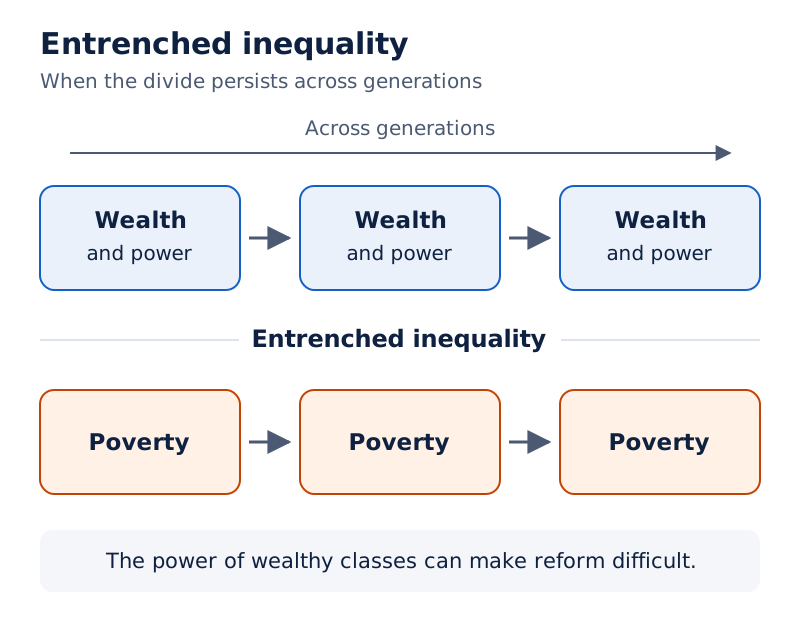
Draw two parallel sequences: wealth across generations with associated power, and poverty across generations. Label the resulting divide “entrenched inequality”. Add a note that the power of wealthy classes can make reform difficult.
Drawn by One Young India.
Opportunity and mobility are therefore important to the discussion of economic equality. Reducing inherited obstacles is different from insisting that every choice or effort must produce an identical result.
How does feminism explain inequality between women and men?
Feminism is a political doctrine supporting equal rights for women and men. Feminists include both women and men who believe that many inequalities between the sexes are neither natural nor necessary and can be changed.
What is patriarchy?
Patriarchy is a social, economic and cultural system that values men more than women and gives men power over women. It presents differences between the sexes as a justification for unequal positions in society.
Feminists challenge this reasoning by distinguishing sex, meaning biological differences, from gender, meaning the different roles assigned to women and men in society. A biological difference does not by itself justify an unequal social role.
For example, women's capacity to bear children does not establish that women alone should look after children. The assignment of responsibility for childcare is a social arrangement, rather than an inevitable consequence of childbirth.
What are the public/private division and double burden?
Patriarchal arrangements associate women with domestic or private matters and men with work in the public domain. Feminists question this division by pointing out that most women all over the world work outside the home while remaining solely responsible for housework.
This combination is called the double burden. In this feminist account, despite carrying responsibilities in both areas, women are given little or no say in decisions taken in the public domain. Feminists challenge the gender inequalities sustained by this arrangement.
| Concept | Meaning in the feminist argument |
|---|---|
| Sex | Biological differences between women and men. |
| Gender | Socially assigned roles for women and men. |
| Patriarchy | A system that values men more highly and gives them power over women. |
| Double burden | Responsibility for housework alongside work outside the home. |
The feminist claim is that many inequalities attributed to nature are produced by society. Changing those arrangements can enable both women and men to lead freer and more equal lives.
How do Marxist and liberal approaches to equality differ?
Marxism and liberalism offer different explanations of entrenched inequality and different ways of addressing it. Their disagreement concerns the role of property, political power, competition and state intervention.
How does private ownership create unequal power?
Marx, a nineteenth-century thinker, identified private ownership of important economic resources as a root cause of entrenched inequality. Resources such as land, forests and oil give owners wealth, but also influence over political decisions.
Owners can use this power to influence state policies and laws, creating a possible threat to democratic government. Marxists and socialists argue that economic inequality supports social distinctions of rank and privilege.
On this view, providing equal opportunities is not enough. Addressing inequality also requires public control over essential resources and forms of property. The economic basis of unequal power must be confronted.
Why do liberals defend fair competition?
Liberals regard competition under free and fair conditions as the most just and efficient way to distribute resources and rewards. People should receive rewards for their talents and efforts, with opportunities open to all.
This does not exclude every role for the state. Liberals accept that intervention may be needed to ensure a minimum standard of living and equal opportunities. Their argument is that these measures should support fair competition.
Competitive admission to professional courses illustrates this approach. Regulation of institutions and entrance tests can seek to ensure a fair chance, even though limited seats mean that not every candidate gains admission.
| Question | Marxist emphasis | Liberal emphasis |
|---|---|---|
| What sustains inequality? | Private ownership of major resources and the political power it gives owners. | Unjust and entrenched barriers that prevent individuals from developing capabilities. |
| What should be done? | Go beyond equal opportunities towards public control of essential resources. | Ensure fair opportunities and open competition, with necessary state intervention. |
| How are inequalities related? | Economic inequality supports social rank and privilege. | Political, social and economic inequalities are not necessarily linked and may need different remedies. |
For liberals, inequality itself is not always the problem. Their concern is with unjust and entrenched inequalities. For Marxists, the concentration of economic resources is central to understanding why unequal power persists.
What does socialism seek, and what was Lohia's Sapta Kranti?
Socialism refers to political ideas that developed in response to inequalities present in, and reproduced by, industrial capitalism. Its central concerns are reducing inequality and distributing resources justly.
What role should government play?
Socialists are not entirely opposed to markets. They favour government regulation, planning and control in important areas such as education and health care. Public action is needed to address inequalities that economic arrangements can reproduce.
The socialist concern extends beyond the legal permission to compete. It asks whether the distribution of resources enables people to enjoy a fair position in society and whether existing institutions perpetuate disadvantage.
Why did Lohia call for simultaneous struggles?
The Indian socialist thinker Rammanohar Lohia argued against treating class inequality as the only inequality worth fighting. He maintained that different inequalities had independent roots and had to be challenged separately and simultaneously.
He identified five inequalities: between women and men, based on skin colour, based on caste, arising from colonial rule, and economic inequality. Ending economic inequality alone would not automatically end the others.
To these struggles he added the protection of civil liberties against unjust interference in private life and a struggle for non-violence. The latter involved renouncing weapons in favour of Satyagraha. Together these formed his Sapta Kranti, or seven revolutions.
- Equality between women and men.
- Opposition to inequality based on skin colour.
- Opposition to caste inequality.
- Opposition to colonial rule.
- Opposition to economic inequality.
- Defence of civil liberties and private life against unjust encroachment.
- Non-violence and Satyagraha in place of weapons.
Lohia's position broadens the understanding of socialist struggle. It recognises several sources of domination and insists that action against one should not postpone action against the others.
How can formal equality and differential treatment promote equal rights?
Formal equality begins by ending systems of privilege and restriction protected by law or custom. Historically, poor people were denied voting rights in many countries, women were excluded from professions, and India's caste system restricted the work open to subordinated castes.
What must law change?
The government and law must stop protecting such inequalities. The Indian Constitution prohibits discrimination on grounds of religion, race, caste, sex or place of birth, and abolishes untouchability.
Equal treatment by law is therefore essential. A person's caste, religion, race or gender should not determine whether legal protection and opportunities are available.
Why may equal rights require different arrangements?
Differential treatment can help people overcome barriers to enjoying the same rights. A ramp at a public building enables access for people with disabilities. An identical entrance arrangement for everyone may leave that access unequal.
Women working at night in call centres may need special protection during travel to and from work. Such support can protect their equal right to work. Its purpose is to make the right effective.
Women's struggles also revealed the need for maternity leave and crèches at workplaces. Equal rights to education, voting and work were important, but practical arrangements were needed to enable women to combine professional and personal life.
| Measure | Barrier addressed | Purpose |
|---|---|---|
| Ramps in public spaces | Difficulties of physical access. | An equal chance to enter public buildings. |
| Protection during night travel | Obstacles to women travelling to and from call-centre work. | Protection of the equal right to work. |
| Maternity leave and workplace crèches | Difficulties women face in combining work and family responsibilities. | Effective enjoyment of equal work opportunities. |
Different treatment must be justified by its contribution to equality. It should not create new structures of domination or become a means for already dominant groups to reclaim privilege.
What is affirmative action, and how does it address past disadvantage?
Affirmative action involves positive measures intended to reduce entrenched social inequalities. It starts from the view that establishing equality in law is insufficient when past exclusion has left groups unable to compete on equal terms.
What forms can affirmative action take?
It can involve preferential spending on facilities for disadvantaged communities, including scholarships and hostels. It can also take the form of special consideration in educational admissions and employment.
India has adopted reservations, or quotas of seats in education and jobs, to promote opportunity for deprived groups. Reservations are one form of affirmative action; they do not exhaust the range of possible measures.
Why is special help defended?
Groups subjected to social prejudice, exclusion and segregation have experienced the cumulative effects of unequal opportunities. Ending a discriminatory rule does not immediately remove those accumulated disadvantages.
A first-generation learner whose parents and ancestors were illiterate faces circumstances different from those of someone born into an educated family. Equal consideration must therefore be accompanied by concern for the fairness of the competition itself.
The justification for assistance is that it can help disadvantaged groups overcome existing obstacles and later compete on equal terms. Special assistance is envisaged as temporary or time-bound, rather than as an end in itself.
Note: The case for affirmative action concerns the cumulative effects of social disadvantage. Formal permission to compete does not immediately give previously excluded groups the same starting conditions as more privileged groups.
Educational disadvantage can continue across stages of life. Poor school facilities can hinder qualifications; a lack of money for coaching and high professional-course fees can further limit access. These barriers help explain why social policy may need to do more than announce equal rights.
The intended outcome is an egalitarian society in which disadvantaged people have a fair chance to develop their abilities and pursue opportunities.
How should the debate over reservations and differential treatment be assessed?
The debate over affirmative action involves competing understandings of equality. Supporters stress the need to overcome inherited disadvantage. Critics stress each individual's right to equal treatment and question whether group-based preferences can produce greater equality.
What are the main objections and responses?
Critics describe reservations as reverse discrimination. They argue that quotas can unfairly deny others equal consideration and reinforce caste or racial distinctions that an equal society should seek to remove.
Supporters reply that apparently identical competition can remain unfair where some groups have suffered exclusion for generations. The state may need to help make people equal in their ability to compete, while respecting their equal worth.
There is also disagreement about policy design. Should support use reserved seats or facilities that develop abilities from an early age? Should deprivation be identified through economic circumstances or social inequalities associated with caste?
How can a proposal be examined carefully?
The following questions organise the central considerations in assessing differential treatment. They focus on its justification and effects, rather than assuming that every difference in treatment is either fair or unfair.
- Identify the barrier: What social or economic disadvantage prevents a group from enjoying equal opportunities?
- Examine effective rights: Can those affected use the same rights as others without additional support?
- Assess the proposed help: Would special facilities, assistance or reservations help create a fair chance to compete?
- Check for domination: Could the measure produce fresh oppression or restore the privileges of a dominant group?
- Judge its contribution: Does the policy help make society more egalitarian and fair to all?
This is a framework for reflection, not an automatic answer to every policy dispute. Special treatment requires careful justification because differential treatment has also supported oppressive institutions such as caste hierarchy and apartheid.
The guiding distinction remains between treating everyone identically and treating everyone as equal. Different arrangements are justified when they are needed to secure equal rights and a fairer society.
Glossary
- Equality — The ideal that all human beings deserve equal consideration and respect because of their common humanity.
- Equality of opportunity — Equal rights and chances to develop skills and talents and pursue goals without disadvantages predetermined by birth.
- Natural inequalities — Differences associated with the capabilities and talents with which people are born.
- Socially produced inequalities — Differences arising from unequal opportunities, social arrangements or the exploitation of some groups by others.
- Political equality — Equal citizenship and basic rights enabling people to develop themselves and participate in the affairs of the state.
- Economic inequality — Significant differences in wealth, property or income between individuals or classes in society.
- Entrenched inequality — Inequality that remains relatively unchanged across generations, sustaining divisions between wealthy and poor groups.
- Feminism — A political doctrine supporting equal rights for women and men and challenging gender inequalities produced by society.
- Patriarchy — A social, economic and cultural system that values men more than women and gives men power over women.
- Double burden — Women's responsibility for housework alongside their participation in work outside the home.
- Socialism — Political ideas responding to inequalities reproduced by industrial capitalism and seeking reduced inequality and just resource distribution.
- Formal equality — Equal legal treatment that ends legally protected restrictions and privileges based on social identity.
- Differential treatment — Different arrangements for people whose circumstances require additional help to enjoy the same rights as others.
- Affirmative action — Positive measures designed to correct the cumulative effects of past disadvantage and reduce entrenched social inequality.
- Reservations — Quotas or reserved seats in education and jobs intended to improve equality of opportunity for deprived groups.
Common errors and misconceptions
- Misconception: Equality requires everyone to have the same career, income and achievements. Correct: People can differ in choices, talents and success; the concern is whether birth and social circumstances unfairly determine opportunities.
- Misconception: Any inequality described as natural must be unchangeable. Correct: Social inequalities may be misrepresented as natural, and assistance or technology can reduce the effects of some natural differences.
- Misconception: Equal voting rights establish complete equality. Correct: Political rights are essential, but unequal resources, social customs and inadequate facilities may continue to prevent fair opportunities.
- Misconception: Feminism treats every difference between women and men as biological. Correct: Feminists distinguish biological sex from socially assigned gender roles and challenge inequalities produced by those roles.
- Misconception: Liberals reject every kind of state intervention. Correct: Liberals accept that intervention may be necessary to secure minimum living standards and fair opportunities for competition.
- Misconception: Socialists believe markets must be rejected in every sphere. Correct: Socialists are not entirely opposed to markets, but favour regulation, planning and control in key areas.
- Misconception: Affirmative action means reservations alone. Correct: It also includes measures such as scholarships, hostels and preferential spending on facilities for disadvantaged communities.
- Misconception: Every form of differential treatment promotes equality. Correct: It requires justification in terms of equal rights and must not create domination or restore special privileges.
Exam-style questions with model answers
Q1. Define equality as a moral and political ideal. Does it require identical achievements? [2 marks]
- Equality means that all human beings deserve equal consideration and respect because of their common humanity.
- It does not require identical achievements. Different talents and choices can produce different outcomes, provided birth and social circumstances do not unfairly determine opportunities.
Q2. Distinguish natural inequalities from socially produced inequalities, and state one reason why the distinction is difficult to apply. [2 marks]
- Natural inequalities are associated with differences in capabilities and talents; socially produced inequalities arise from unequal opportunities or exploitation.
- The distinction is difficult because long-established social inequalities may be wrongly presented as consequences of unchangeable natural differences.
Q3. A society guarantees voting rights and freedoms of expression, movement, association and belief. Some citizens still lack adequate health care, nourishment and good education. Explain why political equality alone does not establish equality of opportunity in this situation. [4 marks]
- The guaranteed rights provide political equality by recognising equal citizenship and enabling participation in public affairs.
- However, legal rights do not automatically remove differences in citizens' resources or living conditions.
- Inadequate health care, nourishment and education prevent some citizens from developing their capabilities and competing on fair terms.
- Political equality therefore needs social and economic support. Improving these minimum conditions would help create a level playing field while preserving equal legal rights.
Q4. Women work outside the home but remain responsible for housework, while men are treated as responsible for public matters. Explain this arrangement using patriarchy, gender roles and the double burden. [4 marks]
- Patriarchy is a system that values men more than women and gives men power over women. The stated division reflects its association of women with domestic matters and men with public affairs.
- Gender roles are socially assigned responsibilities. Women's responsibility for all housework is not established simply by biological differences.
- Combining paid or other work outside the home with responsibility for housework creates the double burden.
- Feminists challenge this division because socially produced roles sustain inequality even when women also participate in public work.
Q5. Compare Marxist and liberal views on entrenched inequality, the distribution of resources and the role of the state. [6 marks]
- Marxists identify private ownership of important economic resources as a root cause of entrenched inequality. Ownership concentrates wealth in the hands of a particular class.
- Economic ownership also gives political power. Owners can influence laws and policies, while economic inequality supports social distinctions of rank and privilege.
- Marxists therefore seek public control of essential resources and forms of property, going beyond the provision of equal opportunities.
- Liberals defend free and fair competition as the most just and efficient means of distributing rewards according to talents and efforts.
- They accept that the state may need to secure a minimum standard of living and equal opportunities. Their position does not rule out intervention.
- Liberals do not regard political, social and economic inequalities as necessarily linked. They favour appropriate remedies for each, particularly where entrenched barriers prevent individual development.
Q6. A first-generation learner comes from a family whose parents and ancestors were illiterate, attends a poorly equipped school and cannot afford special coaching or high professional-course fees. Other applicants come from educated families and have better facilities. Explain the case for affirmative action, two possible forms of assistance, one criticism and one safeguard. [6 marks]
- The learner's disadvantages show why formal permission to compete does not create equal starting conditions. Family circumstances, poor schooling and financial barriers can cumulatively restrict opportunity.
- Affirmative action seeks to reduce such entrenched disadvantage so that deprived groups can develop their abilities and compete more fairly.
- One form of assistance is scholarships or hostels for disadvantaged learners.
- Another form is special consideration through reserved seats in education or jobs.
- Critics argue that reservations can deny other individuals equal treatment and reinforce social distinctions. They describe this as reverse discrimination.
- The defence is that fair competition may require help for previously excluded groups. A safeguard is to judge whether special treatment advances equal rights without producing fresh domination or restoring privilege.
Q7. State the five inequalities Lohia wanted to fight simultaneously and the two further struggles that completed his Sapta Kranti. Explain why he rejected an exclusive focus on class inequality. [6 marks]
- Lohia called for a struggle against inequality between women and men.
- He called for a struggle against inequality based on skin colour.
- He called for a struggle against caste inequality.
- He called for a struggle against colonial rule of some countries over others.
- He called for a struggle against economic inequality.
- He added a struggle for civil liberties against unjust encroachments on private life.
- He also added a struggle for non-violence, involving the renunciation of weapons in favour of Satyagraha.
- Together these were the seven revolutions, or Sapta Kranti, which expressed his socialist ideal.
- He rejected the belief that ending class inequality would automatically remove every other inequality. Different inequalities had independent roots, so they had to be fought separately and simultaneously. Action against economic inequality could not justify postponing the other struggles.
Q8. People with disabilities need ramps to enter public buildings. Women working in call centres at night may need protection while travelling to and from work. Explain why these different arrangements can support equality, and state a condition for their justification. [4 marks]
- Equality means enabling people to enjoy the same rights, which may require different arrangements when their circumstances create different barriers.
- Ramps give people with disabilities an equal chance to enter public buildings. Travel protection can help women exercise their equal right to work.
- These arrangements respond to obstacles to effective access rather than denying anyone equal human worth.
- Differential treatment is justified when it promotes equal rights and a fairer society. It must not create new domination or become a means of restoring special privileges.
Key takeaways
- Equality begins with equal human worth and requires equal consideration and respect, regardless of colour, gender, race or nationality.
- Different choices, talents and achievements are compatible with equality when birth and social circumstances do not unfairly determine opportunities.
- The distinction between natural and social inequalities is difficult because social prejudice can disguise itself as an account of nature.
- Political, social and economic equality address different barriers, and legal rights alone cannot ensure fair opportunities for everyone.
- Feminists distinguish biological differences from socially assigned roles and challenge patriarchy, the public/private division and women's double burden.
- Marxists stress ownership and economic power, while liberals emphasise fair competition and the removal of entrenched obstacles to individual development.
- Lohia's Sapta Kranti called for simultaneous struggles against different inequalities, alongside the defence of civil liberties and non-violence.
- Affirmative action seeks to correct accumulated disadvantage, but differential treatment must be justified by its contribution to equal rights and fairness.
Test yourself
What distinguishes equal treatment from identical treatment?
Equal treatment respects equal worth and rights. Achieving it may require different arrangements where people's circumstances create different barriers.
Why is unequal access to education a concern for equality?
It restricts the development of talents and skills, preventing people from competing for opportunities on fair terms.
What makes an economic inequality entrenched?
It remains relatively unchanged across generations, with some groups retaining wealth and power while others remain poor.
How do feminists distinguish sex from gender?
Sex refers to biological differences between women and men; gender refers to the different roles assigned to them in society.
Why does Marx link economic ownership to political inequality?
Ownership of important resources gives wealth and political power, enabling owners to influence laws and state policies.
What state intervention can liberals accept?
They can accept intervention to secure minimum living standards and equal opportunities, supporting competition under free and fair conditions.
Name two forms of affirmative action besides reservations.
Scholarships and hostels are forms of assistance; preferential spending on facilities for disadvantaged communities is another approach.
What test should guide the justification of differential treatment?
It should enable equal enjoyment of rights and promote a fairer society without creating new domination or restoring privilege.