
Federalism | CBSE Class 11 Political Science Notes
On this page
Watch & explore
Start with a few high-quality watches, then dive into the notes below.

This note covers federalism, national and regional identities, the division of powers, India’s strong central government, Centre-State relations, demands for autonomy, Governors and President’s rule, the creation of States, interstate disputes, special provisions and the changing status of Jammu and Kashmir.
What is federalism, and how does it accommodate diversity?
Definition: Federalism is an institutional arrangement accommodating governments at regional and national levels, with each autonomous in its own sphere. Autonomy means the ability to govern within that sphere.
A polity is an organised political community. Federalism accommodates two sets of polities: one regional and one national. Each level has distinct powers, responsibilities and a separate system of government. Federalism has evolved differently in different historical circumstances; American, German and Indian federalism are not identical.
How do two identities coexist?
People can belong to a region and the nation together. Being Gujarati or Jharkhandi can coexist with being Indian. Regional loyalty need not displace national belonging. Some federal countries have dual citizenship, meaning citizenship at both levels, but India has only a single citizenship.
The division is generally recorded in a written constitution, the supreme framework from which both governments receive their powers. Defence and currency concern the whole nation and belong to the central government. Regional or local matters belong to regional governments.
An independent judiciary, meaning courts able to settle legal questions independently, resolves disputes over the distribution of powers. Constitutional arrangements matter, but political parties, history, culture and ideology also shape how a federation actually works.
Why is cooperation essential?
A culture of trust, mutual respect, cooperation and restraint helps a federation work smoothly. Domination by one State, linguistic group or ideology could generate resentment among others. It could encourage secession, the demand to leave the federation, or even civil war.
India has more than 20 major languages, several hundred minor languages, several major religions and several million indigenous people. Shared territory and history, especially the struggle for independence, connect these diversities. Federalism seeks to sustain unity with diversity rather than erase regional identities.
What do the West Indies and Nigeria reveal about federalism?
A federal constitution by itself cannot guarantee unity. Excessive centralisation, an ineffective centre or distrust between communities can undermine the arrangement. Centralisation means concentrating decision-making power at the national level rather than distributing it among the constituent regions.
How did the West Indies federation develop?
The British-colonised West Indies formed a federation in 1958. Its central government was weak, each unit had an independent economy, and the units competed politically. Together, these conditions contributed to its formal dissolution in 1962.
In 1973, the Treaty of Chiguaramas established joint authorities through the Caribbean Community. These included a common legislature, or law-making body, supreme court, currency and, to a degree, a common market for economic exchange. Its common executive, the body administering shared affairs, included the heads of member governments. Separation therefore did not end the need for cooperation.
Why did Nigeria experience conflict?
Northern and Southern Nigeria were separate British colonies until 1914. At the Ibadan Constitutional Conference of 1950, Nigerian leaders chose a federal constitution. Yoruba, Ibo and Hausa-Fulani groups controlled the western, eastern and northern regions respectively.
Attempts to extend influence beyond these regions created fears and conflict, followed by military rule. Under the 1960 constitution, federal and regional governments jointly controlled the police. Under the military-supervised 1979 constitution, no State could have civil police.
Democracy returned in 1999, but religious differences and disputes over oil revenues, meaning income from oil resources, continued. Local ethnic communities resisted centralised control of oil resources. Nigeria illustrates the overlap of religious, ethnic and economic divisions, and the importance of trust between regions.
The USSR, the Union of Soviet Socialist Republics, broke into several countries after 1989. Excessive centralisation and Russian domination over culturally distinct regions, such as Uzbekistan, were major reasons. Canada came very close to division between English-speaking and French-speaking regions; Czechoslovakia, Yugoslavia and Pakistan also experienced division.
Why did India adopt a federal Constitution?
Before independence, most national leaders recognised that governing a large, diverse country required sharing powers between the centre and provinces. Regional and linguistic differences needed recognition. Democracy also required people in each region to have a role in governing themselves.
How did Partition affect the arrangement?
Before Partition, the division of British India into India and Pakistan, negotiations considered granting very extensive regional powers. This was connected with the Muslim League’s demand for greater Muslim representation.
After the decision to partition India, the Constituent Assembly, the body framing the Constitution, chose unity and cooperation between the centre and States, alongside separate State powers. Recognition of diversity was combined with an emphasis on national unity.
The Constitution does not use the word “federation”. Article 1, a numbered constitutional provision, describes India, that is Bharat, as a Union of States. It places the specification of States and their territories in the First Schedule, the relevant constitutional list.
What do changing States demonstrate?
At independence in 1947, British provinces had been organised for administrative convenience. Princely states, territories governed by hereditary rulers, joined the Indian Union and were combined with existing provinces. Since then, State boundaries and names have changed repeatedly, including Mysore becoming Karnataka and Madras becoming Tamil Nadu.
What the figure shows
India in 1947
The map labels areas including Bombay, Madras, Central Provinces and Hyderabad. Its boundaries and names show the territorial arrangement around independence.
Reference: NCERT Class 11, p. 151; unnumbered map
What the figure shows
India Political
The map labels States including Gujarat, Maharashtra, Karnataka and Telangana, and also labels Ladakh. Comparing the two maps reveals changes in territorial organisation and names.
Reference: NCERT Class 11, p. 152; unnumbered map
These changes show that federalism accommodates regional wishes within a common country. The continued existence of the Union does not require every internal boundary or State name to remain unchanged.
How are legislative and financial powers divided?
The Union government governs the country as a whole; a State government governs a constituent State. Both possess constitutional status and identified areas of activity. A legislature is the institution that makes laws. The Constitution distributes legislative subjects through three lists and residuary powers.
| Category | Subjects illustrated | Who can legislate? |
|---|---|---|
| Union List | Defence; atomic energy; foreign affairs; war and peace; banking; railways; post and telegraph; airways; ports; foreign trade; currency and coinage | The Union legislature alone makes laws on these matters. |
| State List | Agriculture; police; prison; local government; public health; land; liquor; trade and commerce; livestock and animal husbandry; State public services | Normally only the State legislature makes laws on these matters. |
| Concurrent List | Education; transfer of property other than agricultural land; forests; trade unions; adulteration; adoption and succession | Both Union and State legislatures can make laws on these matters. |
| Residuary powers | All matters absent from the three lists, such as cyber laws | The Union legislature alone has legislative power. |
What is the significance of residuary powers?
Residuary powers cover subjects that are not mentioned in any list. Cyber laws, laws concerning activity in cyberspace, illustrate this category. They show why dividing known subjects between lists also requires identifying who can legislate on matters outside those lists.
What the figure shows
Division of powers
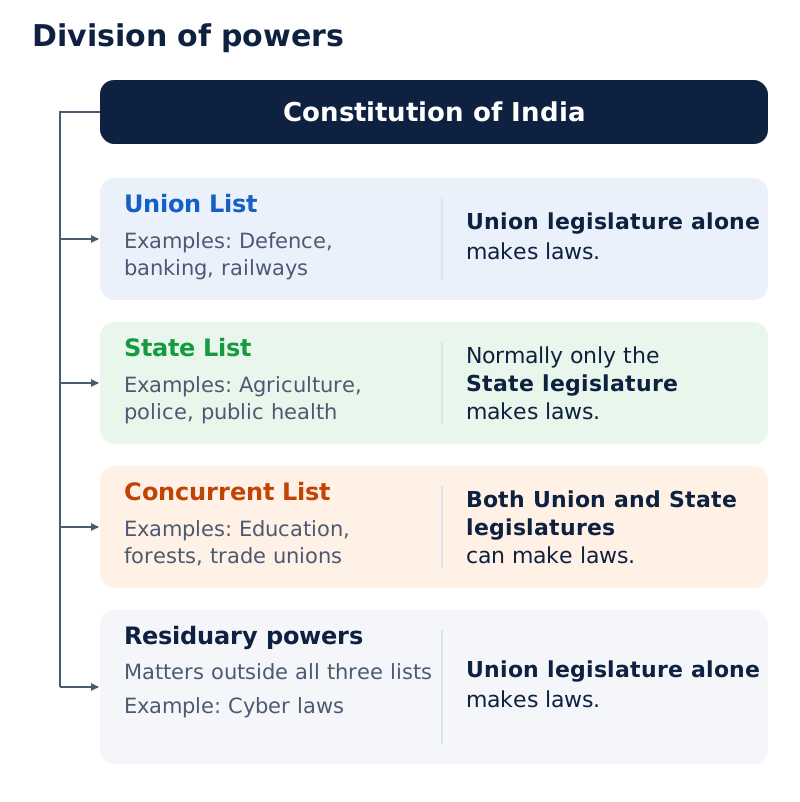
A top box labelled “Constitution of India” connects to columns for the Union, State and Concurrent Lists. A lower box identifies residuary powers and gives cyber laws as an example.
Drawn by One Young India. Reference: NCERT Class 11, p. 159; unnumbered chart
Why are States dissatisfied with financial powers?
The division of responsibilities is accompanied by a concentration of economic and financial powers in the centre. States have immense responsibilities but very meagre revenue sources. Revenue means the income available to government for meeting its responsibilities.
Consequently, constitutional recognition of a State’s sphere does not ensure financial independence. Many revenue-generating items remain centrally controlled, while States are mostly dependent on central grants, meaning financial assistance, and other central support. Disputes about which government holds a constitutional power can be resolved by the judiciary.
Why did the Constitution create a strong central government?
It is generally accepted that the Indian Constitution created a strong centre. The framers wanted a federal arrangement that accommodated diversity while preventing disintegration and enabling social and political change. Unity and development were the connected reasons for this choice.
Why did integration matter?
At independence, India contained British-created provinces and more than 500 princely states. These princely states had to be integrated with existing States, or new States had to be created. The challenge was therefore larger than simply assigning powers within settled boundaries.
A strong centre was intended to help keep this diverse country together. At the same time, the Constitution retained State governments and distinct State responsibilities. Strength at the centre was combined with recognition that regional diversity needed space.
How was development connected with central power?
Poverty, illiteracy and inequalities of wealth required planning and coordination. The framers believed a strong central government, working with the States, could address these social and economic problems. They did not treat the need for national unity as separate from the need for development.
In the Constituent Assembly on 25 November 1949, T. T. Krishnamachari linked movement towards stronger centres with the growth of welfare responsibilities. A welfare state takes responsibility for people’s economic well-being, rather than functioning merely as a police state concerned with maintaining order.
The central question is thus how to combine national coordination with regional self-government. The reasons for a strong centre explain its design, but they do not remove the importance of cooperation or settle every later demand for greater State autonomy.
Which constitutional arrangements strengthen the centre?
The centre’s strength appears in territorial, emergency, financial, legislative and administrative arrangements. A unitary bias means that, within a federal structure, the distribution of authority favours the central government. It does not mean that State governments lack constitutional status.
How do territory, emergencies and finance matter?
Parliament, the national legislature, can create a State by separating territory or combining States. It can alter a State’s boundary or name. The Constitution provides safeguards through securing the views of the State legislature concerned.
Emergency provisions are constitutional arrangements permitting exceptional concentrations of power. During an emergency, the federal system can become highly centralised, and Parliament can legislate on subjects within the States’ sphere.
The centre controls many revenue sources and exercises discretion in distributing grants and loans, meaning assistance that must be repaid in the case of loans. After independence, planning concentrated economic decisions. The Planning Commission, appointed by the Union government, coordinated and supervised the management of State resources under that planning arrangement.
This distribution of economic resources is considered lopsided and has produced accusations of discrimination against opposition-ruled States. Dependence on such assistance affects the practical scope of State autonomy.
How can central authority affect State decisions?
| Arrangement | Effect on State authority |
|---|---|
| Governor’s power to reserve bills | The Governor, an appointed constitutional office-holder in the State, can reserve a bill, or proposed law, for Presidential assent, meaning approval, allowing delay, examination or rejection. |
| Rajya Sabha approval | A move for central legislation on State List matters can be ratified, or formally approved, by the Rajya Sabha, Parliament’s chamber representing States. |
| Article 257(1) | State executive power must not obstruct or prejudice Union executive power; the Union can issue necessary directions for that purpose. |
| All-India services | Officers serve in State administration but remain under central control; States cannot remove them from service or take disciplinary action against them. |
Executive power is the authority to administer and carry out government decisions. Article 257(1) makes clear why central directions can constrain a State’s exercise of that authority.
Article 33 and Article 34 authorise Parliament to protect Union or State personnel for actions to maintain or restore order during martial law, military control used to maintain order. The Armed Forces Special Powers Act was made on the basis of these provisions and has caused tensions between people and armed forces on some occasions.
How have political changes shaped demands for autonomy?
A constitution supplies a framework, but political practice shapes federal relations. States’ separate identities encourage expectations of a greater role in governing both themselves and the country. Legal disputes can be settled by courts; political demands for autonomy require negotiation.
How did Centre-State relations change?
| Period | Political setting | Effect on federal relations |
|---|---|---|
| 1950s and early 1960s | Congress dominated the centre and States under Jawaharlal Nehru. | Relations remained quite normal except over new States. States expected central grants and development policies to support progress. |
| Middle of the 1960s | Congress dominance declined somewhat; opposition parties governed many States. | Demands for greater powers intensified as States protested against perceived central interference. |
| Coalition phase beginning in the 1990s | Coalition politics, involving alliances of parties, grew especially at the centre; national and regional parties governed different States. | States gained a greater say, with more respect for diversity and the beginning of more mature federalism. |
A coalition is an alliance of parties governing together. The contrast between these phases shows that the same constitutional framework can operate differently as party relationships change. The autonomy issue became particularly potent politically during the second phase.
What are the four dimensions of autonomy?
- Legislative autonomy: States demand more powers and more important subjects. Tamil Nadu, Punjab and West Bengal have raised such demands, as have parties including Dravida Munnetra Kazhagam (DMK), Akali Dal and the Communist Party of India (Marxist), abbreviated CPI-M.
- Financial autonomy: States seek independent revenue sources and greater control of resources. In 1977, West Bengal’s Left Front government proposed restructuring Centre-State relations. Tamil Nadu and Punjab’s demands also implicitly supported greater financial powers.
- Administrative autonomy: States resent central control over the administrative machinery, meaning the officials and institutions carrying out government work.
- Cultural and linguistic autonomy: Demands include opposition to Hindi domination in Tamil Nadu and promotion of Punjabi language and culture. Some States experienced agitation against Hindi imposition during the 1960s.
These examples show that autonomy can concern political powers, money, administration or cultural identity, rather than one uniform demand.
Cartoon: Shankar’s cartoon dated 18 September 1949 shows Nehru appealing to a group in which a man raises a stick while others restrain him. Caption: “During discussion on the national language in the Constituent Assembly, Nehru had to appeal to the Hindi-speaking provinces to show greater tolerance towards others.”
Why are Governors and President’s rule controversial?
The Governor is a State’s appointed constitutional office-holder. Governors are not elected and are appointed by the central government. Many have been retired military officers, civil servants or politicians. Their actions are often seen as central interference, particularly when different parties govern at the two levels.
The Sarkaria Commission (1983), appointed to examine Centre-State relations, submitted its report in 1988. It recommended strictly non-partisan appointments of Governors, meaning appointments free from party bias.
Cartoon: Shankar’s cartoon dated 27 April 1952 shows Nehru kicking men who cling to their chairs upwards towards a building labelled “Governors”; curved motion lines trace their flight. The drawing reads “KICKING UPSTAIRS”. Caption: “When Nehru was appointing governors, some were reluctant to quit ministerial chairs.”
How does Article 356 operate?
Article 356 provides for President’s rule when a State government cannot be carried on according to the Constitution. President’s rule means the Union government takes over the State government. A proclamation is the President’s formal declaration bringing this arrangement into operation.
- Constitutional basis: The relevant situation is inability to govern the State in accordance with constitutional provisions.
- Governor’s recommendation: The Governor can recommend dismissal of the State government and suspension or dissolution of the State assembly.
- Presidential proclamation: President’s rule brings about the Union’s takeover of the State government.
- Parliamentary ratification: Parliament must approve the President’s proclamation. President’s rule can be extended till three years.
- Possible judicial examination: Courts can examine the constitutional validity of imposing President’s rule; review is not automatically required in every instance.
Suspension places the assembly’s functioning in abeyance; dissolution ends that assembly. Ratification means formal approval. These are distinct from merely criticising a State government or disagreeing with the party that governs it.
What examples show the controversy?
Kerala’s government was dismissed in 1959 despite its legislative majority. In several States after 1967, governments were dismissed without testing their majority. A State government must retain the confidence of the Legislative Assembly. In a floor test, the ordinary rule is a majority of members present and voting; the presiding officer votes only to break a tie.
Article 356 was used very sparingly until 1967. Subsequently, the centre often used it to dismiss State governments or used Governors to prevent a majority party or coalition taking office. Elected governments in Andhra Pradesh and Jammu and Kashmir were removed in the 1980s.
Some dismissals reached the Supreme Court, which ruled that courts can examine their constitutional validity. This matters because a constitutional power intended for a particular situation can become a source of conflict when used amid party competition.
How and why were new States created?
The national movement built an all-India identity while also strengthening identities based on language, region and culture. Its democratic character encouraged the idea that, as far as possible, States should reflect common cultural and linguistic identities. A linguistic State is organised around a shared language.
The States Reorganisation Commission (December 1953) recommended linguistic States, at least for major linguistic groups. Reorganisation in 1956 began this process. New State demands therefore involved democratic recognition of regional identities as well as changes in administration.
| Date or phase | Reorganisation |
|---|---|
| 1960 | Gujarat and Maharashtra were created. |
| 1966 | Punjab and Haryana were separated. |
| Later North Eastern reorganisation | New States included Manipur, Tripura, Meghalaya, Mizoram and Arunachal Pradesh. |
| 2000 | Madhya Pradesh, Uttar Pradesh and Bihar were divided to create Chhattisgarh, Uttarakhand and Jharkhand respectively. |
| 2014 | Telangana was formed by dividing Andhra Pradesh. |
Cartoon: Shankar’s cartoon dated 26 July 1953 shows Nehru seated on the ground as a crowd advances towards him. Figures at the front have Statehood demands written on their shirts. Caption: “Flood of demands for creating new States”.
The divisions in 2000 responded both to demands for separate States and to the need for greater administrative efficiency. Administrative efficiency means the capacity to organise and carry out government work effectively.
Language is consequently important, but it does not explain every demand or every division. Regional wishes and administration also matter. Vidarbha in Maharashtra illustrates a region seeking separate Statehood. A demand for Statehood within India differs from a demand to secede from India.
Why do interstate disputes require negotiation?
Interstate disputes are disagreements between two or more States. Two recurring forms concern borders and river waters. Courts can arbitrate legal issues, but the disputes have political implications. Negotiation and mutual understanding are therefore essential to resolving them.
Why are border disputes difficult?
Even when language helps define State boundaries, border populations often speak more than one language. A simple linguistic majority does not easily settle every competing claim. Territory can carry strong emotional significance for communities and State governments.
| Dispute | States and issue |
|---|---|
| Belgaum | Maharashtra and Karnataka have a long-standing territorial dispute over the city. |
| North Eastern border | Manipur and Nagaland have a long-standing border dispute. |
| Chandigarh and border areas | Punjab and Haryana dispute territory and Chandigarh, which houses both State capitals. |
| Kaveri waters | Tamil Nadu and Karnataka depend on the river for their farmers’ water requirements. |
| Narmada waters | Gujarat, Madhya Pradesh and Maharashtra dispute the sharing of river water. |
In 1985, Prime Minister Rajiv Gandhi reached an understanding with Punjab’s leadership under which Chandigarh was to go to Punjab. That transfer has not taken place. The example shows how an understanding can leave a difficult political dispute unresolved.
Why are water disputes especially serious?
River-water disputes concern drinking water and agriculture, making them even more serious than border disputes centred on sentiment. Farmers in both Tamil Nadu and Karnataka depend on Kaveri, also spelt Cauvery, waters.
A river-water tribunal is an adjudicating body for settling water disputes. Despite such a mechanism, the Kaveri dispute reached the Supreme Court. Rivers are major resources; sharing them tests States’ patience and cooperative spirit. Legal decisions operate within these wider political and livelihood concerns.
Why do some States have special provisions, and what changed in Jammu and Kashmir?
Asymmetry means unequal or differentiated arrangements rather than identical treatment. Rajya Sabha representation reflects differing State populations and sizes: smaller States have minimum representation, while larger States receive more. Federalism therefore need not mean identical arrangements for every unit.
Although the general division of powers is common to States, special provisions recognise particular social and historical circumstances. Most concern North Eastern States, including Assam, Nagaland, Arunachal Pradesh and Mizoram, largely because of sizeable indigenous tribal populations with distinct histories and cultures.
These provisions have not been able to stop alienation, a sense of estrangement, and insurgency, armed rebellion, in parts of the region. Special provisions also exist for Himachal Pradesh, Andhra Pradesh, Goa, Gujarat, Maharashtra, Sikkim and Telangana.
What was Jammu and Kashmir’s former position?
Jammu and Kashmir (J&K) was a large princely State with the option of joining India, joining Pakistan or remaining independent. In October 1947, Pakistan sent tribal infiltrators to capture Kashmir. Maharaja Hari Singh sought Indian help and acceded, meaning joined, to the Indian Union.
J&K’s circumstances led to greater autonomy under Article 370. State concurrence, meaning agreement, was required to extend Union and Concurrent List powers beyond the centre’s limited powers. This differed from the automatic application of the three-list division in other States.
Two Presidential constitutional orders, made with State concurrence, applied large parts of the Indian Constitution to J&K. Although it retained a separate constitution and flag, Parliament’s law-making power over Union List subjects became fully accepted.
| Former distinction | Position under the earlier arrangement |
|---|---|
| Emergency due to internal disturbances | It required the State’s concurrence. |
| Financial emergency | The Union could not impose it in the State. |
| Directive Principles | These constitutional guidelines for government policy did not apply in J&K. |
| Article 368 amendments | Changes to the Indian Constitution under this provision could apply with the J&K government’s concurrence. |
What is the revised arrangement?
The former special status under Article 370 no longer exists. The Jammu and Kashmir Reorganisation Act 2019 divided the State into two Union Territories, Jammu and Kashmir and Ladakh. A Union Territory is a territorial unit administered under Union authority. The arrangement took effect on 31 October 2019.
How does Belgium illustrate diversity within a federation?
The Belgian constitutional provisions recognise both communities and regions. This illustrates how a federation’s design can reflect particular linguistic and territorial identities rather than follow a single universal model. A community here identifies a linguistic grouping, while a region identifies a territorial unit.
| Belgian provision | Arrangement described |
|---|---|
| Article 1 | Belgium is a federal State made up of communities and regions. |
| Article 2 | Its communities are French, Flemish and German. |
| Article 3 | Its regions are Walloon, Flemish and Brussels. |
| Article 4 | Its linguistic regions are French-speaking, Dutch-speaking, bilingual Brussels Capital and German-speaking. Each commune, or county borough, belongs to one. |
| Article 5 | Walloon provinces include Walloon Brabant, Hainault, Liege, Luxemburg and Namur. Flemish provinces include Antwerp, Flemish Brabant, West Flanders, East Flanders and Limburg. |
Bilingual means using two languages. Belgium’s communities, territorial regions and linguistic regions are different categories, so their names and numbers should not be treated as interchangeable. India’s Article 1 instead describes a Union of States.
What sustains a cooperative federation?
No legal or institutional formula guarantees smooth federal government. A responsive political system must respect diversity and demands for autonomy. Mutual trust, tolerance and cooperation give constitutional arrangements practical meaning.
Forced unity only generates greater social strife and alienation and tends finally to destroy unity. Federalism instead combines distinct identities within a shared political arrangement. The balance between the centre and States requires continuing political effort, rather than a once-for-all constitutional solution.
Glossary
- Federalism — An institutional arrangement combining national and regional governments, each autonomous within its own sphere.
- Autonomy — The capacity of a government to exercise authority within its constitutionally recognised sphere.
- Union government — The government responsible for the country as a whole within India’s federal arrangement.
- State government — The government of a constituent State, possessing constitutional status and defined responsibilities.
- Union List — Subjects such as defence and currency on which the Union legislature alone makes laws.
- State List — Subjects such as agriculture and police on which normally only State legislatures make laws.
- Concurrent List — Subjects such as education and forests on which both Union and State legislatures can legislate.
- Residuary powers — Legislative powers over matters outside all three lists, assigned to the Union legislature.
- Financial autonomy — A State’s greater control over resources and possession of independent sources of revenue.
- President’s rule — Union takeover of State government when governance cannot proceed according to the Constitution.
- Secession — Separation from a federation, distinct from seeking greater autonomy while remaining within it.
- Linguistic State — A State whose territorial organisation reflects a shared linguistic identity among its people.
- Asymmetry — Differentiated federal arrangements recognising differences in population, size, history or social circumstances.
- Concurrence — Agreement required from a government before specified constitutional powers or provisions can apply.
Common errors and misconceptions
- Misconception: Every federation must grant dual citizenship. Correct: Some federal countries do so, but India has only single citizenship.
- Misconception: State List subjects can never be legislated upon by Parliament. Correct: Normally they belong to State legislatures, but specified arrangements, including emergencies, permit central legislation.
- Misconception: A demand for autonomy necessarily means secession. Correct: Autonomy concerns greater self-government; secession involves leaving the federation.
- Misconception: The Governor is elected by the people of the State. Correct: The Governor is an appointed office-holder, and the appointment comes from the centre.
- Misconception: Political opposition between the centre and a State itself establishes grounds for President’s rule. Correct: Article 356 concerns inability to govern according to constitutional provisions.
- Misconception: Every new State was created solely because of language. Correct: The divisions in 2000 also responded to separate State demands and administrative efficiency.
- Misconception: Jammu and Kashmir still has its former Article 370 special status. Correct: That status no longer exists; the two-Union-Territory arrangement took effect on 31 October 2019.
- Misconception: Courts alone can settle every federal disagreement. Correct: Legal adjudication matters, but political demands and interstate disputes also require negotiation and mutual understanding.
Exam-style questions with model answers
Q1. A federal arrangement gives national and regional governments distinct responsibilities and autonomy in their own spheres. People identify with both their region and nation. Explain these two features of federalism. [2 marks]
- Government operates at national and regional levels, each exercising distinct powers within its own sphere.
- People can maintain regional and national identities together, so regional belonging need not displace membership of the nation.
Q2. Defence belongs to the Union List, agriculture to the State List, education to the Concurrent List and cyber laws to residuary powers. Union List and residuary subjects belong to the Union legislature; normally State subjects belong to State legislatures; concurrent subjects belong to both. Classify the legislative authority for each example. [4 marks]
- Defence belongs to the Union List. The Union legislature alone can make laws on this national subject.
- Agriculture belongs to the State List. Normally only a State legislature makes laws on this subject.
- Education belongs to the Concurrent List. Both the Union and State legislatures can make laws concerning it.
- Cyber laws illustrate residuary powers, covering matters absent from all three lists. The Union legislature alone has this authority.
Q3. The West Indies federation began in 1958 with a weak centre, independent unit economies and political competition, and dissolved in 1962. In 1973 the islands established joint authorities through the Caribbean Community, including a common legislature, supreme court, currency and, to a degree, market. Explain three lessons from this sequence. [3 marks]
- The existence of a federation did not itself ensure unity: the weak centre and independent economies limited the basis for common government.
- Political competition between constituent units contributed to the federation’s dissolution in 1962, showing that political practice matters alongside constitutional form.
- The later joint authorities show that independent islands still needed cooperation. Their common arrangements did not amount to restoring the earlier single country.
Q4. States have demanded more important legislative subjects, independent revenue sources and resource control, less central control of administration, and protection of regional languages and culture. Explain the four dimensions of autonomy represented here. [4 marks]
- Legislative autonomy concerns the distribution of subjects and powers. The demand is to assign more, and more important, responsibilities to States.
- Financial autonomy concerns resources. Independent revenue sources and greater resource control would increase States’ ability to finance their responsibilities.
- Administrative autonomy concerns the machinery of government. States seek reduced central control over the officials and institutions administering State affairs.
- Cultural and linguistic autonomy concerns identity. States demand space for regional languages and cultures and resist perceived domination by another language.
Q5. Parliament can change State territories after securing the concerned legislature’s views; emergency provisions centralise power; the centre controls major revenue sources and financial assistance; Governors can reserve State bills for Presidential assent; and Article 257(1) permits Union directions to prevent obstruction of Union executive power. Explain five ways these arrangements strengthen the centre. [5 marks]
- Territorial authority gives Parliament power to reshape constituent units. Securing a State legislature’s views provides a safeguard, while the power to alter territory remains with Parliament.
- Emergency arrangements lawfully concentrate power at the centre. They allow Parliament to legislate on subjects that otherwise fall within the sphere of State government.
- Control over revenue and financial assistance gives the centre substantial influence. States’ responsibilities are extensive, while their reliance on central assistance affects their practical autonomy.
- Reserving State bills for Presidential assent creates central influence over State legislation. Such bills can face delay, examination or complete rejection at this stage.
- Article 257(1) limits how State executive power may operate. Union directions can ensure that State administration does not obstruct or prejudice the exercise of Union executive authority.
Q6. Article 356 applies when State government cannot operate constitutionally. Governors can recommend dismissal and assembly suspension or dissolution. Parliament must ratify the President’s proclamation; President’s rule can extend till three years. Kerala’s government was dismissed despite its majority in 1959, and courts can examine constitutional validity. Explain six aspects of this arrangement and its controversy. [6 marks]
- The constitutional trigger concerns failure to govern according to the Constitution. It is a specific basis for intervention, rather than a general power to settle political disagreements.
- The Governor’s recommendation can affect both the elected government and assembly. This makes the Governor’s role particularly significant in relations between the centre and States.
- The President’s proclamation requires parliamentary ratification. The takeover of State government therefore includes a requirement of approval by the national legislature.
- President’s rule can be extended till three years. This possible duration makes the use of the provision consequential for the State’s government and representative institutions.
- Kerala’s dismissal in 1959 despite a majority illustrates the controversy. Possession of legislative support did not prevent the elected government from being removed.
- Courts may examine constitutional validity. Judicial scrutiny provides a means of questioning whether a particular decision to impose President’s rule meets constitutional requirements.
Q7. The States Reorganisation Commission was appointed in December 1953 and recommended linguistic States, at least for major linguistic groups. Reorganisation followed in 1956. In 2000, divisions created Chhattisgarh, Uttarakhand and Jharkhand to meet separate State demands and administrative needs. Explain three features of State formation shown here. [3 marks]
- Language supplied an important basis for territorial organisation. The Commission recommended recognition of major linguistic groups through the creation of States.
- Reorganisation developed through a process rather than one isolated decision: the Commission’s appointment in December 1953 was followed by reorganisation in 1956.
- Language was not the sole consideration. The 2000 divisions also answered demands for separate States and the need for greater administrative efficiency.
Q8. J&K formerly had greater autonomy under Article 370, including State concurrence for extending constitutional powers. That special status no longer exists. The Jammu and Kashmir Reorganisation Act 2019 created the Union Territories of Jammu and Kashmir and Ladakh from 31 October 2019. Explain the former basis of J&K’s autonomy and identify two changes under the revised arrangement. [3 marks]
- The former arrangement gave J&K greater autonomy under Article 370. State concurrence played an important role in extending constitutional powers and provisions.
- The former Article 370 special status no longer exists. It should therefore be described historically when explaining the earlier relationship with the Union.
- The 2019 Act divided the former State into Jammu and Kashmir and Ladakh as two Union Territories, with the revised arrangement effective from 31 October 2019.
Key takeaways
- Federalism combines national and regional governments, distinct powers and shared belonging within a supreme constitutional framework.
- India’s Constitution recognises State authority while giving the centre substantial territorial, financial, emergency and administrative powers.
- The Union, State and Concurrent Lists distribute legislative subjects; residuary powers belong to the Union legislature.
- Demands for autonomy can concern legislative authority, financial resources, administrative control, language or cultural identity.
- Governors and President’s rule create controversy when central intervention affects elected State governments and their legislative support.
- State reorganisation reflects linguistic identity, regional demands and administrative needs within the wider Indian Union.
- Border and river-water disputes combine legal questions with political concerns that require negotiation and cooperation.
- Special arrangements recognise diversity; Jammu and Kashmir’s former special status differs from the arrangement effective since October 2019.
- Trust, restraint, tolerance and respect for diversity sustain federalism beyond what constitutional rules alone can guarantee.
Test yourself
How does Article 1 describe India?
It describes India, that is Bharat, as a Union of States.
Who has residuary legislative powers in India?
The Union legislature alone legislates on matters not mentioned in any of the three lists.
What did the Sarkaria Commission recommend about Governors?
It recommended that appointments of Governors should be strictly non-partisan, or free from party bias.
How does autonomy differ from secession?
Autonomy concerns governing within one’s sphere; secession means separation from the federation itself.
Which States were formed from Madhya Pradesh, Uttar Pradesh and Bihar in 2000?
Chhattisgarh, Uttarakhand and Jharkhand were created from those three States respectively.
Which two States are involved in the Kaveri dispute?
Tamil Nadu and Karnataka are involved; farmers in both depend on the river’s waters.
What does Nigeria illustrate about divisions within a federation?
It illustrates how religious, ethnic and economic divisions can overlap and undermine trust between units.
When did the two-Union-Territory arrangement for Jammu and Kashmir and Ladakh take effect?
The arrangement took effect on 31 October 2019 under the Jammu and Kashmir Reorganisation Act 2019.