
Executive | CBSE Class 11 Political Science Notes
On this page
Watch & explore
Start with a few high-quality watches, then dive into the notes below.

This note covers the meaning and types of executive, India's parliamentary system, the President and Vice President, presidential discretion, the Prime Minister and Council of Ministers, collective responsibility, coalition governments, State executives, civil services, recruitment and administrative accountability.
What is the executive and how does it administer government?
Definition: The executive is the organ of government primarily responsible for implementing laws and policies and carrying out administration.
The legislature, executive and judiciary are the three organs of government. Together, they maintain law and order and work for public welfare. The Constitution provides for coordination and balance among them.
What does implementation involve?
Administration involves both major decisions and routine work. A school or university needs people who decide policies and people who put them into practice. Similarly, government needs leadership that sets direction and an administrative organisation that carries out decisions.
The executive implements laws and policies adopted by the legislature. It is often involved in framing policy. It also supervises administration and coordinates government work. Its role therefore extends beyond simply announcing decisions.
How do the political and permanent executives differ?
| Basis | Political executive | Permanent executive |
|---|---|---|
| Composition | Head of government and ministers | Civil servants and administrative machinery |
| Main responsibility | Overall direction and responsibility for government policy | Day-to-day administration and implementation |
| Policy role | Takes political decisions about policy | Assists ministers in formulating and implementing policy |
| Relationship | Controls and supervises administration | Works under the political executive's supervision |
The political executive and permanent executive are parts of the same governmental organisation. Ministers require trained officers to translate decisions into action. Officers require political direction because elected representatives carry responsibility for government in a democracy.
Calling civil servants the permanent executive distinguishes their continuing administrative role from political leadership. It does not place them above democratic control. In a parliamentary system, administration remains subject to the policies and supervision of representative institutions.
How do parliamentary, presidential and semi-presidential executives differ?
The title of an office does not reveal its actual powers. A country can have a President and still follow a parliamentary system. The important questions are who runs government, how executive power is distributed and whether the government depends on legislative support.
Who is the head of State and who governs?
| System | Head of State | Effective governmental leadership | Relationship with legislature |
|---|---|---|---|
| Parliamentary | A President or monarch, usually performing a ceremonial role | Prime Minister and cabinet | The government depends on majority support in the legislature |
| Presidential | The President | The President also heads government | The President does not depend on the legislature in the parliamentary manner |
| Semi-presidential | The President | Both President and Prime Minister have roles; the President may exercise substantial everyday powers | The Prime Minister and council are responsible to the legislature |
In a presidential system, the President combines the positions of head of State and head of government. The United States and Brazil illustrate this form. The presidency is powerful in both its formal position and its practical working.
In a parliamentary system, the Prime Minister and cabinet exercise effective power. Germany, Italy, Japan, the United Kingdom and Portugal are examples. Germany calls its head of government the chancellor; Japan has an Emperor as head of State.
A semi-presidential system combines a President with a Prime Minister without limiting the President to a ceremonial role. France, Russia and Sri Lanka illustrate this category. The President and Prime Minister may belong to the same party or opposing parties.
What the figure shows
Types of executive
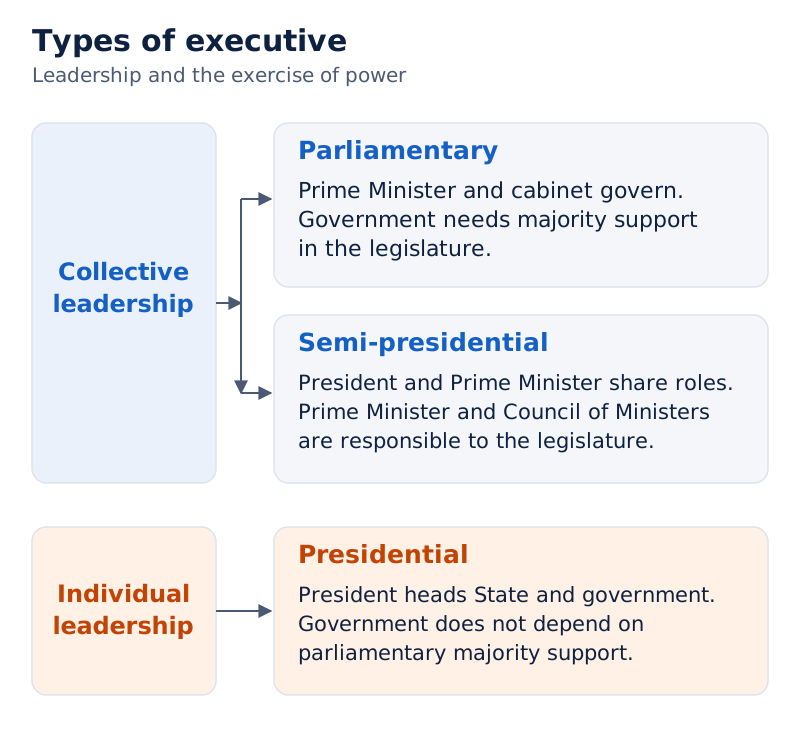
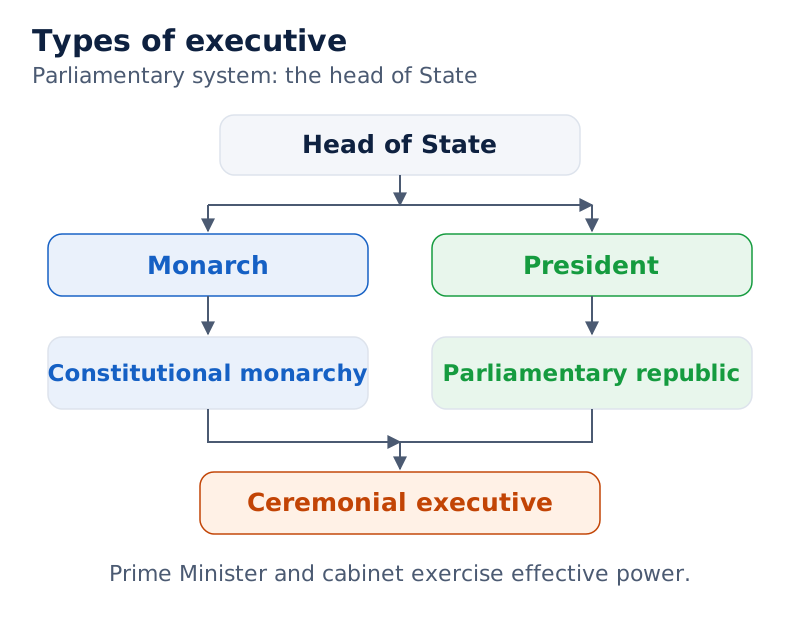
The chart branches into systems based on collective leadership and individual leadership. It compares parliamentary, semi-presidential and presidential arrangements. Within the parliamentary branch, a monarch leads to constitutional monarchy and a President to parliamentary republic; both connect to ceremonial executive.
Drawn by One Young India. Reference: NCERT Class 11, unnumbered chart, page 81
What does the Sri Lankan historical example illustrate?
Sri Lanka introduced Executive Presidency through constitutional change in 1978. In that historical arrangement, people directly elected a President who headed the State and government and served as Commander-in-Chief. The President selected a Prime Minister from the parliamentary majority and could remove the Prime Minister or ministers.
The arrangement described a six-year presidential term and removal through a parliamentary resolution supported by at least two-thirds of all members. A resolution supported by at least half the members could be reported by the Speaker to the Supreme Court if the allegations warranted inquiry.
This example shows why the presence of a Prime Minister alone cannot establish that a system is parliamentary. The actual distribution of executive powers matters. These details concern the historical arrangement introduced in 1978.
Why did India adopt a parliamentary executive?
The Act of 1919 provided India with experience of parliamentary government. The Act of 1935 also provided experience of this system. This experience showed how representatives of the people could exercise control over the executive. The Constitution's makers wanted government to remain sensitive to public expectations and answerable for its conduct.
How were strength and accountability combined?
The aim was a strong executive with safeguards against excessive concentration of power. A presidential executive places considerable emphasis on a single chief executive. The Constitution's makers were concerned about the danger of a personality cult surrounding such an office.
The parliamentary alternative provided mechanisms through which the legislature could regularly supervise and control the executive. Government would have the authority to act, while needing continued support from people's representatives. Responsibility and accountability were central to the choice.
| Level | Formal executive head | Political leadership of government |
|---|---|---|
| Union | President | Prime Minister and Council of Ministers |
| State | Governor | Chief Minister and Council of Ministers |
The system was adopted at both national and State levels. It creates a close relationship between executive and legislature. The legislature controls the executive, while the executive also influences the working of the legislature.
Note: Parliamentary government is not automatically protected against powerful personalities. Representative institutions and citizens must remain vigilant so that constitutional arrangements work as intended.
The choice should therefore be understood as an arrangement for continuing democratic control. It does not mean that the executive is weak or that parliamentary leadership can never become dominant.
How is the President chosen and what is the President's constitutional position?
The Constitution formally places the Union's executive power in the President. In practice, the Council of Ministers, headed by the Prime Minister, exercises governmental authority through this formal framework. The distinction between formal authority and effective political power is essential.
How do election and removal work?
The President serves a five-year term and is elected indirectly. Elected Members of Parliament and elected Members of Legislative Assemblies participate. These are often abbreviated as MPs and MLAs respectively. Ordinary citizens do not directly vote for the President.
The election follows proportional representation through the single transferable vote. Parliament can remove the President through impeachment, which requires a special majority. The ground for impeachment is violation of the Constitution.
What does Article 74(1) require?
Article 74(1) provides for a Council of Ministers headed by the Prime Minister to aid and advise the President. The President must act according to that advice when exercising presidential functions. Ministerial advice is therefore binding.
The President may ask the Council to reconsider its advice. Once advice has been reconsidered and tendered again, the President must accept it. The opportunity for reconsideration does not create an unlimited right to reject the government's decision.
- The Council of Ministers, headed by the Prime Minister, advises the President.
- The President may identify concerns and request reconsideration.
- The Council considers the matter again and tenders its advice after reconsideration.
- The President acts according to that reconsidered advice.
Formally, the presidency carries extensive executive, legislative, judicial and emergency powers. In the parliamentary framework these are ordinarily exercised on ministerial advice. The Prime Minister and Council of Ministers constitute the real executive because they have majority support in the Lok Sabha.
The President also has a right to information about important governmental matters and ministerial deliberations. The Prime Minister must supply information requested by the President. This allows the President to raise questions and express views without taking over everyday government.
When can the President exercise discretion?
Presidential discretion means room for the President's own judgement in particular situations. Binding ministerial advice does not make every presidential action mechanical. Reconsideration of advice, handling certain Bills and appointing a Prime Minister without a clear majority create important opportunities for judgement.
How do reconsideration and veto differ?
The President may return ministerial advice because of legal gaps, flaws or concerns about the country's interests. Such a request would naturally carry a lot of weight. However, if the Council repeats its advice after reconsideration, the President is bound by it.
A Bill passed by Parliament requires presidential assent before becoming law. For Bills other than Money Bills, the President may withhold assent or return the Bill for reconsideration. If Parliament passes the Bill again and returns it, the President must assent.
The absence of a specified time limit for returning a Bill provides room to leave it pending. This informal device is called a pocket veto. It differs from permanently rejecting a Bill that Parliament has reconsidered and passed again.
What happened to the Indian Post Office amendment Bill?
Parliament passed the Indian Post Office (Amendment) Bill in 1986. Critics objected that it would restrict press freedom. President Gyani Zail Singh did not decide on assent, leaving the Bill pending.
After Zail Singh's term, President Venkataraman returned the Bill to Parliament for reconsideration. A different coalition government came to power after the 1989 election and did not bring the Bill back. The delay thus prevented this Bill from becoming law.
How is a Prime Minister chosen without a clear majority?
Normally, the President appoints a leader who has majority support in the Lok Sabha. If no leader clearly commands that support and competing claims arise, the President must assess who can form and run a government.
After the March 1998 election, the Bharatiya Janata Party and its allies held 251 seats, which was 21 short of a majority. President Narayanan asked alliance leader Atal Behari Vajpayee for documents establishing support from the political parties concerned.
Narayanan also advised Vajpayee to obtain a vote of confidence within ten days of taking office. The case illustrates discretion directed towards finding a viable parliamentary majority, rather than selecting a government according to the President's personal preferences.
Party competition increased after 1977. In the four parliamentary elections from 1989 to 1998, no single party or coalition secured a majority. Government formation and requests to dissolve the Lok Sabha consequently made presidential judgement more significant.
Why are the President and Vice President important?
A parliamentary government can lose majority support, requiring a new Council of Ministers. The country therefore needs a head of State whose position is not dependent on the survival of that particular ministry. The President provides this continuity through a fixed term.
What role does the President retain?
The President symbolically represents the whole country and formally appoints the Prime Minister. When a majority is clear, this appointment follows the parliamentary outcome. When support is uncertain, the President has the additional responsibility of identifying a leader able to form a government.
The office combines dignity, constitutional authority and a largely ceremonial role. It is neither the ordinary centre of policy making nor an office without any significance. Information, advice, reconsideration and government formation all help explain its importance.
How does the Vice President provide continuity?
The Vice President is elected for five years. The election method resembles the President's, but members of State legislatures do not participate in the Vice President's electoral college. The Vice President is the ex-officio Chairman of the Rajya Sabha.
Removal requires a resolution passed by a majority in the Rajya Sabha and agreed to by the Lok Sabha. This is different from describing the office as removable by the President acting alone.
If the presidency becomes vacant through death, resignation, impeachment or otherwise, the Vice President acts as President until a new President is elected. B. D. Jatti performed this role after the death of President Fakhruddin Ali Ahmed.
These arrangements preserve continuity while political leadership or office holders change. Acting as President during a vacancy does not mean that the Vice President automatically receives a new full presidential term.
How are the Prime Minister and Council of Ministers appointed?
The President formally appoints as Prime Minister a leader who commands majority support in the Lok Sabha. This may be the leader of a majority party or a leader acceptable to partners in a coalition with majority support.
Who selects ministers?
The Prime Minister chooses the members of the Council of Ministers and allocates their ranks and portfolios. A portfolio is the area of governmental work assigned to a minister. Seniority and political importance influence whether a minister receives cabinet, minister of State or deputy minister rank.
The Prime Minister and ministers must belong to Parliament. A person appointed without being a Member of Parliament must get elected to Parliament within six months. Chief Ministers similarly choose ministers from their party or coalition at the State level.
Ministerial selection has political as well as administrative significance. It involves choosing among supporters of the government and considering the political weight of aspirants. Under coalition government, the Prime Minister must also consider the expectations of partner parties.
Why was the size of ministries restricted?
Before the 91st Amendment Act (2003), the size of Councils of Ministers depended on political circumstances and perceived requirements. Large ministries developed, and ministerial posts could be used to attract support when no party possessed a clear majority.
The amendment introduced a ceiling of 15 per cent of the total membership of the Lok Sabha for the Union Council of Ministers. It also introduced a 15 per cent ceiling linked to Assembly membership for State ministries.
Note: The percentage ceiling addresses the use of ministerial positions to secure political support. It should not be confused with the six-month requirement for an appointed minister who is not already a parliamentarian.
Was another method of selection considered?
In the Constituent Assembly on 17 July 1947, Begum Aizaz Rasul favoured a Swiss-style arrangement in which the legislature elected the executive for a fixed period. She supported the single transferable vote as a way to represent different interests.
The adopted arrangement instead gives the Prime Minister or Chief Minister the role of choosing ministers. This places the head of government at the centre of the formation and organisation of the ministry.
What does collective responsibility mean?
The Council of Ministers is collectively responsible to the Lok Sabha. It governs as a united body on behalf of the parliamentary majority. If the Council loses the confidence of the Lok Sabha, it must resign.
How does cabinet solidarity operate?
Cabinet solidarity requires ministers to support decisions for which the government is collectively responsible. A minister who disagrees with a cabinet decision must accept it or resign. Remaining in office while rejecting that collective responsibility conflicts with the principle.
The responsibility belongs to the ministry as a whole. A no-confidence challenge, even when directed against the conduct of one minister, can therefore require the entire Council to leave office if the Lok Sabha withdraws confidence in the government.
This differs from an individual minister leaving office for other reasons. The death, dismissal or resignation of one minister creates a ministerial vacancy. It does not by itself dissolve the entire Council.
Why is the Prime Minister indispensable?
The Council comes into existence after the Prime Minister takes the oath of office. It cannot exist without its head. The Prime Minister's death or resignation brings about the dissolution of the Council of Ministers.
| Situation | Consequence |
|---|---|
| The ministry loses Lok Sabha confidence | The Council of Ministers must resign |
| A minister rejects a cabinet policy | The minister must accept the decision or resign |
| An individual minister resigns | A vacancy arises in the ministry |
| The Prime Minister resigns | The Council of Ministers is dissolved |
The distinction links parliamentary accountability with the internal organisation of government. Collective responsibility keeps the ministry answerable to the Lok Sabha, while the Prime Minister's indispensable position gives the Council a common political head.
What makes the Prime Minister powerful?
The Prime Minister occupies a pre-eminent position because the office leads the Council of Ministers and commands majority support in the Lok Sabha. The President normally acts on the advice of the Council that the Prime Minister heads.
How does the Prime Minister coordinate government?
The Prime Minister links the Council of Ministers with the President and Parliament. Decisions concerning Union administration and proposals for legislation must be communicated to the President. The Prime Minister participates in crucial decisions and determines the government's policy direction.
Jawaharlal Nehru described the Prime Minister as the linchpin of government. The expression captures how the office connects institutions, directs the ministry and holds together the government's political work.
- Control over ministers: Selecting ministers and assigning ranks and portfolios gives the Prime Minister organisational influence.
- Lok Sabha leadership: Support in the House supplies the parliamentary foundation for governing.
- Administrative command: Control of the bureaucratic machinery helps translate policy into action.
- Public visibility: Access to media and the projection of personalities during elections strengthen national prominence.
- International visibility: Summits and foreign visits project the Prime Minister as a national leader.
Cartoon: The Prime Minister leads the ministry (NCERT Class 11, page 89). Shankar's cartoon dated 22 August 1954 shows the Prime Minister walking towards a doorway marked "Lok Sabha", with ministers following behind. Its caption reads: "There is no Council of Ministers without the Prime Minister. This cartoon shows how, literally, the Prime Minister ‘leads’ the Council of Ministers!"
Is prime ministerial power unlimited?
Actual power depends on political conditions. Majority support makes the office powerful, but loss of that support removes the basis for remaining in office. Party expectations and the needs of supporting groups also matter.
The Prime Minister consequently has a greater say than other ministers without becoming a ruler free of parliamentary limits. Constitutional position and political support work together to determine the office's effective authority.
How do coalitions and State politics affect the parliamentary executive?
A coalition government brings together political parties to secure majority support. When no single party has enough seats, partners must agree on leadership and the terms of working together. Since 1989, India has experienced many such governments.
How does coalition government change leadership?
Many coalition governments lost majority support and resigned or were removed before completing the Lok Sabha's term. Such conditions increased the President's role in selecting a Prime Minister and made the government's survival dependent on cooperation among partners.
- Parties agree to support a government, whether through arrangements made before or after an election.
- A leader acceptable to the supporting partners is chosen to head the government.
- Partners negotiate ministerial appointments, ranks and portfolios, restricting the Prime Minister's freedom of choice.
- Government policies and programmes emerge through consultation, negotiation and compromise among the allies.
In coalition government, the Prime Minister has to act more as a negotiator than as leader of the government. Different parties may bring different ideologies and priorities into the coalition. Agreement cannot simply be assumed from the fact that they support the same government.
This does not abolish parliamentary responsibility. The ministry still requires majority support in the Lok Sabha. Coalition politics changes how that support is organised and maintained, and therefore how the Prime Minister's authority operates.
How does the State executive compare?
States follow the same broad parliamentary principles, with a Chief Minister and Council of Ministers. The Chief Minister leads the majority in the Legislative Assembly. However, the State's formal executive head is a Governor, appointed by the President on central government advice.
The Governor has more discretionary powers than the President. This is a significant variation within the common parliamentary framework. It is therefore inaccurate to treat every feature of the Union and State executives as identical.
How is the permanent executive recruited and expected to work?
The bureaucracy consists of trained and skilled government employees who assist ministers in policy formulation and implementation. It is called the civil service to distinguish it from military service. Its work gives continuity and professional support to government.
What does political neutrality require?
Political neutrality means that officials do not take a partisan position on policy matters. When an election replaces one government with another, the administrative machinery must faithfully and efficiently help develop and implement the new government's policies.
Neutrality does not mean freedom from supervision. Elected representatives and ministers direct government, and the legislature controls administration within the parliamentary framework. Officers cannot disregard policies adopted by the legislature simply because they hold different preferences.
How are merit and representation combined?
The Union Public Service Commission, abbreviated as UPSC, conducts recruitment processes for the Government of India's civil servants. States have Public Service Commissions too. These institutions are intended to support impartial selection based on merit.
Public Service Commission members hold office for fixed terms. Safeguards surrounding removal or suspension include a thorough inquiry by a Supreme Court judge. Institutional protection helps recruitment remain professional and non-partisan.
Efficiency and merit are important, but recruitment must also provide opportunities for weaker sections. Constitutional provisions for reservation include Scheduled Castes and Scheduled Tribes. The aim is a more representative bureaucracy in which social inequality does not block entry.
Subsequent reservation provisions also concern women, Other Backward Classes and Economically Weaker Sections. The latter two are commonly abbreviated as OBC and EWS. Representation and professional competence are both concerns in organising public employment.
Note: Political neutrality concerns how officials perform their public duties. It requires faithful service to the elected government of the day, while professional recruitment concerns how officials enter that service.
The administrative system includes All India Services, State services, local government employees and the technical and managerial personnel of public sector undertakings. Its size and range make coordination and accountability essential.
How are civil services organised and held accountable?
The civil services operate across different levels of government. The Indian Administrative Service, abbreviated as IAS, and Indian Police Service, abbreviated as IPS, form a major part of the higher bureaucracy working in the States.
What are the main service categories?
| Category | Examples | Working arrangement |
|---|---|---|
| All India Services | Indian Administrative Service and Indian Police Service | Officers work in their allotted State and may serve at the Centre on deputation |
| Central Services | Indian Foreign Service and Indian Custom Service | Service in central government offices; the foreign service includes work in Indian missions abroad |
| State Services | Provincial Civil Service | Service within the State in which recruited |
What the figure shows
Classification of civil services
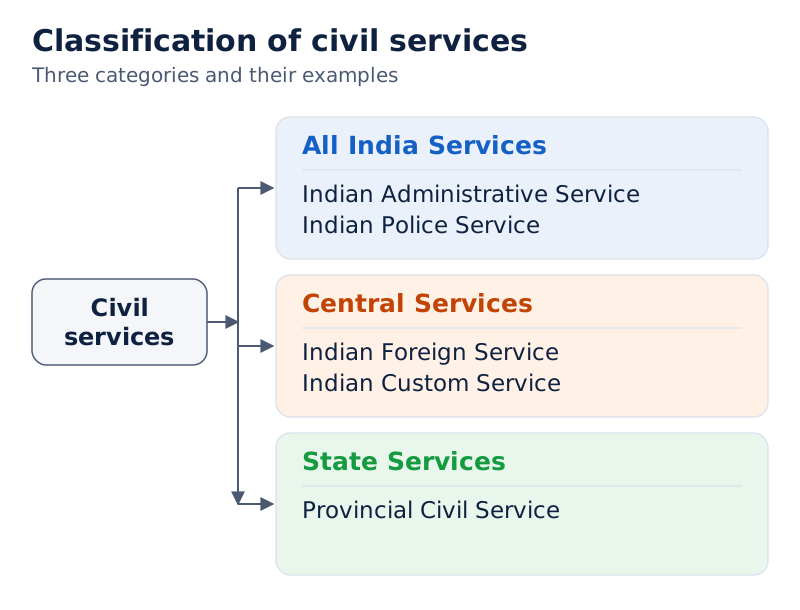
A heading branches into All India Services, Central Services and State Services. The first lists administrative and police services, the second foreign and custom services, and the third the provincial civil service.
Drawn by One Young India. Reference: NCERT Class 11, unnumbered chart, page 96
A district collector is normally an IAS officer. IAS and IPS officers working in a State are supervised by its government, while central appointment and service conditions connect them with the Union. State Public Service Commissions recruit other officers for State administration.
This arrangement strengthens central influence over State administration. It also shows why an officer's place of work and the authority responsible for the service are not necessarily the same.
Why are both control and professional independence needed?
Bureaucracy is the machinery through which welfare policies should reach people. Yet most often bureaucracy is so powerful that people are afraid of approaching an official, and insensitivity to ordinary citizens' demands and expectations is a common experience. Democratic control is needed to address these problems.
Excessive political interference turns the bureaucracy into an instrument in the hands of politicians. Independent recruitment alone does not settle every difficulty concerning interference in daily work or accountability to citizens.
There is an expectation that measures such as the Right to Information may make bureaucracy a little more responsive and accountable. The objective is an administration that serves people efficiently while remaining under legitimate democratic supervision.
The broader executive requires control because it is a powerful institution. Regular elections, constitutional limits and democratic politics restrain its authority. Parliamentary supervision helps ensure that the capacity to implement policy remains connected to public responsibility.
Glossary
- Executive — The governmental organ primarily responsible for implementing laws and policies and carrying out public administration.
- Political executive — The head of government and ministers who carry overall political responsibility for government policy.
- Permanent executive — The continuing administrative machinery of civil servants responsible for everyday government work and policy implementation.
- Parliamentary executive — An executive whose continuation in office depends on majority support in the legislature.
- Presidential executive — An arrangement in which the President combines the positions of head of State and head of government.
- Semi-presidential executive — A system with a President and Prime Minister in which the President may exercise substantial everyday powers.
- Impeachment — The parliamentary procedure for removing the President of India on the ground of violating the Constitution.
- Pocket veto — The informal presidential device of leaving a Bill pending without deciding on assent or returning it.
- Collective responsibility — The obligation of the Council of Ministers to retain Lok Sabha confidence and act together on government policy.
- Cabinet solidarity — The principle requiring ministers to accept collective cabinet decisions or leave the ministry through resignation.
- Coalition government — A government supported by multiple political parties that cooperate to obtain and maintain a parliamentary majority.
- Political neutrality — The duty of officials to serve elected governments professionally without taking partisan positions on policy matters.
- Portfolio — A particular area of governmental work allocated to a minister by the head of government.
Common errors and misconceptions
- Misconception: Every country with a President has a presidential system. Correct: India has a President but follows a parliamentary system; powers and legislative responsibility determine the type.
- Misconception: The President of India is directly elected by citizens. Correct: The election is indirect, involving elected parliamentarians and elected members of State Legislative Assemblies.
- Misconception: The President can repeatedly reject reconsidered ministerial advice. Correct: The President may request reconsideration but must accept the advice tendered after it.
- Misconception: The largest party's leader must become Prime Minister regardless of support. Correct: The decisive requirement is the capacity to command majority support in the Lok Sabha.
- Misconception: The resignation of any minister dissolves the whole Council. Correct: An individual minister's resignation creates a vacancy; the Prime Minister's resignation dissolves the Council.
- Misconception: Collective responsibility allows ministers to remain in office while rejecting cabinet decisions. Correct: A dissenting minister must accept the decision or resign.
- Misconception: Political neutrality makes bureaucracy independent of elected government. Correct: Officials must work professionally under democratic supervision and implement the elected government's policies faithfully.
- Misconception: The Vice President automatically receives a full presidential term when a vacancy occurs. Correct: The Vice President acts as President until a new President is elected.
Exam-style questions with model answers
Q1. Ministers carry overall responsibility for policy, while civil servants handle day-to-day administration and assist with implementation. Identify the two parts of the executive and distinguish their roles. [2 marks]
- Ministers belong to the political executive and provide policy direction and political responsibility.
- Civil servants form the permanent executive, supplying continuing administrative support and implementing decisions under ministerial supervision.
Q2. Article 74(1) makes ministerial advice binding, but permits the President to request reconsideration. Advice given after reconsideration must be accepted. Can the President reject that advice again? Explain. [2 marks]
- The President cannot reject the reconsidered advice again. The opportunity to request reconsideration allows concerns to be raised.
- Once the Council tenders advice after reconsideration, the President must act according to it.
Q3. In a presidential system the President heads both State and government. In a parliamentary system a ceremonial President or monarch is head of State, while the Prime Minister and cabinet govern with legislative majority support. Compare the systems on three bases. [3 marks]
- Leadership: The presidential system combines head of State and head of government in one office. The parliamentary system separates the ceremonial head from effective governmental leadership.
- Selection of the head of government: In a presidential system, the President is usually directly elected by the people. In a parliamentary system, the Prime Minister leads a majority party or commands the support of a majority coalition in the legislature.
- Legislative relationship: Parliamentary government depends on majority support in the legislature. Presidential leadership does not rest on that same parliamentary relationship of continuing majority confidence.
Q4. In March 1998, the Bharatiya Janata Party and its allies won 251 seats, 21 short of a majority. President Narayanan required Atal Behari Vajpayee to document supporting parties' backing and advised a confidence vote within ten days of being sworn in. Explain how these actions addressed uncertain majority support. [4 marks]
- The alliance's 251 seats did not establish a majority because it remained 21 seats short. Its leader therefore needed support beyond those seats to demonstrate the ability to govern.
- Requiring documents from supporting parties provided evidence for assessing Vajpayee's claim instead of relying solely on an assertion of support.
- A confidence vote within ten days would allow the Lok Sabha itself to test the government's support.
- The President's discretion served government formation within the parliamentary framework. It was directed towards identifying majority support, not replacing that requirement with personal choice.
Q5. Parliament passed the Indian Post Office (Amendment) Bill in 1986 amid criticism about press freedom. Zail Singh left it pending. Venkataraman later returned it; the different coalition elected in 1989 did not revive it. There was no specified time limit for returning the Bill, but a Bill passed again after reconsideration would require assent. Explain the pocket veto and its limits using these facts. [5 marks]
- The pocket veto operates through delay. A President leaves a Bill pending rather than immediately assenting to it or returning it for reconsideration.
- The absence of a specified time limit made this delay possible. Zail Singh did not take a decision on the 1986 postal amendment Bill despite Parliament having passed it.
- Venkataraman subsequently returned the Bill to Parliament for reconsideration.
- Political circumstances had changed: the coalition elected in 1989 did not bring the Bill back, so it did not become law.
- This outcome does not establish an unlimited presidential power to reject Parliament's final decision. If Parliament had reconsidered, passed the Bill again and returned it, assent would have been required.
Q6. The Council of Ministers must retain Lok Sabha confidence; ministers must accept cabinet decisions or resign. The Prime Minister selects ministers and portfolios, links the Council with the President and Parliament, and is indispensable to the Council's existence. An ordinary minister's departure creates a vacancy, but the Prime Minister's resignation dissolves the Council. Explain collective responsibility and the Prime Minister's special position. [6 marks]
- Collective responsibility makes the ministry answerable as one body to the Lok Sabha. Loss of the House's confidence requires the Council to resign, because its authority depends on parliamentary support.
- Cabinet solidarity gives this responsibility an internal meaning. Ministers must support collective decisions while remaining in office. A minister who cannot accept a decision must resign.
- The Prime Minister selects the members of the Council of Ministers, giving the office a special role in forming the government.
- The Prime Minister allocates ministers' ranks and portfolios, shaping the organisation and distribution of work within the ministry.
- The Prime Minister also connects the Council with the President and Parliament, making the office central to communication and coordination.
- The consequences of departure show this difference clearly. An ordinary minister's departure leaves a vacancy; the Prime Minister's resignation dissolves the Council because it cannot exist without its head.
Q7. Coalition partners may have different ideologies. They negotiate leadership, ministerial appointments, ranks, portfolios and policies, and the government needs their continued majority support. Explain why coalition government makes the Prime Minister a negotiator. [4 marks]
- The Prime Minister must retain the support of several parties, rather than assume that one party's preferences will be accepted by the whole government.
- Choosing ministers and allocating ranks and portfolios requires consultation with partners. These negotiations restrict the Prime Minister's freedom to decide alone.
- Policy differences between parties require compromise in the government's programmes. Leadership therefore involves building agreement among allies as well as directing administration.
- Continued majority support remains necessary. Negotiation helps maintain the political cooperation on which the coalition government's survival depends.
Q8. Civil servants assist policy formulation and implementation under elected ministers. They should serve successive governments without partisan bias. Citizens may find officials insensitive, while excessive political interference can turn officials into politicians' instruments. Recruitment commissions promote impartial selection, and Right to Information measures can encourage accountability. Explain the balance needed in a democratic bureaucracy. [5 marks]
- Democratic control is necessary because administration implements public policy. Ministers and elected institutions must supervise it so that officials cannot disregard the government's legitimate direction.
- Professional neutrality is equally necessary. Officials should help successive governments faithfully, without treating their own partisan preferences as the basis for administrative action.
- Control must not become excessive interference. If officials merely serve individual politicians' interests, the professional character and public purpose of administration are weakened.
- Impartial recruitment supports professional administration but does not alone solve insensitivity or political interference in everyday work.
- Accountability to citizens also needs attention. There is an expectation that measures such as the Right to Information may make bureaucracy a little more responsive and accountable.
Key takeaways
- The executive includes political leadership and permanent administration, combining responsibility for policy with the machinery needed to implement it.
- Parliamentary government depends on legislative majority support; the existence of an office called President does not establish a presidential system.
- The President normally acts on ministerial advice and must accept advice tendered after reconsideration, while retaining discretion in particular situations.
- A Prime Minister needs majority support in the Lok Sabha, which may come from one party or a coalition of parties.
- Collective responsibility requires the ministry to retain Lok Sabha confidence and ministers to accept cabinet decisions or resign.
- The Prime Minister leads ministerial selection, coordination and policy making, but actual authority depends on prevailing political conditions.
- Coalition partners negotiate appointments and programmes, making compromise and maintenance of majority support central tasks for the Prime Minister.
- Bureaucracy should combine professional competence, political neutrality, social representation and responsiveness to citizens under democratic supervision.
Test yourself
What is the central test of a parliamentary executive?
Its continuation in office depends on the support of a majority in the legislature.
What must the President do with advice tendered after reconsideration?
The President must accept and act according to the Council of Ministers' reconsidered advice.
What is the ground for impeachment of the President?
The President can be impeached for violating the Constitution through the prescribed parliamentary procedure.
Why might a President request evidence of support before appointing a Prime Minister?
When no leader clearly has a majority, evidence helps establish who can form and sustain a government with Lok Sabha support.
How long may an appointed minister who is not a parliamentarian take to get elected?
The person must get elected to Parliament within six months of becoming a minister.
What happens when a minister cannot accept a cabinet decision?
The minister must accept the collective decision or resign from the Council of Ministers.
What does political neutrality require after a change of government?
Civil servants must faithfully and efficiently assist the new elected government in policy formulation and implementation.
Why is independent recruitment insufficient by itself to ensure good administration?
Impartial recruitment does not alone prevent interference during officials' service or guarantee responsiveness and accountability to ordinary citizens.