
Continuity and Differentiability | CBSE Class 12 Maths Notes
On this page
Watch & explore
Start with a few high-quality watches, then dive into the notes below.

Continuity and Differentiability in Mathematics covers continuity at a point and on a domain, algebra of continuous functions, differentiability, the chain rule, implicit and inverse trigonometric differentiation, exponential and logarithmic functions, logarithmic differentiation, parametric derivatives, and second order derivatives.
What does continuity at a point mean?
Let denote a real-valued function, its input variable, and a point in its domain. The value is the output at that point. A limit describes the value approached by the outputs as the input approaches the point.
Definition: A function is continuous at a point in its domain when its limit there equals its value:
At an interior point, check the left-hand limit, the right-hand limit, and the function value separately. The notation means approach from the left; means approach from the right. Continuity requires all three values to agree.
How do you apply the definition?
- Calculate the assigned value using the applicable part of the definition.
- Calculate , using inputs below the point.
- Calculate , using inputs above the point.
- Compare the results. Equal one-sided limits establish the limit; agreement with the assigned value establishes continuity.
Worked example 1. Check continuity of at .
Answer:
- Evaluate the function:
- Evaluate the limit of this polynomial expression:
- Compare the two quantities: Therefore the function is continuous at the specified point.
Continuity of a function means continuity at every point of its domain. For an interval , where and are its left and right endpoints, use only the right-hand limit at the left endpoint and the left-hand limit at the right endpoint.
The endpoint conditions are and . There is no need to test values outside the specified domain.
How can a function fail to be continuous?
A function can be defined at a point without being continuous there. Two distinct failures must be recognised: its one-sided limits may disagree, or their common value may disagree with the assigned function value. These failures require different comparisons.
What do the introductory graphs show?
What the figure shows
Unequal one-sided limits
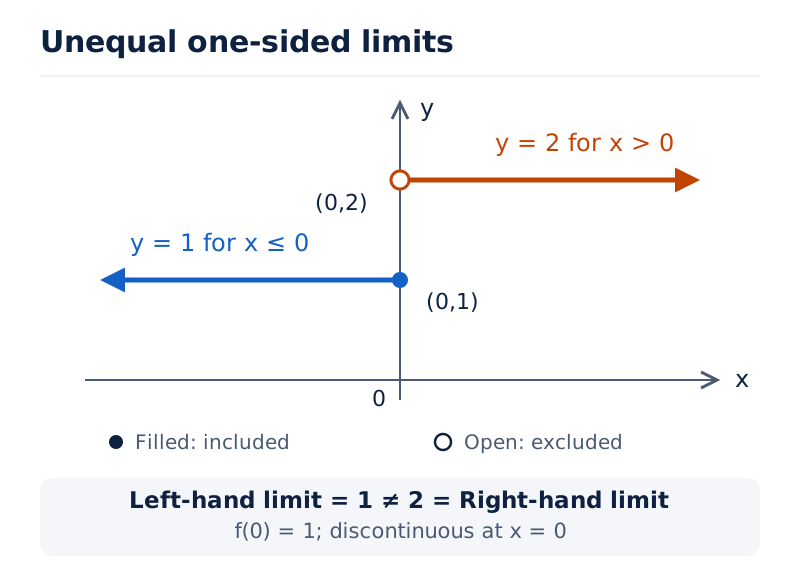
The horizontal left branch lies at and ends at the filled point . The right branch lies at , beginning with an open point at . Here denotes the output coordinate.
Drawn by One Young India. See Fig. 5.1 in your NCERT textbook
In this graph, the left-hand limit is and the right-hand limit is . The function value is . Agreement between the value and just one side cannot establish continuity, because a common two-sided limit does not exist.
What the figure shows
Limit different from the value
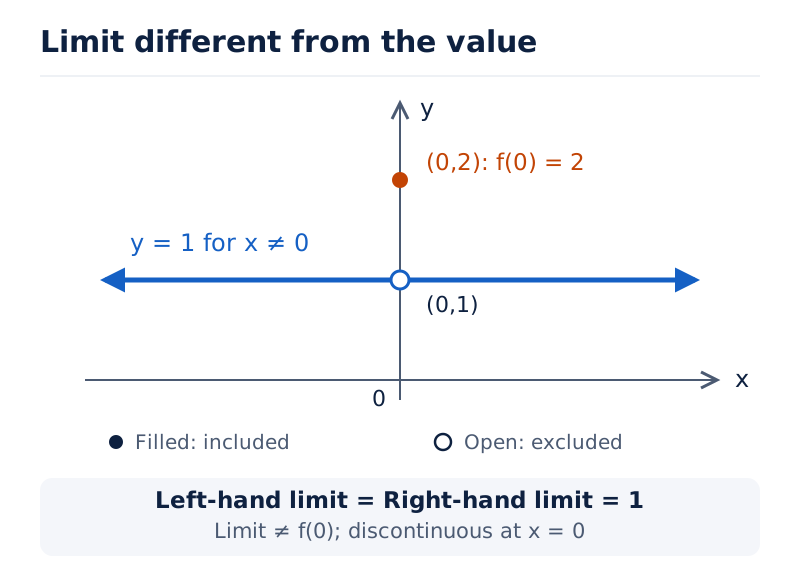
A horizontal line at has an open point at . A separate filled point is shown at . Both sides approach the hole, while the assigned value is represented by the upper point.
Drawn by One Young India. See Fig. 5.2 in your NCERT textbook
Worked example 2. Test continuity at zero for when , with .
Answer:
- Read the special value from the definition:
- Use the expression for nearby nonzero inputs:
- Compare: The limit exists but is not the assigned value, so the function is discontinuous at zero.
The domain also matters. The reciprocal function is continuous at every nonzero real input, which is every point of its domain. Zero is excluded. Its unbounded behaviour near zero does not make it discontinuous at a point belonging to that domain.
Similarly, the greatest integer function , where the brackets mean the greatest integer not exceeding the input, is continuous at non-integers. At an integer , the left limit is , while the right limit and value are .
How does the algebra of continuous functions simplify proofs?
Theorem: Sums, products and quotients preserve continuity
Let and be real functions continuous at , with denoting the second function. Their sum, difference and product are continuous there. Their quotient is continuous there provided . The denominator condition is part of the result.
| Operation | Function | Condition at the point |
|---|---|---|
| Sum or difference | Both functions continuous | |
| Product | Both functions continuous | |
| Quotient | Both continuous and |
Here indicates either addition or subtraction. These results follow from the corresponding laws of limits. For the sum, the reasoning can be written as a short numbered proof.
- Expand the sum function:
- Separate the limits:
- Use continuity of each function:
Polynomial functions are continuous at all real inputs. A rational function, being a quotient of polynomials, is continuous wherever its denominator is nonzero. Sine and cosine are continuous everywhere; their quotient, tangent, is continuous wherever cosine is nonzero.
Theorem: Continuity of a composite function
The composition applies the inner function first and the outer function second. If is continuous at , and is continuous at , the composition is continuous at , provided it is defined.
Worked example 3. Show that is continuous.
Answer:
- Identify the inner function , where denotes the squaring function. It is a polynomial, so it is continuous for every real input.
- Identify the outer function , where is its input. Sine is continuous for every real input.
- Form the composition: The inner output lies in the outer domain, so the continuity theorem applies everywhere.
How are differentiability and continuity related?
Let denote a nonzero increment in the input. The derivative at , written , is defined by the finite limit The prime indicates differentiation with respect to the input.
The function is differentiable at an interior point when the left-hand and right-hand limits of this difference quotient are finite and equal. This test concerns the quotient of changes, whereas continuity concerns the function values themselves.
Theorem: Differentiability implies continuity
Suppose the derivative exists at . Factor the difference in function values into a difference quotient and an input difference. The quotient approaches a finite number, while the input difference approaches zero.
- For , write
- Take limits and use differentiability:
- Rearrange the limiting equality: This is precisely continuity at the point.
The converse is false. Continuity does not ensure differentiability. A function can have matching values from the two sides but different limiting difference quotients. The modulus function provides a direct example of this distinction.
Worked example 4. Discuss continuity and differentiability of at zero, where the vertical bars denote absolute value.
Answer:
- Use for and for . Both one-sided limits are zero and , so the function is continuous.
- For negative increments, compute
- For positive increments, compute
- The two derivative limits differ: Hence the derivative does not exist at zero.
How do derivative rules and the chain rule work?
Write , with the dependent variable. The notations , , and all describe its derivative with respect to . For differentiable functions and , their primes below mean derivatives with respect to .
| Rule | Formula | Condition |
|---|---|---|
| Sum and difference | Both derivatives exist | |
| Product | Both derivatives exist | |
| Quotient | Both derivatives exist and |
Useful standard derivatives include , with a fixed exponent in the applicable domain, , , and . The symbols , , and denote sine, cosine, tangent and secant.
Theorem: Chain rule for composite functions
If is an intermediate variable and , the chain rule states provided the required derivatives exist. Differentiate the outer function at the inner expression, then multiply by the inner derivative.
Worked example 5. Differentiate .
Answer:
- Set , so the outer function is .
- Differentiate the inner function:
- Differentiate the outer function:
- Multiply and restore the original input:
Nested compositions require one derivative factor for each layer. Work from the outside towards the inside, keeping every inner expression unchanged until its own derivative is taken. Omitting an inner derivative changes the answer even when the outer derivative is correct.
The same principle differentiates a power of a linear expression. Expanding first is possible for small powers, but recognising the composition avoids unnecessary algebra and continues to work for much larger powers.
How do you differentiate an implicit function?
An explicit function presents the dependent variable directly in terms of the independent variable. An implicit relation links the variables without isolating the dependent variable. Such a relation can be differentiated directly wherever it describes a differentiable dependent variable.
Throughout implicit differentiation, treat as a function of . A term involving therefore needs the chain rule. For example, , because the sine acts on a changing dependent variable.
How do you collect the derivative terms?
- Differentiate both sides of the relation with respect to the independent variable.
- Apply the chain rule to each expression involving the dependent variable.
- Collect all terms containing the required derivative on one side.
- Factor out that derivative, divide by its coefficient when nonzero, and state the resulting condition.
Worked example 6. Find when .
Answer:
- Differentiate each side:
- Apply the chain rule:
- Collect the derivative:
- Divide where the coefficient is nonzero:
The restriction can also be expressed as , where is any integer and is the usual circle constant. This condition comes from division during the calculation, so it belongs alongside the derivative.
Do not replace the dependent variable by a constant. The final derivative may legitimately contain both variables. Solving explicitly first is optional when possible; direct differentiation often keeps the calculation much shorter.
How are inverse trigonometric derivatives obtained?
The notation denotes the principal inverse sine, not the reciprocal of sine. Similarly, and denote principal inverse cosine and inverse tangent. Their derivative formulas must be paired with their domains of differentiability.
Derivation: Derivative of inverse sine
Let , restricting the input to . Use the inverse relationship, differentiate implicitly, and then choose the sign of the square root from the principal range.
- Rewrite the inverse relation:
- Differentiate with respect to the input:
- Use the trigonometric identity:
- Since , cosine is positive:
- Divide to obtain
The principal range determines the sign. The formula is not a finite derivative at the endpoint inputs. A function's domain and the domain of its derivative need not be identical.
| Function | Derivative | Derivative domain |
|---|---|---|
| Every real input |
When the input is itself a function, use the chain rule in addition to this table. Replace the input in the denominator by the complete inner expression, and multiply the numerator by its derivative.
Before simplifying an inverse trigonometric composition, check the principal range. Reversing an inverse relationship without its range restriction can turn a locally valid identity into an incorrect global statement. The sign information used in the derivation is therefore essential.
What are exponential and logarithmic functions?
An exponential function has a fixed positive base and a variable exponent. For a base , the function is defined for every real input, has positive outputs, passes through , and increases as the input increases.
The constant is the base of natural exponentials and lies between and . The natural exponential function is . Base gives the common exponential function.
How does a logarithm reverse exponentiation?
For a positive number , the statement means . Here means logarithm to base . Thus a logarithm records the exponent required to obtain its positive argument from its base.
The logarithmic function with base greater than one has positive inputs and all real outputs. It passes through and is increasing. Natural logarithm is written ; in these notes also means natural logarithm.
| Property | Formula | Conditions |
|---|---|---|
| Product | , with positive arguments | |
| Quotient | ||
| Power | , with a real exponent | |
| Change of base | , with bases |
Positivity is a domain requirement. In real-variable work, a logarithm of a non-positive number is not defined. The inverse identity therefore applies only for positive inputs, even though the exponential function itself accepts every real input.
These properties explain the usefulness of logarithms in differentiation: products become sums, quotients become differences, and powers become factors. Each transformation must retain the conditions that make the logarithms meaningful.
How do you differentiate exponentials and logarithms?
Result: Basic exponential and logarithmic derivatives
The natural exponential function reproduces itself under differentiation: The natural logarithm has derivative The second formula includes the domain of the logarithm.
For a differentiable inner function , applying the chain rule gives . For a positive inner function it gives . The inner derivative is required in both expressions.
Worked example 7. Differentiate , with .
Answer:
- Set , making .
- Differentiate the inner expression:
- Differentiate the outer expression and multiply:
- Substitute back:
Worked example 8. Differentiate .
Answer:
- Identify the inner expression .
- Differentiate the inner expression:
- Differentiate the exponential with respect to its argument:
- Multiply and restore the input:
General positive bases require an additional constant factor. For a fixed positive base , logarithmic differentiation gives . The natural base is special because , so that factor becomes unity.
A useful check is to identify which expression is the exponent and which is the base. The power rule treats a fixed exponent, while the exponential rule treats a fixed base. Neither rule alone handles both quantities varying with the input.
When should you use logarithmic differentiation?
Logarithmic differentiation is useful when a positive function contains a variable base raised to a variable exponent. It can also simplify products and quotients by turning multiplication and division into addition and subtraction before differentiation.
How is the variable-power formula derived?
Let , where is a positive differentiable base function and a differentiable exponent function. The resulting dependent variable must be positive so that its real logarithm exists.
- Take natural logarithms:
- Differentiate using the product and chain rules:
- Multiply by the original function:
Both changing parts contribute. One term comes from differentiating the exponent; the other comes from differentiating the logarithm of the base. A constant-exponent power rule would miss the first contribution.
Worked example 9. Differentiate , with .
Answer:
- Take logarithms:
- Differentiate the product on the right:
- Multiply through by the dependent variable:
- Replace it by the original expression:
Keep the original function available until the end, since the logarithmic derivative gives the derivative divided by the function. Stopping before multiplication by the function produces an incomplete answer.
For a product, check that the particular logarithms used are defined before splitting it into separate logarithms. Algebraic convenience does not remove positivity restrictions. The calculation and its domain must remain consistent at every step.
How do you differentiate functions in parametric form?
In parametric form, both variables depend on a third variable, called the parameter. Write and , with the parameter and the functions giving the two coordinates.
The chain rule relates change in the dependent variable to change in the independent variable through their common parameter. This avoids eliminating the parameter, which can otherwise require substantial algebra.
Result: Ratio of parameter derivatives
- Write the chain-rule relation:
- Require a nonzero denominator:
- Divide to obtain Here the primes denote derivatives with respect to the parameter.
Worked example 10. Find for , , where is a nonzero constant and is an angle parameter.
Answer:
- Differentiate the independent coordinate:
- Differentiate the dependent coordinate:
- Divide where : The symbol denotes cotangent.
Worked example 11. Find for , , where is a nonzero constant.
Answer:
- Differentiate the first coordinate:
- Differentiate the second coordinate:
- For , form the ratio:
The final answer may contain the parameter. This is expected because the derivative describes the relation through that parameter. Cancelling common factors is valid only after checking the denominator condition; cancellation cannot justify division by zero.
What is a second order derivative?
If the first derivative is itself differentiable, differentiating it again gives the second order derivative. Its notations are , , and . The double prime means that differentiation with respect to the same independent variable has been performed twice.
The defining operation is This is not the square of the first derivative. Any product, quotient or composition appearing after the first differentiation must be differentiated using the appropriate rules again.
How do you calculate and verify a second derivative?
Worked example 12. Find the second derivative of , wherever tangent is defined.
Answer:
- Differentiate once:
- Differentiate the polynomial term:
- Differentiate the squared secant by the chain rule:
- Add the results:
Second derivatives also allow verification of relations involving a function and its derivatives. Calculate the derivatives independently before substituting them into the proposed relation. This keeps the verification from assuming the result it is meant to establish.
Worked example 13. For , with and fixed real constants, prove .
Answer:
- Differentiate once, keeping the constants unchanged:
- Differentiate again:
- Compare with the given function:
- Add the original function:
Check signs at both stages. Differentiating cosine introduces a negative sign, while differentiating negative sine retains its existing negative coefficient. Errors from either stage carry into every subsequent substitution.
Glossary
- Continuity at a point — Equality between the function's limiting value and its assigned value at a point in its domain.
- Continuous function — A function that is continuous at every point belonging to its specified domain.
- Left-hand limit — The value approached by a function when its input approaches a specified point from below.
- Right-hand limit — The value approached by a function when its input approaches a specified point from above.
- Discontinuity — Failure of a function to be continuous at a specified point of its domain.
- Differentiability — Existence of a finite derivative, requiring equal one-sided difference-quotient limits at an interior point.
- Derivative — The limit of the difference quotient as the nonzero input increment approaches zero.
- Composite function — A function obtained by applying an outer function to the output of an inner function.
- Chain rule — A differentiation rule that multiplies the outer derivative by the derivative of the inner function.
- Implicit differentiation — Differentiation of a relation while treating the dependent variable as a function of the independent variable.
- Natural logarithm — The logarithm with the natural exponential constant as its base, defined for positive real arguments.
- Logarithmic differentiation — A method that takes logarithms before differentiation to simplify suitable positive powers, products or quotients.
- Parameter — A third variable through which two other variables are separately expressed in a parametric relation.
- Second order derivative — The derivative of the first derivative, obtained by differentiating again with respect to the same variable.
Common errors and misconceptions
- Misconception: Equal one-sided limits alone prove continuity. Correct: Their common value must also equal the defined function value at the point.
- Misconception: Every continuous function is differentiable. Correct: Differentiability implies continuity, but the modulus function is continuous at zero without being differentiable there.
- Misconception: A quotient of continuous functions is continuous without restrictions. Correct: The denominator must be nonzero at the point being considered.
- Misconception: Differentiating the outer function finishes a composite derivative. Correct: Multiply by the derivative of the inner expression as well.
- Misconception: A dependent variable acts as a constant in implicit differentiation. Correct: Apply the chain rule to its powers and other functions.
- Misconception: Real logarithms can be taken for any input. Correct: Their arguments must be positive, including each argument introduced by splitting a logarithm.
- Misconception: A parametric derivative is the ratio of the coordinates. Correct: Divide their parameter derivatives, with the independent coordinate's derivative nonzero.
- Misconception: A second derivative means squaring the first derivative. Correct: Differentiate the first derivative again with respect to the independent variable.
Exam-style questions with model answers
Q1. State the condition for continuity of a real function at an interior point of its domain. [2 marks]
- The function value must exist, and the left-hand and right-hand limits must both exist and agree.
- Their common value must equal the function value:
Q2. For when , and when , find all points of discontinuity. [3 marks]
- On either side of the joining point, each expression is a polynomial and is continuous throughout its corresponding open interval.
- At the joining point, the first branch supplies the value . Its left-hand limit is
- The second branch gives the right-hand limit
- The one-sided limits differ, so the function is discontinuous at . There are no other points of discontinuity.
Q3. Prove that differentiability of at an interior point implies continuity there. Use at zero to show that the converse is false. [5 marks]
- For an input different from the point, factor the change in the function as
- Differentiability makes the first factor approach the finite value . The second factor approaches zero, so
- Consequently , proving continuity at the specified point.
- For the modulus function, both one-sided limits at zero equal its value, zero. It is therefore continuous there.
- Its left derivative is , while its right derivative is , where is the input increment. Their inequality means that the two-sided difference-quotient limit does not exist. This proves non-differentiability and disproves the converse, despite the already established continuity.
Q4. Differentiate for , showing the logarithmic differentiation steps. [4 marks]
- The positive input makes the base and the function positive, so natural logarithms may be taken. The power becomes a product:
- Differentiate the left side by the chain rule and the right side by the product rule:
- Multiply by the dependent variable and replace it by the original expression:
Q5. Find if , assuming is differentiable and . [3 marks]
- Differentiate the relation with respect to the independent variable. The dependent variable inside sine also changes, so its derivative must be included:
- Collect the two terms containing the required derivative:
- The stated nonzero condition permits division by the coefficient. Therefore Both variables can remain in an implicit derivative.
Q6. Given , , where is constant and is the parameter, find . [2 marks]
- Differentiate both coordinates with respect to the parameter: and .
- The denominator is nonzero under the given conditions. Therefore
Q7. If , prove that , where primes mean derivatives with respect to . [5 marks]
- Differentiate each exponential term using the chain rule. The exponents contribute their constant derivatives, giving
- Differentiate the resulting expression again, retaining those inner derivative factors:
- Substitute the original function and both independently calculated derivatives into the required expression:
- Expand the numerical multipliers and group terms with the same exponential factor. This checks cancellation separately for each exponential. Their coefficients are and . Thus both contributions vanish and , as required for every real input. The identity follows from exact cancellation of coefficients, so it does not depend on choosing any particular numerical input.
Key takeaways
- Continuity at an interior point requires the two one-sided limits and the assigned function value to agree.
- Every differentiable function is continuous, but continuity alone does not guarantee that a derivative exists.
- Sums, differences and products preserve continuity; a quotient also requires a nonzero denominator at the point.
- The chain rule multiplies an outer derivative by the inner derivative, with one factor for each layer.
- Implicit differentiation treats the dependent variable as a function, so its derivative accompanies every relevant chain-rule term.
- Logarithmic differentiation handles positive variable powers by converting the exponent into a factor before differentiating.
- A parametric derivative divides the two parameter derivatives, provided the independent coordinate has a nonzero derivative.
- A second derivative differentiates the first derivative again; it does not square the first derivative.
Test yourself
Can equal one-sided limits coexist with discontinuity?
Yes. Their common value can differ from the function's assigned value at the point.
Which one-sided limit tests continuity at the left endpoint of a closed interval?
Use the right-hand limit, approaching the endpoint through inputs belonging to the interval.
Why is the modulus function not differentiable at zero?
Its left derivative is , while its right derivative is ; these finite values are unequal.
What factor is easily missed when differentiating ?
The inner derivative must multiply the cosine of the unchanged inner expression.
Where does the standard derivative formula for inverse sine apply?
It applies for ; the endpoint inputs do not give a finite value in that formula.
What conditions permit taking logarithms of a variable-power function?
The base function and the resulting dependent variable must both be positive for their real logarithms to exist.
Must a parametric derivative be rewritten without the parameter?
No. The derivative can remain expressed in terms of the parameter linking the two coordinates.
How is the second derivative obtained from the first derivative?
Differentiate the first derivative again with respect to the same independent variable, using all required differentiation rules.