
Quadratic Equations | CBSE Class 10 Maths Notes
On this page
Watch & explore
Start with a few high-quality watches, then dive into the notes below.

These Mathematics notes cover quadratic equations in standard form, the meaning of roots, simplification, mathematical modelling, factorisation, repeated roots, the quadratic formula, the discriminant, and applications involving areas, numbers, costs and distances.
What makes an equation quadratic?
A quadratic equation is an equation in one variable whose highest power, after simplification, is two. Let denote the variable. Let , and denote real coefficients, with the coefficient of the squared term, the coefficient of the linear term, and the constant term.
Definition: The standard form of a quadratic equation is The restriction on the leading coefficient ensures that the squared term remains present.
Why does standard form matter?
In standard form, all terms are on one side and zero is on the other. The terms are arranged in descending order of degree. This makes it possible to identify coefficients accurately before factorising or applying the quadratic formula.
The coefficient belongs to its term together with its sign. A negative coefficient must therefore remain negative when it is substituted into a formula. The written order of terms does not change their degree: identify the squared term even when it is not written first.
| Equation | Standard form | Coefficients |
|---|---|---|
A quadratic polynomial becomes a quadratic equation when it is equated to zero. Keep the distinction clear: the polynomial is an expression, while the equation makes a statement that is true for its solutions. Solving means finding values of the variable that make this statement true.
How do you recognise a quadratic equation after simplification?
Do not decide the degree from the largest power visible in the original question. Expand both sides, bring all terms to one side and collect like terms. Squared terms may cancel completely. Conversely, cubic terms may cancel and leave a quadratic equation.
How can a squared expression become linear?
Worked example 1. Check whether is quadratic.
Answer: Simplify both sides before identifying the degree.
- Expand the left side:
- Expand the right side using the difference of squares:
- Rewrite the equation:
- Subtract the squared term from both sides and collect constants:
The simplified equation has degree one, so it is not quadratic. The squared terms were present during expansion but cancelled when the equation was simplified.
How can a cubic-looking equation become quadratic?
Worked example 2. Check whether is quadratic.
Answer: Expand the cube and then cancel like terms.
- Use the cube expansion:
- Substitute this expansion into the equation:
- Subtract the cubic term from both sides and add four:
- Divide every term by six:
The coefficient of the squared term is non-zero. The simplified equation therefore has degree two and is quadratic.
These two calculations show why simplification comes before classification. Cancelling identical terms on opposite sides preserves the equation. Dividing every term by a non-zero constant also preserves its solutions, while often making the standard form easier to read.
Note: Classifying an equation and solving it are different tasks. You can establish that an equation is quadratic without finding its roots or deciding whether real roots exist.
How are word problems translated into quadratic equations?
Begin by choosing one unknown and stating exactly what it represents. Express the other quantities in terms of that unknown. Then translate the relation in the question into an equation. A product of two expressions involving the unknown often produces the squared term.
How do changed quantities affect the equation?
Worked example 3. John and Jivanti together have 45 marbles. Each loses five marbles, and the product of the numbers remaining is 124. Form a quadratic equation for John's original number of marbles.
Answer: Here denotes John's original number of marbles.
- Use the original total to express Jivanti's original number as .
- After the losses, John has marbles and Jivanti has marbles.
- Use the product of the remaining numbers:
- Expand the left side:
- Collect terms and move the right side to the left:
- Multiply every term by negative one:
This is the required mathematical model. Its product condition concerns the remaining marbles, while its variable represents an original quantity.
How are total cost and cost per item connected?
Worked example 4. A cottage industry produces toys. The production cost of each toy, in rupees, is 55 minus the number of toys produced that day. The total production cost is ₹750. Form the equation for the number produced.
Answer: Here denotes the number of toys produced that day.
- Express the production cost per toy, in rupees, as .
- Multiply the number produced by the cost per toy:
- Expand the product:
- Move the total cost to the left side:
- Multiply through by negative one:
The equation uses total production cost, not a selling price or profit. Each expression must retain the meaning assigned by the question.
When checking a model, read the original conditions again. Verify that quantities refer to the same time or stage, and distinguish a total from a rate or cost per item. Forming the equation is complete once the required relationship has been expressed correctly.
What are roots, and how can they be verified?
Result: Roots and polynomial zeroes coincide
Let , read as alpha, denote a real number being tested as a possible root. It is a root of a quadratic equation if substituting it for the variable makes the equation true. This is also described as satisfying the equation.
Definition: The number is a root of precisely when The roots of the equation are the zeroes of its quadratic polynomial.
A quadratic polynomial has at most two zeroes, so a quadratic equation has at most two distinct real roots. The phrase “at most” matters. Some quadratic equations have two different real roots, some have equal real roots, and some have no real roots.
How does substitution check a proposed solution?
For the equation , test the proposed value . Substitute into the original expression, evaluate the square, and then complete the multiplication and addition in order.
- Replace the variable by the proposed root:
- Evaluate the square and products:
- Combine the terms:
The result equals the right side, so the proposed value is a root. A substitution check confirms a candidate already obtained; checking one candidate alone does not identify every possible solution. The solving method must still account for the other factor or formula branch.
Use the original equation for the final check. This makes the check useful even if a sign error occurred while rearranging or factorising. In an application, also check that a root is meaningful for the quantity represented by the variable.
How does factorisation give the roots?
Result: A zero product gives a zero factor
The factorisation method rewrites the quadratic expression as a product of two linear factors. When that product equals zero, at least one factor equals zero. Solving the two resulting linear equations gives the roots of the quadratic equation.
When splitting the middle term, choose two contributions whose sum reproduces its coefficient and whose product matches the product of the leading and constant coefficients. Both conditions must hold. Then group terms to obtain a common linear factor.
Worked example 5. Solve by factorisation.
Answer: Split the middle coefficient into negative two and negative three.
- Check the split:
- Rewrite the middle term:
- Group the terms and factor each group:
- Take out the common factor:
- Set each factor equal to zero:
- Solve the linear equations:
- Verify the first root in the original expression:
- Verify the second root:
The roots are and . Each makes the original expression zero.
How are negative and fractional roots handled?
Worked example 6. Solve .
Answer: A positive and a negative contribution are needed when splitting the middle term.
- Check the selected coefficients:
- Split the middle term:
- Group and factor:
- Write the product:
- Set each factor to zero and solve:
- Check the positive root:
- Check the negative root:
The roots are and . A negative root is valid for this algebraic equation.
The zero-product condition applies after the equation has zero on one side. Keep the equality to zero throughout the working. Simply expressing a polynomial as factors is not yet a complete solution: state the values obtained from those factors.
What happens when the two factors are identical?
Two linear factors can be identical. Setting either one equal to zero then gives the same value. The equation has two equal real roots, also called coincident roots. There is one distinct value, but it occurs for both factors.
How does a repeated factor produce a repeated root?
Worked example 7. Solve .
Answer: Split the middle term into two equal contributions.
- Rewrite the equation:
- Factor each group:
- Take out the common factor:
- Set the repeated factor equal to zero:
- Rearrange and divide by the non-zero coefficient:
- Check the root in the original expression:
Both roots are . The factorisation contains the same factor twice, so the solution value is repeated.
The square-root coefficients do not change the logic of factorisation. The two cross-products combine to give the required middle term , and the square of the constant in the factor supplies the constant term of the quadratic.
Distinguish equal roots from two different roots with the same sign. Equal roots have the same numerical value. Later, the discriminant provides another way to identify this case directly from the coefficients, even before the factorisation is known.
How are valid dimensions selected from algebraic roots?
A quadratic equation formed from a measurement problem can have a negative root. The negative value may satisfy the algebra perfectly but fail to represent a possible length. First find all the algebraic roots; then use the meaning of the variable to select an admissible value.
What the figure shows
Rectangular prayer hall
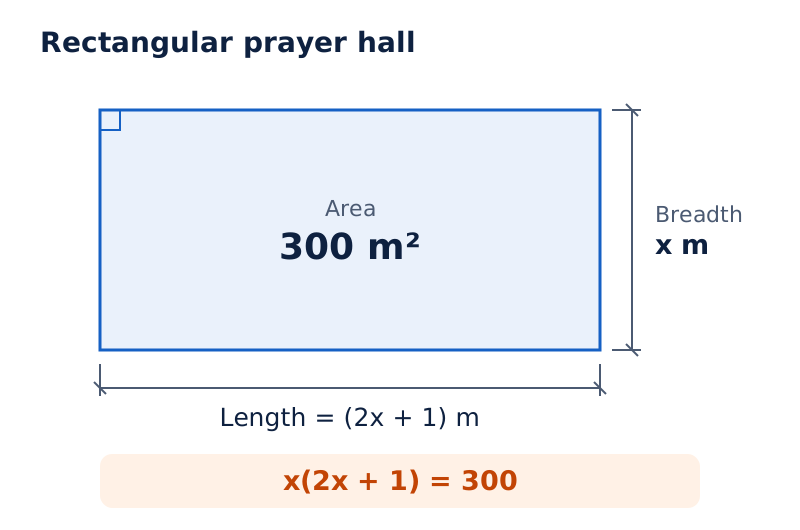
A rectangle represents the hall. Its interior is labelled , its lower side is labelled , and its right side is labelled .
Drawn by One Young India. See Fig. 4.1 in your NCERT textbook
How does the area condition determine the breadth?
Worked example 8. A rectangular prayer hall has area 300 square metres. Its length is one metre more than twice its breadth. Find its dimensions.
Answer: Here denotes the numerical value of the breadth in metres, so the length in metres is .
- Use length multiplied by breadth for the area:
- Expand and rearrange:
- Split the middle term:
- Group and factor:
- Take out the common factor:
- Solve the two linear equations:
- Reject the negative breadth and calculate the length:
- Check the area and relation between dimensions:
The breadth is 12 metres and the length is 25 metres. These dimensions satisfy both conditions in the question.
The final answer should identify which dimension is which, rather than merely listing the two numbers. It should also carry the appropriate unit. Rejecting the negative value is a decision about the physical situation, not a claim that negative numbers cannot solve quadratic equations.
How is the quadratic formula used?
Result: The quadratic formula gives the real roots
For the standard equation, the quadratic formula expresses the roots in terms of its coefficients. Let denote the discriminant, defined by . Real roots are obtained from the formula when .
Definition: For , with and , the roots are The plus-or-minus symbol tells you to calculate both the plus and minus branches.
The entire numerator is divided by twice the leading coefficient. Substitute a negative coefficient inside brackets so that its sign is clear. Calculate the discriminant separately before simplifying the square root. This separates two common sources of error: signed arithmetic and the final division.
How do you apply the formula to a distance equation?
Worked example 9. Solve using the quadratic formula.
Answer: The coefficients are , and .
- Calculate the discriminant:
- Evaluate its positive square root:
- Substitute in the formula:
- Evaluate the plus branch:
- Evaluate the minus branch:
- Check both values:
The roots are and . Their interpretation depends on what the variable represents in an application.
Factorisation and the formula are two ways of solving the same equation. When convenient linear factors are visible, factorisation gives a short route. The formula organises the calculation directly from the coefficients and also explains how the discriminant controls the nature of the roots.
How does the discriminant determine the nature of roots?
The discriminant is the expression under the square root in the quadratic formula. Its sign determines whether the two formula branches give different real values, the same real value, or no real values. Finding the nature of the roots does not always require calculating the roots themselves.
What are the three possible cases?
| Discriminant condition | Nature of roots | Reason from the formula |
|---|---|---|
| Two distinct real roots | The non-zero square root gives different plus and minus results. | |
| Two equal real roots | Both branches give . | |
| No real roots | No real number has a square equal to the negative discriminant. |
Worked example 10. Find the nature of the roots of .
Answer: Here , and .
- Substitute the signed coefficients:
- Evaluate the square and product:
- Subtract and identify the sign:
The equation has no real roots. A negative discriminant does not mean that its roots are negative real numbers.
How are equal roots calculated?
Worked example 11. Find the discriminant and roots of .
Answer: Here , and .
- Calculate the discriminant:
- Use the equal-root form of the formula:
- Substitute and simplify:
- Check the value:
The equation has two equal real roots, both .
Keep the sign of a root separate from the sign of the discriminant. The discriminant classifies real-root existence and equality. Once real roots have been obtained, their signs and values can be interpreted using the original equation or the context of the problem.
How can a geometric condition lead to a quadratic equation?
Geometry can supply the relation needed to form a quadratic equation. A diagram helps identify which lengths are connected, but the algebra must use the stated measurements and a valid geometric property. In the circular-park problem, the diameter creates a right angle at a point on the circumference.
What the figure shows
Pole on a circular park boundary
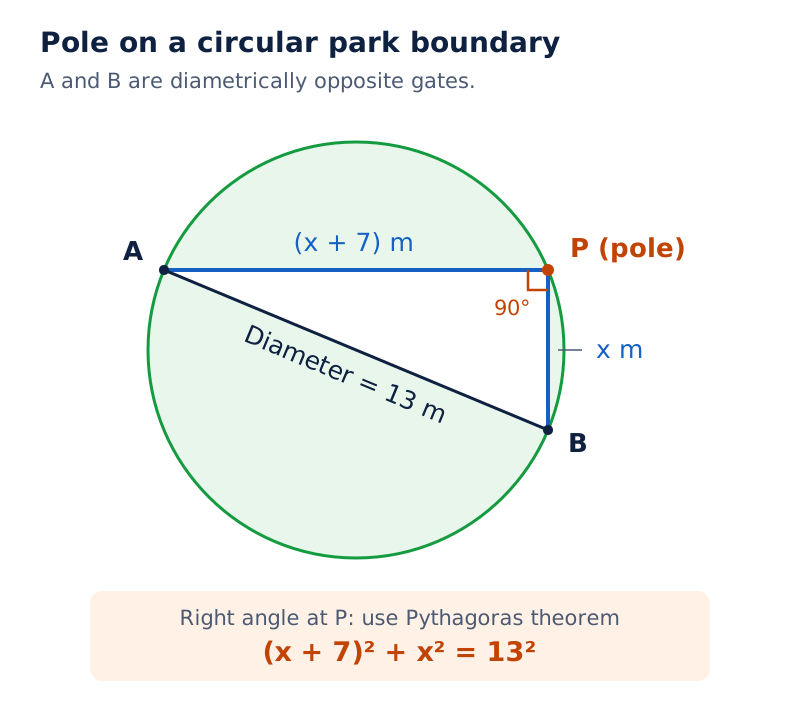
The circle contains a triangle joining points , and on its boundary. The segment crosses the circle diagonally and is labelled . Segments from join the two endpoints.
Drawn by One Young India. See Fig. 4.2 in your NCERT textbook
How are the distances from two gates found?
Worked example 12. A circular park has diameter 13 metres. Gates and are diametrically opposite. Can a pole be placed on the boundary so that its distances from the gates differ by seven metres? Find the distances if possible.
Answer: Let denote the pole's location. Choose as the nearer gate, and let denote the numerical value of the distance from in metres. Thus metres and metres.
- Use the angle in a semicircle:
- Apply the Pythagoras theorem to the right triangle:
- Substitute the lengths in metres:
- Expand both sides:
- Collect terms and divide by two:
- Calculate the discriminant:
- Use the quadratic formula:
- Calculate both roots and retain the positive distance:
- Find the other distance:
- Check the difference and right-triangle relation:
The placement is possible. The pole is five metres from the nearer gate and 12 metres from the farther gate.
The calculation combines three checks: the geometry gives the equation, the discriminant confirms real roots, and the positive root supplies a possible distance. The final substitution confirms that the distances meet both the difference condition and the fixed diameter.
Glossary
- Quadratic equation — An equation whose simplified standard form has a non-zero squared-term coefficient and no higher-degree term.
- Standard form — The arrangement with polynomial terms in descending degree on one side and zero on the other.
- Variable — A symbol representing the unknown number or quantity whose possible values are being sought.
- Coefficient — The numerical multiplier of a variable term, including the sign attached to that term.
- Constant term — The term independent of the variable in the polynomial expression forming the equation.
- Root — A value of the variable that makes the equation true when substituted into it.
- Zero of a polynomial — A value of the variable at which the polynomial expression evaluates to zero.
- Factorisation — Rewriting a polynomial expression as a product of factors that reproduce the original expression.
- Linear factor — A factor of degree one that gives a linear equation when equated to zero.
- Repeated root — A root occurring for both identical linear factors, giving two equal solution values.
- Quadratic formula — The expression using the three coefficients to calculate roots when the discriminant is non-negative.
- Discriminant — The expression under the square root in the quadratic formula, determining the nature of roots.
Common errors and misconceptions
- Misconception: An equation containing a squared term must be quadratic. Correct: Expand and simplify first. Squared terms may cancel, as in , leaving a linear equation.
- Misconception: A cubic term makes an equation cubic regardless of the other side. Correct: Cubic terms can cancel. The simplified equation determines the degree, as in .
- Misconception: A middle-term split is correct if its coefficients have the right sum. Correct: Their product must also match the product of the leading and constant coefficients, so check both conditions.
- Misconception: Finding one factor equal to zero completes every quadratic solution. Correct: Solve the equation from each factor. Different factors can give different roots, while repeated factors give equal roots.
- Misconception: A negative discriminant means two negative roots. Correct: It means no real roots. The sign of the discriminant concerns real-root existence and equality, not whether the roots are positive.
- Misconception: In the quadratic formula, only the square-root term is divided by the denominator. Correct: Divide the entire numerator by , retaining the minus sign before the coefficient .
- Misconception: Every algebraic root must be accepted in a word problem. Correct: Check the meaning of the variable. A negative breadth or distance is rejected even when it satisfies the quadratic equation.
Exam-style questions with model answers
Q1. Determine whether is quadratic, showing the simplification. [2 marks]
- Expand both sides to obtain .
- Cancel the identical squared terms and collect constants: .
- The highest remaining power of the variable is one. The equation is linear, so it is not quadratic despite its original squared terms.
Q2. Solve by factorisation and verify both roots. [3 marks]
- Choose the split using and .
- Rewrite and group: , giving .
- Factor the common bracket: . Therefore either or .
- The roots are and . These are separate solutions obtained from the two linear factors.
- Substitution checks give and , respectively. Both roots therefore satisfy the original equation.
Q3. Find the discriminant of , state the nature of its roots, and find them. [3 marks]
- Read the signed coefficients from standard form: , , and .
- Substitute into the discriminant expression: .
- A zero discriminant gives two equal real roots because the square-root contribution in both branches of the quadratic formula is zero.
- Each root is .
- Check by substitution: . Hence both roots are , as required.
Q4. Find two consecutive positive integers whose squares have sum 365. Form and solve a quadratic equation. [4 marks]
- Let denote the smaller integer. The next integer is , so .
- Expand and rearrange: , then , and hence .
- Split the middle term: . Grouping gives , so .
- Thus or . Reject the negative value because both integers must be positive. The integers are and .
- Check both conditions: and . The values are consecutive and have the required sum of squares.
Q5. A cottage industry produces pottery articles. On one day, each article costs, in rupees, three more than twice the number of articles produced. The total production cost is ₹90. Find the number of articles and the cost per article. [5 marks]
- Let denote the number of articles produced that day. The production cost of one article, measured in rupees, is therefore .
- Multiply the number of articles by the cost per article to represent the total: .
- Expand and rearrange into standard form: . Split the middle term using coefficients with sum three and product negative 180: .
- Group the terms: . Hence , giving or .
- The number of articles must be a positive integer, so accept six articles and reject the negative value.
- The cost per article is rupees. Check the total: rupees. Both the given cost relationship and the total are satisfied.
Q6. Is it possible to design a rectangular park with perimeter 80 metres and area 400 square metres? Find its length and breadth if possible. [5 marks]
- Let denote the numerical value of the breadth in metres. Half the perimeter is metres, so the length in metres is .
- Use the stated area to write . Expanding gives , and standard form is .
- The discriminant is . Thus the equation has two equal real roots, so a real candidate dimension exists.
- Factor the equation as . It follows that , giving the positive breadth .
- The length is metres. Equal length and breadth meet the specified rectangular conditions.
- Verify the perimeter: metres. Verify the area: square metres. The design is therefore possible, with both dimensions equal to 20 metres.
Key takeaways
- A quadratic equation has a non-zero squared-term coefficient after expansion, cancellation and collection of like terms.
- Write the equation in standard form before identifying coefficients, and preserve each coefficient's sign during substitution.
- A root makes the equation true; the same value is a zero of the corresponding quadratic polynomial.
- Factorisation solves a quadratic by expressing a zero product and equating each linear factor to zero.
- Repeated linear factors give two equal roots, so equal roots represent one distinct numerical solution value.
- The quadratic formula requires both branches, with the entire numerator divided by twice the leading coefficient.
- The discriminant distinguishes two distinct real roots, two equal real roots, and the absence of real roots.
- In applications, check every candidate against the original conditions and reject values that cannot represent the required quantity.
Test yourself
Why must the leading coefficient in a quadratic equation be non-zero?
If the leading coefficient were zero, the squared term would disappear, so the equation would not have degree two.
What must you do before deciding whether an equation with powers on both sides is quadratic?
Expand both sides, move all terms to one side, and collect like terms before identifying the highest remaining power.
What does it mean for a number to be a root?
Substituting that number for the variable makes the equation true, so the corresponding polynomial evaluates to zero.
What do identical linear factors tell you about the roots?
They give the same value when equated to zero, so the equation has two equal real roots.
What is the nature of roots when the discriminant is positive?
There are two distinct real roots because the square-root term gives different plus and minus results.
What is the nature of roots when the discriminant is negative?
There are no real roots because a real number cannot have a square equal to a negative discriminant.
Why is a negative breadth rejected in the prayer-hall problem?
The variable represents a physical breadth, which must be positive, even though the negative root satisfies the algebraic equation.
Why should a word-problem answer be checked against every stated condition?
The accepted values must satisfy the original quantities and relationships, including any total, difference, area or measurement restriction.