
Trigonometric Functions | CBSE Class 11 Maths Notes
On this page
Watch & explore
Start with a few high-quality watches, then dive into the notes below.
These Class 11 Mathematics notes cover angles and their measurement, degrees and radians, arc length, trigonometric functions on the unit circle, signs, domains, ranges, graphs, periodicity, sum and difference identities, multiple angles, and transformations between sums and products.
How are angles measured as rotations?
An angle measures the rotation of a ray about its initial point. The ray before rotation is the initial side; its final position is the terminal side. The fixed point about which it rotates is the vertex.
The direction of rotation determines the sign. An anticlockwise rotation gives a positive angle, whereas a clockwise rotation gives a negative angle. The amount of rotation matters as well as the final position, so angles need not be restricted to one revolution.
What the figure shows
Positive and negative rotations
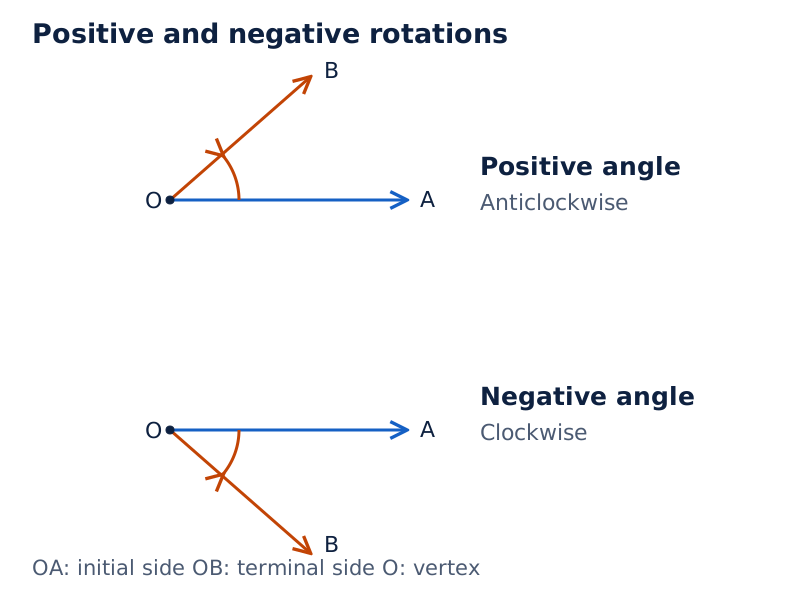
Two pairs of rays share a vertex labelled . In each pair, is the initial side and the terminal side. Curved arrows distinguish anticlockwise and clockwise rotation.
Drawn by One Young India. See Fig. 3.1 in your NCERT textbook
What do degrees, minutes and seconds mean?
One degree is one three-hundred-and-sixtieth of a revolution. A degree divides into sixty angular minutes, and each minute divides into sixty angular seconds. These are subdivisions of angle; the minute hand examples later also use minutes as a unit of time.
Using the degree, prime and double-prime signs for these angular units, the conversion relations are and . One complete revolution measures , while a half revolution measures .
Rotations such as and therefore have valid meanings. Their magnitudes exceed one full revolution, and their signs specify opposite directions. Before converting an angle, combine any degrees and minutes into a single degree measure.
Definition: A radian is the angle subtended at the centre of a unit circle by an arc of length one unit. More generally, an arc as long as the radius subtends one radian.
The unit circle has radius one unit. Unlike degree measure, radian measure connects an angle directly to the ratio of an arc length and a radius. This connection makes radians especially useful when defining trigonometric functions for real inputs.
How do we convert between degrees and radians?
Let denote the constant equal to a circle's circumference divided by its diameter. A full revolution measures radians and . Consequently, radians corresponds to . Both units describe the same rotation, using different numerical measures.
Result: Degree and radian conversion
Let be the numerical degree measure of an angle and its numerical radian measure. Then and . Here , pronounced theta, represents an angle, not an arc length.
| Degree measure | Radian measure |
|---|---|
Worked example 1. Convert to radians.
Answer:
- Convert the angular minutes to degrees:
- Combine the degree measures:
- Multiply the numerical degree measure by the conversion factor:
- The exact answer is radians. Keeping in the answer avoids an unnecessary approximation.
Why can radian measures be real numbers?
Imagine a line tangent to the unit circle, with zero at the point of contact. Wrap its positive part anticlockwise around the circle and its negative part clockwise. Each real number then corresponds to a directed radian measure, including measures involving several revolutions.
The notation convention is to omit the word radian when no degree sign appears. Thus a trigonometric expression with an unmarked real input uses radians. A degree sign must be retained when an input is a degree measure.
How does radian measure connect an arc to its radius?
Let be a circle's radius and the length of an arc, measured in the same length unit. The abbreviation denotes centimetres. Let be the positive central angle subtended by that arc, measured in radians. An arc equal in length to the radius subtends one radian.
Result: The arc-length relation
Equal arcs subtend equal angles at the centre of a given circle. Scaling the arc length therefore scales the corresponding central angle. The relation is , or equivalently . To find the radius, rearrange it as .
What the figure shows
Radian measure on a circle
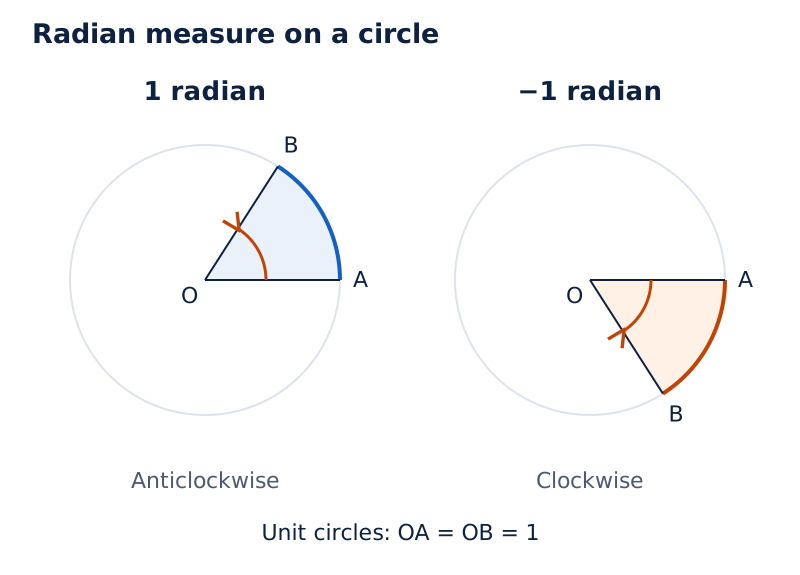
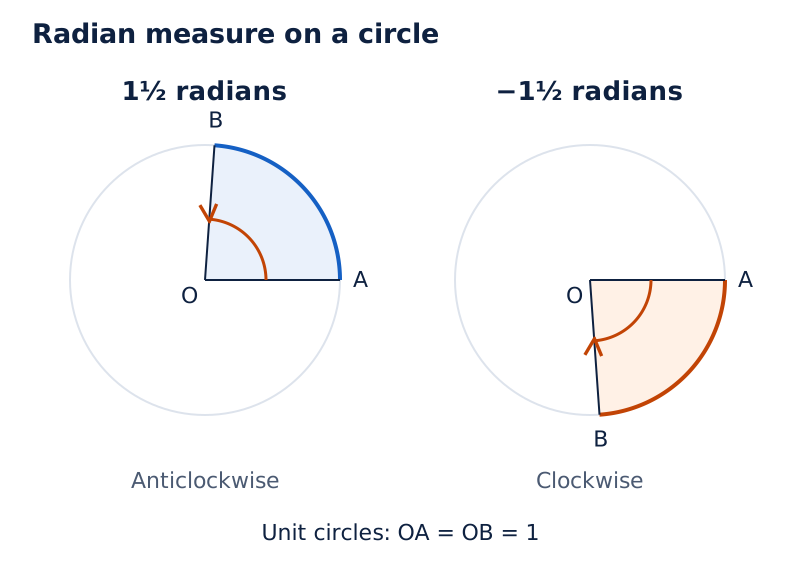
Four circles show initial radius , terminal radius , and shaded sectors. The marked rotations are , , , and radians, with arrows showing their directions.
Drawn by One Young India. See Fig. 3.4 in your NCERT textbook
Worked example 2. A central angle of intercepts an arc of length . Find the radius, using .
Answer:
- Convert the central angle:
- Rearrange the arc-length relation:
- Use the specified approximation:
- Check by substitution: The radius reproduces the stated arc length under the chosen approximation.
Worked example 3. A watch's minute hand is long. How far does its tip move in forty minutes? Use .
Answer:
- The hand completes one revolution in sixty minutes. In forty minutes, the fraction of a revolution is
- Use the magnitude of the rotation:
- The hand length is the radius of the tip's circular path. Therefore
- Apply the supplied approximation:
The distance travelled is an arc length, rather than the straight-line distance between the tip's initial and final positions. Convert the angle before using the formula, and express the final distance in the same unit as the radius.
Worked example 4. Equal-length arcs in two circles subtend and at their centres. Find the ratio of their radii.
Answer:
- Let and be the respective radii, and let and be the corresponding radian measures:
- The common arc length gives
- Divide by the non-zero quantities to obtain
- Thus . The smaller central angle belongs to the larger radius when the arc lengths are equal.
How does the unit circle define the six trigonometric functions?
Let be the origin and let be a point on the unit circle. Here is the horizontal coordinate and the vertical coordinate. Let be the directed radian angle from the positive horizontal axis to the radius through this point.
The cosine and sine functions are defined by and . These definitions extend the familiar ratios of sides in a right-angled triangle to angles beyond the first quadrant and to negative angles.
What the figure shows
Coordinates on the unit circle
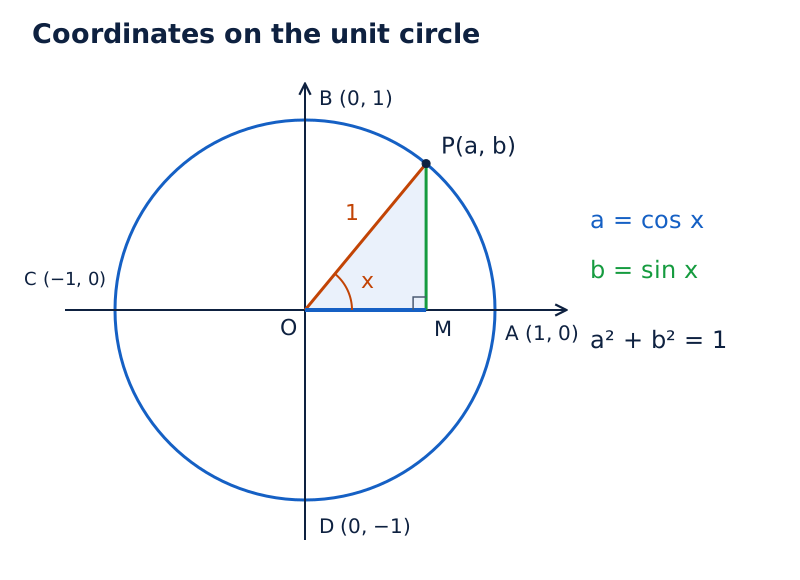
The circle has centre , with four axis points labelled , , , and . The point lies in the first quadrant, and a perpendicular meets the horizontal axis at .
Drawn by One Young India. See Fig. 3.6 in your NCERT textbook
Identity: The fundamental sine-cosine relation
- The unit radius gives the coordinate relation
- Substitute the definitions of sine and cosine:
- Where , divide by its square:
- Where , divide the fundamental relation by its square:
Reciprocal and quotient functions give compact forms for the last two relations. The notation means the square of the sine value, namely ; it does not double the input angle.
| Function | Definition | Condition |
|---|---|---|
| Tangent | ||
| Cotangent | ||
| Secant | ||
| Cosecant |
The corresponding identities are and , on their respective domains. Each follows from the same unit-circle equation, with a different division.
A denominator restriction is part of a function's definition. A reciprocal cannot be evaluated at an input where the original function is zero. Writing a reciprocal formula therefore requires checking that the value being inverted is non-zero.
How do standard values and quadrants determine signs?
The signs of sine and cosine follow the signs of the vertical and horizontal coordinates. Both coordinates are positive in the first quadrant. In the second, only the vertical coordinate is positive; in the third, both are negative; in the fourth, only the horizontal coordinate is positive.
Which functions are positive in each quadrant?
| Quadrant | Positive functions | Negative functions |
|---|---|---|
| First | All six functions | None |
| Second | Sine and cosecant | Cosine, secant, tangent and cotangent |
| Third | Tangent and cotangent | Sine, cosecant, cosine and secant |
| Fourth | Cosine and secant | Sine, cosecant, tangent and cotangent |
The quadrantal angles are integer multiples of . Their terminal sides lie on the coordinate axes. These boundary angles need direct evaluation from the unit circle, because some coordinates vanish and certain quotients or reciprocals are undefined.
| Angle | Sine | Cosine | Tangent |
|---|---|---|---|
| Not defined | |||
| Not defined | |||
Worked example 5. Given , with in the third quadrant, find the other five function values.
Answer:
- Use the fundamental identity:
- The square alone permits either sign. Sine is negative in the third quadrant, so
- Take reciprocals:
- Form the two quotients:
Worked example 6. Given , with in the second quadrant, find the other five function values.
Answer:
- Invert the given value:
- Apply the secant identity:
- Secant is negative in this quadrant. Thus
- Recover sine using the quotient definition:
- Finally take its reciprocal:
In both examples, the identity gives a squared value before the quadrant condition fixes its sign. Taking the positive square root automatically would produce an incorrect answer even if the arithmetic were otherwise correct.
What are the domains, ranges and graphs of the functions?
A function's domain is its set of permitted inputs; its range is its set of outputs. Write for the real numbers and for the integers. In the restrictions below, denotes any integer.
For a graph, denotes the function value corresponding to the angle input . Sine and cosine are defined for every real input because every rotation determines a unit-circle point. Its coordinates each lie between negative one and positive one, inclusive.
In interval notation, a square bracket includes an endpoint, while a round bracket excludes it. The symbol combines sets. The symbols and indicate unbounded behaviour; they are not real outputs attained by the functions.
| Function | Domain | Range |
|---|---|---|
| , | ||
| Real inputs except | ||
| Real inputs except | ||
| Real inputs except | ||
| Real inputs except |
What does each graph show?
What the figure shows
Sine and cosine waves
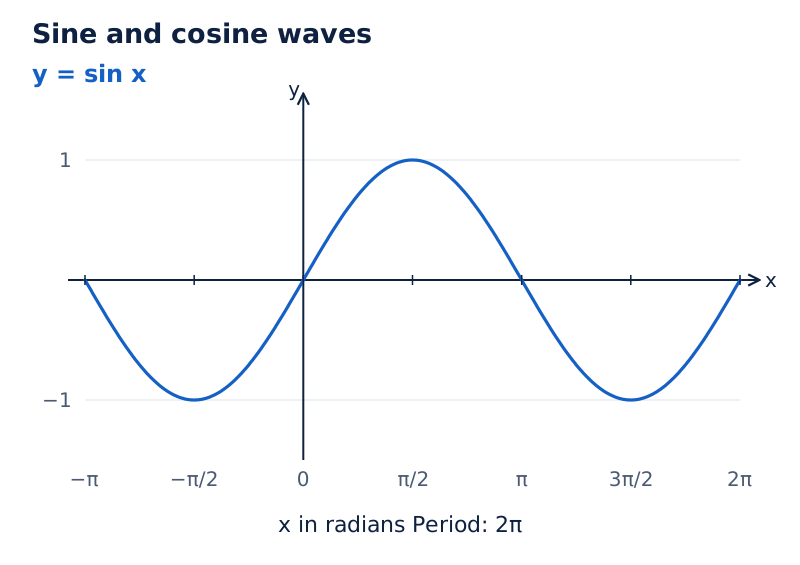
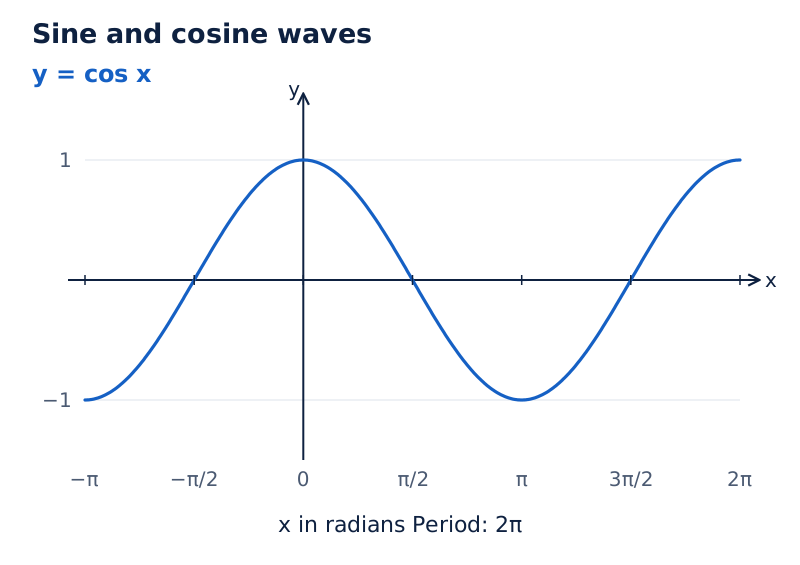
Smooth curves oscillate above and below the horizontal axis. The sine curve passes through the origin, while the cosine curve has height one there. Both repeat their shapes along the angle axis.
Drawn by One Young India. See Figs. 3.8 and 3.9 in your NCERT textbook
Over the first revolution, sine increases from zero to one, decreases to zero and then to negative one, and finally increases to zero. Cosine decreases from one to zero and then to negative one, before increasing through zero back to one.
What the figure shows
Tangent and cotangent branches
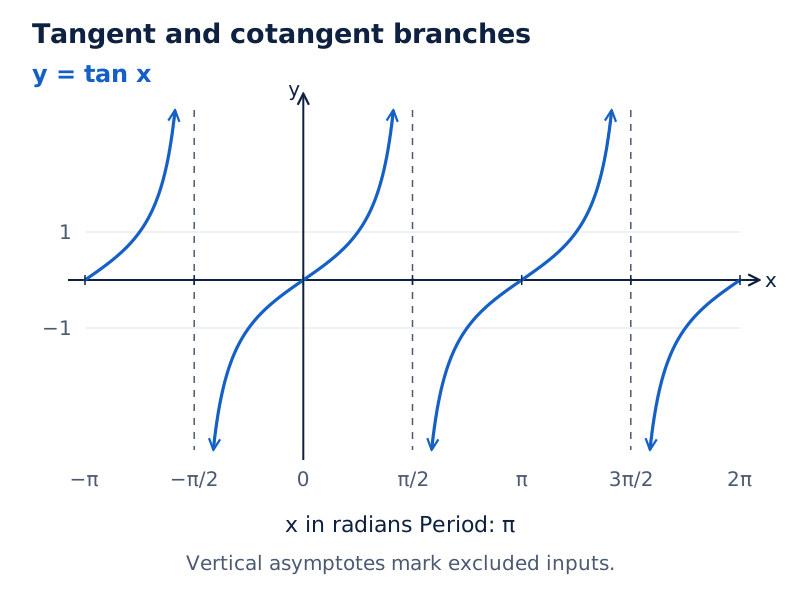
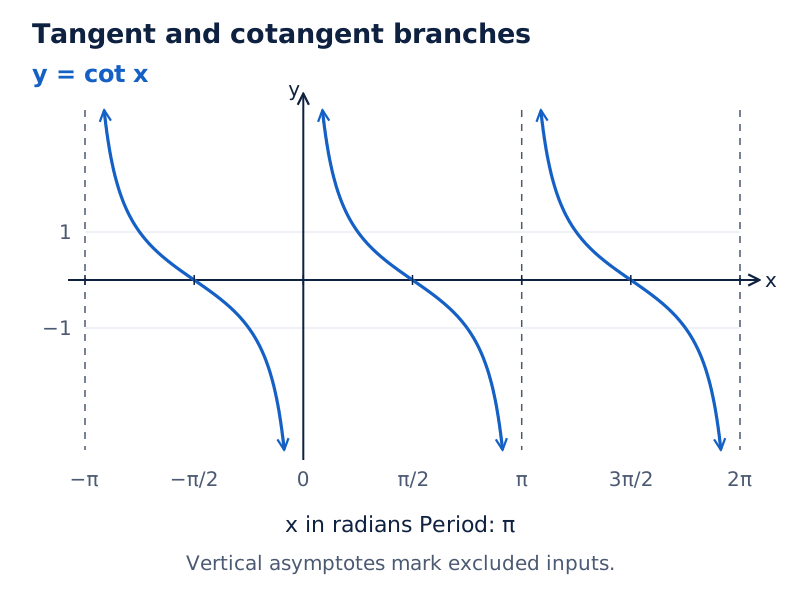
The tangent curve rises through the origin between dashed vertical lines. The cotangent branches fall, with the central vertical asymptote coinciding with the solid vertical axis and dashed lines marking the other vertical asymptotes.
Drawn by One Young India. See Figs. 3.10 and 3.11 in your NCERT textbook
The disconnected branches reflect excluded inputs. Near such inputs, the function values can grow arbitrarily large in magnitude. An arrow or an unbounded branch does not assign a value at a point excluded from the domain.
What the figure shows
Secant and cosecant branches
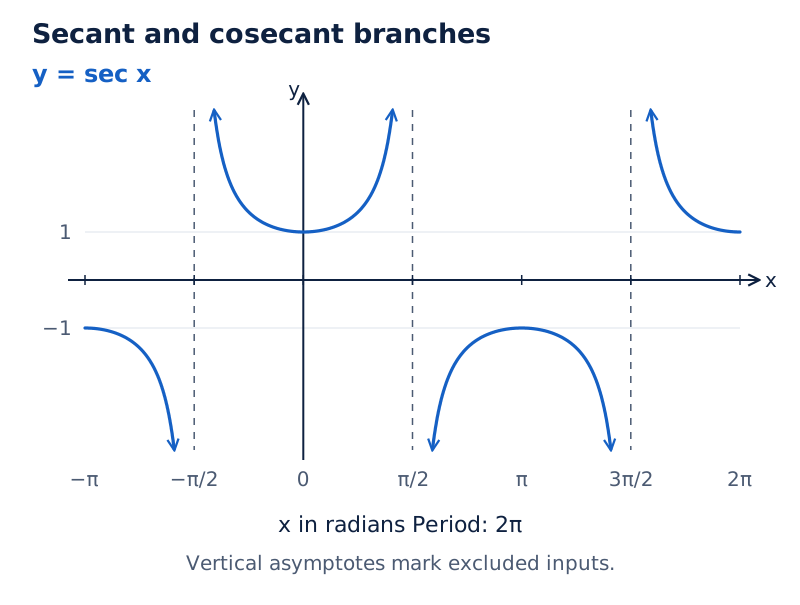
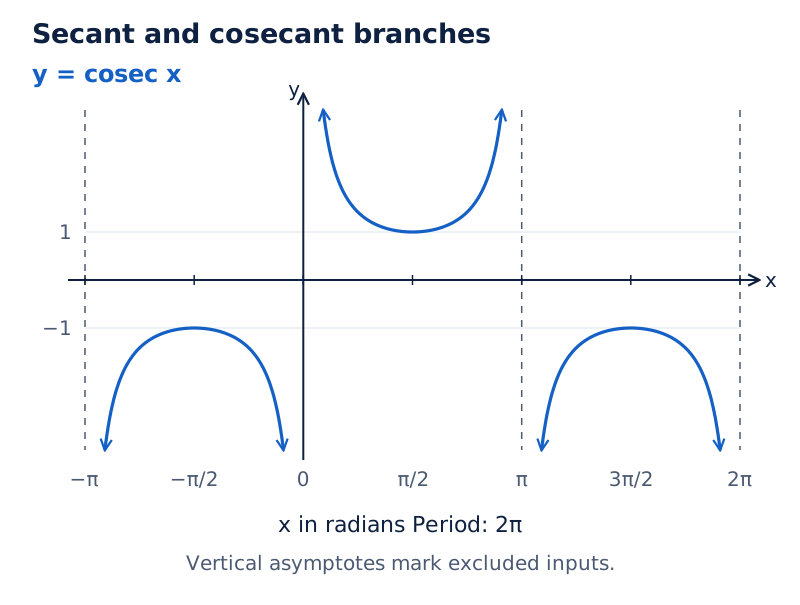
Separate curved branches lie above or below the horizontal axis, with dashed vertical lines between them. The secant graph has an upward branch through height one on the vertical axis.
Drawn by One Young India. See Figs. 3.12 and 3.13 in your NCERT textbook
How do periodicity and negative angles simplify calculations?
Adding a complete revolution brings the terminal point back to the same position on the unit circle. Its coordinates remain unchanged. Therefore sine and cosine repeat after a radian increment of , and so do their reciprocal functions wherever defined.
Property: Periodic repetition
For any integer , the coordinate definitions give and . Tangent and cotangent repeat after , so and on their domains.
A period is an input increment after which function values repeat. Periodicity lets us replace a large positive or negative angle by a simpler angle without changing the value of the relevant function.
Worked example 7. Find .
Answer:
- Separate complete revolutions from the angle:
- Recognise the full-period part:
- Apply periodicity and the standard value:
Worked example 8. Find .
Answer:
- Add five complete revolutions to simplify the input:
- Cosine is unchanged by this addition:
- At this quadrantal angle the horizontal coordinate vanishes, so
Property: Behaviour under reversal of angle
Reversing the angle reflects the terminal point across the horizontal axis. The horizontal coordinate stays the same, whereas the vertical coordinate changes sign. Thus and .
What the figure shows
Reflection for negative angles
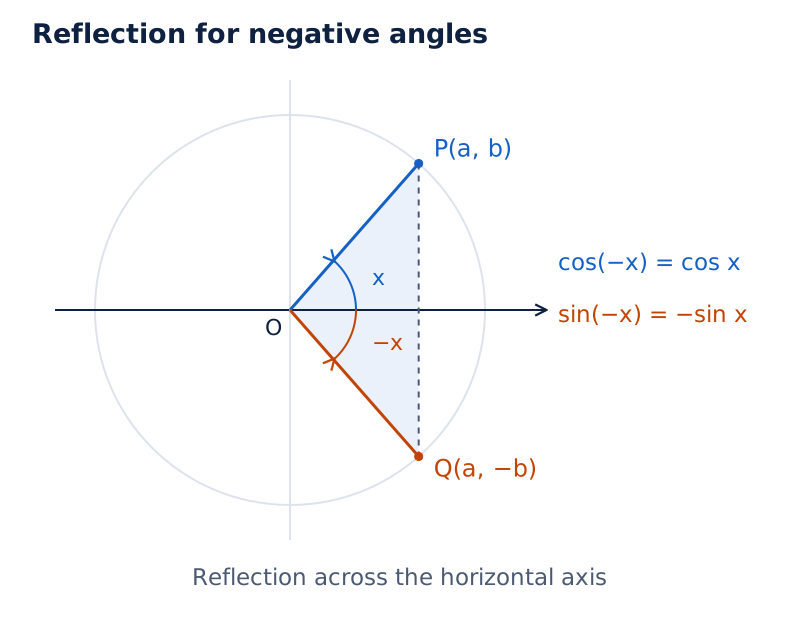
Points and lie on opposite sides of the horizontal axis. Their radii form angles and with the positive horizontal axis.
Drawn by One Young India. See Fig. 3.7 in your NCERT textbook
The first relation makes cosine an even function; the second makes sine an odd function. These names describe the displayed equalities. Use the equality appropriate to the function, rather than applying the same sign rule to both.
How are the sum and difference identities established?
In this section, and denote two real angle measures in radians. The value of a function at their sum depends on both sine and cosine values. It is not obtained merely by adding the two separate function values.
Identity: Cosine of a sum
The fundamental addition identity is . Its geometric proof compares two equal chords on a unit circle, then expresses their lengths through coordinates.
What the figure shows
Chords for the cosine addition identity
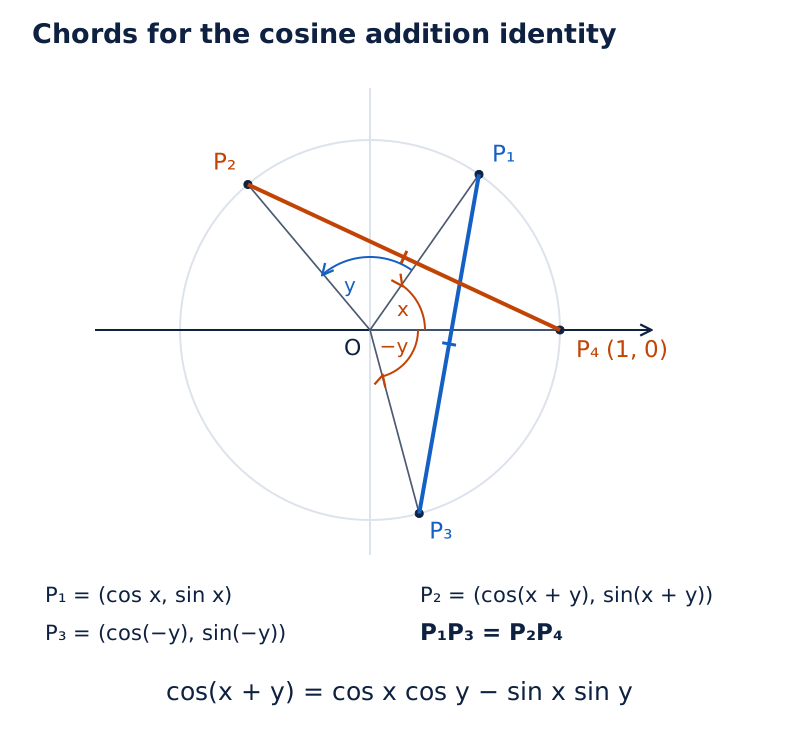
A unit circle centred at contains points , , , and . Radii and connecting chords are drawn; lies at on the positive horizontal axis.
Drawn by One Young India. See Fig. 3.14 in your NCERT textbook
Derivation: Comparing the two chords
- Use four unit-circle points, whose subscripts distinguish their labels: The remaining points are
- The corresponding triangles in the construction have equal unit radii and equal included angles. Their chord lengths satisfy
- Apply the distance formula and the negative-angle identities to the first chord:
- Expand, then use the fundamental identity for each angle:
- Compute the second squared chord length:
- Equate the expressions, subtract the common constant, and divide by negative two:
Difference identity: replacing the second angle by its negative changes the sign before the sine product. This yields .
How do the sine identities follow?
- Apply the cosine difference identity at a right angle:
- Replace the input by its complement:
- Rewrite the sine of a sum as a cosine:
- Expand and use the complementary relations:
- Replace the second angle by its negative:
The complementary-angle identities interchange sine and cosine. The four addition and subtraction identities apply to all real angles. Later quotient identities need further restrictions, because forming a quotient introduces a denominator that must remain non-zero.
How do addition identities give exact values and related-angle formulas?
An angle without a familiar table value can often be expressed as a sum or difference of standard angles. The addition identities then give an exact answer involving fractions and radicals, rather than a decimal approximation.
Worked example 9. Find the exact value of .
Answer:
- Write the angle as a difference:
- Expand the sine of that difference:
- Substitute the standard values:
- Combine the terms:
What happens when an angle is shifted by a right or straight angle?
Substituting a right angle, straight angle, or full revolution into the addition identities gives the following related-angle formulas. Their signs agree with the corresponding coordinate changes on the unit circle.
| Input | Sine value | Cosine value |
|---|---|---|
Worked example 10. Given and , with both angles in the second quadrant, find .
Answer:
- Find the square of the missing cosine: The quadrant gives .
- Find the square of the missing sine: The quadrant gives .
- Substitute into the sine addition identity:
- Calculate each product and add:
The sign information is required separately for each angle. Although both angles lie in the second quadrant, their sum is a different angle. Expanding first avoids an unsupported guess about which sign the final sine value should have.
How are tangent and cotangent addition formulas derived?
Tangent is the quotient of sine by cosine. Dividing the sine addition identity by the cosine addition identity therefore produces a tangent formula. This method works only when each quotient used in the calculation is defined.
Derivation: Tangent of a sum
- Require , , and . Begin with
- Expand numerator and denominator:
- Divide every term by the non-zero product :
- Replace the second angle by its negative to obtain For this version, also require .
Domain conditions mean that neither individual angle nor the relevant sum or difference may be an odd multiple of . A zero denominator makes the displayed tangent formula unusable at that input.
Worked example 11. Find the exact value of .
Answer:
- Remove the tangent period and split the remaining angle:
- Apply the difference formula and substitute the standard values:
- Multiply numerator and denominator by :
- Rationalise and simplify:
What are the corresponding cotangent formulas?
Dividing the cosine sum or difference formula by the sine formula, then dividing each term by , gives
For the chosen formula, neither angle nor the relevant sum or difference may be a multiple of . Notice the order in the subtraction denominator: reversing it changes the sign of the result.
How do double, triple and half-angle identities follow?
Setting the two angles equal in an addition identity produces a double-angle identity. Applying an addition identity to a double angle and the original angle produces a triple-angle identity. These are consequences of the same addition formulas.
Identity: Double-angle formulas
- Set the two sine inputs equal:
- Do the same for cosine:
- Eliminate either square using the fundamental identity:
- Use the tangent addition formula where both sides are defined:
The sine and cosine forms hold for all real inputs. The tangent form requires both and to exist. The alternative forms and require .
Derivation: The sine triple-angle formula
- Split the input into two parts:
- Apply the sum formula:
- Substitute double-angle expressions:
- Replace the cosine square and collect terms:
Related triple-angle results are and . The tangent expression requires both the original tangent and the triple-angle tangent to be defined.
Worked example 12. Find .
Answer:
- Let denote the required tangent value. Doubling the input gives
- Rearrange to a quadratic equation:
- Complete the square:
- The angle lies in the first quadrant, where tangent is positive. Hence
How are half-angle signs chosen?
Rearranging the cosine double-angle formulas gives and . Taking square roots still leaves a choice of sign. Determine the quadrant of the half-angle before making that choice.
Worked example 13. Given and , find the sine, cosine and tangent of .
Answer:
- Find the cosine magnitude: Since the original angle is in the third quadrant, .
- Halve the given interval: The half-angle lies in the second quadrant.
- Calculate the sine square and choose the positive root:
- Calculate the cosine square and choose the negative root:
- Form the quotient:
How do we transform sums into products and prove identities?
Adding or subtracting paired addition formulas removes selected terms. The resulting sum-to-product identities replace two trigonometric terms by a product involving the average and half-difference of their input angles.
Derivation: A cosine sum as a product
- Let and be auxiliary angle measures. Write the paired identities:
- Add them, cancelling the sine products:
- Choose the auxiliary angles as Then and .
- Substitute to obtain
The other three transformations follow by subtracting the cosine formulas or by adding and subtracting the sine formulas:
How do product-to-sum formulas reverse the process?
The reverse transformations are and . The mixed products give and .
In a proof, choose the transformation that makes the two sides easier to compare. A sum in a numerator and a difference in a denominator may produce a shared factor. Cancel that factor only where the original expression is defined.
How is a quotient identity proved?
For a real angle , consider , assuming its denominator is non-zero. The intended result is . The proof makes the relevant factors explicit.
- Transform the numerator using its average and half-difference:
- Transform the denominator in the same way:
- The non-zero denominator permits cancellation, giving
- Apply the cotangent definition:
A trigonometric identity is an equality valid for every input for which its expressions are defined. Transforming one side into the other proves the equality on that domain; it does not restore inputs excluded by an original denominator.
Glossary
- Angle — A measure of the rotation of a ray about its initial point.
- Initial side — The original position of a ray before its rotation forms an angle.
- Terminal side — The final position of a ray after the rotation forming an angle.
- Vertex — The fixed point about which the ray rotates when forming an angle.
- Degree — An angular unit equal to one three-hundred-and-sixtieth of a complete revolution.
- Radian — The central angle subtended by an arc equal in length to the radius.
- Unit circle — A circle with radius one unit, used to define sine and cosine through coordinates.
- Quadrantal angle — An angle that is an integer multiple of a right angle.
- Domain — The set of input values for which a function is defined.
- Range — The set of output values attained by a function over its domain.
- Periodicity — Repetition of function values when the input increases by a fixed interval.
- Trigonometric identity — An equality of trigonometric expressions valid for every input in their shared domain.
Common errors and misconceptions
- Misconception: A clockwise angle must be between zero and a full revolution. Correct: Clockwise rotation gives a negative angle, and its magnitude may exceed a complete revolution.
- Misconception: Degree measure can be substituted directly into . Correct: The angle in this formula is measured in radians; convert degrees before multiplying by the radius.
- Misconception: A squared trigonometric value determines a positive function value. Correct: Taking a square root gives two possible signs; the given quadrant selects the appropriate one.
- Misconception: An undefined tangent value equals infinity. Correct: Infinity describes unbounded nearby behaviour. Tangent has no value where cosine is zero.
- Misconception: . Correct: Use , including both cosine factors.
- Misconception: Sine and cosine obey the same negative-angle rule. Correct: Sine changes sign under angle reversal, whereas cosine retains its value.
- Misconception: Cancelling a denominator factor makes all inputs valid. Correct: The original denominator must remain non-zero, even when the final expression has a wider domain.
- Misconception: A half-angle belongs to the same quadrant as the original angle. Correct: Halve the given interval first, then choose the signs of the half-angle functions.
Exam-style questions with model answers
Q1. Convert into radians, giving an exact answer. [2 marks]
- Convert angular minutes to degrees: , so the complete degree measure is .
- Multiply by the degree-to-radian conversion factor: The answer is radians.
Q2. A watch's minute hand is long and completes one revolution in sixty minutes. Find the distance travelled by its tip in forty minutes, using . [3 marks]
- The hand travels along a circle whose radius is its length. Its fraction of one revolution is .
- Convert that fraction to radian measure:
- The required distance is the arc length, so
- With the specified approximation, . This measures the full circular arc travelled by the tip.
Q3. Given , with in the third quadrant, calculate the other five trigonometric function values. [4 marks]
- Start from the fundamental identity: . Since the angle is in the third quadrant, sine is negative, giving .
- Take the reciprocals of the non-zero cosine and sine values: and .
- Divide sine by cosine: .
- Divide cosine by sine: . Both quotients are positive, consistent with their signs in the third quadrant.
Q4. Given and , where both angles lie in the second quadrant, find . [4 marks]
- Find the missing cosine from . The second-quadrant condition selects .
- Similarly, . Sine is positive in the second quadrant, so .
- Use the addition identity:
- Substitute the four known values and calculate both products: Both quadrant conditions are needed to fix the missing signs before substitution.
Q5. Given and , calculate , , and , explaining the signs. [5 marks]
- Use , giving . The original angle lies in the third quadrant, where cosine is negative, so .
- Divide the complete interval by two: . The half-angle therefore lies in the second quadrant, where sine is positive and cosine is negative.
- Apply the half-angle square identity: Choose the positive square root, obtaining .
- Similarly, Choose the negative square root, obtaining .
- Divide the sine value by the cosine value: The quotient is negative, as required for tangent in the second quadrant.
Q6. Prove for real with . [3 marks]
- Apply the cosine sum-to-product formula to the numerator:
- Apply the sine difference-to-product formula to the denominator:
- The assumed non-zero denominator means that its factors are non-zero. Cancellation is therefore permitted, and the quotient becomes This proves the identity on the domain specified in the question.
Q7. Use the tangent double-angle identity to find the exact value of , explaining which root is valid. [3 marks]
- Let denote . The doubled angle is , whose tangent equals one, so .
- Multiply through and rearrange: , giving .
- Complete the square: , so .
- The input angle is in the first quadrant, where tangent is positive. Consequently the valid root is , giving the required exact value.
Q8. State the domain and range of sine and tangent, explaining the excluded tangent inputs. [2 marks]
- Sine has domain and range .
- Tangent has range , with domain all real inputs except , for integer . These inputs make its cosine denominator zero.
Key takeaways
- Angles record both the amount and direction of rotation; anticlockwise rotation is positive and clockwise rotation is negative.
- Convert degree measures to radians before using the arc-length relation, keeping radius and length in matching units.
- The unit circle defines cosine through the horizontal coordinate and sine through the vertical coordinate of its terminal point.
- Use an identity to calculate a squared function value, then use the given quadrant to choose its sign.
- Function domains exclude zero denominators, while ranges describe possible outputs; unbounded behaviour does not make infinity a function value.
- Addition identities generate difference, double-angle and triple-angle formulas; their quotient versions require appropriate non-zero denominators.
- For half-angle calculations, halve the original angle interval before selecting the signs of the resulting square roots.
- Sum-to-product transformations can reveal common factors, but cancellation preserves the restrictions of the original expression.
Test yourself
What determines the sign of an angle?
The direction of rotation determines it: anticlockwise is positive and clockwise is negative.
What condition on the angle is required in ?
The central angle must be measured in radians, with arc length and radius using the same length unit.
Which functions are positive in the second quadrant?
Sine and cosecant are positive; cosine, secant, tangent and cotangent are negative.
Where is tangent undefined?
It is undefined at odd multiples of , because its cosine denominator is zero there.
How do sine and cosine behave when an angle changes sign?
Sine changes sign, so ; cosine stays unchanged, so .
What periods simplify sine and tangent inputs?
Sine repeats after , while tangent repeats after , wherever tangent is defined.
Why does a half-angle square identity not settle the sign?
A square determines magnitude, while the quadrant of the half-angle determines the required sign.
What restriction survives cancellation in a quotient identity?
The original denominator must stay non-zero, even if the simplified expression is defined at additional inputs.
Write about it
Turn a question from this chapter into a paper.
The Writing Studio has a structure guide, a rubric and citation tools for 15 formats, from essays to research papers. Drafting is free with an account. Learnacy Essential adds feedback from an AI writing coach and submission to The OYI Review.
Learnacy Essential is ₹1,499 for the year. Publication depends on review and is not guaranteed.