
Pair of Linear Equations in Two Variables | CBSE Class 10 Maths Notes
On this page
Watch & explore
Start with a few high-quality watches, then dive into the notes below.
This Mathematics note covers pairs of linear equations in two variables, graphical solutions, intersecting, parallel and coincident lines, consistency conditions, substitution, elimination, forming equations from word problems, and checking solutions involving purchases, ages, incomes and two-digit numbers.
What does a pair of linear equations in two variables represent?
A pair of linear equations expresses two conditions involving the same two unknown quantities. Let and denote those unknown quantities. A solution of the pair must satisfy both equations together, rather than just one of them.
The general form is and . Here and are the coefficients of ; and are the coefficients of ; and and are constant terms.
Definition: A common solution is an ordered pair of values that makes both equations true. In the ordered pair , the first entry gives the value of , and the second gives the value of .
How do two conditions become two equations?
Define the quantities before translating the words. A condition about how often something happens gives one equation. A condition about total expenditure gives another. Keep the meaning of each variable unchanged throughout the calculation, so that the final values answer the original question.
Worked example 1. Akhila plays Hoopla half as many times as she rides the Giant Wheel. Each ride costs ₹3 and each Hoopla game costs ₹4. She spends ₹20. Find the number of rides and games.
- Let be the number of rides and the number of Hoopla games. The frequency condition is
- Write the total cost condition:
- Replace in the cost equation:
- Simplify and solve for the rides:
- Find the games from the first condition:
- Check both conditions:
Answer: Akhila takes 4 rides and plays 2 games. The same two counts satisfy the frequency condition and the expenditure condition.
How does the graphical method give a common solution?
Each linear equation in two variables represents a straight line. Every point on that line gives values satisfying its equation. A point common to two lines therefore gives values satisfying both equations. Its coordinates are the solution of the pair.
How should the two lines be plotted?
- Choose convenient values for one variable in the first equation and calculate the corresponding values of the other variable.
- Plot two distinct points obtained for that equation and draw the straight line through them.
- Repeat the calculation and plotting for the second equation on the same coordinate axes.
- Inspect the two lines. If they meet, read the coordinates of the intersection and verify those values in both original equations.
Worked example 2. Check graphically whether and are consistent, and find their solution. Here and are the unknown coordinates.
- For the first line, set : Set : This gives the points and .
- For the second line, set : Then set :
- Draw the first line through its two points and the second through and . Their intersection is .
- Verify the coordinates directly:
Answer: The unique solution is , . Because a common solution exists, the pair is consistent.
What the figure shows
Intersecting lines
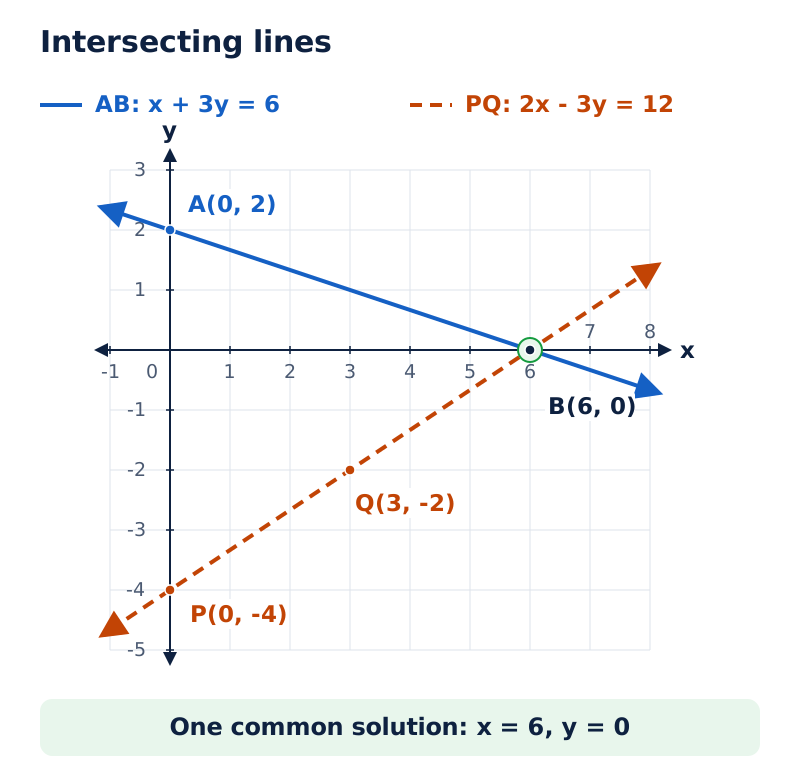
The graph marks points , , and . Here the letters label plotted points. Line slopes downwards and line slopes upwards; they meet at on the horizontal axis.
Drawn by One Young India. See Fig. 3.1 in your NCERT textbook
A graph gives a useful picture of the common point. However, reading a fractional coordinate precisely can be difficult. Algebraic methods provide exact values without relying on the accuracy of a plotted intersection.
How do coefficient ratios tell us the number of solutions?
Write both equations in the same general form before comparing coefficients. The constant term includes its sign after all terms have been brought to one side. Compare the coefficients of the same variable in the same order in each ratio.
Result: Different variable-coefficient ratios give one solution
For the coefficients defined above, means the lines intersect at one point. The pair has a unique solution and is consistent. There is one ordered pair common to the two lines.
Result: Equal ratios of all three coefficients give infinitely many solutions
If , the equations represent coincident lines. Every point on this common line satisfies both equations. The pair is dependent and consistent, with infinitely many common solutions.
Result: Equal variable ratios but a different constant ratio give no solution
If , the lines are parallel. They have no common point, so the pair has no solution and is inconsistent. Equal variable ratios alone therefore do not establish infinitely many solutions.
| Equations in general form | Ratio comparison | Conclusion |
|---|---|---|
| ; | Intersecting lines; one common solution | |
| ; | Coincident lines; infinitely many common solutions | |
| ; | Parallel lines; no common solution |
Note: Use these fraction comparisons only when their denominators are non-zero. If a denominator is zero, use substitution or elimination to determine consistency instead of dividing by zero.
The word consistent includes two possibilities: exactly one solution or infinitely many solutions. It does not mean that the solution must be unique. A dependent pair is consistent because the common line contains solutions to both equations.
How does substitution reduce a pair to one unknown?
The substitution method begins by expressing one variable in terms of the other. Put that expression into the other equation. This removes one unknown from that equation, allowing you to solve for the remaining unknown and then return to the first expression.
Which equation should be rearranged first?
Choose whichever equation makes the rearrangement convenient. In the example below, the coefficient of in the second equation is one. Isolating there avoids a fraction at the first stage, although the final solution itself contains fractions.
Worked example 3. Solve and by substitution, where and denote the unknown numbers.
- Rearrange the second equation to express one unknown:
- Substitute this expression into the first equation:
- Expand the bracket:
- Combine the terms containing and subtract the constant:
- Divide both sides by the coefficient:
- Substitute back into the rearranged equation:
- Check the first original equation:
- Check the second original equation:
Answer: and . Both checks succeed, so these fractional values form the common solution.
Keep exact fractions during the working. A rounded decimal can make the final verification appear slightly unequal even when the algebra is correct. The exact answer also illustrates why an algebraic method can be more convenient than reading coordinates from a graph.
Do not stop after finding one variable. A solution of the pair needs both values. Substitution back into an original equation completes the ordered pair and connects the reduced equation to the original problem.
How should present, past and future ages be represented?
An age problem compares ages at specified times. Define the variables as present ages, then subtract the same number of years from both for a past comparison, or add the same number for a future comparison. The multiplier applies to the whole age at that time.
Why do brackets matter in age equations?
Seven times a person's age seven years ago is seven times their entire past age. It is different from seven times their present age followed by subtracting seven. Writing the past or future age in brackets preserves the intended comparison.
Worked example 4. Seven years ago, Aftab was seven times as old as his daughter. Three years from now, he will be three times as old as she will be. Find their present ages.
- Let denote Aftab's present age in years and his daughter's present age in years. Translate the past condition:
- Expand and rearrange it:
- Translate and simplify the future condition:
- Substitute into the past equation:
- Collect terms and solve:
- Recover the father's age:
- Check the past comparison:
- Check the future comparison:
Answer: Aftab is 42 years old and his daughter is 12 years old. Both time comparisons hold for these present ages.
The time reference is part of the meaning of each variable. State the answer as present ages because that is how the variables were defined. The past and future values are checks on the answer, rather than separate answers to the question.
How does elimination remove one of the variables?
In the elimination method, multiply the equations by suitable non-zero constants so that the coefficients of one variable become numerically equal. Add or subtract the resulting equations to cancel that variable. Solve the remaining equation, then substitute back to find the other unknown.
When should equations be added or subtracted?
If the chosen coefficients have the same sign and value, subtraction cancels them. If their signs are opposite and their magnitudes equal, addition cancels them. Multiply every term, including the constant, when preparing the equations for cancellation.
Worked example 5. Two persons have monthly incomes in the ratio and monthly expenditures in the ratio . Each saves ₹2,000 per month. Find their monthly incomes.
- Let be the common income scale in rupees and the common expenditure scale in rupees. The incomes are and , while the expenditures are and .
- Subtract expenditure from income to represent each saving:
- Multiply the first equation by three:
- Multiply the second equation by four:
- Subtract the transformed first equation from the transformed second:
- Cancel and simplify:
- Substitute into the first original equation:
- Find the expenditure scale:
- Calculate the actual incomes and expenditures:
- Verify both savings and both ratios:
Answer: The monthly incomes are ₹18,000 and ₹14,000. The values and are scale values, not the two incomes themselves.
This distinction is essential in ratio problems. The variables may represent common multipliers rather than the quantities requested. After solving, return to the expressions used to define the incomes and calculate each person's actual amount.
Either variable could have been eliminated. Here, matching the expenditure coefficients gives small whole-number multipliers and keeps the calculation direct. The choice affects the working, but both valid methods must lead to the same incomes.
What does an identity tell us about a dependent pair?
During substitution or elimination, all variable terms may cancel and leave a true statement. This does not give one particular value of a variable. It shows that the second equation adds no different condition to the first: the equations represent the same line.
Why can two price statements still be insufficient?
Two statements are not necessarily two independent restrictions. If the quantities and total cost in one purchase are all doubled in another purchase, the second statement repeats the first. It cannot determine two individual prices uniquely.
Worked example 6. Two pencils and three erasers cost ₹9. Four pencils and six erasers cost ₹18. Determine whether these facts give a unique cost for each item.
- Let be the cost of one pencil in rupees and the cost of one eraser in rupees. Write
- Express the pencil cost using the first equation:
- Substitute into the second equation:
- Simplify the multiplier and expand:
- Cancel the variable terms: This is an identity, so no single value of either price has been determined.
Answer: The equations have infinitely many common solutions. The ₹9 and ₹18 purchase totals do not determine unique individual prices.
A dependent pair is therefore consistent. Its failure to determine a unique pair of prices is different from a contradiction. Each solution must still satisfy the original relation between the two prices.
For a further coefficient check, consider the pair and . Here and again denote unknown coordinates.
- Multiply the second equation throughout by :
- Simplify each term:
- Compare with the first equation. They are identical, so their lines coincide and the pair has infinitely many solutions.
What does a contradiction tell us about an inconsistent pair?
A false statement after correct elimination or substitution means that no pair of values satisfies both original equations. The working has exposed incompatible conditions. There is no missing value to calculate after the variables disappear into a contradiction.
How does substitution reveal parallel lines?
Worked example 7. Two rails are represented by and , where and are coordinates. Will the rails cross?
- Express from the first equation:
- Put this expression into the second equation:
- Expand the bracket:
- Cancel the variable terms and combine the constants:
- Recognise the false statement. There is no common solution, so the two represented lines are parallel and the rails do not cross.
Answer: The rails do not cross. The contradiction establishes that the pair is inconsistent.
How does elimination reveal the same type of failure?
The pair and also has incompatible conditions. The left side of the second equation is twice that of the first, but its right side is not twice the first right side.
- Multiply the first equation by two:
- Subtract the second original equation from this new equation:
- Simplify the two sides: Since this is false, the original pair has no solution.
Compare this with the identity in the pencil-and-eraser example. A contradiction rules out every common solution; an identity leaves the original line of solutions. Neither outcome should be reported as a unique zero value for an unknown.
How can purchase conditions lead to a zero answer?
A word problem must be translated according to its stated conditions, even when the answer is unexpected. A zero value may be valid. Check it against both conditions before rejecting it merely because the question mentions that kind of item.
How should “less than twice” and “less than four times” be translated?
First form the multiple named in the statement, then subtract the stated amount. Use the same variable for the same item in both conditions. This keeps the two equations connected to one purchase rather than two unrelated situations.
Worked example 8. Champa says that the number of skirts she bought is two less than twice the number of pants, and four less than four times the number of pants. Find the numbers bought.
- Let be the number of pants and the number of skirts. Translate both statements:
- For the first line, calculate two points:
- For the second line, calculate two points:
- Plot the two lines through these points. They intersect at .
- Confirm the intersection algebraically by equating the expressions for :
- Subtract and add four to both sides, then divide by two:
- Recover and check the skirt count:
Answer: Champa bought 1 pair of pants and no skirts. The zero skirt count satisfies both statements.
What the figure shows
Champa's purchase conditions
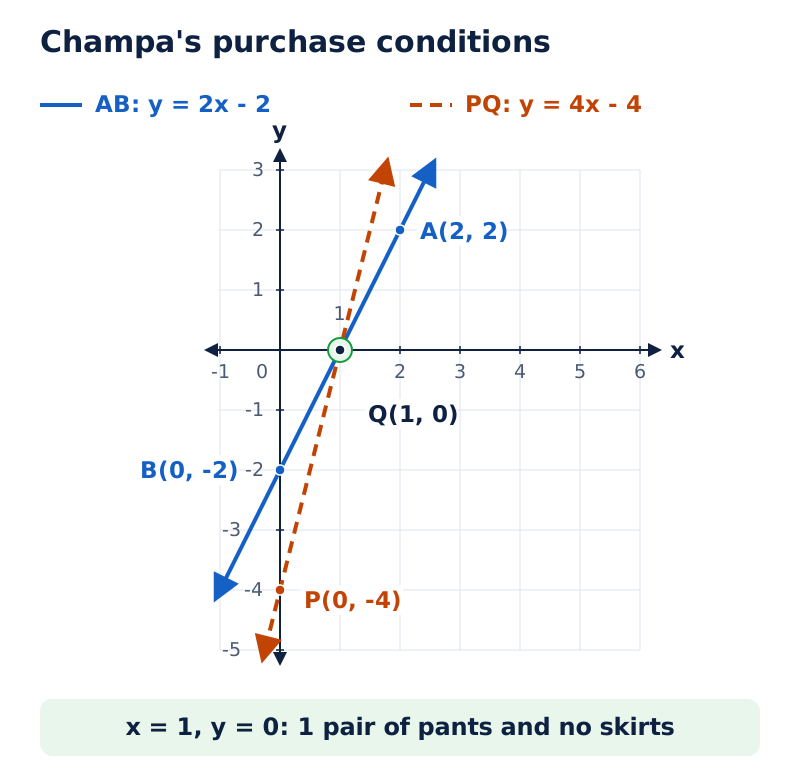
Two rising lines represent and . The graph labels , , and . These letters name plotted points; the two lines meet at on the horizontal axis.
Drawn by One Young India. See Fig. 3.2 in your NCERT textbook
Some plotting points have negative coordinates. They help draw the complete mathematical lines; they are not claims that Champa purchased negative quantities. The common solution must be interpreted using the meanings assigned to the variables.
How are two-digit numbers and reversed digits modelled?
A two-digit number depends on place value. The tens digit contributes ten times its value, while the units digit contributes its own value. Reversing the digits interchanges these roles, so the expressions for the two numbers must reflect both place values.
Why can a difference condition require two cases?
The statement that two digits differ by a given amount does not specify which digit is larger. Unless the question supplies that information, both possible orders must be considered. Solving just one order can omit a valid number.
Worked example 9. A two-digit number and the number obtained by reversing its digits have a sum of 66. The digits differ by 2. Find all possible original numbers.
- Let be the tens digit and the units digit of the original number. The original number is ; the reversed number is .
- Use the sum condition:
- Collect terms and divide by eleven:
- For the case in which the tens digit is larger, use . Add it to the sum equation:
- Find the other digit and the original number:
- For the case in which the units digit is larger, use . Add it to the sum equation:
- Find the other digit and the second possible original number:
- Check the two possibilities:
Answer: There are two possible original numbers, 42 and 24. Each satisfies the sum condition and the stated difference between the digits.
Each case gives a unique digit pair, but the wording permits two cases. This differs from a dependent pair with infinitely many solutions. The two answers arise from the alternative meanings of the difference condition, not from coincident lines.
How should you choose a method and verify a final answer?
The graphical, substitution and elimination methods describe the same common solutions in different ways. A graph shows how the lines are positioned. Algebra determines exact values or reveals why there is no unique solution. Choose the method that suits the coefficients and the task.
How do the methods compare?
| Method | Main operation | Useful feature |
|---|---|---|
| Graphical | Plot the two lines and inspect their common points. | Shows intersection, coincidence or parallelism visually. |
| Substitution | Express one variable in terms of the other and replace it. | Convenient when one variable is easy to isolate. |
| Elimination | Scale the equations and add or subtract to cancel a variable. | Convenient when coefficients can be matched directly. |
A solution obtained by one method can be checked without repeating that whole method. Substitute the proposed values into both original equations. For a word problem, also check the original conditions, since an incorrectly formed equation can still be solved correctly.
What should a complete verification include?
- Identify exactly what each variable represents. Decide whether its value is already the requested quantity or merely a multiplier used to express that quantity.
- Substitute both values into the first original equation and calculate the two sides independently.
- Repeat for the second original equation. Satisfying just the first equation establishes membership of one line, not necessarily the common solution.
- Return to the wording. Check costs, time shifts, ratios or digit order as appropriate, and state the requested quantities with their units or meanings.
When an identity or contradiction appears, the conclusion replaces the search for numerical values. Report infinitely many solutions or no solution as appropriate. Do not continue dividing after the unknowns have cancelled, and do not manufacture a missing second equation.
Glossary
- Pair of linear equations — Two linear equations involving the same two variables, considered together to find their common solutions.
- Variable — A symbol representing an unknown quantity whose value is constrained by the given equations.
- Coefficient — The numerical factor multiplying a variable in a term of an equation.
- Constant term — A term that does not contain a variable, including its positive or negative sign.
- Common solution — An ordered pair of values that satisfies both equations in the given pair.
- Consistent pair — A pair of linear equations having at least one common solution.
- Inconsistent pair — A pair of linear equations with no common solution, represented by distinct parallel lines.
- Dependent pair — A pair of equivalent linear equations having infinitely many distinct common solutions.
- Coincident lines — Lines that lie exactly on one another and share every point on the line.
- Unique solution — Exactly one common ordered pair, represented by the intersection point of two lines.
- Substitution method — A method that replaces one variable using an expression obtained from the other equation.
- Elimination method — A method that cancels one variable by suitably adding or subtracting equations.
- Identity — A true statement remaining after variable terms cancel in a dependent pair.
- Contradiction — A false statement obtained after valid algebraic operations, showing that no common solution exists.
Common errors and misconceptions
- Misconception: Satisfying one equation solves the pair. Correct: The same values must satisfy both original equations; otherwise they give a point on only one line.
- Misconception: Every consistent pair has exactly one solution. Correct: Consistency includes a unique solution and infinitely many solutions. A dependent pair is also consistent.
- Misconception: Matching the variable-coefficient ratios proves coincidence. Correct: Compare the constant ratio too. A different constant ratio means parallel lines and no solution.
- Misconception: Multiplying an equation means multiplying only its variable terms. Correct: Multiply every term on both sides, including the constant, to preserve the equation.
- Misconception: Subtracting equations changes the sign of just the first term in the subtracted equation. Correct: Subtract the entire expression, changing every term's sign.
- Misconception: An identity such as means both unknowns are zero. Correct: It supplies no particular values; the pair has infinitely many common solutions.
- Misconception: A zero answer in a purchase problem must be wrong. Correct: Check it against the conditions. Champa's zero skirt count satisfies both purchase statements.
- Misconception: Digits differing by two necessarily satisfy . Correct: If and denote the digits and neither is specified as larger, also consider .
Exam-style questions with model answers
Q1. Classify the pair and , where and are unknowns, by comparing coefficient ratios. State its number of solutions. [2 marks]
- The ratios of corresponding coefficients are .
- All three ratios are equal, so the lines coincide. The equations form a dependent, consistent pair with infinitely many common solutions.
Q2. Solve and by substitution, where and are unknown numbers. [3 marks]
- Rearrange the second equation as . This expresses one unknown in terms of the other without introducing a fraction.
- Substitute into the first: . Expanding gives , hence and .
- Substitute back: . Therefore the common solution is , .
- Check both equations: and . Both original conditions hold exactly.
Q3. Aftab was seven times his daughter's age seven years ago. Three years from now he will be three times her age. Form equations and find their present ages. [4 marks]
- Let be Aftab's present age and his daughter's present age, both in years. Then and .
- Rearranging gives and . Substitute to obtain , so , and .
- Now . Aftab is 42 years old; his daughter is 12.
- Check: seven years ago, ; three years from now, . Both comparisons use ages at the same time.
Q4. Two persons' monthly incomes are in the ratio , and their monthly expenditures are in the ratio . Each saves ₹2,000 per month. Find their incomes using elimination. [5 marks]
- Let be the income scale in rupees and the expenditure scale in rupees. Write incomes as , and expenditures as , . Savings give and .
- Multiply the first equation by three and the second by four: , . Subtract the first transformed equation from the second to get .
- Substitute back: , so and . Thus the incomes are rupees and rupees.
- The expenditures are rupees and rupees. Check savings: , . Also, and . These checks confirm the requested monthly incomes of ₹18,000 and ₹14,000.
Q5. Two pencils and three erasers cost ₹9; four pencils and six erasers cost ₹18. Use substitution to explain whether the cost of each item can be determined uniquely. [3 marks]
- Let be the pencil cost and the eraser cost in rupees. Then and .
- From the first equation, . Substitution into the second gives , then .
- The result is true without specifying either price. The second purchase condition repeats the first, so the pair is dependent with infinitely many solutions. Individual prices cannot be uniquely determined from these data.
Q6. A two-digit number added to the number formed by reversing its digits gives 66. Its digits differ by 2. Find all such numbers, showing both possible digit orders. [5 marks]
- Let be the tens digit and the units digit of the original number. The two numbers are and . Their sum gives , so .
- If the tens digit is larger, . Add this to the sum equation: , hence . Then , giving .
- If the units digit is larger, . Adding to the sum equation gives , hence . Then , giving .
- Both orders are allowed because the question does not identify the larger digit. Verification gives and the digit difference . Therefore the two possible original numbers are 42 and 24.
Q7. Use elimination to determine whether the pair and , with unknowns and , has any solution. [2 marks]
- Multiply the first equation by two to get .
- Subtract the second equation: . This false statement proves that the pair is inconsistent and has no solution.
Key takeaways
- A solution of a pair must satisfy both equations with the same values of the two variables.
- Intersecting lines have one common solution, parallel lines have none, and coincident lines have infinitely many.
- Consistency means that a common solution exists; it does not require that the solution be unique.
- Substitution expresses one variable in terms of another, then replaces it in the other equation.
- Elimination matches coefficients through multiplication, then adds or subtracts equations to remove one variable.
- A true statement after cancellation signals infinitely many solutions; a false statement signals an inconsistent pair.
- Define variables before forming word-problem equations, and interpret their values using the quantities originally requested.
- Check exact answers in both original equations and in the conditions of the original problem.
Test yourself
What distinguishes a common solution from a solution of one equation?
A common solution satisfies both equations using the same pair of values, not merely one equation.
What does the intersection point of two lines represent?
Its coordinates give the unique ordered pair satisfying both equations represented by the lines.
Can a dependent pair also be consistent?
Yes. A dependent pair has infinitely many common solutions, so it meets the condition for consistency.
Why must the constant term be included when scaling an equation?
Multiplication must apply to the entire equation to preserve its original equality and solutions.
Why does an identity after cancellation fail to determine unique prices?
It shows that one price equation repeats the other and supplies no additional independent restriction.
What should you conclude when valid elimination produces ?
The statement is false, so the original pair is inconsistent and has no common solution.
Why can graphical solutions be inconvenient for fractional coordinates?
Reading exact non-integral coordinates from a plotted intersection can be difficult and may introduce errors.
Why must both digit orders be checked when only their difference is given?
The wording does not identify the larger digit, so either order may produce a valid original number.