
Coordination Compounds | ISC Class 12 Chemistry Notes
On this page
This note covers coordination entities, Werner’s theory, ligands, coordination number, oxidation state, systematic nomenclature, structural and stereoisomerism, valence bond theory, crystal field theory, colour, magnetic behaviour, stability and applications of coordination compounds.
What makes a coordination compound different from a double salt?
What is a coordination entity?
A coordination compound contains a metal atom or ion bonded to surrounding ions or molecules by sharing electrons. The metal together with these attached groups forms a coordination entity. A ligand is an ion or molecule attached to the central metal through an electron-pair donor atom.
The central atom or ion accepts electron pairs from ligands. It therefore acts as a Lewis acid, meaning an electron-pair acceptor. The attached ligands and central metal together make up the coordination sphere, which is enclosed in square brackets in a formula.
For example, [Co(NH₃)₆]Cl₃ contains cobalt, represented by Co, surrounded by six ammonia molecules, NH₃. Its coordination entity is [Co(NH₃)₆]³⁺. The three chloride ions, Cl⁻, outside the brackets are counter ions: ions that balance the charge of the coordination entity. Subscripts count atoms or groups; a superscript outside the brackets gives the charge of the entire entity.
How does dissolution distinguish the two?
Both double salts and complexes result from combining stable compounds in definite proportions. A double salt dissociates completely into simple ions in water. A complex ion retains its identity rather than breaking into its constituent simple ions under the conditions being considered.
In the formulae below, Fe represents iron, SO₄²⁻ is sulphate, NH₄⁺ is ammonium, H₂O is water, K represents potassium and CN⁻ is cyanide. Iron(II) indicates iron assigned oxidation state +2.
| Feature | Double salt | Complex compound |
|---|---|---|
| Example | Mohr’s salt, FeSO₄·(NH₄)₂SO₄·6H₂O | Potassium hexacyanidoferrate(II), K₄[Fe(CN)₆] |
| Behaviour in water | Gives its constituent simple ions | Gives potassium ions and the intact complex ion |
| Iron-containing species | Iron(II) ions, Fe²⁺ | Hexacyanidoferrate(II) ions, [Fe(CN)₆]⁴⁻ |
Water written after a dot is included in the crystal composition. The cyanide groups in [Fe(CN)₆]⁴⁻ remain coordinated rather than appearing as separate cyanide ions.
How did Werner explain primary and secondary valences?
Werner’s theory distinguishes two kinds of metal linkage. A primary valence corresponds to oxidation state, the formal charge assigned to the metal. Primary valences are normally ionisable and are satisfied by negative ions. A secondary valence counts the groups attached directly to the metal.
Secondary valences are non-ionisable and are satisfied by neutral molecules or negative ions. Their number corresponds to the coordination number. In Werner’s formulation this number is fixed for a metal, and the attached groups have characteristic arrangements in space.
What did chloride precipitation establish?
Silver nitrate, AgNO₃, supplies silver ions, Ag⁺. With chloride ions it forms a precipitate, an insoluble solid, of silver chloride, AgCl. On adding excess silver nitrate solution in the cold, some chloride ions in cobalt-ammonia compounds precipitate while coordinated chloride remains bound.
The unit mol means mole, the unit of amount of substance. The observations below refer to one mole of each compound. All four have six groups bound directly to cobalt, even though the amount of precipitated silver chloride differs.
| Compound and colour | Coordination formula | AgCl from 1 mol | Electrolyte ratio |
|---|---|---|---|
| CoCl₃·6NH₃, yellow | [Co(NH₃)₆]Cl₃ | 3 mol | 1:3 |
| CoCl₃·5NH₃, purple | [CoCl(NH₃)₅]Cl₂ | 2 mol | 1:2 |
| CoCl₃·4NH₃, green | [CoCl₂(NH₃)₄]Cl | 1 mol | 1:1 |
| CoCl₃·4NH₃, violet | [CoCl₂(NH₃)₄]Cl | 1 mol | 1:1 |
An electrolyte produces ions in solution. The ratios here count complex cations, positively charged ions, relative to counter anions, negatively charged ions. The green and violet compounds share a composition but differ in properties, providing evidence of different arrangements of their attached groups.
How can precipitation data determine the coordination number?
For these chloride compounds, each precipitated chloride forms one AgCl. Let count counter chlorides per formula unit, count all chlorides, count neutral unidentate ligands and be the coordination number. The symbol denotes an amount in mol.
Use excess silver nitrate in the cold. The coordinated chloride remains bound under these conditions, so subtracting the counter chlorides from the total gives the number of chloride donor atoms within the sphere.
Worked example 1. One mole of CoCl₃·4NH₃ gives 1 mol AgCl with excess silver nitrate in the cold. Find the coordination formula and coordination number.
Formula: ; .
Substitute: ; ; .
Answer: From 1 mol of compound, 1 mol AgCl identifies one counter chloride. Two chlorides and four ammonia molecules are coordinated. The formula is [CoCl₂(NH₃)₄]Cl and the coordination number is 6.
Worked example 2. One mole of yellow CoCl₃·6NH₃ gives 3 mol AgCl with excess silver nitrate in the cold. Determine the coordination formula and coordination number.
Formula: ; .
Substitute: ; ; .
Answer: The 3 mol AgCl from 1 mol of compound account for all three chlorides outside the sphere. Six ammonia molecules bind to cobalt. The formula is [Co(NH₃)₆]Cl₃ and the coordination number is 6.
Worked example 3. One mole of PdCl₂·4NH₃ gives 2 mol AgCl with excess silver nitrate. Pd denotes palladium. Determine its secondary valence.
Formula: ; .
Substitute: ; ; .
Answer: The 2 mol AgCl from 1 mol of compound show that both chlorides are counter ions. Four ammonia donor atoms remain attached to palladium, so the secondary valence, or coordination number, is 4.
Worked example 4. One mole of NiCl₂·6H₂O gives 2 mol AgCl with excess silver nitrate. Ni denotes nickel. Determine its secondary valence.
Formula: ; .
Substitute: ; ; .
Answer: The 2 mol AgCl from 1 mol of compound show that both chlorides lie outside the sphere. The six water molecules each supply one donor atom, giving nickel a secondary valence of 6.
Worked example 5. One mole of PtCl₄·2HCl gives no AgCl with excess silver nitrate. Pt denotes platinum. Determine its secondary valence.
Formula: ; .
Substitute: ; ; .
Answer: The yield is 0 mol AgCl from 1 mol of compound. None of the six chlorides is precipitated as a counter chloride: all six are coordinated. Platinum therefore has secondary valence 6.
Worked example 6. One mole of PtCl₂·2NH₃ gives no AgCl with excess silver nitrate. Determine the secondary valence of platinum.
Formula: ; .
Substitute: ; ; .
Answer: The yield is 0 mol AgCl from 1 mol of compound, so neither chloride is a counter ion. Two coordinated chlorides and two ammonia molecules supply four donor atoms. The secondary valence is 4.
How are ligands classified by their donor atoms?
A donor atom supplies the electron pair used in a metal-ligand bond. Denticity is the number of donor atoms of one ligand that bind to the same metal. Count these attachment sites rather than the total number of atoms present in the ligand.
| Ligand class | Number of donor sites used | Meaning or example |
|---|---|---|
| Unidentate or monodentate | One | Chloride, water and ammonia each bind through one atom |
| Didentate or bidentate | Two | Ethane-1,2-diamine and oxalate |
| Tridentate | Three | Three donor atoms attach to the same metal |
| Tetradentate | Four | Four donor atoms attach to the same metal |
| Pentadentate | Five | Five donor atoms attach to the same metal |
| Hexadentate | Six | Ethylenediaminetetraacetate can bind through six atoms |
Polydentate describes a ligand with several donor atoms. Ethane-1,2-diamine, H₂NCH₂CH₂NH₂, is abbreviated en and binds through two nitrogen atoms. Oxalate, C₂O₄²⁻, is another didentate ligand. Ethylenediaminetetraacetate, EDTA⁴⁻, can attach through two nitrogen and four oxygen atoms.
How do chelating and ambidentate ligands differ?
A chelating ligand uses two or more donor atoms simultaneously to bind one metal ion, producing a ring containing the metal. Such chelate complexes tend to be more stable than similar complexes containing unidentate ligands. The comparison is a tendency, not an unconditional rule.
An ambidentate ligand has two different possible donor atoms but attaches through either one in a particular linkage. Nitrite, NO₂⁻, can bind through nitrogen or oxygen. Thiocyanate, SCN⁻, can bind through sulphur or nitrogen. Alternative attachment does not make either ligand didentate.
A homoleptic complex has one kind of donor group, as in [Co(NH₃)₆]³⁺. A heteroleptic complex has more than one kind, as in [Co(NH₃)₄Cl₂]⁺. These terms classify the kinds of attached groups, not the overall electrical charge of the entity.
How are coordination number, oxidation state and shape determined?
The coordination number counts ligand donor atoms directly bonded to the central metal. It counts sigma bonds, bonds formed by direct orbital overlap along the metal-donor direction. Additional pi bonding, involving sideways orbital overlap, does not add to this count.
The oxidation number, also called oxidation state, is the charge the metal would carry if all ligands were removed with the shared electron pairs. It differs from the charge on the whole complex, which also includes the charges assigned to its ligands.
How does charge balance work?
Let x denote the metal oxidation number and q the total charge on the coordination entity. Charges are used with their signs. Neutral ligands such as water, ammonia and en contribute zero; each chloride or cyanide contributes −1, and each oxalate contributes −2.
x + total ligand charge = q
Worked example 7. Find the oxidation number and coordination number of iron in [Fe(C₂O₄)₃]³⁻. Each oxalate has charge −2 and supplies two donor atoms.
Answer: x + 3(−2) = −3, so x = +3. Three didentate ligands provide 3 × 2 = 6 donor atoms. Iron is in oxidation state +3 and has coordination number 6.
Worked example 8. Find the oxidation number of copper, Cu, in [Cu(CN)₄]³⁻. Each cyanide ligand has charge −1.
Answer: x + 4(−1) = −3, so x = +1. The metal is copper(I), although the complete coordination entity has charge −3.
What is a coordination polyhedron?
A coordination polyhedron describes the spatial arrangement of donor atoms around the metal. Common arrangements are octahedral, with six donor positions; tetrahedral, with four positions directed towards tetrahedron corners; and square planar, with four donor positions in one square plane.
What the figure shows
Coordination polyhedra
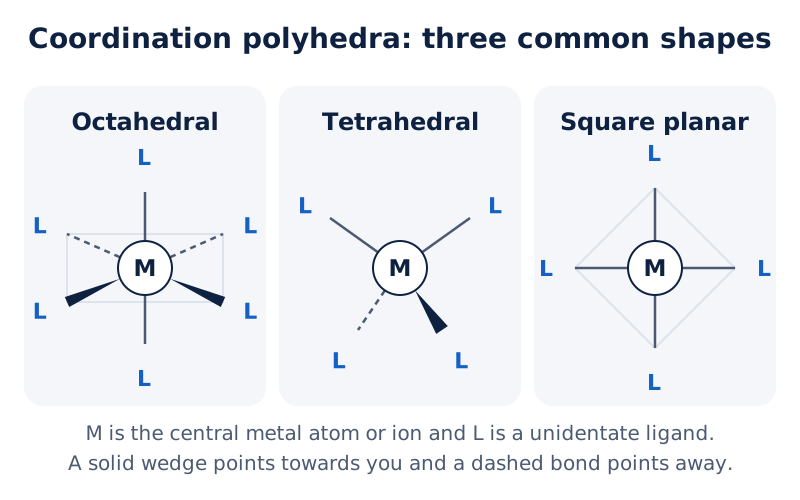
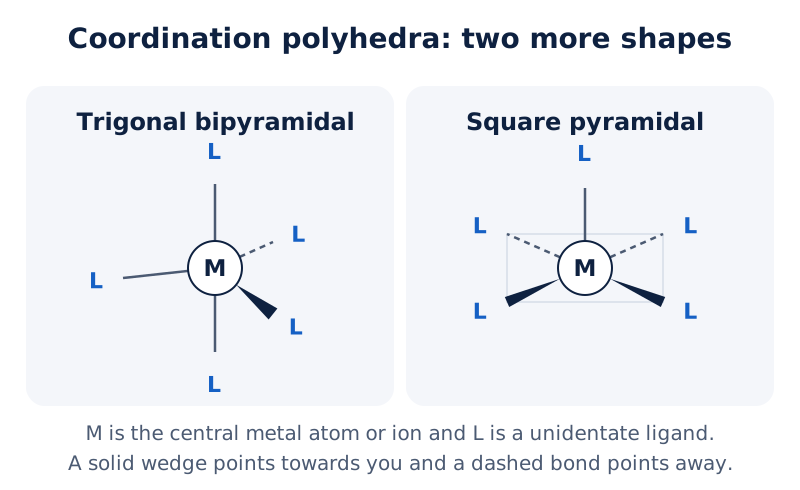
The drawings show octahedral, tetrahedral, square planar, trigonal bipyramidal and square pyramidal arrangements. M labels the central metal atom or ion, and L labels a unidentate ligand. Lines, solid wedges and dashed bonds distinguish directions in space.
Drawn by One Young India.
Coordination number alone does not uniquely determine shape: four-coordinate entities can be tetrahedral or square planar. Identifying the metal’s electron arrangement and magnetic behaviour gives additional information needed to distinguish these possibilities.
How are coordination compounds named and their formulae written?
IUPAC means International Union of Pure and Applied Chemistry. Its systematic nomenclature identifies the ligands, metal and oxidation state. A mononuclear coordination entity has one central metal atom. Name the cation before the anion when naming an ionic compound.
What sequence is used in a name?
- Name the ligands alphabetically before the metal. Ignore multiplying prefixes when deciding alphabetical order.
- Use di-, tri-, tetra-, penta- and hexa- for repeated simple ligands. Use bis-, tris- or tetrakis- with appropriate complex ligand names, enclosing those names in parentheses.
- Name the metal, followed by its oxidation state as a Roman numeral in parentheses.
- For an anionic entity, use a metal name ending in -ate. Iron becomes ferrate. For a cationic or neutral entity, retain the ordinary metal name.
| Ligand formula | Free species | Name when coordinated |
|---|---|---|
| NH₃ | Ammonia | Ammine |
| H₂O | Water | Aqua |
| CO | Carbon monoxide | Carbonyl |
| Cl⁻ | Chloride | Chlorido |
| CN⁻ | Cyanide | Cyanido |
| C₂O₄²⁻ | Oxalate | Oxalato |
Worked example 9. Name [Cr(NH₃)₃(H₂O)₃]Cl₃. Cr is chromium; ammonia and water are neutral, and each counter chloride has charge −1.
Answer: The entity has charge +3, so chromium is +3. Ammine precedes aqua alphabetically. The name is triamminetriaquachromium(III) chloride.
How is a name converted into a formula?
Write the central metal first inside square brackets, followed by ligand formulae alphabetically. For abbreviated ligands, use the first letter of the abbreviation. Enclose polyatomic ligands in parentheses and put the number of each outside those parentheses. Balance the entity’s charge with counter ions.
Worked example 10. Write the formula of potassium trioxalatoaluminate(III). Aluminium is Al; potassium ions have charge +1 and oxalate has charge −2.
Answer: Three oxalates contribute −6 and aluminium contributes +3. The entity has charge −3 and requires three potassium ions. The formula is K₃[Al(C₂O₄)₃].
Note: The Roman numeral gives the metal oxidation state, not the coordination number. Ammine has a double m. An anionic complex requires the -ate metal ending even when its central metal has a positive oxidation state.
What changes in structural isomerism?
Isomers have the same chemical formula but different arrangements of atoms, producing differences in one or more properties. Structural isomers differ in their bonds. First identify what is attached to the metal and what lies outside the coordination sphere.
How do the four structural types differ?
In the pairs below, NO₂ indicates nitrite attachment through nitrogen, ONO indicates attachment through oxygen, and Br⁻ is bromide. Br represents bromine.
| Type | Change involved | Representative pair |
|---|---|---|
| Linkage | The donor atom of an ambidentate ligand changes | [Co(NH₃)₅(NO₂)]Cl₂ and [Co(NH₃)₅(ONO)]Cl₂ |
| Coordination | Ligands exchange between complex cation and complex anion | [Co(NH₃)₆][Cr(CN)₆] and [Cr(NH₃)₆][Co(CN)₆] |
| Ionisation | A coordinated ligand and a counter ion exchange places | [Co(NH₃)₅(SO₄)]Br and [Co(NH₃)₅Br]SO₄ |
| Solvate | Solvent changes between coordinated and uncoordinated positions | [Cr(H₂O)₆]Cl₃ and [Cr(H₂O)₅Cl]Cl₂·H₂O |
In the linkage pair, the nitrogen-bound cobalt complex is yellow; the oxygen-bound form is red. The ligand composition remains nitrite in both cases. Thiocyanate similarly permits either a sulphur-metal or nitrogen-metal linkage.
In coordination isomerism, both ionic components are complexes. Ammonia groups initially coordinated to cobalt can instead be coordinated to chromium, while cyanide groups change in the opposite direction. This is different from simply moving an ion across one coordination sphere’s boundary.
In the ionisation isomers, the first formula has bromide as counter ion and sulphate coordinated; the second has sulphate as counter ion and bromide coordinated. Their different free ions provide a way to distinguish them in solution.
Hydrate isomerism is solvate isomerism involving water. The hexaaquachromium compound in the table is violet; the form containing one coordinated chloride and one uncoordinated water molecule is grey-green. Count both coordinated and uncoordinated water when checking that the overall compositions agree.
How do geometrical and optical isomers differ?
Stereoisomers have the same chemical formula and bonds but differ in spatial arrangement. The two principal types are geometrical and optical isomerism. Drawing the coordination geometry first helps separate a change of position from a change of bonding.
What do cis, trans, fac and mer mean?
In a square planar entity with two pairs of unidentate ligands, like ligands may occupy adjacent positions, giving the cis form, or opposite positions, giving the trans form. Platinum, Pt, gives this pair in [Pt(NH₃)₂Cl₂]. Octahedral [Co(NH₃)₄Cl₂]⁺ also has cis and trans arrangements.
What the figure shows
Cis and trans arrangements
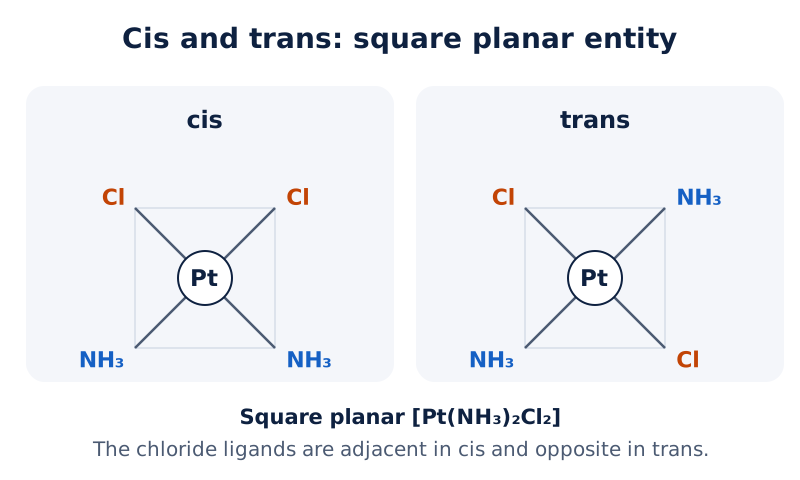
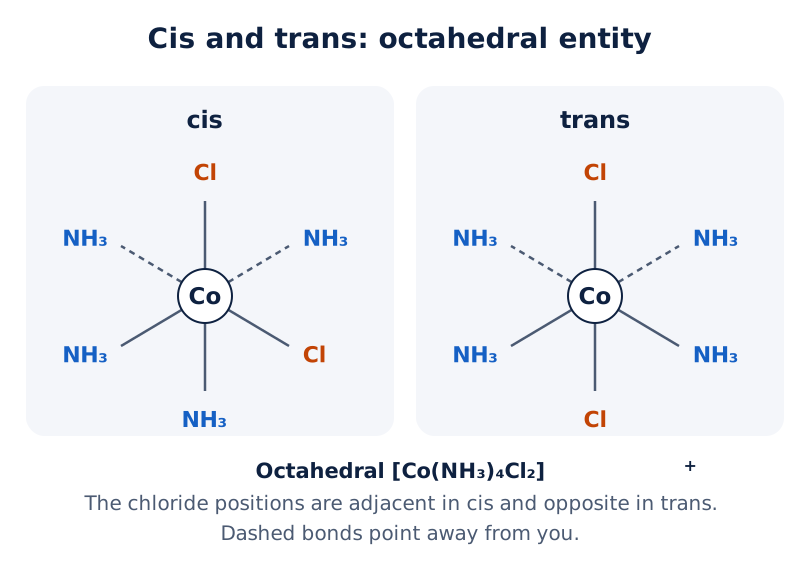
The platinum drawings place the two chloride ligands next to each other in cis and opposite each other in trans. The cobalt drawings show the corresponding adjacent and opposite chloride positions in an octahedral entity.
Drawn by One Young India.
For octahedral [Co(NH₃)₃(NO₂)₃], the facial, or fac, isomer has three like donor atoms at the corners of one face. In the meridional, or mer, isomer they lie around a meridian of the octahedron. These names describe arrangements of three matching groups.
Tetrahedral complexes with two different kinds of unidentate ligand do not show geometrical isomerism because the relative positions of the ligand sites are equivalent. A rotated drawing does not establish a new isomer if the same arrangement can be superimposed.
What makes an optical pair?
Optical isomers, or enantiomers, are mirror images that cannot be superimposed. Such an entity is chiral. Plane-polarised light has its vibrations confined to one plane. The dextro form, labelled d, rotates its plane to the right; the laevo form, labelled l, rotates it to the left.
What the figure shows
Optical isomers
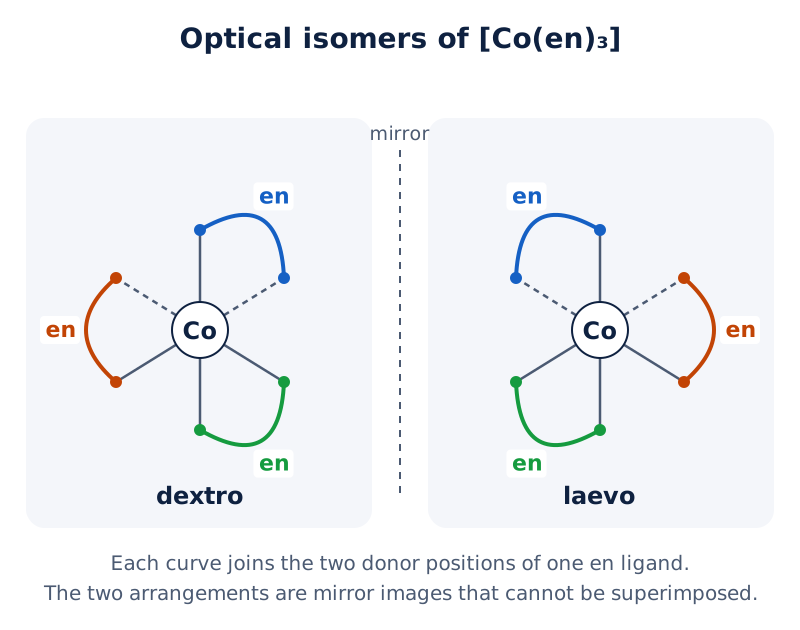
Two [Co(en)₃]³⁺ drawings flank a vertical mirror line. Curved en links connect pairs of donor positions around cobalt. The two arrangements are labelled dextro and laevo and are non-superimposable mirror images.
Drawn by One Young India.
Optical isomerism is common in octahedral complexes involving didentate ligands. In [PtCl₂(en)₂]²⁺, only the cis isomer shows optical activity. Geometrical and optical classifications therefore answer different questions and can both be relevant to the same coordination entity.
How does valence bond theory explain shape and magnetism?
Valence bond theory, abbreviated VBT, describes metal orbitals combining into hybrid orbitals with definite directions. An orbital is a quantum description of an electron’s spatial distribution. Hybridisation is the mathematical combination of atomic orbitals; hybrid orbitals are not separately existing physical objects.
The letters s, p and d label types of atomic orbital. Superscripts in a hybridisation label count the orbitals combined. Thus sp³ combines one s and three p orbitals. Ligands donate electron pairs into the available hybrid orbitals to form metal-ligand bonds.
| Hybridisation | Donor positions | Shape |
|---|---|---|
| sp³ | 4 | Tetrahedral |
| dsp² | 4 | Square planar |
| d²sp³ | 6 | Octahedral |
| sp³d² | 6 | Octahedral |
What distinguishes inner and outer orbital complexes?
For first-series transition metals, d²sp³ uses two inner 3d orbitals, one 4s and three 4p orbitals. It gives an inner orbital complex. In sp³d², two outer 4d orbitals combine with 4s and 4p orbitals, giving an outer orbital complex. The leading number identifies the electron shell.
A species with unpaired electrons is paramagnetic, meaning attracted by a magnetic field. A species with all electrons paired is diamagnetic, meaning weakly repelled. In electron configurations such as 3d⁶, the superscript counts electrons, rather than orbitals being combined.
In [Co(NH₃)₆]³⁺, cobalt(III) is 3d⁶. Pairing leaves two inner 3d orbitals available for d²sp³ hybridisation. The complex is octahedral, low spin and diamagnetic. Low spin means the arrangement has fewer unpaired electrons than the corresponding high-spin possibility.
In [CoF₆]³⁻, F⁻ denotes fluoride. Cobalt(III) again has six 3d electrons, but four remain unpaired. Outer 4d orbitals participate in sp³d² hybridisation. This octahedral complex is high spin, the arrangement with more unpaired electrons, and paramagnetic.
What are VBT’s limitations?
It is usually possible to infer geometry from magnetic behaviour using VBT, but VBT does not make exact tetrahedral versus square planar predictions for four-coordinate complexes. It also fails to explain colour, distinguish weak and strong ligands, or provide quantitative accounts of magnetic data and stability.
How does crystal field splitting produce high-spin and low-spin arrangements?
Crystal field theory, abbreviated CFT, treats metal-ligand bonding electrostatically. Anionic ligands are treated as point charges; neutral ligands as point dipoles, idealised separated positive and negative charges. Repulsion between ligand electrons and metal d electrons changes the energies of the metal’s d orbitals.
What happens in an octahedral field?
The five d orbitals of an isolated gaseous metal atom or ion are degenerate, meaning equal in energy. Six octahedral ligands approach along the coordinate axes, labelled x, y and z for three perpendicular spatial directions. Orbitals pointing towards them experience greater repulsion.
The orbitals labelled d(x²−y²) and d(z²) form the higher-energy eg set. The d(xy), d(yz) and d(xz) orbitals, directed between axes, form the lower-energy t₂g set.
Δₒ denotes the energy gap between the octahedral sets; the subscript o means octahedral. Relative to the average orbital energy, each eg orbital rises by 3Δₒ/5 and each t₂g orbital falls by 2Δₒ/5. The average reference energy is called the barycentre.
Derivation: Why are the octahedral energy shifts unequal?
Measure orbital energies from the average energy in the spherical field. Let be the energy of each of the two higher eg orbitals and that of each of the three lower t₂g orbitals. Their separation is .
- The separation between the two sets gives , so .
- The five orbital energies average to the chosen zero reference. Counting two higher and three lower orbitals gives .
- Substitute for the higher energy: . Collecting terms gives , hence .
- Insert this result into the separation equation: .
Result: Each t₂g orbital lies below the average and each eg orbital lies above it. The unequal shifts reflect the three lower and two higher orbitals.
What the figure shows
Octahedral splitting
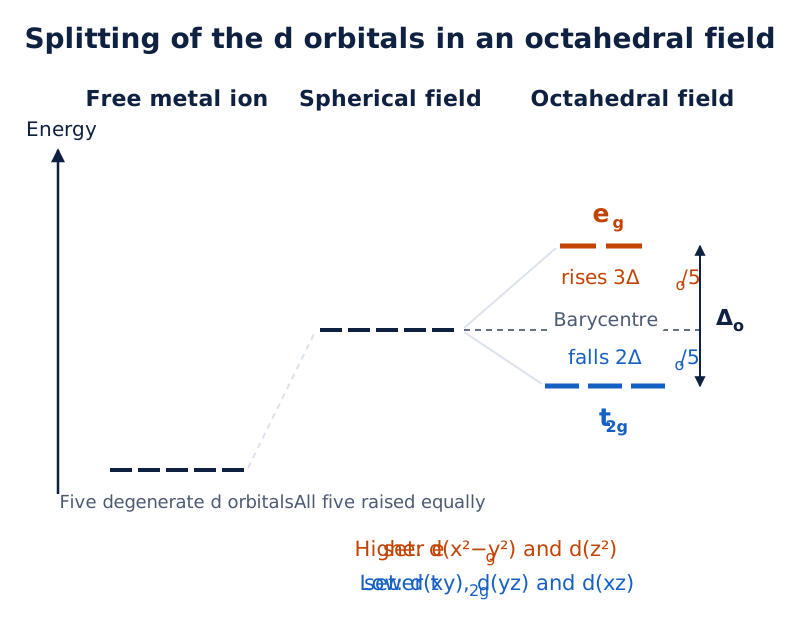
An upward energy arrow accompanies the free-ion, spherical-field and octahedral-field levels. The final diagram places two eg orbitals above the barycentre and three t₂g orbitals below it, marking the total separation Δₒ.
Drawn by One Young India.
Pairing energy, P, is the energy required to pair two electrons in one orbital. For a d⁴ metal ion, meaning four d electrons, the fourth electron faces a choice after three electrons have separately occupied the three lower orbitals.
- If Δₒ < P, the fourth electron enters eg. The arrangement t₂g³eg¹ is high spin.
- If Δₒ > P, the fourth electron pairs in t₂g. The arrangement t₂g⁴eg⁰ is low spin.
The superscripts in these set labels count their electrons. A weak-field ligand produces the smaller splitting associated with the first option; a strong-field ligand produces the larger splitting associated with the second. Here < means less than and > means greater than.
How does a tetrahedral field differ?
In a tetrahedral field the order reverses: the two-orbital e set lies below the three-orbital t₂ set. Δₜ is their energy separation, with t meaning tetrahedral. For the same metal, ligands and metal-ligand distances, the relationship is:
Δₜ = (4/9)Δₒ
The smaller splitting is not sufficiently large to force pairing, so low-spin tetrahedral configurations are rarely observed. The g label is omitted for tetrahedral levels because these complexes lack a centre of symmetry, a point through which opposite equivalent positions can be related.
How do ligands affect colour and magnetic behaviour?
The spectrochemical series is the experimentally determined ordering of ligands by increasing field strength. In general, ligands can be arranged in the following order. Here I⁻ is iodide, S²⁻ is sulphide and OH⁻ is hydroxide; SCN⁻ and NCS⁻ distinguish sulphur-bound and nitrogen-bound thiocyanate.
I⁻ < Br⁻ < SCN⁻ < Cl⁻ < S²⁻ < F⁻ < OH⁻ < C₂O₄²⁻ < H₂O < NCS⁻ < EDTA⁴⁻ < NH₃ < en < CN⁻ < CO
The symbol < means weaker field than. Changing the ligand can therefore change orbital splitting even without changing the identity of the metal.
Why does absorption produce colour?
A d-d transition moves an electron between d-orbital levels. Absorption of light with the required energy can promote an electron from a lower level to a higher one. The observed colour is complementary to the absorbed colour, arising from the light remaining after absorption.
In [Ti(H₂O)₆]³⁺, Ti represents titanium. Titanium(III) has one 3d electron, initially in t₂g. Absorption in the blue-green region promotes it to eg, and the complex appears violet. Changing ligands changes the energy separation and can consequently alter the colour.
Nickel is represented by Ni. Progressive replacement of water by en in nickel(II) complexes changes the colour from green for [Ni(H₂O)₆]²⁺, through pale blue for [Ni(H₂O)₄(en)]²⁺ and blue/purple for [Ni(H₂O)₂(en)₂]²⁺, to violet for [Ni(en)₃]²⁺. Each en replaces two coordinated water molecules.
Why can the same metal ion have different magnetic behaviour?
Worked example 11. Compare [Ni(CN)₄]²⁻ and [NiCl₄]²⁻. Nickel(II) has configuration 3d⁸. In the cyanide complex its d electrons pair to leave one 3d orbital available; in the chloride complex two electrons remain unpaired.
Answer: [Ni(CN)₄]²⁻ uses dsp² hybridisation, is square planar and is diamagnetic. [NiCl₄]²⁻ uses sp³ hybridisation, is tetrahedral and is paramagnetic because it has two unpaired electrons.
Magnetic moment measures the magnetic behaviour associated with the electron arrangement. Measurements can reveal the number of unpaired electrons and help identify structure. However, an inner orbital complex need not be diamagnetic: [Fe(CN)₆]³⁻ has one unpaired electron and remains paramagnetic.
CFT explains structures, colour and magnetism to a large extent. Its point-charge treatment does not account for the covalent character of metal-ligand bonding, and ligand charge alone does not explain the observed ordering of ligand field strengths.
What does the stability constant tell us about a complex?
Stability in solution concerns the extent to which a complex forms from its components at equilibrium. Dynamic equilibrium is the state in which forward and reverse reactions continue at equal rates, leaving the overall composition unchanged. Stability must be discussed for a specified reaction and temperature.
How is a formation constant written?
Consider the formation of the iron(III)-thiocyanate complex. Iron(III), Fe³⁺, combines with thiocyanate, SCN⁻, to form [Fe(SCN)]²⁺. The symbol ⇌ indicates a reversible reaction proceeding in both directions.
Fe³⁺ + SCN⁻ ⇌ [Fe(SCN)]²⁺
Let K be the formation, or stability, constant for this reaction. In the concentration expression below, c(complex), c(iron) and c(thiocyanate) denote the equilibrium concentrations of [Fe(SCN)]²⁺, free Fe³⁺ and free SCN⁻ respectively, expressed using the same concentration convention.
K = c(complex)/(c(iron)c(thiocyanate))
A larger formation constant indicates a greater tendency for the components to form the complex under comparable conditions. A small formation constant indicates less favourable formation. The direction of the reaction matters: a constant for breaking the complex apart has the opposite interpretation.
Derivation: How are formation and dissociation constants related?
Define as the constant for dissociation of [Fe(SCN)]²⁺. Use the same temperature and concentration convention for both reaction directions. Let , and denote equilibrium concentrations of free Fe³⁺, free SCN⁻ and [Fe(SCN)]²⁺ respectively.
- For formation, the complex is the product. Each coefficient is one, so the equilibrium expression is .
- Reverse the reaction. Free iron and thiocyanate are now the products, giving .
- Multiply the expressions: . Dividing by the formation constant gives .
Result: Formation and dissociation constants are reciprocals for the same equilibrium at the same temperature. A large formation constant therefore corresponds to a small dissociation constant.
What should not be inferred from stability?
The equilibrium constant does not tell us how quickly equilibrium is reached. A statement about the amount of complex present at equilibrium is therefore different from a statement about its reaction speed. Compare constants only after checking the balanced reactions and the conditions to which they refer.
Chelation also matters. Complexes containing chelating ligands tend to be more stable than similar complexes containing unidentate ligands. Differences in the stability of calcium and magnesium complexes with EDTA allow their selective estimation. A claim about stability should identify the complexes being compared.
Where are coordination compounds useful?
How are they used in analysis and metal extraction?
Qualitative analysis identifies substances, while quantitative analysis determines their amounts. Characteristic colour reactions between metal ions and ligands form the basis of many analytical methods. Chelating reagents are particularly useful because they bind metals into identifiable coordination entities.
Water hardness, associated with calcium and magnesium ions, is estimated by titration with disodium EDTA, Na₂EDTA, where Na represents sodium. A titration determines an amount by measuring the reagent required for a reaction. Calcium and magnesium form stable complexes with EDTA.
Complex formation is used in extracting silver and gold. Gold, Au, combines with cyanide in the presence of oxygen and water to form [Au(CN)₂]⁻ in solution. Adding zinc separates gold in metallic form. Here complex formation first helps bring the metal into solution.
Purification can use formation followed by decomposition of a complex. Impure nickel is converted into tetracarbonylnickel(0), [Ni(CO)₄]. Decomposition of this compound yields pure nickel. The zero in its name identifies nickel’s oxidation state in the carbonyl compound.
What roles do complexes play in living systems?
Photosynthesis is the light-driven process by which green plants make food. Pernicious anaemia is a form of anaemia associated with vitamin B₁₂ deficiency.
| Coordination compound | Central metal | Biological role |
|---|---|---|
| Chlorophyll | Magnesium | Pigment responsible for photosynthesis |
| Haemoglobin | Iron | Red blood pigment that carries oxygen |
| Vitamin B₁₂ | Cobalt | Anti-pernicious-anaemia factor |
These examples show that coordination chemistry includes important biological substances as well as laboratory salts and industrial reagents.
Electroplating, deposition of a metal coating using electric current, gives smoother and more even silver and gold coatings from their cyanide complexes than from simple metal-ion solutions. The usefulness depends on the behaviour of the coordinated metal, not merely on which element is present.
Glossary
- Coordination entity — A central metal atom or ion together with its directly attached ligands.
- Ligand — An ion or molecule attached to a central metal through an electron-pair donor atom.
- Denticity — The number of donor atoms through which one ligand binds the same metal.
- Coordination number — The number of ligand donor atoms directly bonded to the central metal.
- Coordination sphere — The central metal and attached ligands collectively enclosed in square brackets.
- Counter ion — An ion outside the coordination sphere that balances the entity’s charge.
- Ambidentate ligand — A ligand capable of attaching through either of two different donor atoms.
- Chelating ligand — A ligand binding one metal through multiple donor atoms to form a ring.
- Geometrical isomers — Entities with the same bonds but different relative positions of attached ligands.
- Enantiomers — Mirror-image forms that cannot be superimposed on one another in space.
- Crystal field splitting — Separation of initially equal d-orbital energies under the influence of surrounding ligands.
- Pairing energy — The energy required for two electrons to pair in a single orbital.
- Stability constant — An equilibrium constant expressing the tendency for a specified complex-formation reaction to proceed.
Common errors and misconceptions
- Misconception: Coordination number equals the number of ligand molecules. Correct: Count donor atoms; three didentate en ligands give coordination number six.
- Misconception: The complex charge is the metal oxidation state. Correct: Include ligand charges; [Cu(CN)₄]³⁻ contains copper(I), despite the entity’s negative charge.
- Misconception: Ambidentate means two atoms attach simultaneously. Correct: An ambidentate ligand offers alternative donor atoms; didentate describes simultaneous attachment through two donors.
- Misconception: Every chloride in a complex precipitates immediately with silver nitrate in the cold. Correct: The Werner observations distinguish counter chloride from coordinated chloride under those conditions.
- Misconception: Coordination number four establishes tetrahedral shape. Correct: Square planar entities also have four donor positions; electron arrangement and bonding must be considered.
- Misconception: Every inner orbital complex is diamagnetic. Correct: Inner orbital [Fe(CN)₆]³⁻ is paramagnetic because one electron remains unpaired.
- Misconception: The colour seen is the colour absorbed. Correct: The observed colour is complementary to the absorbed colour, as in violet [Ti(H₂O)₆]³⁺.
- Misconception: A large stability constant proves rapid complex formation. Correct: It describes equilibrium formation tendency, not the speed of reaching equilibrium.
Exam-style questions with model answers
Q1. In [Fe(C₂O₄)₃]³⁻, each oxalate has charge −2 and binds through two oxygen atoms. Determine iron’s oxidation number and coordination number. [2 marks]
- Writing iron’s oxidation number as x gives x + 3(−2) = −3, hence x = +3.
- Three oxalate ligands each supply two donor atoms, so the coordination number is 3 × 2 = 6.
Q2. One mole of CoCl₃·5NH₃ gives two moles of AgCl with excess silver nitrate in the cold. Assume only counter chloride precipitates and each ammonia or coordinated chloride supplies one donor atom. Deduce the coordination formula, coordination number and complex charge. [3 marks]
- Two moles of silver chloride indicate two chloride ions outside the coordination sphere per formula unit. Of the three chlorides in the composition, one therefore remains coordinated.
- The coordination formula is [CoCl(NH₃)₅]Cl₂. Five ammonia molecules and one coordinated chloride supply six donor atoms, so the coordination number is six.
- The two external chloride ions contribute total charge −2. Electrical neutrality therefore requires the complex ion [CoCl(NH₃)₅]²⁺ to have charge +2.
Q3. Name [Cr(NH₃)₃(H₂O)₃]Cl₃ systematically and explain the name. Cr is chromium; NH₃ and H₂O are neutral ligands named ammine and aqua; each counter chloride has charge −1. [3 marks]
- The three counter chloride ions have total charge −3. The coordination entity must therefore have charge +3; because both ligand types are neutral, chromium has oxidation state +3.
- Three ammine and three aqua ligands give triamminetriaqua, with ammine before aqua alphabetically. The metal follows as chromium(III), using a Roman numeral for its oxidation state.
- The complete name is triamminetriaquachromium(III) chloride. Chloride is named after the positive coordination entity because it is the counter anion.
Q4. Classify and explain the isomerism in each pair: (a) [Co(NH₃)₅(NO₂)]Cl₂ and [Co(NH₃)₅(ONO)]Cl₂, where NO₂ binds through nitrogen and ONO through oxygen; (b) [Co(NH₃)₅(SO₄)]Br and [Co(NH₃)₅Br]SO₄. [4 marks]
- Pair (a) shows linkage isomerism. Both formulae contain the same nitrite ligand, but the donor atom attached to cobalt differs.
- Nitrite is ambidentate: it can bind through nitrogen in the first entity or through oxygen in the second, changing the metal-ligand linkage.
- Pair (b) shows ionisation isomerism. In the first compound sulphate is coordinated and bromide lies outside the coordination sphere.
- In the second compound bromide is coordinated and sulphate is the counter ion. Their interchange changes which ion is released outside the complex in solution.
Q5. Use VBT to compare [Ni(CN)₄]²⁻ and [NiCl₄]²⁻. In both, Ni²⁺ is 3d⁸ and each ligand supplies one donor pair. Cyanide causes pairing that leaves one vacant 3d orbital; chloride leaves two unpaired 3d electrons. Identify coordination number, hybridisation, shape and magnetism. [5 marks]
- Both entities have coordination number four because four unidentate ligands each provide one donor atom directly attached to nickel. Their common coordination number does not establish a common shape.
- In the cyanide complex, pairing makes one inner 3d orbital available. This combines with one 4s and two 4p orbitals to give dsp² hybridisation.
- The four dsp² orbitals have a square planar arrangement. All nickel d electrons are paired in [Ni(CN)₄]²⁻, so this complex is diamagnetic.
- In the chloride complex, one 4s and three 4p orbitals form four sp³ hybrid orbitals directed tetrahedrally. Hence [NiCl₄]²⁻ is tetrahedral.
- The two unpaired 3d electrons remain in the chloride complex, making it paramagnetic. The different electron arrangements explain the magnetic contrast despite the same metal oxidation state.
Q6. An octahedral d⁴ ion has three lower t₂g orbitals and two higher eg orbitals, separated by energy Δₒ. Pairing two electrons in one orbital costs energy P. Explain the fourth electron’s placement, configuration and spin when (a) Δₒ < P and (b) Δₒ > P. [5 marks]
- The first three electrons occupy the three lower t₂g orbitals separately. The fourth can either pair in one of these orbitals or occupy a higher eg orbital.
- When Δₒ < P, entering the higher level requires less energy than pairing. The fourth electron therefore occupies an eg orbital rather than sharing an occupied t₂g orbital.
- This gives t₂g³eg¹, the high-spin configuration associated with weak-field splitting. Its four electrons occupy separate orbitals, so there are four unpaired electrons.
- When Δₒ > P, pairing costs less energy than promotion to eg. The fourth electron therefore pairs with one of the electrons already in t₂g.
- This gives t₂g⁴eg⁰, the low-spin configuration associated with strong-field splitting. One lower orbital contains a pair and two contain single electrons, leaving two unpaired electrons.
Q7. For Fe³⁺ + SCN⁻ ⇌ [Fe(SCN)]²⁺, let a, b and c be the equilibrium concentrations of free Fe³⁺, free SCN⁻ and complex respectively. Write the formation constant K, interpret a larger K under comparable conditions, and state whether K predicts formation speed. [3 marks]
- The formation constant is K = c/(ab). The complex concentration appears in the numerator, and the free iron and thiocyanate concentrations appear as a product in the denominator.
- A larger formation constant indicates a greater tendency towards formation of the complex at equilibrium, provided the balanced reaction and conditions used for comparison are appropriate.
- K does not predict the speed of formation or the time taken to reach equilibrium. It describes equilibrium composition, while reaction speed is a separate matter.
Q8. Titanium(III) in octahedral [Ti(H₂O)₆]³⁺ has one electron in t₂g. Its empty eg level lies higher in energy. The complex absorbs blue-green light and appears violet. Explain its colour using CFT. [2 marks]
- Absorbed blue-green light supplies energy for the electron to move from t₂g to eg, producing a d-d transition.
- The remaining transmitted light gives the complementary observed colour, so the complex appears violet rather than blue-green.
Key takeaways
- The coordination sphere contains the central metal and directly attached ligands; counter ions outside it balance the entity’s charge.
- Coordination number counts donor atoms, whereas oxidation number follows charge balance after the ligand charges are included.
- Werner’s chloride precipitation evidence distinguishes coordinated chloride from counter chloride under the stated cold silver nitrate conditions.
- Structural isomerism changes bonding, while stereoisomerism preserves bonding and changes the spatial arrangement of attached groups.
- Valence bond theory relates hybridisation to shape and electron pairing to magnetism, but has important predictive limitations.
- Crystal field theory separates d-orbital energies; the competition between splitting and pairing energy determines electron distribution.
- Observed colour is complementary to absorbed colour, and changing ligands can change the colour of a metal complex.
- A formation constant describes equilibrium stability rather than reaction speed; chelate complexes tend to be more stable than similar unidentate complexes.
Test yourself
Why does [Co(en)₃]³⁺ have coordination number six?
Each of the three ethane-1,2-diamine ligands supplies two donor atoms, giving six metal-donor attachments.
What distinguishes ambidentate and didentate ligands?
An ambidentate ligand uses either of two alternative donor atoms; a didentate ligand binds through two donor atoms simultaneously.
Which metal name ending is used for an anionic coordination entity?
The metal name ends in -ate; iron, for example, becomes ferrate in an anionic entity.
What is the difference between cis and trans?
Like ligands occupy adjacent positions in cis and opposite positions in trans for the geometries discussed here.
Why is low spin rarely observed in tetrahedral complexes?
Tetrahedral splitting is smaller and is generally insufficient to force the electrons to pair in lower orbitals.
Does inner orbital hybridisation guarantee diamagnetism?
No. Inner orbital [Fe(CN)₆]³⁻ retains one unpaired electron and is therefore paramagnetic.
What does a large formation constant tell you?
It indicates favourable complex formation at equilibrium for the specified reaction and conditions, without establishing reaction speed.
Which metals occur in chlorophyll, haemoglobin and vitamin B₁₂?
Chlorophyll contains magnesium, haemoglobin contains iron, and vitamin B₁₂ contains cobalt as their coordinated metals.
Write about it
Turn a question from this chapter into a paper.
The Writing Studio has a structure guide, a rubric and citation tools for 15 formats, from essays to research papers. Drafting is free with an account. Learnacy Essential adds feedback from an AI writing coach and submission to The OYI Review.
Publication depends on review and is not guaranteed.