
Haloalkanes and Haloarenes | ISC Class 12 Chemistry Notes
On this page
This note covers the classification and naming of haloalkanes and haloarenes, carbon-halogen bonding, preparation, physical properties, substitution mechanisms, optical rotation, elimination, reactions with metals, and the preparation, uses and environmental effects of important polyhalogen compounds.
How are haloalkanes and haloarenes classified and named?
Haloalkanes contain halogen bonded to a saturated carbon of an alkyl group. A hydrocarbon contains only carbon and hydrogen. An alkyl group is formed by removing hydrogen from an alkane, a hydrocarbon with only single carbon-carbon bonds. Haloarenes contain halogen bonded directly to an aromatic ring, such as the ring in benzene.
In the notation R-X, R represents an alkyl group and X represents a halogen: fluorine, chlorine, bromine or iodine, written F, Cl, Br or I. The formula CₙH₂ₙ₊₁X describes saturated, open-chain monohaloalkanes; n is the number of carbon atoms. C and H denote carbon and hydrogen.
Hybridisation means mixing atomic orbitals to form bonding orbitals. The symbols sp³ and sp² denote mixing one s orbital with three or two p orbitals, respectively. The halogen-bearing carbon is sp³ hybridised in haloalkanes and sp² hybridised in haloarenes.
| Class | Structural feature | Example |
|---|---|---|
| Primary alkyl halide, 1° | Halogen-bearing carbon is bonded to one other carbon | CH₃CH₂Br, bromoethane |
| Secondary alkyl halide, 2° | Halogen-bearing carbon is bonded to two other carbons | CH₃CH(Cl)CH₂CH₃, 2-chlorobutane |
| Tertiary alkyl halide, 3° | Halogen-bearing carbon is bonded to three other carbons | (CH₃)₃CBr, 2-bromo-2-methylpropane |
| Allylic halide | Halogen-bearing sp³ carbon is next to a carbon-carbon double bond | CH₂=CHCH₂Br, allyl bromide |
| Benzylic halide | Halogen-bearing sp³ carbon is attached to an aromatic ring | C₆H₅CH₂Cl, benzyl chloride |
| Vinylic halide | Halogen is directly attached to a double-bonded carbon | CH₂=CHCl, vinyl chloride |
| Aryl halide | Halogen is directly attached to an aromatic ring carbon | C₆H₅Cl, chlorobenzene |
What do the naming prefixes tell us?
Mono-, di- and tri- mean one, two and three halogen atoms. Geminal dihalides have both halogens on the same carbon; vicinal dihalides have them on adjacent carbons. Their common names use alkylidene and alkylene dihalide, respectively.
Common names place the alkyl name before the halide name. The IUPAC, or International Union of Pure and Applied Chemistry, system treats halogens as substituents on the parent hydrocarbon. Thus sec-butyl chloride is 2-chlorobutane; chloroform, CHCl₃, is trichloromethane.
For disubstituted benzene, ortho, meta and para, abbreviated o-, m- and p-, mean positions 1,2; 1,3; and 1,4.
How does the carbon-halogen bond affect physical properties?
Electronegativity is an atom's tendency to attract the shared electrons of a bond. Halogens are more electronegative than carbon, so the carbon-halogen bond is polar. Carbon carries a partial positive charge, δ+, and halogen carries a partial negative charge, δ−; δ means partial.
Bond length is the distance between bonded nuclei. Bond enthalpy measures the energy needed to break bonds, while dipole moment measures charge separation. In the table, pm means picometre, kJ mol⁻¹ means kilojoules per mole, and Debye is the dipole-moment unit.
| Bond in compound | Bond length / pm | Bond enthalpy / kJ mol⁻¹ | Dipole moment / Debye |
|---|---|---|---|
| CH₃-F | 139 | 452 | 1.847 |
| CH₃-Cl | 178 | 351 | 1.860 |
| CH₃-Br | 193 | 293 | 1.830 |
| CH₃-I | 214 | 234 | 1.636 |
From fluorine to iodine, increasing halogen size increases bond length. The table also shows decreasing bond enthalpy. Dipole moment does not follow electronegativity alone: chloromethane has a greater value than fluoromethane.
Why do boiling points and solubility vary?
Pure alkyl halides are colourless, but bromides and iodides develop colour on exposure to light. Methyl chloride, methyl bromide, ethyl chloride and some chlorofluoromethanes are gases at room temperature; higher members are liquids or solids.
For the same alkyl group, boiling points decrease as RI > RBr > RCl > RF. The sign > means greater than. Increasing halogen size and mass strengthens van der Waals attractions, the intermolecular attractions associated with electron distributions. Branching lowers the boiling points of isomeric haloalkanes.
Isomeric dihalobenzenes have very nearly the same boiling points. Para-isomers have higher melting points than the ortho- and meta-isomers because their greater symmetry allows better packing in the crystal lattice, the regular arrangement of particles in a solid.
Haloalkanes are very slightly soluble in water. Breaking water's hydrogen bonds requires more energy than the new haloalkane-water attractions release. They tend to dissolve in organic solvents because the attractions formed and broken have much the same strength. Bromo, iodo and polychloro derivatives are heavier than water.
How are haloalkanes prepared?
How is an alcohol converted into a halide?
An alcohol contains a hydroxyl group, -OH, attached to a saturated carbon. Replacing this group with halogen gives a haloalkane. Here O denotes oxygen, P phosphorus and S sulphur. An arrow, →, means that the reactants form the products shown.
| Reagent | Reaction | Important feature |
|---|---|---|
| Hydrogen chloride, HCl | ROH + HCl → RCl + H₂O | Primary and secondary alcohols require zinc chloride, ZnCl₂, as catalyst |
| Phosphorus trihalide, PX₃ | 3ROH + PX₃ → 3RX + H₃PO₃ | X is Cl or Br in this equation; H₃PO₃ is phosphorous acid |
| Phosphorus pentachloride, PCl₅ | ROH + PCl₅ → RCl + POCl₃ + HCl | POCl₃ is phosphorus oxychloride |
| Thionyl chloride, SOCl₂ | ROH + SOCl₂ → RCl + SO₂ + HCl | Sulphur dioxide, SO₂, and hydrogen chloride escape as gases |
Thionyl chloride is preferred because its gaseous by-products escape, leaving the alkyl chloride. With a given haloacid, alcohol reactivity follows tertiary > secondary > primary. Tertiary alcohols react with concentrated hydrochloric acid at room temperature. Phosphorus tribromide and triiodide are usually generated in situ, meaning within the reaction mixture.
What other preparation routes are useful?
Free-radical halogenation replaces hydrogen in an alkane using chlorine or bromine under heat or light. A free radical is a species containing an unpaired electron. This method gives complex mixtures of mono- and polyhaloalkanes, making separation difficult and the yield of an individual compound low.
Adding a hydrogen halide across an alkene's carbon-carbon double bond forms a haloalkane. Markovnikov's rule directs hydrogen mainly to the double-bonded carbon already carrying more hydrogen atoms. Thus propene, CH₃CH=CH₂, with hydrogen bromide, HBr, gives mainly 2-bromopropane under ordinary addition conditions.
Finkelstein reaction: RCl + NaI → RI + NaCl, in dry acetone. NaI is sodium iodide and NaCl sodium chloride. Alkyl bromides also react. The sodium chloride or bromide precipitates, meaning it separates as a solid, facilitating the forward reaction.
Swarts reaction: heating an alkyl chloride or bromide with a metallic fluoride replaces halogen by fluorine. For example, RBr + AgF → RF + AgBr; AgF is silver fluoride and AgBr silver bromide.
Hunsdiecker reaction: heating a dry silver salt of a fatty acid with bromine in carbon tetrachloride, CCl₄, gives an alkyl bromide with one fewer carbon atom: RCOOAg + Br₂ → RBr + CO₂ + AgBr. RCOOAg is a silver carboxylate, the salt of a carboxylic acid containing -COOH; CO₂ is carbon dioxide.
What products form in nucleophilic substitution of haloalkanes?
A nucleophile donates an electron pair to an electron-deficient centre. The reacting organic molecule is the substrate. In haloalkanes, the partially positive carbon attracts the nucleophile; halogen departs as a halide ion, called the leaving group. Ions are electrically charged atoms or groups.
The reaction can be represented as RX + Nu⁻ → RNu + X⁻. Nu⁻ denotes a negatively charged nucleophile, and the superscript minus denotes its charge. Neutral molecules, including water and ammonia, also act as nucleophiles. Replacement of one group by another is substitution.
In the following table, R′ and R″ represent additional organic groups, which may be the same as or different from R. An amine is an ammonia derivative containing organic groups bonded to nitrogen; primary, secondary and tertiary amines contain one, two and three such groups.
| Reagent | Organic product | Product identity |
|---|---|---|
| Aqueous sodium hydroxide, NaOH, or water, H₂O | ROH | Alcohol; aqueous means dissolved in water |
| Sodium iodide, NaI | RI | Alkyl iodide |
| Ammonia, NH₃ | RNH₂ | Primary amine |
| Primary amine, R′NH₂ | RNHR′ | Secondary amine |
| Secondary amine, R′R″NH | RNR′R″ | Tertiary amine |
| Potassium cyanide, KCN | RCN | Nitrile, with carbon bonded to R |
| Silver cyanide, AgCN | RNC | Isocyanide, with nitrogen bonded to R |
| Potassium nitrite, KNO₂ | R-O-N=O | Alkyl nitrite, joined through oxygen |
| Silver nitrite, AgNO₂ | R-NO₂ | Nitroalkane, joined through nitrogen |
| Silver carboxylate, R′COOAg | R′COOR | Ester, containing a -COO- linkage |
| Lithium aluminium hydride, LiAlH₄ | RH | Hydrocarbon formed by replacing halogen with hydrogen |
Why can similar reagents give different products?
Ambident nucleophiles have two alternative atoms through which they can bond. Cyanide and nitrite ions are examples. Ionic bonding involves attraction between oppositely charged ions; covalent bonding involves shared electron pairs. KCN is predominantly ionic, and attack occurs mainly through carbon, giving a nitrile. AgCN is mainly covalent, leaving nitrogen available for attack and giving an isocyanide as the main product.
Reaction with ammonia is ammonolysis. The primary amine formed can react further to give secondary and tertiary amines, then a quaternary ammonium salt, whose nitrogen bears four organic groups and positive charge. A large excess of ammonia makes the primary amine the major product.
How does the Sₙ2 mechanism work?
Sₙ2 means bimolecular nucleophilic substitution: S indicates substitution, n indicates nucleophilic, and 2 indicates involvement of two reacting species in the single reaction step. Chloromethane reacts with hydroxide ion, OH⁻, to form methanol, CH₃OH: CH₃Cl + OH⁻ → CH₃OH + Cl⁻.
The rate equation is rate = k[CH₃Cl][OH⁻]. Square brackets mean concentration, the amount of a substance per unit volume; k is the rate constant at the stated conditions. Both reactant concentrations affect the reaction rate, so this is second-order kinetics.
- The hydroxide nucleophile approaches the carbon from the side opposite the chlorine atom.
- The carbon-oxygen bond begins forming while the carbon-chlorine bond begins breaking.
- A transition state is reached, with incoming and outgoing groups partly bonded to carbon. It is an unstable arrangement, not an isolable intermediate.
- Chloride leaves and the new carbon-oxygen bond becomes complete, with inversion of the arrangement around the reacting carbon.
What the figure shows
Simultaneous bond formation and breaking
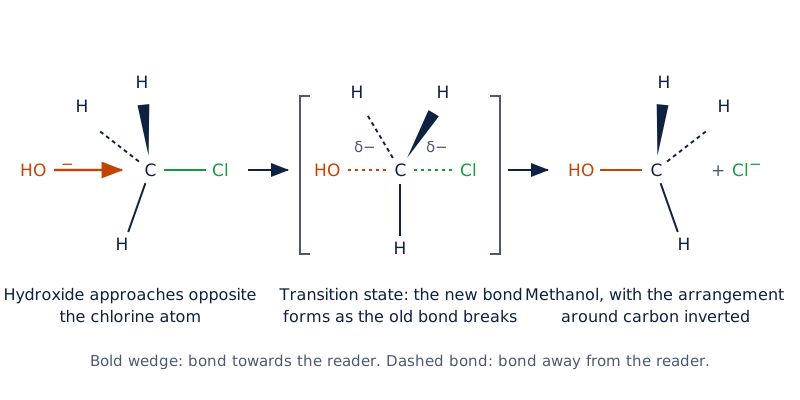
The ball model shows a red incoming hydroxide group approaching opposite a green outgoing halide. The middle arrangement shows partial attachments on opposite sides; the final arrangement shows the halide separated from the product.
Drawn by One Young India.
How does crowding affect this reaction?
Steric hindrance means obstruction caused by bulky groups around the reaction centre. Since the nucleophile must approach carbon closely, increasing crowding slows Sₙ2 attack. Among simple alkyl halides, methyl halides react most rapidly; the order then follows primary > secondary > tertiary.
Configuration means the spatial arrangement of groups around a centre. Back-side attack in Sₙ2 causes inversion of configuration, like an umbrella turning inside out. This geometric change does not predict the sign of optical rotation.
What the figure shows
Steric obstruction of nucleophilic attack
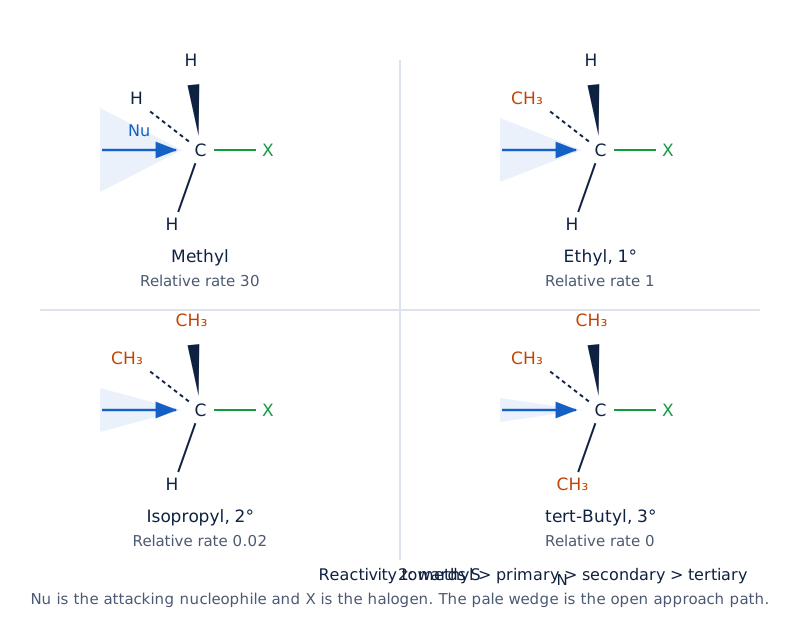
Four panels compare methyl, ethyl, isopropyl and tert-butyl halides. An approaching nucleophile is shown on the left of each carbon-halogen bond; the surrounding alkyl groups progressively crowd its approach.
Drawn by One Young India.
How does Sₙ1 differ from Sₙ2?
Sₙ1 means unimolecular nucleophilic substitution. The number 1 refers to the single substrate molecule involved in the rate-determining step, the slowest step controlling the overall rate. The reaction of tert-butyl bromide, (CH₃)₃CBr, with hydroxide gives tert-butyl alcohol, (CH₃)₃COH.
- The polar carbon-bromine bond breaks slowly, with the bonding electron pair going to bromine.
- This reversible ionisation produces bromide ion, Br⁻, and a tertiary carbocation, (CH₃)₃C⁺. A carbocation contains a positively charged carbon.
- The nucleophile attacks the electron-deficient carbocation in the subsequent fast step.
- Bond formation completes substitution and produces the alcohol.
The rate equation is rate = k[(CH₃)₃CBr]. At constant temperature and unchanged solvent conditions, changing hydroxide concentration does not alter this rate equation. The concentration of the haloalkane controls the slow ionisation step, giving first-order kinetics.
Which factors favour Sₙ1?
Sₙ1 reactions are generally carried out in polar protic solvents, such as water and alcohol. A protic solvent can provide hydrogen for hydrogen bonding. Solvation, the stabilising interaction of solvent molecules with dissolved species, helps the departing halide ion form.
Greater carbocation stability favours faster Sₙ1 reaction. Among simple alkyl halides, tertiary halides react faster than secondary and primary halides. Allylic and benzylic halides also show high reactivity because resonance, the delocalisation of electrons represented by contributing structures, stabilises their carbocations.
| Feature | Sₙ1 | Sₙ2 |
|---|---|---|
| Bond-changing sequence | Ionisation, followed by nucleophilic attack | Bond formation and breaking occur together |
| Rate dependence | Haloalkane concentration | Haloalkane and nucleophile concentrations |
| Intermediate | Carbocation | No intermediate |
| Main structural factor | Carbocation stability | Accessibility of the reacting carbon |
| Optically active substrates | Racemisation, formation of equal proportions of mirror-image products | Inversion of configuration |
For a given alkyl group, leaving-group reactivity follows RI > RBr > RCl ≫ RF in both mechanisms. The symbol ≫ means much greater than. Mechanism selection also depends on nucleophile and conditions; the words primary, secondary and tertiary do not alone specify every reaction outcome.
What are optical activity, chirality and racemisation?
Plane-polarised light has its vibrations confined to one plane. An optically active substance rotates that plane. The angle of rotation is measured using a polarimeter. Clockwise rotation is dextrorotatory, denoted (+), and anticlockwise rotation is laevorotatory, denoted (−).
Chirality means that an object or molecule cannot be superimposed on its mirror image. Mirror images that can be superimposed are achiral. A tetrahedral carbon bonded to four different groups is an asymmetric carbon or stereocentre; tetrahedral describes the arrangement of four bonds towards the corners of a tetrahedron.
For example, the second carbon in 2-chlorobutane has hydrogen, chlorine, methyl and ethyl groups attached. Methyl is CH₃ and ethyl is C₂H₅. These four different groups make that carbon a stereocentre. Propan-2-ol has two identical methyl groups at the corresponding carbon and is achiral.
How are mirror-image molecules related?
Enantiomers are stereoisomers that are non-superimposable mirror images; stereoisomers have the same connectivity but different spatial arrangements. Enantiomers have identical melting points, boiling points and refractive indices, but rotate plane-polarised light in opposite directions. Refractive index describes how a material changes the speed of light.
What the figure shows
Butan-2-ol and its mirror image
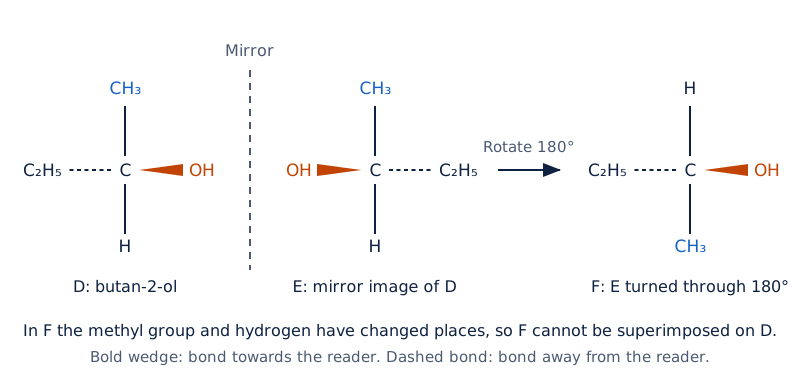
Structures D and E lie on opposite sides of a mirror line. E is rotated through 180° to form F. The hydrogen, hydroxyl, methyl and ethyl groups remain arranged so that F cannot be superimposed on D.
Drawn by One Young India.
A racemic mixture contains equal proportions of two enantiomers and has zero net optical rotation because their rotations cancel. It is written with (±) or dl. Racemisation is conversion of an enantiomer into a racemic mixture.
In Sₙ1 substitution of optically active haloalkanes, the planar, sp²-hybridised carbocation can be attacked from either side, producing racemisation. In Sₙ2, attack occurs opposite the leaving group, giving inversion. Retention means preservation of the spatial arrangement around a stereocentre during a reaction.
Note: The sign of optical rotation is not necessarily related to the actual configuration. Two different compounds with the same configuration may have opposite signs of rotation. Do not equate inversion with a guaranteed change from (+) to (−).
How do elimination and reactions with metals change haloalkanes?
When does an alkene form?
The α-carbon, read alpha-carbon, is the carbon bearing halogen. An adjacent carbon is a β-carbon, read beta-carbon; a hydrogen attached there is a β-hydrogen. Heating a haloalkane containing β-hydrogen with alcoholic potassium hydroxide, KOH dissolved in alcohol, removes hydrogen and halogen from adjacent carbons.
This is β-elimination, or dehydrohalogenation, and forms a carbon-carbon double bond. A base is a proton acceptor; a proton here is a hydrogen ion, H⁺. The base removes β-hydrogen while halogen leaves the α-carbon.
Saytzeff's rule states that the preferred alkene has more alkyl groups attached to its doubly bonded carbons. When several alkenes can form, usually one is the major product. Thus 2-bromopentane gives pent-2-ene as the major product, rather than pent-1-ene.
Product prediction: identify the halogen-bearing carbon, locate adjacent carbons with hydrogen, then place the new double bond between the α-carbon and a suitable β-carbon. Compare the alkyl substitution of the possible double bonds before selecting the major product.
Substitution and elimination compete. Their relative importance depends on substrate, strength and size of base or nucleophile, and conditions. A bulkier nucleophile prefers to act as a base. Secondary halides may undergo substitution or elimination depending on these factors.
What do sodium and magnesium do?
In the Wurtz reaction, sodium, Na, couples alkyl halides in dry ether: 2RX + 2Na → R-R + 2NaX. Ether is the organic solvent. Using the same alkyl halide joins two identical alkyl groups and doubles the number of carbon atoms in the hydrocarbon.
A Grignard reagent is an organomagnesium halide, RMgX, formed by RX + Mg → RMgX in dry ether; Mg denotes magnesium. Organometallic compounds contain carbon-metal bonds. In RMgX, the carbon-magnesium bond is highly polar, with carbon attracting electrons from magnesium.
Grignard reagents react readily with proton sources: RMgX + H₂O → RH + Mg(OH)X. Mg(OH)X represents the magnesium hydroxyhalide product. Even traces of moisture destroy the reagent, so the preparation requires dry conditions. Alcohols and amines also supply protons that convert it into a hydrocarbon.
How are haloarenes prepared?
How does direct halogenation differ from diazonium replacement?
An electrophile accepts an electron pair. In electrophilic aromatic substitution, an electrophile replaces hydrogen on an aromatic ring. Benzene reacts with chlorine or bromine in the presence of a Lewis acid catalyst, an electron-pair acceptor such as iron(III) chloride, FeCl₃.
For chlorination, C₆H₆ + Cl₂ → C₆H₅Cl + HCl, with FeCl₃ as catalyst. The aromatic starting material is benzene, C₆H₆, and the product is chlorobenzene. Direct iodination is reversible and needs an oxidising agent to remove the hydrogen iodide formed. Fluorination is unsuitable by this method because fluorine is highly reactive.
An aromatic primary amine has an -NH₂ group directly attached to an aromatic ring. Aniline, C₆H₅NH₂, reacts with sodium nitrite, NaNO₂, and hydrochloric acid at 273 to 278 K to form benzenediazonium chloride. K means kelvin, the absolute-temperature unit.
Diazotisation is this conversion of a primary aromatic amine into a diazonium salt. In C₆H₅N₂⁺Cl⁻, N₂⁺ denotes the positively charged diazonium group and Cl⁻ is the counter-ion. Its replacement releases nitrogen gas, N₂.
| Method | Reagent applied to diazonium salt | Replacement product |
|---|---|---|
| Sandmeyer reaction | Copper(I) chloride, CuCl, or copper(I) bromide, CuBr | Chlorobenzene or bromobenzene |
| Gattermann reaction | Copper powder with hydrochloric or hydrobromic acid | Chlorobenzene or bromobenzene |
| Iodide replacement | Potassium iodide, KI | Iodobenzene, without requiring copper(I) halide |
Copper(I) means copper has oxidation state +1, a formal charge assigned by electron-counting rules. Sandmeyer uses copper(I) salts, whereas Gattermann uses copper powder and the corresponding halogen acid.
Why are haloarenes resistant to nucleophilic substitution, and when do they react?
In chlorobenzene, chlorine's lone pairs, electron pairs not used in a single bond, interact with the ring's π electrons, the electrons associated with its delocalised multiple bonding. This resonance gives the carbon-chlorine bond partial double-bond character and makes cleavage more difficult.
The sp² carbon of a haloarene has more s-character than the sp³ carbon of a haloalkane and holds the bonding electrons more tightly. A shorter, stronger bond is harder to break. The phenyl cation that direct ionisation would produce is not stabilised by resonance, ruling out ordinary Sₙ1 substitution.
Because of possible repulsion, an electron-rich nucleophile is less likely to approach an electron-rich aromatic ring. These factors explain why haloarenes are extremely less reactive towards nucleophilic substitution than haloalkanes. They do not mean that replacement is impossible under suitable conditions.
How can chlorine be replaced by hydroxyl or amino groups?
Heating chlorobenzene with aqueous sodium hydroxide at 623 K and 300 atmospheres, followed by acidification, gives phenol, C₆H₅OH. Atmosphere is a pressure unit. Acidification means adding acid to convert the phenoxide ion, C₆H₅O⁻, into phenol.
For an unactivated haloarene, strong-base substitution can follow an elimination-addition mechanism involving benzyne. Benzyne is a reactive aromatic intermediate with an additional bond between adjacent ring carbons. Removing an ortho hydrogen and the halide produces this intermediate; nucleophilic addition and proton transfer then give the substituted product.
Chlorobenzene treated with sodium amide, NaNH₂, in liquid ammonia gives aniline. The amide ion, NH₂⁻, acts first as a strong base to form benzyne and then as a nucleophile. Protonation, addition of H⁺, of the resulting carbon-centred anion gives C₆H₅NH₂.
Why do ortho and para nitro groups help?
A nitro group, -NO₂, withdraws electron density. At an ortho or para position it increases reactivity towards nucleophilic substitution by stabilising the negatively charged intermediate. A carbanion is a species containing a negatively charged carbon.
- Hydroxide attacks the carbon bearing chlorine in the nitro-substituted haloarene.
- An anionic intermediate forms with both hydroxyl and chlorine attached at that carbon.
- Resonance spreads the negative charge; an ortho or para nitro group stabilises this intermediate.
- Chloride leaves and the aromatic system is restored. This is addition-elimination, distinct from benzyne formation.
A meta nitro group does not stabilise this negative charge through the same resonance structures.
How do haloarenes undergo electrophilic substitution and reactions with metals?
Halogens are slightly deactivating but ortho- and para-directing. The inductive effect is electron withdrawal or release through the framework of single bonds. Chlorine's negative inductive effect, written -I, withdraws electrons and makes the ring somewhat less reactive than benzene.
Through resonance, chlorine donates electron density more towards ortho and para positions than meta positions. Resonance also stabilises the intermediates for ortho and para attack. The stronger inductive effect controls overall reactivity, while resonance controls the preferred orientation of substitution.
What is the substitution mechanism?
- The reagents generate or activate an electrophile. For chlorination, anhydrous FeCl₃, meaning water-free iron(III) chloride, polarises chlorine.
- The ring attacks the electrophile at an ortho or para carbon. A carbon-electrophile bond forms and aromaticity is temporarily lost.
- The resulting sigma complex, a positively charged ring intermediate with a new single bond, is stabilised by resonance.
- Loss of H⁺ from the attacked carbon restores aromaticity, the stability associated with the ring's delocalised electron system.
| Reaction | Reagents and conditions | Products from chlorobenzene |
|---|---|---|
| Chlorination | Cl₂ with anhydrous FeCl₃ | 1,2-Dichlorobenzene and 1,4-dichlorobenzene; para is major |
| Nitration, introduction of -NO₂ | Concentrated nitric acid, HNO₃, and sulphuric acid, H₂SO₄ | 1-Chloro-2-nitrobenzene and 1-chloro-4-nitrobenzene; para is major |
| Sulphonation, introduction of -SO₃H | Concentrated H₂SO₄ and heat | 2-Chlorobenzenesulphonic acid and 4-chlorobenzenesulphonic acid; para is major |
In nitration, the attacking species is the nitronium ion, NO₂⁺, produced by the acid mixture. Sulphur trioxide, SO₃, acts as an electrophile in sulphonation. These reactions retain the original carbon-chlorine bond: a ring hydrogen is replaced.
How are carbon-carbon bonds formed, and how is halogen removed?
In the Wurtz-Fittig reaction, an aryl halide and an alkyl halide react with sodium in dry ether: ArX + RX + 2Na → Ar-R + 2NaX. Ar represents an aryl group, derived by removing ring hydrogen from an aromatic hydrocarbon.
In the Fittig reaction, two aryl groups join: 2ArX + 2Na → Ar-Ar + 2NaX, in dry ether. Thus aryl-alkyl coupling and aryl-aryl coupling are different reactions even though both use sodium.
Aryl halides also form Grignard reagents: ArX + Mg → ArMgX in dry ether. Hydrolysis, reaction with water, then gives ArH: ArMgX + H₂O → ArH + Mg(OH)X. Chlorobenzene can also be reduced to benzene with nickel-aluminium alloy in alkaline medium, replacing chlorine by hydrogen.
How are polyhalogen compounds prepared, used and linked to environmental effects?
How are chloroform and iodoform prepared?
Polyhalogen compounds contain more than one halogen atom. Chloroform is CHCl₃; iodoform is CHI₃, or triiodomethane. Both can be prepared through the haloform reaction, which converts a methyl group next to a carbonyl group into CHX₃.
A carbonyl group is C=O; a methyl ketone contains CH₃CO- bonded to another carbon group. Propanone, CH₃COCH₃, also called acetone, reacts with halogen and alkali. Using iodine gives yellow solid iodoform; using chlorine gives chloroform.
Chloroform preparation: CH₃COCH₃ + 3Cl₂ + 4NaOH → CHCl₃ + CH₃COONa + 3NaCl + 3H₂O. Here CH₃COONa is sodium ethanoate. One carbon enters chloroform; two remain in ethanoate.
Iodoform preparation: CH₃COCH₃ + 3I₂ + 4NaOH → CHI₃ + CH₃COONa + 3NaI + 3H₂O. Heating with iodine and alkali produces the characteristic yellow precipitate. Iodoform's former antiseptic action was due to liberated iodine, not iodoform itself; its objectionable smell led to replacement by other iodine formulations.
What properties and effects matter?
Dichloromethane, CH₂Cl₂, is a solvent used in paint removal, drug manufacture and metal cleaning. It harms the central nervous system. Lower airborne exposure can cause slightly impaired hearing and vision, while higher levels cause dizziness, nausea, tingling and numbness.
Chloroform dissolves fats, alkaloids and iodine. Alkaloids are nitrogen-containing organic bases. Its vapour depresses the central nervous system, and chronic exposure may damage the liver and kidneys. Its historical use as an anaesthetic has been replaced by safer substances.
Air and light slowly oxidise chloroform to phosgene, carbonyl chloride, COCl₂: 2CHCl₃ + O₂ → 2COCl₂ + 2HCl. Phosgene is extremely poisonous. Chloroform is stored in completely filled, closed, dark-coloured bottles to exclude air and limit exposure to light.
Tetrachloromethane, CCl₄, is used in making refrigerants and other chemicals. There is some evidence that exposure causes liver cancer in humans. It can damage nerve cells and affect the heart. Released into air, it reaches the atmosphere and depletes the ozone layer.
Ozone, O₃, is a three-oxygen-atom form of oxygen. Atmospheric ozone depletion is believed to increase human exposure to ultraviolet rays, leading to increased skin cancer, eye diseases and possible disruption of the immune system. Ultraviolet radiation lies beyond violet in the light spectrum.
Why are freons and DDT persistent concerns?
Freons are chlorofluorocarbon derivatives of methane and ethane. Freon-12, CCl₂F₂, has two chlorine and two fluorine atoms bonded to carbon and is made from CCl₄ by Swarts reaction. Freons are extremely stable, unreactive and easily liquefiable gases used for refrigeration, air conditioning and aerosol propellants.
Most freon eventually reaches the atmosphere and diffuses unchanged into the stratosphere, the atmospheric layer containing much of the ozone layer. There it can initiate radical chain reactions that upset the natural ozone balance. A chain reaction regenerates reactive intermediates as it proceeds.
DDT means dichlorodiphenyltrichloroethane. Its structure is (p-ClC₆H₄)₂CHCCl₃: a carbon bearing hydrogen is attached to two para-chlorophenyl groups and a trichloromethyl group. It has been used against mosquitoes and lice, but many insect species developed resistance, and it is highly toxic to fish.
DDT is chemically stable and fat-soluble. Animals do not metabolise it very rapidly; instead, it is stored in fatty tissues. If ingestion continues at a steady rate, it builds up over time. These properties connect molecular stability with persistence in living organisms.
Glossary
- Haloalkane — An organic compound with halogen attached to a saturated carbon of an alkyl group.
- Haloarene — An organic compound with halogen bonded directly to a carbon of an aromatic ring.
- Nucleophile — An electron-rich species that donates an electron pair to form a new chemical bond.
- Electrophile — An electron-deficient species that accepts an electron pair during formation of a chemical bond.
- Leaving group — An atom or group that departs from the substrate during a substitution reaction.
- Ambident nucleophile — A nucleophile possessing two alternative atoms through which it can form a new bond.
- Carbocation — A positively charged organic species in which a carbon atom bears the positive charge.
- Steric hindrance — Obstruction of a reacting species by bulky groups near the reaction centre.
- Chirality — The property of a molecule or object that cannot be superimposed on its mirror image.
- Enantiomers — Stereoisomers related as mirror images that cannot be superimposed on one another.
- Racemic mixture — An equal mixture of two enantiomers whose opposite optical rotations cancel each other.
- Inversion of configuration — Reversal of the spatial arrangement of groups around a reacting stereocentre.
- Grignard reagent — An organomagnesium halide containing a carbon-magnesium bond and requiring protection from moisture.
- Dehydrohalogenation — Elimination of hydrogen and halogen from adjacent carbons to produce a carbon-carbon double bond.
Common errors and misconceptions
- Misconception: Benzyl chloride is an aryl halide because it contains benzene. Correct: Its chlorine is attached to the side-chain sp³ carbon, making it a benzylic halide.
- Misconception: Primary and tertiary classify the size of the whole molecule. Correct: They describe the number of carbons attached to the carbon bearing halogen.
- Misconception: Sₙ2 proceeds through an isolable five-bonded intermediate. Correct: It has a transition state with partial incoming and outgoing bonds, and no intermediate.
- Misconception: KCN and AgCN give the same chief product. Correct: KCN gives mainly nitrile; AgCN gives mainly isocyanide through a different attacking atom.
- Misconception: Inversion necessarily changes the sign of optical rotation. Correct: Configuration and the measured sign of rotation are distinct properties.
- Misconception: Chlorine activates the aromatic ring because it directs ortho and para. Correct: It is slightly deactivating overall, while resonance controls orientation.
- Misconception: Alcoholic and aqueous potassium hydroxide give identical outcomes. Correct: Aqueous hydroxide favours substitution; heating with alcoholic hydroxide favours elimination when β-hydrogen is available.
- Misconception: Slightly soluble means completely insoluble. Correct: Haloalkanes are very slightly soluble in water; the small solubility is explained by the energy balance of intermolecular attractions.
Exam-style questions with model answers
Q1. Classify CH₂=CHCH₂Br and C₆H₅Cl according to the carbon bonded to halogen, giving a reason for each. [2 marks]
- CH₂=CHCH₂Br is an allylic halide because bromine is attached to an sp³ carbon adjacent to a carbon-carbon double bond.
- C₆H₅Cl is an aryl halide because chlorine is directly attached to an sp² carbon of the benzene ring.
Q2. Explain why bromoethane gives different main organic products with potassium cyanide, KCN, and silver cyanide, AgCN. State both products and explain the difference. [3 marks]
- With KCN, bromoethane gives propanenitrile, CH₃CH₂CN, as the main organic product. The incoming group attaches through carbon, extending the carbon chain by one carbon atom.
- KCN is predominantly ionic and supplies cyanide ions. Although cyanide has two attacking centres, bonding occurs mainly through carbon because the resulting carbon-carbon bond is more stable.
- AgCN is mainly covalent, leaving nitrogen available to donate its electron pair. Bromoethane therefore gives ethyl isocyanide, CH₃CH₂NC, as the chief organic product.
Q3. Chloromethane reacts with hydroxide by Sₙ2 to form methanol and chloride. Explain the rate dependence, direction of attack, bond changes and stereochemical outcome of this mechanism. [4 marks]
- The rate depends on both chloromethane and hydroxide concentrations: rate = k[CH₃Cl][OH⁻], where k is the rate constant and brackets denote concentrations.
- Hydroxide approaches the carbon from the side opposite chlorine. This back-side approach determines how the groups around carbon rearrange during substitution.
- Carbon-oxygen bond formation and carbon-chlorine bond breaking occur together through a transition state. No carbocation intermediate is formed.
- The arrangement around the reacting carbon inverts. For an optically active haloalkane, the same Sₙ2 mechanism therefore gives a product with inverted configuration.
Q4. Compare Sₙ1 and Sₙ2 nucleophilic substitution of haloalkanes under six headings: steps, rate dependence, intermediate, structural preference, role of crowding and stereochemical outcome for optically active substrates. [6 marks]
- Sₙ1 separates slow ionisation from subsequent nucleophilic attack. Sₙ2 forms the new bond while breaking the old bond in a single step.
- Sₙ1 rate depends on haloalkane concentration. Sₙ2 rate depends on both haloalkane and nucleophile concentrations, reflecting participation of both in its single step.
- Sₙ1 forms a carbocation intermediate. Sₙ2 has a transition state with partially formed and broken bonds, but no intermediate that can be isolated.
- Simple tertiary halides favour Sₙ1 because they form more stable carbocations. Methyl and primary halides react more readily through Sₙ2.
- Crowding around the reacting carbon obstructs the incoming nucleophile in Sₙ2. In Sₙ1, formation and stability of the carbocation govern the slow step.
- Optically active haloalkanes undergoing Sₙ1 give racemisation through attack on either face of a planar carbocation. Sₙ2 gives inversion through back-side attack.
Q5. Explain why chlorobenzene is resistant to ordinary nucleophilic substitution. Then state the temperature, pressure and final treatment used to convert it into phenol with aqueous sodium hydroxide. [4 marks]
- Resonance between chlorine's lone pairs and the aromatic ring gives the carbon-chlorine bond partial double-bond character, making cleavage more difficult.
- The halogen-bearing carbon is sp² hybridised and holds the bonding electrons more tightly than an sp³ carbon, strengthening the carbon-halogen bond.
- Direct ionisation would produce an unstable phenyl cation that is not stabilised by resonance. Ordinary Sₙ1 substitution is therefore unfavourable.
- Heat chlorobenzene with aqueous sodium hydroxide at 623 K and 300 atmospheres, then acidify the resulting phenoxide to obtain phenol.
Q6. Explain how chlorine can deactivate chlorobenzene but direct electrophilic substitution mainly to ortho and para positions. Outline the substitution sequence. [5 marks]
- Chlorine withdraws electron density through its negative inductive effect. This makes the aromatic ring somewhat less reactive towards electrophiles than benzene.
- Chlorine's lone pairs also interact with the ring through resonance, increasing electron density more at ortho and para positions than at meta positions.
- The stronger inductive effect determines net deactivation, while resonance makes ortho and para attack relatively more favourable and therefore controls the orientation.
- An electrophile attacks a ring carbon, forming a new bond and a positively charged sigma complex. Aromaticity is temporarily lost during this addition step.
- Resonance stabilises the intermediate, particularly for ortho and para attack. Loss of a proton from the attacked carbon restores the aromatic ring and completes substitution.
Q7. Describe chloroform's reaction with air in light, explain its storage conditions, and distinguish iodoform's antiseptic action from an intrinsic action of the compound. [3 marks]
- Chloroform is slowly oxidised by air in light to poisonous phosgene: 2CHCl₃ + O₂ → 2COCl₂ + 2HCl. COCl₂ is carbonyl chloride.
- It is stored in closed, dark-coloured bottles filled completely. Excluding air and reducing light exposure limit the conditions that promote formation of phosgene.
- Iodoform was formerly used as an antiseptic because it liberates free iodine. The antiseptic property is due to that iodine, not to iodoform itself.
Q8. A solution contains equal proportions of the two enantiomers of butan-2-ol. Predict its net optical rotation and explain your answer. [2 marks]
- The solution has zero net optical rotation and is called a racemic mixture, written (±)-butan-2-ol.
- The two enantiomers rotate plane-polarised light equally in opposite directions, so their contributions cancel when present in equal proportions.
Key takeaways
- Classify a halide by the carbon directly bonded to halogen, distinguishing alkyl, allylic, benzylic, vinylic and aryl structures.
- Carbon-halogen bond polarity makes haloalkanes susceptible to nucleophilic attack, while bond strength and leaving-group ability affect reactivity.
- Sₙ2 combines bond formation and breaking in one step; steric crowding slows attack and the reacting configuration inverts.
- Sₙ1 proceeds through a carbocation, depends on haloalkane concentration and gives racemisation for optically active substrates.
- Aqueous hydroxide and heated alcoholic hydroxide favour different pathways; identify β-hydrogens before predicting elimination products.
- Halogens slightly deactivate aromatic rings but direct electrophilic substitution towards ortho and para positions through resonance.
- Dry ether is essential for Grignard reagent preparation because even traces of water convert the reagent into a hydrocarbon.
- The stability and fat solubility of some halogen compounds explain environmental persistence, accumulation and effects on living organisms.
Test yourself
How do geminal and vicinal dihalides differ?
Geminal dihalides have both halogens on the same carbon; vicinal dihalides have them on adjacent carbons.
Why is thionyl chloride preferred for preparing alkyl chlorides from alcohols?
Sulphur dioxide and hydrogen chloride escape as gases, leaving the alkyl chloride and facilitating its purification.
Which solvent is used in the Finkelstein reaction, and why?
Dry acetone is used. Sodium chloride or bromide precipitates from it, facilitating the forward halogen-exchange reaction.
Why does branching lower Sₙ2 reactivity near the reaction centre?
Bulky groups obstruct the nucleophile's approach to the carbon bearing the leaving group, producing steric hindrance.
What is the major alkene from heated alcoholic potassium hydroxide and 2-bromopentane?
Pent-2-ene is the major product because its double bond bears more alkyl groups, following Saytzeff's rule.
How do Wurtz-Fittig and Fittig reactions differ?
Wurtz-Fittig joins an aryl group to an alkyl group; Fittig joins two aryl groups using sodium in dry ether.
Why is optical inactivity insufficient to prove that a sample contains achiral molecules?
A racemic mixture contains chiral enantiomers in equal proportions, but their opposite optical rotations cancel.
What does the formula CCl₂F₂ tell you about freon-12?
Its carbon is bonded to two chlorine atoms and two fluorine atoms, making it a chlorofluorocarbon.
Write about it
Turn a question from this chapter into a paper.
The Writing Studio has a structure guide, a rubric and citation tools for 15 formats, from essays to research papers. Drafting is free with an account. Learnacy Essential adds feedback from an AI writing coach and submission to The OYI Review.
Learnacy Essential is ₹1,499 for the year. Publication depends on review and is not guaranteed.