
d- and f- Block Elements | ISC Class 12 Chemistry Notes
On this page
This note covers the positions and electronic configurations of d- and f-block elements, transition-metal properties, oxidation states, colour and magnetism, complexes, catalysis, alloys, potassium dichromate, potassium permanganate, lanthanoid contraction, and the chemistry of lanthanoids and actinoids.
Where are the d- and f-block elements placed?
Definition: A transition element has an incompletely filled d subshell in its neutral atom or in one of its ions. A subshell is a group of atomic orbitals of the same type within an electron shell.
An orbital describes an electron's spatial distribution in an atom. The letters s, p, d and f identify orbital types. The d-block occupies the middle of the periodic table, between the s- and p-blocks, and includes Groups 3 to 12.
A group is a vertical column; a period is a horizontal row. The 3d, 4d and 5d series involve progressive occupation of d orbitals in the penultimate shell, meaning the shell immediately inside the outermost one.
| Series | Elements defining its range | Subshell involved |
|---|---|---|
| First d series | Scandium to zinc | 3d |
| Second d series | Yttrium to cadmium | 4d |
| Third d series | Lanthanum, then hafnium to mercury | 5d |
| Lanthanoids | Cerium to lutetium | 4f |
| Actinoids | Thorium to lawrencium | 5f |
Why does block membership need a separate definition?
Zinc, cadmium and mercury belong to the d-block, but have filled d subshells in their ground states and common oxidation states, the formal charges assigned by electron-accounting rules. The ground state is the lowest-energy electronic state. These elements are therefore not regarded as transition elements.
Scandium qualifies because its neutral atom contains one 3d electron, even though its common tripositive ion, an ion of charge 3+, has none. The definition permits an incomplete subshell in either the atom or an ion; it does not require both.
The f-block, shown separately below the main table, contains the inner transition elements. Lanthanum and actinium are usually discussed with the following series because of their chemical similarities. Zirconium and hafnium occur together in nature.
How are electronic configurations written and interpreted?
An electronic configuration records the distribution of electrons among orbitals. In 3d⁵, the number 3 identifies the shell, d identifies the subshell, and the superscript 5 gives its electron count. A d subshell contains five orbitals and can accommodate ten electrons.
The general outer configuration is (n−1)d¹⁻¹⁰ns¹⁻², with exceptions. Here n is the principal quantum number of the outer shell; the superscript ranges mean one to ten d electrons and one to two s electrons. Palladium has the exceptional outer configuration 4d¹⁰5s⁰.
What is special about chromium and copper?
The energies of the 3d and 4s orbitals are close. The relative stability of half-filled subshells, with one electron per orbital, and filled subshells, with two per orbital, helps explain why chromium has 3d⁵4s¹, rather than 3d⁴4s², and copper has 3d¹⁰4s¹, rather than 3d⁹4s².
In the following table, [Ar] represents the filled inner electron configuration of argon. Element symbols are given beside their names. When these atoms form positive ions, electrons are removed from 4s before 3d.
| Element | Neutral atom | Illustrative ion |
|---|---|---|
| Scandium, Sc | [Ar]3d¹4s² | Sc³⁺: [Ar]3d⁰ |
| Chromium, Cr | [Ar]3d⁵4s¹ | Cr³⁺: [Ar]3d³ |
| Manganese, Mn | [Ar]3d⁵4s² | Mn²⁺: [Ar]3d⁵ |
| Iron, Fe | [Ar]3d⁶4s² | Fe³⁺: [Ar]3d⁵ |
| Copper, Cu | [Ar]3d¹⁰4s¹ | Cu²⁺: [Ar]3d⁹ |
| Zinc, Zn | [Ar]3d¹⁰4s² | Zn²⁺: [Ar]3d¹⁰ |
The superscript charge indicates electrons lost relative to the neutral atom: 2+ means two electrons have been removed. Write the neutral configuration first, remove the outer s electrons, and then remove any further electrons required from d.
Note: The order in which orbitals are occupied in neutral atoms must not be confused with the order of electron removal during ion formation. Iron(III) has five 3d electrons, not three; the Roman numeral indicates oxidation state.
How do metallic properties and atomic sizes vary?
Nearly all transition elements show typical metallic properties: lustre, thermal and electrical conductivity, ductility, malleability and high tensile strength. Ductility means being drawn into wires; malleability means being shaped into sheets; tensile strength measures resistance to breaking under tension.
With the exceptions of zinc, cadmium and mercury, these metals are very hard and have low volatility, meaning a low tendency to enter the vapour state. Their high melting and boiling points reflect strong bonding between metal atoms.
Why is bonding often strong?
Both outer s electrons and inner d electrons can contribute to metallic bonding, the attraction holding metal atoms together through shared, mobile electrons. In general, more valence electrons produce stronger bonding. Valence electrons are those available for bonding.
Enthalpy of atomisation is the heat change at constant pressure needed to form gaseous atoms from the element. High values indicate strong interatomic interaction. Values tend to be greatest near the middle of a transition series, where several unpaired electrons, each occupying an orbital singly, are available.
The melting-point trend has exceptions, including manganese and technetium. Metals of the second and third series have greater atomisation enthalpies than corresponding first-series metals.
Why do radii change only gradually?
Atomic radius describes atomic size; ionic radius describes ion size. Radii is the plural of radius.
Shielding is the reduction of nuclear attraction experienced by an electron because other electrons lie between it and the nucleus. In general, ions of the same charge decrease in radius across a transition series as nuclear charge increases and d electrons shield imperfectly.
Atomic radii show a similar general trend, but the variation within a series is small. Compare ions of equal charge before drawing a trend: changing the charge introduces another influence on size.
Sizes increase from the 3d to the 4d series, but corresponding 4d and 5d radii are virtually the same because of lanthanoid contraction, the overall size decrease across the lanthanoids. Zirconium has a radius of 160 pm and hafnium 159 pm; pm means picometre, or 10⁻¹² metre.
Why do ionisation enthalpies and oxidation states show irregularities?
Ionisation enthalpy is the enthalpy required to remove electrons from gaseous atoms or ions. Successive ionisation enthalpies refer to successive removals. Across the first transition series, first ionisation enthalpy generally increases, but only slightly and with irregularities.
Increasing nuclear charge favours stronger electron attraction, while added 3d electrons partly shield outer electrons. Removing an electron also changes relative orbital energies. The stability of empty, half-filled and completely filled d subshells contributes to departures from a smooth trend.
How does configuration influence electron removal?
Removing an electron from manganese(II), Mn²⁺, disrupts a stable d⁵ configuration. Removing one from iron(II), Fe²⁺, produces the d⁵ configuration of Fe³⁺. Consequently, iron's third ionisation enthalpy is lower than manganese's.
Oxidation state is the formal charge assigned to an atom by electron-accounting rules. Transition metals show variable oxidation states because both s and d electrons can participate in bonding. An oxidation state in a compound is not necessarily the actual charge on its metal atom.
Manganese exhibits oxidation states from +2 to +7. Elements near the middle of the series offer the widest variety. Towards the beginning, fewer electrons are available; towards the end, increasing d occupation limits the orbitals available for sharing electrons.
Which stability comparisons matter?
Oxidation involves electron loss; reduction involves electron gain. A reducing agent supplies electrons, while an oxidising agent accepts them. Chromium(II) is reducing because formation of chromium(III), with d³ configuration, is favourable in aqueous solution, meaning solution in water.
Manganese(III) is oxidising because accepting an electron gives the particularly stable d⁵ configuration of manganese(II). Thus, two ions with d⁴ configurations can have opposite redox behaviour: compare the products they form, not merely their starting configurations.
Disproportionation is simultaneous oxidation and reduction of the same species. Copper(I) ions in water undergo: 2Cu⁺ → Cu²⁺ + Cu. The greater energy released when water surrounds Cu²⁺, called hydration enthalpy, helps stabilise it relative to Cu⁺.
High oxidation states are stabilised by oxygen and fluorine. Across a d-block group, higher oxidation states can become more stable in heavier members: molybdenum(VI) and tungsten(VI) are more stable than chromium(VI). Ionisation enthalpy alone cannot settle every stability comparison.
Why are many transition-metal ions coloured and magnetic?
A ligand is an ion or molecule bound to a central metal through electron-pair donation. Water can act as a ligand. In a ligand environment, d orbitals can have different energies; absorption of suitable light promotes an electron between them.
The absorbed frequency generally lies in the visible region. The observed colour is complementary to the absorbed colour, and depends on the ligand. Thus, colour belongs to a specified chemical species and environment, rather than being an unchanging property of the metal's name.
| Ion in aqueous solution | d configuration | Colour |
|---|---|---|
| Titanium(III), Ti³⁺ | 3d¹ | Purple |
| Chromium(III), Cr³⁺ | 3d³ | Violet |
| Manganese(II), Mn²⁺ | 3d⁵ | Pink |
| Iron(II), Fe²⁺ | 3d⁶ | Green |
| Copper(II), Cu²⁺ | 3d⁹ | Blue |
| Zinc(II), Zn²⁺ | 3d¹⁰ | Colourless |
How is magnetic behaviour connected to electrons?
Paramagnetic substances are attracted by an applied magnetic field because they contain unpaired electrons. Diamagnetic substances are repelled. Spin is an intrinsic electron property associated with magnetic behaviour.
For first-series transition-metal compounds, the spin-only magnetic moment is calculated as . Here μ is magnetic moment, n is the number of unpaired electrons, and BM means Bohr magneton, the unit used for this magnetic moment.
The n in this formula is an electron count, not the principal quantum number used in electronic configurations. The formula neglects the orbital contribution, which is effectively quenched for these first-series compounds. It should not be applied indiscriminately to all inner transition ions.
Worked example 1. Calculate the spin-only magnetic moment of a divalent ion in aqueous solution whose atomic number is 25.
Answer: The ion is manganese(II), with a 3d⁵ configuration and five unpaired electrons. Using , substitute five for n:
The ion is paramagnetic.
Worked example 2. Calculate the spin-only magnetic moment of an aqueous divalent ion whose atomic number is 27.
Answer: The ion is cobalt(II), with a 3d⁷ configuration and three unpaired electrons. Using , substitute three for n:
This calculated value need not equal its measured moment exactly.
Colour and magnetism are related to electronic structure, but are not interchangeable tests. Permanganate is intensely coloured even though its manganese has no d electrons; its colour requires an explanation beyond a simple transition between occupied and empty d orbitals.
How do complexes, catalysis, interstitial compounds and alloys arise?
A complex compound contains a metal centre bound to surrounding ions or neutral molecules. Transition-metal ions form many complexes because of their comparatively small sizes, high ionic charges and availability of d orbitals for bonding.
An example is [Cu(NH₃)₄]²⁺: the brackets enclose a complex in which four ammonia molecules, NH₃, surround copper. Complex formation changes the metal's environment and can affect its colour, stability and chemical reactivity.
Why can a transition metal be a catalyst?
A catalyst increases reaction rate through an alternative pathway and is regenerated overall. Transition metals and their compounds can change oxidation state and form complexes. At solid surfaces, bonding to reactant molecules increases their surface concentration and weakens bonds within them.
This lowers activation energy, the energy barrier a reaction must overcome. Finely divided iron catalyses ammonia formation in the Haber process; nickel catalyses hydrogenation, the addition of hydrogen; vanadium(V) oxide catalyses sulphur dioxide oxidation in the Contact process.
Iron(III) catalyses reaction between iodide and peroxodisulphate ions. Iodide is I⁻, iodine is I₂, peroxodisulphate is S₂O₈²⁻, and sulphate is SO₄²⁻. The sequence regenerates the starting iron(III):
2Fe³⁺ + 2I⁻ → 2Fe²⁺ + I₂
2Fe²⁺ + S₂O₈²⁻ → 2Fe³⁺ + 2SO₄²⁻
How do interstitial compounds differ from alloys?
Interstitial compounds form when small atoms such as hydrogen, carbon or nitrogen occupy gaps in a metal crystal lattice, the regular arrangement of its atoms. They are usually non-stoichiometric, meaning their composition does not follow a simple fixed whole-number ratio.
They are neither typically ionic nor covalent. They have high melting points, are very hard, retain metallic conductivity and are chemically inert. Their formulas should not be interpreted using ordinary metal oxidation-state assumptions.
An alloy is a blend containing metals. Similar atomic radii allow transition metals to substitute for one another in solid mixtures. The resulting alloys are hard and often have high melting points. Chromium, vanadium, tungsten, molybdenum and manganese are used in steels.
Brass contains copper and zinc; bronze contains copper and tin. An alloy and an interstitial compound should therefore be distinguished by how the additional atoms are accommodated, even though both can alter the properties of a metal.
How is potassium dichromate prepared and how are its ions structured?
Potassium dichromate, K₂Cr₂O₇, is an orange crystalline oxidising agent. Its preparation begins with chromite ore, FeCr₂O₄, an iron-chromium oxide. An ore is a naturally occurring material from which a useful substance can be extracted.
In the following equations, O₂ is oxygen gas, CO₂ is carbon dioxide and H₂O is water. Na represents sodium and K potassium. Coefficients give relative numbers of reacting species.
What is the sequence from chromite to dichromate?
- Fuse chromite with sodium carbonate, Na₂CO₃, in free access of air. Fusion means heating the solid mixture strongly so the reaction can occur.
- The reaction forms sodium chromate, Na₂CrO₄: 4FeCr₂O₄ + 8Na₂CO₃ + 7O₂ → 8Na₂CrO₄ + 2Fe₂O₃ + 8CO₂. Fe₂O₃ is iron(III) oxide.
- Filter the yellow chromate solution and acidify it with sulphuric acid. Acidification supplies hydrogen ions, H⁺, and converts chromate into dichromate.
- Add potassium chloride, KCl, to sodium dichromate solution. Less-soluble potassium dichromate crystallises: Na₂Cr₂O₇ + 2KCl → K₂Cr₂O₇ + 2NaCl. NaCl is sodium chloride.
How does acidity alter the ions present?
Chromate is CrO₄²⁻ and dichromate is Cr₂O₇²⁻. Increasing acidity favours orange dichromate; adding hydroxide ions, OH⁻, favours yellow chromate. The quantity pH expresses acidity, with lower pH indicating greater hydrogen-ion concentration.
2CrO₄²⁻ + 2H⁺ → Cr₂O₇²⁻ + H₂O
Cr₂O₇²⁻ + 2OH⁻ → 2CrO₄²⁻ + H₂O
Chromium remains in oxidation state +6 in both ions. These are not redox reactions: chromium neither gains nor loses electrons.
What the figure shows
Chromate and dichromate structures
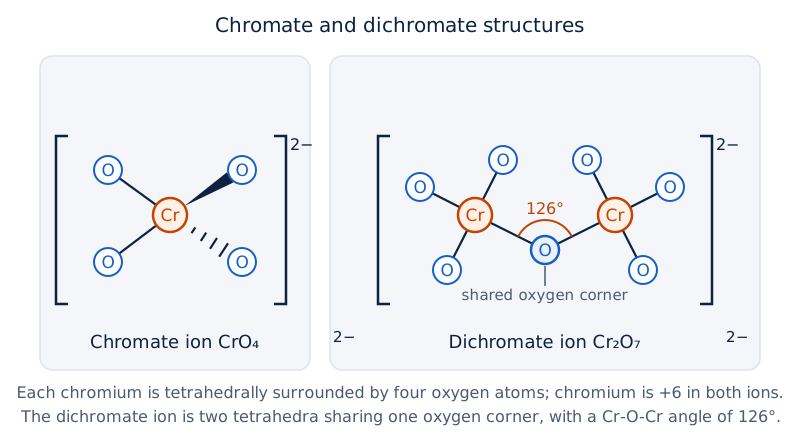
Chromate shows one chromium surrounded tetrahedrally by four oxygen atoms. Dichromate shows two such tetrahedra sharing an oxygen corner, with a labelled Cr-O-Cr angle of 126°. Brackets show each ion's 2− charge.
Drawn by One Young India.
Tetrahedral describes four surrounding positions directed towards the corners of a tetrahedron. In dichromate, each chromium has this local arrangement; the entire ion must not be mistaken for one tetrahedron.
How does dichromate act as an oxidising agent in different media?
In an acidic medium, the hydrogen-ion concentration exceeds the hydroxide-ion concentration; in an alkaline or basic medium, the hydroxide-ion concentration exceeds the hydrogen-ion concentration. The medium influences both the chromium species present and the product obtained on reduction. Dichromate is a strong oxidising agent in acidic solution.
Its reduction half-equation, which displays electron transfer separately from the other reactant's oxidation, is:
The standard reduction potential for this half-reaction is , where V denotes volt.
Here e⁻ denotes an electron. Each chromium changes from +6 to +3, so one dichromate ion accepts six electrons. This electron count determines how much reducing agent can react, rather than the visible colour of the reagent.
Derivation: How is the dichromate and iron(II) ionic equation obtained?
Combine the reduction and oxidation half-equations in acidic solution, conserving both atoms and charge.
- Start with dichromate reduction: . One dichromate ion accepts six electrons.
- Iron(II) loses one electron per ion. Multiply its half-equation by six: .
- Add the half-equations and cancel the six electrons on opposite sides. Each side contains two chromium atoms, six iron atoms, seven oxygen atoms and fourteen hydrogen atoms, with total charge +24.
Result: .
Acidified dichromate also oxidises iodide to iodine and hydrogen sulphide, H₂S, to sulphur, S. The balanced ionic equations are:
Cr₂O₇²⁻ + 14H⁺ + 6I⁻ → 2Cr³⁺ + 3I₂ + 7H₂O
Cr₂O₇²⁻ + 8H⁺ + 3H₂S → 2Cr³⁺ + 3S + 7H₂O
What changes in neutral or basic conditions?
Dichromate's oxidising action is weaker outside acidic conditions. In alkaline solution, chromate predominates. Where chromium(VI) is reduced to insoluble chromium(III) hydroxide, Cr(OH)₃, the appropriate alkaline half-equation is:
CrO₄²⁻ + 4H₂O + 3e⁻ → Cr(OH)₃ + 5OH⁻
Using dichromate as the starting species, the corresponding neutral or alkaline bookkeeping form is Cr₂O₇²⁻ + 7H₂O + 6e⁻ → 2Cr(OH)₃ + 8OH⁻. These equations specify a reduction product; they do not imply that every reductant reacts rapidly in every medium.
A titration determines an amount by measuring the volume of a reacting solution of known concentration. Potassium dichromate serves as a primary standard, a sufficiently pure, stable substance used to establish an accurately known concentration in volumetric analysis.
In an acidic iron(II) titration, one dichromate ion reacts with six iron(II) ions. The six-electron relationship follows from the balanced equation and must be retained when interpreting the result.
How is potassium permanganate prepared from pyrolusite?
Pyrolusite is manganese dioxide, MnO₂. Its manganese is in oxidation state +4. Preparation of potassium permanganate, KMnO₄, first raises manganese to +6 in potassium manganate, K₂MnO₄, and then to +7 in permanganate.
Why is manganate an intermediate?
Fuse manganese dioxide with potassium hydroxide, KOH, and an oxidising agent such as oxygen or potassium nitrate, KNO₃. With oxygen, the reaction is:
2MnO₂ + 4KOH + O₂ → 2K₂MnO₄ + 2H₂O
The product is dark green manganate. In neutral or acidic solution, manganate disproportionates into permanganate and manganese dioxide:
3MnO₄²⁻ + 4H⁺ → 2MnO₄⁻ + MnO₂ + 2H₂O
Two manganese atoms are oxidised from +6 to +7 while another is reduced from +6 to +4. Commercial manufacture uses alkaline oxidative fusion followed by electrolytic oxidation, oxidation brought about using an electric current, of manganate to permanganate.
What are the important physical and structural features?
Potassium permanganate forms dark purple, almost black, crystals. Both manganate and permanganate ions are tetrahedral. Green manganate is paramagnetic because it has one unpaired electron; permanganate is diamagnetic because it has no unpaired electron.
The salt also exhibits temperature-dependent weak paramagnetism alongside its diamagnetism. Its intense colour should not be explained by assigning unpaired d electrons to manganese(VII). The electronic explanation is more complex than the simple d-orbital colour model.
On heating, potassium permanganate decomposes at 513 K: 2KMnO₄ → K₂MnO₄ + MnO₂ + O₂. Here K after a numerical temperature means kelvin, the temperature unit; K within a chemical formula means potassium.
Keep manganate, MnO₄²⁻, and permanganate, MnO₄⁻, distinct. They contain the same number of oxygen atoms but different charges and manganese oxidation states, and therefore differ in colour, magnetism and redox behaviour.
How does the medium control permanganate reactions and titrations?
Permanganate's reduction product depends on the medium. In acidic solution, manganese(VII) becomes manganese(II); in neutral or faintly alkaline conditions, manganese dioxide commonly forms; in strongly alkaline conditions, reduction to manganate is possible.
| Medium and product | Reduction half-equation | Electrons accepted per permanganate ion |
|---|---|---|
| Acidic, manganese(II) | MnO₄⁻ + 8H⁺ + 5e⁻ → Mn²⁺ + 4H₂O | 5 |
| Neutral or faintly alkaline, manganese dioxide | MnO₄⁻ + 2H₂O + 3e⁻ → MnO₂ + 4OH⁻ | 3 |
| Strongly alkaline, manganate | MnO₄⁻ + e⁻ → MnO₄²⁻ | 1 |
Standard reduction potentials refer to specified half-reactions. For reduction to manganate, , the value is .
For , the value is . This half-equation explicitly contains hydrogen ions, so its potential belongs to this acidic form.
For , the value is . Hydrogen-ion concentration influences the reaction, and reaction rate must also be considered when predicting observed behaviour.
Which reactions occur in acidic solution?
Iron(II) sulphate, FeSO₄, supplies Fe²⁺ ions. Potassium iodide, KI, supplies iodide ions. Oxalic acid dihydrate, (COOH)₂·2H₂O, contains oxalic acid with two waters of crystallisation, meaning water incorporated in the crystal formula.
Iron(II) oxidation: 5Fe²⁺ + MnO₄⁻ + 8H⁺ → Mn²⁺ + 4H₂O + 5Fe³⁺.
Iodide oxidation: 10I⁻ + 2MnO₄⁻ + 16H⁺ → 2Mn²⁺ + 8H₂O + 5I₂.
Derivation: How is the permanganate and oxalate ionic equation obtained?
Oxalate is , the ion corresponding to oxalic acid. Its oxidation by acidified permanganate is carried out at 333 K.
- Use the oxalate oxidation half-equation: . Five oxalate ions release ten electrons.
- Each acidic permanganate half-equation consumes five electrons. Multiply it by two: .
- Add the half-equations and cancel ten electrons. Each side contains ten carbon atoms, two manganese atoms, twenty-eight oxygen atoms and sixteen hydrogen atoms, with total charge +4.
Result: .
Written with oxalic acid, H₂C₂O₄, the same reaction is 5H₂C₂O₄ + 2MnO₄⁻ + 6H⁺ → 2Mn²⁺ + 8H₂O + 10CO₂. Waters of crystallisation do not contribute additional reducing capacity.
What happens to iodide and hydrogen sulphide in other media?
In neutral or faintly alkaline solution, iodide is oxidised to iodate, IO₃⁻, rather than iodine: 2MnO₄⁻ + H₂O + I⁻ → 2MnO₂ + 2OH⁻ + IO₃⁻.
In strongly alkaline solution, where permanganate becomes manganate, the corresponding iodide oxidation is 6MnO₄⁻ + I⁻ + 6OH⁻ → 6MnO₄²⁻ + IO₃⁻ + 3H₂O. Thus, “alkaline” must be qualified when the reduction product matters.
For neutral hydrogen sulphide oxidation to sulphur, the equation is 2MnO₄⁻ + 3H₂S → 2MnO₂ + 3S + 2OH⁻ + 2H₂O. This explicitly couples sulphur formation to manganese dioxide formation.
What must be controlled during titration?
In acidic permanganate titrations, dilute sulphuric acid provides the required acidity. Permanganate acts as a self-indicator: a slight persistent pink colour marks the first small excess after the reducing agent has been consumed.
Note: Hydrochloric acid is unsuitable for permanganate titrations because it is oxidised to chlorine. The reagent would then be consumed by a side reaction as well as by the substance being measured.
The endpoint is the observed indication used to stop a titration. A balanced equation establishes the reacting ratio: one permanganate ion consumes five iron(II) ions in acid, while two permanganate ions consume five oxalate ions. Always connect the ratio to the specified medium.
What characterises lanthanoids and lanthanoid contraction?
The lanthanoids comprise the fourteen elements from cerium to lutetium. Their atoms have 6s² in common with variable 4f occupancy. The symbol Ln denotes a lanthanoid metal and is also used when discussing lanthanum alongside the series.
The predominant oxidation state is +3. Some members occasionally form +2 or +4 species. Empty, half-filled and filled f subshells have particular stability: cerium(IV) has 4f⁰, europium(II) has 4f⁷, and ytterbium(II) has 4f¹⁴.
Why does contraction occur and why does it matter?
Lanthanoid contraction is the overall decrease in atomic and ionic radii from lanthanum (La) to lutetium (Lu). Increasing nuclear charge is incompletely shielded by added 4f electrons, so the electron cloud is pulled inward. Atomic-radius decreases are less regular than those of tripositive ions.
What the figure shows
Ionic radii across the lanthanoids
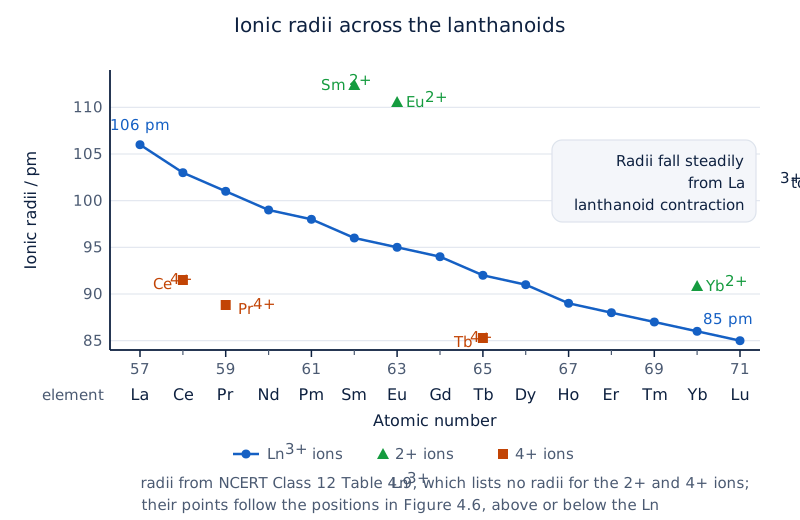
Atomic number, the number of nuclear protons, is on the horizontal axis and ionic radius in picometres on the vertical axis. A descending line joins labelled tripositive ions from La³⁺ to Lu³⁺; separate labelled points represent selected ions of charges 2+ and 4+.
Drawn by One Young India.
The cumulative contraction makes corresponding second- and third-transition-series radii very similar. Zirconium and hafnium consequently have closely similar properties, occur together in nature and are difficult to separate.
How do colour, magnetism and complex formation behave?
Many trivalent lanthanoid ions are coloured in solids and aqueous solution. Their colour may be attributed to f electrons; absorption bands are narrow, probably because excitation occurs within the f level. Lanthanum(III) and lutetium(III) are colourless.
Ions other than the f⁰ and f¹⁴ types are paramagnetic. Cerium(IV) is a strong oxidant returning to +3; europium(II) and ytterbium(II) are reducing agents tending towards +3. A favourable electron configuration does not mean an unusual oxidation state is unreactive.
Worked example 3. Use Hund's rule to obtain the electronic configuration of cerium(III), then calculate its magnetic moment using the spin-only formula.
Answer: Cerium has the configuration [Xe]4f¹5d¹6s². Removing the two 6s electrons and the 5d electron leaves [Xe]4f¹. The single 4f electron is unpaired.
Substitute one for n in :
This is the requested spin-only value, not a measured magnetic moment.
Lanthanoid ions form complexes, though their tendency is generally less extensive than that of transition-metal ions. Bonding in these complexes is largely ionic because the buried 4f orbitals contribute little to bonding. Small size and high charge favour attraction to ligands.
What reactions and uses should be connected to the series?
The metals are silvery white and tarnish rapidly in air, developing a surface coating through reaction. In general, earlier members are quite reactive like calcium, while increasing atomic number brings behaviour more like aluminium.
They combine with hydrogen on gentle heating and liberate hydrogen from dilute acids. Heating with carbon forms carbides, compounds containing carbon bonded to the metal. Their oxides and hydroxides are basic.
What the figure shows
Chemical reactions of lanthanoids
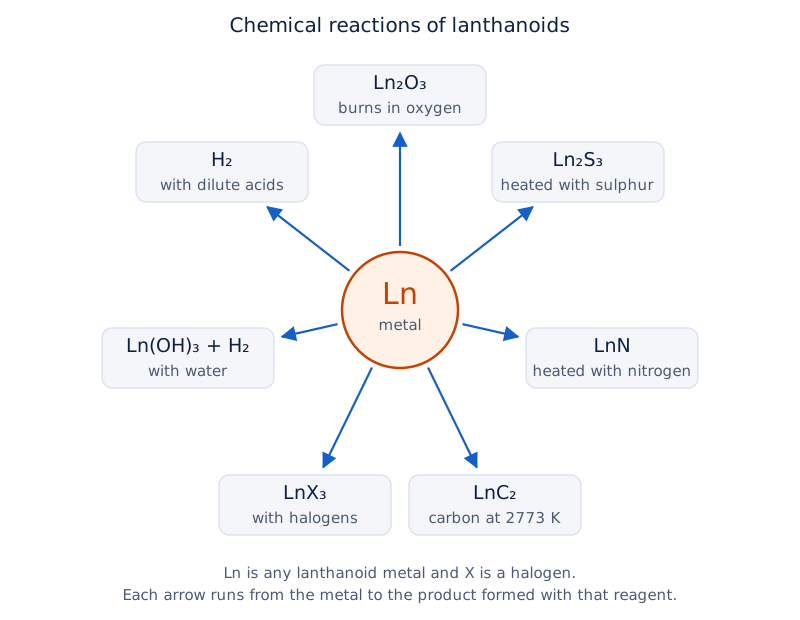
A central Ln circle has outward arrows: burning in oxygen gives Ln₂O₃; heating with sulphur gives Ln₂S₃; heating with nitrogen gives LnN; carbon at 2773 K gives LnC₂; halogens give LnX₃; water gives Ln(OH)₃ and H₂; acids liberate H₂.
Drawn by One Young India.
Here X denotes a halogen atom; a halogen is a Group 17 element. Ln₂S₃ is a sulphide, LnN a nitride, LnC₂ a carbide, and Ln(OH)₃ a hydroxide. Hydrogen gas is H₂.
Lanthanoid metals are used in alloy steels. Mischmetall contains approximately 95% lanthanoid metal and approximately 5% iron, with traces of sulphur, carbon, calcium and aluminium. Its magnesium-based alloys are used for lighter flints. Mixed lanthanoid oxides also catalyse petroleum cracking, the breakdown of larger hydrocarbon molecules.
How do actinoids compare with lanthanoids?
The actinoids are the fourteen elements from thorium to lawrencium. They are radioactive, meaning their unstable nuclei undergo spontaneous change. Radioactivity and the small quantities available for many later members complicate their chemical study.
All actinoids are believed to have 7s² with variable 5f and 6d occupancy. The 5f orbitals are less deeply buried than 4f orbitals, so their electrons can participate in bonding to a far greater extent.
Why are their oxidation states more varied?
The 5f, 6d and 7s energy levels are comparable, making several electron arrangements accessible. Actinoids show +3 in general, but higher states occur frequently in the first half of the series.
Maximum oxidation states rise from +4 in thorium to +5 in protactinium, +6 in uranium and +7 in neptunium, then decrease in succeeding elements. The +3 and +4 ions tend to hydrolyse, meaning they react with water to form altered species.
| Feature | Lanthanoids | Actinoids |
|---|---|---|
| Subshell involved | 4f | 5f |
| Characteristic oxidation states | Predominantly +3; occasional +2 and +4 | +3 in general; wider range especially in earlier members |
| Contraction | Imperfect shielding by 4f electrons | Greater element-to-element contraction owing to poor 5f shielding |
| Participation of f electrons in bonding | 4f electrons are more deeply buried | 5f electrons participate to a far greater extent |
| Magnetic behaviour | Connected with unpaired f electrons | More complex than in lanthanoids |
What other similarities and differences matter?
Actinoid contraction is the gradual decrease in atomic and tripositive ionic sizes across the series. Actinoids generally show a greater tendency to form complexes than lanthanoids. Many actinoid ions are coloured, with colour depending on oxidation state and environment.
Actinoids can also form alloys. Their metals are silvery and highly reactive, especially when finely divided. Boiling water produces mixtures of oxides and hydrides, compounds containing hydrogen combined with the metal. They combine with most non-metals at moderate temperatures.
Hydrochloric acid attacks the metals, but most are only slightly affected by nitric acid because protective oxide layers form. Alkalies have no action. Similarity to lanthanoid behaviour becomes clearer in the second half of the actinoid series; the early members show more varied oxidation chemistry.
Glossary
- Transition element — Element with an incomplete d subshell in its neutral atom or in one of its ions.
- Electronic configuration — Distribution of an atom's or ion's electrons among its available shells, subshells and orbitals.
- Shielding — Reduction in nuclear attraction experienced by an electron because of the presence of other electrons.
- Ionisation enthalpy — Enthalpy required for electron removal from gaseous atoms or ions in a specified ionisation step.
- Oxidation state — Formal charge assigned to an atom using electron-accounting rules for the species concerned.
- Ligand — Ion or molecule attached to a central metal by donating an electron pair for bonding.
- Paramagnetism — Attraction towards an applied magnetic field associated with the presence of unpaired electrons.
- Disproportionation — Reaction in which the same species undergoes both oxidation and reduction, forming higher and lower oxidation states.
- Interstitial compound — Compound formed when small atoms occupy spaces within the crystal lattice of a metal.
- Alloy — Blend containing metals, often with atoms of one component distributed within the structure of another.
- Lanthanoid contraction — Overall decrease in atomic and ionic radii from lanthanum to lutetium owing to imperfect electron shielding.
- Primary standard — Sufficiently pure and stable substance used to establish an accurately known concentration for volumetric analysis.
- Self-indicator — Reagent whose own visible change signals the endpoint, avoiding the need for a separate indicator.
Common errors and misconceptions
- Misconception: Every d-block element is a transition element. Correct: Zinc, cadmium and mercury have complete d subshells in their atoms and common ions, so block membership alone is insufficient.
- Misconception: Remove 3d electrons before 4s electrons when making first-series metal ions. Correct: Remove 4s electrons first, then remove further electrons from 3d as required by the charge.
- Misconception: A d⁴ ion must be an oxidising agent. Correct: Chromium(II) is reducing whereas manganese(III) is oxidising; compare the stability of the resulting configurations.
- Misconception: All coloured transition-metal compounds must contain unpaired d electrons. Correct: Permanganate is intensely coloured without unpaired electrons; the simple d-orbital explanation does not cover every colour.
- Misconception: Chromate becoming dichromate is oxidation. Correct: Chromium remains +6; acidity changes the species present without changing its oxidation state.
- Misconception: Permanganate accepts five electrons in every medium. Correct: It accepts five on reduction to manganese(II), three to manganese dioxide, or one to manganate.
- Misconception: Lanthanoids show only +3 and every radius decreases perfectly regularly. Correct: Some show +2 or +4; atomic-radius variation is less regular than the tripositive ionic trend.
Exam-style questions with model answers
Q1. Define a transition element. Given scandium's outer configuration 3d¹4s² and zinc's configurations 3d¹⁰4s² in its atom and 3d¹⁰ in Zn²⁺, explain why scandium qualifies but zinc does not. [2 marks]
- A transition element has an incompletely filled d subshell in its neutral atom or in one of its ions.
- Scandium's atom contains an incomplete 3d¹ subshell. Zinc has filled 3d¹⁰ subshells in both its atom and its common Zn²⁺ ion, so it does not qualify.
Q2. An aqueous manganese(II) ion has five unpaired electrons. Calculate its spin-only magnetic moment using μ = √[n(n + 2)] BM, where n is the unpaired-electron count, μ the moment and BM the Bohr magneton unit. State its magnetic behaviour. [3 marks]
- The supplied number of unpaired electrons is five, so n = 5. This count must be used in the spin-only formula, rather than the ion's charge or atomic number.
- Substitution gives μ = √[5(5 + 2)] = √35 ≈ 5.92 BM.
- The ion is paramagnetic because it contains unpaired electrons and is attracted by an applied magnetic field.
Q3. Explain lanthanoid contraction, its shielding cause and one consequence. Use the supplied atomic radii: zirconium 160 pm and hafnium 159 pm, where pm means picometre. [3 marks]
- Lanthanoid contraction is the overall decrease in atomic and ionic sizes across the series from lanthanum to lutetium.
- Added 4f electrons imperfectly shield one another from increasing nuclear charge, so the electron cloud experiences increasing attraction and contracts.
- The contraction offsets the expected size increase in the third transition series. Zirconium and hafnium therefore have nearly identical supplied radii, closely similar properties and are difficult to separate.
Q4. In acid, dichromate accepts six electrons: Cr₂O₇²⁻ + 14H⁺ + 6e⁻ → 2Cr³⁺ + 7H₂O. Iron(II) loses one electron: Fe²⁺ → Fe³⁺ + e⁻. Derive the full ionic equation and state the dichromate-to-iron(II) reacting ratio. [3 marks]
- Multiply the iron oxidation half-equation by six, giving 6Fe²⁺ → 6Fe³⁺ + 6e⁻. The electron loss now equals the six-electron gain specified for dichromate.
- Add the half-equations and cancel the transferred electrons: Cr₂O₇²⁻ + 14H⁺ + 6Fe²⁺ → 2Cr³⁺ + 6Fe³⁺ + 7H₂O.
- The reacting ratio is one dichromate ion to six iron(II) ions. It applies to the specified acidic reaction.
Q5. Describe preparation of potassium dichromate from chromite, including the fusion equation, acidification, potassium-salt formation, the solubility reason for crystallisation and the dichromate ion's structure. Use FeCr₂O₄ for chromite and sodium carbonate for fusion. [5 marks]
- Fuse chromite with sodium carbonate in air: 4FeCr₂O₄ + 8Na₂CO₃ + 7O₂ → 8Na₂CrO₄ + 2Fe₂O₃ + 8CO₂.
- Filter the yellow chromate solution and acidify with sulphuric acid. Hydrogen ions convert chromate into dichromate: 2CrO₄²⁻ + 2H⁺ → Cr₂O₇²⁻ + H₂O.
- Add potassium chloride to sodium dichromate solution: Na₂Cr₂O₇ + 2KCl → K₂Cr₂O₇ + 2NaCl, producing potassium dichromate.
- Potassium dichromate is less soluble than sodium dichromate, so orange potassium dichromate crystals separate from the solution.
- The dichromate ion contains two chromium-centred oxygen tetrahedra sharing one oxygen corner. Each chromium is surrounded by four oxygen atoms, with a bridging oxygen linking the two chromium centres.
Q6. Compare permanganate reduction in acidic, neutral or faintly alkaline, and strongly alkaline media. For each, name the product and electrons accepted per ion. Manganese starts at +7 and ends at +2, +4 and +6 respectively. Explain why hydrochloric acid is unsuitable for a permanganate titration. [4 marks]
- In acidic solution, permanganate is reduced to Mn²⁺. Manganese changes from +7 to +2, so each permanganate ion accepts five electrons.
- In neutral or faintly alkaline solution, manganese dioxide forms. Manganese changes from +7 to +4, corresponding to three electrons accepted.
- In strongly alkaline solution, reduction to manganate changes manganese from +7 to +6, requiring one electron per permanganate ion.
- Hydrochloric acid is oxidised to chlorine by permanganate. This side reaction consumes reagent and interferes with measuring the intended reducing agent.
Q7. Explain four characteristic behaviours of transition metals: complex formation, catalytic activity, interstitial-compound formation and alloy formation. Give one named catalytic example. [4 marks]
- Small metal-ion sizes, high charges and available d orbitals favour binding of surrounding ligands, so many complex compounds form.
- Variable oxidation states and complex formation support catalytic pathways. Finely divided iron, for example, catalyses ammonia manufacture in the Haber process.
- Small atoms such as hydrogen, carbon or nitrogen fit into gaps in metal lattices, producing interstitial compounds that retain metallic conductivity.
- Similar atomic radii enable atoms of different metals to mix within solid structures, favouring alloy formation. Such alloys are hard and often have high melting points.
Q8. Compare lanthanoids and actinoids in terms of the subshell being filled, f-electron involvement in bonding, oxidation states, contraction and magnetic behaviour. [5 marks]
- Lanthanoids involve progressive occupation of 4f orbitals, whereas actinoids involve 5f orbitals. Both series are classed as inner transition elements.
- Lanthanoid 4f electrons are more deeply buried. Actinoid 5f electrons can participate in bonding to a far greater extent because their orbitals are less buried.
- Lanthanoids predominantly show +3, with occasional +2 or +4 states. Actinoids show +3 in general but exhibit a wider range, especially among earlier members.
- Both series contract as increasing nuclear charge is imperfectly shielded. Actinoid contraction is greater from element to element because 5f electrons shield poorly.
- Unpaired f electrons contribute to magnetic behaviour in both series. Actinoid magnetic properties are more complex than those of lanthanoids.
Key takeaways
- Transition-element status requires an incomplete d subshell in an atom or ion; d-block membership by itself is insufficient.
- Remove outer s electrons before d electrons when forming transition-metal ions, and check chromium and copper configurations carefully.
- Trends in radii and ionisation enthalpy are general patterns with irregularities, influenced by nuclear charge, shielding and configuration stability.
- Colour depends on electronic transitions and the surrounding ligands; magnetic behaviour depends strongly on the number of unpaired electrons.
- Chromate and dichromate interconvert with acidity while chromium remains +6; acidic dichromate reduction involves six electrons per ion.
- Permanganate accepts five, three or one electrons on reduction to manganese(II), manganese dioxide or manganate respectively.
- Lanthanoid contraction explains the close sizes and chemical similarities of corresponding second- and third-transition-series elements, notably zirconium and hafnium.
- Actinoids have more accessible f electrons and more varied oxidation states; their radioactivity adds difficulty to their study.
Test yourself
Why does scandium qualify as a transition element even though Sc³⁺ has no d electrons?
Its neutral atom has an incomplete 3d¹ subshell. The definition requires an incomplete d subshell in the atom or an ion.
Which electrons are removed first when an iron atom forms Fe²⁺?
The two 4s electrons are removed first, leaving the 3d⁶ configuration of iron(II).
Why is chromium(II) reducing while manganese(III) is oxidising?
Chromium(II) loses an electron to form chromium(III), d³, whose octahedral aqua ion has a stable half-filled set of three lower-energy d orbitals, . Manganese(III) gains an electron to form manganese(II), with an especially stable half-filled d⁵ subshell.
What happens when hydroxide is added to dichromate solution?
Orange dichromate converts into yellow chromate, while chromium remains in oxidation state +6.
What does neutral or faintly alkaline permanganate do to iodide?
It oxidises iodide to iodate while permanganate is reduced to manganese dioxide.
Why must permanganate titrations not use hydrochloric acid?
Permanganate oxidises hydrochloric acid to chlorine, consuming reagent in an interfering side reaction.
Why are zirconium and hafnium difficult to separate?
Lanthanoid contraction makes their radii almost identical, giving closely similar physical and chemical properties.
Why do actinoids show a wider range of oxidation states?
Their 5f, 6d and 7s energy levels are comparable, and 5f electrons can participate substantially in bonding.
Write about it
Turn a question from this chapter into a paper.
The Writing Studio has a structure guide, a rubric and citation tools for 15 formats, from essays to research papers. Drafting is free with an account. Learnacy Essential adds feedback from an AI writing coach and submission to The OYI Review.
Learnacy Essential is ₹1,499 for the year. Publication depends on review and is not guaranteed.