
Electrolysis | ICSE Class 10 Chemistry Notes
On this page
Watch & explore
Start with a few high-quality watches, then dive into the notes below.
Try an idea before you read. Test your understanding of electrolytic cells and discharge rules with these scenarios. Explore →

This note covers electrolytes and non-electrolytes, strong and weak electrolytes, ion migration, electrodes, oxidation and reduction, selective discharge, electrolysis of molten lead bromide, acidified water and copper sulphate solution, nickel and silver electroplating, and electrolytic refining of copper.
What makes a substance an electrolyte?
Electrolysis is chemical decomposition brought about by passing an electric current through a substance in its molten state or aqueous solution. Molten means melted; aqueous means dissolved in water. An electric current is a flow of electrical charge. Electrical energy drives the chemical changes occurring during the process.
Definition: An electrolyte conducts electricity in its molten state or aqueous solution through moving ions and undergoes chemical change during electrolysis. An ion is an atom or group of atoms carrying an electrical charge.
A non-electrolyte does not furnish mobile ions for this conduction in solution. Glucose and alcohol solutions are examples. Dissolving a substance in water does not, by itself, make the resulting solution an electrolyte.
How does ionic conduction differ from metallic conduction?
In a metal, electric current is carried by electrons, which are negatively charged particles. In an electrolyte, current is carried by ions moving through the liquid. The metallic wire and the electrolyte therefore conduct by different mechanisms within the same circuit.
| Feature | Metallic conduction | Electrolytic conduction |
|---|---|---|
| Moving charge carriers | Electrons in the metal | Positive and negative ions in the liquid |
| Example | A copper connecting wire | Copper sulphate solution |
| Chemical effect | The metal's composition remains unchanged during conduction | Electrode reactions accompany the passage of direct current |
A direct current flows in one direction. A battery supplies the external circuit used in elementary electrolysis experiments. The conducting surfaces touching the electrolyte are called electrodes; the chemical reactions occur at these surfaces.
What the figure shows
Testing conduction by an acid solution
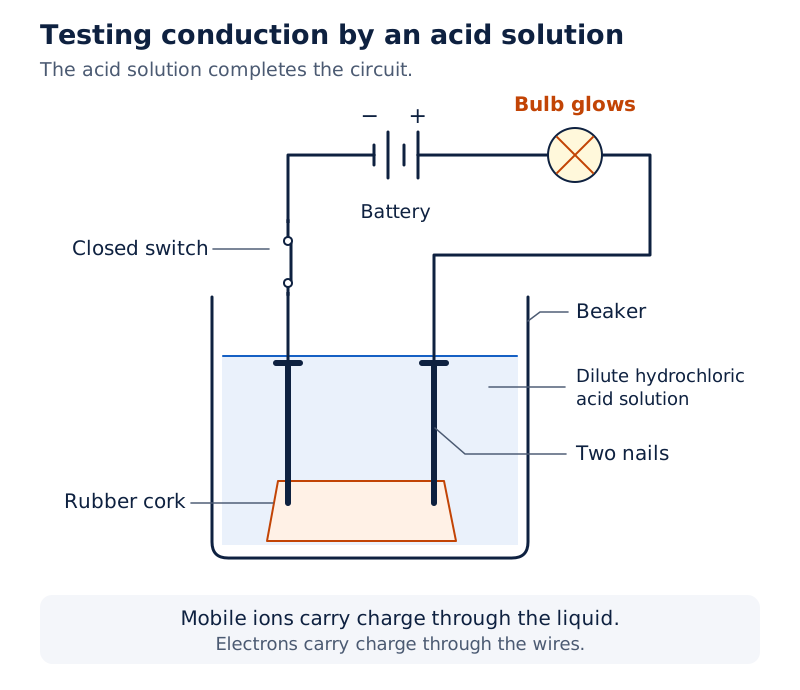
A beaker contains dilute hydrochloric acid solution and two nails supported by a rubber cork. Connecting wires join the nails to a battery, bulb and switch. The labelled components show how the liquid completes the circuit.
Drawn by One Young India.
The bulb glows with the acid solution but not with glucose or alcohol solution in this comparison. The result concerns the presence of mobile ions, rather than merely the presence of dissolved material or hydrogen in a compound.
How do molecules and ions distinguish strong, weak and non-electrolytes?
A molecule is an electrically neutral group of bonded atoms that can exist as a unit. Electrolytic behaviour depends on whether the substance supplies mobile ions, remains as molecules, or exists as a mixture of its molecules and ions.
Dissociation separates ions already present in an ionic compound when it melts or dissolves. Ionisation produces ions from molecules, for example when hydrogen chloride dissolves in water. These terms distinguish the starting particles, even though both processes can supply ions for conduction.
What does electrolyte strength mean?
A strong electrolyte is substantially completely dissociated or ionised under the stated conditions. A weak electrolyte is only partly ionised, so its solution contains both unionised solute molecules and ions. Ethanoic acid, also called acetic acid, is a weak electrolyte.
| Category | Particles supplied by the solute | Example |
|---|---|---|
| Strong electrolyte | Essentially ions in dilute aqueous solution | Sodium chloride or hydrochloric acid |
| Weak electrolyte | Both molecules and ions in solution | Ethanoic acid |
| Non-electrolyte | Molecules without an appreciable supply of ions | Glucose or alcohol |
Concentration describes the amount of solute in a given amount of solution; solute means the dissolved substance. Strength describes the extent of ionisation. A dilute strong electrolyte and a concentrated weak electrolyte are therefore possible.
Note: Describing a strong electrolyte as containing “ions only” refers to its dissolved solute particles. An aqueous solution also contains water molecules. Do not interpret this classification as saying that the whole solution contains no molecules.
Why does physical state matter?
Solid sodium chloride contains ions held in a rigid structure, so they cannot move through the solid to carry current. In molten sodium chloride, the ions can move freely. Its aqueous solution also contains mobile ions.
Thus, an ionic solid may fail a conduction test without being a non-electrolyte. State the physical state before explaining conductivity. The important combination is the presence of charged particles and their ability to move, rather than either feature considered alone.
How do ions move towards the anode and cathode?
An electrolytic cell is an arrangement in which an external electrical supply drives a chemical reaction. It contains the electrolyte and two electrodes connected to opposite terminals of that supply. The electrodes allow electron transfer between the external circuit and substances in the cell.
The cathode is the electrode at which reduction, or gain of electrons, occurs. The anode is the electrode at which oxidation, or loss of electrons, occurs. In an electrolytic cell, the cathode is negative and the anode is positive.
Which ions move to which electrode?
A cation is a positively charged ion and moves towards the cathode. An anion is a negatively charged ion and moves towards the anode. This directed movement of ions in the electrolyte is called migration.
| Feature | Cathode | Anode |
|---|---|---|
| Battery connection in electrolysis | Negative terminal | Positive terminal |
| Ions attracted | Cations | Anions |
| Electrode process | Reduction | Oxidation |
| Electron change | Electrons are accepted by the reacting species | Electrons are released by the reacting species |
Discharge means the conversion of an ion into a neutral atom or molecule by electron transfer at an electrode. Migration and discharge are different: several ions may migrate towards an electrode, while only a selected species reacts there under the given conditions.
- Identify the electrolyte and whether it is molten or aqueous.
- Connect the cathode to the negative terminal and the anode to the positive terminal of the supply.
- Identify the mobile cations and anions present in the electrolyte.
- Trace their migration, then determine the actual electrode reactions from the ions, concentrations and electrode materials.
Do not draw electrons travelling through the liquid from one electrode to the other. Electrons carry current in the wires; ions carry current within the electrolyte. The electrode reactions connect these two forms of conduction.
How are oxidation and reduction written as electrode equations?
Oxidation is loss of electrons, and reduction is gain of electrons. These definitions apply even when oxygen does not appear in the reaction. Electrolysis contains both processes, with oxidation at the anode and reduction at the cathode.
A half-equation shows the electron transfer at one electrode. In the equations below, Cu means copper, Cu²⁺ means a copper(II) ion with two positive charges, and e⁻ means an electron. The Roman numeral II here indicates that copper is present as an ion with two positive charges.
The state symbols (s), (l), (g) and (aq) mean solid, liquid, gas and aqueous solution respectively. The arrow → means “forms”. A number before a formula multiplies the whole particle; a subscript gives the number of atoms within that formula.
What happens to copper ions and copper atoms?
At a cathode, a copper(II) ion gains two electrons and becomes a copper atom:
Cu²⁺(aq) + 2e⁻ → Cu(s)
At a copper anode, a copper atom loses two electrons and enters solution as a copper(II) ion:
Cu(s) → Cu²⁺(aq) + 2e⁻
The first change is reduction; the second is oxidation. In the cathode equation the two positive charges are balanced by two negative electron charges. In the anode equation, the products have zero total charge, matching the neutral copper atom.
How should a half-equation be checked?
- Write the correct formula and charge for each reacting particle.
- Balance the number of atoms of each element on the two sides.
- Add electrons to balance the total electrical charge.
- Check that reduction has electrons on the left and oxidation has electrons on the right.
An overall equation combines the half-equations with equal numbers of electrons lost and gained. Cancel those electrons when adding the equations. Electrons must not remain as a net product of a complete electrolysis reaction.
What factors influence selective discharge?
Selective discharge is the preferential reaction of one species when alternatives are available at an electrode. An aqueous electrolyte contains water as well as the dissolved substance, so its electrode products cannot be predicted merely by splitting the solute formula.
How does the activity series help?
The activity series arranges metals in decreasing order of reactivity. Among sodium, magnesium, iron and copper, the order is sodium, magnesium, iron, copper. Their symbols are Na, Mg, Fe and Cu respectively. More reactive metals have a greater tendency to form positive ions.
Conversely, their ions are harder to reduce back to the metals. Under comparable aqueous conditions, copper ions are discharged more readily than ions of highly reactive metals such as sodium. Hydrogen formation may compete with deposition of a metal from water-based solutions.
Why must concentration and electrode material also be considered?
The relative concentrations of competing species influence the products. For example, concentrated aqueous sodium chloride gives chlorine at the anode, whereas sufficiently dilute chloride solution can give oxygen. Sodium chloride is written NaCl; its chloride ion, Cl⁻, carries one negative charge.
An inert electrode, such as platinum in the examples here, does not participate chemically in the reaction. An active electrode can participate. A copper anode dissolves during electrolysis of copper sulphate, while a platinum anode permits oxygen formation from the aqueous medium.
| Factor | Question to ask | Relevant comparison |
|---|---|---|
| Relative ease of discharge | Which species accepts or loses electrons more readily? | Copper deposition rather than sodium deposition from aqueous solutions |
| Concentration | Are competing ions present in different concentrations? | Concentrated and sufficiently dilute chloride solutions |
| Nature of electrode | Does the electrode itself react? | Copper and platinum anodes in copper sulphate solution |
Note: The activity series is a guide, not a complete prediction method independent of conditions. First specify the electrolyte, concentration where relevant, physical state and electrode material; then write the products and balanced half-equations.
For a molten binary salt containing one kind of cation and one kind of anion, the choice is simpler because water is absent. A binary compound contains two elements. Molten lead bromide illustrates this simpler situation.
What happens during electrolysis of molten lead bromide?
Lead(II) bromide, written PbBr₂, is an ionic compound. Pb means lead and Br means bromine. Its ions are Pb²⁺, a lead(II) cation, and Br⁻, a bromide anion. The two bromide ions balance the two positive charges on each lead ion.
The electrolyte must be molten so that these ions can move. Use inert graphite electrodes; graphite is a conducting form of carbon. Heating permits ion movement, while the electric current drives the decomposition. These have different roles in the process.
What are the ions and electrode reactions?
The ionic representation of the melt is:
PbBr₂(l) → Pb²⁺(l) + 2Br⁻(l)
Lead ions migrate towards the negative cathode, gain electrons and form molten lead:
Pb²⁺(l) + 2e⁻ → Pb(l)
Bromide ions migrate towards the positive anode, lose electrons and form bromine. Bromine molecules contain two atoms and are written Br₂:
2Br⁻(l) → Br₂(g) + 2e⁻
The overall decomposition is PbBr₂(l) → Pb(l) + Br₂(g). Lead forms at the cathode and reddish-brown bromine vapour appears at the anode. Bromine vapour is hazardous, so this is a supervised laboratory demonstration with suitable fume control.
How do the observations follow from the equations?
The metallic product belongs at the cathode because the positive lead ions gain electrons there. The non-metallic bromine product belongs at the anode because bromide ions lose electrons there. Writing the signs before the reactions helps prevent these products being reversed.
There are no water-derived ions to compete in the molten electrolyte. Consequently, the products are lead and bromine rather than hydrogen and oxygen. Solid lead bromide would not conduct by ion migration because its ions are held in fixed positions.
The equation for the melt describes the available ions; it is not the cathode equation. The cathode equation must show electrons being gained. Keeping these two statements separate prevents the common mistake of treating melting and reduction as the same change.
How is acidified water electrolysed with platinum electrodes?
Acidified water here means water containing a small amount of dilute sulphuric acid. Sulphuric acid is written H₂SO₄, and water is H₂O. Pure water contains very small amounts of ions and conducts electricity very poorly; adding the acid supplies more ions.
The elementary ionic representation is H₂SO₄(aq) → 2H⁺(aq) + SO₄²⁻(aq). Here H⁺(aq) represents an aqueous hydrogen ion and SO₄²⁻ is the sulphate ion with two negative charges. Hydrogen ions in water are hydrated, meaning associated with water molecules.
Water also provides hydrogen and hydroxide ions: H₂O(l) ⇌ H⁺(aq) + OH⁻(aq). OH⁻ is the hydroxide ion. The double arrow ⇌ indicates a reversible change, proceeding in both directions. Only a very small proportion of pure water is ionised.
Which reactions produce the gases?
With platinum electrodes, hydrogen ions gain electrons at the cathode. H₂ denotes hydrogen gas, whose molecules contain two hydrogen atoms:
2H⁺(aq) + 2e⁻ → H₂(g)
At the anode, oxidation of water produces oxygen. O₂ denotes oxygen gas, whose molecules contain two oxygen atoms:
2H₂O(l) → O₂(g) + 4H⁺(aq) + 4e⁻
The anode change may also be expressed in the elementary hydroxide-ion form:
4OH⁻(aq) → 2H₂O(l) + O₂(g) + 4e⁻
These are alternative ways to represent the oxygen-forming electrode change. They are not two separate anode reactions to add together. In dilute sulphuric acid, oxygen formation is preferred to oxidation of sulphate ions.
What is observed, and what remains in solution?
Doubling the cathode equation and combining it with the water-based anode equation gives 2H₂O(l) → 2H₂(g) + O₂(g). At the same temperature and pressure, the hydrogen volume is twice the oxygen volume. Bubbles appear at both electrodes.
Hydrogen burns with a pop when appropriately tested; oxygen relights a glowing splint. These gas tests belong to supervised laboratory work. The acid assists conduction and is not consumed in the overall equation; water is decomposed.
What the figure shows
Electrolysis of water
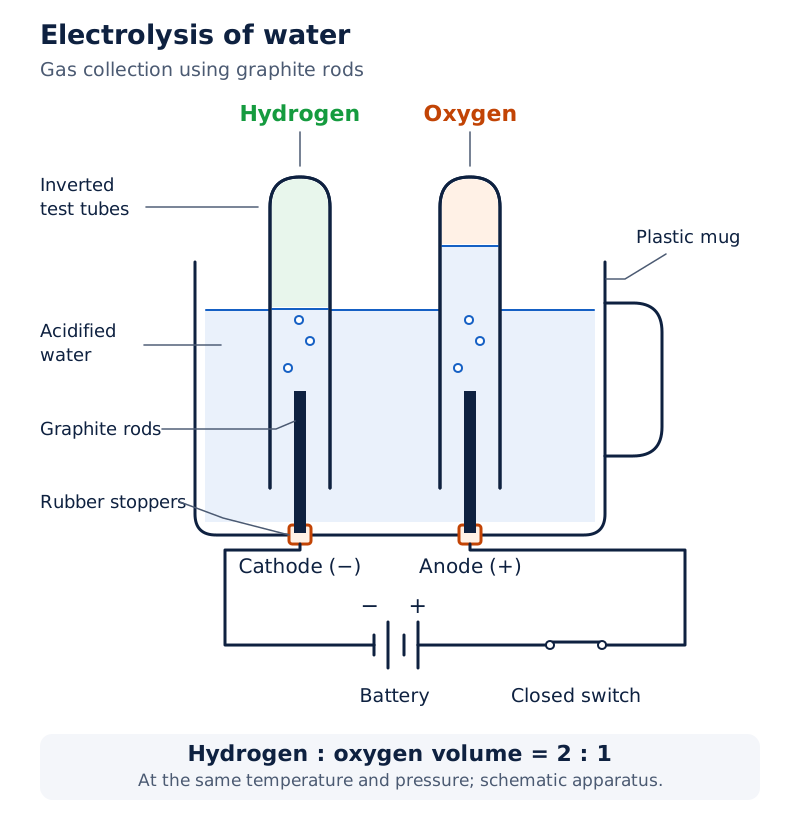
Two inverted test tubes collect gases over graphite rods inside a plastic mug. The drawing labels oxygen above the anode and hydrogen above the cathode, with rubber stoppers, water, a switch and a battery. This drawing uses graphite; the platinum-electrode arrangement uses the same gas-collection principle.
Drawn by One Young India.
The electrode material must be stated accurately when describing an apparatus. The platinum electrodes in this process are inert and do not supply the gases by decomposing themselves. The electrolyte and the electrode reactions explain the products.
How do copper and platinum electrodes change copper sulphate electrolysis?
Copper(II) sulphate, written CuSO₄, supplies copper(II) and sulphate ions in aqueous solution: CuSO₄(aq) → Cu²⁺(aq) + SO₄²⁻(aq). The solution is blue because of the copper(II) ions. Water is also present and provides competing electrode possibilities.
What happens with copper electrodes?
At the cathode, copper(II) ions are selectively reduced to copper: Cu²⁺(aq) + 2e⁻ → Cu(s). Copper is deposited, so the cathode gains mass. In these conditions copper deposition is preferred to hydrogen formation.
At the anode, the copper electrode itself reacts: Cu(s) → Cu²⁺(aq) + 2e⁻. It loses mass as copper enters the solution. An equivalent amount of copper is supplied to the solution as is removed at the cathode.
The blue colour remains approximately unchanged during the intended copper-transfer process because copper ions are replenished. No gas is expected from the principal electrode reactions. The net result is transfer of copper from anode to cathode.
What happens with platinum electrodes?
The cathode reaction is still copper deposition. Platinum is inert, however, so the anode cannot replace copper ions by dissolving. Instead, water is oxidised: 2H₂O(l) → O₂(g) + 4H⁺(aq) + 4e⁻.
Oxygen bubbles appear at the anode. Copper ions are removed without being replenished, so the blue colour gradually fades. Hydrogen ions accumulate with sulphate ions remaining in solution, making the solution more acidic as electrolysis proceeds.
| Observation or process | Copper electrodes | Platinum electrodes |
|---|---|---|
| Cathode product | Copper deposit | Copper deposit |
| Anode process | Copper dissolves to form copper(II) ions | Water is oxidised to oxygen |
| Anode mass | Decreases | Remains unchanged in the intended reaction |
| Blue colour | Approximately unchanged | Gradually fades |
| Copper ions in solution | Replaced by the anode reaction | Not replaced by the anode |
How can the overall platinum-electrode change be checked?
Multiply the copper-deposition equation by two so that it consumes the four electrons released in oxygen formation. The net ionic equation is 2Cu²⁺(aq) + 2H₂O(l) → 2Cu(s) + O₂(g) + 4H⁺(aq).
Sulphate ions do not appear in that net equation because they are not discharged. A spectator ion is an ion present in solution that does not take part in the net reaction being written.
When comparing the cells, identify the unchanged cathode reaction first and then explain the different anode reactions. The same electrolyte name does not guarantee the same full set of products when the electrode material changes.
How can a copper-deposition calculation be worked through?
Worked example 1. A copper sulphate solution is electrolysed for 10 minutes with a current of 1.5 amperes. Calculate the mass of copper deposited. Use a copper molar mass of 63 g per mole and a charge of 96487 coulombs per mole of electrons.
Here Q is charge in coulombs (C), I is current in amperes (A), t is time in seconds (s), m is deposited mass in grams (g), M is molar mass and F is charge per mole of electrons.
Formula: For constant current, . Copper deposition requires two electrons per copper ion, so .
Substitute: Convert the time: . Then .
The cathode reaction is . Thus .
Answer: 0.2938 g of copper is deposited. The charge units and mole units cancel, leaving mass in grams.
How does the electron ratio determine the charge required?
The Faraday constant is the charge carried by one mole of electrons. For approximate calculations, use . The copper calculation above uses the more precise supplied value of 96487 coulombs per mole.
Let be the amount of reacting substance in moles, z the number of electrons transferred per particle, and n the amount of electrons in moles. Counting electrons gives ; the required charge is .
First balance the electrode reaction, then use its electron ratio. A singly charged silver ion accepts one electron, a magnesium or copper(II) ion accepts two, and an aluminium ion accepts three. These ratios determine the charge for equal amounts of the metals.
Worked example 2. Calculate the charge needed to reduce 1 mol of silver ions to silver. Use 96500 coulombs per mole of electrons.
The reaction is . Each silver ion accepts one electron.
Formula: and .
Substitute: . Hence .
Answer: Reducing 1 mol of silver ions requires 1 mol of electrons, carrying 96,500 C of charge.
Worked example 3. Calculate the charge needed to reduce 1 mol of magnesium ions in a molten electrolyte to magnesium. Use 96500 coulombs per mole of electrons.
The reaction is . Each magnesium ion accepts two electrons.
Formula: and .
Substitute: . Hence .
Answer: Reducing 1 mol of magnesium ions in a molten electrolyte requires 2 mol of electrons, carrying 193,000 C of charge.
Worked example 4. Calculate the charge needed to reduce 1 mol of aluminium ions to aluminium. Use 96500 coulombs per mole of electrons.
The reaction is . Each aluminium ion must gain three electrons to become a neutral atom.
Formula: and .
Substitute: . Hence .
Answer: Reducing 1 mol of aluminium ions requires 3 mol of electrons, carrying 289,500 C of charge.
Worked example 5. Calculate the charge needed to reduce 1 mol of copper(II) ions to copper. Use 96500 coulombs per mole of electrons.
The reaction is . Each copper(II) ion accepts two electrons.
Formula: and .
Substitute: . Hence .
Answer: Reducing 1 mol of copper(II) ions requires 2 mol of electrons, carrying 193,000 C of charge.
Worked example 6. How much electricity, in coulombs, is required to oxidise 1 mol of water to oxygen? Use 96500 coulombs per mole of electrons.
The balanced reaction is . Two moles of water release four moles of electrons, so the electron ratio per water molecule is .
Formula: and .
Substitute: . Thus .
Answer: Oxidising 1 mol of water transfers 2 mol of electrons, corresponding to 193,000 C. Using four moles of electrons here would incorrectly apply the charge for two moles of water.
Why is electroplating useful, and how is nickel deposited?
Electroplating deposits a layer of a desired metal on another material by means of electricity. The surface coating provides a useful property that the underlying material may lack. It can improve appearance or resistance to corrosion while using a cheaper material for the main object.
Corrosion is deterioration of a metal through reaction with its surroundings. The purpose of plating depends on the coating chosen; do not assume that every coating gives identical protection or that appearance is the only reason for plating.
What arrangement is used for nickel plating?
For nickel electroplating, the article to be coated is the cathode and a plate of pure nickel is the anode. The electrolyte is nickel sulphate solution. Nickel has the symbol Ni; nickel sulphate is NiSO₄ and supplies Ni²⁺ ions carrying two positive charges.
The ionic representation is NiSO₄(aq) → Ni²⁺(aq) + SO₄²⁻(aq). At the cathode, Ni²⁺(aq) + 2e⁻ → Ni(s). At the anode, Ni(s) → Ni²⁺(aq) + 2e⁻. Nickel lost from the solution is replenished by the dissolving anode.
What conditions help produce a satisfactory coating?
- Clean the article thoroughly so that grease, dirt and surface oxide do not obstruct adhesion of the deposit.
- Connect the article to the negative terminal, making it the cathode where metal ions gain electrons.
- Use the plating metal as the anode and an appropriate electrolyte containing that metal.
- Pass a steady direct current at a suitably low current density, allowing controlled deposition rather than a rough coating.
Current density means current per unit area of electrode surface. The suitable value depends on the plating bath and article; no single numerical value applies to all plating arrangements. Time must also be sufficient for the desired coating.
Reversing the article's connection does not merely change where bubbles appear. It removes the required cathodic conditions for depositing nickel on that article. The connection, electrolyte and anode together determine whether the intended plating process can occur.
How is silver electroplating carried out?
Silver electroplating gives an article a surface layer of silver without making the entire article from silver. The article is connected as the cathode, and pure silver is used as the anode. Silver's chemical symbol is Ag.
The electrolyte is sodium argentocyanide, written Na[Ag(CN)₂]. It contains sodium ions and the silver-containing complex ion [Ag(CN)₂]⁻. A complex ion is a charged group containing a central metal joined to surrounding atoms or groups.
Why is this electrolyte chosen?
In this complex, silver is associated with cyanide groups. Cyanide ion is written CN⁻ and contains carbon and nitrogen. The complex keeps the concentration of free silver ions low, allowing controlled deposition and helping produce a smooth, adherent coating.
The choice of electrolyte therefore involves more than its ability to conduct electricity. It must also supply the plating metal in a form suited to the desired deposit. Sodium argentocyanide should not be treated as a solution containing only free silver ions.
How are the electrode reactions represented?
The elementary silver-transfer half-equations are Ag⁺(aq) + e⁻ → Ag(s) at the cathode and Ag(s) → Ag⁺(aq) + e⁻ at the anode. Ag⁺ means a silver ion with one positive charge.
These show the electron change. To represent the silver-containing complex explicitly, write the cathode reaction as [Ag(CN)₂]⁻(aq) + e⁻ → Ag(s) + 2CN⁻(aq).
The corresponding anode reaction is Ag(s) + 2CN⁻(aq) → [Ag(CN)₂]⁻(aq) + e⁻. Silver leaves the anode and is deposited on the article. Both equations balance atoms and electrical charge.
| Part of the cell | Silver plating arrangement |
|---|---|
| Cathode | Clean article receiving the silver coating |
| Anode | Pure silver plate |
| Electrolyte | Sodium argentocyanide solution |
| Net transfer | Silver moves from the anode to the article |
The article must be clean and deposition controlled, as in nickel plating. Cyanide-containing baths are highly poisonous and belong to properly controlled specialist operations. This arrangement explains the chemistry and is not a home experiment.
How is impure copper refined by electrolysis?
Electrolytic refining purifies a metal using electrolysis. In copper refining, the impure copper is the anode and a thin strip of pure copper is the cathode. The electrolyte is acidified copper sulphate solution.
The electrical supply causes copper to dissolve from the impure anode and pure copper to deposit on the cathode. The relevant reactions are Cu(s) → Cu²⁺(aq) + 2e⁻ at the anode and Cu²⁺(aq) + 2e⁻ → Cu(s) at the cathode.
What happens to the impurities?
Soluble impurities enter the solution, while insoluble impurities settle below the anode as anode mud. Do not say that every impurity forms mud. The distinction between soluble and insoluble material explains why both the liquid and the deposit below the anode matter.
- Place impure copper at the positive anode and a thin pure copper strip at the negative cathode.
- Immerse both electrodes in acidified copper sulphate solution.
- Pass direct current so that copper dissolves from the anode and is deposited on the cathode.
- Distinguish the purified cathode deposit from soluble impurities in the electrolyte and insoluble anode mud.
What the figure shows
Electrolytic refining of copper
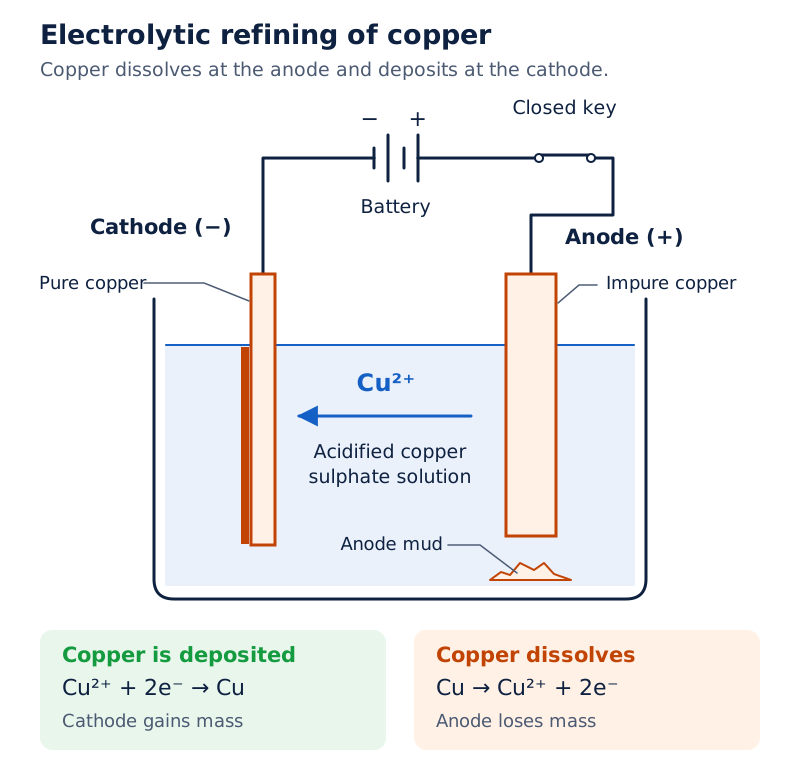
A tank contains acidified copper sulphate solution. The cathode is drawn on the left and the anode on the right, connected through an external circuit with a key. Copper-ion labels appear in the solution, and impurities labelled “anode mud” lie beneath the anode.
Drawn by One Young India.
How does refining differ from electroplating?
In refining, the aim is to obtain pure metal from an impure anode. In electroplating, the aim is to cover an article with a surface layer. Both use cathodic metal deposition, but their purposes and choice of cathode differ.
The anode becomes smaller and the cathode gains copper during refining. These changes follow from the half-equations, rather than from copper particles simply falling from one electrode onto the other. Dissolution, migration through the solution and reduction are distinct parts of the process.
Glossary
- Electrolysis — Chemical decomposition driven by electric current through a molten substance or its aqueous solution.
- Electrolyte — Substance conducting through mobile ions in the molten or dissolved state and undergoing electrolytic chemical change.
- Non-electrolyte — Substance that does not supply appreciable mobile ions for electrolytic conduction in solution.
- Strong electrolyte — Electrolyte substantially completely dissociated or ionised under the stated conditions of its solution.
- Weak electrolyte — Electrolyte only partly ionised, leaving both unionised solute molecules and ions in solution.
- Cation — Positively charged ion that migrates towards the negative cathode during electrolysis.
- Anion — Negatively charged ion that migrates towards the positive anode during electrolysis.
- Cathode — Electrode where reduction occurs; connected to the negative terminal in an electrolytic cell.
- Anode — Electrode where oxidation occurs; connected to the positive terminal in an electrolytic cell.
- Oxidation — Loss of electrons by a reacting species, occurring at the anode during electrolysis.
- Reduction — Gain of electrons by a reacting species, occurring at the cathode during electrolysis.
- Selective discharge — Preferential electrode reaction of one species when competing species are available under the stated conditions.
- Electroplating — Deposition of a layer of a desired metal on another material by electricity.
- Electrolytic refining — Purification of an impure metal by anodic dissolution and deposition of pure metal at the cathode.
- Anode mud — Insoluble impurities that settle below the anode during electrolytic refining of a metal.
Common errors and misconceptions
- Misconception: Any dissolved substance makes water conduct well. Correct: Mobile ions are needed; glucose and alcohol solutions do not conduct in the comparison with acid solutions.
- Misconception: Strong means concentrated and weak means dilute. Correct: Strength concerns the extent of ionisation; concentration concerns the amount of solute in a given amount of solution.
- Misconception: Ionic solids cannot be electrolytes because they do not conduct. Correct: Their ions are fixed in the solid but become mobile on melting or dissolving.
- Misconception: Electrons flow through the electrolyte between the electrodes. Correct: Ions carry current through the liquid, while electrons carry current in the external metallic circuit.
- Misconception: All ions reaching an electrode must be discharged. Correct: Selective discharge depends on the competing species, their concentrations and the electrode material.
- Misconception: Acidified water produces equal volumes of hydrogen and oxygen. Correct: At the same temperature and pressure, hydrogen occupies twice the oxygen volume.
- Misconception: Copper sulphate has identical anode products with copper and platinum. Correct: Copper anodes dissolve, whereas inert platinum anodes allow oxygen formation from water.
- Misconception: All impurities become anode mud during copper refining. Correct: Insoluble impurities form mud; soluble impurities enter the solution.
Exam-style questions with model answers
Q1. Solid sodium chloride contains fixed ions, whereas its melt contains mobile ions. Explain their different electrical behaviour. [2 marks]
- Solid sodium chloride does not conduct by ion movement because its ions are held in fixed positions.
- The molten salt conducts because its mobile ions carry electrical charge through the liquid towards the electrodes.
Q2. Distinguish a strong electrolyte, a weak electrolyte and a non-electrolyte by the particles supplied by the solute in water. Give one example of each. [3 marks]
- A strong electrolyte supplies essentially ions because the dissolved solute is substantially completely dissociated or ionised. Sodium chloride is an example; water molecules are still present as solvent.
- A weak electrolyte supplies both ions and unionised solute molecules because ionisation is partial. Ethanoic acid is an example.
- A non-electrolyte remains as molecules without an appreciable supply of ions for conduction. Glucose is an example.
Q3. Molten lead(II) bromide contains Pb²⁺ and Br⁻ ions and is electrolysed using inert graphite electrodes. State each ion's destination and write both electrode half-equations. [4 marks]
- Positive lead(II) ions migrate towards the cathode, which is connected to the negative terminal of the electrical supply.
- At the cathode, reduction produces molten lead: Pb²⁺(l) + 2e⁻ → Pb(l).
- Negative bromide ions migrate towards the anode, which is connected to the positive terminal of the supply.
- At the anode, oxidation produces bromine: 2Br⁻(l) → Br₂(g) + 2e⁻. The bromide ions lose electrons.
Q4. Water containing a little dilute sulphuric acid is electrolysed using platinum electrodes. Explain the acid's role, give the two electrode equations, state the overall equation and compare gas volumes at the same temperature and pressure. [5 marks]
- The dilute sulphuric acid supplies ions and improves the conductivity of water, which conducts very poorly when pure. It assists the process without being consumed in the overall reaction.
- At the negative cathode, hydrogen ions gain electrons to form hydrogen gas: 2H⁺(aq) + 2e⁻ → H₂(g).
- At the positive anode, water is oxidised to oxygen: 2H₂O(l) → O₂(g) + 4H⁺(aq) + 4e⁻.
- Doubling the cathode equation and cancelling electrons and hydrogen ions gives the overall equation: 2H₂O(l) → 2H₂(g) + O₂(g).
- The hydrogen volume is twice the oxygen volume at the same temperature and pressure, corresponding to the two-to-one ratio of gaseous products.
Q5. Compare aqueous copper(II) sulphate electrolysis using copper electrodes and using inert platinum electrodes. Give the cathode reaction, both anode reactions, and explain the colour change in each cell. [5 marks]
- In both cells, copper(II) ions gain electrons at the cathode and deposit copper: Cu²⁺(aq) + 2e⁻ → Cu(s). The cathode therefore gains copper during the intended process.
- With copper electrodes, the anode dissolves: Cu(s) → Cu²⁺(aq) + 2e⁻. The copper anode loses mass.
- The blue colour remains approximately unchanged with copper electrodes because the anode replaces the copper ions removed from solution at the cathode.
- With platinum electrodes, the inert anode does not supply copper ions. Water is oxidised there: 2H₂O(l) → O₂(g) + 4H⁺(aq) + 4e⁻.
- The blue colour gradually fades with platinum electrodes because copper ions are removed at the cathode without replacement by the anode.
Q6. Describe nickel electroplating using nickel sulphate solution. Identify both electrodes, give their half-equations and state one preparation condition for an adherent coating. [5 marks]
- The article to be coated is the cathode, connected to the negative terminal. This is the electrode on which nickel is to be deposited.
- A pure nickel plate is the anode, connected to the positive terminal. It supplies nickel to replace that deposited from the nickel sulphate solution.
- At the cathode, nickel ions gain electrons: Ni²⁺(aq) + 2e⁻ → Ni(s). Nickel forms a surface deposit on the article.
- At the anode, nickel loses electrons and dissolves: Ni(s) → Ni²⁺(aq) + 2e⁻.
- Clean the article thoroughly before plating so that grease, dirt and surface oxide do not interfere with adhesion of the deposited nickel.
Q7. For silver plating with sodium argentocyanide solution, identify the electrodes and explain why silver is supplied in a complex form. [3 marks]
- The clean article is the cathode, connected to the negative terminal, so that silver can be deposited on its surface by reduction.
- A pure silver plate is the anode, connected to the positive terminal; silver from it enters the electrolyte during electrolysis.
- The silver-containing complex keeps free silver-ion concentration low. This permits controlled deposition and helps produce a smooth, adherent silver coating.
Q8. Describe electrolytic refining of impure copper. Name both electrodes and the electrolyte, give the two copper half-equations, and distinguish the fates of soluble and insoluble impurities. [6 marks]
- The anode is impure copper and is connected to the positive terminal of the direct-current supply.
- The cathode is a thin strip of pure copper connected to the negative terminal. It receives the purified copper deposit.
- The electrolyte is acidified copper sulphate solution, providing mobile ions and copper(II) ions for deposition at the cathode.
- At the anode, copper is oxidised and dissolves into solution: Cu(s) → Cu²⁺(aq) + 2e⁻.
- At the cathode, copper(II) ions are reduced to pure copper: Cu²⁺(aq) + 2e⁻ → Cu(s). The cathode gains copper.
- Soluble impurities enter the solution, while insoluble impurities settle beneath the anode as anode mud. Not every impurity becomes mud.
Key takeaways
- Electrolytes conduct through mobile ions; ionic solids need melting or dissolution before their ions can carry current through the material.
- Strong and weak describe the extent of ionisation, while concentrated and dilute describe the amount of solute in solution.
- During electrolysis, reduction occurs at the negative cathode and oxidation occurs at the positive anode.
- Selective discharge depends on the species present, their relative concentrations and whether the electrodes participate chemically.
- Molten lead bromide gives lead at the cathode and bromine at the anode, without competition from water.
- Acidified water gives hydrogen and oxygen in a two-to-one volume ratio at the same temperature and pressure.
- Copper anodes replenish copper ions during copper sulphate electrolysis; platinum anodes instead permit oxygen formation.
- Electroplating coats an article at the cathode, whereas copper refining deposits pure copper from an impure anode.
Test yourself
Why does a glucose solution differ from an acid solution in a conduction test?
Glucose does not supply appreciable ions, whereas the acid supplies mobile ions that carry current through its solution.
Does “ions only” mean an aqueous strong electrolyte contains no water molecules?
No. It describes the solute particles; water molecules remain present as the solvent in the aqueous solution.
What is the difference between migration and discharge?
Migration is movement of ions towards an electrode. Discharge involves electron transfer at the electrode, converting the reacting ions into neutral products.
Why are electrons on the left in Cu²⁺ + 2e⁻ → Cu?
The copper ion gains electrons, so this is reduction and the electrons are reactants.
Which electrode gives bromine from molten lead bromide?
The positive anode gives bromine because bromide ions lose electrons there.
Why does copper sulphate become paler with platinum electrodes?
Copper ions are removed at the cathode, while the inert platinum anode does not replenish them.
Which electrolytes are used for nickel and silver plating?
Nickel plating uses nickel sulphate solution; silver plating uses sodium argentocyanide solution.
Why is “all impurities settle as anode mud” incorrect?
Only insoluble impurities settle as anode mud; soluble impurities enter the electrolyte during refining.
Try it
Electrolysis Fundamentals and Preferential Discharge
Test your understanding of electrolytic cells and discharge rules with these scenarios.
1Imagine you are setting up an electrolysis experiment to decompose a compound, but you accidentally connect the cell to an alternating current (AC) power source instead of a direct current (DC) source. What will happen to the chemical decomposition process, and why?
Correct! The text explicitly states that AC cannot be used for electrolysis because its rapid reversal of polarity prevents any net chemical change from taking place.
Incorrect. The text states that AC prevents any net chemical change from taking place due to continuous switching between oxidation and reduction; it does not speed up decomposition.
Incorrect. The text notes that in electrolytes, electrical resistance actually decreases as temperature increases. The failure of AC is due to polarity reversal, not resistance.
2You are electrolyzing an aqueous solution containing both sulfate and hydroxide ions, but you decide to use an active copper anode instead of an inert graphite one. According to the rules of preferential discharge, what will happen at the anode?
Incorrect. While hydroxide is indeed lower in the series, the text states that when an active electrode like copper is used, it participates in the reaction and dissolves instead of discharging the anions.
Correct! The text explains that the nature of the electrodes is a governing rule: active electrodes (like copper) participate in the reaction, causing the anode to dissolve by losing electrons rather than discharging the anions present.
Incorrect. The text states that active electrodes dissolve instead of discharging anions. Additionally, sulfate is higher in the discharge series, making it harder to discharge than hydroxide.
Great job! You've successfully applied the principles of direct current necessity and the rules of preferential discharge involving active electrodes.