
Sulphuric Acid | ICSE Class 10 Chemistry Notes
On this page
Watch & explore
Start with a few high-quality watches, then dive into the notes below.
Try an idea before you read. Test your understanding of the manufacturing and distinct chemical properties of sulphuric acid through this 2-step scenario challenge. Explore →
This note covers sulphuric acid, its manufacture, dilution, acidic behaviour, salt formation, reactions with metals and other compounds, oxidation of carbon and sulphur, removal of water from sugar and crystals, displacement of volatile acids, and identification tests.
What do the formula and concentration of sulphuric acid tell us?
Sulphuric acid has the formula H₂SO₄. Here H represents hydrogen, S sulphur and O oxygen. The small numbers indicate the numbers of atoms: one molecule contains two hydrogen atoms, one sulphur atom and four oxygen atoms. An omitted number means one.
An acid produces hydrogen ions in aqueous solution, meaning a solution in water. An ion is an electrically charged particle. Hydrogen ions in water are written H⁺(aq), where the superscript plus indicates a positive charge and “aq” means aqueous.
Hydrogen ions combine with water molecules and are also represented as hydronium ions, H₃O⁺. Water has the formula H₂O. Sulphuric acid therefore belongs to the group of acids whose aqueous solutions show acidic behaviour, including changing blue litmus to red.
How do dilute and concentrated acid differ?
Dilute sulphuric acid contains relatively more water and less acid per unit volume than concentrated sulphuric acid. Concentration describes how much of a substance is present in a given amount of solution. It does not, by itself, describe every chemical property.
The word strong, when used for an acid, concerns its ionisation in water, which is the formation of ions. Sulphuric acid is a strong acid; its first ionisation in water is almost complete. Diluting it does not rename it a weak acid: “dilute” and “weak” describe different ideas.
| Expression | Meaning | What to watch for |
|---|---|---|
| Dilute sulphuric acid | Acid mixed with a relatively large amount of water | Ordinary acid reactions, such as hydrogen production with zinc |
| Concentrated sulphuric acid | Acid containing relatively little water | Removal of water and, when hot, oxidation reactions |
| Hot concentrated acid | Concentrated acid under heating conditions | The concentration and heating condition both matter |
In the equations below, → means “produces”; substances before it are reactants, and substances after it are products. A plus sign separates substances. A number before a formula multiplies the whole formula. State symbols (s), (l) and (g) mean solid, liquid and gas.
How is sulphuric acid manufactured by the Contact Process?
The Contact Process is an industrial method of making sulphuric acid. It first produces sulphur dioxide, SO₂, then converts it into sulphur trioxide, SO₃. The names distinguish compounds containing two and three oxygen atoms respectively for each sulphur atom.
Oxidation here means addition of oxygen. A catalyst changes a reaction's rate without being consumed overall. An oxidation state is the formal charge assigned to an atom for tracking chemical change; Roman numerals in compound names indicate this state.
What are the main stages and conditions?
- Produce sulphur dioxide: burn sulphur in air. Oxygen gas, O₂, combines with sulphur: S + O₂ → SO₂. This provides the sulphur-containing gas needed for the next stage.
- Purify and dry the gases: remove impurities and moisture from the gas mixture before it reaches the catalyst. Impurities can reduce the catalyst's effectiveness.
- Oxidise sulphur dioxide: pass the gases over vanadium(V) oxide, V₂O₅, at about 450 °C and a low pressure of about 1 to 2 atmospheres. Here V represents vanadium, °C means degrees Celsius, and atmosphere is a unit of pressure.
- Absorb sulphur trioxide: bring it into contact with concentrated sulphuric acid to form oleum, represented by H₂S₂O₇. Oleum is sulphur trioxide dissolved in sulphuric acid.
- Dilute oleum under controlled conditions: its reaction with water produces sulphuric acid. This completes the manufacture after the absorption stage.
The catalytic conversion is 2SO₂ + O₂ ⇌ 2SO₃. The symbol ⇌ indicates a reversible reaction, which can proceed in both directions. The Roman numeral V in vanadium(V) oxide means an oxidation state of +5.
The absorption equation is SO₃ + H₂SO₄ → H₂S₂O₇. The subsequent equation is H₂S₂O₇ + H₂O → 2H₂SO₄. Keep these stages separate: the acid used for absorption and the water used later have different roles.
Diagram
Contact Process sequence
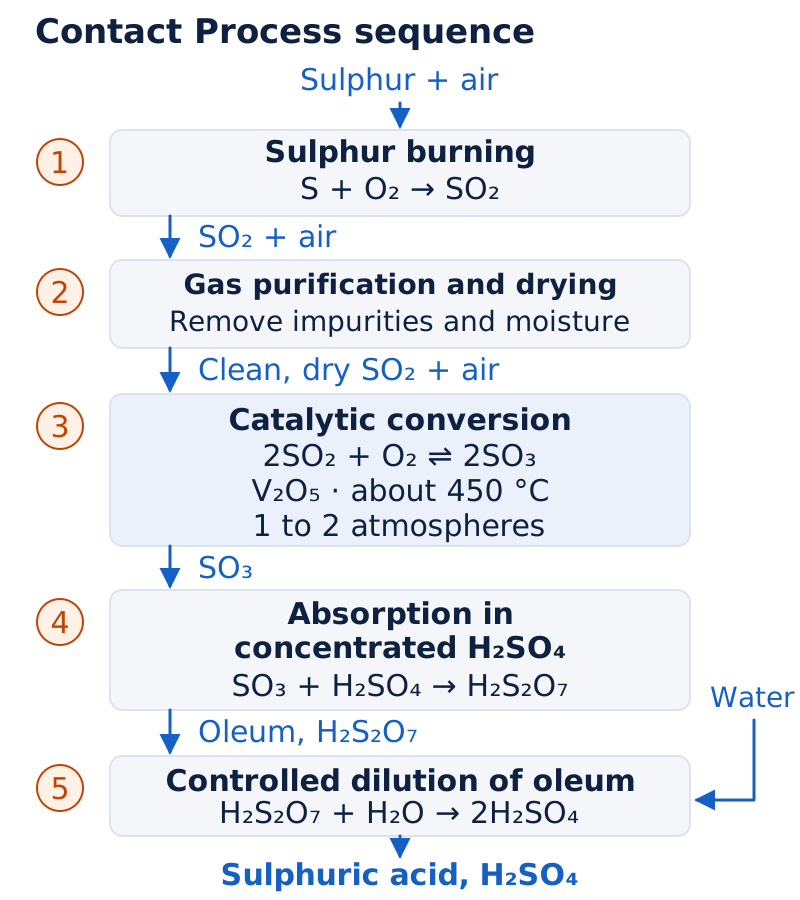
Draw connected boxes for sulphur burning, gas purification and drying, catalytic conversion, absorption in concentrated sulphuric acid, and controlled dilution of oleum. Label the converter with V₂O₅ and about 450 °C, and label each gas or liquid entering the next stage.
Drawn by One Young India.
Why are the Contact Process conditions and the oleum stage important?
The conversion of sulphur dioxide into sulphur trioxide is exothermic, meaning that it releases heat. It is also reversible. The operating temperature must therefore allow a useful reaction rate while retaining a useful proportion of sulphur trioxide in the reacting mixture.
What does the catalyst achieve?
Equilibrium is the condition in a reversible reaction when the forward and reverse reactions occur at equal rates. A catalyst helps the reacting mixture reach equilibrium faster. It does not change the equilibrium composition or turn the reversible reaction into an irreversible one.
At a low temperature, conversion can be too slow for practical manufacture. A higher temperature increases the reaction rate, but excessive heating is unfavourable to the equilibrium yield of sulphur trioxide. Yield means the amount of desired product obtained.
About 450 °C with vanadium(V) oxide provides suitable working conditions. The gases are kept clean because a contaminated catalyst may become less effective. This explains why gas preparation precedes catalytic conversion in the process sequence.
Why is sulphur trioxide not absorbed directly in water?
Direct absorption of sulphur trioxide in water forms an acid fog that is difficult to condense. Acid fog consists of very fine droplets dispersed in the gas. Writing a possible overall equation does not show whether a method collects the acid effectively.
Absorption in concentrated sulphuric acid produces oleum instead. Its subsequent controlled dilution allows sulphuric acid to be obtained through a manageable intermediate stage. The two equations for absorption and dilution therefore explain why oleum is part of the manufacture.
Note: Do not replace the industrial absorption stage with “add sulphur trioxide directly to water”. The chemical combination is possible, but the acid fog makes direct collection difficult.
The sequence can be remembered through changes in composition: sulphur becomes sulphur dioxide; oxygen converts this into sulphur trioxide; absorption gives oleum; controlled addition of water gives sulphuric acid. Each stage has a distinct chemical or practical purpose.
Why must concentrated sulphuric acid be diluted carefully?
Dilution means adding water so that the concentration of the dissolved substance decreases. Dissolving concentrated sulphuric acid in water is highly exothermic. The release of heat is part of the mixing process, so dilution requires care even without an external flame.
The acid must always be added slowly to water with constant stirring. Adding water to concentrated acid may produce intense local heating. The mixture may splash out and cause burns, and the glass container may also break.
What is the reasoning behind the correct order?
- Begin with water in the receiving vessel, so that each small addition of acid enters the water already present.
- Add the acid slowly, avoiding a large addition that would release substantial heat in one place.
- Stir continuously while adding it, distributing the acid and the heat through the mixture.
- Remember that the diluted solution is still acidic. Dilution reduces concentration; it does not neutralise the acid.
Neutralisation is the reaction of an acid with a base to form salt and water. A base is a substance that neutralises an acid. A salt is an ionic compound formed when replaceable hydrogen in an acid is replaced by a metal or another positive ion. Adding water alone is dilution, so it should not be described as producing a neutral salt solution.
The observation associated with dilution is a rise in temperature. This is different from the gas bubbles produced when dilute acid reacts with a suitable metal. A temperature change and gas evolution are different observations and should be recorded separately.
Note: “May splash” and “may break” describe hazards, not inevitable outcomes. The correct procedure remains slow addition of acid to water with continuous stirring.
This distinction also helps interpret reaction descriptions. A statement that the acid is dilute specifies its concentration. A statement that the reaction is exothermic specifies a heat change. Neither statement alone identifies the products of a separate chemical reaction.
How does dilute sulphuric acid react with metals, oxides and hydroxides?
Dilute sulphuric acid shows the usual reactions of an acid. With a suitable reactive metal it produces a salt and hydrogen gas. With a basic metal oxide or a hydroxide it produces a salt and water. The salt formed contains the sulphate ion, SO₄²⁻, carrying two negative charges.
What happens with zinc?
Zinc, represented by Zn, reacts with dilute sulphuric acid to give zinc sulphate, ZnSO₄, and hydrogen gas, H₂: Zn + H₂SO₄ → ZnSO₄ + H₂. Bubbles form as the gas is released. Hydrogen burns with a characteristic pop in the usual small-sample test.
Do not generalise this to every metal. Copper, Cu, does not displace hydrogen from dilute sulphuric acid. The metal's reactivity matters. A reaction involving hot concentrated acid belongs to a different set of conditions.
What the figure shows
Zinc reacting with dilute sulphuric acid
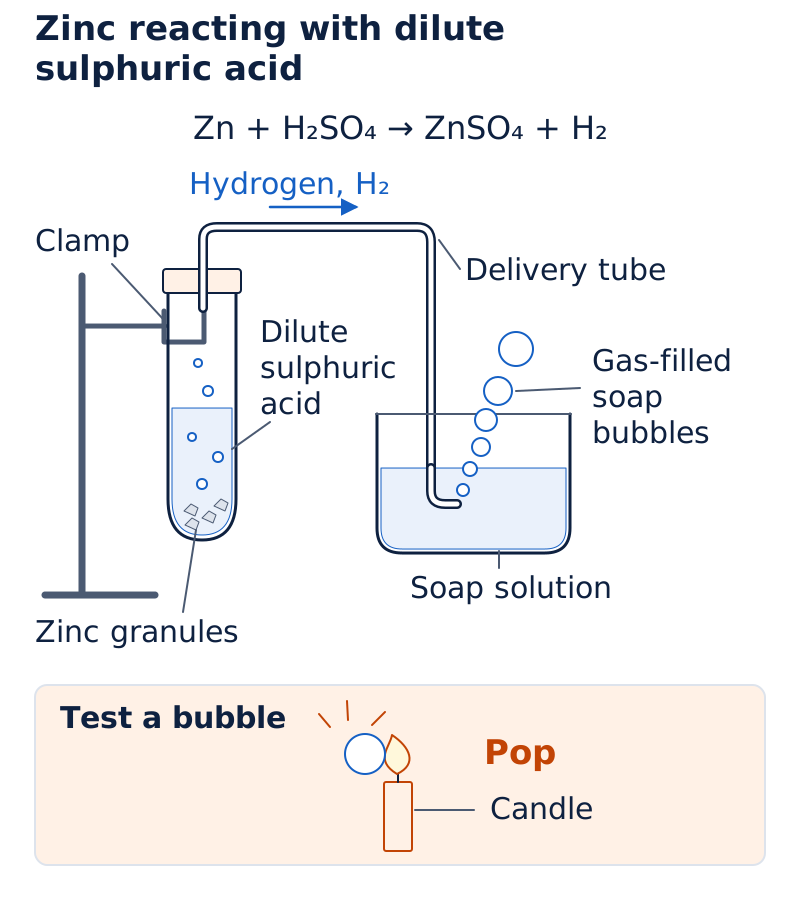
A clamped test tube contains zinc granules and dilute sulphuric acid. A delivery tube carries hydrogen into soap solution. Gas-filled bubbles rise, and a candle is shown igniting a bubble with a pop.
Drawn by One Young India.
How do an oxide and a hydroxide react?
A basic oxide is an oxide that neutralises an acid. Black copper(II) oxide, CuO, reacts with dilute sulphuric acid, forming copper(II) sulphate, CuSO₄, and water: CuO + H₂SO₄ → CuSO₄ + H₂O. The solid dissolves as a blue solution forms.
The Roman numeral II indicates copper's +2 oxidation state. In these copper compounds, the name distinguishes this state from other possible states of copper. Keep the name and formula together when identifying the oxide and the sulphate formed from it.
Sodium hydroxide, NaOH, is an alkali, meaning a base soluble in water; Na represents sodium. Its complete neutralisation is 2NaOH + H₂SO₄ → Na₂SO₄ + 2H₂O. Sodium sulphate, Na₂SO₄, and water form without hydrogen gas being a product.
Worked example 1. Check whether Zn + H₂SO₄ → ZnSO₄ + H₂ is balanced. Answer: each side contains one zinc atom, two hydrogen atoms, one sulphur atom and four oxygen atoms. No coefficient needs changing. Balance equations by adjusting coefficients, not by changing chemical formulae.
What happens with carbonates, sulphites and sulphides?
The gas produced by dilute sulphuric acid depends on the compound reacting with it. A carbonate contains the carbonate ion, CO₃²⁻, while a hydrogen carbonate contains HCO₃⁻. Both give carbon dioxide, CO₂, when acidified; C represents carbon.
A sulphite contains SO₃²⁻, while a hydrogen sulphite contains HSO₃⁻. These give sulphur dioxide. A sulphide contains S²⁻; a suitable metal sulphide gives hydrogen sulphide, H₂S. Similar-sounding names must therefore be distinguished by their formulae.
Which equations show the different gas products?
| Reactant | Balanced equation with dilute acid | Gas formed |
|---|---|---|
| Sodium carbonate, Na₂CO₃ | Na₂CO₃ + H₂SO₄ → Na₂SO₄ + H₂O + CO₂ | Carbon dioxide |
| Sodium hydrogen carbonate, NaHCO₃ | 2NaHCO₃ + H₂SO₄ → Na₂SO₄ + 2H₂O + 2CO₂ | Carbon dioxide |
| Sodium sulphite, Na₂SO₃ | Na₂SO₃ + H₂SO₄ → Na₂SO₄ + H₂O + SO₂ | Sulphur dioxide |
| Sodium hydrogen sulphite, NaHSO₃ | 2NaHSO₃ + H₂SO₄ → Na₂SO₄ + 2H₂O + 2SO₂ | Sulphur dioxide |
| Iron(II) sulphide, FeS; Fe represents iron | FeS + H₂SO₄ → FeSO₄ + H₂S | Hydrogen sulphide; the salt is iron(II) sulphate |
Effervescence means the formation and escape of gas bubbles. Carbon dioxide, sulphur dioxide and hydrogen sulphide are colourless gases, so the appearance of bubbles alone does not identify which gas has formed. Use the reactant and the appropriate gas test together.
Carbon dioxide turns limewater, a solution of calcium hydroxide, milky. Calcium is represented by Ca. The reaction is Ca(OH)₂ + CO₂ → CaCO₃ + H₂O. Calcium carbonate, CaCO₃, forms a white precipitate, an insoluble solid produced in a reaction.
Sulphur dioxide decolourises acidified potassium permanganate solution, a purple testing solution. Hydrogen sulphide blackens moist lead(II) acetate paper by forming lead(II) sulphide. These tests distinguish the sulphur-containing gases; they should not be confused with the hydrogen pop test.
Note: Sulphate and sulphite are different ions. Replacing SO₃²⁻ with SO₄²⁻ changes the substance, not just its spelling. The sulphur dioxide equation above is a sulphite reaction.
Why is sulphuric acid dibasic, and which salts does it form?
A dibasic acid has two replaceable hydrogen ions per molecule that can take part in complete neutralisation. Sulphuric acid is dibasic. Its basicity is therefore two; this does not mean that the acid is a base or has two different acidic substances mixed together.
Because replacement can be partial or complete, sulphuric acid forms two series of salts. Hydrogen sulphates retain one replaceable hydrogen, while sulphates result when both acidic hydrogens have been replaced. Sodium salts provide a clear comparison.
How does partial neutralisation differ from complete neutralisation?
| Extent of neutralisation | Equation | Salt formed |
|---|---|---|
| Partial neutralisation | H₂SO₄ + NaOH → NaHSO₄ + H₂O | Sodium hydrogen sulphate, NaHSO₄ |
| Complete neutralisation | H₂SO₄ + 2NaOH → Na₂SO₄ + 2H₂O | Sodium sulphate, Na₂SO₄ |
| Further neutralisation of the hydrogen sulphate | NaHSO₄ + NaOH → Na₂SO₄ + H₂O | Sodium sulphate from the remaining acidic hydrogen |
An acid salt is formed by partial replacement of the replaceable hydrogen of an acid. A normal salt is formed by complete replacement. These terms describe composition; they should not be used as a substitute for testing the acidity of an unfamiliar salt solution.
Read the coefficients together with the salt formula. One unit of sodium hydroxide per sulphuric acid molecule gives the hydrogen sulphate in the partial-neutralisation equation. Twice that amount is required for complete neutralisation to sodium sulphate.
Adding the first and third equations gives the complete-neutralisation equation. Sodium hydrogen sulphate appears as a product in the first step and a reactant in the second, so it cancels when the two stages are combined.
Definition: Basicity counts replaceable acidic hydrogen ions per molecule. Concentration describes how much acid is present in a solution. Sulphuric acid remains dibasic when its aqueous solution is diluted.
How does hot concentrated sulphuric acid oxidise carbon and sulphur?
In reactions involving oxygen transfer, oxidation means gain of oxygen and reduction means loss of oxygen. An oxidising agent causes another substance to be oxidised and is itself reduced. Hot concentrated sulphuric acid is a moderately strong oxidising agent.
The conditions are essential. The oxidation of carbon and sulphur discussed here uses hot concentrated acid. Do not transfer the products of a dilute-acid reaction to these reactions simply because the same acid formula appears.
What happens when carbon is oxidised?
Carbon is converted into carbon dioxide, while sulphuric acid is reduced to sulphur dioxide. Water also forms. The balanced equation is C + 2H₂SO₄ → CO₂ + 2SO₂ + 2H₂O, using hot concentrated sulphuric acid.
Two different gaseous oxides are produced: carbon dioxide comes from oxidation of carbon, and sulphur dioxide comes from reduction of the acid. The presence of both gases is different from the production of hydrogen when zinc reacts with dilute acid.
What happens when sulphur is oxidised?
Elemental sulphur is oxidised to sulphur dioxide. At the same time, sulphuric acid is reduced to sulphur dioxide. The equation is S + 2H₂SO₄ → 3SO₂ + 2H₂O, again with hot concentrated acid.
In this case the same gaseous substance appears from both changes. One sulphur atom enters as the element and two enter in the acid. The three sulphur atoms are accounted for by the coefficient three before sulphur dioxide.
Worked example 2. Check the carbon-oxidation equation above. Answer: the reactants contain one carbon, four hydrogen, two sulphur and eight oxygen atoms. The products contain the same totals: oxygen contributes two atoms in CO₂, four in 2SO₂ and two in 2H₂O.
This atom count checks the equation, while the oxygen-transfer explanation identifies the acid's role. Both are needed for a full chemical explanation: a balanced equation records quantities, and the reaction description explains which substance is oxidised and which is reduced.
How does concentrated sulphuric acid remove water from sugar and crystals?
A dehydrating agent removes water from another substance. Concentrated sulphuric acid can remove the elements of water from sugar and the water of crystallisation from hydrated copper(II) sulphate. Dehydration must be distinguished from dilution, which adds water to a solution.
Why does sugar turn black?
Ordinary sugar, sucrose, has the formula C₁₂H₂₂O₁₁. Removal of hydrogen and oxygen in the proportion present in water leaves a black carbon residue. The simplified dehydration equation is C₁₂H₂₂O₁₁ → 12C + 11H₂O, in the presence of concentrated sulphuric acid.
The acid is written as the condition for dehydration rather than inserted as a reactant in this simplified equation. The formula shows why eleven water molecules correspond to the twenty-two hydrogen atoms and eleven oxygen atoms removed from each sucrose molecule.
Charring means the formation of a black carbon-rich residue. Here it demonstrates dehydration. The explanation is removal of the elements of water, rather than merely the disappearance of moisture already lying on the sugar's surface.
What happens to hydrated copper(II) sulphate?
Water of crystallisation is the fixed number of water molecules present in one formula unit of a crystalline salt. A formula unit expresses the simplest composition of an ionic compound. Blue hydrated copper(II) sulphate is written CuSO₄·5H₂O.
The dot indicates water associated with the salt in its crystal. Five water molecules accompany each copper sulphate formula unit. Hydrated means containing water of crystallisation; anhydrous means without it. Removing this water produces white anhydrous copper(II) sulphate.
The change is represented by CuSO₄·5H₂O → CuSO₄ + 5H₂O. Concentrated sulphuric acid removes the water as a dehydrating agent. Heating can also remove the water, but heating and treatment with acid are different ways of producing dehydration.
What the figure shows
Removing water of crystallisation
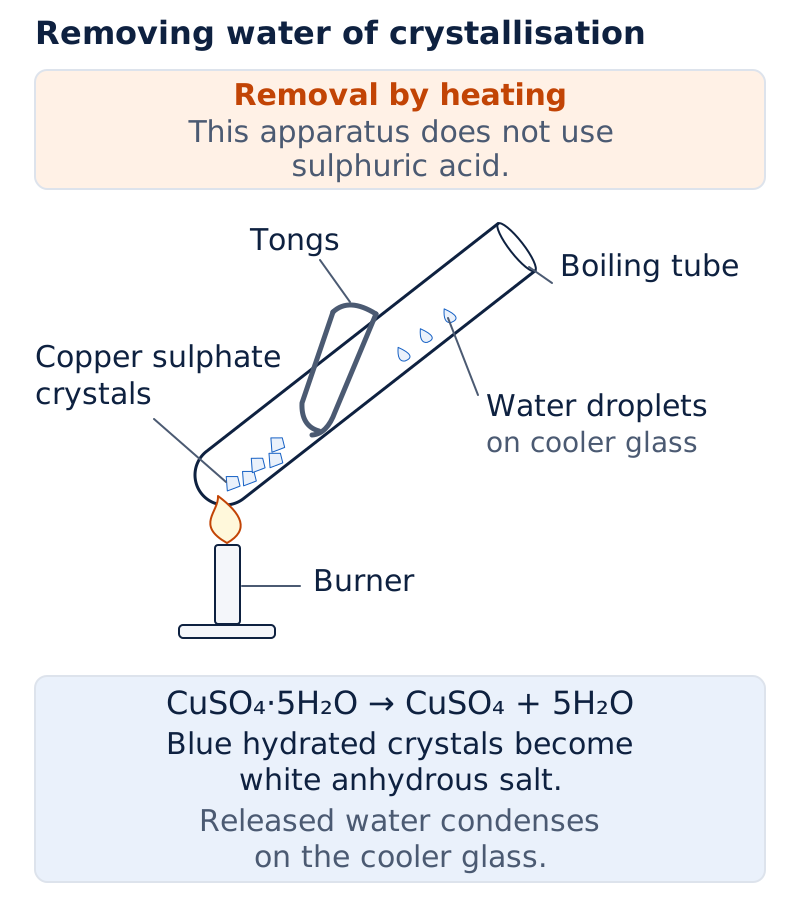
A boiling tube containing copper sulphate crystals is held at an angle with tongs above a burner. Water droplets are labelled on the cooler part of the tube. This figure shows removal by heating, not treatment with sulphuric acid.
Drawn by One Young India.
Adding water to the anhydrous salt restores its blue colour. This connects the colour change with hydration. It does not mean that adding water reverses the charring of sugar: the two examples involve different starting substances and different changes.
How does the non-volatile nature of sulphuric acid help prepare other acids?
A volatile substance readily passes into vapour. Sulphuric acid is comparatively non-volatile, so concentrated sulphuric acid can displace more volatile acids from suitable salts on heating. The displaced acid leaves as gas or vapour, while a hydrogen sulphate remains in the gently heated mixture.
How are chlorides and nitrates used?
Hydrogen chloride, HCl, contains chlorine, represented by Cl. Its aqueous solution is hydrochloric acid. Nitric acid is HNO₃, where N represents nitrogen. Sodium chloride is NaCl and sodium nitrate is NaNO₃; replacing Na with K gives the corresponding potassium salts, KCl and KNO₃.
| Salt used | Equation with concentrated sulphuric acid | Volatile acid obtained |
|---|---|---|
| Sodium chloride | NaCl + H₂SO₄ → NaHSO₄ + HCl | Hydrogen chloride |
| Potassium chloride | KCl + H₂SO₄ → KHSO₄ + HCl | Hydrogen chloride |
| Sodium nitrate | NaNO₃ + H₂SO₄ → NaHSO₄ + HNO₃ | Nitric acid |
| Potassium nitrate | KNO₃ + H₂SO₄ → KHSO₄ + HNO₃ | Nitric acid |
Here K represents potassium and KHSO₄ is potassium hydrogen sulphate. The equations describe the hydrogen sulphate stage. For chloride preparation, gentle heating below about 200 °C gives this stage; nitric acid preparation also uses gentle heating below about 200 °C to limit decomposition of the acid.
This property is non-volatility, not the oxidation of the chloride or nitrate. Sulphuric acid's role must be identified from the particular reaction. The same reagent may show different properties in different chemical settings.
What the figure shows
Preparation of hydrogen chloride gas
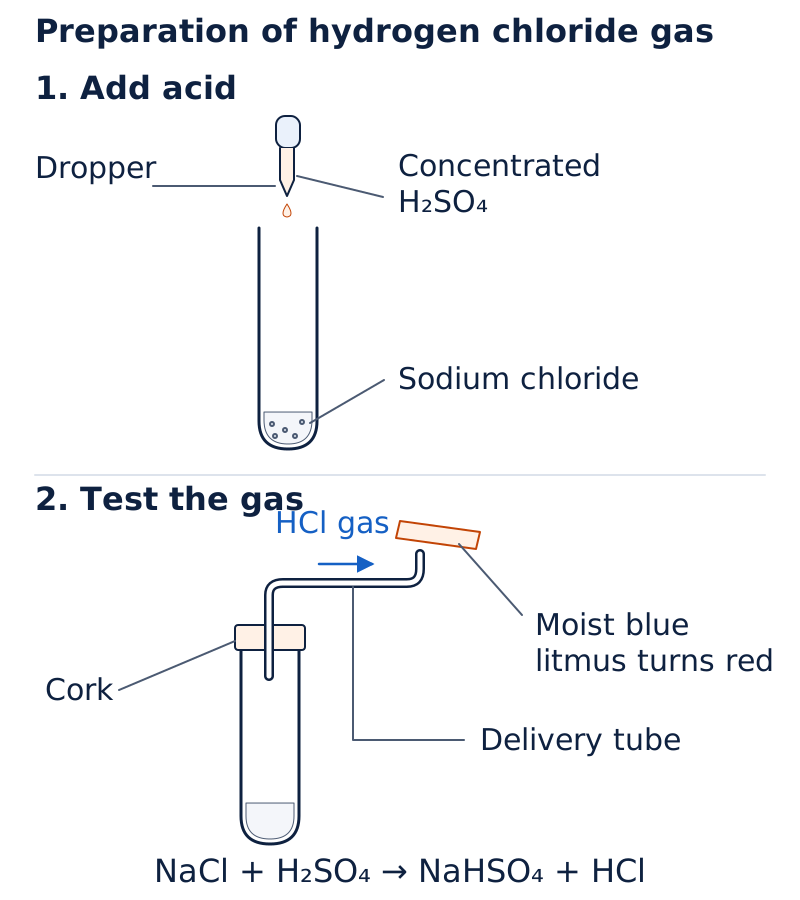
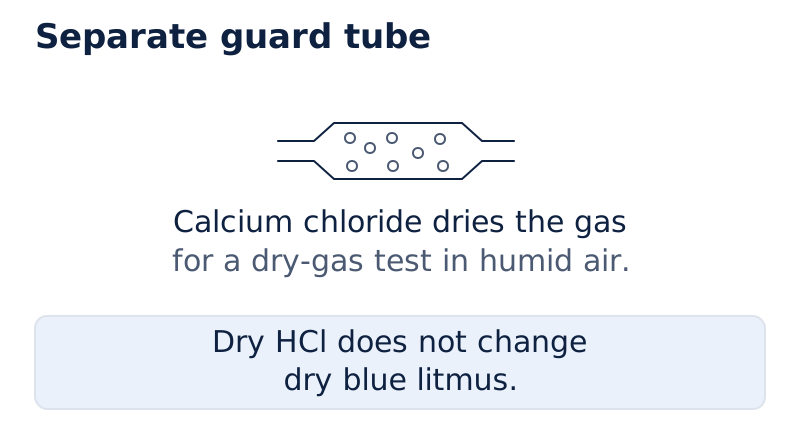
A dropper adds concentrated sulphuric acid to sodium chloride in a test tube. A cork and delivery tube direct the gas towards moist litmus paper. A separate guard tube containing calcium chloride is also shown.
Drawn by One Young India.
Dry hydrogen chloride does not change dry blue litmus, but the gas turns moist blue litmus red. Water allows hydrogen ions to form in solution. This explains why the condition of the indicator paper matters when identifying the acidic behaviour of the gas.
How can sulphuric acid be identified and its reactions distinguished?
A test for acidity and a test for sulphate provide different information. Blue litmus turning red indicates an acidic solution, but this observation alone does not identify sulphuric acid. Other acids give the same indicator change.
What does the barium chloride test show?
Barium chloride, BaCl₂, supplies barium ions; Ba represents barium. Addition to a dilute sulphuric acid sample produces a white precipitate of barium sulphate, BaSO₄. The equation is H₂SO₄ + BaCl₂ → BaSO₄ + 2HCl.
The precipitate remains insoluble in dilute hydrochloric acid. In testing an unknown solution for sulphate, acidify with dilute hydrochloric acid before adding barium chloride. This removes interference from carbonates and sulphites, which can also give white barium salts.
Do not acidify with sulphuric acid for this test: that would introduce the sulphate being tested for. The sulphate test identifies the ion, so sodium sulphate solution also gives a white barium sulphate precipitate. It does not by itself prove that the original sample was an acid.
How should a reaction be interpreted?
- Identify the reactants: distinguish a metal from its oxide, and distinguish carbonate, sulphite, sulphide and sulphate formulae.
- Read the conditions: notice whether the acid is dilute or concentrated and whether heating is specified.
- State the products: name the salt, gas and water where applicable, then give the balanced equation.
- Connect observations to the products: distinguish gas bubbles, a precipitate, a colour change and a temperature rise.
- Name the demonstrated property: use acidic behaviour, oxidation, dehydration or non-volatility as appropriate to that reaction.
For example, a black residue from sugar indicates dehydration, whereas conversion of carbon into carbon dioxide by hot concentrated acid indicates oxidation. A white precipitate with barium chloride is a sulphate test. None of these observations should be substituted for another merely because sulphuric acid is present.
Glossary
- Dibasic acid — An acid with two replaceable hydrogen ions per molecule available for complete neutralisation.
- Dilution — Addition of water to a solution so that the concentration of dissolved substance decreases.
- Neutralisation — Reaction between an acid and a base that produces a salt and water.
- Catalyst — A substance that changes the rate of a reaction without being consumed overall.
- Reversible reaction — A reaction that can proceed in both forward and reverse directions under suitable conditions.
- Exothermic process — A process that releases heat to its surroundings as it takes place.
- Oleum — Sulphur trioxide dissolved in sulphuric acid, represented by H₂S₂O₇ in the manufacturing equations.
- Oxidising agent — A substance that causes oxidation of another substance while itself undergoing reduction.
- Dehydrating agent — A substance that removes water, or the elements of water, from another substance.
- Water of crystallisation — The fixed number of water molecules present in one formula unit of a crystalline salt.
- Anhydrous salt — A salt without water of crystallisation, such as white anhydrous copper(II) sulphate.
- Non-volatile substance — A substance that does not readily pass into vapour under the conditions being considered.
- Precipitate — An insoluble solid formed during a chemical reaction between substances in solution.
- Effervescence — The formation and escape of gas bubbles during a reaction in a liquid.
Common errors and misconceptions
- Misconception: Dilute sulphuric acid is a weak acid. Correct: Dilution describes concentration; acid strength concerns ionisation in water.
- Misconception: Water should be poured into concentrated sulphuric acid. Correct: Add acid slowly to water with constant stirring; mixing releases considerable heat.
- Misconception: Every metal releases hydrogen with dilute sulphuric acid. Correct: The metal's reactivity matters; zinc does, whereas copper does not displace hydrogen from the dilute acid.
- Misconception: Sulphur trioxide is absorbed directly in water during manufacture. Correct: Concentrated sulphuric acid absorbs it to form oleum, avoiding acid fog that is difficult to condense.
- Misconception: Dibasic means sulphuric acid behaves as a base. Correct: It means that each molecule has two replaceable acidic hydrogen ions.
- Misconception: Charring sugar and oxidising carbon demonstrate the same property. Correct: Charring demonstrates dehydration; carbon dioxide formation with hot concentrated acid demonstrates oxidation.
- Misconception: A sulphate test alone identifies sulphuric acid. Correct: Sulphate salts also give barium sulphate; acidity must be established separately.
- Misconception: Sulphite and sulphide give the same gas with dilute acid. Correct: A sulphite gives sulphur dioxide, while a suitable metal sulphide gives hydrogen sulphide.
Exam-style questions with model answers
Q1. State the correct order for diluting concentrated sulphuric acid and explain the reason for it. [2 marks]
- Add concentrated sulphuric acid slowly to water, stirring constantly throughout the addition.
- Dilution is highly exothermic. Adding water to concentrated acid may cause local heating, splashing and burns, and may break the glass container.
Q2. Describe the Contact Process starting from sulphur. Include sulphur dioxide formation, the conversion equation and conditions, the two oleum-stage equations, and the reason for avoiding direct absorption in water. [6 marks]
- Burn sulphur in air to form sulphur dioxide: S + O₂ → SO₂. Purify and dry the gases before catalytic conversion.
- Oxidise sulphur dioxide by the reversible reaction 2SO₂ + O₂ ⇌ 2SO₃, producing sulphur trioxide.
- Use vanadium(V) oxide, V₂O₅, as catalyst at about 450 °C and about 1 to 2 atmospheres pressure.
- Absorb sulphur trioxide in concentrated sulphuric acid to form oleum: SO₃ + H₂SO₄ → H₂S₂O₇.
- Dilute oleum under controlled conditions to obtain sulphuric acid: H₂S₂O₇ + H₂O → 2H₂SO₄.
- Direct absorption of sulphur trioxide in water forms acid fog that is difficult to condense, so the oleum route is used.
Q3. Explain why sulphuric acid is dibasic. Give balanced equations for its partial and complete neutralisation by sodium hydroxide, naming each salt. [3 marks]
- Sulphuric acid is dibasic because each molecule has two replaceable hydrogen ions available for neutralisation; the word does not mean that it is a base.
- Partial neutralisation produces sodium hydrogen sulphate: H₂SO₄ + NaOH → NaHSO₄ + H₂O. One replaceable hydrogen remains in this acid salt.
- Complete neutralisation produces sodium sulphate: H₂SO₄ + 2NaOH → Na₂SO₄ + 2H₂O. Both acidic hydrogens have been replaced.
Q4. Separate samples of sodium carbonate, sodium sulphite and iron(II) sulphide are treated with dilute sulphuric acid. For each, write the balanced equation and name the gas; then give a distinguishing test for each gas. [6 marks]
- Sodium carbonate gives carbon dioxide: Na₂CO₃ + H₂SO₄ → Na₂SO₄ + H₂O + CO₂. Sodium sulphate and water are the other products.
- Carbon dioxide turns limewater milky because calcium carbonate precipitates, but sulphur dioxide also turns limewater milky. To distinguish carbon dioxide from the two sulphur-containing gases, test a separate portion with acidified potassium permanganate: carbon dioxide leaves it purple, whereas sulphur dioxide and hydrogen sulphide decolourise it.
- Sodium sulphite gives sulphur dioxide: Na₂SO₃ + H₂SO₄ → Na₂SO₄ + H₂O + SO₂. The salt product is again sodium sulphate.
- Sulphur dioxide decolourises acidified potassium permanganate, whereas carbon dioxide does not. To distinguish it from hydrogen sulphide, test a separate portion with moist lead(II) acetate paper: sulphur dioxide does not blacken the paper, whereas hydrogen sulphide does.
- Iron(II) sulphide gives hydrogen sulphide: FeS + H₂SO₄ → FeSO₄ + H₂S. Iron(II) sulphate is the other product.
- Hydrogen sulphide blackens moist lead(II) acetate paper because black lead(II) sulphide is formed.
Q5. Carbon and sulphur are separately heated with concentrated sulphuric acid. Write both balanced equations and identify the oxidising agent and its reduction product. [4 marks]
- Carbon is oxidised to carbon dioxide: C + 2H₂SO₄ → CO₂ + 2SO₂ + 2H₂O. The condition is hot concentrated acid.
- Sulphur is oxidised to sulphur dioxide: S + 2H₂SO₄ → 3SO₂ + 2H₂O, again with hot concentrated acid.
- Sulphuric acid is the oxidising agent in both reactions because it brings about oxidation of the element.
- The acid is itself reduced to sulphur dioxide. In the sulphur reaction, sulphur dioxide also comes from oxidation of the elemental sulphur.
Q6. Explain the action of concentrated sulphuric acid on sucrose, C₁₂H₂₂O₁₁, and hydrated copper(II) sulphate, CuSO₄·5H₂O. Give the visible change and a dehydration equation for each. [4 marks]
- Sucrose loses the elements of water and leaves a black carbon residue, so concentrated sulphuric acid acts as a dehydrating agent.
- The simplified sugar equation is C₁₂H₂₂O₁₁ → 12C + 11H₂O, with concentrated sulphuric acid providing the dehydrating condition.
- Blue hydrated copper(II) sulphate loses its water of crystallisation and becomes white anhydrous copper(II) sulphate.
- The crystal change is represented by CuSO₄·5H₂O → CuSO₄ + 5H₂O. The acid removes the water from the hydrated salt.
Q7. Explain how concentrated sulphuric acid's non-volatility is used to prepare hydrogen chloride from sodium chloride and nitric acid from potassium nitrate. Give the equations and heating conditions. [3 marks]
- Concentrated sulphuric acid is comparatively non-volatile. It displaces a more volatile acid, which leaves the reaction mixture as gas or vapour.
- Gentle heating of sodium chloride with the acid below about 200 °C gives the hydrogen sulphate stage: NaCl + H₂SO₄ → NaHSO₄ + HCl.
- Gently heat potassium nitrate with the concentrated acid below about 200 °C: KNO₃ + H₂SO₄ → KHSO₄ + HNO₃. Excessive heating promotes nitric acid decomposition.
Q8. An unknown solution is to be tested for acidity and sulphate. State the litmus result for an acidic sample, describe the sulphate test and its result, give the equation for sulphuric acid with barium chloride, and explain the limitation of the sulphate test. [4 marks]
- An acidic sample turns blue litmus red. This establishes acidic behaviour but does not identify the particular acid.
- Acidify a separate portion with dilute hydrochloric acid and add barium chloride solution. A white precipitate insoluble in dilute hydrochloric acid indicates sulphate.
- For sulphuric acid, the reaction is H₂SO₄ + BaCl₂ → BaSO₄ + 2HCl. The precipitate is barium sulphate.
- Sulphate salts also produce this precipitate, so the sulphate result alone does not prove that the solution contains sulphuric acid.
Key takeaways
- Sulphuric acid is dibasic, forming hydrogen sulphates by partial neutralisation and sulphates by complete neutralisation.
- The Contact Process converts sulphur dioxide into sulphur trioxide before absorption in concentrated acid and controlled dilution of oleum.
- Always add concentrated sulphuric acid slowly to water with constant stirring because dilution releases considerable heat.
- Dilute acid reactions depend on the partner: metals, oxides, hydroxides, carbonates, sulphites and sulphides do not all give the same products.
- Hot concentrated sulphuric acid oxidises carbon and sulphur while itself being reduced to sulphur dioxide.
- Dehydration leaves a black residue from sugar and removes water of crystallisation from blue copper(II) sulphate.
- The non-volatile acid displaces hydrogen chloride and nitric acid from suitable chlorides and nitrates under appropriate heating conditions.
- White barium sulphate confirms sulphate ions; an independent acidity test is needed when identifying an acidic sample.
Test yourself
What does the subscript four in H₂SO₄ represent?
It represents four oxygen atoms in each molecule of sulphuric acid.
Why is oleum formed during sulphuric acid manufacture?
Absorption in concentrated acid avoids direct contact of sulphur trioxide with water, which would form acid fog that is difficult to condense.
What is the difference between dilution and neutralisation?
Dilution adds water and reduces concentration. Neutralisation reacts an acid with a base to produce salt and water.
Which gases distinguish a carbonate, sulphite and suitable metal sulphide reacting with dilute acid?
A carbonate gives carbon dioxide, a sulphite gives sulphur dioxide, and a suitable metal sulphide gives hydrogen sulphide.
How do NaHSO₄ and Na₂SO₄ illustrate dibasicity?
Sodium hydrogen sulphate retains one replaceable hydrogen; sodium sulphate results when both acidic hydrogens have been replaced.
What two gaseous oxides form when hot concentrated sulphuric acid reacts with carbon?
Carbon dioxide forms by oxidation of carbon, and sulphur dioxide forms by reduction of sulphuric acid.
What does CuSO₄·5H₂O tell you about the crystal?
Each copper sulphate formula unit is associated with five water molecules as water of crystallisation.
Why should sulphuric acid not be used to acidify an unknown solution for a sulphate test?
It would introduce sulphate ions itself, so a positive result could come from the testing reagent rather than the original sample.
Try it
ICSE Class 10 Chemistry: Mastering Sulphuric Acid
Test your understanding of the manufacturing and distinct chemical properties of sulphuric acid through this 2-step scenario challenge.
1An industrial plant engineer is setting up the final stage of the Contact Process to produce sulphuric acid from sulphur trioxide. Instead of adding water directly to the sulphur trioxide, the engineer directs the gas into concentrated sulphuric acid to form oleum. Why is this indirect step required?
The text states that adding water directly to sulphur trioxide creates a highly exothermic, uncontrollable fog of acid that is impossible to condense. Therefore, it is first dissolved in concentrated sulphuric acid to form oleum, which is then safely diluted.
The 450°C equilibrium temperature and the conversion of sulphur dioxide to sulphur trioxide occur in the second step of the Contact Process, not the final hydration step. The direct addition of water is avoided because it produces a violent, uncontrollable acid fog.
Vanadium Pentoxide is used as a catalyst in the second stage (converting sulphur dioxide to sulphur trioxide), not during the hydration stage. The real reason is that adding water directly produces a highly exothermic fog of acid that cannot be condensed.
2A lab technician adds metal turnings of copper to a test tube containing an unknown sample of sulphuric acid and heats it. The metal dissolves to form copper(II) sulphate while releasing choking fumes of sulphur dioxide gas. Which form of sulphuric acid was used, and which specific chemical personality does this demonstrate?
The text notes that copper normally does not react with dilute acids. Dilute acid reacts with active metals to produce hydrogen gas, not sulphur dioxide.
The text explains that hot concentrated sulphuric acid is a potent oxidizing agent that readily gives up oxygen, oxidizing copper to copper(II) sulphate while reducing itself to release choking fumes of sulphur dioxide gas.
Dehydration refers to concentrated sulphuric acid ripping the elements of water (hydrogen and oxygen) out of substances like sugar to leave carbon. Its reaction with copper is an example of its oxidizing power.
You have mastered the dual nature of sulphuric acid—from avoiding hazardous acid fogs via oleum in the Contact Process to distinguishing its oxidizing reactions from typical dilute acid behavior.