
Metallurgy | ICSE Class 10 Chemistry Notes
On this page
Watch & explore
Start with a few high-quality watches, then dive into the notes below.
Try an idea before you read. Test your metallurgical decision-making skills through this 2-step extraction scenario. Explore →
This note covers minerals and ores, occurrence of metals, ore concentration, roasting and calcination, reduction of metallic oxides, electrolytic extraction, purification of bauxite, aluminium extraction, electrorefining, alloys and amalgams.
What are minerals, ores and gangue?
Metallurgy involves extracting metals from their ores and purifying the metals obtained. A metal may occur naturally as an uncombined element or as part of a compound. Its chemical reactivity helps explain which form is likely to occur.
Definition: Minerals are naturally occurring elements or compounds in the Earth's crust. Ores are those minerals from which a metal can be extracted profitably.
The distinction between a mineral and an ore is therefore important. Merely containing a metal does not make a mineral a suitable source for its extraction. The amount of metal present and the feasibility of obtaining it must make extraction worthwhile.
Gangue means the unwanted earthy impurities associated with an ore, such as soil and sand. Removing gangue makes the ore richer in its useful constituent. This does not, by itself, turn the metal compound into the free metal.
How does reactivity affect occurrence?
Gold, silver, platinum and copper can occur in the free state. Copper and silver also occur in combined forms. Thus, finding a metal uncombined does not mean that none of its compounds occurs naturally.
Highly reactive metals, including potassium, sodium, calcium, magnesium and aluminium, occur in combined forms. Metals of intermediate reactivity, including zinc, iron and lead, commonly occur as oxides, sulphides or carbonates.
| Term | Meaning | Point to remember |
|---|---|---|
| Mineral | Naturally occurring element or compound in the Earth's crust | It need not be an economically useful source of a metal. |
| Ore | Mineral suitable for profitable metal extraction | It is selected as a source of the metal. |
| Gangue | Unwanted material mixed with the ore | It is removed during concentration. |
Keep the three ideas separate when describing an extraction: the ore supplies the metal, gangue is removed, and the metal-bearing compound undergoes the chemical changes needed to release the metal.
Which ores of iron, aluminium and zinc should you recognise?
An ore name identifies a natural mineral material; its formula identifies the principal metal compound being considered. Learning the name and formula together helps explain whether the ore needs roasting, calcination or another treatment before the metal is obtained.
In the formulas below, Fe represents iron, Al aluminium, Zn zinc, O oxygen, S sulphur, C carbon and H hydrogen. A subscript indicates the number of atoms of that element in the formula.
| Metal | Ore or mineral name | Principal composition | Type |
|---|---|---|---|
| Iron | Haematite | Fe₂O₃ | Iron(III) oxide |
| Iron | Magnetite | Fe₃O₄ | Mixed oxide of iron |
| Iron | Siderite | FeCO₃ | Iron(II) carbonate |
| Iron | Iron pyrites | FeS₂ | Iron disulphide |
| Aluminium | Bauxite | Hydrated aluminium oxide | Common school representation: Al₂O₃·2H₂O |
| Zinc | Zinc blende or sphalerite | ZnS | Zinc sulphide |
| Zinc | Calamine | ZnCO₃ | Zinc carbonate |
| Zinc | Zincite | ZnO | Zinc oxide |
Bauxite is a natural material of variable composition. The dot in its simplified hydrated-oxide formula indicates associated water; it is not a multiplication sign. Treat the displayed formula as a school representation, rather than a claim that every bauxite sample has identical composition.
Haematite and magnetite are important oxide sources of iron. Iron pyrites contains iron, but oxide ores are generally preferred for extracting it. A list of iron-bearing minerals should not imply that each is equally suitable for industrial extraction.
Zinc blende and calamine illustrate why the chemical form matters. Zinc sulphide is converted into zinc oxide by roasting, whereas zinc carbonate gives zinc oxide by calcination. Both routes can then lead to reduction of the oxide.
Do not confuse bauxite with cryolite, sodium aluminium fluoride, Na₃AlF₆. Here Na means sodium and F means fluorine. Cryolite is used in the aluminium electrolytic bath; purified alumina supplies the aluminium being extracted.
How do the stages of metal extraction fit together?
An extraction process must deal with two different problems: separating useful material from gangue and freeing the metal from its compound. A further purification stage may then be needed because the metal obtained by reduction can still contain impurities.
What is the usual sequence?
- Pulverisation: crush and grind the ore into smaller particles so that the useful mineral and associated impurities can be separated more effectively.
- Concentration or dressing: remove gangue using differences between the properties of the ore and its impurities.
- Conversion to oxide: where appropriate, heat a sulphide or carbonate ore under suitable conditions to obtain the metallic oxide.
- Reduction: obtain the metal from its compound using a suitable chemical reducing agent or electrolysis.
- Refining: remove remaining impurities from the metal when greater purity is required.
This sequence is a guide, not a rule that every ore must undergo every operation. An oxide ore does not require conversion from a sulphide or carbonate first. Highly reactive metals need an electrolytic route rather than ordinary reduction with carbon.
What the figure shows
Routes from ore to metal
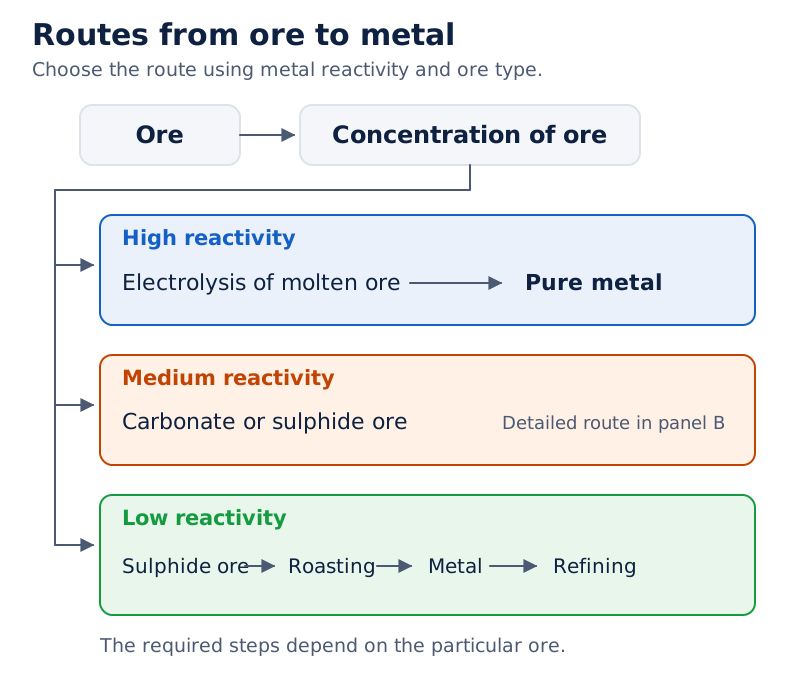
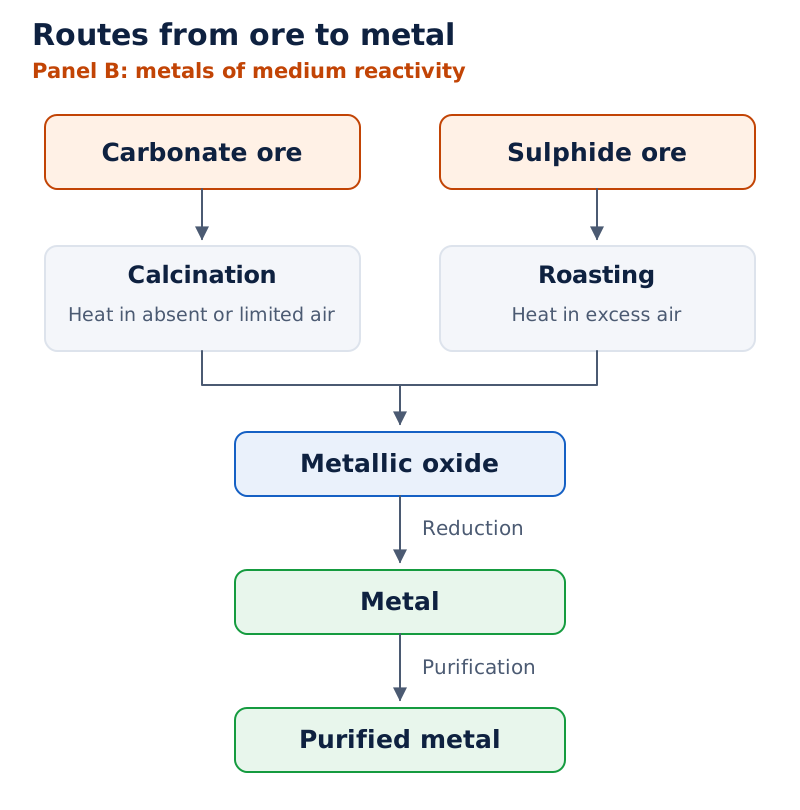
The flowchart starts with ore and concentration, then branches into metals of high, medium and low reactivity. The medium-reactivity branch shows carbonate ore undergoing calcination and sulphide ore undergoing roasting. Both lead to oxide, reduction and purification.
Drawn by One Young India.
What determines the route?
The reactivity of the metal and the chemical nature of its ore are central. First identify whether the ore is an oxide, sulphide or carbonate. Then consider whether its oxide can be reduced chemically or whether electrolytic reduction is required.
Concentration and refining also occur at different points. Concentration treats the ore before extraction; refining treats the metal after it has been obtained. Keeping this order clear prevents the common mistake of describing dressing as purification of an already extracted metal.
How do hydraulic washing, magnetic separation and froth flotation concentrate ores?
Concentration removes gangue by exploiting a difference between it and the useful mineral. A method succeeds because the two materials behave differently under the chosen conditions. The same method is therefore not suitable for every ore.
How does hydraulic washing work?
Hydraulic washing, or gravity separation, uses differences in density. Water carries away lighter gangue from crushed ore while the heavier ore particles remain or settle. The process separates materials physically; it does not reduce a metal compound to the metal.
The important condition is a useful density difference between the components. Crushing prepares the material for separation, while the water stream performs the washing. The collected heavier fraction is the concentrated ore.
How does magnetic separation work?
Magnetic separation is suitable when the ore and gangue differ in magnetic behaviour. Powdered material passes over a moving belt near a magnetic roller. The magnetic component is attracted more strongly, so the two components follow different paths and can be collected separately.
The magnetic fraction is not automatically the useful ore. The method can separate a magnetic ore from non-magnetic impurities, or magnetic impurities from a non-magnetic ore. The identity of the valuable component determines which fraction is retained.
How does froth flotation work?
Froth flotation is used to concentrate sulphide ores. It depends on differences in wetting: the sulphide particles are preferentially wetted by oil, while the gangue is wetted by water.
- Mix the powdered sulphide ore with water to form a suspension.
- Add the flotation reagents, including an oil such as pine oil in the school description.
- Agitate the mixture and pass air through it to form froth carrying the useful sulphide particles.
- Remove the mineral-rich froth and recover the concentrated ore from it; the water-wetted gangue remains behind.
| Method | Difference used | Essential distinction |
|---|---|---|
| Hydraulic washing | Density | Heavier ore is separated from lighter gangue. |
| Magnetic separation | Magnetic behaviour | One component responds more strongly to the magnet. |
| Froth flotation | Wetting by oil and water | Sulphide particles are collected with the froth. |
How do roasting and calcination differ?
Many moderately reactive metals are more easily obtained from their oxides than directly from their sulphides or carbonates. Concentrated ore is therefore often converted into an oxide before reduction. Roasting and calcination are two different ways of making this conversion.
In the equations that follow, → means “produces”. A number before a formula gives its stoichiometric coefficient, the relative number of formula units or molecules taking part. “On heating” states the reaction condition; it is not an extra reactant.
What happens during roasting?
Roasting means heating an ore strongly in excess air. A sulphide ore reacts with oxygen to form the metallic oxide, commonly releasing sulphur dioxide. For zinc sulphide, oxygen is written O₂ and sulphur dioxide is SO₂.
On strong heating in excess air: 2ZnS + 3O₂ → 2ZnO + 2SO₂.
The zinc remains combined with another element after this step. The product is zinc oxide, not zinc metal. Oxygen is a reactant in the equation, and the sulphur leaves in a gaseous oxide.
What happens during calcination?
Calcination means heating an ore strongly in the absence or a limited supply of air. Carbonate ores decompose to oxides and carbon dioxide, written CO₂. Hydrated ores can lose water, written H₂O.
On strong heating: ZnCO₃ → ZnO + CO₂.
For a hydrated oxide, the general dehydration can be written Al₂O₃·xH₂O → Al₂O₃ + xH₂O on heating. Here x represents the number of water units associated with each formula unit of aluminium oxide.
| Feature | Roasting | Calcination |
|---|---|---|
| Air supply | Excess air | Absent or limited air |
| Typical starting material | Sulphide ore | Carbonate or hydrated ore |
| Typical gaseous product | Sulphur dioxide from sulphides | Carbon dioxide or water vapour |
| Zinc example | Zinc sulphide becomes zinc oxide. | Zinc carbonate becomes zinc oxide. |
Note: Heating occurs in both processes. Distinguish them by the air supply, the starting compound and the chemical change, rather than by the word “heating” alone.
How are metallic oxides reduced to metals?
Reduction can be understood as removal of oxygen from a metal oxide. In electron terms, reduction means gain of electrons. A reducing agent brings about reduction of another substance and is itself oxidised.
Carbon, carbon monoxide and hydrogen can reduce suitable metallic oxides on heating. The agent must be chosen for the particular oxide and conditions. Their names are not a licence to assume that each can reduce every oxide.
What do the main reduction equations show?
In these equations, Cu means copper and Pb means lead. Hydrogen gas is H₂ and carbon monoxide is CO. Copper(II) oxide is CuO, lead(II) oxide is PbO, and iron(III) oxide is Fe₂O₃.
| Heated oxide and agent | Balanced equation | Meaning |
|---|---|---|
| Copper(II) oxide and hydrogen | CuO + H₂ → Cu + H₂O | The oxide loses oxygen; hydrogen forms water. |
| Lead(II) oxide and carbon | 2PbO + C → 2Pb + CO₂ | Carbon removes oxygen from the heated oxide. |
| Iron(III) oxide and carbon monoxide | Fe₂O₃ + 3CO → 2Fe + 3CO₂ | Carbon monoxide is oxidised to carbon dioxide. |
| Zinc oxide and carbon | ZnO + C → Zn + CO | Strong heating gives zinc and carbon monoxide. |
When heated copper(II) oxide reacts with hydrogen, its black solid changes to reddish-brown copper and water forms. The oxide is reduced, while hydrogen is oxidised. A complete explanation identifies both changes, not just the metal produced.
Can a more reactive metal act as the reducing agent?
Aluminium can remove oxygen from iron(III) oxide. Once initiated, this highly exothermic thermit reaction releases enough heat to produce molten iron: Fe₂O₃ + 2Al → 2Fe + Al₂O₃ + heat.
The reaction is used for joining railway tracks or cracked machine parts. Aluminium becomes aluminium oxide and is oxidised. Iron(III) oxide loses oxygen and is reduced. This illustrates obtaining a less reactive metal using a more reactive one.
Aluminium oxide and magnesium oxide are too stable for ordinary reduction with carbon. Their metals have a stronger affinity for oxygen than carbon does. The ability to reduce zinc oxide therefore cannot be extended to aluminium oxide simply because both are metallic oxides.
Why are highly reactive metals extracted by electrolysis?
Highly reactive metals hold oxygen strongly in their oxides. Ordinary heating with carbon does not release metals such as sodium, calcium, magnesium or aluminium from these oxides. Electrolytic reduction provides an alternative route using electrical energy.
An electrolyte conducts electricity through mobile ions and undergoes chemical decomposition during electrolysis. The negative electrode is the cathode, where reduction occurs. The positive electrode is the anode, where oxidation occurs.
What happens to the ions?
In a molten ionic compound, ions can move to the electrodes. Positive metal ions gain electrons at the cathode and form metal atoms. Negative ions move towards the anode, where oxidation takes place.
For molten sodium chloride, NaCl, the cathode change is Na⁺ + e⁻ → Na. Here Na⁺ is a sodium ion carrying one positive charge, and e⁻ represents one electron.
At the anode, 2Cl⁻ → Cl₂ + 2e⁻. Cl means chlorine, Cl⁻ is a chloride ion carrying one negative charge, and Cl₂ is chlorine gas. Electrons are gained at the cathode but released at the anode.
The same cathode principle applies to potassium and calcium ions: K⁺ + e⁻ → K and Ca²⁺ + 2e⁻ → Ca. K means potassium, Ca means calcium, and the superscript 2+ denotes a double positive charge.
What the figure shows
Reactivity and extraction route
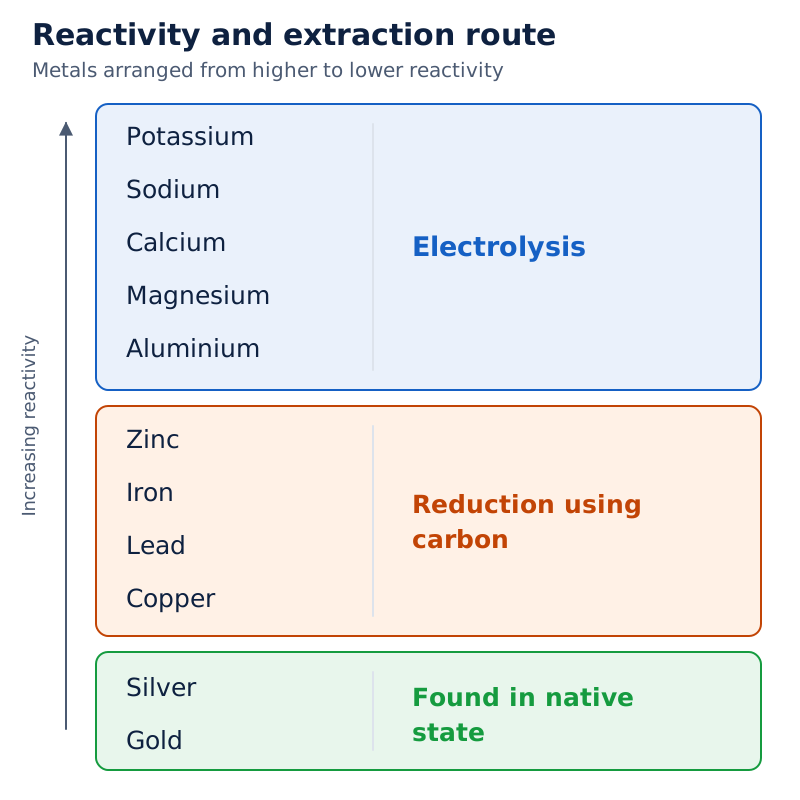
The vertical series shows potassium, sodium, calcium, magnesium and aluminium grouped with electrolysis; zinc, iron, lead and copper with reduction using carbon; and silver and gold with occurrence in the native state.
Drawn by One Young India.
Mg is the symbol for magnesium; its oxide is MgO. Magnesium and calcium can be obtained by electrolysis of molten chlorides. Aluminium is obtained from alumina in a molten electrolyte, with the bath composition chosen for its extraction.
Note: Molten and aqueous electrolytes are different. The molten-salt extraction described here must not be replaced by an aqueous salt solution while assuming that the same metal will be deposited.
How does Bayer's process purify bauxite?
Bayer's (Baeyer's) process chemically purifies bauxite to obtain alumina, aluminium oxide, Al₂O₃. This is the preparation stage before electrolytic extraction. It produces a purified compound, not aluminium metal.
Bauxite contains impurities such as iron(III) oxide and silica, silicon dioxide. Silica is SiO₂, where Si represents silicon. The useful aluminium compound is separated by its behaviour towards concentrated sodium hydroxide, NaOH.
What are the steps and equations?
- Digest the powdered bauxite: heat it with concentrated sodium hydroxide solution under pressure. The aluminium oxide dissolves, forming soluble sodium aluminate.
- Separate insoluble impurities: filter off the insoluble iron-rich residue, commonly called red mud.
- Precipitate aluminium hydroxide: dilute and cool the aluminate solution and seed it with aluminium hydroxide to promote precipitation.
- Obtain alumina: filter and strongly heat the aluminium hydroxide precipitate so that it loses water and leaves purified aluminium oxide.
A conventional school equation for dissolution is Al₂O₃ + 2NaOH → 2NaAlO₂ + H₂O. Sodium aluminate is represented here by NaAlO₂. The equation describes the oxide component of bauxite; associated water is omitted from this simplified step.
The simplified precipitation equation is NaAlO₂ + 2H₂O → Al(OH)₃ + NaOH. Aluminium hydroxide is Al(OH)₃. The brackets show that the hydroxide group, OH, occurs three times in this formula.
On strong heating, 2Al(OH)₃ → Al₂O₃ + 3H₂O. This final heating removes water and supplies alumina for the electrolytic cell. Sodium hydroxide participates in purification; it is not the reducing agent that liberates aluminium metal.
Why does selective dissolution matter?
Alumina is amphoteric, meaning that it can react with both acids and alkalis. Its reaction with sodium hydroxide allows it to enter solution while insoluble impurities can be separated. Silica can also react with alkali, so it is inaccurate to say that every impurity remains insoluble.
Keep the products in order: bauxite gives an aluminate solution, then aluminium hydroxide, then purified alumina. The metal appears only in the subsequent electrolytic process.
How does the Hall-Héroult process extract aluminium?
The Hall-Héroult process electrolyses alumina dissolved in a molten fluoride bath. The bath includes cryolite, Na₃AlF₆, and calcium fluoride, CaF₂, also called fluorspar. The additives help lower the working melting temperature and improve the conducting molten mixture.
Using pure alumina alone would require a much higher melting temperature. Dissolving it in the fluoride bath makes electrolysis more practical. Alumina remains the source of aluminium; cryolite and fluorspar assist the operation of the electrolyte.
What are the cell components?
| Component | Arrangement | Purpose |
|---|---|---|
| Steel vessel | Lined internally with carbon | Holds the molten contents; its carbon lining acts as cathode. |
| Graphite anodes | Dip into the electrolyte from above | Provide the positive electrode surfaces. |
| Molten electrolyte | Alumina dissolved in a fluoride bath | Provides mobile ions for electrolysis. |
| Molten aluminium | Collects beneath the electrolyte | Can be withdrawn from the cell. |
Diagram
Aluminium extraction cell
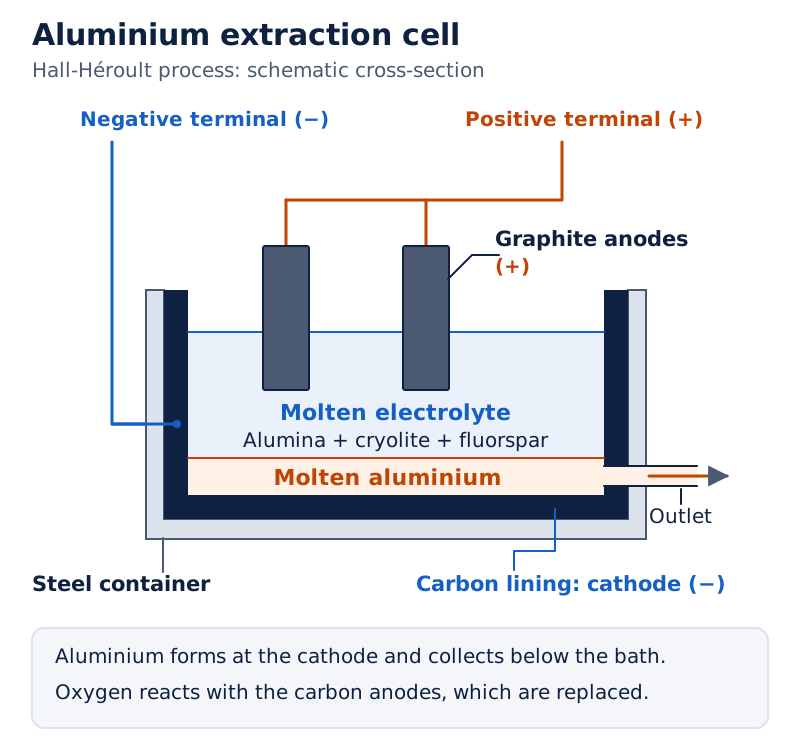
Draw a steel container with a carbon lining connected to the negative terminal. Show graphite anodes dipping into the molten electrolyte and connected to the positive terminal. Label alumina with cryolite and fluorspar in the bath, and molten aluminium collected at the bottom with an outlet.
Drawn by One Young India.
What reactions occur at the electrodes?
In the simplified ionic description, Al³⁺ represents an aluminium ion with three positive charges and O²⁻ an oxide ion with two negative charges. At the cathode, aluminium ions gain electrons: Al³⁺ + 3e⁻ → Al.
At the anode, oxide ions lose electrons: 2O²⁻ → O₂ + 4e⁻. The oxygen reacts with the hot carbon anodes. Carbon dioxide and carbon monoxide can form: C + O₂ → CO₂ and 2C + O₂ → 2CO.
The graphite anodes are therefore gradually consumed and need replacement. They are not inert supports. When carbon dioxide is the carbon-containing product, the overall reaction is 2Al₂O₃ + 3C → 4Al + 3CO₂.
Molten aluminium collects at the bottom and is tapped off. More alumina is supplied as it is consumed. Distinguish the two roles of carbon: the lining provides the cathode surface, while the anodes are oxidised during operation.
How do refining and alloying make metals useful?
Refining removes unwanted impurities from an extracted metal. Alloying deliberately mixes selected elements to obtain useful properties. A pure metal and an alloy are therefore different products, each chosen according to its intended use.
What is electrorefining?
In electrolytic refining, the impure metal is the anode and a thin strip of pure metal is the cathode. The electrolyte is a solution of a salt of that metal. Current transfers metal from the anode into solution and deposits pure metal at the cathode.
For copper, acidified copper sulphate solution is used. Soluble impurities enter the solution, while insoluble impurities collect beneath the anode as anode mud. This is purification of an extracted metal, not concentration of its ore.
What are alloys and amalgams?
An alloy is a homogeneous mixture of two or more metals, or a metal and a non-metal. It can be prepared by melting the main metal, adding other elements in chosen proportions and cooling the mixture. An alloy containing mercury is an amalgam.
Alloying can change hardness, strength, resistance to corrosion and melting behaviour. Stainless steel illustrates improved resistance to rusting. Solder illustrates the usefulness of a low melting point. Do not assume that every alloy improves every property of its main metal.
| Alloy | Constituent elements | Typical uses |
|---|---|---|
| Stainless steel | Iron, chromium, nickel and a small amount of carbon | Cutlery, utensils and surgical instruments |
| Magnalium | Aluminium and magnesium | Light scientific instruments and aircraft components |
| Duralumin | Aluminium, copper, magnesium and manganese | Aircraft structures |
| Brass | Copper and zinc | Utensils and musical instruments |
| Bronze | Copper and tin | Statues and medals |
| Soft solder or traditional tin-lead fuse alloy | Tin and lead | Soldering electrical connections; suitable low-melting compositions for fuse wire |
These names identify alloy families; constituent proportions can differ with the intended use. Brass contains zinc, whereas bronze contains tin. Neither should be confused with pure copper. Tin-lead solder is useful because it melts readily when joining electrical wires.
A familiar alloying example is jewellery gold. Pure gold is described as 24 carat and is soft. In 22-carat gold, 22 parts are gold and 2 parts are other metals, commonly copper or silver, which make it harder.
What does the Delhi iron pillar illustrate?
The iron pillar near the Qutub Minar in Delhi illustrates historical skill in producing rust-resistant iron. It is more than 1,600 years old, about 8 metres high and weighs 6 tonnes, or 6,000 kilograms. Its resistance to rusting has attracted scientific study.
This example does not mean ordinary iron cannot rust. Iron exposed to moist air develops rust, and protective treatments or suitable alloying help resist corrosion. The pillar is a particular example of metallurgical skill, not a property to assign to every iron object.
Glossary
- Metallurgy — The processes involved in extracting metals from ores and purifying the metals obtained.
- Mineral — An element or compound occurring naturally in the Earth's crust.
- Ore — A mineral from which a metal can be extracted profitably.
- Gangue — Unwanted earthy impurities, such as soil and sand, associated with an ore.
- Pulverisation — Crushing and grinding ore into smaller particles before further treatment.
- Concentration — Removal of gangue to increase the proportion of useful mineral in an ore.
- Roasting — Strong heating in excess air, commonly converting sulphide ores into metallic oxides.
- Calcination — Strong heating in absent or limited air to decompose carbonates or remove associated water.
- Reduction — Gain of electrons, or removal of oxygen from a substance in relevant reactions.
- Alumina — Aluminium oxide, the purified compound used as the aluminium source in electrolytic extraction.
- Cathode — The electrode at which reduction occurs; it is negative in an electrolytic cell.
- Anode — The electrode at which oxidation occurs; it is positive in an electrolytic cell.
- Refining — Removal of impurities from an extracted metal to improve its purity.
- Alloy — A homogeneous mixture of metals, or of a metal with a non-metal.
- Amalgam — An alloy in which mercury is one of the constituent metals.
Common errors and misconceptions
- Misconception: Every mineral containing a metal is an ore. Correct: An ore must permit profitable extraction of that metal.
- Misconception: Concentration produces pure metal. Correct: Concentration removes gangue; the metal-bearing compound still requires extraction.
- Misconception: Roasting and calcination are identical. Correct: Roasting uses excess air; calcination uses absent or limited air, with different starting compounds and changes.
- Misconception: Carbon reduces every metallic oxide. Correct: Aluminium oxide and magnesium oxide are not reduced by ordinary heating with carbon.
- Misconception: Bayer's process produces aluminium metal. Correct: It purifies bauxite to alumina, which is then electrolysed.
- Misconception: Cryolite replaces alumina as the aluminium feed. Correct: Alumina supplies the extracted aluminium; cryolite assists the molten electrolyte.
- Misconception: Graphite anodes remain unchanged during aluminium extraction. Correct: Oxygen reacts with their carbon, so the anodes are consumed and replaced.
- Misconception: Bronze contains copper and zinc. Correct: Brass contains copper and zinc; bronze contains copper and tin.
Exam-style questions with model answers
Q1. Define an ore and gangue, and state which is removed during concentration. [2 marks]
- An ore is a mineral from which a metal can be extracted profitably.
- Gangue is unwanted earthy material associated with the ore. Concentration removes this gangue, rather than removing the useful metal compound.
Q2. Zinc sulphide, ZnS, is heated in excess oxygen, O₂, to form zinc oxide, ZnO, and sulphur dioxide, SO₂. Zinc carbonate, ZnCO₃, gives ZnO and carbon dioxide, CO₂, on heating in limited air. Name and distinguish the processes, and write their balanced equations. [4 marks]
- The sulphide undergoes roasting, which means strong heating in excess air to convert the sulphide into an oxide.
- Its balanced equation is 2ZnS + 3O₂ → 2ZnO + 2SO₂, on heating.
- The carbonate undergoes calcination, involving strong heating in absent or limited air. Its equation is ZnCO₃ → ZnO + CO₂.
- Roasting consumes oxygen in this example; carbonate calcination releases carbon dioxide without oxygen as a reactant. Both produce zinc oxide, which still needs reduction to obtain zinc metal.
Q3. Explain how hydraulic washing, magnetic separation and froth flotation separate useful ore particles from gangue. State the property used by each method. [3 marks]
- Hydraulic washing uses a density difference. A water stream carries away lighter gangue while the heavier ore is retained or settles.
- Magnetic separation uses different magnetic responses. One component is attracted more strongly by a magnetic roller and follows a different path from the other.
- Froth flotation uses different wetting behaviour. Oil-wetted sulphide particles are carried by froth, while water-wetted gangue remains behind. The useful froth is collected to recover concentrated ore.
Q4. Describe purification of bauxite by Bayer's process. Use the simplified formulas Al₂O₃ for alumina, NaOH for sodium hydroxide, NaAlO₂ for sodium aluminate, Al(OH)₃ for aluminium hydroxide and H₂O for water. Include the three main equations and identify the final product. [5 marks]
- Powdered bauxite is heated with concentrated sodium hydroxide under pressure. Its aluminium oxide component dissolves as sodium aluminate: Al₂O₃ + 2NaOH → 2NaAlO₂ + H₂O.
- Insoluble iron-rich impurities are filtered off as red mud. This separates them from the solution containing the useful aluminium compound.
- The solution is diluted, cooled and seeded with aluminium hydroxide to encourage precipitation. The simplified equation is NaAlO₂ + 2H₂O → Al(OH)₃ + NaOH.
- The precipitated hydroxide is filtered and strongly heated: 2Al(OH)₃ → Al₂O₃ + 3H₂O.
- The product is purified alumina. No aluminium metal is formed during these purification stages; the alumina is subsequently used in electrolytic extraction.
Q5. Describe the Hall-Héroult cell and explain the roles of alumina, cryolite, fluorspar and carbon electrodes. Using Al³⁺ for aluminium ions, O²⁻ for oxide ions and e⁻ for electrons, give both electrode equations and explain anode replacement. [5 marks]
- The cell is a steel vessel lined with carbon. The carbon lining is the negative cathode, while graphite anodes connected to the positive terminal dip into the molten electrolyte.
- Alumina supplies the aluminium. Cryolite and fluorspar help form a conducting bath at a lower melting temperature than pure alumina.
- At the cathode, aluminium ions gain electrons: Al³⁺ + 3e⁻ → Al. Molten aluminium collects at the bottom and is withdrawn.
- At the anode, oxide ions lose electrons: 2O²⁻ → O₂ + 4e⁻.
- The oxygen reacts with hot carbon to form carbon dioxide and carbon monoxide. This consumes the graphite anodes, so they need replacement during operation.
Q6. Heated copper(II) oxide, CuO, reacts with hydrogen, H₂, forming copper, Cu, and water, H₂O. Write the equation, identify what is oxidised and reduced, and explain why carbon cannot similarly extract aluminium from aluminium oxide. [3 marks]
- The equation is CuO + H₂ → Cu + H₂O, on heating. Copper(II) oxide loses oxygen and is reduced to copper.
- Hydrogen gains oxygen to form water and is oxidised. It is the reducing agent because it removes oxygen from copper(II) oxide.
- Aluminium has a stronger affinity for oxygen than carbon. Its oxide cannot be reduced by ordinary heating with carbon, so aluminium is obtained by electrolytic reduction instead.
Q7. Give the constituent elements and one use each of brass, bronze, duralumin and solder. Explain why solder's melting behaviour is useful for its stated purpose. [4 marks]
- Brass contains copper and zinc and is used in musical instruments.
- Bronze contains copper and tin and is used for statues.
- Duralumin contains aluminium, copper, magnesium and manganese and is used for aircraft structures.
- Traditional soft solder contains tin and lead and is used to join electrical wires. Its low melting point allows it to melt readily during soldering and then solidify at the connection. The compositions of brass and bronze must not be interchanged.
Q8. Distinguish concentration, reduction, refining and alloying. Explain why Bayer's process and the Hall-Héroult process are separate stages, naming the product of each. [5 marks]
- Concentration removes gangue from an ore, increasing its useful mineral content. It does not by itself free the metal from its compound.
- Reduction obtains metal from a compound by removal of oxygen or gain of electrons, depending on the description used.
- Refining removes unwanted impurities from the metal already obtained. Electrolytic refining is one method of doing this.
- Alloying deliberately combines selected elements to alter properties. An alloy is not simply an impure metal awaiting refining.
- Bayer's process purifies bauxite to aluminium oxide, called alumina. The Hall-Héroult process electrolytically reduces alumina to aluminium metal. The first supplies the purified compound required for the second; their products and purposes are different.
Key takeaways
- Minerals become useful ores when their metals can be extracted profitably; gangue is the unwanted material removed during concentration.
- Choose an ore-dressing method using differences in density, magnetic behaviour or wetting between the ore and its gangue.
- Roasting converts sulphides into oxides in excess air, while calcination decomposes carbonates or removes water with absent or limited air.
- Carbon, carbon monoxide and hydrogen reduce suitable oxides; highly reactive metals require an appropriate electrolytic extraction route.
- Bayer's process purifies bauxite through an aluminate solution and aluminium hydroxide to obtain alumina for electrolysis.
- The Hall-Héroult process uses a molten fluoride bath, a carbon cathode lining and graphite anodes that are gradually consumed.
- Refining removes impurities from metal; alloying deliberately changes composition to provide useful properties for particular applications.
- Learn alloy constituents with their uses, especially brass versus bronze, and remember that an amalgam contains mercury.
Test yourself
Why does concentrating an ore not necessarily produce a metal?
Concentration removes gangue. The metal usually remains chemically combined in the useful mineral and still needs extraction.
Which zinc ores illustrate roasting and calcination?
Zinc blende undergoes roasting to zinc oxide; calamine undergoes calcination to zinc oxide with carbon dioxide released.
What separates hydraulic washing from froth flotation?
Hydraulic washing uses density differences, while froth flotation uses differences in wetting by oil and water.
What does Bayer's process produce before electrolysis?
It produces purified alumina, aluminium oxide, after precipitation and heating of aluminium hydroxide.
Why must graphite anodes be replaced during aluminium extraction?
Oxygen formed at the anodes reacts with their carbon, producing carbon oxides and gradually consuming the graphite.
Where is aluminium formed in its electrolytic cell?
Aluminium forms at the negative cathode by gain of electrons and collects as molten metal beneath the electrolyte.
How do brass and bronze differ in composition?
Both contain copper. Brass contains zinc as its other principal constituent, whereas bronze contains tin.
What distinguishes an amalgam from the general class of alloys?
An amalgam is specifically an alloy containing mercury as one of its constituent metals.
Try it
ICSE Class 10 Chemistry: Complete Conceptual Guide to Metallurgy
Test your metallurgical decision-making skills through this 2-step extraction scenario.
1You are overseeing a smelting operation where the ore is contaminated with non-fusible acidic silica (SiO2) gangue. To remove this impurity as an easily fusible slag, which flux must you add?
According to the text, basic fluxes like limestone (CaCO3) or magnesite (MgCO3) are added to combine with acidic gangue such as SiO2, forming an easily fusible waste slag like calcium silicate (CaSiO3).
Silica (SiO2) is an acidic flux used to remove basic impurities like FeO or CaO. Because the gangue here is already acidic SiO2, adding an acidic flux will not neutralize it to form slag.
Cryolite and fluorspar are used in the Hall-Héroult electrolytic reduction to lower the melting point of alumina and enhance electrical conductivity, not as fluxes to remove gangue during smelting.
2In the Hall-Héroult electrolytic cell for extracting aluminium, the suspended carbon anode rods are continually depleted and require periodic replacement. What causes this loss?
At the anode, oxidation of oxygen ions releases O2 gas (2O2- - 4e- → O2), which attacks the carbon anode rods at 950°C (C + O2 → CO2 and 2C + O2 → 2CO), burning them away.
Molten aluminium is produced at the cathode (reduction: Al3+ + 3e- → Al), not at the anode, and it sinks to the bottom of the cell because it is denser than the electrolyte.
The layer of powdered coke is sprinkled on the surface to reduce heat loss via radiation and protect the anodes from burning in atmospheric air, not to degrade them.
Understanding gangue-flux chemistry and electrolytic cell dynamics ensures successful extraction and operational maintenance in industrial metallurgy.