
Organic Chemistry | ICSE Class 10 Chemistry Notes
On this page
Try an idea before you read. Explore key laboratory preparations and reaction conditions in organic chemistry through this 2-step interactive scenario. Explore →
Learnacy Labs Try it hands-on: open the Organic Chemistry lab
This note covers carbon bonding, chains and rings, hydrocarbon structures, homologous series, structural isomerism, organic nomenclature, preparation and reactions of methane, ethane, ethene and ethyne, and the properties and uses of ethanol and ethanoic acid.
Why does carbon form so many organic compounds?
Tetravalency and shared electrons
Organic chemistry studies carbon compounds, with conventional exceptions such as carbon oxides, carbides, carbonates and hydrogencarbonates. Carbon compounds were once thought to require a living system for their formation. Friedrich Wöhler disproved this idea in 1828 by preparing urea from ammonium cyanate.
Carbon has atomic number six and four electrons in its outermost shell. Its combining capacity, or valency, is four: this is tetravalency. Gaining or losing four electrons is energetically difficult, so carbon commonly completes its outer shell by sharing electrons.
Definition: A covalent bond is formed when two atoms share a pair of electrons. A single, double or triple bond contains one, two or three shared pairs respectively.
In formulae, C means carbon and H means hydrogen. A small subscript counts atoms: CH₄ contains one carbon atom and four hydrogen atoms. Lines between atoms represent bonds; a double line represents a double bond, and ≡ represents a triple bond.
In methane, carbon shares one electron pair with each of four hydrogen atoms. Each hydrogen completes a two-electron shell, while carbon has eight electrons in its outer shell when shared electrons are counted.
What the figure shows
Electron sharing in methane
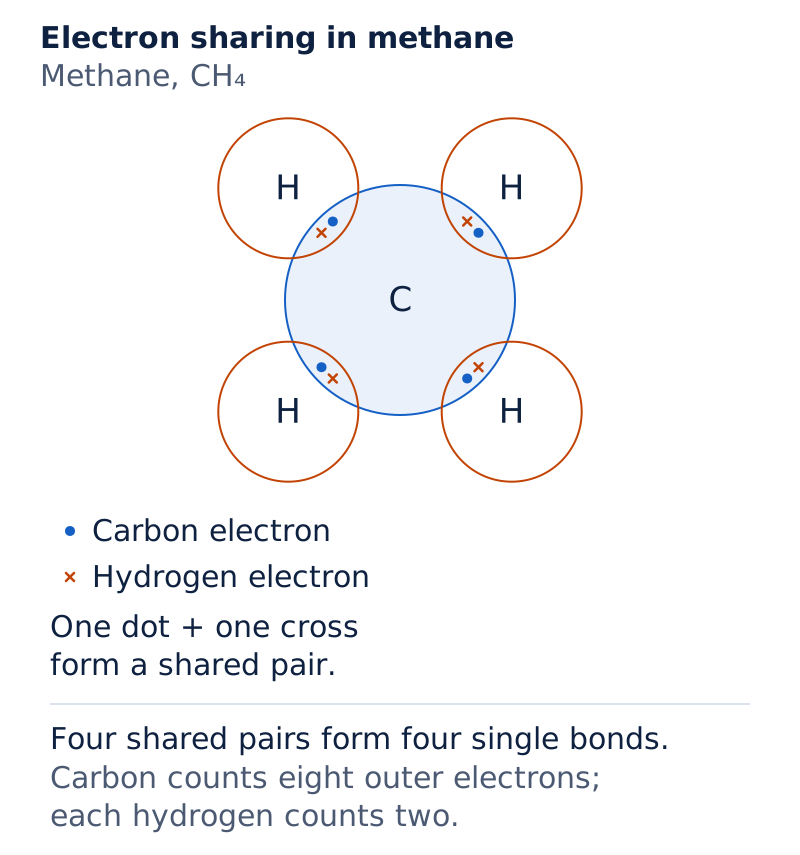
A central carbon is surrounded by four hydrogen atoms. Each overlap contains one dot and one cross, showing a shared electron pair between carbon and hydrogen.
Drawn by One Young India.
Catenation and molecular properties
Catenation is the ability of an element to bond with its own atoms. Strong carbon-carbon bonds allow long chains, branches and rings. Carbon also bonds with hydrogen, oxygen and other elements, producing many different compounds.
Covalent bonds within molecules are strong, but attractions between many small carbon-compound molecules are relatively weak. Such substances often have low melting and boiling points. They are generally poor electrical conductors because their molecules do not provide freely moving ions.
How are hydrocarbons and homologous series classified?
Hydrocarbons contain carbon and hydrogen only. Open-chain hydrocarbons may be straight or branched. A saturated hydrocarbon has only single carbon-carbon bonds; an unsaturated hydrocarbon contains a carbon-carbon double or triple bond.
The three open-chain families
In the general formulae below, n is the number of carbon atoms in one molecule. These formulae apply to open-chain alkanes, alkenes with one double bond, and alkynes with one triple bond. They should not be applied indiscriminately to every cyclic compound.
| Family | Carbon-carbon bonding | General formula | First member |
|---|---|---|---|
| Alkanes | Single bonds | CₙH₂ₙ₊₂ | Methane, CH₄; n begins at 1 |
| Alkenes | One double bond | CₙH₂ₙ | Ethene, C₂H₄; n begins at 2 for stable members |
| Alkynes | One triple bond | CₙH₂ₙ₋₂ | Ethyne, C₂H₂; n begins at 2 |
A homologous series is a family with the same characteristic functional group or bonding pattern and a common general formula. Successive members differ by one CH₂ unit and show similar chemical reactions. Their physical properties change progressively as molecular size increases.
For example, methane, ethane and propane have formulae CH₄, C₂H₆ and C₃H₈. Each successive formula adds one carbon and two hydrogen atoms. Boiling points generally rise along a homologous series as molecular mass increases; physical properties need not be identical.
Worked example 1. Calculate the molecular-mass differences for methane and ethane, ethane and propane, and propane and butane. Use atomic masses: carbon, 12 u; hydrogen, 1 u. The symbol u denotes the unified atomic mass unit.
Answer: Multiply each atomic mass by the number of atoms of that element, then add. Here denotes the molecular mass of the compound indicated in brackets.
Compound Molecular-mass calculation Methane, CH₄ Ethane, C₂H₆ Propane, C₃H₈ Butane, C₄H₁₀ Subtract the smaller molecular mass from the larger for each pair: methane to ethane, ; ethane to propane, ; propane to butane, .
Each successive formula adds one carbon and two hydrogen atoms. This CH₂ increment has mass , explaining the equal differences.
Members of a series should therefore be compared in two ways: their common chemical behaviour reflects their shared characteristic group, while the changing chain length explains the gradation in physical properties.
How are hydrocarbon structures written up to five carbon atoms?
Build the carbon skeleton first
A molecular formula gives the number of each kind of atom. A structural formula also shows how those atoms are connected. When writing structures, satisfy carbon's valency of four and hydrogen's valency of one at every position.
- Join the required carbon atoms to make the carbon skeleton.
- Insert the stated double or triple bond at its specified position.
- Add enough hydrogen atoms to complete four bonds at every carbon.
- Count all atoms and compare the result with the molecular formula.
The following condensed structural formulae show the unbranched members. A CH₃ group contains three hydrogens attached to that carbon; CH₂ contains two. Parentheses, used later for branches, identify groups attached to the preceding carbon.
| Carbon atoms | Alkane | Alkene with terminal double bond | Alkyne with terminal triple bond |
|---|---|---|---|
| 1 | Methane: CH₄ | No stable one-carbon member | No one-carbon member |
| 2 | Ethane: CH₃-CH₃ | Ethene: CH₂=CH₂ | Ethyne: HC≡CH |
| 3 | Propane: CH₃-CH₂-CH₃ | Propene: CH₂=CH-CH₃ | Propyne: HC≡C-CH₃ |
| 4 | Butane: CH₃-CH₂-CH₂-CH₃ | But-1-ene: CH₂=CH-CH₂-CH₃ | But-1-yne: HC≡C-CH₂-CH₃ |
| 5 | Pentane: CH₃-CH₂-CH₂-CH₂-CH₃ | Pent-1-ene: CH₂=CH-CH₂-CH₂-CH₃ | Pent-1-yne: HC≡C-CH₂-CH₂-CH₃ |
In ethane each carbon makes one bond with the other carbon and three with hydrogen. In ethene each carbon makes a double bond with the other carbon and two single bonds with hydrogen. In ethyne each carbon makes a triple bond and one carbon-hydrogen bond.
What the figure shows
Building ethane
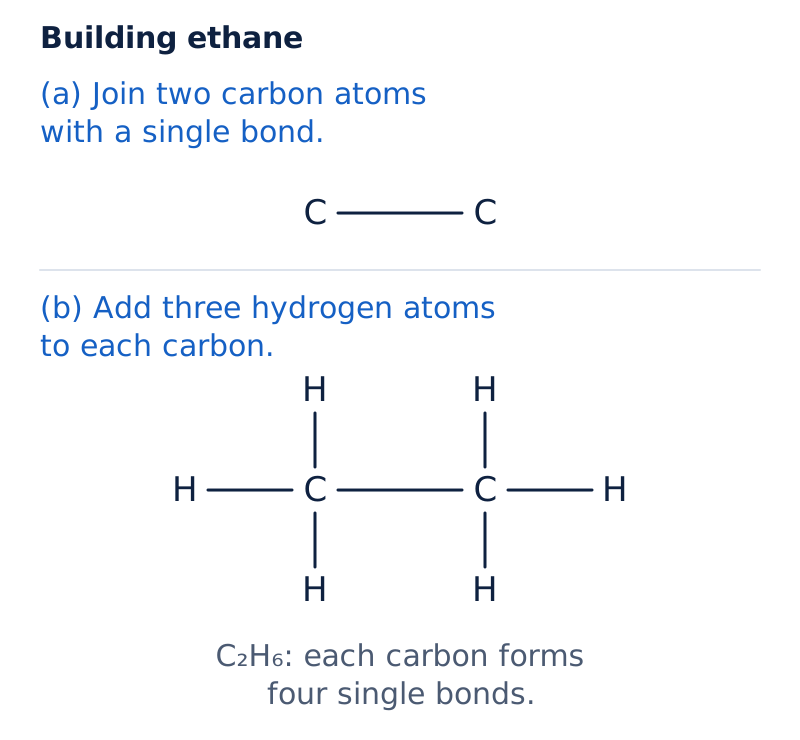
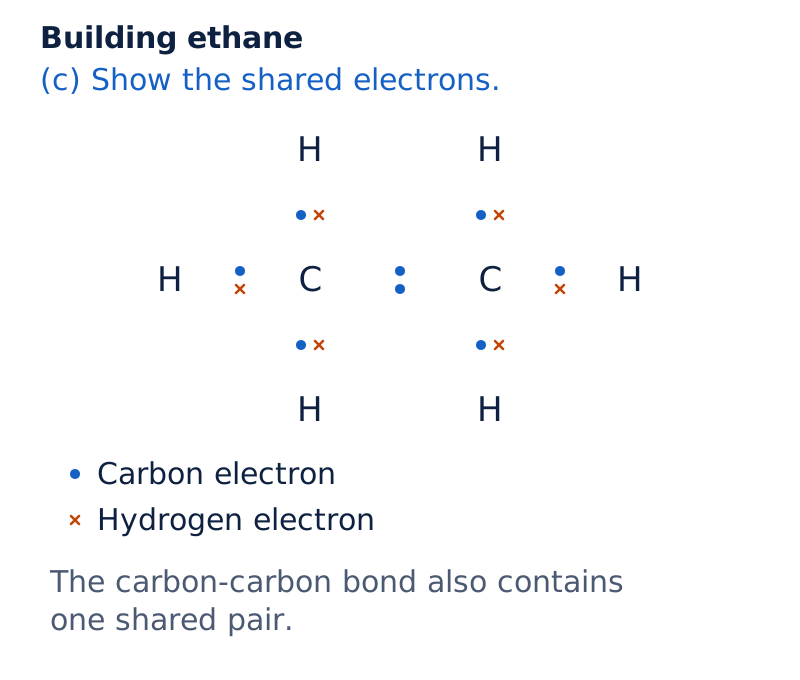
Part (a) joins two carbon atoms by a single bond. Part (b) adds three hydrogens to each carbon. Part (c) shows electron sharing, including the shared pair between the carbons.
Drawn by One Young India.
Derivation: The structure of ethane from carbon's valency
- Start with the molecular formula C₂H₆ and join the two carbon atoms with a single bond.
- The single bond satisfies one of the four valencies of each carbon. Three valencies on each carbon remain available for hydrogen atoms.
- Attach three hydrogen atoms to each carbon. The resulting molecule contains two carbon atoms and six hydrogen atoms, with all valencies satisfied by single bonds.
Result: Ethane has the condensed structure . Each carbon forms four bonds and each hydrogen forms one, so ethane is a saturated hydrocarbon.
Derivation: Why ethene needs a double bond
- Start with the molecular formula C₂H₄ and link the two carbon atoms with a single bond.
- Attach two hydrogen atoms to each carbon. Each carbon now has three bonds, leaving one valency on each carbon unsatisfied.
- Satisfy those remaining valencies by adding a second bond between the carbon atoms. Each carbon then has two bonds to hydrogen and a double bond to the other carbon.
Result: Ethene has the condensed structure . Its carbon-carbon double bond makes it an unsaturated hydrocarbon.
The benzene ring
Benzene, C₆H₆, is a cyclic hydrocarbon. Its conventional structural drawing uses a six-carbon ring with alternating single and double bonds and one hydrogen attached to each carbon. It is an aromatic compound, distinct from the open-chain alkene series.
What the figure shows
Benzene structure
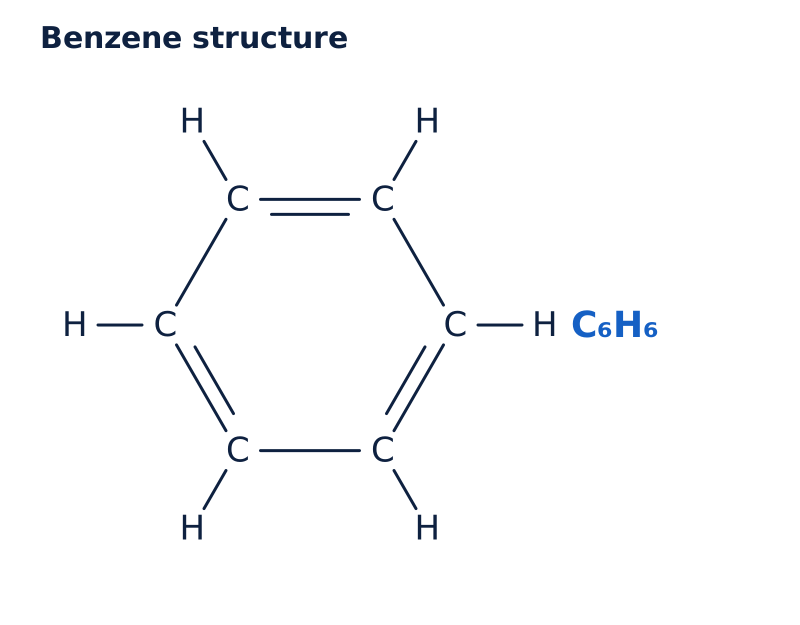
Six labelled carbon atoms form a ring with alternating single and double bonds. Each carbon carries one outward-facing hydrogen. The adjacent molecular formula is C₆H₆.
Drawn by One Young India.
How do chain and position isomerism differ?
Structural isomers have the same molecular formula but different arrangements of bonds between atoms. They are different compounds. Merely reversing a structural formula on the page does not make a new isomer: the connectivity must change.
Chain isomerism
In chain isomerism, the arrangement of the carbon skeleton changes. Butane has two chain isomers: straight-chain butane, CH₃CH₂CH₂CH₃, and branched 2-methylpropane, CH₃CH(CH₃)CH₃. Both contain four carbons and ten hydrogens.
| Formula | Isomer | Condensed structure |
|---|---|---|
| C₅H₁₂ | Pentane | CH₃CH₂CH₂CH₂CH₃ |
| C₅H₁₂ | 2-Methylbutane, or isopentane | CH₃CH(CH₃)CH₂CH₃ |
| C₅H₁₂ | 2,2-Dimethylpropane, or neopentane | CH₃C(CH₃)₂CH₃ |
Position isomerism
In position isomerism, the carbon skeleton remains the same but a multiple bond or functional group occupies a different position. But-1-ene, CH₂=CHCH₂CH₃, and but-2-ene, CH₃CH=CHCH₃, are position isomers. Each has formula C₄H₈.
The third open-chain structural alkene isomer of C₄H₈ is 2-methylprop-1-ene, CH₂=C(CH₃)₂. It has a branched skeleton, so it shows chain isomerism with either unbranched butene. Do not count different spatial arrangements when asked specifically for structural isomers.
Worked example 2. Write all open-chain structural alkene isomers of C₅H₁₀, with one double bond.
Answer: The five are pent-1-ene, CH₂=CHCH₂CH₂CH₃; pent-2-ene, CH₃CH=CHCH₂CH₃; 2-methylbut-1-ene, CH₂=C(CH₃)CH₂CH₃; 3-methylbut-1-ene, CH₂=CHCH(CH₃)CH₃; and 2-methylbut-2-ene, CH₃C(CH₃)=CHCH₃.
For alkynes, C₄H₆ gives but-1-yne, HC≡CCH₂CH₃, and but-2-yne, CH₃C≡CCH₃. The three C₅H₈ structures are pent-1-yne, HC≡CCH₂CH₂CH₃; pent-2-yne, CH₃C≡CCH₂CH₃; and 3-methylbut-1-yne, HC≡CCH(CH₃)CH₃.
To check an isomer list, count carbons, count hydrogens, verify four bonds at each carbon, and look for duplicate connectivities. These checks prevent a branch from accidentally creating an extra carbon or an impossible carbon valency.
How are simple organic compounds named?
IUPAC means International Union of Pure and Applied Chemistry. Systematic names identify the parent chain, its characteristic bonds or functional group, and the positions of branches. Common or trivial names are also widely used for familiar compounds.
Choosing and numbering the parent chain
- Select the longest carbon chain containing the relevant functional group or multiple bond.
- Number it from the end giving that group or multiple bond the lowest possible number.
- Identify branches such as methyl, CH₃-, and state their positions. For alkanes, give branches the lowest possible numbers.
- Combine the chain name with the required prefix or suffix. Use commas between numbers and hyphens between numbers and words.
The roots meth-, eth-, prop-, but- and pent- indicate one to five carbons. The endings -ane, -ene and -yne indicate alkane, alkene and alkyne respectively. Thus CH₃CH=CHCH₃ is but-2-ene, not but-3-ene.
Recognising functional groups
A functional group is the atom or group responsible for characteristic reactions. Here O denotes oxygen, Cl chlorine, Br bromine and I iodine. In the table, R and R′ stand for alkyl groups; X stands for a halogen atom.
| Class and group | Naming pattern | Example |
|---|---|---|
| Halide: R-X | Chloro-, bromo- or iodo- prefix | CH₃CH₂Br: bromoethane, ethyl bromide |
| Alcohol: R-OH | -ol | CH₃CH₂OH: ethanol, ethyl alcohol |
| Aldehyde: R-CHO | -al | CH₃CHO: ethanal, acetaldehyde |
| Ketone: R-C(=O)-R′ | -one | CH₃COCH₃: propanone, acetone |
| Carboxylic acid: R-COOH | -oic acid | CH₃COOH: ethanoic acid, acetic acid |
| Ether: R-O-R′ | Alkoxyalkane | CH₃OCH₃: methoxymethane, dimethyl ether |
| Ester: R-C(=O)-O-R′ | Alkyl alkanoate | CH₃COOCH₂CH₃: ethyl ethanoate, ethyl acetate |
An aldehyde has a terminal -CHO group, while a ketone has a carbonyl carbon bonded to two carbon groups. An ether has an oxygen linking carbon groups; an ester additionally contains a carbonyl group, C=O, next to that oxygen.
For an ester, name the alkyl group attached through oxygen first, then the acid-derived part. In ethyl ethanoate, the ethyl group comes from ethanol and the ethanoate part from ethanoic acid. The carbon of -COOH belongs to the acid's parent chain.
Worked example 3. Name the three-carbon compound CH₃COCH₃.
Answer: The parent chain has three carbons and the functional group is a ketone. Replace the final e of propane with -one to obtain propanone. Its common name is acetone.
How are methane and ethane prepared?
Heating sodium salts with soda lime
Soda lime is a mixture of sodium hydroxide and calcium oxide. Here Na denotes sodium and Ca calcium. On heating a sodium carboxylate with soda lime, an alkane with one fewer carbon atom than the original acid is formed.
This process is decarboxylation. Sodium ethanoate, also called sodium acetate, produces methane. Sodium propanoate, also called sodium propionate, produces ethane. Calcium oxide is part of the soda-lime mixture, while sodium hydroxide appears in the balanced equation.
CH₃COONa + NaOH → CH₄ + Na₂CO₃
Condition: heat with soda lime. Products: methane and sodium carbonate.
CH₃CH₂COONa + NaOH → CH₃CH₃ + Na₂CO₃
Condition: heat with soda lime. Products: ethane and sodium carbonate.
The carboxyl carbon enters the carbonate product, so the organic product has a shorter chain. Sodium ethanoate has two carbon atoms, but the methane formed has one. This carbon count is a useful check when choosing a starting salt.
Reducing alkyl halides
Reduction of an alkyl halide replaces its halogen atom with hydrogen without changing the carbon skeleton. Zinc and dilute hydrochloric acid provide the reducing conditions. Iodomethane, or methyl iodide, gives methane; bromoethane, or ethyl bromide, gives ethane.
In the equations below, [H] means a reducing hydrogen equivalent; 2[H] indicates the hydrogen required for the net change, not a separately isolated substance.
CH₃I + 2[H] → CH₄ + HI
Conditions: zinc and dilute hydrochloric acid. HI is hydrogen iodide.
CH₃CH₂Br + 2[H] → CH₃CH₃ + HBr
Conditions: zinc and dilute hydrochloric acid. HBr is hydrogen bromide.
Note: Reduction and carbon-chain coupling are different reactions. Reducing bromoethane gives ethane. Treating bromoethane with sodium in dry ether joins two ethyl groups and gives butane.
Compare the starting materials before selecting a method: decarboxylation removes one carbon from the acid-derived chain, whereas reduction of an alkyl halide retains the original number of carbon atoms.
How do methane and ethane burn and react with chlorine?
Complete and incomplete combustion
Combustion is burning in oxygen with release of heat. With sufficient oxygen, methane and ethane form carbon dioxide and water. In the equations, O₂ is oxygen gas, CO₂ carbon dioxide, H₂O water and CO carbon monoxide.
| Fuel | Oxygen supply | Balanced equation |
|---|---|---|
| Methane | Sufficient for complete combustion | CH₄ + 2O₂ → CO₂ + 2H₂O |
| Ethane | Sufficient for complete combustion | 2C₂H₆ + 7O₂ → 4CO₂ + 6H₂O |
| Methane | Limited, giving carbon monoxide | 2CH₄ + 3O₂ → 2CO + 4H₂O |
| Ethane | Limited, giving carbon monoxide | 2C₂H₆ + 5O₂ → 4CO + 6H₂O |
| Methane | Insufficient, giving soot | CH₄ + O₂ → C + 2H₂O |
| Ethane | Insufficient, giving soot | 2C₂H₆ + 3O₂ → 4C + 6H₂O |
Incomplete combustion can produce carbon monoxide or deposited carbon, called soot. These equations represent possible outcomes, not a claim that every oxygen-limited flame gives one pure product. Even saturated hydrocarbons can give a smoky flame when the air supply is restricted.
Methane and ethane can serve as fuels because their combustion releases heat. Methane is a major component of natural gas and biogas. It is also a greenhouse gas. Methane is used as a starting material for industrial hydrogen production.
Substitution by chlorine
In a substitution reaction, an atom or group replaces another. In diffused sunlight or ultraviolet light, chlorine replaces hydrogen in methane or ethane. Cl₂ means chlorine gas, and HCl is hydrogen chloride.
- CH₄ + Cl₂ → CH₃Cl + HCl: chloromethane forms.
- CH₃Cl + Cl₂ → CH₂Cl₂ + HCl: dichloromethane forms.
- CH₂Cl₂ + Cl₂ → CHCl₃ + HCl: trichloromethane, or chloroform, forms.
- CHCl₃ + Cl₂ → CCl₄ + HCl: tetrachloromethane, or carbon tetrachloride, forms.
Each step requires the stated light condition. Continued substitution replaces the four hydrogens successively. The carbon skeleton stays intact, unlike a reaction that breaks the molecule into smaller carbon compounds.
For ethane, the first substitution is CH₃CH₃ + Cl₂ → CH₃CH₂Cl + HCl, in diffused sunlight. The organic product is chloroethane. Further substitution is possible, so the first equation should not imply that prolonged chlorination produces only that compound.
How is ethene prepared, and why do conditions matter?
Ethene, also called ethylene, is CH₂=CH₂. It is a colourless gas with a faint sweet smell. Its double bond makes addition reactions possible. Two important preparations remove atoms from neighbouring carbons so that a double bond forms.
Dehydration of ethanol
Dehydration means removal of water. Heat ethanol with excess concentrated sulphuric acid at 443 K; K is kelvin, the unit of thermodynamic temperature. Sulphuric acid, H₂SO₄, acts as a dehydrating agent; S denotes sulphur.
CH₃CH₂OH → CH₂=CH₂ + H₂O
Conditions: excess concentrated sulphuric acid at 443 K.
The two-carbon skeleton remains, but the loss of water changes an alcohol into an unsaturated hydrocarbon. The reaction condition is part of the chemical information: writing ethanol on the left without specifying the reagent and heating is incomplete.
Dehydrohalogenation of bromoethane
Dehydrohalogenation removes a hydrogen atom and a halogen atom from adjacent carbons. Heat bromoethane with alcoholic potassium hydroxide, meaning potassium hydroxide dissolved in alcohol. In chemical formulae K denotes potassium, distinct from K written after a temperature.
CH₃CH₂Br + KOH → CH₂=CH₂ + KBr + H₂O
Conditions: alcoholic potassium hydroxide and heat. KBr is potassium bromide.
The net elimination removes the elements of hydrogen bromide from bromoethane. Potassium hydroxide supplies the base, and potassium bromide and water appear among the products. The carbon count remains two on both sides.
| Reagent used with bromoethane | Main change | Organic product |
|---|---|---|
| Hot alcoholic potassium hydroxide | Elimination of hydrogen and bromine | Ethene |
| Aqueous potassium hydroxide | Replacement of bromine by a hydroxyl group | Ethanol |
Ethene is a starting material for polythene manufacture and can be converted into ethanol. Its ability to undergo addition is central to these uses. The multiple bond, rather than merely its two-carbon formula, explains its characteristic reactivity.
How is ethyne prepared from calcium carbide and a dihalide?
Ethyne, commonly called acetylene, has structure HC≡CH. Each carbon shares three electron pairs with the other carbon and one pair with hydrogen. It is an unsaturated hydrocarbon with fewer hydrogen atoms than ethene or ethane.
Reaction of calcium carbide with water
Calcium carbide reacts with water to release ethyne. The second product is calcium hydroxide. The balanced equation identifies both the gas and the substance left in the reaction mixture.
CaC₂ + 2H₂O → C₂H₂ + Ca(OH)₂
CaC₂ is calcium carbide; Ca(OH)₂ is calcium hydroxide. Water is the reactant that converts the carbide into ethyne.
Count the atoms to check the equation: one calcium and two carbon atoms occur on each side. Four hydrogen atoms are divided between ethyne and calcium hydroxide. Both oxygen atoms remain in the hydroxide product.
Elimination from 1,2-dibromoethane
In 1,2-dibromoethane, also called ethylene dibromide, one bromine atom is attached to each carbon. Two successive eliminations can convert its single carbon-carbon bond into a triple bond. The intermediate still contains bromine and a double bond.
- Start with CH₂Br-CH₂Br, whose bromine atoms occupy neighbouring carbons.
- Use alcoholic potassium hydroxide for the first elimination: CH₂BrCH₂Br + KOH → CH₂=CHBr + KBr + H₂O.
- The intermediate CH₂=CHBr is bromoethene. Treat it with the stronger base sodamide, NaNH₂; N denotes nitrogen.
- The second elimination is CH₂=CHBr + NaNH₂ → HC≡CH + NaBr + NH₃. Sodium bromide and ammonia accompany ethyne.
Note: The second elimination from the double-bonded intermediate needs stronger conditions than the first. Do not assume that the same mild treatment of any halide must produce a triple bond.
Ethyne mixed with oxygen is used in the oxyacetylene flame for welding. Burning ethyne in air can give a sooty flame because combustion is incomplete. Alkynes also provide starting materials for making other organic compounds.
How do addition reactions distinguish ethene and ethyne?
In an addition reaction, atoms attach across a multiple bond. A double bond becomes a single bond after one addition step. A triple bond can undergo successive additions, first producing a double bond and then a single bond.
Hydrogenation
Hydrogenation adds hydrogen, H₂, in the presence of a suitable catalyst. Nickel, palladium or platinum may be used. Palladium and platinum can catalyse the reaction at room temperature; nickel generally requires higher temperature and pressure.
CH₂=CH₂ + H₂ → CH₃CH₃
Ethene gives ethane in the presence of a hydrogenation catalyst.
HC≡CH + 2H₂ → CH₃CH₃
Complete hydrogenation of ethyne uses two hydrogen molecules per ethyne molecule. The structural sequence passes through the ethene stage.
Addition of halogens
Chlorine and bromine add across the double bond of ethene. With ethyne, addition can proceed in two stages. The table gives condensed structures so that the changing bond and the placement of halogen atoms remain visible.
| Starting hydrocarbon | Addition equation | Product |
|---|---|---|
| Ethene | CH₂=CH₂ + Cl₂ → CH₂Cl-CH₂Cl | 1,2-Dichloroethane |
| Ethene | CH₂=CH₂ + Br₂ → CH₂Br-CH₂Br | 1,2-Dibromoethane |
| Ethyne, first bromine addition | HC≡CH + Br₂ → CHBr=CHBr | 1,2-Dibromoethene |
| Second bromine addition | CHBr=CHBr + Br₂ → CHBr₂-CHBr₂ | 1,1,2,2-Tetrabromoethane |
| Ethyne, complete chlorine addition | HC≡CH + 2Cl₂ → CHCl₂-CHCl₂ | 1,1,2,2-Tetrachloroethane |
Bromine solution loses its reddish-orange colour when bromine adds to the multiple bond. This provides a test for unsaturation. Use conditions that avoid initiating substitution in an alkane, so that the comparison actually tests addition.
Iodine, I₂, needs qualification. It does not add to alkenes under normal conditions. Therefore, the chlorine and bromine equations cannot simply be copied with iodine substituted as though the reaction occurred equally readily. Keep the reagent and conditions attached to each addition reaction.
How is ethanol prepared, and what are its properties and uses?
Preparation by hydrolysis
Ethanol, CH₃CH₂OH, contains an alcoholic hydroxyl group, -OH. It can be prepared by hydrolysis of an alkyl halide using aqueous alkali. Heating bromoethane with aqueous potassium hydroxide replaces bromine with a hydroxyl group.
CH₃CH₂Br + KOH → CH₃CH₂OH + KBr
Conditions: aqueous potassium hydroxide and heating. This is substitution, whereas hot alcoholic potassium hydroxide favours elimination to ethene.
Physical and chemical properties
Ethanol is a colourless liquid at room temperature, mixes with water in all proportions and is less dense than water. Its boiling point is approximately 351 K. Its ability to dissolve many substances makes it useful as a solvent.
| Reaction | Conditions and equation | Result |
|---|---|---|
| Combustion | Ignition with sufficient oxygen: C₂H₅OH + 3O₂ → 2CO₂ + 3H₂O | Carbon dioxide, water and released heat |
| Reaction with sodium | 2C₂H₅OH + 2Na → 2C₂H₅ONa + H₂ | Sodium ethoxide and hydrogen gas |
| Dehydration | Excess concentrated sulphuric acid at 443 K: C₂H₅OH → C₂H₄ + H₂O | Ethene and water |
| Ester formation | Warm with ethanoic acid and an acid catalyst | Ethyl ethanoate and water |
The sodium reaction shows that a hydrogen from the hydroxyl group is replaced by sodium. It does not mean that the whole hydroxyl group disappears. In dehydration, by contrast, water is removed and the product has a carbon-carbon double bond.
Uses and denatured spirit
Ethanol is used in medicines, including tincture of iodine and cough syrups, and as an industrial solvent. It is also used as a fuel or petrol additive and as a starting material for other carbon compounds.
Denatured alcohol is ethanol deliberately made unfit for drinking by additives. Methylated spirit is a denatured preparation containing methanol. Denaturation changes its suitability for consumption; it is not the same process as dehydration to ethene.
Spurious alcohol is adulterated alcohol sold as drinkable alcohol; it may contain poisonous methanol. Methanol poisoning can cause blindness or death. Denatured industrial spirit and spurious alcoholic drinks must not be confused with pure ethanol or with safe drinking products.
What are the properties and uses of ethanoic acid?
Structure, acidity and glacial acetic acid
Ethanoic acid, commonly called acetic acid, has the structure CH₃-C(=O)-OH, usually condensed to CH₃COOH. It is an aliphatic monocarboxylic acid: each molecule contains one carboxyl group, -COOH.
It is a colourless liquid with the characteristic odour of vinegar and mixes with water. A 5 to 8% solution in water is called vinegar and is used as a preservative in pickles. The symbol % means per cent.
Pure ethanoic acid melts at about 290 K. Sufficient cooling produces ice-like crystals, giving the name glacial acetic acid. This name refers to the pure acid's freezing behaviour, not to frozen dilute vinegar.
Ethanoic acid is a weak acid, but its aqueous solution turns blue litmus red. Weakness refers to incomplete ionisation in water. It does not mean that the substance lacks acidic reactions or that every solution must be highly dilute.
Reaction with alkali
Ethanoic acid neutralises sodium hydroxide to form sodium ethanoate, also called sodium acetate, and water. This is the acid-plus-alkali pattern of salt formation.
CH₃COOH + NaOH → CH₃COONa + H₂O
Esterification with ethanol
Esterification is the reaction of an alcohol with a carboxylic acid to form an ester and water. Warm ethanol and ethanoic acid with concentrated sulphuric acid as the acid catalyst.
CH₃COOH + C₂H₅OH ⇌ CH₃COOC₂H₅ + H₂O
The symbol ⇌ indicates a reversible reaction. The ester product is ethyl ethanoate, also called ethyl acetate.
Esters generally have a sweet smell and are used in perfumes and flavourings. Ethanoic acid is also used as a solvent and in the food industry as vinegar. Its reaction with ethanol links the acid and alcohol families to the ester family.
What the figure shows
Formation of an ester
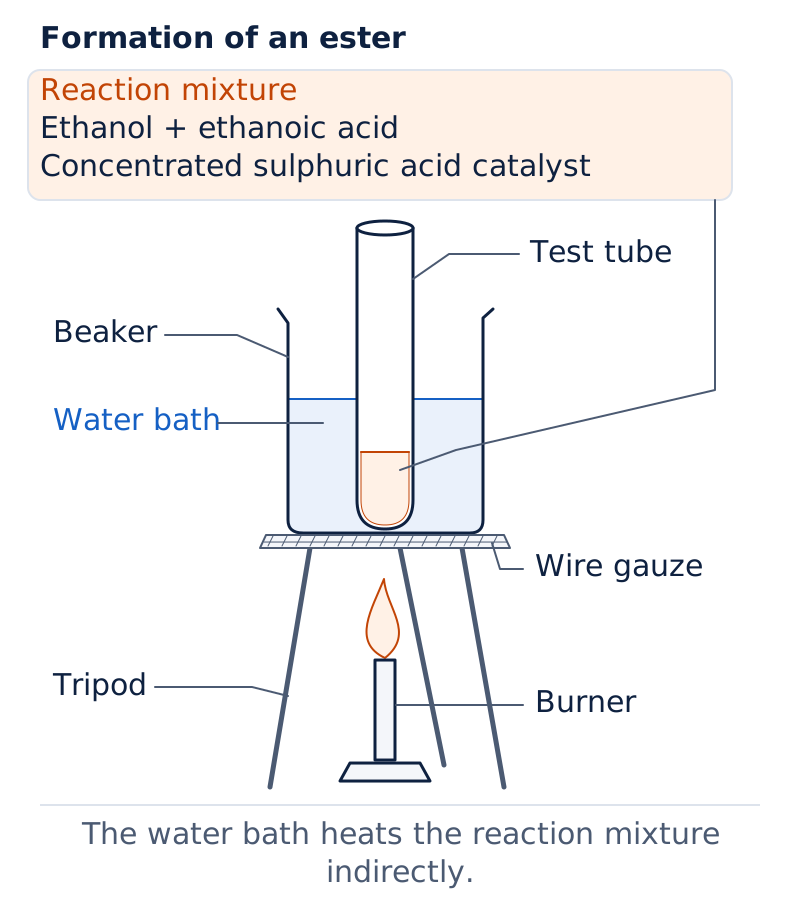
A test tube containing the reaction mixture stands in water in a beaker. The beaker rests on wire gauze on a tripod, with a burner below. The labelled water bath heats the test tube indirectly.
Drawn by One Young India.
When identifying the products, keep the two carbon groups distinct. The ethanoate part retains the acid's carbonyl group, while the ethyl group is attached through oxygen. An ester is therefore different from an ether even though both contain a carbon-oxygen-carbon connection.
Glossary
- Tetravalency — Carbon's combining capacity of four, satisfied through four shared electron pairs in its usual organic compounds.
- Catenation — The ability of an element to bond with its own atoms, forming chains, branches or rings.
- Covalent bond — A bond formed when two atoms share a pair of electrons between them.
- Hydrocarbon — A compound containing carbon and hydrogen only, with no atoms of other elements.
- Homologous series — A family with a common general formula and characteristic group, whose successive members differ by CH₂.
- Functional group — An atom or group of atoms responsible for characteristic reactions of an organic compound.
- Structural isomerism — The existence of compounds with the same molecular formula but different arrangements of bonds between atoms.
- Substitution — A reaction in which one atom or group replaces another atom or group in a compound.
- Addition — A reaction in which atoms attach across a multiple bond, reducing its bond multiplicity.
- Decarboxylation — Removal of the carboxyl carbon, giving an alkane with one fewer carbon in soda-lime preparation.
- Dehydration — Removal of water from a compound, as when heated ethanol forms ethene with concentrated sulphuric acid.
- Dehydrohalogenation — Elimination of the elements of a hydrogen halide from a compound to form a multiple bond.
- Esterification — Reaction between a carboxylic acid and an alcohol to produce an ester and water.
- Denatured alcohol — Ethanol deliberately made unsuitable for drinking by the addition of other substances.
Common errors and misconceptions
- Misconception: Every carbon compound is a hydrocarbon. Correct: Hydrocarbons contain only carbon and hydrogen. Ethanol and ethanoic acid contain oxygen and therefore are not hydrocarbons.
- Misconception: Isomers have different molecular formulae. Correct: Structural isomers share a molecular formula but differ in connectivity. Reversing the same drawing does not create a new compound.
- Misconception: Successive homologues have identical physical properties. Correct: They have similar chemical properties, while physical properties show gradation as molecular mass and chain length change.
- Misconception: Aqueous and alcoholic potassium hydroxide give the same product from bromoethane. Correct: Aqueous alkali gives ethanol; hot alcoholic alkali favours ethene by elimination.
- Misconception: Sodium ethanoate gives ethane with soda lime. Correct: Decarboxylation gives methane, with one fewer carbon. Sodium propanoate gives ethane.
- Misconception: Every halogen adds readily to ethene. Correct: Chlorine and bromine add, but iodine does not show addition under normal conditions.
- Misconception: Weak acetic acid cannot neutralise alkali. Correct: It reacts with sodium hydroxide to give sodium ethanoate and water. Weak refers to its limited ionisation.
- Misconception: Denatured alcohol is ethanol from which water has been removed. Correct: Denaturation adds substances to make ethanol unfit for drinking; dehydration is a chemical reaction that can produce ethene.
Exam-style questions with model answers
Q1. Name the two properties of carbon responsible for the great variety of its compounds and explain each briefly. [2 marks]
- Tetravalency means that carbon has valency four and can form four covalent bonds.
- Catenation is carbon's ability to bond with other carbon atoms, producing chains, branches and rings.
Q2. Methane is CH₄ and ethane is C₂H₆. Using atomic masses carbon = 12 u and hydrogen = 1 u, calculate their molecular masses and explain the difference in terms of a homologous series. Here u is the unified atomic mass unit. [3 marks]
- Methane has molecular mass 12 + (4 × 1) = 16 u.
- Ethane has molecular mass (2 × 12) + (6 × 1) = 30 u. The difference is 30 − 16 = 14 u.
- Ethane differs from methane by CH₂, whose mass is 12 + (2 × 1) = 14 u. They are successive members of the alkane homologous series and have similar chemical properties.
Q3. Write condensed structures for all three chain isomers of C₅H₁₂ and give their IUPAC names. Explain why they are chain isomers. [4 marks]
- Pentane is CH₃CH₂CH₂CH₂CH₃. All five carbon atoms belong to one continuous unbranched chain.
- 2-Methylbutane is CH₃CH(CH₃)CH₂CH₃. Its longest chain has four carbons and carries a methyl branch.
- 2,2-Dimethylpropane is CH₃C(CH₃)₂CH₃. Its longest chain has three carbons and two methyl branches on the central carbon.
- All have five carbons and twelve hydrogens, but their carbon skeletons differ. Therefore, they are chain isomers.
Q4. Give balanced equations and conditions for preparing methane from sodium ethanoate and from iodomethane. Explain how the carbon count changes in each method. [4 marks]
- Heat sodium ethanoate with soda lime, a mixture of sodium hydroxide and calcium oxide: CH₃COONa + NaOH → CH₄ + Na₂CO₃.
- Decarboxylation changes a two-carbon acid-derived salt into one-carbon methane. The other carbon enters sodium carbonate.
- Reduce iodomethane with zinc and dilute hydrochloric acid: CH₃I + 2[H] → CH₄ + HI, where [H] denotes a reducing hydrogen equivalent.
- This reduction replaces iodine with hydrogen, retaining the single carbon atom.
Q5. Separate samples of bromoethane are heated with aqueous potassium hydroxide and alcoholic potassium hydroxide. Identify each organic product, give balanced equations, and explain the difference between the reaction types. [5 marks]
- With aqueous potassium hydroxide, the organic product is ethanol. The equation is CH₃CH₂Br + KOH → CH₃CH₂OH + KBr.
- This is hydrolysis through substitution: a hydroxyl group replaces bromine, while the two-carbon skeleton remains intact.
- With hot alcoholic potassium hydroxide, the organic product is ethene. The equation is CH₃CH₂Br + KOH → CH₂=CH₂ + KBr + H₂O.
- This is dehydrohalogenation. Hydrogen and bromine are removed from adjacent carbons, producing a double bond.
- The solvent condition matters because aqueous and alcoholic alkali favour different changes. Both products contain two carbon atoms, but ethanol is an alcohol and ethene an unsaturated hydrocarbon.
Q6. Starting with ethyne, write the complete hydrogenation equation and the two successive bromine-addition equations. Name the final organic products and state the bromine observation. [5 marks]
- Complete hydrogenation is HC≡CH + 2H₂ → CH₃CH₃. A catalyst such as nickel, palladium or platinum is required; the final product is ethane.
- The first bromine addition is HC≡CH + Br₂ → CHBr=CHBr. The triple bond becomes a double bond and 1,2-dibromoethene forms.
- The second addition is CHBr=CHBr + Br₂ → CHBr₂-CHBr₂. The final organic product is 1,1,2,2-tetrabromoethane.
- The reddish-orange bromine colour disappears as bromine reacts at the unsaturated bond.
- Ethyne can accept two molecules of bromine per molecule during complete addition, because its triple bond permits two successive addition stages.
Q7. Explain how ethanol and ethanoic acid form an ester. Give the balanced equation, conditions, product name, characteristic odour, and one use of esters. [5 marks]
- Warm ethanol and ethanoic acid with concentrated sulphuric acid as an acid catalyst. The reaction is esterification and produces an ester together with water.
- The balanced equation is CH₃COOH + C₂H₅OH ⇌ CH₃COOC₂H₅ + H₂O. The symbol ⇌ shows that the reaction is reversible.
- The organic product is ethyl ethanoate, commonly called ethyl acetate. Its ethyl group comes from the alcohol, while its ethanoate portion comes from the acid.
- Esters generally have a sweet smell.
- They are used in perfumes or as flavouring agents.
Q8. Explain why saturated hydrocarbons can produce soot and why the name glacial acetic acid is used for pure ethanoic acid. [2 marks]
- Restricted oxygen can cause incomplete combustion even in saturated hydrocarbons, producing deposited carbon or soot.
- Pure ethanoic acid forms ice-like crystals on sufficient cooling, hence the name glacial acetic acid.
Key takeaways
- Carbon's tetravalency and catenation support a wide variety of stable chains, branches, rings and compounds containing functional groups.
- Alkanes contain single carbon-carbon bonds; alkenes and alkynes contain double and triple bonds respectively and undergo addition reactions.
- Structural isomers share a molecular formula; chain isomers differ in skeleton, while position isomers differ in the location of a group or bond.
- Successive homologues differ by CH₂ and 14 u in molecular mass, while retaining similar characteristic chemical reactions.
- Soda-lime decarboxylation shortens the acid-derived carbon chain by one carbon; reduction of an alkyl halide preserves its carbon count.
- Hot alcoholic potassium hydroxide converts bromoethane into ethene, whereas aqueous potassium hydroxide produces ethanol by substitution.
- Ethanol undergoes combustion, reaction with sodium, dehydration and esterification; denatured ethanol has deliberately been made unsuitable for drinking.
- Ethanoic acid turns blue litmus red, neutralises alkali and reacts with ethanol to form ethyl ethanoate and water.
Test yourself
Why is ethanol not a hydrocarbon?
Ethanol contains oxygen as well as carbon and hydrogen; a hydrocarbon contains carbon and hydrogen only.
How many shared electron pairs are present in a carbon-carbon triple bond?
There are three shared electron pairs between the two carbon atoms.
What distinguishes but-1-ene from but-2-ene?
The double bond occupies a different position on the same four-carbon skeleton, so they are position isomers.
Which sodium salt gives ethane on heating with soda lime?
Sodium propanoate gives ethane because decarboxylation removes one carbon from the three-carbon acid-derived chain.
What reagent and temperature convert ethanol into ethene?
Heat ethanol with excess concentrated sulphuric acid at 443 K, where K denotes kelvin.
What accompanies ethyne when calcium carbide reacts with water?
Calcium hydroxide forms alongside ethyne: CaC₂ + 2H₂O → C₂H₂ + Ca(OH)₂.
What are the products when ethanol reacts with sodium?
Sodium ethoxide and hydrogen form: 2C₂H₅OH + 2Na → 2C₂H₅ONa + H₂.
Why does weak ethanoic acid still react with sodium hydroxide?
It is still an acid and neutralises alkali to form sodium ethanoate and water; weak refers to incomplete ionisation.
Try it
ICSE Class 10 Chemistry: Complete Conceptual Guide to Organic Chemistry
Explore key laboratory preparations and reaction conditions in organic chemistry through this 2-step interactive scenario.
1A student preparing methane in the laboratory decides to heat anhydrous sodium ethanoate with pure solid sodium hydroxide alone, omitting calcium oxide. What issue will occur as a result of this modification?
The text explains that soda lime contains calcium oxide (CaO) alongside NaOH because CaO is deliquescent, keeping the sodium hydroxide dry, and prevents the glass test tube from fusing with corrosive molten NaOH during the decarboxylation reaction.
According to the text, ethane is prepared from sodium propanoate, not sodium ethanoate. Omitting calcium oxide does not change the carbon chain length; calcium oxide's role is to keep NaOH dry and protect the glass.
A violent, explosive reaction yielding carbon soot and hydrogen chloride gas occurs when methane reacts with chlorine in direct sunlight, not during the decarboxylation of sodium ethanoate.
2A chemist needs to carry out a controlled, stepwise substitution reaction between methane and chlorine to obtain chloromethane. Which light condition must be selected?
The text states that in direct sunlight, the reaction between methane and chlorine is violent and explosive, yielding carbon soot and hydrogen chloride gas (CH₄ + 2Cl₂ → C + 4HCl) rather than a controlled substitution.
The text specifies that in diffused sunlight, methane reacts with chlorine via stepwise displacement of hydrogen atoms (forming CH₃Cl, CH₂Cl₂, CHCl₃, and CCl₄), whereas direct sunlight leads to a violent, explosive decomposition into soot and HCl.
Mastering organic chemistry requires understanding how specific reagents (like soda lime in decarboxylation) and precise reaction conditions (like diffused sunlight in substitution) dictate reaction pathways and outcomes.