
Issue and Redemption of Debentures | CBSE Class 12 Accountancy Notes
On this page
This note covers the meaning and types of debentures, differences from shares, issue at par, discount and premium, oversubscription, non-cash consideration, collateral security, interest, discount write-off, redemption reserves and investments, and redemption through repayment, market purchase or conversion.
What is a debenture, and how does it differ from a share?
Definition: A debenture is a written instrument acknowledging a debt under the common seal of a company. It contains the terms for repayment of principal and payment of interest.
Funds raised through debentures form borrowed capital. Companies may raise these long-term funds through private placement or a public offer. Share capital is seldom adequate to meet a company's long-term financial needs, so most companies also turn to debentures.
The repayment contract may provide for payment after a specified period, at intervals or at the company's option. Interest is usually payable half-yearly or yearly on fixed dates. A bond also acknowledges debt; the terms bond and debenture are now used interchangeably.
Which differences affect accounting?
| Basis | Shares | Debentures |
|---|---|---|
| Ownership | Part of owned capital; represents ownership | Part of borrowed capital; acknowledges debt |
| Return | Dividend; rate may vary with profits | Interest; rate is prefixed |
| Treatment of return | Appropriation of profits | Charge against profits, payable even without profit |
| Repayment | Normally not returned during the life of the company | Generally repayable after a specified period |
| Voting rights | Shareholders enjoy voting rights | Debentureholders do not normally enjoy voting rights |
| Security | No charge over assets | Generally secured by a fixed or floating charge |
| Conversion | Shares cannot be converted into debentures | Conversion into shares is possible when issue terms provide for it |
How are the different types of debentures classified?
Security, tenure and convertibility
Secured debentures carry a charge over company assets for payment in case of default. A fixed charge attaches to a specific asset held for operations; a floating charge covers general assets, excluding those assigned to secured creditors.
Unsecured debentures do not carry a specific charge, although a floating charge may arise by default. Normally, these kinds of debentures are not issued. Do not treat the absence of a specific charge as the same thing as a fixed charge.
Redeemable debentures are payable after a specific period, either in a lump sum or instalments. Irredeemable or perpetual debentures carry no undertaking to repay during a specified normal tenure; repayment occurs on winding-up or expiry of a long period.
Convertible debentures may become equity shares or another security, at the option specified in their terms. They may be fully or partly convertible. Non-convertible debentures cannot be so converted; most company debentures belong to this category.
Coupon and registration
Specific coupon rate debentures carry a stated interest rate, which may be fixed or floating. A floating rate is usually linked to the bank rate. Zero coupon debentures carry no specific interest rate and are issued at a substantial discount.
Registered debentures have holders' particulars entered in the company's register and require a regular transfer deed. Bearer debentures pass by delivery; interest is paid to the person presenting the attached interest coupon.
What the figure shows
Types of Debenture/Bond
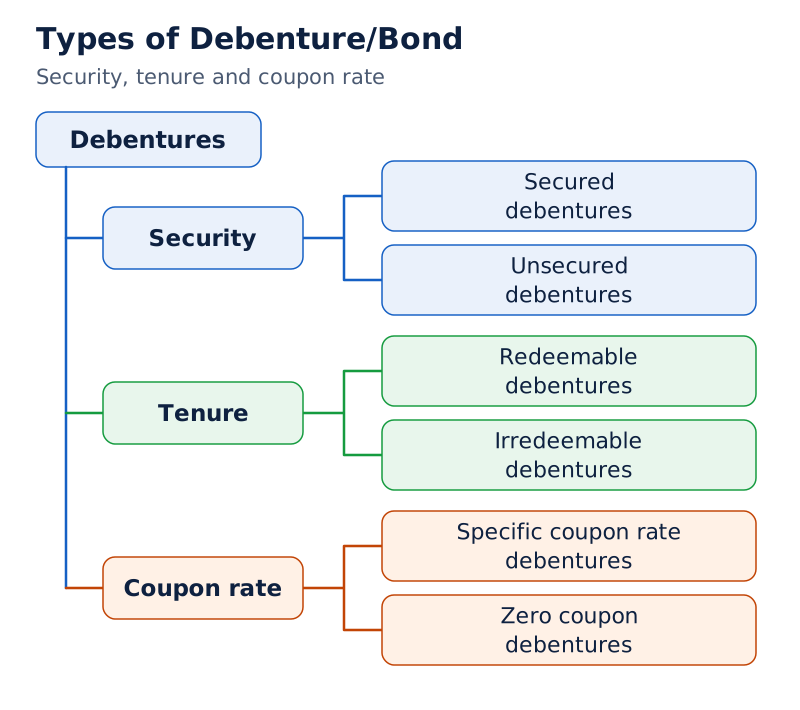
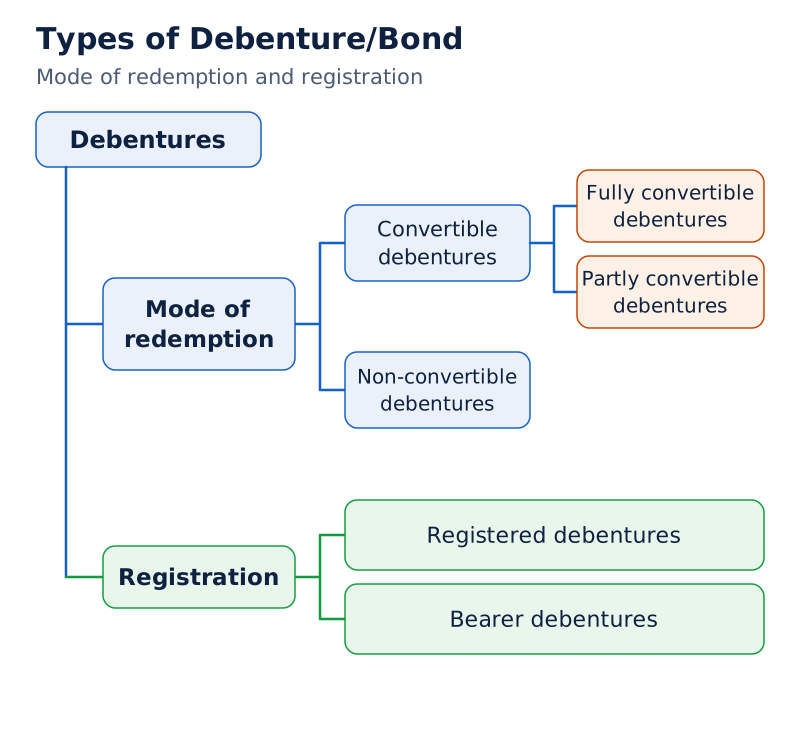
A branching tree divides debentures by security, tenure, mode of redemption, coupon rate and registration. The convertible branch divides again into fully convertible and partly convertible debentures.
Drawn by One Young India. Reference: NCERT Class 12, p. 78
How are debentures issued for cash at par?
An issue is at par when issue price equals face value. Investors apply on the basis of a prospectus. The company may collect the whole amount on application or collect it through application, allotment and calls.
When the entire amount is collected at once, debit Bank and credit Debenture Application & Allotment. On allotment, debit Debenture Application & Allotment and credit Debentures. The first entry records receipt; the second transfers that receipt to the borrowing account.
How are separate instalments recorded?
- On receiving application money, debit Bank and credit Debenture Application.
- On transferring accepted application money, debit Debenture Application and credit Debentures.
- When allotment money becomes due, debit Debenture Allotment and credit Debentures.
- On receiving allotment money, debit Bank and credit Debenture Allotment.
A call follows the same due-and-receipt pattern, using the relevant Debenture Call account. Normally, the whole amount is collected on application or in application and allotment instalments. Keep the amount called due distinct from the cash actually received.
Worked example 1. ABC Limited offers 10,000, 12% debentures of ₹100 each, payable ₹30 on application and the balance on allotment. Applications for 9,000 debentures are fully accepted and all allotment money is received. Record the issue.
Answer: Application money = 9,000 × ₹30 = ₹2,70,000. Allotment money = 9,000 × ₹70 = ₹6,30,000. The nominal liability and total bank receipt are each ₹9,00,000.
| Date | Particulars | L.F. | Debit (₹) | Credit (₹) |
|---|---|---|---|---|
| Unspecified | Bank A/c Dr. | - | 2,70,000 | - |
| Unspecified | To 12% Debenture Application A/c | - | - | 2,70,000 |
| Unspecified | (Application money received on 9,000 debentures) | - | - | - |
| Unspecified | 12% Debenture Application A/c Dr. | - | 2,70,000 | - |
| Unspecified | To 12% Debentures A/c | - | - | 2,70,000 |
| Unspecified | (Application money transferred on allotment) | - | - | - |
| Unspecified | 12% Debenture Allotment A/c Dr. | - | 6,30,000 | - |
| Unspecified | To 12% Debentures A/c | - | - | 6,30,000 |
| Unspecified | (Allotment money due at ₹70 per debenture) | - | - | - |
| Unspecified | Bank A/c Dr. | - | 6,30,000 | - |
| Unspecified | To 12% Debenture Allotment A/c | - | - | 6,30,000 |
| Unspecified | (Allotment money received) | - | - | - |
Balance sheet extract: ABC Limited, date not specified. Relevant items only.
| Particulars | Note No. | Amount (₹) |
|---|---|---|
| I. Equity and Liabilities: Non-current liabilities; Long-term borrowings | 1 | 9,00,000 |
| II. Assets: Current assets; Cash and cash equivalents | 2 | 9,00,000 |
| Notes to Accounts | Details | Amount (₹) |
|---|---|---|
| 1. Long-term borrowings | 9,000, 12% debentures of ₹100 each | 9,00,000 |
| 2. Cash and cash equivalents | Cash at bank | 9,00,000 |
What changes when debentures are issued at discount or premium?
An issue at discount brings in less than nominal value. An issue at premium brings in more. The Debentures account records nominal value, while the difference is recorded separately. The price of issue does not change the face value credited.
How are issue price and nominal value separated?
Discount = Nominal value × Discount rate / 100
Issue premium = Nominal value × Premium rate / 100
Issue proceeds = Nominal value + Issue premium − Discount
Discount on Issue of Debentures is debited. Issue premium is credited to Securities Premium Reserve, shown within reserves and surplus. Premium collected with allotment must be separated from the nominal portion of that instalment.
Worked example 2. TV Components Ltd. issues 10,000, 12% debentures of ₹100 each at 5% discount, payable ₹40 on application and ₹55 on allotment. All instalments are collected. Calculate the issue amounts.
Answer: Nominal value is ₹10,00,000; discount is ₹50,000. Application receipts are ₹4,00,000 and allotment receipts ₹5,50,000, giving total proceeds of ₹9,50,000. The allotment entry debits Debenture Allotment ₹5,50,000 and Discount on Issue ₹50,000, and credits 12% Debentures ₹6,00,000.
Worked example 3. XYZ Industries Ltd. issues 2,000, 10% debentures of ₹100 each at ₹10 premium, payable ₹50 on application and ₹60 on allotment. All money is received. Calculate and record allotment.
Answer: Nominal value = ₹2,00,000; premium = ₹20,000; proceeds = ₹2,20,000. Application receipts are ₹1,00,000. Allotment due is ₹1,20,000, comprising ₹1,00,000 nominal value and ₹20,000 premium.
| Date | Particulars | L.F. | Debit (₹) | Credit (₹) |
|---|---|---|---|---|
| Unspecified | 10% Debenture Allotment A/c Dr. | - | 1,20,000 | - |
| Unspecified | To 10% Debentures A/c | - | - | 1,00,000 |
| Unspecified | To Securities Premium Reserve A/c | - | - | 20,000 |
| Unspecified | (Allotment due including premium) | - | - | - |
| Unspecified | Bank A/c Dr. | - | 1,20,000 | - |
| Unspecified | To 10% Debenture Allotment A/c | - | - | 1,20,000 |
| Unspecified | (Allotment money received) | - | - | - |
For XYZ Industries, long-term borrowings are ₹2,00,000, Securities Premium Reserve is ₹20,000 and cash at bank is ₹2,20,000. These are separate balance sheet items; the premium is not added to the Debentures account.
How is excess application money handled on oversubscription?
Oversubscription occurs when applications exceed the debentures offered. A company cannot allot more than it invited for subscription. It may accept some applications fully, allot fewer debentures than requested to others, and reject the remaining applications.
Money received from applicants allotted no debentures must be refunded. Excess money from successful applicants may be retained for adjustment against allotment and later calls. Consequently, the gross allotment amount due can exceed the fresh cash collected on allotment.
How does the application account clear?
Worked example 4. X Limited offers 10,000, 12% debentures of ₹100, with ₹40 payable on application and ₹60 on allotment. Applications total 14,000. Applications for 9,000 are accepted fully; applicants for 2,000 receive 1,000; the remaining applications are rejected. All money is received.
Answer: Applications rejected = 14,000 − 9,000 − 2,000 = 3,000. Application receipts = ₹5,60,000; transfer to Debentures = ₹4,00,000; excess adjusted = ₹40,000; refund = ₹1,20,000. Allotment due = ₹6,00,000, so fresh allotment cash = ₹5,60,000.
| Date | Particulars | L.F. | Debit (₹) | Credit (₹) |
|---|---|---|---|---|
| Unspecified | Bank A/c Dr. | - | 5,60,000 | - |
| Unspecified | To 12% Debenture Application A/c | - | - | 5,60,000 |
| Unspecified | (Application money received) | - | - | - |
| Unspecified | 12% Debenture Application A/c Dr. | - | 5,60,000 | - |
| Unspecified | To 12% Debentures A/c | - | - | 4,00,000 |
| Unspecified | To Debenture Allotment A/c | - | - | 40,000 |
| Unspecified | To Bank A/c | - | - | 1,20,000 |
| Unspecified | (Application money transferred, excess adjusted and rejected applications refunded) | - | - | - |
| Unspecified | Debenture Allotment A/c Dr. | - | 6,00,000 | - |
| Unspecified | To 12% Debentures A/c | - | - | 6,00,000 |
| Unspecified | (Allotment money due) | - | - | - |
| Unspecified | Bank A/c Dr. | - | 5,60,000 | - |
| Unspecified | To Debenture Allotment A/c | - | - | 5,60,000 |
| Unspecified | (Balance allotment money received) | - | - | - |
How are debentures issued for consideration other than cash?
A company may acquire assets or a business and settle the vendor's claim through debentures. This is an issue for consideration other than cash. First record the purchase and the amount payable to the vendor; then record settlement through debentures.
For assets purchased, debit the asset accounts and credit the vendor. On settlement, debit the vendor and credit Debentures with nominal value. Credit Securities Premium Reserve for an issue premium, or debit Discount on Issue of Debentures for an issue discount.
How are the number of debentures and goodwill found?
Debenture count = Purchase consideration / Issue price per debenture
Net assets = Assets taken over − Liabilities taken over
When a whole business is acquired, include liabilities taken over in the purchase entry. If purchase consideration exceeds net assets, debit the difference to Goodwill. If net assets exceed purchase consideration, credit the difference to Capital Reserve.
Worked example 5. Blue Prints Ltd. buys a building for ₹1,50,000, machinery for ₹1,40,000 and furniture for ₹10,000 from XYZ Co., taking over liabilities of ₹20,000. Purchase consideration of ₹3,15,000 is settled with 12% debentures of ₹100 at 5% premium.
Answer: Assets total ₹3,00,000 and net assets are ₹2,80,000. Goodwill = ₹3,15,000 − ₹2,80,000 = ₹35,000. Issue price = ₹105; debentures issued = ₹3,15,000 / ₹105 = 3,000. Nominal value is ₹3,00,000 and premium ₹15,000.
| Date | Particulars | L.F. | Debit (₹) | Credit (₹) |
|---|---|---|---|---|
| Unspecified | Building A/c Dr. | - | 1,50,000 | - |
| Unspecified | Plant & Machinery A/c Dr. | - | 1,40,000 | - |
| Unspecified | Furniture A/c Dr. | - | 10,000 | - |
| Unspecified | Goodwill A/c Dr. | - | 35,000 | - |
| Unspecified | To Sundry Liabilities A/c | - | - | 20,000 |
| Unspecified | To XYZ Co. | - | - | 3,15,000 |
| Unspecified | (Assets purchased and liabilities taken over) | - | - | - |
| Unspecified | XYZ Co. Dr. | - | 3,15,000 | - |
| Unspecified | To 12% Debentures A/c | - | - | 3,00,000 |
| Unspecified | To Securities Premium Reserve A/c | - | - | 15,000 |
| Unspecified | (3,000 debentures issued at 5% premium) | - | - | - |
What happens when debentures are issued as collateral security?
Definition: Collateral security is subsidiary, secondary or additional security supplied alongside the primary security for a loan or overdraft.
A lender may require debentures as additional security even when assets are already pledged. If the company defaults and realisation of primary security is insufficient, the lender may invoke the collateral security, presenting the debentures for redemption or selling them in the market.
What are the two accounting methods?
Under the first method, make no entry for the collateral debentures. Show the bank loan and disclose that debentures have been issued as collateral security. This does not mean that the actual borrowing is left unrecorded.
Under the second method, debit Debenture Suspense and credit Debentures with the collateral debentures' nominal value. In the notes to long-term borrowings, deduct Debenture Suspense from these debentures. On repayment of the loan, reverse the collateral entry.
Worked example 6. A company takes a ₹10,00,000 loan from Punjab National Bank and issues 10% debentures with nominal value ₹12,00,000, each of ₹100, as collateral security. Show the treatment under the second method.
Answer: Number of collateral debentures = ₹12,00,000 / ₹100 = 12,000. Debit Debenture Suspense ₹12,00,000 and credit 10% Debentures ₹12,00,000. Deduct the suspense balance from collateral debentures in the notes; the bank loan remains ₹10,00,000.
| Notes to long-term borrowings | Amount (₹) | Net amount (₹) |
|---|---|---|
| Secured loan from Punjab National Bank | 10,00,000 | 10,00,000 |
| 12,000, 10% debentures of ₹100 each as collateral | 12,00,000 | - |
| Less: Debenture Suspense | 12,00,000 | 0 |
| Total long-term borrowings | - | 10,00,000 |
How do issue terms and redemption terms combine?
Redemption discharges the debenture liability according to the terms of issue. Issue price concerns the amount received initially; redemption price concerns the amount repaid. Debentures may be issued at par, discount or premium and redeemed at par or premium.
Which accounts are used in the six combinations?
| Issue and redemption | Debit on allotment, besides application money | Credit besides nominal Debentures |
|---|---|---|
| At par; redeemed at par | None | None |
| At discount; redeemed at par | Discount on Issue of Debentures | None |
| At premium; redeemed at par | None | Securities Premium Reserve |
| At par; redeemed at premium | Loss on Issue: redemption premium | Premium on Redemption of Debentures |
| At discount; redeemed at premium | Loss on Issue: discount plus redemption premium | Premium on Redemption of Debentures |
| At premium; redeemed at premium | Loss on Issue: redemption premium | Securities Premium Reserve and Premium on Redemption of Debentures |
Issue loss = Issue discount + Redemption premium
This formula applies when debentures are issued at discount and redeemed at premium. If issue is at par, the loss equals redemption premium. When both prices include premiums, record the issue premium and redemption premium separately.
Note: Premium on Redemption of Debentures is a future liability. It is credited when the debentures are issued, with the corresponding debit to Loss on Issue. It is not Securities Premium Reserve.
Worked example 7. Debentures with face value ₹1,00,000 carrying 9% interest are issued at 5% discount and redeemable at 5% premium. Record allotment after application money has been received.
Answer: Cash received = ₹95,000; issue discount = ₹5,000; redemption premium = ₹5,000. Loss on Issue = ₹10,000. Total debits and total credits on allotment are each ₹1,05,000.
| Date | Particulars | L.F. | Debit (₹) | Credit (₹) |
|---|---|---|---|---|
| Unspecified | Debenture Application & Allotment A/c Dr. | - | 95,000 | - |
| Unspecified | Loss on Issue of Debentures A/c Dr. | - | 10,000 | - |
| Unspecified | To 9% Debentures A/c | - | - | 1,00,000 |
| Unspecified | To Premium on Redemption of Debentures A/c | - | - | 5,000 |
| Unspecified | (Debentures allotted at discount and redeemable at premium) | - | - | - |
How are debenture interest and tax deducted at source recorded?
Debenture interest is calculated on nominal value, not issue proceeds. The rate is generally included in the name, such as 10% Debentures. Interest is a charge against profit and must be paid whether or not the company earns a profit.
Interest = Nominal value × Annual rate / 100 × Months / 12
Where tax deducted at source applies, gross interest is divided between the net amount payable to debentureholders and Income Tax Payable. The tax withheld is subsequently deposited with the tax authorities; it is not a reduction of interest expense.
What is the sequence of entries?
- Debit Debenture Interest with gross interest; credit Debentureholders with net interest and Income Tax Payable with tax withheld.
- Debit Debentureholders and credit Bank when net interest is paid.
- Debit Income Tax Payable and credit Bank when the withheld tax is deposited.
- Debit Statement of Profit and Loss and credit Debenture Interest to transfer the expense.
Worked example 8. A Ltd. issues 2,000, 10% debentures of ₹100 on 1 April 2016 at 10% discount, redeemable at 10% premium. Interest is paid on 30 September and 31 March. Assume TDS of 10%. Find each half-year payment and the annual expense.
Answer: Nominal value = ₹2,00,000. Half-year gross interest = ₹2,00,000 × 10/100 × 6/12 = ₹10,000. TDS = ₹1,000 and net interest = ₹9,000 each half-year. Annual interest expense is ₹20,000, despite initial proceeds of ₹1,80,000.
| Date | Particulars | L.F. | Debit (₹) | Credit (₹) |
|---|---|---|---|---|
| 30 September 2016 | Debenture Interest A/c Dr. | - | 10,000 | - |
| 30 September 2016 | To Debentureholders A/c | - | - | 9,000 |
| 30 September 2016 | To Income Tax Payable A/c | - | - | 1,000 |
| 30 September 2016 | (Half-year interest due with 10% TDS) | - | - | - |
| 30 September 2016 | Debentureholders A/c Dr. | - | 9,000 | - |
| 30 September 2016 | To Bank A/c | - | - | 9,000 |
| 30 September 2016 | (Net interest paid) | - | - | - |
| 30 September 2016 | Income Tax Payable A/c Dr. | - | 1,000 | - |
| 30 September 2016 | To Bank A/c | - | - | 1,000 |
| 30 September 2016 | (Tax deducted at source deposited) | - | - | - |
Repeat these amounts on 31 March 2017 for the second half-year. At year-end, debit Statement of Profit and Loss ₹20,000 and credit Debenture Interest ₹20,000. The 10% TDS rate here is an explicit assumption of this example.
How is discount or loss on issue written off?
Discount or loss on issue is a capital loss. Write it off in the year of issue. Use the available Securities Premium Reserve towards the write-off; charge any deficiency to the revenue profits of that year through Statement of Profit and Loss.
The entry debits Securities Premium Reserve to the extent of the available balance and debits Statement of Profit and Loss for the remainder. Credit Discount on Issue or Loss on Issue with the total amount being written off.
How does the available reserve affect the calculation?
Worked example 9. On 1 July 2019, a company issues 15,000, 9% debentures of ₹100 at 10% discount. Securities Premium Reserve has a balance of ₹1,00,000. Calculate and record the write-off for the year ending 31 March 2020.
Answer: Nominal value = ₹15,00,000. Discount = ₹15,00,000 × 10/100 = ₹1,50,000. Use Securities Premium Reserve ₹1,00,000 and charge the remaining ₹50,000 to Statement of Profit and Loss.
| Date | Particulars | L.F. | Debit (₹) | Credit (₹) |
|---|---|---|---|---|
| Year ending 31 March 2020 | Securities Premium Reserve A/c Dr. | - | 1,00,000 | - |
| Year ending 31 March 2020 | Statement of Profit and Loss Dr. | - | 50,000 | - |
| Year ending 31 March 2020 | To Discount on Issue of Debentures A/c | - | - | 1,50,000 |
| Year ending 31 March 2020 | (Discount on issue written off) | - | - | - |
Writing off the loss does not extinguish Premium on Redemption of Debentures. The loss account and the future liability have different purposes. The redemption premium remains payable according to the issue terms even after its corresponding loss has been written off.
For Rohit Ltd., 50,000, 8% debentures of ₹100 issued on 1 July 2019 at 9% discount and redeemable after five years at 7% premium create discount of ₹4,50,000 and redemption premium of ₹3,50,000.
The total loss is therefore ₹8,00,000. With Securities Premium Reserve of ₹5,00,000, the debit to Statement of Profit and Loss is ₹3,00,000. Do not spread this loss over five years merely because redemption occurs after five years.
How are lump-sum and instalment redemptions accounted for?
Under lump-sum redemption, the entire amount is paid at maturity according to the terms of issue. Under instalment redemption, portions become payable on specified dates. The actual debentures selected for repayment are usually identified by drawing lots.
What the figure shows
Methods of Redemption of Debentures
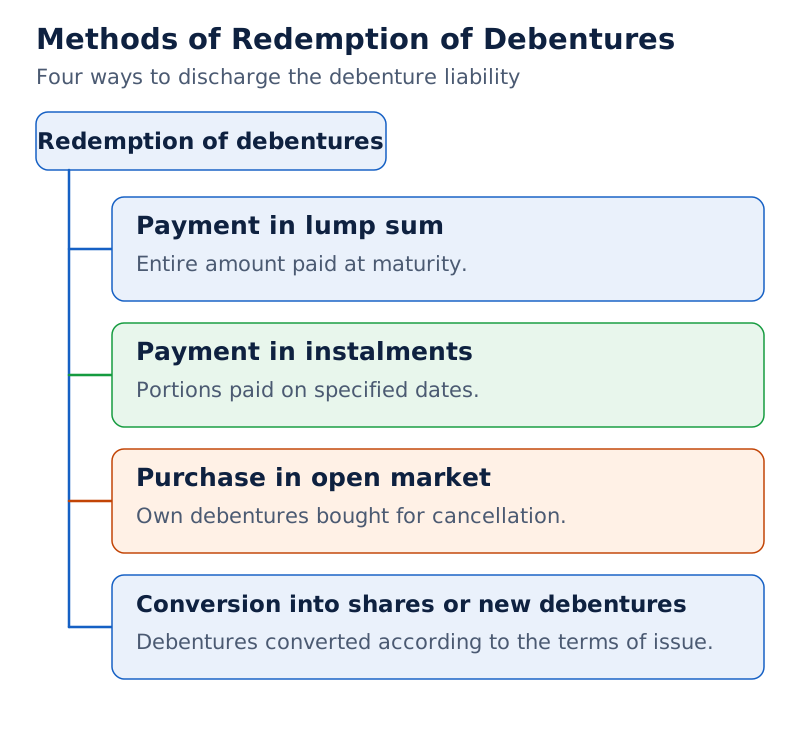
One heading branches into four boxes: payment in lump sum, payment in instalments, purchase in open market, and conversion into shares or new debentures.
Drawn by One Young India. Reference: NCERT Class 12, p. 110
What entries make redemption due and settle it?
At par, debit Debentures and credit Debentureholders. At a premium, also debit Premium on Redemption of Debentures and credit Debentureholders with the full amount due. For payment, debit Debentureholders and credit Bank.
Worked example 10. X Ltd. has 1,000, 12% debentures of ₹100 issued at par and redeemable after four years at 10% premium. Record the amount due and its payment at redemption.
Answer: Principal is ₹1,00,000 and premium ₹10,000, making ₹1,10,000 due. These entries settle principal and redemption premium.
| Date | Particulars | L.F. | Debit (₹) | Credit (₹) |
|---|---|---|---|---|
| At redemption | 12% Debentures A/c Dr. | - | 1,00,000 | - |
| At redemption | Premium on Redemption of Debentures A/c Dr. | - | 10,000 | - |
| At redemption | To Debentureholders A/c | - | - | 1,10,000 |
| At redemption | (Principal and redemption premium due) | - | - | - |
| At redemption | Debentureholders A/c Dr. | - | 1,10,000 | - |
| At redemption | To Bank A/c | - | - | 1,10,000 |
| At redemption | (Redemption amount paid) | - | - | - |
How do DRR and DRI differ?
Debenture Redemption Reserve (DRR) is created from profits. For the category of other unlisted companies requiring DRR, the reserve is 10% of outstanding debentures. Listed companies are exempt from creating DRR. Redemption may be financed out of capital or profits.
Debenture Redemption Investment (DRI) involves investing or depositing funds. The required investment is at least 15% of debentures maturing during the year ending on the following 31 March, made by 30 April. A reserve transfer does not itself create an investment.
Debit Surplus in Statement of Profit and Loss and credit DRR to create the reserve. Debit DRI and credit Bank to invest. On realisation, debit Bank and credit DRI. After redemption, transfer the relevant DRR balance to General Reserve.
For instalments, carry investments forward towards the next redemption requirement. Realise an excess or invest a shortfall as needed. Funds invested for redemption are to be used for that purpose. The reserve and investment serve different roles and need separate entries.
What does the debenture ledger show?
ABC Ltd. issues 3,000, 14% debentures of ₹100 on 1 April 2012 at 5% discount, redeemable at par in three equal instalments at the ends of the third, fourth and fifth years. Each principal instalment is ₹1,00,000.
The following 14% Debentures Account extract covers the first redemption year. It carries down the remaining principal; interest belongs in a separate account. Interest for this year is ₹3,00,000 × 14/100 = ₹42,000.
| Debit date | Debit particulars | J.F. | Debit amount (₹) | Credit date | Credit particulars | J.F. | Credit amount (₹) |
|---|---|---|---|---|---|---|---|
| 31 March 2015 | To Debentureholders A/c | - | 1,00,000 | 1 April 2014 | By Balance b/d | - | 3,00,000 |
| 31 March 2015 | To Balance c/d | - | 2,00,000 | - | - | - | - |
| 31 March 2015 | Total | - | 3,00,000 | 31 March 2015 | Total | - | 3,00,000 |
How do open-market purchase and conversion redeem debentures?
What happens on purchase for cancellation?
A company may buy its own debentures in the market for immediate cancellation. This allows redemption when surplus funds are available and may permit purchase below nominal value. Profit on redemption arises when the cost of cancellation is below the liability cancelled.
Worked example 11. X Ltd. purchases its own debentures of ₹100 each, with total face value ₹20,000, for immediate cancellation at ₹92 each. Calculate the payment and profit.
Answer: Number purchased = ₹20,000 / ₹100 = 200. Payment = 200 × ₹92 = ₹18,400. Profit = ₹20,000 − ₹18,400 = ₹1,600.
| Date | Particulars | L.F. | Debit (₹) | Credit (₹) |
|---|---|---|---|---|
| Unspecified | Debentures A/c Dr. | - | 20,000 | - |
| Unspecified | To Bank A/c | - | - | 18,400 |
| Unspecified | To Profit on Redemption of Debentures A/c | - | - | 1,600 |
| Unspecified | (Own debentures purchased for immediate cancellation) | - | - | - |
| Unspecified | Profit on Redemption of Debentures A/c Dr. | - | 1,600 | - |
| Unspecified | To Capital Reserve | - | - | 1,600 |
| Unspecified | (Profit on redemption transferred to Capital Reserve) | - | - | - |
If purchase price exceeds nominal value, debit the excess to Loss on Redemption of Debentures. The cancellation entry debits Debentures and Loss on Redemption and credits Bank. Transfer the loss to Statement of Profit and Loss.
How is conversion into shares recorded?
Conversion replaces the old debenture liability with shares or new debentures under the agreed terms. Debit the old Debentures account and credit Debentureholders for the amount due; then debit Debentureholders and credit the new capital or debenture accounts.
Where new shares are issued at premium, separate their nominal capital from Securities Premium Reserve. Divide the amount settled by the issue price per share, including premium, to calculate the number of shares.
Arjun Plastics Limited converts 1,000, 15% debentures of ₹100 into equity shares of ₹10 issued at ₹2.50 premium. Amount settled = ₹1,00,000; issue price = ₹12.50; shares issued = ₹1,00,000 / ₹12.50 = 8,000 shares.
Debit 15% Debentures ₹1,00,000 and credit Debentureholders ₹1,00,000. Then debit Debentureholders ₹1,00,000, credit Equity Share Capital ₹80,000 and credit Securities Premium Reserve ₹20,000. The two credits total the liability discharged.
Glossary
- Debenture — A written acknowledgement of company debt containing terms for repayment of principal and payment of interest.
- Nominal value — The face value of a debenture, used to record the principal liability and calculate coupon interest.
- Issue premium — The excess of a debenture's issue price over its nominal value, credited to Securities Premium Reserve.
- Issue discount — The excess of nominal value over issue price, recorded as a capital loss on issue.
- Coupon rate — The specified rate of interest attached to a debenture, which may be fixed or floating.
- Zero coupon debenture — A debenture carrying no specific interest rate, issued at substantial discount to compensate the investor.
- Collateral security — Secondary or additional security provided to a lender alongside the primary security for borrowing.
- Debenture Suspense — The account debited when collateral debentures are recorded, deducted from those debentures in the borrowing notes.
- Purchase consideration — The agreed amount payable to a vendor for assets or a business acquired by the company.
- Redemption premium — The amount payable above nominal value on redemption, recognised as a liability when debentures are issued.
- Debenture Redemption Reserve — A reserve created by transferring profits for redemption, distinct from cash invested in redemption investments.
- Debenture Redemption Investment — Funds invested or deposited for redemption, recorded separately from the reserve created through a profit transfer.
- Draw of lots — A method used to identify the particular outstanding debentures selected for repayment under instalment redemption.
- Convertible debenture — A debenture convertible into equity shares or another security under the terms governing its issue.
Common errors and misconceptions
- Misconception: Debentureholders own part of the company just like shareholders. Correct: Debentures represent borrowed capital; shares represent owned capital. Debentureholders do not normally enjoy voting rights.
- Misconception: Interest can be omitted when the company incurs a loss. Correct: Debenture interest is a charge against profits and remains payable even when there is no profit.
- Misconception: Issue proceeds determine the amount credited to Debentures. Correct: The account records nominal value; issue discount or premium is recorded separately from the principal liability.
- Misconception: Every rupee received on oversubscription becomes debenture capital. Correct: Rejected applications are refunded; excess money on accepted applications may be adjusted against allotment or calls.
- Misconception: Collateral debentures create an additional net borrowing equal to their face value. Correct: They provide additional security. Under the suspense method, the corresponding suspense balance is deducted.
- Misconception: Issue premium and redemption premium are the same reserve. Correct: Issue premium is credited to Securities Premium Reserve; redemption premium is a separate future liability.
- Misconception: Creating DRR means money has already been invested. Correct: DRR is a transfer from profits. DRI is a separate investment requiring a debit to DRI and credit to Bank.
- Misconception: Profit on buying and cancelling own debentures is ordinary revenue profit. Correct: Profit on redemption through cancellation is transferred to Capital Reserve, rather than Statement of Profit and Loss.
Exam-style questions with model answers
Q1. Distinguish shares and debentures on ownership and treatment of return. [2 marks]
- A share represents owned capital and ownership of the company; a debenture acknowledges debt and forms part of borrowed capital.
- Dividend on shares is an appropriation of profits. Debenture interest is a charge against profits and is payable even when the company earns no profit.
Q2. Explain collateral security and the two accounting methods for debentures issued as collateral security. [3 marks]
- Collateral security is additional or secondary security besides primary security. A lender may invoke it if default occurs and primary security does not cover the loan.
- Under the first method, make no entry for the collateral debentures; disclose their issue as security in the notes relating to the loan.
- Under the second method, debit Debenture Suspense and credit Debentures. Deduct suspense from the collateral debentures in the borrowing notes and reverse this entry when the loan is repaid.
Q3. X Limited offers 10,000, 12% debentures of ₹100, payable ₹40 on application and ₹60 on allotment. Applications total 14,000: 9,000 are accepted fully, applications for 2,000 receive 1,000, and the rest are rejected. Excess is adjusted against allotment and all balances are received. Calculate application receipts, transfer to Debentures, refund and adjustment, and fresh allotment cash. [4 marks]
- Application receipts equal 14,000 × ₹40 = ₹5,60,000. This is the total initially received before rejection or adjustment of any application.
- The amount transferred from application to Debentures is 10,000 × ₹40 = ₹4,00,000, based on debentures actually allotted.
- Rejected applications are 3,000, requiring refund of ₹1,20,000. Excess on the partly accepted applications is (2,000 − 1,000) × ₹40 = ₹40,000, adjusted against allotment.
- Gross allotment due is 10,000 × ₹60 = ₹6,00,000. Deducting the ₹40,000 adjustment leaves fresh allotment cash of ₹5,60,000.
Q4. A Ltd. issues 2,000, 10% debentures of ₹100 on 1 April 2016 at 10% discount, redeemable at 10% premium. Interest is paid half-yearly on 30 September and 31 March; assume TDS of 10%. Calculate gross half-year interest, TDS, net payment and annual interest expense, giving the associated entries. [4 marks]
- Nominal value is 2,000 × ₹100 = ₹2,00,000. Half-year gross interest is ₹2,00,000 × 10/100 × 6/12 = ₹10,000; issue discount does not reduce the interest base.
- TDS each half-year is ₹10,000 × 10/100 = ₹1,000. When interest becomes due, debit Debenture Interest ₹10,000, credit Income Tax Payable ₹1,000 and credit Debentureholders ₹9,000.
- Pay ₹9,000 by debiting Debentureholders and crediting Bank. Deposit ₹1,000 TDS by debiting Income Tax Payable and crediting Bank each half-year.
- Annual interest expense is ₹20,000. On 31 March 2017, debit Statement of Profit and Loss ₹20,000 and credit Debenture Interest ₹20,000.
Q5. Blue Prints Ltd. acquires from XYZ Co. a building of ₹1,50,000, machinery of ₹1,40,000 and furniture of ₹10,000, taking over liabilities of ₹20,000. The agreed consideration is ₹3,15,000, settled through 12% debentures of ₹100 at 5% premium. Calculate net assets, goodwill and debenture count, and give both journal entries. [5 marks]
- Total assets acquired are ₹1,50,000 + ₹1,40,000 + ₹10,000 = ₹3,00,000. Deduct liabilities of ₹20,000 to obtain net assets of ₹2,80,000.
- Consideration exceeds net assets. Goodwill is ₹3,15,000 − ₹2,80,000 = ₹35,000, to be debited in the purchase entry.
- Each debenture is issued for ₹100 + ₹5 = ₹105. Number issued is ₹3,15,000 / ₹105 = 3,000; nominal value is ₹3,00,000 and premium ₹15,000.
- Purchase entry: debit Building ₹1,50,000, Plant & Machinery ₹1,40,000, Furniture ₹10,000 and Goodwill ₹35,000; credit Sundry Liabilities ₹20,000 and XYZ Co. ₹3,15,000.
- Settlement entry: debit XYZ Co. ₹3,15,000; credit 12% Debentures ₹3,00,000 and Securities Premium Reserve ₹15,000. Both sides equal the consideration settled.
Q6. Rohit Ltd. issues 50,000, 8% debentures of ₹100 on 1 July 2019 at 9% discount, redeemable after five years at 7% premium. Its Securities Premium Reserve balance is ₹5,00,000. Calculate proceeds, discount, redemption premium and total loss; give the allotment entry after receipt of application money and the loss write-off entry. [6 marks]
- Nominal value is 50,000 × ₹100 = ₹50,00,000. Issue proceeds are 91% of nominal value, giving ₹45,50,000 received from applicants.
- Issue discount is ₹50,00,000 × 9/100 = ₹4,50,000. This is the shortfall between nominal value and proceeds.
- Redemption premium is ₹50,00,000 × 7/100 = ₹3,50,000. It is recognised as a separate liability when the debentures are issued.
- Total Loss on Issue is ₹4,50,000 + ₹3,50,000 = ₹8,00,000, combining the issue discount and redemption premium.
- Allotment: debit Debenture Application & Allotment ₹45,50,000 and Loss on Issue ₹8,00,000; credit 8% Debentures ₹50,00,000 and Premium on Redemption ₹3,50,000.
- Write-off: debit Securities Premium Reserve ₹5,00,000 and Statement of Profit and Loss ₹3,00,000; credit Loss on Issue ₹8,00,000. The entire loss is written off in the issue year.
Q7. X Ltd. purchases its own debentures of ₹100 each with total face value ₹20,000 for immediate cancellation at ₹92 each. Calculate the payment and profit, and give the cancellation and profit-transfer entries. [3 marks]
- The company purchases ₹20,000 / ₹100 = 200 debentures. The payment is 200 × ₹92 = ₹18,400, giving profit of ₹20,000 − ₹18,400 = ₹1,600.
- For immediate cancellation, debit Debentures ₹20,000, credit Bank ₹18,400 and credit Profit on Redemption of Debentures ₹1,600. This removes the nominal liability.
- Transfer the capital profit by debiting Profit on Redemption of Debentures ₹1,600 and crediting Capital Reserve ₹1,600.
Q8. Arjun Plastics Limited redeems 1,000, 15% debentures of ₹100 by conversion into equity shares of ₹10 at ₹2.50 premium per share. Calculate the shares issued and give the two conversion entries. [3 marks]
- The amount converted is 1,000 × ₹100 = ₹1,00,000. Each share's issue price is ₹12.50, so the company issues ₹1,00,000 / ₹12.50 = 8,000 shares.
- Make the old liability due by debiting 15% Debentures ₹1,00,000 and crediting Debentureholders ₹1,00,000. This identifies the amount to be settled through shares.
- Debit Debentureholders ₹1,00,000; credit Equity Share Capital 8,000 × ₹10 = ₹80,000 and Securities Premium Reserve 8,000 × ₹2.50 = ₹20,000.
Key takeaways
- Debentures represent borrowed capital; their interest is a charge against profits, payable even when the company earns no profit.
- Record nominal value in the Debentures account, keeping issue discount, issue premium and redemption premium in their appropriate separate accounts.
- On oversubscription, refund rejected applications and adjust retained excess application money before calculating fresh cash due on allotment.
- For a vendor settlement, divide purchase consideration by issue price per debenture, including any premium or discount.
- Collateral debentures provide additional security; the suspense method deducts their corresponding suspense balance to avoid double-counting the borrowing.
- Calculate coupon interest on nominal value and divide gross interest into tax withheld and the net amount payable.
- Write off issue discount or loss in the issue year, using available Securities Premium Reserve and charging the remaining amount to profits.
- Keep DRR, DRI and redemption payments distinct; transfer profit on cancellation of own debentures to Capital Reserve.
Test yourself
Why is a debentureholder different from a shareholder?
A debentureholder provides borrowed capital; a shareholder holds owned capital and has ownership rights in the company.
How can a zero coupon debenture compensate its investor?
It is issued at substantial discount; the difference between nominal value and issue price represents interest for its duration.
Which account receives the premium collected on issuing debentures?
Securities Premium Reserve is credited with the issue premium, separately from the nominal value credited to Debentures.
Where does excess purchase consideration over net assets go?
The excess is debited to Goodwill when recording the purchase of the vendor's business.
Which entry records collateral debentures under the suspense method?
Debit Debenture Suspense and credit Debentures with the nominal value of debentures issued as collateral security.
What makes up Loss on Issue when issue is at discount and redemption at premium?
It combines the discount allowed on issue with the premium payable on redemption of the debentures.
Why does TDS not reduce the gross interest expense?
TDS is part of interest withheld for payment to the tax authorities; only the cash paid directly to holders is reduced.
Where is profit on cancellation of own debentures transferred?
It is transferred from Profit on Redemption of Debentures to Capital Reserve after the cancellation entry.
Write about it
Turn a question from this chapter into a paper.
The Writing Studio has a structure guide, a rubric and citation tools for 15 formats, from essays to research papers. Drafting is free with an account. Learnacy Essential adds feedback from an AI writing coach and submission to The OYI Review.
Publication depends on review and is not guaranteed.