
Cash Flow Statement | CBSE Class 12 Accountancy Notes
On this page
Watch & explore
Start with a few high-quality watches, then dive into the notes below.
This note covers cash and cash equivalents, the purpose and benefits of a cash flow statement, operating, investing and financing activities, special items, direct and indirect methods, working-capital adjustments, tax and dividend treatment, ledger workings and preparation of the complete statement.
What does a cash flow statement show, and why is it useful?
Definition: A cash flow statement reports inflows and outflows of cash and cash equivalents during a particular period, classified into operating, investing and financing activities.
A balance sheet describes financial position on a particular date. A statement of profit and loss describes the result of operations over a period. The cash flow statement explains the sources and uses of cash over that period.
Its primary objective is to provide useful information about cash flows under the three activity headings. Users can assess the enterprise's ability to generate cash and cash equivalents and its need to use them. The timing and certainty of generation also matter.
How does cash information help users?
- Read with other financial statements, it helps users evaluate changes in net assets and the financial structure, including liquidity and solvency.
- It helps assess the ability to influence the amounts and timing of cash flows when circumstances and opportunities change.
- It supports assessment of future cash flows and comparison of their present values across enterprises.
- It improves comparison of operating performance by removing the effects of different accounting treatments for the same transactions and events.
- It helps examine the relationship between profitability and net cash flow, assess earlier cash-flow forecasts and understand the impact of changing prices.
Profit and cash therefore answer different questions. Profit includes accruals and non-cash charges. A cash flow statement focuses on cash movement and helps explain why the change in cash need not equal the reported profit.
The three activity totals also explain the composition of the change. Cash generated by the main business, cash committed to long-term assets and cash obtained from providers of capital have different meanings for users assessing the enterprise.
What counts as cash, cash equivalents and a cash flow?
Cash comprises cash in hand and demand deposits with banks. Cash equivalents are short-term, highly liquid investments that can readily be converted into known cash amounts and face an insignificant risk of changes in value.
An investment normally qualifies when it has a short maturity, of say, three months or less from acquisition. The period is considered from the date of acquisition, rather than simply describing the investment as short-term.
Which investments need care?
Investments in shares are excluded unless they are, in substance, cash equivalents. Preference shares acquired shortly before their specified redemption date may qualify, provided the risk of the company failing to repay at maturity is insignificant.
Short-term marketable securities that can readily be converted into cash without a considerable change in value are treated as cash equivalents. Both ready convertibility and the limited risk of value changes are relevant to the classification.
A cash inflow arises when cash is received from an item outside cash and cash equivalents. A cash outflow arises when cash is paid. Collection from trade receivables, payment to employees and cash purchase or sale of machinery are examples.
Note: Investment of excess cash in an instrument that qualifies as a cash equivalent is part of cash management. It is not reported as an investing outflow in the cash flow statement.
This distinction prevents a transfer within the combined cash-and-cash-equivalent balance from being treated as a change in that balance. Establish which investments qualify before calculating the opening balance, closing balance or net increase in cash and cash equivalents.
How are operating activities identified and classified?
Operating activities are the principal revenue-producing activities of the enterprise and activities that are neither investing nor financing. For a garment manufacturer, procuring raw materials, incurring manufacturing expenses and selling garments belong to the main business.
Operating cash flow indicates how far operations generate sufficient cash to maintain operating capability, pay dividends, make new investments and repay loans without relying on external finance. It is an important indicator of the enterprise's internal ability to generate cash.
What are the main operating receipts and payments?
| Direction | Examples |
|---|---|
| Cash inflows | Receipts from sale of goods and rendering of services |
| Cash inflows | Receipts from royalties, fees, commissions and other revenues |
| Cash outflows | Payments to suppliers for goods and services |
| Cash outflows | Payments to and on behalf of employees |
| Cash outflows | Payments to an insurance enterprise for premiums and policy benefits |
| Cash outflows | Income tax payments unless specifically identifiable with investing or financing activities |
These cash flows generally arise from transactions and events entering into the determination of net profit or loss. However, the activity classification depends on the nature of the enterprise, so the name of an asset alone does not settle the answer.
Securities held for dealing or trading represent inventory held for resale. Cash flows from their purchase and sale are therefore operating cash flows. Similarly, advances and loans made by a financial enterprise are usually operating because they relate to its main activity.
What the figure shows
Classification of cash inflows and cash outflows
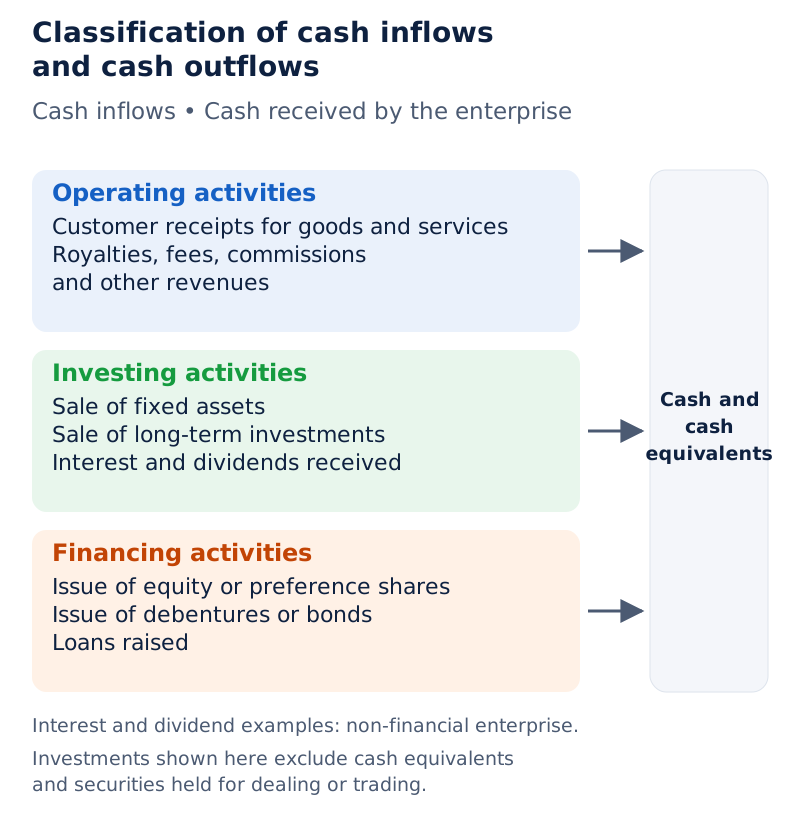
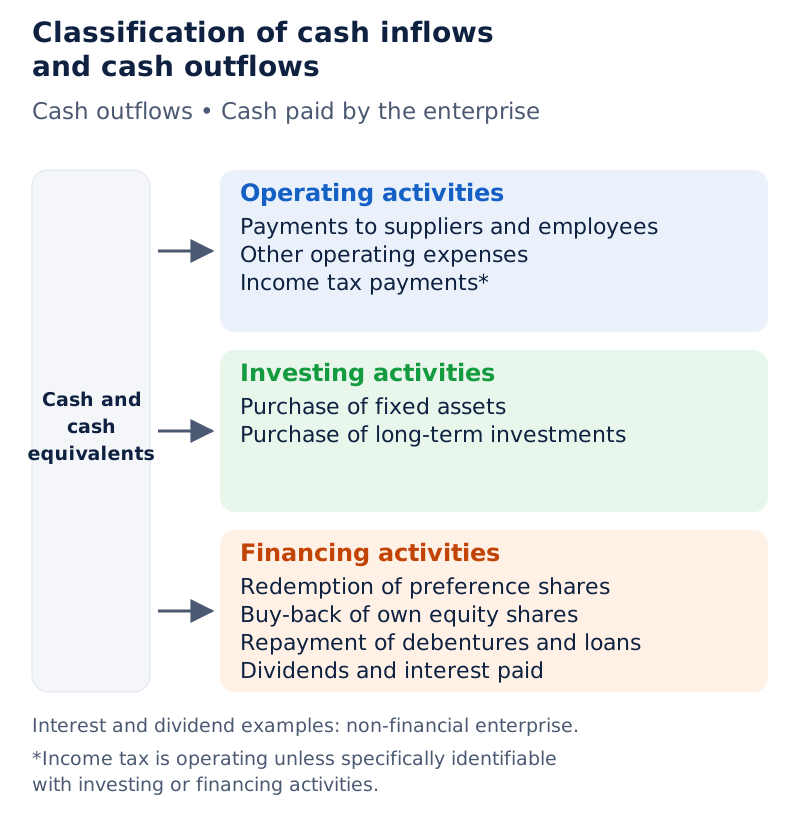
The diagram places Operating Activities, Investing Activities and Financing Activities in the centre. Linked boxes place cash inflows on the left and cash outflows on the right, including customer receipts, asset transactions, borrowings and repayments.
Drawn by One Young India. Reference: NCERT Class 12 Exhibit 6.1
The diagram separates the direction of movement from the activity category. Each of the three categories can contain both receipts and payments; its net total depends on their relative amounts.
Which cash flows belong to investing activities?
Investing activities concern acquisition and disposal of long-term assets and investments that are not included in cash equivalents. Examples of long-term assets include machinery, furniture, land and buildings. Transactions involving long-term investments also belong here.
Separate reporting shows the extent of expenditure on resources intended to produce future income and cash flows. Buying an asset is a cash outflow when cash is paid; disposing of it creates an inflow when the sale proceeds are received.
What receipts and payments are included?
| Transaction | Investing cash-flow treatment |
|---|---|
| Acquire fixed assets, including intangibles | Cash outflow, including capitalised research and development payments |
| Dispose of fixed assets, including intangibles | Cash inflow from the proceeds received |
| Acquire shares, warrants or debt instruments of other enterprises | Cash outflow, excluding instruments held for trading and cash equivalents |
| Dispose of those investments | Cash inflow, subject to the same classification exclusions |
| Advance or lend to third parties | Cash outflow, except for the operating activity of financial enterprises |
| Receive repayment of those advances or loans | Cash inflow, except for the operating activity of financial enterprises |
| Receive interest or dividends in a non-financial enterprise | Investing cash inflow |
Distinguish the sale proceeds from the profit or loss on disposal. The investing section records the cash received. Under the indirect method, the profit or loss included in accounting profit is adjusted separately when calculating operating cash flow.
Major gross receipts and payments should be shown separately before reporting the net investing total. A net outflow therefore does not mean that the enterprise received no investing cash during the period; its payments may simply exceed its receipts.
How are financing cash flows calculated?
Financing activities change the size or composition of owners' capital and borrowings. They include equity and preference share capital and both short-term and long-term borrowings. Separate disclosure helps users anticipate future cash claims by providers of funds.
Receipts from issuing shares, debentures, bonds and loans are financing inflows. Repayment of borrowed amounts and payment of dividends are outflows. For a non-financial enterprise, interest paid on debentures and long-term loans is also classified as financing.
Why is the change in a loan balance insufficient?
The closing loan balance records what remains outstanding. It does not, by itself, show total new borrowing if repayments also occurred. Reconstruct the account so that gross receipts and payments can be disclosed separately.
Worked example 1. Long-term loans were ₹2,00,000 on 1 April 2016 and ₹2,50,000 on 31 March 2017. The company repaid ₹1,00,000 during the year. Calculate new borrowings and net financing cash flow from these loans.
Answer: New borrowings = ₹2,50,000 + ₹1,00,000 − ₹2,00,000 = ₹1,50,000. Net financing inflow = ₹1,50,000 − ₹1,00,000 = ₹50,000.
New loans = Closing loans + Repayments − Opening loans
The Long-term Loan Account below reconstructs the movement. The debit side records repayment and the closing balance; the credit side records the opening balance and the new cash borrowing.
| Dr. particulars | Amount (₹) | Cr. particulars | Amount (₹) |
|---|---|---|---|
| Cash: loan repaid | 1,00,000 | Balance b/d | 2,00,000 |
| Balance c/d | 2,50,000 | Cash: new loan raised | 1,50,000 |
| Total | 3,50,000 | Total | 3,50,000 |
The financing section therefore shows ₹1,50,000 as proceeds and ₹1,00,000 as repayment. Reporting only the ₹50,000 increase would conceal the separate borrowing and repayment transactions.
How are interest, dividends, extraordinary items and non-cash transactions treated?
The same cash receipt or payment can have a different classification depending on the enterprise. Identify whether it is a financial enterprise before deciding the treatment of interest paid, interest received and dividends received.
| Item | Financial enterprise | Non-financial enterprise |
|---|---|---|
| Interest paid | Operating | Financing |
| Interest received | Operating | Investing |
| Dividend received | Operating | Investing |
| Dividend paid | Financing | Financing |
How are unusual cash flows and taxes classified?
Extraordinary items are non-recurring, such as losses associated with theft, earthquake or flood. Associated cash flows are classified as operating, investing or financing according to their nature and disclosed separately. This helps users understand their effect on present and future cash flows.
Taxes on income are separately disclosed. They are normally operating cash flows unless specifically identifiable with investing or financing activities. Tax connected with the sale of fixed assets belongs with investing activity; tax paid on a dividend belongs with financing activity.
Classification can also require splitting a payment. For a fixed asset acquired on deferred payment terms, an instalment containing both interest and an asset-related loan element is separated: the interest is financing and the asset-related element is investing.
What happens when no cash moves?
Non-cash investing and financing transactions are excluded from the cash flow statement. Acquiring machinery by issuing equity shares and redeeming debentures through an issue of equity shares do not use cash or cash equivalents.
Such transactions are disclosed elsewhere in the financial statements with the relevant information. Exclusion from the cash flow statement does not mean that the acquisition, redemption or change in share capital is omitted from accounting records.
Note: Machinery acquired through an issue of shares creates no cash investing outflow and no cash financing inflow. Recording both would invent cash movement that did not occur.
A purchase of shares for a share brokerage firm's trading business is operating, whereas a purchase as an investment by another enterprise is investing. Classification follows the transaction's role in that enterprise.
How do the direct and indirect methods differ?
The direct method reports major classes of gross operating cash receipts and payments. The indirect method starts from profit and adjusts it for non-cash transactions, accruals and deferrals, and items whose cash effects belong to investing or financing.
Both methods arrive at the same operating cash-flow total when applied to the same information. The direct method supplies information useful for estimating future cash flows. In practice, companies mostly use the indirect method.
Why must accounting profit be adjusted?
The statement of profit and loss is prepared on the accrual basis. It includes income and expenses that need not coincide with cash receipts and payments, as well as depreciation and items such as profit on asset sales.
- Begin with net profit or loss before tax and extraordinary items.
- Add back non-cash charges and expenses associated with investing or financing cash flows.
- Deduct incomes associated with investing or financing cash flows.
- Adjust operating current assets and current liabilities to convert the accrual result into cash generated from operations.
- Deduct income tax paid and show relevant extraordinary cash flows separately to obtain net operating cash flow.
Worked example 2. Profit before tax is ₹30,000 after charging depreciation of ₹5,000 and finance costs of ₹5,000, and including profit on sale of land of ₹2,000. Find operating profit before working-capital changes.
Answer: ₹30,000 + ₹5,000 + ₹5,000 − ₹2,000 = ₹38,000. Depreciation is added back as a non-cash charge; finance costs are removed from operating profit; the land-sale profit is deducted.
This ₹38,000 is an intermediate subtotal. Working-capital changes and tax payments are still required before it can be called net cash from operating activities. Adding back an expense changes its treatment within the statement; it does not turn the expense into a cash receipt.
The interest cash payment belongs in financing for a non-financial enterprise. The full cash proceeds of the land sale belong in investing. Neither amount should be confused with the adjustments used to remove their effects from accounting profit.
How do working-capital changes affect operating cash flow?
Working-capital adjustments reconcile operating profit with the cash received and paid. Compare the opening and closing operating current assets and current liabilities. Cash and cash equivalents themselves are excluded from these adjustments.
| Change | Adjustment | Examples |
|---|---|---|
| Increase in operating current assets | Deduct | Increase in trade receivables, inventory or prepaid expenses |
| Decrease in operating current assets | Add | Decrease in trade receivables, inventory or prepaid expenses |
| Increase in operating current liabilities | Add | Increase in trade payables or outstanding expenses |
| Decrease in operating current liabilities | Deduct | Decrease in trade payables or outstanding expenses |
Why do these signs apply?
An increase in trade receivables means that part of recognised revenue remains uncollected. Deduct that increase. An increase in trade payables means that some recognised purchases or expenses remain unpaid, so add it when converting profit into cash.
Prepaid expenses involve cash paid before the related expense is fully recognised. Their increase reduces operating cash flow relative to profit. Outstanding expenses have the opposite effect: their increase represents expense recognised without the corresponding cash payment.
Worked example 3. Profit before tax and extraordinary items is ₹42,000 and depreciation is ₹20,000. Trade receivables increase ₹3,000, inventories ₹5,000 and prepaid insurance ₹500. Trade payables decrease ₹2,000; outstanding employee-benefit expenses increase ₹1,000. Income tax paid is ₹11,000. Calculate operating cash flow.
Answer: Operating profit before working-capital changes = ₹42,000 + ₹20,000 = ₹62,000. Cash generated = ₹62,000 − ₹3,000 − ₹5,000 − ₹500 − ₹2,000 + ₹1,000 = ₹52,500. Net operating cash flow = ₹52,500 − ₹11,000 = ₹41,500.
Net operating cash = Cash generated − Income tax paid
This formula applies to the example, which has no extraordinary cash-flow adjustment. Where such an item exists, its cash effect must also be shown under the appropriate activity.
Note: Increases in share capital and changes in patents are not operating working-capital adjustments. Identify the nature of each balance instead of applying the current-asset and current-liability sign rules indiscriminately.
How are tax payments, tax refunds and retained profits adjusted?
Tax expense and tax paid are different figures. Tax expense contributes to the year's profit calculation. Actual payment depends on the opening tax liability, the current provision and the liability still outstanding at the end.
Tax paid = Opening provision + Current provision − Closing provision
This reconciliation applies where those are the movements in the provision account. Do not substitute the closing tax provision for tax paid merely because it appears in the balance sheet.
How can tax and working-capital adjustments be combined?
Worked example 4. Profit after tax is ₹12,000 after a tax provision of ₹8,000. It includes a ₹3,000 income tax refund and ₹2,000 machinery-sale profit, and charges depreciation ₹5,000, goodwill amortisation ₹2,000 and equipment-sale loss ₹3,000.
Tax provision moves from ₹10,000 to ₹13,000; rent payable from ₹2,000 to ₹2,500; trade payables from ₹21,000 to ₹25,000; receivables from ₹15,000 to ₹21,000; and inventories from ₹25,000 to ₹22,000. Calculate net operating cash flow.
Answer: Adjusted starting profit = ₹12,000 + ₹8,000 − ₹3,000 = ₹17,000. Operating profit before working-capital changes = ₹17,000 + ₹5,000 + ₹2,000 + ₹3,000 − ₹2,000 = ₹25,000.
Cash generated = ₹25,000 + ₹3,000 + ₹500 + ₹4,000 − ₹6,000 = ₹26,500. Tax paid = ₹10,000 + ₹8,000 − ₹13,000 = ₹5,000. Net operating cash flow = ₹26,500 − ₹5,000 + ₹3,000 = ₹24,500.
The rent payable increases by ₹500, so it is added. The refund is removed from the starting profit and then shown separately as an operating cash receipt. This prevents counting it twice.
How are surplus movements and dividends handled?
When profit is not supplied, compare opening and closing balances of the statement of profit and loss. Restore appropriations debited to surplus, such as transfers to reserves and declared dividends, where necessary to reconstruct profit. Add the current tax provision to obtain profit before tax.
A previous year's proposed dividend, once approved in the current year, is accounted for as dividend payable. When it has reduced surplus, restore it in reconstructing profit; the cash dividend paid appears under financing activities.
If the starting figure is profit from the statement of profit and loss and dividend has not reduced that figure, do not add dividend again. A current proposal by itself is not evidence of a cash payment.
How do machinery ledgers reveal purchases, depreciation and sale proceeds?
A change in the machinery balance can reflect purchases, disposals and depreciation. When accumulated depreciation is shown separately, distinguish machinery at cost from its carrying amount. Analyse the disposal before calculating the cash purchase figure.
Worked example 5. Welprint Ltd. has machinery at cost of ₹50,000 on 1 April 2016 and ₹60,000 on 31 March 2017. Accumulated depreciation is ₹25,000 and ₹15,000 respectively. Machinery costing ₹25,000, with accumulated depreciation ₹15,000, is sold for ₹13,000. Find purchases, depreciation, disposal profit and net investing cash flow.
Answer: Carrying amount of machinery sold = ₹25,000 − ₹15,000 = ₹10,000. Disposal profit = ₹13,000 − ₹10,000 = ₹3,000. Machinery purchases = ₹60,000 + ₹25,000 − ₹50,000 = ₹35,000.
Depreciation for the year = ₹15,000 + ₹15,000 − ₹25,000 = ₹5,000. Net investing cash flow = ₹13,000 − ₹35,000 = −₹22,000, a cash outflow.
Carrying amount = Original cost − Accumulated depreciation
Disposal profit = Sale proceeds − Carrying amount
What do the ledger accounts show?
The Machinery Account below records cost, sale proceeds, accumulated depreciation removed on disposal and disposal profit. The balancing cash debit identifies new machinery purchased. Its two sides both total ₹88,000.
| Dr. particulars | Amount (₹) | Cr. particulars | Amount (₹) |
|---|---|---|---|
| Balance b/d | 50,000 | Cash: sale proceeds | 13,000 |
| Statement of Profit and Loss: disposal profit | 3,000 | Accumulated depreciation | 15,000 |
| Cash: machinery purchased | 35,000 | Balance c/d | 60,000 |
| Total | 88,000 | Total | 88,000 |
The Accumulated Depreciation Account removes depreciation attached to the asset sold and carries forward the remaining balance. The balancing credit is depreciation charged during the year.
| Dr. particulars | Amount (₹) | Cr. particulars | Amount (₹) |
|---|---|---|---|
| Machinery: depreciation on asset sold | 15,000 | Balance b/d | 25,000 |
| Balance c/d | 15,000 | Statement of Profit and Loss: depreciation | 5,000 |
| Total | 30,000 | Total | 30,000 |
For operating cash flow, add back depreciation and deduct the disposal profit if they have affected profit. For investing cash flow, report the ₹13,000 receipt and ₹35,000 payment separately. The ₹3,000 profit is not an additional cash receipt.
How is the complete cash flow statement prepared and checked?
Prepare the operating, investing and financing sections separately, calculate each net total, and combine them. Then add opening cash and cash equivalents. The resulting closing figure should agree with the corresponding balance-sheet amounts, including qualifying short-term investments.
Net cash change = A + B + C
Closing balance = Opening balance + Net cash change
Here A, B and C denote net operating, investing and financing cash flows. In the second formula, opening and closing balances include both cash and cash equivalents. Use negative amounts for net cash used by an activity.
What does a complete numerical statement look like?
Worked example 6. Consider a simplified case for a non-financial enterprise, with all figures in ₹ thousands. Assume the stated new cash borrowing and cash repayments are the only loan movements. Profit before tax is 3,530, including earthquake insurance proceeds 140, interest income 300 and dividend income 200, after depreciation 450 and interest expense 400.
Receivables rise from 1,200 to 1,700; inventory falls from 1,950 to 900; trade payables fall from 1,890 to 150. Tax expense is 300 and tax payable falls from 1,000 to 400. Interest payable rises from 100 to 230.
Cash fixed-asset purchases are 350 and sale proceeds 20. Interest received is 200 and dividends received, net of TDS, are 200. Shares issued bring 250; new loans bring 250; loans outstanding move from 1,040 to 1,110. Dividends paid are 1,200.
Opening cash and bank balances are 25 and qualifying short-term investments 135. Closing balances are 200 and 670 respectively. Prepare and reconcile the statement using these data.
Answer: Tax paid = 1,000 + 300 − 400 = 900. Interest paid = 100 + 400 − 230 = 270. Loan repayment = 1,040 + 250 − 1,110 = 180. The completed statement follows, with all amounts in ₹ thousands.
| Particulars | Amount (₹ thousands) |
|---|---|
| A. Operating activities: profit before tax and extraordinary item, 3,530 − 140 | 3,390 |
| Add depreciation | 450 |
| Deduct interest income | (300) |
| Deduct dividend income | (200) |
| Add interest expense | 400 |
| Operating profit before working-capital changes | 3,740 |
| Deduct increase in trade receivables | (500) |
| Add decrease in inventories | 1,050 |
| Deduct decrease in trade payables | (1,740) |
| Cash generated from operations | 2,550 |
| Deduct income tax paid | (900) |
| Cash flow before extraordinary item | 1,650 |
| Add earthquake disaster settlement proceeds | 140 |
| A. Net operating cash flow | 1,790 |
| B. Investing activities: purchase of fixed assets | (350) |
| Proceeds from sale of equipment | 20 |
| Interest received | 200 |
| Dividends received, net of TDS | 200 |
| B. Net investing cash flow | 70 |
| C. Financing activities: issue of share capital | 250 |
| Proceeds from long-term borrowings | 250 |
| Repayment of long-term borrowings | (180) |
| Interest paid | (270) |
| Dividends paid | (1,200) |
| C. Net financing cash flow | (1,150) |
| Net increase in cash and cash equivalents: A + B + C | 710 |
| Add opening cash and cash equivalents: 25 + 135 | 160 |
| Closing cash and cash equivalents: 200 + 670 | 870 |
How is the reconciliation verified?
The activity totals give 1,790 + 70 − 1,150 = 710. Adding the opening balance of 160 gives 870. Independently, closing cash and bank balances of 200 plus qualifying investments of 670 also give 870.
Retain the ₹ thousands unit throughout this example. Mixing rupees with thousands would distort every subtotal. The final reconciliation checks the combined cash balance, while the separate headings explain how each activity contributed to its movement.
Glossary
- Cash — Cash in hand and demand deposits with banks available to the enterprise.
- Cash equivalents — Short-term, highly liquid investments readily convertible into known cash amounts and subject to insignificant risk of value changes.
- Cash inflow — Cash received from transactions such as customer collections or disposal of machinery.
- Cash outflow — Cash paid for transactions such as purchases, employee payments or loan repayments.
- Cash flow statement — A statement showing changes in cash and cash equivalents through operating, investing and financing activities over a period.
- Operating activities — Principal revenue-producing activities and other activities that are neither investing nor financing.
- Investing activities — Acquisition and disposal of long-term assets and investments excluded from cash equivalents.
- Financing activities — Activities changing the size or composition of owners' capital and enterprise borrowings.
- Direct method — Reporting operating cash flows through major classes of gross cash receipts and payments.
- Indirect method — Determining operating cash flow by adjusting profit for non-cash items, accruals and investing or financing effects.
- Extraordinary items — Non-recurring items whose associated cash flows are separately disclosed under the appropriate activity.
- Non-cash transactions — Investing or financing transactions that require no use of cash or cash equivalents.
Common errors and misconceptions
- Misconception: Net profit is the same as operating cash flow. Correct: Profit includes accruals, non-cash charges and non-operating items that require adjustment under the indirect method.
- Misconception: Every investment purchase is an investing cash outflow. Correct: Acquisition of a qualifying cash equivalent is cash management; securities bought for trading are operating items.
- Misconception: An increase in receivables increases operating cash. Correct: Deduct the increase because revenue recognised has not yet been fully collected.
- Misconception: Depreciation added back is a cash receipt. Correct: The adjustment reverses a non-cash expense already deducted in calculating profit; it creates no receipt.
- Misconception: The profit on a machinery sale is its investing inflow. Correct: Show the actual sale proceeds as investing cash and remove the disposal profit from operating profit.
- Misconception: The closing tax provision equals tax paid. Correct: Reconcile opening provision, current provision and closing provision to determine the actual payment.
- Misconception: Interest has the same classification for every enterprise. Correct: Interest paid and received are operating for financial enterprises; for non-financial enterprises, payment is financing and receipt investing.
- Misconception: Issuing shares to acquire machinery creates two cash flows. Correct: It is a non-cash transaction, excluded from the cash flow statement and disclosed elsewhere in the financial statements.
Exam-style questions with model answers
Q1. Define cash and cash equivalents. [2 marks]
- Cash comprises cash in hand and demand deposits with banks.
- Cash equivalents are short-term, highly liquid investments readily convertible into known amounts of cash, with insignificant risk of value changes.
Q2. For a non-financial enterprise, classify cash receipts from selling goods, cash purchase of machinery and proceeds from issuing equity shares. Explain each classification. [3 marks]
- Receipts from selling goods are operating inflows because sales form part of the enterprise's principal revenue-producing activities and bring cash from customers.
- Cash purchase of machinery is an investing outflow because the enterprise pays to acquire a long-term asset intended to support future activity.
- Proceeds from issuing equity shares are financing inflows because they increase owners' capital through funds received from shareholders.
Q3. Explain the indirect-method treatment of an increase in trade receivables, a decrease in inventory, an increase in trade payables and a decrease in outstanding expenses. [4 marks]
- Deduct the increase in trade receivables because part of recognised revenue has not yet produced a cash receipt.
- Add the decrease in inventory when converting operating profit into cash generated, following the rule for decreases in operating current assets.
- Add the increase in trade payables because the recognised purchases or expenses have not all been paid in cash.
- Deduct the decrease in outstanding expenses because settlement of previously unpaid expenses reduces cash relative to the accrual profit.
Q4. Welprint Ltd.'s machinery at cost rises from ₹50,000 to ₹60,000. Accumulated depreciation falls from ₹25,000 to ₹15,000. Machinery costing ₹25,000 with accumulated depreciation ₹15,000 is sold for ₹13,000. Calculate its carrying amount, disposal profit, purchases, depreciation charge and net investing cash flow. [5 marks]
- The carrying amount of the machinery sold is original cost less accumulated depreciation: ₹25,000 − ₹15,000 = ₹10,000. This is distinct from its cash sale proceeds.
- The disposal profit is sale proceeds less carrying amount: ₹13,000 − ₹10,000 = ₹3,000. This profit is removed when adjusting operating profit.
- Machinery purchases equal closing cost plus cost disposed of less opening cost: ₹60,000 + ₹25,000 − ₹50,000 = ₹35,000.
- The depreciation charge equals closing accumulated depreciation plus depreciation removed on disposal less opening accumulated depreciation: ₹15,000 + ₹15,000 − ₹25,000 = ₹5,000.
- Net investing cash flow is ₹13,000 − ₹35,000 = −₹22,000. Report sale proceeds ₹13,000 and purchases ₹35,000 separately, giving a net cash outflow of ₹22,000.
Q5. Profit before tax and extraordinary items is ₹42,000; depreciation is ₹20,000. Receivables increase ₹3,000, inventories ₹5,000 and prepaid insurance ₹500. Trade payables decrease ₹2,000; outstanding employee-benefit expenses increase ₹1,000. Tax paid is ₹11,000. Using only these adjustments, calculate net operating cash flow in six stages. [6 marks]
- Start with profit before tax and extraordinary items of ₹42,000. Add back depreciation ₹20,000 because it reduced profit without a cash payment, giving ₹62,000 before working-capital changes.
- Deduct the ₹3,000 increase in trade receivables to adjust for revenue not yet collected. The running subtotal becomes ₹59,000.
- Deduct inventory increase ₹5,000 and prepaid insurance increase ₹500, both increases in operating current assets. The running subtotal becomes ₹53,500.
- Deduct the ₹2,000 decrease in trade payables because this change reduces operating cash relative to profit. The subtotal becomes ₹51,500.
- Add the ₹1,000 increase in outstanding employee-benefit expenses. Cash generated from operations before payment of tax is now ₹52,500.
- Deduct income tax paid ₹11,000. Net cash from operating activities is ₹52,500 − ₹11,000 = ₹41,500, an operating cash inflow.
Q6. Opening long-term loans are ₹2,00,000 and closing loans ₹2,50,000. During the year, ₹1,00,000 is repaid. These are the only loan movements apart from new cash borrowings. Calculate new borrowings and show the financing cash flows. [3 marks]
- Reconstruct the loan movement: new borrowing equals closing loans plus repayment less opening loans, or ₹2,50,000 + ₹1,00,000 − ₹2,00,000 = ₹1,50,000.
- Report ₹1,50,000 as proceeds from long-term borrowings and ₹1,00,000 as a separate financing payment for repayment of loans during the year.
- The net financing inflow from these transactions is ₹1,50,000 − ₹1,00,000 = ₹50,000, matching the increase in the outstanding loan balance.
Q7. Machinery is acquired entirely by issuing equity shares. How is this treated in the cash flow statement and other financial statements? [2 marks]
- Exclude the transaction from the cash flow statement because no cash or cash equivalents are used or received.
- Disclose the relevant information elsewhere in the financial statements as a non-cash investing and financing transaction.
Q8. Explain four differences or relationships between the direct and indirect methods of reporting operating cash flows. [4 marks]
- The direct method reports major classes of gross cash receipts and gross cash payments arising from operating activities.
- The indirect method begins with profit before tax and extraordinary items and adjusts non-cash, non-operating and working-capital effects.
- The direct method provides information useful for estimating future cash flows; that information is not available in the same form under the indirect method.
- Both methods produce the same net operating cash flow from the same underlying information, although companies mostly use the indirect method in practice.
Key takeaways
- A cash flow statement explains changes in cash and cash equivalents through operating, investing and financing activities during a period.
- Cash equivalents require ready conversion into known cash amounts and insignificant risk of changes in value.
- Classify each transaction by its role in the enterprise; financial enterprises treat several interest-related flows as operating.
- The indirect method removes non-cash and non-operating effects from profit before adjusting operating current assets and liabilities.
- Deduct increases in operating current assets and decreases in operating current liabilities; apply the opposite treatment to opposite changes.
- Use actual asset sale proceeds, cash purchases, borrowings and repayments, supported by ledger workings where balances alone are insufficient.
- Exclude non-cash investing and financing transactions from the cash flow statement while disclosing their relevant information elsewhere.
- Check that the three net activity totals plus opening cash and cash equivalents equal the closing combined balance.
Test yourself
From which date is the normal short maturity of a cash equivalent considered?
From the date of acquisition, normally with a maturity of, say, three months or less.
Why is depreciation added back under the indirect method?
It reduced accounting profit but did not involve a cash payment during the period.
How is an increase in prepaid expenses treated?
Deduct it because an increase in an operating current asset reduces cash relative to profit.
How does a non-financial enterprise classify interest received and interest paid?
Interest received is an investing inflow; interest paid is a financing outflow.
Why is the profit on sale of machinery different from its cash inflow?
Profit is sale proceeds less carrying amount; the investing cash inflow is the full proceeds received.
Where are extraordinary cash flows reported?
Separately within operating, investing or financing activities, according to the nature of the cash flow.
What happens to the purchase of a qualifying cash equivalent?
It is treated as cash management, not as an investing outflow in the cash flow statement.
What is the final reconciliation in a cash flow statement?
Opening cash and cash equivalents plus net operating, investing and financing cash flows equal closing cash and cash equivalents.