
Matter | ICSE Class 8 Chemistry Notes
On this page
Watch & explore
Start with a few high-quality watches, then dive into the notes below.
Try an idea before you read. Investigate how kinetic energy and intermolecular forces drive state transitions and cooling effects at the molecular level. Explore →

This note covers matter and its constituent particles, the kinetic theory of matter, interparticle spaces and attractions, solids, liquids and gases, particle motion and collisions, melting, boiling, evaporation, freezing, condensation, sublimation, deposition, and conservation of mass in physical and chemical changes.
What is matter, and what are its constituent particles?
Definition: Matter has mass and occupies space. It is made up of extremely small constituent particles.
Stones, water, sugar and air are examples of matter. Their appearances differ, but each has mass and occupies space. Matter need not be visible: air occupies space inside a balloon even though we cannot see the air itself.
What does breaking chalk show?
A stick of chalk can be broken into pieces. Grinding those pieces with a mortar and pestle produces a fine powder. Each visible speck is still chalk. Breaking and grinding change the size of the pieces without producing a new substance.
Even these fine grains contain much smaller units. A constituent particle is a basic unit making up a larger piece of a substance. A visible grain of chalk or sugar must not be mistaken for a single constituent particle.
- Observe a whole stick of chalk.
- Break it into smaller pieces, then grind the pieces into powder.
- Examine the powder using a magnifying glass.
- Recognise that the visible grains remain chalk and contain still smaller constituent particles.
How small are these particles?
Constituent particles are too small to be seen even through an ordinary microscope. Dust particles suspended in air are much larger: each dust particle itself contains a very large number of constituent particles. The word particle therefore needs to be understood in context.
Atoms and molecules are particles that constitute matter. Iron consists of iron atoms, while a water molecule contains two hydrogen atoms and one oxygen atom. These are descriptions of composition, distinct from whether a substance is solid, liquid or gaseous.
Acharya Kanad proposed an ancient idea of tiny, indivisible particles called Parmanu, recorded in the Vaisheshika Sutras. The particle model helps connect the materials we observe with the much smaller units from which they are built.
How does the kinetic theory explain the behaviour of matter?
The kinetic theory of matter explains the behaviour of matter through its particles and their motion. It connects the state of a substance with particle spacing, attractive forces and the energy available for movement.
What are the main ideas of the particle model?
- Tiny particles: Matter consists of extremely small constituent particles.
- Interparticle spaces: There are spaces between particles, including particles in a solid.
- Interparticle attractions: Attractive forces hold particles together. Their strength depends on the substance and the distance between particles.
- Motion: Solid particles vibrate about their positions; liquid and gas particles can move from place to place.
- Heating: Supplying heat increases particle movement and can bring about a change of state.
These ideas work together. Strong attraction and close packing explain why a solid retains its shape. Slightly weaker attractions allow liquid particles to move past one another within a limited space. Negligible attractions in gases allow particles to spread through the available space.
Why do collisions matter?
Moving particles collide with other particles. In water containing potassium permanganate, water particles help separate particles from the grain and hit them, spreading them through the liquid. In air, collisions help fragrance particles spread from an incense stick through a room.
Particle motion continues even when the material appears still. A stationary piece of wood is not evidence that its constituent particles have stopped moving. Their motion is restricted to vibrations about their positions, rather than free movement through the object.
Note: Interparticle spaces are not filled with air. Air is itself matter made of particles. In this particle model, the spaces between constituent particles contain nothing.
The energy associated with heating influences particle motion and separation. Changes in separation affect attraction, so heating and cooling help explain why the same substance can occur in different physical states.
Why do solids have a definite shape and volume?
An iron nail, a stone, rock salt, a wooden block, a key and a piece of aluminium are examples of solids. A solid has a definite shape and volume because its particles are closely packed and held by strong attractive forces.
How do particles move in a solid?
The particles occupy fixed positions relative to one another. They can move to and fro about those positions, a motion called vibration or oscillation. They cannot move past one another freely as liquid particles can.
Fixed positions do not mean complete absence of movement. They mean that ordinary particle motion does not carry the particles from one place in the solid to another. This distinction explains how a solid can retain its shape while its particles remain in motion.
Close packing also does not mean that every space has vanished. There are still gaps between particles, but these are much smaller than those in gases. The strong attractions and close arrangement together account for the characteristic behaviour of solids.
Why is a heap of grains still solid?
Grains of rice and rice flour may take the overall shape of a container. This does not make them liquids. Each grain is a separate solid piece. Rearranging many pieces is different from particles within a liquid moving past one another.
What the figure shows
Particle spacing in three states
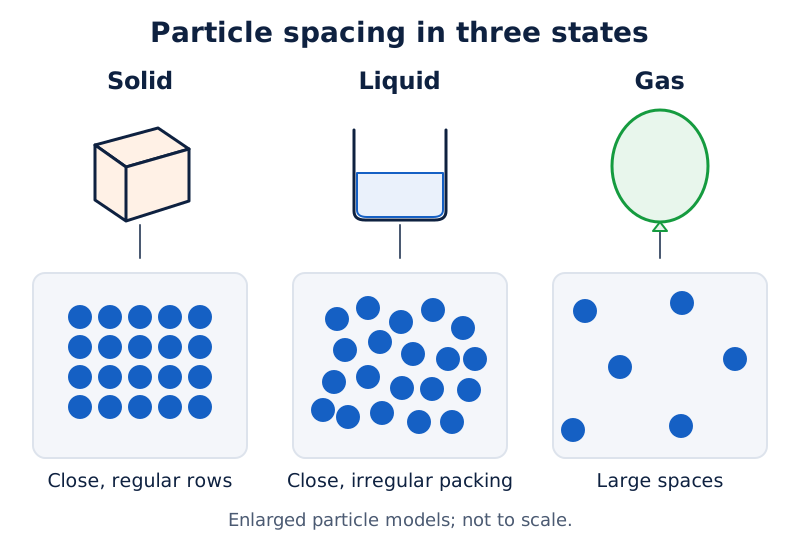
Three enlarged particle pictures are linked to a solid, water in a beaker and gas in a balloon. The solid picture has closely arranged rows, the liquid picture has close but irregularly arranged particles, and the gas picture has widely separated particles.
Drawn by One Young India.
These pictures represent a model of the arrangement, rather than a view through an ordinary microscope. Use the relative spacing and arrangement to compare states, while remembering that real constituent particles are extremely small.
How do liquids keep their volume while changing shape?
A liquid has a definite volume but no fixed shape. Its particles can move past one another, so the liquid takes the shape of the part of the container it occupies. Their attractions still keep them close together.
What does transferring water demonstrate?
Consider three clean, dry containers of different shapes, labelled A, B and C. These letters identify the containers. Mark the same volume, 200 millilitres, in each. The unit symbol mL means millilitre and is used to express volume.
- Fill container A with water up to its 200 mL mark.
- Transfer the water carefully into container B without spilling it.
- Observe that the water takes a different shape but reaches the 200 mL mark.
- Transfer it into container C and again compare its shape and volume.
The shape changes with the container, but the volume remains the same. If a container is not clean, some water may stick to its walls, causing the amount transferred to be slightly less. This practical loss should not be confused with a change in the nature of liquids.
What the figure shows
Equal volumes in different containers
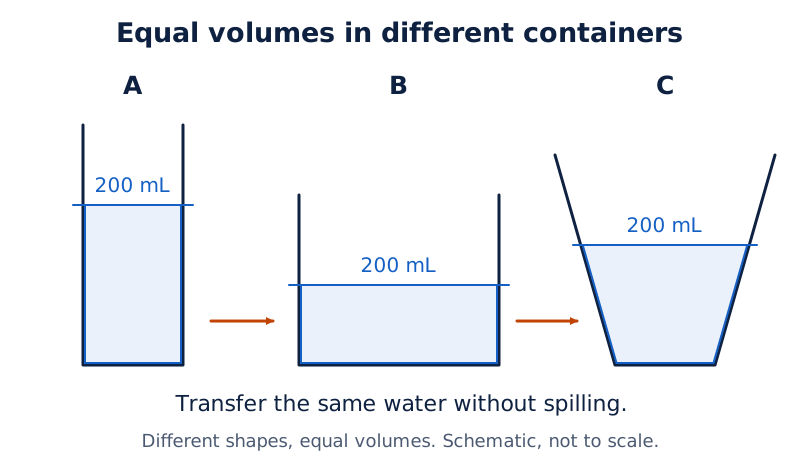
Water is shown in three differently shaped containers labelled A, B and C. Each water level is marked 200 mL, although the shapes and heights of the water differ.
Drawn by One Young India.
What keeps the particles together?
Interparticle attractions in liquids are slightly weaker than in solids, but remain strong enough to keep particles close. Moving a finger through water temporarily displaces it. Once the finger is removed, the water returns, unlike a permanently cut solid.
Liquid particles move within a limited space. This combination of mobility and attraction explains both observations: the water can flow into a new shape, yet the same sample does not expand to fill every part of a larger container.
Why do gases spread and compress more easily than liquids?
A gas has neither a fixed shape nor a fixed volume. Its particles move freely in all directions, have large spaces between them and experience negligible interparticle attractions. A gas therefore spreads through the space available to it.
How does a syringe show compressibility?
Compression means reducing the space occupied by a sample. A needle-free syringe can be used to compare trapped air with water. Preventing escape is essential: otherwise, movement of the plunger might simply push material out.
- Pull the plunger of a syringe without a needle outwards to trap air.
- Cover the open end with a thumb so that the air cannot escape.
- Push the plunger slowly inwards and observe the reduced volume of air.
- Repeat with water and compare how readily the volume changes.
Air compresses because its particles can be forced closer together, reducing the large spaces between them. Water is practically incompressible in this activity. Its particles are already much closer together, leaving far less space to reduce.
What the figure shows
Compressing trapped air
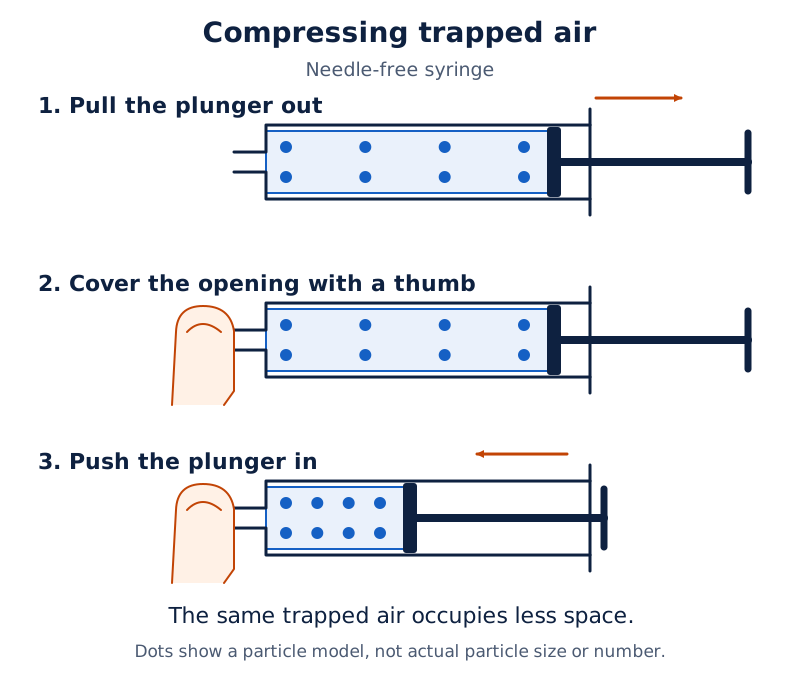
Three drawings show a needle-free syringe with its plunger pulled out, a thumb covering the open end, and the plunger being pushed inwards. Arrows indicate the direction of plunger movement.
Drawn by One Young India.
How do the three states compare?
| Property | Solid | Liquid | Gas |
|---|---|---|---|
| Shape | Definite | Takes the container's shape | Takes the container's shape |
| Volume | Definite | Definite | Fills available space |
| Particle motion | Vibration about fixed positions | Movement within a limited space | Free movement in all directions |
| Attraction | Strong | Slightly weaker than in solids | Negligible |
| Spacing | Generally smallest | Generally slightly greater than in solids | Much greater |
Liquids and gases are called fluids because they flow and do not retain a fixed shape. Their shared ability to flow does not mean that they have the same volume behaviour or the same compressibility.
Smoke can make spreading visible, but smoke particles are not individual gas particles. They are suspended in air and are constantly hit by invisible gas particles. Their movement helps demonstrate the motion occurring in the surrounding gas.
What do dissolving and spreading reveal about particles?
When sugar dissolves in water, the visible sugar grains disappear, but the sugar remains present. Its constituent particles separate and occupy available spaces between water particles. A sweet solution therefore provides evidence that material can remain present even when its particles cannot be seen.
Does dissolving simply add the two volumes?
In a glass vessel, mark the initial water level as A. Add two teaspoons of sugar and mark the higher level as B. After stirring until the sugar dissolves, mark the final level as C. Here A, B and C identify levels.
After dissolution, the level may decrease to some extent from B. The solution's volume is less than the sum of the separate volumes of water and sugar. This supports the presence of spaces between water particles into which sugar particles can fit.
Do not turn this observation into a claim that the final volume must exactly equal the original water volume. The observation concerns a possible decrease from the level immediately after adding sugar, together with the existence of interparticle spaces.
How does colour spread without stirring?
Put a few grains of potassium permanganate into water. Pink streaks initially spread from the grains. With time, the water becomes uniformly pink as moving water particles separate and strike the dissolved particles, spreading them through the liquid.
Compare this process in hot water, water at room temperature and ice-cold water. The colour spreads fastest in hot water and slowest in ice-cold water. This shows that particle movement increases when heat is supplied.
Sand behaves differently from sugar. It does not dissolve in water: its particles settle and occupy space. In such substances, particles are held together strongly enough that water particles cannot pull them out in the way needed for dissolution.
Note: Use a spoon or spatula to handle potassium permanganate, not bare hands. The observation depends on the spreading colour; tasting is not part of this activity.
How does heating turn a solid into a liquid?
Melting is the conversion of a solid into a liquid. Heating increases the energy available to particles. In a solid, this first appears as increasingly vigorous vibrations about their positions.
What changes at the particle level?
- Particles in the solid are closely packed and held in position by strong attractions.
- Heating makes their vibrations more vigorous.
- At melting, supplied energy helps overcome the attractions that keep particles in their fixed positions.
- The particles can then move past one another, producing the liquid state.
The melting point is the minimum temperature at which a solid melts into a liquid at atmospheric pressure. The pressure condition belongs with the definition. A quoted melting temperature should not be treated as independent of the conditions.
The symbol °C means degree Celsius, a unit used to express temperature. Different substances have different melting points because their particles are held together with different strengths of attraction.
| Solid | Melting point at atmospheric pressure |
|---|---|
| Ice | 0 °C |
| Urea | 133 °C |
| Iron | 1538 °C |
What the figure shows
A solid changing into liquid
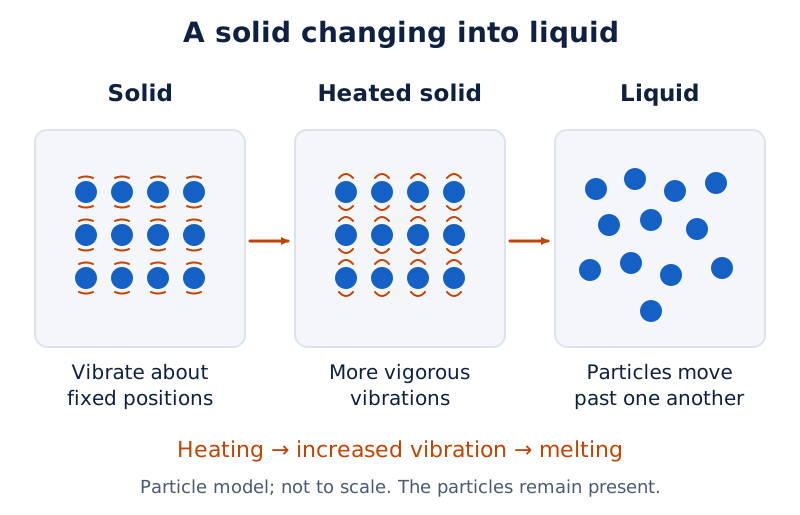
The first picture shows particles closely arranged in regular rows. The middle picture shows increased vibrations around particle positions. The final picture shows an irregular arrangement labelled liquid.
Drawn by One Young India.
What exception must be remembered for ice?
Generally, liquid particles are somewhat farther apart than particles in the corresponding solid. Ice is an exception: its particles are farther apart than those in liquid water. Do not apply the usual spacing comparison to ice without this qualification.
Melting changes the arrangement and freedom of movement of particles. It does not mean that matter disappears. Ice, liquid water and water vapour are different physical states of water, linked by heating and cooling.
The same particle explanation helps relate observations to causes: increased movement weakens the restriction imposed by attraction, allowing particles to leave their fixed positions and form a liquid.
How do boiling, evaporation, freezing and condensation differ?
A liquid can become a gas, and cooling can reverse changes of state. Naming the starting and ending states helps distinguish the processes. Water provides familiar examples through ice, liquid water and water vapour.
What distinguishes boiling from evaporation?
The boiling point is the temperature at which a liquid boils and turns into vapour at atmospheric pressure. Particle movement becomes vigorous enough for particles to separate and escape from the liquid state.
During boiling, vapour forms rapidly both at the surface and within the liquid. Formation inside the liquid is observed as bubbles. This differs from evaporation, which occurs slowly at the surface, including at temperatures below the boiling point.
| Feature | Boiling | Evaporation |
|---|---|---|
| Where vapour forms | Within the liquid and at its surface | At the surface |
| Temperature | At the boiling point for the stated pressure | Also occurs below the boiling point |
| Observation | Rapid vapour formation and bubbles | Slower surface loss of liquid |
Spilled water can disappear gradually without being heated to its boiling point. Its particles enter the air as vapour. The water has changed state and location; the observation does not show that matter has been destroyed.
How can cooling reverse these changes?
Freezing converts a liquid into a solid. Water placed in a freezer becomes ice; liquid candle wax also becomes solid when cooled. Cooling reduces particle movement and allows the solid arrangement, with particles held in positions, to be established.
Condensation converts water vapour into liquid water. When water vapour in air meets a cold surface, droplets can form. The droplets on the outside of a glass containing ice-cold water come from the surrounding air.
A marked water level helps distinguish condensation from leakage. If the water inside does not fall while extra water gathers outside, the observation supports condensation on the outer surface rather than water seeping through the glass.
| Process | Starting state | Ending state |
|---|---|---|
| Melting | Solid | Liquid |
| Freezing | Liquid | Solid |
| Boiling or evaporation | Liquid | Gas |
| Condensation | Gas | Liquid |
Can a solid change directly into vapour?
Sublimation changes a solid directly into vapour without passing through the liquid state. Camphor can sublime when heated below its melting point. On cooling, its vapour can form solid camphor directly, a process called deposition.
A mixture of camphor and sand illustrates this difference. Camphor sublimes on heating while sand remains behind. Cooling the vapour recovers solid camphor. Naphthalene and solid carbon dioxide, called dry ice, are other examples of substances that undergo sublimation.
These processes complete the direct solid-to-gas and gas-to-solid routes. They should be distinguished from evaporation and condensation, which involve the liquid state.
How is mass conserved during a physical change?
A physical change alters a physical feature, such as state or size, without forming a new substance. Grinding chalk, tearing paper and forming a solution of common salt in water provide ways to investigate the mass before and after such changes.
What does the conservation of mass mean?
The law of conservation of mass states that mass is neither created nor destroyed in a chemical reaction. The total mass also remains the same during a physical change. The comparison must account for all the material involved.
Antoine Lavoisier proposed the law in 1789. It describes the equality of the total masses before and after a change, even when the substances change their appearance or new substances form during a chemical reaction.
How can dissolving salt test this?
- Place a clean, dry beaker on a digital balance and reset the reading to zero.
- Add water and a spatula of common salt.
- Record the reading before the salt has dissolved.
- Swirl the beaker until the salt dissolves, then record the reading again.
The mass of the solution equals the sum of the masses of the salt and water taken. Practically, there is no change in the measured mass during solution formation. The salt has not ceased to exist simply because individual grains can no longer be seen.
Tearing a piece of paper provides another comparison. Weigh the paper before tearing and all its pieces afterwards. All the pieces must be included in the second weighing, because leaving some out would no longer compare the same total material.
Note: Conservation of mass is not conservation of visible shape or separate volumes. Dissolving can alter the volume occupied by materials while their total mass remains the same.
A useful explanation therefore identifies both the physical change and the complete material being measured. Changing appearance, becoming invisible in a solution, or spreading into the air is not by itself evidence of loss of matter.
How do experiments verify mass conservation in chemical changes?
During a chemical change, substances react to form new substances. The starting substances are called reactants, and the substances formed are called products. Their properties can differ while the total mass remains the same.
What happens when two solutions react?
Mixing sodium sulphate solution and barium chloride solution forms a white precipitate, an insoluble solid, of barium sulphate, together with sodium chloride. A word equation records the substances involved; the arrow means “forms”.
Sodium sulphate + Barium chloride → Barium sulphate + Sodium chloride
- Place two clean, dry conical flasks on a balance and reset it to zero.
- Put sodium sulphate solution in one flask and barium chloride solution in the other.
- Record their combined mass before mixing.
- Pour one solution into the other, observe the white precipitate, and weigh both flasks together again.
Keeping both flasks in the final weighing includes any solution left on the walls of the pouring flask. The total mass remains the same. This reaction can be observed in an open arrangement because no gas is formed and lost.
What the figure shows
Weighing a reaction before and after mixing
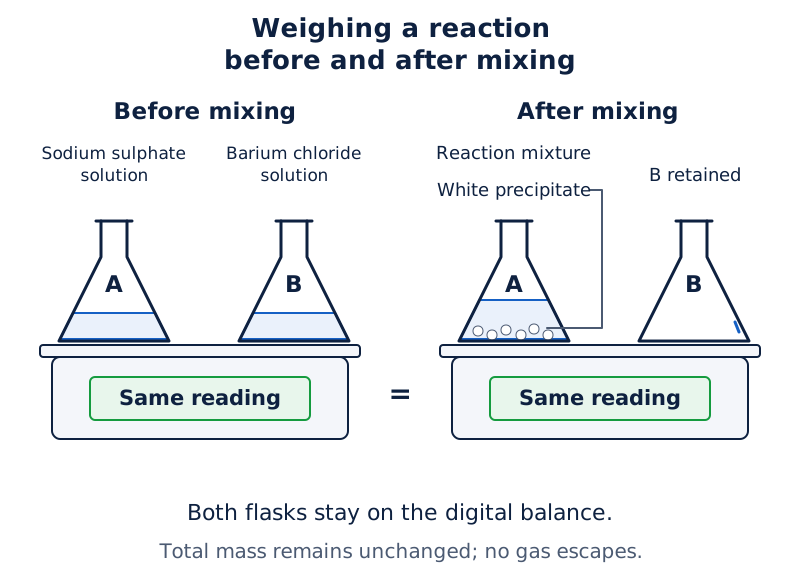
Two conical flasks, labelled A and B, stand together on a digital balance. Before mixing they contain sodium sulphate and barium chloride solutions separately. Afterwards the reaction mixture is in flask A, while both flasks remain on the balance.
Drawn by One Young India.
Why can an open reaction appear to lose mass?
Vinegar reacts with baking soda, also called sodium hydrogencarbonate, to release carbon dioxide gas and form other substances. In an open flask, the gas escapes. A balance then measures less material remaining in the apparatus.
Repeat the reaction with the baking soda initially held in a balloon attached to the flask's mouth. Lift the balloon so that the powder falls into the vinegar. The gas inflates the balloon instead of escaping, and the final reading matches the initial reading.
| Arrangement | What happens to the gas? | Interpretation |
|---|---|---|
| Open vinegar and baking soda reaction | Carbon dioxide escapes | The apparatus no longer contains all the products |
| Flask fitted with a balloon | Carbon dioxide is retained | The complete reaction mixture retains its total mass |
The law is not disproved by an incomplete measurement. Gases are matter too. In reactions involving atmospheric gases, their masses must be included with the reacting materials. Comparing only a visible solid or liquid before and after a reaction may omit essential material.
How are conservation-of-mass calculations worked out?
Begin by identifying the reactants and products, then add the masses on each side. Use the same unit throughout the comparison. Here g means gram, a unit of mass. No mass should be omitted merely because the substance is gaseous.
How can given measurements be checked?
Worked example 1. In a closed container, 4.0 g of calcium carbonate reacts with 2.92 g of hydrochloric acid. The products are 1.76 g of carbon dioxide, 0.72 g of water and 4.44 g of calcium chloride. Verify conservation of mass.
Formula: and . Here and are the total reactant and product masses; , are the two reactant masses, and , , are the three product masses in the order given.
Substitute: Add the reactant masses: .
Add all three product masses: .
Answer: Both totals are 6.92 g, so the measurements obey the law of conservation of mass.
The comparison uses the mass of carbon dioxide along with the liquid and other product. The closed container matters because it keeps the gas within the material being considered. Ignoring the gas would give an incomplete product total.
How can a known reaction ratio be used?
Worked example 2. A reaction combines 12 g of carbon with 32 g of oxygen to form 44 g of carbon dioxide. If 2.4 g of carbon reacts completely with sufficient oxygen in the same proportion, calculate the carbon dioxide produced.
Each 12 g of carbon gives 44 g of carbon dioxide. For 1 g of carbon, the carbon dioxide mass is .
For 2.4 g of carbon, multiply this amount by 2.4: .
Answer: The mass of carbon dioxide produced is 8.8 g.
This calculation uses the supplied reaction proportion as well as complete reaction of the carbon. Conservation of mass alone cannot supply an unspecified reaction ratio. All numerical information needed to scale the reaction is therefore included in the question.
Worked example 3. Hydrogen of mass 20 g reacts completely with oxygen of mass 160 g to form water. Find the mass of water produced.
Add the masses of both gases that reacted: .
Answer: The mass of water formed is 180 g. The mass includes both gases that reacted.
Worked example 4. A reaction uses 5.3 g of sodium carbonate and 6.0 g of acetic acid. It produces 2.2 g of carbon dioxide, 0.9 g of water and 8.2 g of sodium acetate. Verify conservation of mass.
Formula: and , using the mass labels from Worked example 1 in the order given here. Calculate the two totals separately before comparing them.
Substitute: The total reactant mass is .
The total product mass is .
Answer: Both totals are 11.3 g. The given masses obey the law of conservation of mass, including the carbon dioxide among the products.
State the unit with the answer and finish by linking the result to the relevant idea: equal total masses, or a product amount calculated from the given reaction proportion.
Glossary
- Matter — Material that has mass and occupies space, including solids, liquids and gases.
- Constituent particle — A basic unit that makes up a larger piece of a substance or material.
- Interparticle space — The space between constituent particles, which differs in the three states of matter.
- Interparticle attraction — An attractive force between constituent particles that helps hold a substance together.
- Vibration — To-and-fro motion of a particle about its position, as occurs in a solid.
- Fluid — A substance that flows and does not retain a fixed shape; liquids and gases are fluids.
- Melting — The change of a substance from its solid state into its liquid state.
- Melting point — The minimum temperature at which a solid changes into a liquid at atmospheric pressure.
- Boiling point — The temperature at which a liquid boils and changes into vapour at atmospheric pressure.
- Evaporation — The slower formation of vapour at a liquid's surface, including below its boiling point.
- Freezing — The conversion of a liquid into a solid when it is sufficiently cooled.
- Condensation — The conversion of water vapour into liquid water, such as droplets on a cold surface.
- Reactants — The starting substances that participate in a chemical reaction to form products.
- Products — The substances formed during a chemical reaction.
- Conservation of mass — The principle that total mass remains unchanged when all material involved in a change is included.
Common errors and misconceptions
- Misconception: Particles in a solid do not move. Correct: They vibrate about their positions, although they cannot move past one another freely.
- Misconception: Interparticle spaces contain air. Correct: These spaces contain nothing in the particle model; air is itself made of constituent particles.
- Misconception: Dissolved sugar has disappeared from existence. Correct: Its constituent particles remain in the solution even though they cannot be seen separately.
- Misconception: All liquids are more widely spaced than their solids. Correct: This is the general pattern, but ice has particles farther apart than liquid water.
- Misconception: A liquid must boil before it becomes vapour. Correct: Evaporation also occurs below the boiling point, at the surface of the liquid.
- Misconception: Taking the shape of a container proves a material is liquid. Correct: Rice grains can rearrange within a container while each grain remains solid.
- Misconception: A lower balance reading after a reaction proves destruction of mass. Correct: Gas may have escaped; all reactants and products must be included.
Exam-style questions with model answers
Q1. Define matter and give two examples from stones, water, sugar and air. [2 marks]
- Matter has mass and occupies space.
- Stones and water are examples. Sugar and air are also valid examples, even though air cannot be seen directly.
Q2. Explain three differences between solids and gases in terms of particle spacing, attraction and movement. [3 marks]
- Solid particles are closely packed with small spaces between them. Gas particles have much larger spaces and can spread throughout the available volume.
- Solid particles experience strong attractions, while attractions between gas particles are negligible.
- Solid particles vibrate about fixed positions. Gas particles move freely in all directions, so gases lack a fixed shape and volume.
Q3. Water of volume 200 mL is transferred without spilling or retention from one clean container into two others of different shapes in turn. What happens to its shape and volume, and how does particle behaviour explain this? Here mL means millilitre. [3 marks]
- The water takes the shape of the part of each container it occupies. Its volume remains 200 mL because the same sample is transferred without loss.
- Liquid particles can move past one another, which allows the shape to change.
- Attractions between the particles remain strong enough to keep them close, restricting their movement to a limited space and maintaining a definite volume.
Q4. A needle-free syringe contains air and its opening is blocked. Its plunger can be pushed inwards. With water instead, the volume changes very little. Explain both observations and why blocking the opening matters. [4 marks]
- Air has large spaces between its particles.
- Pushing the plunger forces the air particles closer together and reduces the volume of the trapped sample.
- Water particles are already close together, so there is much less space to reduce. Water is practically incompressible in this activity.
- The blocked opening prevents escape. The observed reduction therefore demonstrates compression of the trapped material, rather than simply pushing some of it out of the syringe.
Q5. Explain melting in terms of particle motion, attraction and heating. Define melting point, state its pressure condition, and identify the spacing exception when ice melts. [5 marks]
- In a solid, particles are closely packed and held in positions by strong interparticle attractions. Their movement is restricted to vibrations about those positions.
- Heating supplies energy and makes the particles vibrate more vigorously. At melting, energy helps overcome the attractions that restrict their movement.
- The particles can leave their fixed positions and move past one another, producing a liquid.
- The melting point is the minimum temperature at which a solid changes into liquid at atmospheric pressure.
- Liquid particles are generally farther apart than solid particles, but ice is an exception: its particles are farther apart than those in liquid water.
Q6. Vinegar and baking soda form carbon dioxide gas and other products. An open flask gives a lower final balance reading, while a flask with a balloon retaining the gas gives the same initial and final reading. Explain these observations using conservation of mass and describe a fair comparison. [5 marks]
- The law of conservation of mass states that mass is neither created nor destroyed in a chemical reaction. The total reactant mass equals the total product mass.
- In the open flask, carbon dioxide escapes into the surroundings. The balance no longer measures every product, so its reading decreases.
- In the balloon arrangement, the gas remains inside the apparatus and inflates the balloon. The total mass being measured remains the same.
- A fair comparison weighs the complete flask and balloon arrangement before and after reaction, retaining all products and including any traces of baking soda left in the balloon.
- The open-flask result is an incomplete measurement of the products, not a violation of mass conservation.
Q7. In a closed container, 4.0 g of calcium carbonate reacts with 2.92 g of hydrochloric acid, forming 1.76 g of carbon dioxide, 0.72 g of water and 4.44 g of calcium chloride. Verify conservation of mass. Here g means gram. [3 marks]
- Total mass of reactants = 4.0 g + 2.92 g = 6.92 g.
- Total mass of products = 1.76 g + 0.72 g + 4.44 g = 6.92 g. The carbon dioxide must be included along with the other products.
- The two totals are equal. The supplied measurements therefore obey conservation of mass, with all the products retained in the closed container.
Q8. Given that 12 g of carbon combines with 32 g of oxygen to produce 44 g of carbon dioxide, find the carbon dioxide produced when 2.4 g of carbon reacts completely with sufficient oxygen in the same proportion. Here g means gram. [2 marks]
- The given proportion is 44 g of carbon dioxide for every 12 g of carbon.
- Carbon dioxide produced = (2.4 ÷ 12) × 44 g = 8.8 g.
Key takeaways
- Matter has mass, occupies space and consists of extremely small constituent particles separated by interparticle spaces.
- Solid particles vibrate about fixed positions; liquid particles move within limited space; gas particles move freely in all directions.
- Liquids have definite volume but change shape, while gases expand to occupy the available space.
- Heating increases particle movement and can overcome attractions sufficiently for a substance to change its physical state.
- Boiling produces vapour within a liquid and at its surface; evaporation occurs at the surface, including below boiling point.
- Freezing changes liquid into solid, while condensation changes water vapour into liquid water on cooling.
- Mass remains conserved during physical and chemical changes when every part of the material involved is included.
- Gas escaping from an open reaction explains an apparent decrease in mass without contradicting conservation of mass.
Test yourself
Why does grinding chalk not produce a new substance?
The pieces become smaller, but each remains chalk. Grinding changes the size of the pieces and is a physical change.
Are the particles in a stationary solid also stationary?
No. Solid particles vibrate about their positions, even though they cannot move past one another freely.
Why does air compress readily in a blocked syringe?
Air has large interparticle spaces. Pushing the plunger forces its particles closer together and reduces the volume of the trapped air.
Why does potassium permanganate spread faster in hot water?
Water particles move faster when heated. Their motion and collisions spread potassium permanganate through hot water faster than through cold water.
What is unusual about particle spacing in ice?
Ice particles are farther apart than particles in liquid water, reversing the usual solid-to-liquid spacing comparison.
How can water become vapour without boiling?
Water evaporates at its surface at temperatures below its boiling point, so gradual vapour formation does not require boiling.
Why are both flasks weighed after mixing sodium sulphate and barium chloride solutions?
Some solution may remain on the walls of the pouring flask. Including both flasks keeps this material in the total mass measured.
Why is the carbon dioxide from vinegar and baking soda collected in a balloon?
The balloon retains the gas, allowing the complete apparatus to be weighed before and after the reaction without losing that product.
Try it
ICSE Class 8 Chemistry: Particle Dynamics and Changes of State
Investigate how kinetic energy and intermolecular forces drive state transitions and cooling effects at the molecular level.
1You are heating an ice cube in a beaker. According to the Kinetic Molecular Theory, what is happening to the particles at the microscopic level to cause this transition into liquid water?
Correct! Heating increases the kinetic energy of the particles. At the melting point, they vibrate hard enough to break the rigid lattice bonds and begin sliding and rolling over each other as a liquid.
Heating does not change the particles themselves; it only increases their kinetic energy and helps them overcome intermolecular forces of attraction.
Water ice melts into a liquid as bonds are partially broken; only unique substances with very weak solid intermolecular forces (like iodine or camphor) undergo sublimation to skip the liquid phase.
2A thin layer of liquid is left on your skin at room temperature, and you feel a cooling sensation as it evaporates. Why does evaporation produce this cooling effect?
A violent, bulk transition occurring at one specific temperature with bubbles forming deep within the liquid describes boiling, not evaporation.
Correct! Because particles with the highest kinetic energy escape from the surface into the air, the average kinetic energy of the remaining liquid drops, resulting in a lower temperature.
Evaporation involves higher-energy liquid particles escaping into the gas phase at the surface, not particles freezing into a solid.
You have successfully navigated particle dynamics, state transitions, and the kinetic basis of evaporation!