
Money and Banking | ISC Class 12 Economics Notes
On this page
Watch & explore
Start with a few high-quality watches, then dive into the notes below.
This note covers the meaning and kinds of money, its primary, secondary and contingent functions, measures of money supply, high-powered money, inflation, commercial banking, credit creation and its limitations, central-bank functions, and methods of credit control.
What is money, and how does it overcome barter difficulties?
Definition: Money is a commonly accepted medium of exchange, meaning something people accept in payment for goods and services.
Barter means exchanging goods or services directly without using money. It requires a double coincidence of wants: each participant must want what the other offers. Finding this match can make exchange difficult, especially when many people participate.
Why does general acceptability matter?
A person with surplus rice who wants clothing must find someone with surplus clothing who wants rice. Without that match of wants, the proposed direct exchange cannot take place. Searching for a suitable partner may involve considerable time and expense.
Money separates selling from buying. The rice seller can accept money and use it to purchase clothing. The clothing seller need not want rice because the payment received can be used for another purchase.
General acceptability is therefore central to money's usefulness. An object performs the monetary function because people accept it in exchange; its physical substance alone does not explain that role.
What other difficulties arise under barter?
Barter also makes it difficult to express values in a common unit and preserve wealth conveniently. Rice is perishable, takes storage space and may require another search for a buyer when its owner wants different goods later.
Money provides a common measuring unit and a convenient way to carry purchasing power into the future. Purchasing power means the quantity of goods and services that a sum of money can buy.
These functions are connected but distinct. Accepting money in a sale uses it as a medium of exchange. Quoting a price uses it as a unit of account. Keeping the proceeds for later expenditure uses it as a store of value.
How are the functions of money classified?
What are the primary functions?
The primary functions are medium of exchange and measure of value. A measure of value, also called a unit of account, provides the common monetary unit in which prices and other economic values are expressed.
Once goods have money prices, their relative values can be compared. Relative price means the price of one good expressed in units of another. A common unit avoids expressing every exchange directly as a separate barter ratio.
Worked example 1. A pencil costs Rs 2 and a pen costs Rs 10. Here Rs means rupees. Find the relative price of a pen in pencils.
Answer: Divide the pen's price by the pencil's price: Rs 10 ÷ Rs 2 = 5 pencils. The common monetary unit makes this comparison possible.
What are the secondary functions?
The secondary functions are store of value, standard of deferred payments and transfer of value. A store of value preserves wealth for future use. Money is less costly to store than bulky, perishable goods such as rice.
A standard of deferred payments provides the unit for payments due in the future. Debts can be stated and repaid in money. Transfer of value means moving purchasing power between people or places through monetary payments.
Money performs its store-of-value function well only when its value is sufficiently stable. A rising price level may erode its purchasing power. Other assets, meaning things owned that hold value, can also store wealth but may be harder to exchange.
What are the contingent functions?
Contingent functions are further uses that arise from money's basic functions. They include providing a basis for credit, facilitating income distribution, helping consumers allocate expenditure, and providing liquidity to wealth.
- Basis of credit: Credit is purchasing power made available with an obligation to repay. Money supplies the common unit for stating loans and repayments.
- Income distribution: Payments for productive services can be expressed in money and distributed among the people supplying those services.
- Allocation of expenditure: Consumers can compare the additional satisfaction obtained from spending money on different goods when deciding how to use their budgets.
- Liquidity: This is the ease with which an asset can be used for payment or converted into a means of payment. Holding money makes wealth readily available for purchases.
What the figure shows
Speculative demand for money
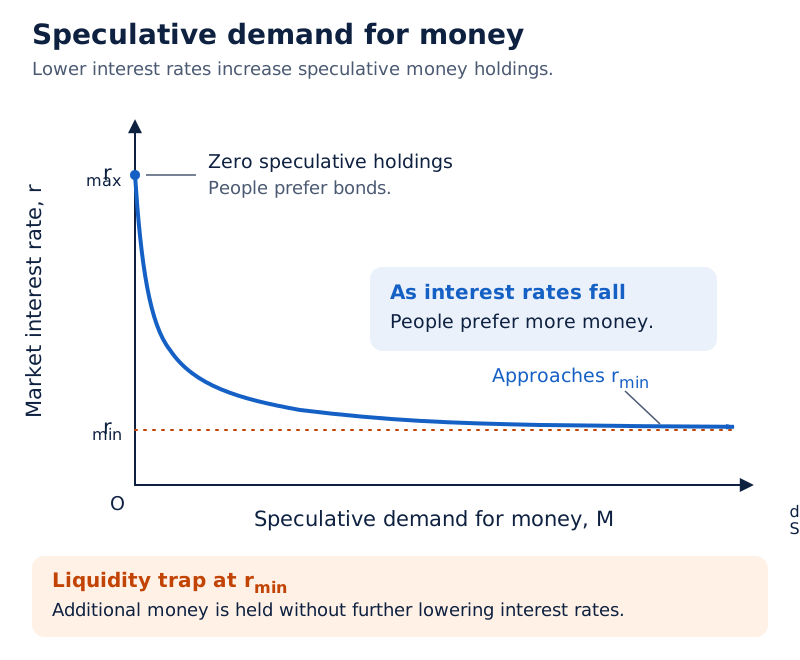
The horizontal axis shows speculative demand for money, , and the vertical axis shows the market interest rate, . The curve slopes down from and approaches the dotted horizontal line at .
Speculative demand means holding money in response to expectations about future interest rates and bond prices. At the upper interest rate, speculative money holdings are zero: people expect interest rates to fall and bond prices to rise, so they hold bonds.
As interest rates fall, more people expect a future rise and a loss from falling bond prices, so they prefer money. At the lower limit, , the curve becomes infinitely elastic: additional money is held without further lowering interest rates. This is the liquidity trap.
Drawn by One Young India.
What are the different kinds of money?
Money can be classified by its physical form, the source of its value and the basis of its acceptance. These classifications overlap. The same currency note can be paper money, fiat money and legal tender.
How do commodity and modern money differ?
Commodity money is a commodity used as a medium of exchange. Gold and other precious metals have served this purpose. Metallic money takes the form of metal coins, while paper money takes the form of currency notes.
Full-bodied money has a monetary value equal to the value of its material. Token money has a face value, the amount stated on it, greater than the value of its material. These terms distinguish monetary value from material value.
Fiat money derives its monetary value from the issuing authority's guarantee rather than a corresponding intrinsic value. Intrinsic value means the value of the material itself. Modern currency notes and coins are examples of fiat money.
| Kind or feature | Meaning | Important distinction |
|---|---|---|
| Commodity money | A commodity functions as money | The commodity has uses or value apart from its monetary role |
| Paper money | Money in the form of currency notes | The paper's material value differs from its purchasing power |
| Deposit money | Bank deposits available for making payments | A deposit is a claim on a bank |
| Legal tender | Money recognised by law for settling monetary obligations | Legal status differs from acceptance based on confidence |
Are cheques themselves legal tender?
A demand deposit is a bank deposit repayable when the account-holder demands it. A cheque is an instruction to a bank to pay from an account. It transfers deposit money; it is not itself currency. Payment by cheque can be refused, so demand deposits do not have the same legal-tender status as currency.
Fiduciary money depends on confidence and acceptance between the parties. Cheque payments illustrate this reliance on trust.
How are the measures of money supply defined?
Definition: Money supply is the stock of money held by the public at a particular point in time. A stock is measured at an instant, whereas a flow is measured over a period.
The Reserve Bank of India (RBI) is India's central bank, the monetary authority responsible for regulating money and credit. Different measures of money supply include different categories of deposits, so their meanings must be kept separate.
What do M₁, M₂, M₃ and M₄ include?
The symbols M₁, M₂, M₃ and M₄ name four monetary aggregates, meaning measures that combine specified monetary components. Let CU denote currency notes and coins held by the public, and DD denote the public's net demand deposits with commercial banks, institutions that accept public deposits and lend funds.
Let OD denote other deposits with the RBI, meaning eligible deposits there other than bankers' and government deposits. The fuller Indian statistical definition is:
M₁ = CU + DD + OD
In the simplified currency-plus-deposits model, other deposits with the RBI are left aside, giving M₁ = CU + DD. Use the fuller definition when listing the components of the Indian monetary aggregate.
M₂ = M₁ + Post Office savings deposits
M₂ adds savings deposits held with Post Office savings banks. It does not add every kind of deposit offered by postal savings organisations.
Time deposits have a specified period to maturity, meaning the date when repayment becomes due. Fixed deposits are an example. M₃ adds net time deposits of commercial banks to M₁.
M₃ = M₁ + Net bank time deposits
M₄ = M₃ + Eligible total postal deposits
Here eligible total postal deposits means total deposits with Post Office savings organisations excluding National Savings Certificates, a government small-savings instrument. The exclusion is part of the definition, not an optional adjustment.
Why are some deposits excluded?
Interbank deposits are deposits that one commercial bank holds with another. They are excluded when measuring the public's money holdings. The word net prevents treating the banking system's internal claims as additional money held by the public.
M₁ and M₂ are called narrow money; M₃ and M₄ are called broad money. The measures run in decreasing order of liquidity. M₁ is the most liquid, while M₃ is the most commonly used measure, also called aggregate monetary resources.
What is high-powered money, and how does it differ from deposits?
High-powered money, also called reserve money or the monetary base, supports the banking system's creation of credit. M₀ is the symbol used for reserve money. It must not be confused with the public's demand deposits.
M₀ = Currency in circulation + Bankers' deposits with RBI + Other deposits with RBI
Currency in circulation includes currency held by the public and cash held by banks. Bankers' deposits with the RBI are balances commercial banks hold with the central bank. These are different from the deposits customers hold with commercial banks.
Why is the monetary base called high-powered?
Commercial banks keep reserves, including cash and balances with the central bank, to support their deposit liabilities. A liability is an amount owed to someone else. Customer deposits are bank liabilities because the bank must repay them.
The same monetary base can support a larger amount of deposits when banks lend and the proceeds return as deposits. This is the sense in which reserve money is high-powered. It provides the base for deposit expansion.
| Point of comparison | Monetary base | Demand deposits |
|---|---|---|
| Institutional relationship | Includes currency and balances at the RBI | Public's claims on commercial banks |
| Role in banking | Supports the reserve base for lending | Can expand through the lending process |
| Measurement warning | Includes bankers' deposits with the RBI | Must not include interbank deposits as public money |
Keeping these categories distinct prevents double counting. A bank's reserve balance at the RBI and a customer's deposit at that bank are claims at different levels of the monetary system.
What is inflation, and how do demand-pull and cost-push inflation differ?
Inflation is a sustained rise in the general price level. The general price level describes prices across the economy, rather than the price of a single commodity. A higher price for one good alone does not establish general inflation.
When prices generally rise, each unit of money buys less. This is a fall in money's purchasing power. A person can retain the same number of rupees while the goods and services those rupees purchase become fewer.
What causes demand-pull inflation?
Demand-pull inflation arises when aggregate demand increases beyond the economy's capacity to supply goods and services at existing prices. Aggregate demand means total planned expenditure on goods and services in the economy.
If production cannot expand sufficiently to meet stronger spending, buyers' increased demand puts upward pressure on prices. The essential explanation links excessive spending to limited available output, rather than treating every rise in demand as inflationary.
What causes cost-push inflation?
Cost-push inflation arises from rising production costs that put upward pressure on prices. Production costs are the expenses incurred in producing output. Higher costs can reduce the amount firms are willing to supply at existing prices.
| Basis | Demand-pull inflation | Cost-push inflation |
|---|---|---|
| Initial pressure | Spending exceeds available supply at existing prices | Production costs increase |
| Main side affected initially | Demand for goods and services | Conditions of production and supply |
| Common outcome | Upward pressure on the general price level | Upward pressure on the general price level |
Both explanations concern a general price rise, but their starting mechanisms differ. Identifying the source of the pressure is necessary before explaining the resulting movement in prices.
What functions do commercial banks perform?
A commercial bank accepts deposits from the public and uses funds for lending and investment. It connects people with surplus funds to people who need funds. State Bank of India (SBI), HDFC Bank and ICICI Bank are examples.
How do deposit and lending functions work?
A current account allows withdrawals up to the available balance without prior notice. A savings account encourages individuals to save while providing withdrawal facilities. A fixed deposit places funds with the bank for a specified period.
Accepting deposits and granting loans are the bank's primary functions. Interest is the payment made for the use of borrowed funds. Banks pay interest on interest-bearing deposits and charge interest on loans.
The spread is the difference between the lending interest rate and the deposit interest rate. Lending provides income, but the bank must also keep sufficient funds available to meet withdrawals.
Security in lending means an asset offered as backing for repayment. A trade bill is a written payment instrument arising from a credit sale and payable at a specified time. Discounting converts it into funds before that time.
| Form of lending | Meaning |
|---|---|
| Loan | An agreed amount lent for repayment under specified terms |
| Overdraft | Permission to withdraw more than the current-account balance, up to an agreed limit |
| Cash credit | A sanctioned borrowing limit against security, from which the borrower draws as needed |
| Discounting a trade bill | Providing funds before a bill falls due after deducting a discount charge |
What are agency and general utility services?
Agency services are services performed on a customer's behalf. They include collecting cheques and making authorised payments. A cheque-collection service enables a customer to receive money from a cheque drawn on another bank.
General utility services provide other banking conveniences. These include locker facilities for safekeeping and remittances, meaning transfers of funds from one place to another. Banks also provide bill-payment services.
Deposits can make payments more convenient through cheques and debit cards. A debit card authorises payment from the holder's bank account. It may be safer to keep excess funds in a bank rather than at home.
The bank's need to repay depositors remains central to all these activities. Depositors' confidence depends on being able to obtain their money under the terms of their accounts. Lending cannot be considered independently of this obligation.
How do commercial banks create credit?
Credit creation is the expansion of bank deposits through lending. When a bank grants a loan and credits the borrower's account, it creates a deposit. The banking system can therefore expand deposit money without printing currency notes.
What assumptions make the process clear?
Consider a simplified economy with one bank. Loan proceeds return to this bank as deposits, and people do not retain any currency outside it. The bank lends funds not needed for required reserves.
The required reserve ratio is the proportion of deposits that must be held as reserves. In this example it is 20 per cent. The opening deposit is Rs 100, and the bank initially has Rs 100 in reserves.
- Accept the deposit: Leela deposits Rs 100. The bank records a deposit liability of Rs 100 and an equal reserve asset.
- Keep required reserves: At 20 per cent, the bank must retain Rs 20 against the initial deposit.
- Grant the first loan: It lends Rs 80 to Jaspal Kaur. The loan proceeds return as deposits, raising total deposits to Rs 180.
- Recalculate the requirement: Required reserves become 20 per cent of Rs 180, or Rs 36. Out of its original Rs 100 reserves, Rs 64 remains available for further lending.
- Continue the process: The bank lends Rs 64 to Junaid. Further lending and redepositing continue until the full Rs 100 is needed as required reserves.
What does the bank's balance sheet show?
A balance sheet records assets and liabilities at a particular date. A loan is an asset of the bank because it represents a claim on the borrower. A customer deposit is a liability because the bank owes that amount.
In the simplified model, Assets = Reserves + Loans. Also, Net worth = Assets − Liabilities. Net worth is the excess of assets over amounts owed. The example starts with zero net worth and leaves it unchanged.
Worked example 2. A bank has an initial deposit and reserves of Rs 100. Its required reserve ratio is 20 per cent. Find its first-round required reserve and loan.
Answer: Required reserves = 0.20 × Rs 100 = Rs 20. The first loan = Rs 100 − Rs 20 = Rs 80. Lending is limited by the reserve requirement.
How is the multiplier calculated, and what limits credit creation?
The deposit multiplier expresses the ratio of total deposits supported to the initial reserves in this simplified model. Let m denote this multiplier and r the required reserve ratio expressed as a decimal fraction.
m = 1 ÷ r
A reserve ratio of 20 per cent is 0.20, so the multiplier is 1 ÷ 0.20 = 5. This result assumes that funds return as deposits and banks lend available amounts beyond required reserves.
Worked example 3. Initial reserves are Rs 100, the reserve ratio is 20 per cent, all lending returns as deposits, and there is no currency held outside the bank. Find total deposits and total loans at full expansion.
Answer: The multiplier is 1 ÷ 0.20 = 5. Total deposits = 5 × Rs 100 = Rs 500. Total loans = Rs 500 − Rs 100 = Rs 400. The original deposit is included in the Rs 500.
| Final balance-sheet item | Amount | Explanation |
|---|---|---|
| Reserves | Rs 100 | Equal to 20 per cent of final deposits |
| Loans | Rs 400 | Cumulative loans created during expansion |
| Total assets | Rs 500 | Reserves plus loans |
| Deposits | Rs 500 | Initial deposit plus deposits created by lending |
Note: Rs 400 is the total outstanding lending at the end, not a further loan in the last round. Required reserves already absorb the full Rs 100 at that point.
Why can actual expansion be smaller?
Limitations of credit creation include the reserve requirement, withdrawals into currency, banks' decisions to retain extra reserves, and the availability of borrowers able and willing to repay. Central-bank credit policy also influences banks' scope to lend.
Currency retained outside banks does not return as a deposit in the next round. Extra reserves held voluntarily are not lent. Weak demand for loans or concern about repayment can also prevent the banking system from reaching the simple model's limit.
Worked example 4. Reserves remain Rs 100, but the reserve ratio rises from 20 per cent to 25 per cent. Assume complete redepositing and no extra reserves. Find the new maximum deposits and loans.
Answer: The new multiplier is 1 ÷ 0.25 = 4. Deposits can reach Rs 400, and loans Rs 300. Compared with Rs 500 deposits and Rs 400 loans previously, each falls by Rs 100.
Diagram
Reserve requirements and credit creation
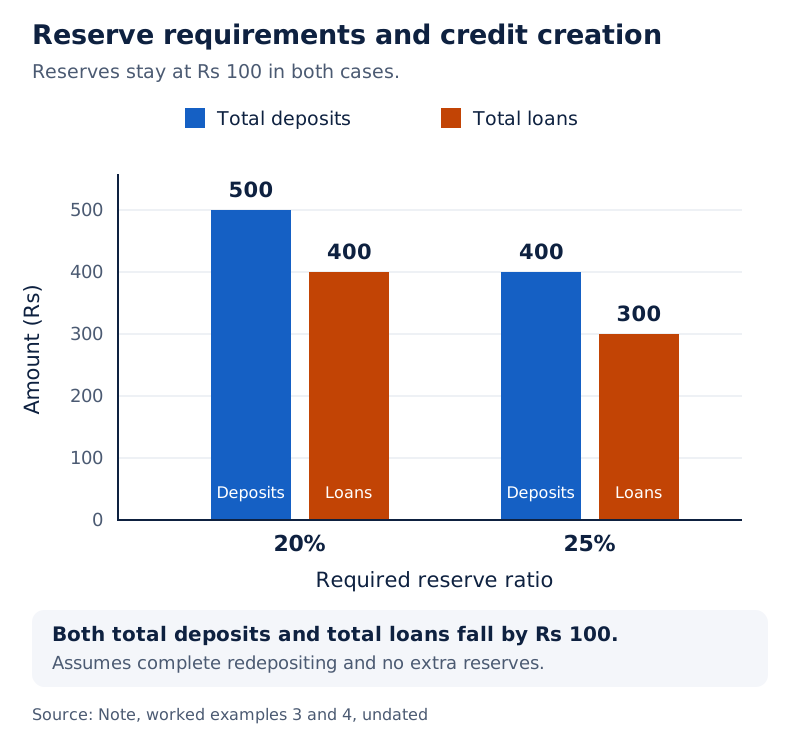
Draw a grouped bar graph with reserve ratios of 20 per cent and 25 per cent on the horizontal axis and amounts in rupees on the vertical axis, starting at zero. Label the two bars in each group Total deposits and Total loans.
For 20 per cent, draw the deposits bar at Rs 500 and the loans bar at Rs 400. For 25 per cent, draw them at Rs 400 and Rs 300 respectively. Reserves remain Rs 100, with complete redepositing and no extra reserves.
The lower bars at 25 per cent show how a higher reserve requirement reduces the deposits and loans supported by the same reserves. Both totals fall by Rs 100.
Drawn by One Young India.
What functions does the central bank perform?
A central bank regulates the monetary and banking system. The RBI performs this role in India. Its responsibilities extend beyond accepting customer deposits or granting ordinary business loans.
How do its principal functions fit together?
- Currency issue: The RBI issues currency notes, while the Government of India issues coins. Currency provides part of the economy's means of payment.
- Banker to the government: The central bank handles government banking business, including accounts and payments, and provides banking support to the government.
- Bankers' bank: Commercial banks hold reserve balances with the central bank and can obtain funds from it. The central bank occupies a supporting position in the banking system.
- Custodian of foreign exchange reserves: It holds the economy's foreign exchange reserves, meaning reserve assets in foreign currencies and related external assets.
- Controller of credit: It influences money supply and bank lending through reserve requirements, interest-rate instruments, security transactions and selective measures.
What is the lender-of-last-resort function?
The lender of last resort provides support when commercial banks need funds and cannot obtain adequate assistance elsewhere. This role helps banks meet funding difficulties and supports confidence in the banking system.
The central bank also acts as a clearing house, helping banks settle claims against one another. Settlement means discharging the payment obligations created when customers of different banks make payments to each other.
| Basis | Commercial bank | Central bank |
|---|---|---|
| Main activity | Accepting deposits and lending to customers | Regulating money, credit and the banking system |
| Deposit creation | Creates deposit money through lending | Supplies and influences the monetary base |
| Reserve relationship | Maintains balances with the central bank | Holds bankers' balances and provides support |
The distinction explains why commercial-bank credit creation is not unrestricted. The institution creating customer deposits operates within requirements and policies set by the monetary authority.
How do reserve requirements and interest-rate policies control credit?
Quantitative credit controls influence the overall volume of credit and money. They include reserve requirements, bank-rate policy and open market operations. Their effects work through the funds banks can use and the cost of obtaining those funds.
What are CRR and SLR?
The Cash Reserve Ratio (CRR) is the proportion of a bank's relevant deposit liabilities that it must maintain as cash balances with the RBI. A higher requirement leaves less scope for lending from a given reserve base.
The Statutory Liquidity Ratio (SLR) requires a prescribed proportion of relevant liabilities to be held in specified liquid assets, including cash, gold and approved securities, meaning eligible financial claims. A liquid asset can be converted readily into a means of payment.
CRR and SLR are distinct requirements. CRR concerns cash balances with the central bank; SLR concerns eligible liquid assets maintained by banks. Their percentages must not be treated as interchangeable labels.
| Policy change | Immediate effect | Direction of influence |
|---|---|---|
| Higher reserve requirement | More backing is required for a given deposit total | Restrains the scope for credit expansion |
| Lower reserve requirement | Less backing is required for a given deposit total | Can support greater credit expansion |
| Higher bank rate | Central-bank borrowing becomes more expensive | Restrains borrowing and credit expansion |
How do bank rate and repo rate operate?
Bank rate is the rate associated with central-bank lending to commercial banks. Raising it makes borrowing more expensive and reduces the reserves banks obtain through such borrowing. A fall in the bank rate can increase money supply.
A repurchase agreement, or repo, involves the central bank buying a security with an agreement specifying its later resale date and price. A security is a financial claim; a government bond is a security representing government borrowing.
The repo rate is the interest rate charged on funds supplied through the repo arrangement. Raising it makes this source of funds more expensive. Lowering it can encourage bank borrowing and credit expansion.
These are mechanisms, not promises that lending must rise whenever a rate falls. Banks still need borrowers and must consider repayment and liquidity. The simple reserve calculation shows potential lending under its stated assumptions.
How do open market operations and qualitative controls work?
Open market operations are purchases and sales of government bonds by the central bank in the open market. An outright purchase injects funds; an outright sale withdraws funds. Outright means there is no accompanying promise to reverse that transaction later.
How does a bond purchase expand money supply?
- The RBI purchases government bonds from market participants.
- It pays for the purchase, adding funds to the banking system.
- The transaction increases bank reserves and provides additional support for lending.
- Further lending and deposit creation can increase money supply within reserve requirements and the other limits on credit creation.
A sale works in the opposite direction: payment for bonds reduces banking-system reserves and restrains money supply. The relevant transaction is the central bank's purchase or sale, so the direction must be read from its viewpoint.
What is a reverse repo?
A reverse repurchase agreement, or reverse repo, involves the central bank selling securities with an agreement specifying when and at what price it will repurchase them. The operation absorbs funds temporarily.
The reverse repo rate is the rate associated with funds absorbed under that arrangement. Repo supplies funds to the banking system, while reverse repo absorbs them. Their agreed reversal distinguishes these transactions from outright operations.
How do qualitative controls influence selected uses of credit?
Qualitative credit controls influence the direction and use of lending. They can encourage or discourage particular categories of credit rather than acting solely on the total volume.
- Moral suasion: The central bank persuades commercial banks to follow a desired lending policy through advice and appeals.
- Margin requirements: A margin is the difference between the value of security offered and the loan permitted against it. A higher required margin reduces borrowing against the same security.
- Credit rationing: Limits are placed on credit available for specified purposes or borrowers.
- Direct action: The central bank takes measures against banks that fail to comply with its credit directions.
- Consumer-credit regulation: Conditions governing instalment credit, such as initial payments and repayment periods, influence borrowing for consumer purchases.
The distinction is between influencing credit generally and influencing its allocation. Quantitative and qualitative methods can operate together: one affects overall lending conditions, while the other guides particular uses of available funds.
Glossary
- Money — A commonly accepted medium through which people pay for goods and services.
- Barter — Direct exchange of goods or services without using money as an intermediary.
- Double coincidence of wants — A situation in which each exchanging party wants what the other offers.
- Unit of account — A common monetary unit used to express prices and compare economic values.
- Store of value — An asset's capacity to carry wealth forward for use at a later time.
- Fiat money — Money whose monetary value rests on the issuing authority's guarantee rather than its material value.
- Demand deposit — A deposit repayable by the bank when the account-holder demands payment.
- Time deposit — A deposit placed with a bank for a specified period to maturity.
- Money supply — The stock of money held by the public at a particular point in time.
- High-powered money — Reserve money that provides the monetary base supporting banks' creation of deposits.
- Credit creation — Expansion of bank deposits through lending and the return of loan proceeds as deposits.
- Deposit multiplier — The ratio of deposits supported to initial reserves in a specified banking model.
- Inflation — A sustained rise in the general price level that reduces money's purchasing power.
- Open market operations — Central-bank purchases and sales of government bonds that influence banking-system reserves.
- Moral suasion — Central-bank persuasion intended to encourage commercial banks to follow a desired lending policy.
Common errors and misconceptions
- Misconception: Money means currency notes alone. Correct: Monetary measures include coins and specified deposits as well. Different aggregates include different deposit categories, so the measure being discussed must be identified.
- Misconception: Money's material value must equal its purchasing power. Correct: Fiat money derives monetary value from the issuing authority's guarantee. The paper in a currency note does not explain its face value.
- Misconception: M₀ and M₁ are interchangeable. Correct: M₀ is reserve money and includes bankers' deposits with the RBI. M₁ includes the public's demand deposits, which are claims on commercial banks.
- Misconception: Banks can create unlimited credit. Correct: Reserve requirements constrain expansion. Currency withdrawals, extra reserves, lending decisions and borrowers' ability and willingness to borrow can limit the actual outcome further.
- Misconception: Rs 500 final deposits mean Rs 500 new loans. Correct: With Rs 100 initial reserves and a 20 per cent reserve ratio in the simple model, final loans are Rs 400.
- Misconception: CRR and SLR require exactly the same assets. Correct: CRR requires cash balances with the RBI, whereas SLR involves prescribed liquid assets held by banks.
- Misconception: A central-bank bond sale expands reserves. Correct: An open-market sale withdraws funds and reduces reserves. A purchase adds funds and expands the reserve base supporting credit.
- Misconception: Any increase in one price is inflation. Correct: Inflation concerns a sustained rise in the general price level. Demand-pull and cost-push explanations identify different sources of that pressure.
Exam-style questions with model answers
Q1. Define barter and explain the double coincidence of wants required for direct exchange. [2 marks]
- Barter is the direct exchange of goods or services without using money as a medium of exchange.
- A double coincidence of wants exists when each party wants what the other offers, allowing them to exchange directly.
Q2. Explain the two primary functions of money and any two secondary functions. [4 marks]
- As a medium of exchange, money is accepted in payment and removes the need to find someone with exactly matching wants.
- As a measure of value, it expresses prices in a common monetary unit, allowing the relative values of goods to be compared.
- As a store of value, it carries wealth forward for later use, although rising prices may erode its purchasing power.
- As a standard of deferred payments, it provides the unit in which debts and other future payments are stated and settled.
Q3. Distinguish demand-pull inflation from cost-push inflation. Explain inflation and its effect on purchasing power as part of your answer. [4 marks]
- Inflation is a sustained rise in the general price level, rather than an isolated increase in one commodity's price.
- Demand-pull inflation begins when aggregate spending exceeds the goods and services available at existing prices and output cannot expand sufficiently.
- Cost-push inflation begins with rising production costs, which put upward pressure on prices and can reduce supply at existing prices.
- Both reduce money's purchasing power: a given number of rupees buys fewer goods and services when the general price level rises.
Q4. A one-bank economy starts with an initial deposit and reserves of Rs 100. The required reserve ratio is 20 per cent. All loan proceeds return as deposits, the public holds no currency, and the bank lends all amounts beyond required reserves. Calculate first-round reserves and lending, total deposits after redepositing the first loan, the multiplier, final deposits and final loans. [6 marks]
- First-round required reserves are 20 per cent of Rs 100, giving 0.20 × Rs 100 = Rs 20.
- The first loan is the initial Rs 100 less required reserves of Rs 20, so the bank lends Rs 80.
- When the Rs 80 loan returns as a deposit, total deposits become Rs 100 + Rs 80 = Rs 180.
- The deposit multiplier is the reciprocal of the reserve ratio expressed as a decimal: 1 ÷ 0.20 = 5.
- Final deposits equal initial reserves multiplied by the multiplier: Rs 100 × 5 = Rs 500, including the original deposit.
- Final loans equal deposits less reserves: Rs 500 − Rs 100 = Rs 400. These are cumulative loans, not one final-round advance.
Q5. Explain four commercial-bank functions: accepting deposits, lending, cheque collection and remittance of funds. [4 marks]
- Banks accept deposits through accounts such as current, savings and fixed-deposit accounts, providing facilities for holding funds under agreed conditions.
- Banks lend funds to borrowers and earn interest, while retaining resources needed to meet withdrawals and reserve requirements.
- Banks collect cheques drawn on other banks for customers, helping them receive payments through their deposit accounts.
- Banks remit funds, meaning transfer money from one place to another, allowing customers to make payments without personally carrying the cash.
Q6. Explain six central-bank functions: currency issue, government banking, bankers' banking, holding foreign exchange reserves, credit control and lending as a last resort. [6 marks]
- The central bank issues currency notes, supplying a basic means of payment. In India, the RBI issues notes while the Government of India issues coins.
- As banker to the government, it handles government accounts and payments and supports the government's banking requirements.
- As bankers' bank, it holds commercial banks' reserve balances and supplies funds to support the operation of the banking system.
- As custodian of foreign exchange reserves, it holds the economy's reserve assets in foreign currencies and related external assets.
- As controller of credit, it influences money supply and lending through reserve requirements, interest-rate tools, government-security transactions and selective controls.
- As lender of last resort, it provides support when banks face funding needs that they cannot adequately meet from other sources.
Q7. Explain how an RBI open-market purchase of government bonds can increase money supply. Give four linked steps. [4 marks]
- The RBI begins by purchasing government bonds in the open market from holders willing to sell them.
- Its payment for those bonds adds funds to the banking system and increases the reserves available to commercial banks.
- Additional reserves provide backing for further bank lending, subject to the applicable reserve requirements and banks' lending decisions.
- As loan proceeds return as deposits, deposit money can expand, increasing money supply within the limits of the credit-creation process.
Q8. Reserves remain Rs 100. The required reserve ratio rises from 20 per cent to 25 per cent. Assume all loan proceeds are redeposited, no currency is held outside the bank, and no extra reserves are retained. Find the new multiplier, maximum deposits and loans, and compare them with the amounts supported at 20 per cent. [4 marks]
- The new multiplier is 1 ÷ 0.25 = 4, compared with 1 ÷ 0.20 = 5 at the original reserve ratio.
- Maximum deposits become Rs 100 × 4 = Rs 400, compared with Rs 100 × 5 = Rs 500 previously.
- Maximum loans become Rs 400 − Rs 100 = Rs 300, compared with Rs 500 − Rs 100 = Rs 400 previously.
- Deposits and loans therefore each fall by Rs 100. A higher reserve requirement reduces credit-creation capacity for the unchanged reserve base.
Key takeaways
- Money facilitates exchange by removing the need for a double coincidence of wants between buyers and sellers.
- Money's primary functions concern exchange and measurement; its secondary and contingent functions extend its usefulness across the economy.
- Money supply is a stock measured at a point in time, with different aggregates including different deposit categories.
- Reserve money supports bank lending, while the public's deposits are liabilities created and held within the commercial banking system.
- The reciprocal reserve-ratio multiplier depends on complete redepositing and lending assumptions; actual expansion can be smaller.
- Inflation reduces purchasing power, while demand-pull and cost-push explanations identify different sources of upward pressure on prices.
- The RBI influences credit through reserve requirements, rates, security transactions and qualitative controls directing selected uses of lending.
- A central-bank bond purchase adds reserves, while a sale withdraws reserves and restrains the scope for deposit expansion.
Test yourself
Why does money reduce the search difficulty associated with barter?
A seller can accept money and spend it elsewhere, without finding someone who wants exactly the good offered in exchange.
Why can money perform poorly as a store of value during inflation?
A rising general price level may erode purchasing power, so the same money balance buys fewer goods and services later.
How does a demand deposit differ from a time deposit?
A demand deposit is repayable on demand, while a time deposit has a specified period to maturity.
Which postal component is excluded when defining M₄?
National Savings Certificates are excluded from the total Post Office deposits added to M₃ when defining M₄.
Why is a loan an asset for the bank?
The loan gives the bank a claim on the borrower for repayment, so it is recorded as a bank asset.
With Rs 100 reserves and a 20 per cent reserve ratio, what maximum deposits can the simple complete-redepositing model support?
The multiplier is 1 ÷ 0.20 = 5, so Rs 100 reserves support Rs 500 deposits under the stated assumptions.
How do repo and reverse repo differ in their immediate effects?
Repo supplies funds to the banking system, while reverse repo absorbs funds under an agreement for a later reversal.
Why is moral suasion a qualitative credit control?
It uses central-bank persuasion to influence commercial banks' lending behaviour and the direction of credit, rather than directly fixing total money supply.
Take this further
How does India make policy?
The Model NITI Aayog self-paced course: 41 chapters, about 19 hours of study, on how India makes policy, from the policy cycle and writing a white paper to the economy, the Union Budget and governance. It comes with Learnacy Essential.
Learnacy Essential also adds feedback from an AI writing coach, submission to The OYI Review, World 101’s member tools and the 3D labs. Publication is not guaranteed. See what a year includes
Or create a free account to draft in the Writing Studio, explore World 101’s map and open the 2D version of every lab. Create a free account