
Public Finance | ISC Class 12 Economics Notes
On this page
Watch & explore
Start with a few high-quality watches, then dive into the notes below.

This note covers public finance, fiscal policy, taxation, public expenditure, public debt and its redemption, deficit financing, government budgets, revenue and capital accounts, budget deficits, and the effects of government spending and taxes on income.
What is public finance and why does government intervene?
Public finance concerns government revenue, expenditure and borrowing. It examines how government raises resources, uses them and manages its financial obligations. In a mixed economy, both government and private enterprises participate in economic activity.
The government budget is a statement of estimated government receipts and expenditure for a financial year. Receipts are money received by government; expenditure is money it spends. Budget decisions affect the provision of services, the distribution of income and overall economic activity.
How does the allocation function work?
The allocation function concerns providing goods and services through the use of resources. National defence, roads and government administration are examples of public goods. A public park and measures to reduce air pollution illustrate benefits available to many people.
Public goods have two central features. They are non-rivalrous: one person's use does not reduce the amount available to others. They are non-excludable: there is no feasible way of excluding people from enjoying their benefits.
A free-rider enjoys benefits without paying. Because collecting fees is difficult and sometimes impossible, private enterprise will in general not provide public goods. Government therefore has a role in financing their provision through its budget.
Public provision means budget financing with use possible without direct payment. Public production means production directly by government. Public goods may be produced by either government or private enterprises; financing and production are distinct questions.
How does redistribution work?
The redistribution function concerns changing the distribution of income towards one considered fair by society. Taxes and transfers affect households' personal disposable income, meaning income available for consumption and saving. Consumption is household spending on goods and services; saving is disposable income not consumed.
Transfers are payments without a corresponding current supply of goods or services.
Government spending and revenue decisions therefore have connected purposes. Financing a service concerns allocation, while the distribution of tax payments and transfer benefits affects redistribution. A budget cannot be understood merely as a list of money received and money spent.
What is fiscal policy and how does it stabilise the economy?
Definition: Fiscal policy is government policy concerning expenditure, taxation and borrowing used to influence economic activity, including output, income and employment.
The stabilisation function involves government intervention to expand or restrain demand. Aggregate demand means total planned spending on goods and services. Spending decisions by households, firms and government influence the level of employment and prices.
Demand may be insufficient for full utilisation of labour and other resources. Government can intervene to raise spending. Conversely, demand may exceed available output under conditions of high employment and thus may give rise to inflation, a rise in the general price level.
| Instrument | Meaning | Connection with fiscal policy |
|---|---|---|
| Public revenue | Government income from taxes and other revenue sources | Taxes affect disposable income and finance expenditure. |
| Public expenditure | Spending by government | Purchases directly enter demand; transfers influence household spending. |
| Public debt | Outstanding government borrowing | Borrowing finances expenditure but creates repayment and interest obligations. |
| Deficit financing | Financing spending exceeding available receipts | The financing method matters for debt and money creation. |
How do deliberate and automatic responses differ?
Discretionary fiscal policy means deliberate changes in fiscal instruments to stabilise the economy. Government can increase its purchases when private investment falls. Here, investment means expenditure that adds to capital, such as productive equipment.
An automatic stabiliser moderates fluctuations without a fresh policy decision. A proportional income tax takes a constant fraction of income. When income falls, tax payments fall too, cushioning the reduction in disposable income and consumption.
When income rises, some additional income goes into taxes, limiting the increase in consumption. Welfare transfers also help sustain consumption during a slump. Built-in stabilisers reduce only part of economic fluctuations; deliberate policy initiatives must address the remainder.
How do taxes and non-tax revenue differ?
A tax is a compulsory payment to government without a direct, equivalent service in return to that particular taxpayer. Tax revenue finances public activity collectively. Non-tax revenue comes from sources other than taxation, including fees, interest, dividends and profits.
A fee is a payment for a service rendered. Interest receipts arise when government has lent money. Dividends and profits arise from government investments. Cash grants from foreign countries and international organisations also form part of central government non-tax revenue.
What distinguishes direct and indirect taxes?
A direct tax is imposed on the person or organisation intended to bear it. An indirect tax is collected through a supplier, with its burden capable of being passed to the buyer through price. Legal payment and economic burden must be distinguished.
| Basis | Direct taxes | Indirect taxes |
|---|---|---|
| Object of taxation | Examples include personal income and company profits. | Examples include the supply of goods and services. |
| Payment and burden | The person taxed is intended to bear the burden. | The supplier remits tax while the burden can pass through price. |
| Examples | Personal income tax and corporation tax | Goods and Services Tax and customs duties |
Goods and Services Tax (GST) is an indirect tax on supplies of goods and services. Customs duties are taxes on goods imported into or exported from the country. Corporation tax is a tax on company profits.
How are taxes classified by their relationship with income?
Under progressive taxation, the tax rate increases as income increases. This supports redistribution. Under proportional taxation, the rate remains a constant proportion of income. A constant rate does not mean a constant amount of tax.
Under regressive taxation, the proportion of income paid in tax falls as income rises. This classification concerns the relative burden. It is different from the direct and indirect classification, which concerns how a tax is imposed and its burden transferred.
Tax revenue and total government receipts are not interchangeable expressions. Government also receives non-tax revenue and money from borrowing or asset sales. These sources have different consequences for its financial position and must be classified separately.
What is public expenditure and why is its composition important?
Public expenditure is government spending on its functions and obligations. It finances services, supports welfare, creates assets and meets commitments such as interest on borrowing. Its effects depend on what the money purchases or finances.
Revenue expenditure is expenditure for purposes other than creating government physical or financial assets. It includes the normal operation of departments and services, interest payments and grants to state governments and other parties.
Capital expenditure creates physical or financial assets or reduces financial liabilities. An asset is a resource or financial claim held by government. A liability is a financial obligation, such as a loan that must be repaid.
| Transaction | Classification | Reason |
|---|---|---|
| Salaries and pensions | Revenue expenditure | These meet current obligations rather than acquire government assets. |
| Interest on government debt | Revenue expenditure | It pays the cost of borrowing without repaying the principal, the borrowed amount owed. |
| Purchase of land, buildings or machinery | Capital expenditure | Government acquires physical assets. |
| Loans advanced by government | Capital expenditure | Government acquires financial claims on borrowers. |
| Repayment of government borrowing | Capital expenditure | It reduces a financial liability. |
Why does the distinction require care?
A subsidy is government support intended to increase welfare by reducing costs or prices. Support can be explicit, as with food and fertilisers, or implicit through under-pricing public services such as education and health.
Grants given by the central government are revenue expenditure in its accounts even when some grants are intended for asset creation. The classification refers to the assets of the government making the expenditure, rather than simply the eventual use of every payment.
Revenue expenditure is not synonymous with waste. Education, health and the operation of existing services require continuing expenditure. Cutting spending in vital areas can adversely affect the economy. Capital expenditure matters for asset creation, but its usefulness also depends on productive use.
Note: Interest and principal are different. Interest is the charge for borrowing; principal is the borrowed amount owed. Paying interest does not itself redeem the principal.
What are Union and State budgets and their main components?
The Union Budget is the budget of the central government. A State Budget is the budget of a state government. This distinction identifies the government whose estimated receipts and expenditure the statement records.
In India, the financial year runs from 1 April to 31 March. The central government's Annual Financial Statement presents estimated receipts and expenditure for that year. Although a budget concerns a particular year, its effects can extend into subsequent years.
How are revenue and capital budgets organised?
The revenue budget contains revenue receipts and revenue expenditure. Revenue receipts neither create repayment obligations nor reduce government assets. The capital budget contains capital receipts and capital expenditure. Capital receipts create liabilities or reduce financial assets. This division separates current financial requirements from transactions concerning government assets and liabilities.
Diagram
Components of a government budget
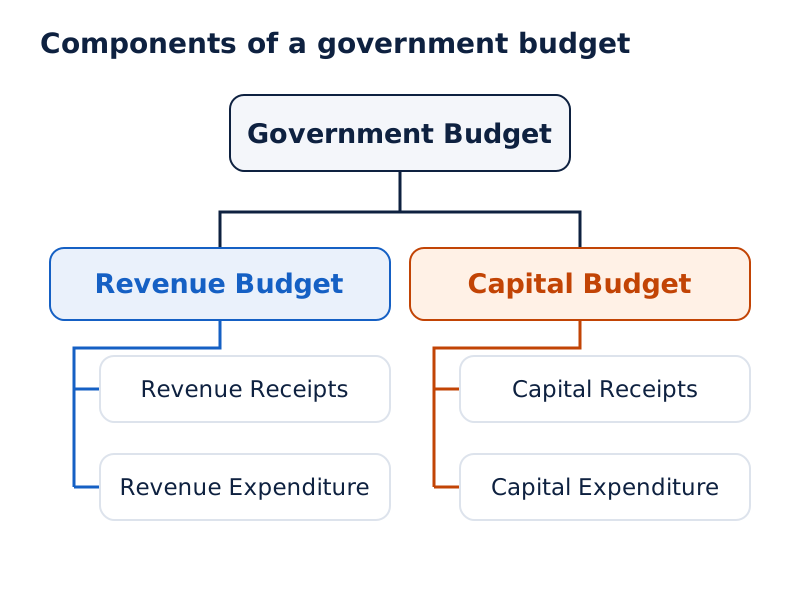
Draw a box labelled Government Budget. Divide it into Revenue Budget and Capital Budget. Under Revenue Budget place Revenue Receipts and Revenue Expenditure; under Capital Budget place Capital Receipts and Capital Expenditure.
Drawn by One Young India.
A budget also expresses policy choices. The balance between taxes, expenditure and borrowing influences demand and the distribution of resources. Examining the accounts together shows how expenditure is financed and whether government is acquiring assets or accumulating liabilities.
How do balanced, surplus and deficit budgets differ?
A balanced budget has equal receipts and expenditure on the comparison being made. A surplus budget has receipts exceeding expenditure. A deficit budget has expenditure exceeding receipts. A deficit must have a source of finance.
In analytical comparisons of expenditure with non-borrowed receipts, borrowing finances the gap. Do not first count borrowing as ordinary revenue and then conclude that there is no fiscal deficit. The fiscal deficit, which measures the borrowing requirement, specifically excludes borrowing from receipts.
These classifications answer different questions. Union and State identify the level of government; revenue and capital identify the nature of transactions; balanced, surplus and deficit describe the relationship between the expenditure and receipts being compared.
How should government receipts be classified?
Revenue receipts do not create a repayment claim on government and do not reduce its assets. Tax receipts and non-tax receipts belong here. They differ from money obtained by taking a loan or selling an existing asset.
Capital receipts either create liabilities or reduce financial assets. Borrowing creates a liability because money must be returned. Selling government shares reduces the government's financial assets. Both provide cash, but their financial consequences differ.
Disinvestment means sale of government ownership shares in enterprises. A Public Sector Undertaking (PSU) is a government-owned enterprise. Receipts from selling its shares are capital receipts; dividends from retaining shares are non-tax revenue.
Which capital receipts create debt?
| Receipt | Account | Financial effect |
|---|---|---|
| Income tax | Revenue receipt | No repayment obligation arises. |
| Interest received on government loans | Non-tax revenue receipt | Government receives income from lending. |
| Fresh government borrowing | Debt-creating capital receipt | An obligation to repay is created. |
| Recovery of loans previously advanced | Non-debt capital receipt | An existing financial claim is reduced. |
| Sale of government shares | Non-debt capital receipt | Government reduces its ownership assets. |
Non-debt capital receipts are capital receipts that do not create borrowing obligations. Loan recoveries and disinvestment proceeds belong to this category. They must be separated from borrowing when calculating the fiscal deficit.
Classification should follow the transaction's effect. Receiving interest is income from a loan; recovering principal reduces the loan asset itself. Similarly, receiving dividends is income from shares; selling the shares disposes of the asset that generated that income.
Fresh loans bring future repayment and interest obligations. An asset sale removes the government's future earnings from the asset sold. Thus, raising money through capital receipts can affect later budgets even though the receipt occurs in the present year.
What do revenue, fiscal and primary deficits measure?
A budget deficit is a shortfall of the receipts being considered relative to expenditure. Different measures isolate different features of the government's accounts. They are related, but they are not substitutes for one another.
What is the revenue deficit?
Revenue deficit = Revenue expenditure − Revenue receipts
A revenue deficit means current revenue does not cover revenue expenditure. Government is dissaving, meaning it spends more on the revenue account than it receives. Borrowing then finances part of its consumption requirements as well as investment.
This adds to debt and interest liabilities. Often government reduces productive capital expenditure or welfare expenditure when pressure to cut spending arises. Such reductions have adverse growth and welfare implications.
What is the fiscal deficit?
Fiscal deficit = Total expenditure − (Revenue receipts + Non-debt capital receipts)
The fiscal deficit measures total borrowing requirements. Total expenditure here combines revenue and capital expenditure under the deficit accounting convention, excluding debt repayment. Borrowing is excluded from the receipts subtracted because it finances the deficit itself.
Fiscal deficit = Revenue deficit + Capital expenditure − Non-debt capital receipts
In this identity, capital expenditure follows the same deficit accounting convention. A large share of revenue deficit within fiscal deficit indicates that much borrowing finances consumption requirements rather than investment. The composition matters alongside the size of borrowing.
What is the primary deficit?
Primary deficit = Fiscal deficit − Interest payments
The primary deficit removes interest payments on accumulated debt from the fiscal deficit. It focuses attention on the current imbalance apart from that inherited interest burden. A zero primary deficit means the fiscal deficit equals interest payments, not that debt has disappeared.
Note: A net-interest version uses net interest liabilities instead of gross interest payments. Net interest liabilities are interest payments minus government interest receipts on net domestic lending. Use the convention specified by the data consistently.
Keep the three questions separate: whether revenue receipts cover revenue expenditure, how much overall borrowing is required, and how much of that requirement remains after removing interest. A single deficit figure cannot answer all three.
How are deficit calculations interpreted correctly?
Begin by identifying the account and the unit. Gross Domestic Product (GDP) is the value of final goods and services produced within the domestic territory during a period. Expressing a deficit as a percentage of GDP compares its size with the economy's output.
A final good or service is used for final consumption or investment rather than as an input into further production. All entries used in one deficit calculation must refer to the same period and use a common unit.
Worked example 1. Revenue expenditure is 11.8 per cent of GDP and revenue receipts are 9.2 per cent of GDP. Calculate the revenue deficit.
Answer: Revenue deficit = 11.8 − 9.2 = 2.6 per cent of GDP. The difference between the two ratios is 2.6 percentage points; the deficit itself is 2.6 per cent of GDP.
Worked example 2. Fiscal deficit is 5.6 per cent of GDP and interest payments are 3.6 per cent of GDP. Using the interest-payments convention, calculate the primary deficit.
Answer: Primary deficit = 5.6 − 3.6 = 2.0 per cent of GDP. This is the borrowing requirement remaining after deducting interest payments from the fiscal deficit.
What sequence prevents common mistakes?
- Identify whether the question asks for revenue, fiscal or primary deficit.
- Write the relevant identity and classify the supplied receipts and expenditure.
- Exclude borrowing from receipts when calculating the fiscal deficit.
- Substitute figures in consistent units, calculate, and explain what the result measures.
Do not combine rupee amounts with percentages of GDP. Do not subtract interest from revenue deficit to obtain primary deficit. Primary deficit begins with fiscal deficit, while revenue deficit begins with revenue expenditure and revenue receipts.
The interpretation should follow the calculation. A positive revenue deficit identifies a revenue-account shortfall. A primary deficit identifies an imbalance after removing interest under the stated convention. Neither figure, by itself, describes the quality of every government spending programme.
What is public debt and how is it redeemed?
Public debt is the stock of outstanding government borrowing. A stock is measured at a point in time; a flow is measured over a period. A deficit is a flow, whereas accumulated debt is a stock.
Repeated borrowing adds to debt and creates interest obligations. These interest payments can themselves contribute to later deficits. The distinction explains why one year's budget position and the government's accumulated debt are different measures.
Where can government borrow?
Government can borrow domestically, from its central bank, or abroad. In India, the central bank is the Reserve Bank of India (RBI). Borrowing from the public can take place through bonds, which are instruments recording debt obligations, and small savings schemes.
Internal debt is borrowing from lenders within the country; external debt is borrowing from foreign lenders. Debt owed abroad involves sending resources abroad to meet interest obligations. Domestic debt redistributes claims within the country, but this does not settle every question about its economic burden.
What does redemption mean?
Redemption of public debt means repayment of the principal borrowed. It reduces outstanding debt. Payment of interest alone services the debt but does not redeem it. Governments therefore need to distinguish the cost of borrowing from repayment of the original obligation.
| Method or arrangement | Meaning | Effect on debt |
|---|---|---|
| Repayment from a budget surplus | Available surplus funds are used to repay principal. | Outstanding principal falls. |
| Sinking fund | Money is set aside over time in a fund for eventual repayment. | Debt is redeemed when the accumulated fund pays principal. |
| Refunding | A new loan is raised to repay an old loan. | The old obligation is replaced; total debt need not fall. |
| Conversion | Existing debt is replaced on altered terms, commonly at a lower interest rate. | Debt servicing, meaning payments required on debt, may become cheaper without principal being extinguished. |
Refunding and conversion are debt-management arrangements rather than proof that the overall debt burden has been removed. Always identify whether the principal has actually been repaid from available resources or merely replaced by another obligation.
What are deficit financing and the possible burdens of debt?
Deficit financing, in its broad sense, means financing the gap between government expenditure and available non-borrowed receipts. Borrowing and money creation are financing methods. In the narrower monetary sense, it refers to financing through newly created money.
These meanings should be distinguished. Borrowing from the public raises funds from existing holders of money. Financing involving creation of money has a different monetary effect. The meaning of the term must remain consistent throughout an explanation.
Must a deficit cause inflation?
Higher government spending or lower taxes raises aggregate demand. Firms may be unable to supply the additional goods at prevailing prices, creating upward pressure on prices. But when resources are unutilised, demand can support higher output, so a high fiscal deficit need not be inflationary.
Crowding out means reduced opportunities for private borrowing or investment when government competes for funds. Government bonds can attract savings that might otherwise finance private investment. However, the flow of saving is not fixed if income can increase.
If deficits raise production and income, saving can also rise, allowing both government and industry to borrow more. Investment in infrastructure may benefit future generations, provided its return exceeds the interest rate. Debt therefore has to be judged alongside growth and the use of borrowed funds.
How can deficits be reduced?
Government can increase taxes, reduce expenditure, improve the efficiency of spending or raise receipts through asset sales. Cutting vital programmes in agriculture, education, health or poverty alleviation can adversely affect the economy. The method of reduction matters.
Larger deficits do not always signify more expansionary fiscal policy. During a recession, a period of declining economic activity, incomes and tax receipts fall. The deficit can therefore rise even without a change in fiscal policy.
How does higher government spending increase income?
In a simple income-determination model, equilibrium income is the income level at which output equals planned aggregate demand. Government purchases directly add to spending. With scope to expand production, higher demand starts successive rounds of additional income and consumption.
Let Y denote income, G government purchases and c the marginal propensity to consume, meaning the fraction of additional disposable income spent on consumption. The symbol Δ means a change, so ΔY and ΔG are changes in income and government purchases.
Government spending multiplier means the ratio of the change in equilibrium income to the initial change in government purchases. In the simple model with fixed taxes and transfers, and with c between zero and one, the relationship is:
ΔY = ΔG / (1 − c)
Worked example 3. The marginal propensity to consume is 0.8. Government purchases increase by 100 monetary units. Taxes and transfers remain fixed in the simple multiplier model. Calculate the increase in equilibrium income.
Answer: The multiplier is 1 / (1 − 0.8) = 5. The increase in income is 5 × 100 = 500 monetary units. This is the final change after successive spending rounds have worked through the model.
How is the spending effect shown graphically?
For the graph, AD denotes aggregate demand, C̄ consumption independent of income, I fixed investment and T a lump-sum tax, meaning a fixed tax independent of income. A prime, as in G′, denotes the changed level.
E denotes the initial equilibrium and E′ the new equilibrium. Y′ denotes the new income; Y* denotes equilibrium income. These are labels within the model, not observed values for a particular economy.
What the figure shows
Effect of higher government expenditure
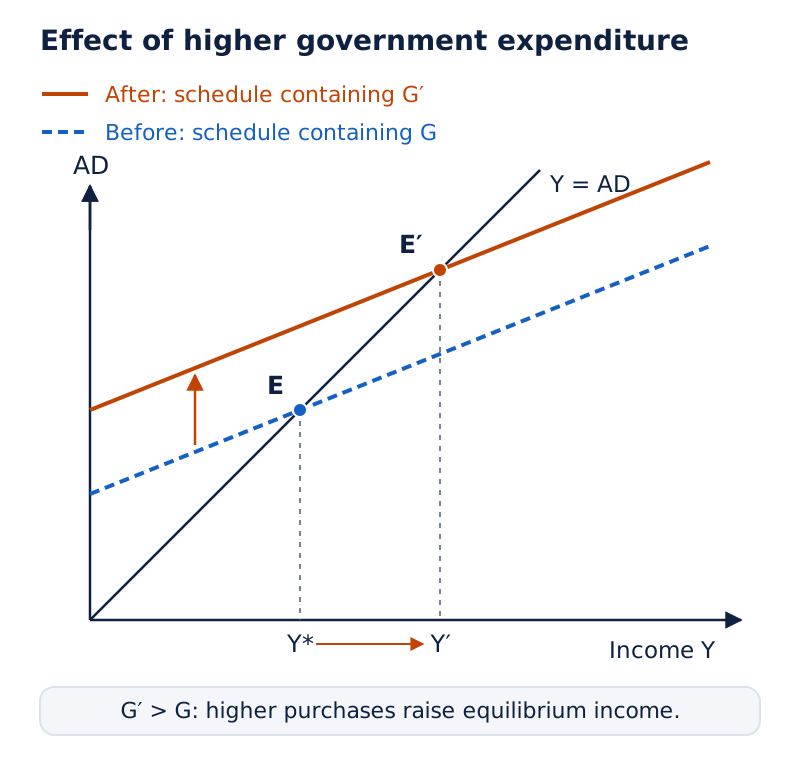
The vertical axis is AD and the horizontal axis is income Y. Two parallel upward-sloping schedules cross the line Y = AD at E and E′. The schedule containing G′ lies above the schedule containing G, and the new income Y′ lies to the right of the initial equilibrium income Y*.
Drawn by One Young India.
At the original income, higher purchases make demand exceed output. Firms expand production and income rises. The result depends on the model's assumptions; it is not a claim that government spending produces the same numerical response under every economic condition.
How do changes in taxes affect income differently?
A tax change affects demand through disposable income and consumption. It does not enter demand in the same direct way as government purchases. With a lump-sum tax, the tax payment remains independent of income.
The tax multiplier measures the change in equilibrium income for a change in taxes. Autonomous spending means spending independent of income. Keeping other autonomous spending fixed in the simple model, its value is −c / (1 − c). Here c retains its meaning as the marginal propensity to consume.
ΔT denotes the change in lump-sum taxes.
ΔY = [−c / (1 − c)] × ΔT
A tax increase is positive and a tax cut negative. The multiplier is negative because higher taxes reduce disposable income, consumption and output, while lower taxes raise them in this model.
Worked example 4. The marginal propensity to consume is 0.8 and lump-sum taxes fall by 100 monetary units. Government purchases and other autonomous spending remain fixed. Calculate the change in equilibrium income.
Answer: The tax multiplier is −0.8 / (1 − 0.8) = −4. Since ΔT = −100, the income change is (−4) × (−100) = 400 monetary units. A tax reduction produces an increase in income.
Why is the response smaller than for equal additional purchases?
The absolute value, or magnitude ignoring the sign, of the tax multiplier is smaller than the spending multiplier. Only the consumed fraction of a tax reduction initially enters spending. Government purchases enter demand directly in their full amount.
T′ denotes the lower lump-sum tax level after the reduction.
What the figure shows
Effect of a reduction in taxes
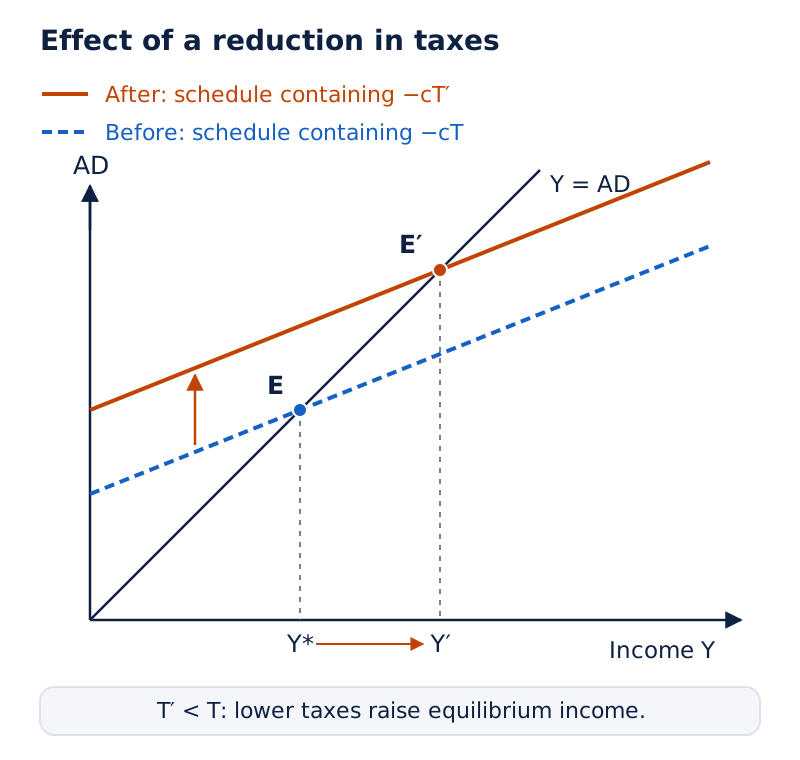
AD is on the vertical axis and Y on the horizontal axis. The schedule with the term −cT′ lies above the schedule with −cT. Their intersections with Y = AD are E′ and E respectively. The new equilibrium income Y′ lies to the right of the initial equilibrium income Y*.
Drawn by One Young India.
Here T′ is the lower tax level, so subtracting cT′ gives a higher demand schedule. The schedules are parallel because changing a lump-sum tax changes the level of demand without changing its slope.
Within this framework, equal increases in government purchases and lump-sum taxes give a balanced budget multiplier of one. The increase in income equals the increase in purchases. This result depends on the specified model and does not apply automatically to proportional taxation.
Glossary
- Public finance — The study of government revenue, expenditure, borrowing and management of financial obligations.
- Fiscal policy — Government use of taxation, expenditure and borrowing to influence economic activity and stability.
- Public goods — Goods with non-rivalrous consumption and benefits from which people cannot feasibly be excluded.
- Revenue receipts — Government receipts that neither create repayment obligations nor reduce the government's existing assets.
- Capital receipts — Receipts that create government liabilities or reduce its financial assets.
- Revenue expenditure — Government expenditure for purposes other than creating its physical or financial assets.
- Capital expenditure — Government expenditure creating physical or financial assets or reducing financial liabilities.
- Revenue deficit — The excess of government revenue expenditure over its revenue receipts.
- Fiscal deficit — The borrowing requirement measured by expenditure exceeding revenue receipts and non-debt capital receipts.
- Primary deficit — Fiscal deficit after deducting interest payments under the interest-payments convention.
- Public debt — The stock of outstanding government borrowing at a particular point in time.
- Debt redemption — Repayment of borrowed principal, reducing the government's outstanding debt obligation.
- Crowding out — Reduction in private financing opportunities as government borrowing competes for available funds.
- Automatic stabiliser — A fiscal feature that moderates fluctuations without requiring a fresh policy decision.
- Marginal propensity to consume — The fraction of additional disposable income that households spend on consumption.
Common errors and misconceptions
- Misconception: Every government receipt is revenue. Correct: Borrowing and asset sales are capital receipts because they create liabilities or reduce assets.
- Misconception: Interest payments repay the original loan. Correct: Interest services the debt; redemption requires repayment of principal.
- Misconception: Revenue expenditure is necessarily wasteful. Correct: It includes operating services and welfare expenditure whose reduction can harm the economy.
- Misconception: Primary deficit equals revenue deficit minus interest. Correct: It equals fiscal deficit minus interest payments under the stated convention.
- Misconception: A zero primary deficit means no public debt. Correct: It means fiscal deficit equals interest payments; the outstanding debt can remain.
- Misconception: Every fiscal deficit causes inflation. Correct: With unutilised resources, additional demand can increase output, so a deficit need not be inflationary.
- Misconception: Refunding removes the government's total debt. Correct: A new loan replaces the old one, so total debt need not decrease.
- Misconception: Equal tax cuts and spending increases have equal multiplier effects. Correct: In the simple model, the tax multiplier has a smaller absolute value because part of additional disposable income is saved.
Exam-style questions with model answers
Q1. Distinguish public provision from public production. [2 marks]
- Public provision means financing goods through the government budget so that they can be used without direct payment.
- Public production means government directly produces the goods. Publicly provided goods may instead be produced by private enterprises.
Q2. Explain three functions of the government budget. [3 marks]
- The allocation function provides public goods, such as national defence, whose non-rivalrous and non-excludable benefits make private market provision difficult to finance.
- The redistribution function uses taxes and transfers to affect disposable incomes and change the distribution of income towards one considered fair by society.
- The stabilisation function expands demand when resources are underutilised or restrains demand when it exceeds available output and threatens price stability.
Q3. Classify these receipts and explain each classification: personal income tax, interest on government loans, recovery of loan principal, and fresh government borrowing. [4 marks]
- Personal income tax is a tax revenue receipt. It provides government income without creating an obligation to repay the taxpayer.
- Interest received on government loans is a non-tax revenue receipt because it is income earned from the government's lending.
- Recovery of loan principal is a non-debt capital receipt. It reduces the government's existing financial claim on the borrower.
- Fresh borrowing is a debt-creating capital receipt because government receives funds while acquiring an obligation to repay them.
Q4. Revenue expenditure is 11.8 per cent of Gross Domestic Product (GDP), revenue receipts are 9.2 per cent, fiscal deficit is 5.6 per cent and interest payments are 3.6 per cent. Calculate and interpret revenue deficit and primary deficit using the interest-payments convention. [4 marks]
- Revenue deficit equals revenue expenditure minus revenue receipts. Therefore, it is 11.8 − 9.2 = 2.6 per cent of GDP.
- This revenue deficit means revenue receipts do not cover revenue expenditure, so part of the government's current expenditure requires other financing.
- Primary deficit equals fiscal deficit minus interest payments. Therefore, it is 5.6 − 3.6 = 2.0 per cent of GDP.
- This primary deficit measures the remaining borrowing requirement after removing interest payments on accumulated debt from the fiscal deficit.
Q5. Explain why a fiscal deficit need not always cause inflation or impose a burden on future generations. Give five separate points. [5 marks]
- A fiscal deficit can increase demand through higher spending or lower taxes. If firms cannot expand supply at prevailing prices, that increased demand puts upward pressure on prices.
- When resources are unutilised, greater demand can instead raise production. A high deficit accompanied by higher output therefore need not be inflationary.
- Government borrowing can compete with private borrowers for savings. To the extent that this reduces capital formation, meaning additions to the capital stock, and growth, future generations bear a burden.
- However, higher production can raise income and saving. The available flow of savings need not remain fixed, allowing government and private industry to borrow more.
- Infrastructure investment may benefit future generations if its return exceeds the interest rate. The use of borrowing and growth of the economy matter when assessing debt.
Q6. In the simple multiplier model, the marginal propensity to consume is 0.8. Compare two separate policies: government purchases rise by 100 monetary units with taxes fixed; or lump-sum taxes fall by 100 monetary units with purchases fixed. Transfers and other autonomous spending remain fixed, and output can respond to demand. Calculate and explain both income effects. [5 marks]
- The government spending multiplier is 1 divided by one minus the marginal propensity to consume: 1 / (1 − 0.8) = 5.
- Increasing purchases by 100 therefore raises equilibrium income by 5 × 100 = 500 monetary units after the multiplier process works through.
- The tax multiplier is the negative marginal propensity to consume divided by one minus that propensity: −0.8 / (1 − 0.8) = −4.
- The tax change is −100, so income rises by (−4) × (−100) = 400 monetary units. The two negative signs give a positive change.
- The tax effect is smaller because only the consumed fraction of extra disposable income initially enters demand. Government purchases directly increase spending by their full amount.
Q7. Explain debt redemption, a sinking fund and refunding, distinguishing actual repayment from replacement of debt. [3 marks]
- Debt redemption means repayment of the principal borrowed. Paying interest alone meets the cost of borrowing but does not extinguish that principal obligation.
- A sinking fund accumulates money set aside over time for debt repayment. Principal is redeemed when the fund is used to repay creditors.
- Refunding raises a fresh loan to repay an old one. The old obligation is replaced, so refunding need not reduce the government's total outstanding debt.
Q8. Explain why a larger budget deficit does not necessarily show that government has adopted a more expansionary fiscal policy. [2 marks]
- During a recession, incomes and tax receipts fall, increasing the deficit even without a change in tax or spending policy.
- The deficit therefore reflects both fiscal decisions and the state of the economy; its size alone cannot identify a policy change.
Key takeaways
- Government budgets support allocation, redistribution and stabilisation through their connected decisions on receipts and expenditure.
- Revenue receipts differ from capital receipts because borrowing creates liabilities and asset sales reduce government financial assets.
- Revenue expenditure finances current obligations, while capital expenditure creates assets or reduces financial liabilities.
- Revenue deficit measures the revenue-account shortfall; fiscal deficit measures borrowing requirements; primary deficit removes interest payments.
- Public debt is a stock, while a deficit is a flow measured over a period.
- Redemption repays principal; refunding replaces an old loan and does not necessarily reduce total government debt.
- A fiscal deficit need not be inflationary when unutilised resources allow additional demand to raise output.
- In the simple multiplier model, government purchases affect demand directly, while taxes affect it through disposable income and consumption.
Test yourself
Why can free-riding make public goods difficult to finance privately?
People can enjoy non-excludable benefits without paying, making it difficult and sometimes impossible to collect fees.
Why is recovery of a government loan a capital receipt?
It reduces an existing government financial asset rather than creating current income or a new borrowing obligation.
Does a proportional tax imply an unchanged tax payment as income rises?
No. The tax rate stays constant, but the amount paid rises because it is a proportion of income.
Which deficit subtracts interest payments from fiscal deficit?
Primary deficit removes interest payments from fiscal deficit under the interest-payments convention.
Why must borrowing be excluded from receipts when measuring fiscal deficit?
Borrowing finances the gap that fiscal deficit measures; including it would conceal the borrowing requirement.
Why does a tax cut have a positive income effect despite a negative tax multiplier?
A tax cut is a negative tax change. Multiplying it by the negative multiplier gives a positive income change.
When might borrowing for infrastructure benefit future generations?
Future generations may benefit provided the return on the investment exceeds the interest rate.
Why can a deficit increase during recession without a new fiscal policy decision?
Falling household and firm incomes reduce tax receipts, increasing the deficit even when fiscal policy is unchanged.
Take this further
How does India make policy?
The Model NITI Aayog self-paced course: 41 chapters, about 19 hours of study, on how India makes policy, from the policy cycle and writing a white paper to the economy, the Union Budget and governance. It comes with Learnacy Essential.
Learnacy Essential is ₹1,499 for the year. It also adds feedback from an AI writing coach, submission to The OYI Review, World 101’s member tools and the 3D labs. Publication is not guaranteed. See what a year includes
Or create a free account to draft in the Writing Studio, explore World 101’s map and open the 2D version of every lab. Create a free account