
Motion in a Straight Line | ISC Class 11 Physics Notes
On this page
This note covers frames of reference, point objects, position, distance and displacement, speed and velocity, acceleration, motion graphs, elementary differentiation and integration, equations for uniformly accelerated straight-line motion, free fall, stopping distance and reaction time.
How do we describe rest and motion in a straight line?
Motion is a change in an object's position with time. Rest means that its position does not change with time relative to the chosen reference point. Kinematics describes motion without investigating its causes.
What reference system is needed?
A frame of reference is the system relative to which positions and motion are described. For straight-line motion, choose a reference point, a directed coordinate axis and a clock. The origin is the point assigned zero position.
Rectilinear motion means motion along a straight line. It is one-dimensional because one position coordinate is sufficient. Let x denote that signed coordinate and t the clock reading. The SI unit of position is the metre, symbol m; that of time is the second, symbol s.
Here SI means the International System of Units. In dimensional notation, square brackets indicate dimensions, L represents length and T represents time. Position has dimension [L], while time has dimension [T]. A dimension identifies the kind of physical quantity, independently of its unit.
Choose one direction along the line as positive. Positions on the other side of the origin are negative. A negative coordinate identifies a location; it does not by itself tell us which way the object is moving.
When can an extended body be treated as a point?
Definition: A point object is an approximation in which the object's size is neglected when describing its position and motion. A point mass similarly represents a body's mass concentrated at a point.
The approximation is valid when the object's size is much smaller than the distance it moves in a reasonable time. In a good number of real-life situations, objects can be treated as point-like without much error. The approximation must suit the motion being studied.
How are distance and displacement different?
Distance travelled is the total length of the path covered. Displacement is the net change in position between two instants. An instant is one clock reading; a time interval is the duration between two readings.
Let x₁ and x₂ be the initial and final position coordinates. The symbol Δ, read as delta, means a change. Thus Δx denotes displacement along the chosen axis:
Δx = x₂ − x₁
The SI unit of displacement is the metre. Distance also has the unit metre, and both have dimension [L]. Their common unit does not make them interchangeable: one records path length, while the other records the difference between endpoints.
How do direction and a return journey affect them?
A scalar has magnitude, or numerical size with its unit, without an associated direction. Distance is a scalar. A vector has magnitude and direction and follows vector addition. Displacement is a vector; along one axis its direction is represented by its sign. Vector addition combines directed quantities; in one dimension it reduces to signed addition.
| Feature | Distance travelled | Displacement |
|---|---|---|
| Meaning | Total path length | Final position minus initial position |
| Direction | No direction attached | Direction is required |
| Sign in one dimension | Non-negative | Positive, negative or zero |
| Return to starting point | Includes outward and return paths | Zero |
| Dependence on route | Depends on the path covered | Depends on the endpoints |
The magnitude of displacement is less than or equal to distance travelled. Equality holds in straight-line motion without turning back. If an object reverses direction, the distances on successive parts add, while the corresponding signed displacements can partly or completely cancel.
For an athlete who runs from the starting point to a position 100 m ahead and then returns to a position 40 m ahead, the total distance is 100 m + 60 m = 160 m. The displacement is +40 m, taking the outward direction as positive.
Note: A return journey can have zero displacement and a non-zero distance. Zero displacement states that the endpoints coincide; it does not establish that the object remained at rest throughout the interval.
How do average speed and average velocity describe a journey?
Average speed is total distance travelled divided by the elapsed time. Average velocity is displacement divided by the elapsed time. Both refer to a specified interval, so its starting and finishing instants must be clear.
Let D represent total distance in metres, t₁ and t₂ the starting and finishing times, and Δt the elapsed time. Let w denote average speed and v̄, read as v-bar, average velocity.
Δt = t₂ − t₁
w = D/Δt
v̄ = Δx/Δt
The SI unit of speed is metre per second, written m s⁻¹ or m/s. The SI unit of velocity is also metre per second. Both have dimension [LT⁻¹]. The sign of average velocity indicates the direction of the net displacement. One metre per second corresponds to one metre travelled per second at constant speed.
When are the two averages equal in magnitude?
Average speed is greater than or equal to the magnitude of average velocity. In one-dimensional motion without a reversal, the two magnitudes are equal. A reversal can make average speed greater because path length includes travel in both directions.
Worked example 1. An athlete starts at position 0 m, reaches 100 m, then returns to 40 m. The complete journey takes 16 s. Find the distance, displacement, average speed and average velocity, taking the outward direction as positive.
Formula: D = outward distance + return distance; Δx = x₂ − x₁; w = D/Δt; v̄ = Δx/Δt.
Substitute: D = 100 + 60 = 160 m; Δx = 40 − 0 = +40 m; Δt = 16 s.
Answer: Average speed = 160/16 = 10 m s⁻¹. Average velocity = 40/16 = +2.5 m s⁻¹. The difference arises because the athlete turns back.
What distinguishes uniform from non-uniform motion?
In uniform motion, equal distances are covered in equal time intervals, for all possible choices of such intervals. In non-uniform motion, unequal distances are covered in equal intervals. For uniform velocity, both speed and direction remain constant.
An average for a whole journey does not reveal the velocity at each instant. An object can speed up, slow down or reverse direction within the interval. Its average must therefore be calculated from total displacement and total elapsed time, rather than from an arbitrary selection of velocities.
How is instantaneous velocity obtained from position?
Instantaneous velocity, denoted by v, describes the rate of change of position at a particular instant. It is the limiting value of average velocity as the time interval becomes infinitesimally small. The word limit means the value approached as the interval shrinks towards zero.
v = lim(Δt → 0) Δx/Δt
v = dx/dt
The notation dx/dt is the derivative of position with respect to time, or its instantaneous rate of change. Instantaneous speed is the magnitude of instantaneous velocity. The notation |v| means the non-negative magnitude of v.
For example, velocities +24.0 m s⁻¹ and −24.0 m s⁻¹ both correspond to speed 24.0 m s⁻¹. The signs distinguish the directions of motion. For uniform motion, instantaneous velocity equals average velocity at all instants.
What does the slope of a position-time graph show?
A position-time graph plots position vertically and time horizontally. Its slope is change in the vertical quantity divided by change in the horizontal quantity. The slope of the line joining two points gives average velocity between those times.
A tangent gives the local direction of the curve at a point. As the two times approach one another, the joining line approaches this tangent. Its slope gives instantaneous velocity. A steeper slope in magnitude means a greater instantaneous speed.
What the figure shows
Velocity from a position-time curve
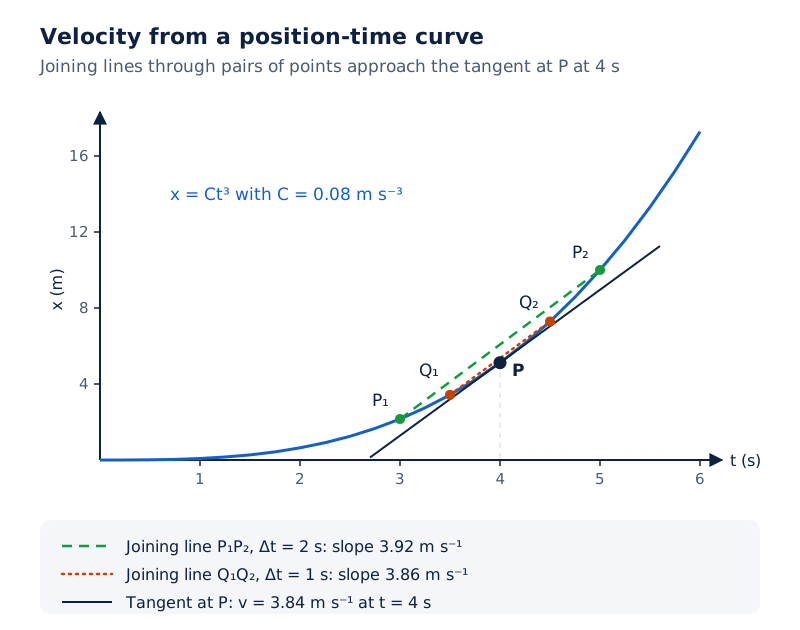
The graph has x in metres vertically and t in seconds horizontally. A rising curved line is marked with pairs of points around P at 4 s. The joining lines approach the tangent at P.
Drawn by One Young India.
Worked example 2. Position is x = A + Bt², where A = 8.5 m is a constant position term and B = 2.5 m s⁻² is the coefficient of t². Find velocity at 0 s and 2.0 s, and average velocity from 2.0 s to 4.0 s.
Formula: v = dx/dt = 2Bt; v̄ = [x(4.0 s) − x(2.0 s)]/(4.0 s − 2.0 s). Here x(t) means position at time t.
Substitute: v = (5.0 m s⁻²)t; v̄ = B[(4.0 s)² − (2.0 s)²]/(2.0 s).
Answer: The velocities are 0 m s⁻¹ and 10 m s⁻¹ respectively. The average velocity is 15 m s⁻¹. The constant A cancels when taking the difference of positions.
Worked example 3. A car's position is x = Ct³, where C = 0.08 m s⁻³ is a constant coefficient. Find its instantaneous velocity at t = 4.0 s.
Formula: v = dx/dt = 3Ct². Substitute: v = 3 × 0.08 × (4.0)² m s⁻¹.
Answer: v = 3.84 m s⁻¹. Average velocities over progressively smaller intervals centred on 4.0 s approach this value.
How does acceleration describe a change in velocity?
Acceleration is the rate of change of velocity with time. Let v₁ and v₂ be velocities at times t₁ and t₂, and let Δv mean v₂ − v₁. The average acceleration, denoted by ā, is:
ā = Δv/Δt
The instantaneous acceleration a is the limiting value as the interval becomes infinitesimally small. In derivative notation:
a = dv/dt
The SI unit of acceleration is metre per second squared, written m s⁻² or m/s². Its dimension is [LT⁻²]. It measures a change in velocity per unit time, rather than a change in position per unit time.
Does negative acceleration mean slowing down?
The sign of acceleration specifies its direction relative to the chosen axis. It does not by itself establish whether speed increases or decreases. To decide that, compare the directions of velocity and acceleration.
| Velocity | Acceleration | Effect on speed |
|---|---|---|
| Positive | Positive | Speed increases |
| Positive | Negative | Speed decreases while velocity remains positive |
| Negative | Negative | Speed increases |
| Negative | Positive | Speed decreases while velocity remains negative |
Deceleration describes acceleration that reduces speed. In straight-line motion this acceleration is opposite to the velocity. An object moving in the negative direction can therefore slow down under positive acceleration.
At a turning point, velocity can be zero while acceleration is non-zero. A ball thrown vertically upwards provides an example: it is momentarily at rest at its highest point, yet its downward acceleration continues.
For uniform acceleration, acceleration remains constant in magnitude and direction. Average acceleration then equals instantaneous acceleration throughout the interval. Constant velocity is different: it means no change in velocity and hence zero acceleration.
What information can be read from motion graphs?
A motion graph relates a physical quantity to time; it is not a drawing of the object's path. A curved position-time graph can represent straight-line motion. The curve shows how the coordinate changes with time, not a curved route through space.
How are slope and area interpreted?
| Graph | Useful measurement | Physical interpretation |
|---|---|---|
| Position-time | Slope of tangent | Instantaneous velocity |
| Velocity-time | Slope of tangent | Instantaneous acceleration |
| Velocity-time | Signed area over an interval | Displacement |
| Acceleration-time | Signed area over an interval | Change in velocity |
Signed area is counted positively above the time axis and negatively below it. On a velocity-time graph, areas on opposite sides can cancel in the displacement. Adding their magnitudes instead gives the distance travelled.
The units explain the area rule: velocity multiplied by time has units (m s⁻¹) × s = m. Similarly, acceleration multiplied by time has units (m s⁻²) × s = m s⁻¹, the unit of a velocity change.
A horizontal position-time graph indicates rest. An inclined straight position-time graph indicates constant non-zero velocity. A horizontal velocity-time graph indicates constant velocity, while a straight inclined velocity-time graph indicates constant non-zero acceleration.
What the figure shows
Signs of velocity and acceleration
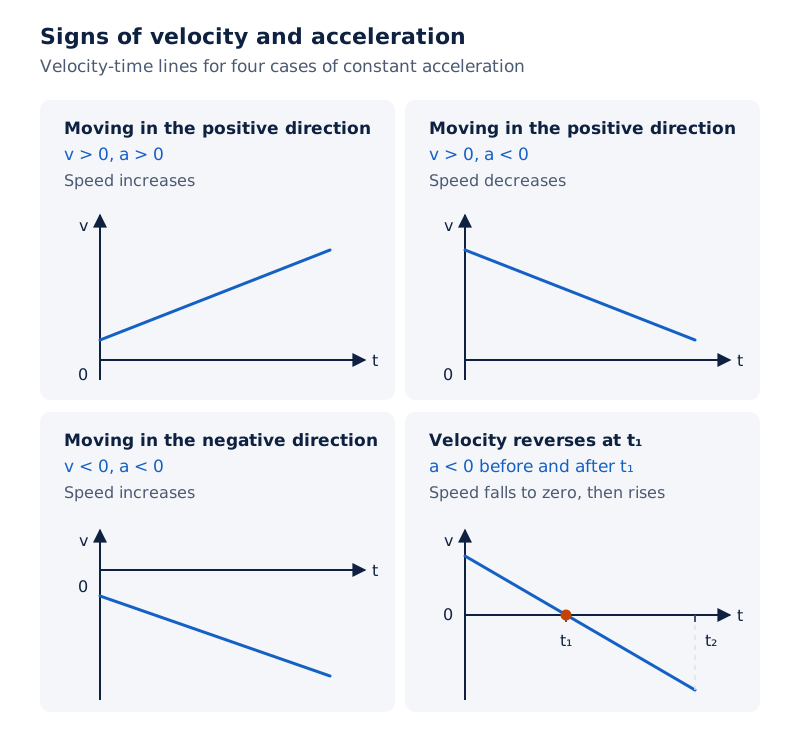
Four velocity-time plots show straight lines: rising above the time axis, falling above it, falling below it, and falling across it. In the last plot, the line crosses at t₁ and continues to t₂.
Drawn by One Young India.
In that last plot, t₁ marks the reversal of direction and t₂ a later instant. Before the crossing, positive velocity decreases towards zero. After the crossing, velocity is negative and its magnitude increases. The slope remains negative throughout, so acceleration does not reverse at the turning point.
What graph shapes represent uniform acceleration?
For constant non-zero acceleration, the position-time graph is a parabola, the curve represented by a quadratic function of time, whose highest power of time is two. The velocity-time graph is straight and inclined, and the acceleration-time graph is horizontal. For zero acceleration, the position-time relation is linear.
Note: Read the axis labels before interpreting slope or area. The slope of a position-time graph is velocity; the slope of a velocity-time graph is acceleration. The same visual shape has different meanings on different axes.
How are the constant-acceleration equations derived graphically?
Let u be the initial velocity at time zero, v the velocity after elapsed time t, and a the constant acceleration. Let x₀ be the initial position and s the displacement x − x₀. Here the symbol s in an equation denotes displacement; the unit symbol s after a number means seconds.
The equations below apply to rectilinear motion provided acceleration remains constant in both magnitude and direction. The quantities are signed. Choosing the positive direction first allows the same equations to describe speeding up, slowing down and reversal.
Derivation: velocity after an elapsed time
- Draw a velocity-time graph with initial velocity u at time zero and final velocity v at time t.
- Constant acceleration makes this graph a straight line, so its slope is the same throughout the interval.
- The slope equals acceleration: a = (v − u)/t. Multiplying by t gives at = v − u.
v = u + at
Derivation: displacement from the area under the graph
- For positive initial velocity and positive acceleration, divide the area below the velocity-time line into a rectangle and a triangle.
- The rectangle has height u and base t, so its area is ut. The triangle has height v − u and base t, so its area is ½(v − u)t.
- Add these areas to obtain displacement: s = ut + ½(v − u)t.
- Substitute v − u = at into the triangle's area to obtain s = ut + ½at².
s = ut + ½at²
What the figure shows
Displacement as rectangle plus triangle
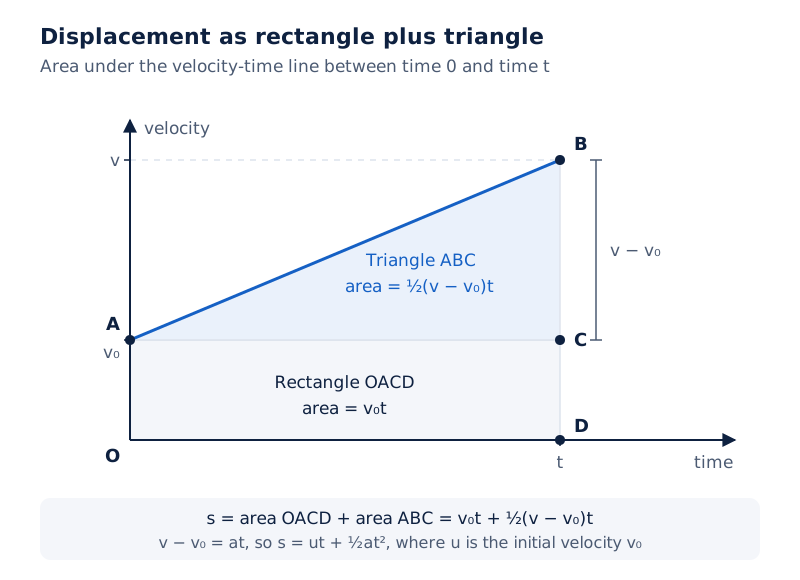
The straight velocity-time line rises from A to B. The grey rectangle is labelled OACD and the blue triangle ABC. D marks time t; the triangle's vertical side is labelled v − v₀, where v₀ is the figure's initial velocity.
Drawn by One Young India.
The figure uses v₀ for the initial velocity called u here. Its total area can also be written as half the sum of the initial and final velocities multiplied by time. Thus:
s = ½(u + v)t
For constant acceleration, average velocity is therefore (u + v)/2. This arithmetic mean of endpoint velocities is not a general rule for motion with changing acceleration.
How is time eliminated?
For non-zero constant acceleration, rearrange v = u + at to obtain t = (v − u)/a. Substitute into s = ½(u + v)t. Multiplying gives 2as = (v + u)(v − u) = v² − u².
v² = u² + 2as
The final relation also holds when acceleration is zero. If the origin is not the initial position, replace s by x − x₀. In particular, the position equation is x = x₀ + ut + ½at². A displacement-time, or s-t, graph plots s against t. Subtracting the fixed initial position shifts the position graph vertically without changing its slope.
How do differentiation and integration describe motion?
Differentiation finds an instantaneous rate of change. Applied to position with respect to time, it gives velocity. Applied to velocity with respect to time, it gives acceleration. These definitions can be used even when acceleration is not constant.
Integration reverses differentiation and also represents accumulation over an interval. Integrating velocity with respect to time gives displacement; integrating acceleration with respect to time gives the change in velocity. Initial conditions, such as the starting position and velocity, are needed to obtain a particular position or velocity.
Which elementary differentiation rules are useful?
In the following table, z is a mathematical variable, n a constant power and d/dz the instruction to differentiate with respect to z. The functions sin and cos mean sine and cosine; their angular argument is measured in radians.
A radian is the angle subtended at a circle's centre by an arc equal in length to its radius. The symbol e is the base of natural logarithms; eᶻ is the natural exponential function. The notation ln z means logarithm to base e. Arguments of trigonometric, exponential and logarithmic functions are dimensionless.
| Function | Derivative with respect to z | Condition or meaning |
|---|---|---|
| zⁿ | nzⁿ⁻¹ | At points where the power function is differentiable |
| sin z | cos z | Angular argument in radians |
| cos z | −sin z | Angular argument in radians |
| eᶻ | eᶻ | Natural exponential function |
| ln z | 1/z | z is positive |
A constant term has zero derivative. For motion, coefficients retain their units: differentiating a position function with respect to time must produce velocity units. The velocity gradient, dv/dx, means change of velocity per unit change of position, with unit s⁻¹ and dimension [T⁻¹]; it differs from acceleration dv/dt.
What distinguishes definite and indefinite integrals?
The symbol ∫ denotes integration; dz identifies z as the variable of integration. An indefinite integral gives a family of functions whose derivative is the integrand, meaning the expression being integrated. Its arbitrary additive constant is written K. For n ≠ −1, on an interval where the power function is defined:
∫zⁿ dz = zⁿ⁺¹/(n + 1) + K
A definite integral includes a lower and upper limit and gives the accumulated change between those limits. If F(z) is an antiderivative, meaning a function whose derivative is the integrand, the definite integral from z₁ to z₂ is F(z₂) − F(z₁).
Here z₁ and z₂ denote the two integration limits. The additive constant cancels in their difference. For motion, integration limits identify the relevant starting and finishing times or the corresponding positions and velocities.
With constant acceleration, integrating a over time from zero to t gives v − u = at. Integrating u + at over the same interval gives x − x₀ = ut + ½at². These recover the graphical results while keeping the starting conditions explicit.
How are the equations applied to vertical motion under gravity?
Free fall describes motion under gravity when air resistance is neglected. Let g be the magnitude of acceleration due to gravity. It has unit m s⁻² and dimension [LT⁻²]. Near Earth's surface, g can be taken as constant when the fall height is small compared with Earth's radius.
Under that approximation, g = 9.8 m s⁻². Use the value specified in a numerical question when it differs. If upward is positive, acceleration is a = −g during ascent and descent. The direction of acceleration remains downward even when the object reverses its velocity.
What happens to a body released from rest?
Let y be the vertical position measured upwards from the release point and y₀ its initial value. Both have unit metre and dimension [L]. Released from rest means u = 0, and choosing the release point as origin gives y₀ = 0.
v = −gt
y = −½gt²
v² = −2gy
The negative y value identifies a position below the release point. The distance fallen is its magnitude. The acceleration-time graph is horizontal below the time axis, the velocity-time graph slopes down from zero, and the position-time graph curves downwards.
How is an upward throw from a building analysed?
Worked example 4. A ball is thrown vertically upwards at 20 m s⁻¹ from a point 25.0 m above the ground. Neglect air resistance and take g = 10 m s⁻². Find its rise above the launch point and the time until it reaches the ground.
Formula: v² = u² + 2a(y − y₀); y = y₀ + ut + ½at². Choose upward as positive and ground level as y = 0.
Substitute at the highest point: 0 = 20² − 20(y − 25). Thus the rise is 20 m and the greatest height above the ground is 45 m.
Substitute at the ground: 0 = 25 + 20t − 5t². The physically relevant time after release is t = 5 s.
Answer: The ball rises 20 m above its launch point and hits the ground after 5 s. Its greatest height above ground is 45 m.
The same motion can be divided at the highest point. The ascent takes 2 s. Falling from rest through 45 m then takes 3 s, giving 5 s altogether. Using the whole-journey position equation avoids having to divide the path.
Note: At maximum height the ball has zero instantaneous velocity, but its acceleration remains −g for an upward-positive axis. Substituting zero acceleration there would break the constant downward acceleration model.
How do stopping distance and reaction time use these ideas?
Stopping distance here means the distance a vehicle travels after the brakes are applied and before it stops. Let dₛ represent that distance. Choose the initial direction of motion as positive, so u is positive and constant braking acceleration a is negative.
At the stop, v = 0. Substitution into v² = u² + 2adₛ gives:
dₛ = −u²/(2a)
The negative sign makes dₛ positive because a is negative. For the same deceleration, stopping distance is proportional to the square of initial velocity. Doubling initial velocity therefore increases stopping distance by a factor of four.
Worked example 5. A car moving at 126 km h⁻¹ stops over 200 m with uniform retardation, meaning acceleration opposite to its motion. Find its acceleration and stopping time. Here km means kilometre and h means hour.
Formula: a = (v² − u²)/(2s); t = (v − u)/a. Convert u = 126 × 1000/3600 = 35 m s⁻¹, using 1 km = 1000 m and 1 h = 3600 s.
Substitute: a = (0 − 35²)/(2 × 200) = −3.0625 m s⁻²; t = (0 − 35)/(−3.0625).
Answer: Acceleration is approximately −3.06 m s⁻², the retardation magnitude is 3.06 m s⁻², and the stopping time is approximately 11.4 s.
How does a falling ruler measure reaction time?
Reaction time is the time a person takes to observe, think and act. It depends on the individual and the complexity of the situation. In a ruler-drop experiment, the distance fallen before the ruler is caught gives an estimate of this time.
Worked example 6. A ruler falls 21.0 cm from rest before being caught. Neglect air resistance and use g = 9.8 m s⁻². Estimate the reaction time.
Let d be the positive distance fallen and tᵣ the reaction time. Formula: d = ½gtᵣ²; tᵣ = √(2d/g), where √ means the positive square root.
Substitute: d = 0.210 m, since 1 cm = 0.01 m; tᵣ = √(2 × 0.210/9.8) s.
Answer: The estimated reaction time is approximately 0.2 s. This is the elapsed falling time in the experiment.
Reaction time precedes the application of the brakes in a driving response. Keep that delay distinct from the subsequent braking motion. A stopping calculation that specifies distance after braking should use the motion during that stated interval.
Glossary
- Kinematics — The description of motion using position, velocity and acceleration without investigating the causes of motion.
- Frame of reference — The reference system relative to which positions and changes of position are described.
- Point object — An approximation that neglects an object's size compared with the distance relevant to its motion.
- Displacement — The directed change from initial position to final position over a specified interval.
- Distance travelled — The total length of the path covered during a specified time interval.
- Average speed — Total distance travelled divided by the elapsed time for the same journey.
- Average velocity — Displacement divided by the elapsed time over which that displacement occurs.
- Instantaneous velocity — The limiting average velocity as the time interval becomes infinitesimally small.
- Acceleration — The rate of change of velocity with time, including its direction.
- Uniform acceleration — Acceleration that remains constant in both magnitude and direction during the motion considered.
- Differentiation — The mathematical operation used to find the instantaneous rate of change of a function.
- Integration — The mathematical operation that reverses differentiation or calculates accumulation over a specified interval.
- Free fall — Motion under gravity in a model in which air resistance is neglected.
- Reaction time — The interval taken by a person to observe a situation, think and act.
Common errors and misconceptions
- Misconception: Distance and displacement are interchangeable because both use metres. Correct: Distance measures the complete path; displacement measures the directed change between endpoints. Reversing direction can make their magnitudes different.
- Misconception: Average speed equals the magnitude of average velocity for every journey. Correct: Average speed uses total distance. Equality holds for straight-line motion without reversal; a return journey can have zero average velocity.
- Misconception: Negative acceleration means that speed is falling. Correct: Compare acceleration with velocity. Negative acceleration increases speed when velocity is negative and reduces it while velocity is positive.
- Misconception: Zero velocity at the top of an upward throw means zero acceleration. Correct: The ball is momentarily at rest, but downward gravitational acceleration continues under the free-fall assumptions.
- Misconception: Every curved position-time graph represents motion along a curved path. Correct: The graph describes position as a function of time. A parabola can represent uniformly accelerated motion along one straight line.
- Misconception: The area under a velocity-time graph directly gives total distance even after reversal. Correct: Signed area gives displacement. Add magnitudes of the separate areas to find distance travelled.
- Misconception: The three constant-acceleration equations apply to any changing velocity. Correct: They require acceleration to remain constant in magnitude and direction. Derivative definitions apply more generally.
Exam-style questions with model answers
Q1. Distinguish distance travelled from displacement, including the effect of returning to the starting point. [2 marks]
- Distance travelled is the total path length and is a scalar; a journey out and back adds both parts of the path.
- Displacement is the directed change between the initial and final positions. It is zero when the object returns to its starting point.
Q2. An athlete starts at 0 m, reaches 100 m and returns to 40 m in a total of 16 s. Taking the outward direction as positive, calculate distance, displacement, average speed and average velocity. [4 marks]
- The outward distance is 100 m and the return distance is 100 − 40 = 60 m. Total distance is therefore 160 m.
- Displacement is final position minus initial position, giving 40 − 0 = +40 m, in the outward direction.
- Average speed equals total distance divided by elapsed time: 160/16 = 10 m s⁻¹.
- Average velocity equals displacement divided by elapsed time: 40/16 = +2.5 m s⁻¹. It differs from average speed because the athlete reverses direction.
Q3. Position x at time t is x = A + Bt², with A = 8.5 m and B = 2.5 m s⁻². Find the instantaneous velocity at 2.0 s and the average velocity from 2.0 s to 4.0 s. Explain the method used for each. [3 marks]
- Instantaneous velocity is the derivative of position with respect to time. Differentiating gives v = 2Bt; the constant position term A has zero derivative.
- At t = 2.0 s, v = 2 × 2.5 × 2.0 = 10 m s⁻¹. This is the velocity at that particular instant.
- Average velocity uses the displacement across the stated interval: B[(4.0)² − (2.0)²]/(4.0 − 2.0) = 15 m s⁻¹. The A terms cancel between the endpoint positions.
Q4. For straight-line motion with positive initial velocity u and constant positive acceleration a, derive v = u + at and s = ut + ½at² from a velocity-time graph. Here v is final velocity, s is displacement and t is elapsed time. [5 marks]
- Plot time horizontally and velocity vertically. The initial point has velocity u at time zero, and the final point has velocity v at time t.
- Constant acceleration gives a straight line joining these points. Its slope is acceleration, so a = (v − u)/t. Rearranging gives v = u + at.
- Displacement equals the area below the velocity-time line during the interval. Split this area into a rectangle below velocity u and a triangle above it.
- The rectangle has area ut. The triangle has base t and height v − u, so its area is ½(v − u)t. Hence s = ut + ½(v − u)t.
- Substitute v − u = at into this expression to obtain s = ut + ½at². Constant acceleration is the condition that makes the graph straight and the derivation valid.
Q5. A ball is thrown vertically upwards at 20 m s⁻¹ from a point 25.0 m above the ground. Neglect air resistance and take gravitational acceleration as 10 m s⁻² downward. Find its rise above launch, greatest height above ground and time to reach the ground. State its acceleration at the highest point. [5 marks]
- Choose the ground as vertical origin and upward as positive. The initial height is 25.0 m, initial velocity is +20 m s⁻¹ and acceleration is −10 m s⁻².
- At the highest point, velocity is zero. Using the squared-velocity equation gives 0 = 20² + 2(−10) × rise, so the rise above launch is 20 m.
- The greatest height above the ground equals launch height plus rise: 25.0 + 20 = 45 m. The launch point is not the chosen origin.
- At the ground, vertical position is zero. Thus 0 = 25 + 20t − 5t². Solving and choosing the time after launch gives t = 5 s.
- Acceleration at the highest point remains −10 m s⁻², directed downward. Zero velocity at that instant does not remove gravitational acceleration.
Q6. A car moving at 126 km h⁻¹ comes to rest in 200 m under constant acceleration. Use 1 km = 1000 m and 1 h = 3600 s. Taking the original direction as positive, calculate acceleration and stopping time. [3 marks]
- Convert the initial velocity: 126 × 1000/3600 = 35 m s⁻¹. The final velocity is zero and the displacement during braking is +200 m.
- Use the squared-velocity equation: acceleration = (0² − 35²)/(2 × 200) = −3.0625 m s⁻², approximately −3.06 m s⁻². Its negative sign indicates the opposite direction to the initial motion.
- Stopping time equals velocity change divided by constant acceleration: (0 − 35)/(−3.0625) = approximately 11.4 s. Both numerator and denominator are negative, giving a positive elapsed time.
Q7. A ruler falls from rest through 21.0 cm before being caught. Neglect air resistance, take g = 9.8 m s⁻² and use 1 cm = 0.01 m. Estimate the reaction time, explaining the equation and conversion. [3 marks]
- The ruler starts from rest and has constant downward acceleration in this model. Its positive falling distance d is related to reaction time tᵣ by d = ½gtᵣ².
- Convert the distance before substitution: 21.0 cm = 0.210 m. Rearranging the falling-distance equation gives tᵣ = √(2d/g), using the positive root for elapsed time.
- Substitute the supplied values: tᵣ = √(2 × 0.210/9.8) s, approximately 0.2 s. This estimates the time between release and catching the ruler.
Q8. A ball moves vertically under constant downward gravitational acceleration, with air resistance neglected. Taking upward as positive, explain the signs of velocity and acceleration during ascent and descent, and the velocity at maximum height. [3 marks]
- During ascent, velocity is positive because motion is upward. Acceleration is negative because it is downward, so speed decreases while the ball continues upwards.
- At the highest point, instantaneous velocity is zero. Acceleration remains downward and negative; the ball is only momentarily at rest before reversing direction.
- During descent, velocity is negative and acceleration is also negative. They have the same direction, so the ball's speed increases although both signed quantities are negative.
Key takeaways
- Choose a reference point and positive direction before assigning signs to position, displacement, velocity and acceleration.
- Distance records total path length, while displacement records the directed change between the starting and finishing positions.
- Average speed uses distance divided by elapsed time; average velocity uses displacement over that same interval.
- Instantaneous velocity is the position-time tangent slope, and instantaneous acceleration is the velocity-time tangent slope.
- Signed area beneath a velocity-time graph gives displacement; add separate area magnitudes to obtain distance after reversals.
- The standard kinematic equations require constant acceleration in both magnitude and direction throughout the interval considered.
- A freely moving upward-thrown ball has zero velocity at its highest point while retaining downward gravitational acceleration.
- Stopping distance after braking varies as the square of initial velocity when the deceleration remains the same.
Test yourself
When is the point-object approximation appropriate?
When the object's size is much smaller than the distance it moves during a reasonable duration of time.
Can displacement be zero while distance travelled is positive?
Yes. An object that moves away and returns to its starting point has zero displacement but a positive path length.
What does a negative position coordinate tell you?
It places the object on the negative side of the origin; it does not by itself specify its direction of motion.
What does a horizontal velocity-time graph indicate?
The velocity is constant, so its rate of change and the acceleration are zero.
When does negative acceleration increase speed?
When velocity is also negative, acceleration acts in the same direction as motion and increases the speed.
What is the difference between definite and indefinite integration?
An indefinite integral includes an arbitrary additive constant. A definite integral uses specified limits to calculate the accumulated change between them.
Why is the velocity at the top of an upward throw insufficient to determine acceleration?
Zero velocity describes the instantaneous motion, while acceleration describes its rate of change. Downward gravitational acceleration persists at the highest point.
What happens to stopping distance if initial velocity doubles while deceleration stays the same?
The stopping distance after braking becomes four times as large because it depends on the square of initial velocity.
Write about it
Turn a question from this chapter into a paper.
The Writing Studio has a structure guide, a rubric and citation tools for 15 formats, from essays to research papers. Drafting is free with an account. Learnacy Essential adds feedback from an AI writing coach and submission to The OYI Review.
Learnacy Essential is ₹1,499 for the year. Publication depends on review and is not guaranteed.