
Nature and Significance of Management | CBSE Class 12 Business Studies Notes
On this page

This note covers the meaning and characteristics of management, effectiveness and efficiency, management objectives and importance, its nature as art, science and profession, managerial levels and functions, and the meaning, features and importance of coordination.
What is management, and how are effectiveness and efficiency different?
Management is the process of getting work done to achieve organisational goals effectively and efficiently. It brings people and resources together and guides their efforts towards a common objective. This applies to a business as well as a school, hospital or other organisation.
The word process points to the interrelated activities that managers perform: planning, organising, staffing, directing and controlling. A manager does not merely tell people to work. The manager also decides what is to be achieved, arranges resources, places people in suitable roles, guides their work and checks results.
Definition: Effectiveness means doing the right task, completing the activity and achieving the intended goal. Efficiency means doing the task correctly with minimum cost and resources.
Effectiveness focuses on the result. Efficiency considers the relationship between inputs, such as money, materials, equipment and people, and outputs. Efficiency rises when fewer resources produce the same output, or when the same resources yield more output. A manager needs both: completing a target at excessive cost is not enough, and saving resources while missing the target is not enough either.
| Point | Effectiveness | Efficiency |
|---|---|---|
| Main question | Was the intended goal achieved? | Were resources used carefully? |
| Focus | Completion and end result | Inputs, outputs and cost |
| Possible shortfall | The target is missed despite low cost | The target is reached at excessive cost |
| Managerial aim | Do the right task | Do the task correctly |
Worked example 1. A company has a target of 5,000 units. Because of power failures, the manager uses double shifts and produces all 5,000 units, but production costs rise. Answer: The manager is effective because the 5,000-unit target is met, but less efficient because extra inputs increase the cost of the same output.
The two ideas are interrelated. Concentrating only on cost may prevent goods from reaching the market; concentrating only on the target may waste inputs. Management therefore seeks the intended result while using resources as economically as possible.
What are the main characteristics of management?
Management is a goal-oriented process. Organisations exist for particular purposes, and management joins individual efforts towards those goals. The goal of a retail store can be higher sales, while the goal of a social organisation can be providing education to children with special needs.
It is all pervasive: a petrol pump, hospital and school all require management. The activities are common, even though the way managers carry them out may vary with culture, tradition and history. Management is also multidimensional, because it concerns work, people and operations at the same time.
How do the three dimensions fit together?
Management of work turns the work of an organisation into goals, plans, budgets, decisions and assigned responsibilities. Management of people deals with employees both as individuals with different needs and as a group working towards a shared goal. Management of operations deals with the production process that turns inputs into a product or service.
Management is a continuous process. Managers perform several related functions repeatedly, often at the same time. It is a group activity because people with different purposes must work together towards an organisational goal. It is a dynamic function because an organisation must adapt to social, economic and political changes.
Finally, management is an intangible force. It cannot be seen directly, but its presence can be felt when planned targets are met, employees are satisfied and work is orderly. These seven characteristics explain why management is present in organisations of different kinds and sizes.
Diagram
Three dimensions of management
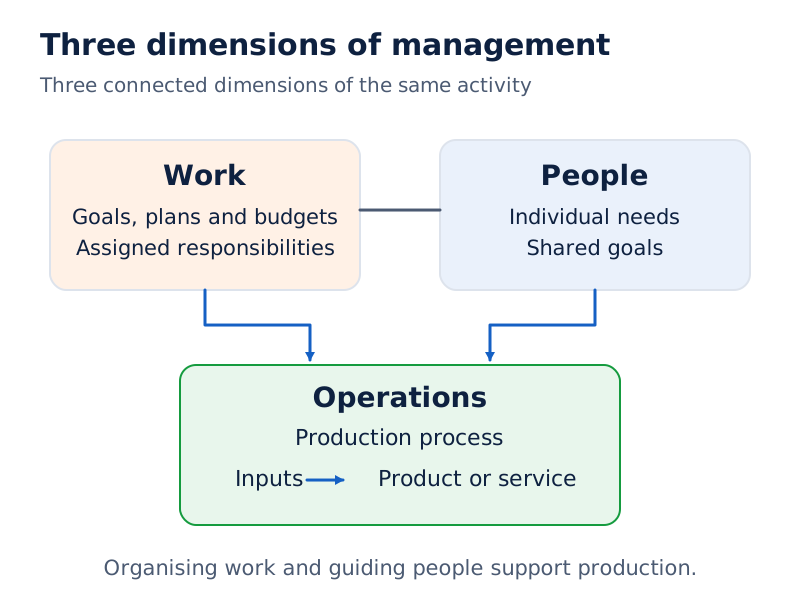
Draw three connected boxes labelled work, people and operations. Show that the production of a product or service depends on organising work and guiding people.
Drawn by One Young India.
Which objectives does management seek to achieve?
Management objectives are the desired results of an organisation's activity. They grow out of its basic purpose and include organisational, social and personnel objectives. A manager needs to consider all three rather than treating one group of interests as the entire purpose of the organisation.
What are organisational objectives?
For a business, the main organisational objectives are survival, profit and growth. Survival requires enough revenue to cover costs. Profit supports continued operation and helps cover business costs and risks. Growth adds to the organisation's prospects in the long run.
Growth can be indicated by higher sales volume, more employees, more products or greater capital investment. Management has to use human and material resources to the greatest possible advantage while considering stakeholders such as employees, customers, shareholders and government.
What are social and personnel objectives?
Social objectives concern benefits for society. They include environmentally friendly production, employment for underprivileged sections and amenities such as schools and healthcare for the community. ITC E-Choupal is a business initiative that gives farmers information and a more direct marketing channel.
Personnel objectives relate to the people who work in the organisation. Their needs can include competitive salaries and perks, recognition by peers, and opportunities for personal growth and development. Management has to reconcile these personal goals with organisational goals so that people can contribute while meeting their own needs.
| Objective | What it concerns | Illustrations |
|---|---|---|
| Organisational | The organisation's economic purpose | Survival, profit and growth |
| Social | Benefits created for society | Environmentally friendly production and community amenities |
| Personnel | Needs of people working in the organisation | Salary, recognition and development |
The three groups are connected. An organisation needs to remain viable, but it also operates within society and depends on people. Management therefore works to achieve objectives in an effective and efficient manner while keeping these interests in view.
Why is management important to an organisation and society?
Management helps an organisation achieve group goals. Individuals perform different tasks, but a manager gives their work a common direction. Without that direction, effort may be spent on separate purposes instead of the organisation's overall goal.
It increases efficiency by reducing costs and increasing productivity through better planning, organising, staffing, directing and controlling. The aim is to use available resources carefully while still reaching the intended result.
Management also creates a dynamic organisation. Organisations face a changing environment, and people may resist change because familiar ways of working feel secure. Managers help them adapt so that the organisation can respond to new conditions and maintain its competitive position.
It helps people achieve personal objectives. Through motivation and leadership, a manager can develop team spirit, cooperation and commitment while employees work towards their own goals. This links the needs of individuals with the organisation's purpose.
Management contributes to the development of society. By serving the needs of several groups, an organisation can provide good-quality products and services, create employment opportunities and adopt technology for people's benefit. These effects arise through the management of the organisation and its resources.
The five points are related but should be distinguished in an answer. Group goals concern a shared direction; efficiency concerns resource use; a dynamic organisation adapts to change; personal objectives concern employees; and social development concerns the wider community.
Why can management be considered an art?
An art is the skilful and personal application of existing knowledge to achieve a desired result. It can develop through study, observation and experience. Art involves theoretical knowledge, personalised application, and practice combined with creativity.
Management meets these features. There is a body of knowledge in areas such as marketing, finance and human resources. A manager studies this knowledge, observes situations and uses experience in day-to-day work. Knowledge alone, however, does not decide exactly how a particular problem should be handled.
Personalised application matters because managers use principles in different ways. The same principle can guide managers facing different circumstances, but each must judge the situation and choose a suitable course of action. This allows different styles of management to develop.
Practice and creativity also matter. A manager draws on imagination, initiative and innovation when applying acquired knowledge. Skill improves with practice, and the manager must adjust methods to the realities of a particular situation. A successful manager therefore combines knowledge with the ability to put it into practice.
The art comparison does not mean management is based on guesswork. Its theoretical knowledge provides a foundation; its practical application requires judgement. Just as two performers can use the same basic principles differently, two managers can use shared management ideas in their own skilful ways.
Note: Calling management an art highlights its personal and creative application. It does not remove the value of study, observation or established principles.
In what sense is management a science, and how do art and science complement each other?
Science is a systematised body of knowledge that explains general truths or laws. Its features include principles based on cause and effect, testing through observation and repeated experimentation, and universal validity. Management has some of these features, but does not match them exactly.
Management has a systematised body of knowledge and its own terms, theories and principles. It also draws on disciplines such as economics, sociology, psychology and mathematics. Shared concepts help managers communicate and understand work situations.
Its principles have developed through observation and experimentation in different organisations. Yet management deals with human beings and their behaviour. Outcomes therefore cannot be predicted or repeated with the precision associated with controlled scientific experiments. For this reason, management is described as an inexact science.
Management principles also lack strict universal validity. A manager may have to modify their use to suit a particular situation. Even so, the principles provide standardised techniques and are useful in the training and development of managers.
What are the merits and limitations of the science comparison?
A merit is that a manager can use organised knowledge instead of relying entirely on personal experience. The limitation is that principles cannot guarantee identical results in every organisation. Human behaviour and circumstances influence how a principle works.
| Feature | Science generally | Management |
|---|---|---|
| Knowledge | Systematised principles | Its own concepts and principles, with knowledge from other disciplines |
| Testing | Controlled, repeated experiments | Observation and experimentation in organisations |
| Prediction | Results can be more exact | Human behaviour makes exact replication difficult |
| Application | Universal validity is a key feature | Principles need adjustment to the situation |
Art and science complement each other. The principles form the science of management; the manager's skilful use of them is the art. Effective practice benefits from both organised knowledge and sound personal judgement.
To what extent is management a profession?
A profession has a well-defined body of knowledge that people can learn through instruction. Entry is normally restricted by a qualification or examination. A professional association regulates membership and conduct, an ethical code guides behaviour, and service to clients is a central motive.
Management has a developed body of knowledge. It is taught through books, colleges and specialised institutions, including the Indian Institutes of Management. Entry to such institutions is usually through an examination. This supports the professional character of management education.
There is, however, no general requirement that a person hold a specific management degree before being appointed a manager. Training and qualifications are desirable, but entry to managerial work is not restricted in the same way as entry to some established professions.
Associations of managers exist. The All India Management Association, for example, has a code of conduct for its members. Yet managers are not compelled to join such an association, and the association does not have statutory backing to regulate every manager.
What are the merits and limitations of calling management a profession?
The professional comparison recognises management's organised knowledge, education and developing standards of conduct. Its limitation is that management does not meet the full tests of restricted entry and compulsory association. The basic purpose of management remains to help the organisation reach its stated goal, whether that goal concerns business activity or service.
Thus management has professional features, but it does not meet all the criteria of a full-fledged profession. A good management team can also serve society by helping provide quality products at reasonable prices.
What are the three levels of management and their responsibilities?
Organisations arrange managerial roles in a hierarchy. Each role carries responsibility for a task and an appropriate degree of authority to make decisions. This creates superior and subordinate relationships and, generally, three levels of management: top, middle, and supervisory or operational.
Top management includes the senior-most executives, such as the chief executive officer, president and vice-president. It integrates different parts of the organisation, coordinates departments, analyses the business environment and formulates overall goals and strategies. It is responsible for the organisation's survival, welfare and impact on society.
Middle management links top management to the first-line managers. A production manager or division head is an example. Middle managers interpret top-level policies, put plans and strategies into action, arrange personnel, assign duties, motivate staff and cooperate with other departments.
Supervisory or operational management includes supervisors and foremen. These managers directly oversee the workforce and convey instructions from middle management. Their efforts help maintain output quality, minimise material wastage and maintain safety standards.
| Level | Position | Main responsibility |
|---|---|---|
| Top | Senior-most executives | Overall goals, strategies, integration and survival |
| Middle | Between top and first-line managers | Implementing plans and guiding lower-level managers |
| Supervisory or operational | Directly above the workforce | Overseeing work, quality, wastage and safety |
Diagram
Managerial levels
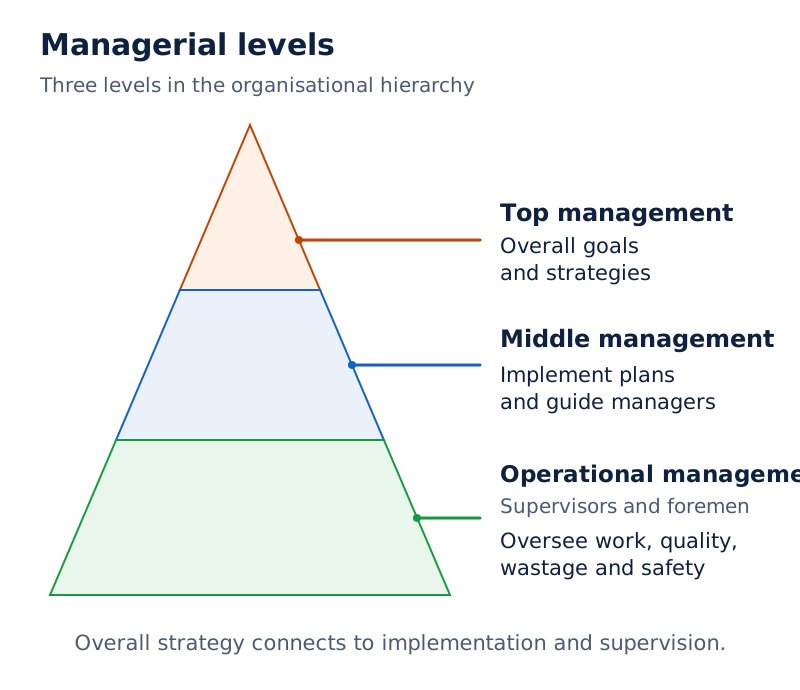
Draw a three-tier pyramid with top management at the narrow upper tier, middle management in the central tier and operational management in the broad lower tier.
Drawn by One Young India.
The levels differ in the scope of their decisions and the people they guide. They are connected: broad strategies need middle-level implementation and direct supervision of the actual work.
Which functions do managers perform?
The five functions of management are planning, organising, staffing, directing and controlling. They help managers use organisational resources and guide members towards specific goals. They are often explained in this order, but actual managerial work interweaves them.
What does each function involve?
- Planning determines in advance what is to be done and who will do it. It sets goals and develops a way to reach them. It can anticipate problems and prepare for them.
- Organising assigns duties, groups tasks, establishes authority and allocates resources. It decides which activities are needed and builds reporting relationships for carrying out the plan.
- Staffing places the right people in the right jobs. It includes recruitment, selection, placement and training so suitable people are available when needed.
- Directing leads, influences and motivates employees. It also involves communication and supervision so people understand and carry out their assigned work.
- Controlling establishes performance standards, measures actual performance, compares it with standards and takes corrective action when deviations appear.
In the candle business, planning can concern the quantities, varieties and colours of candles. Organising then arranges tasks and resources. Staffing ensures that people with suitable skills are available. Directing guides their work, while controlling checks whether the results match the plan.
Diagram
Management functions
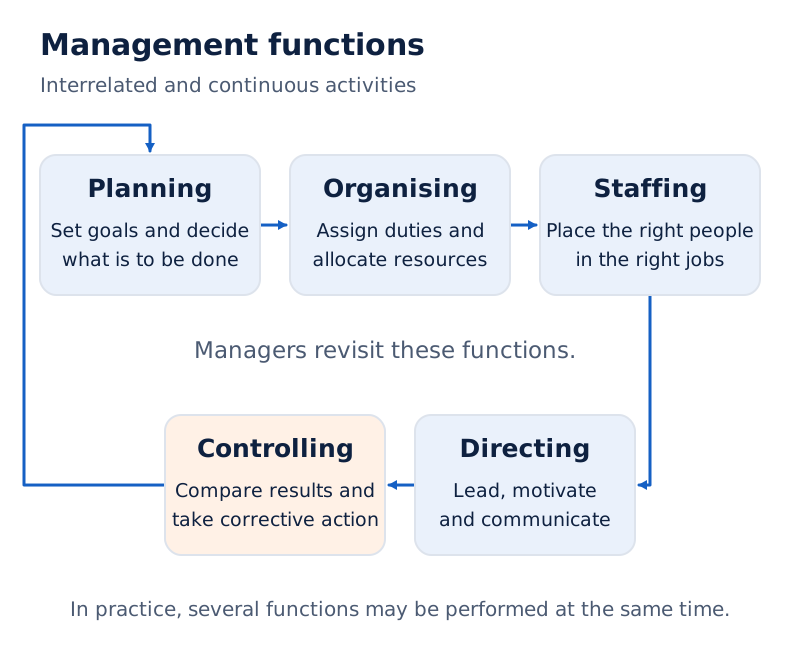
Draw five linked boxes labelled planning, organising, staffing, directing and controlling. Add a connecting arrow to show that managers revisit these related activities rather than completing each once in isolation.
Drawn by One Young India.
A manager may plan an exhibition and address an employee's problem on the same day. This is why the functions are described as interrelated and continuous, not as five tasks that remain separate in practice.
Why is coordination called the essence of management?
Coordination synchronises the work of different people, units and departments towards a common goal. It links activities such as purchasing, production, sales and finance so that the organisation can act with unity rather than as a set of isolated parts.
Coordination is called the essence of management because it runs through every managerial function. Plans for the whole organisation need connected departmental plans. Organising and staffing arrange people and responsibilities in line with those plans. Directing helps people carry them out, and controlling identifies differences between intended and actual results.
The result sought is an orderly arrangement of individual and group efforts. Different units should contribute the required amount and quality of work at the right time and in a suitable sequence. This reduces conflict and supports the achievement of planned objectives.
At Namchi Designer Candles, production and sales must work together so that candle production responds to market demand. If one department acts without information from the other, their efforts may fail to support the same objective.
Diagram
Coordination across functions
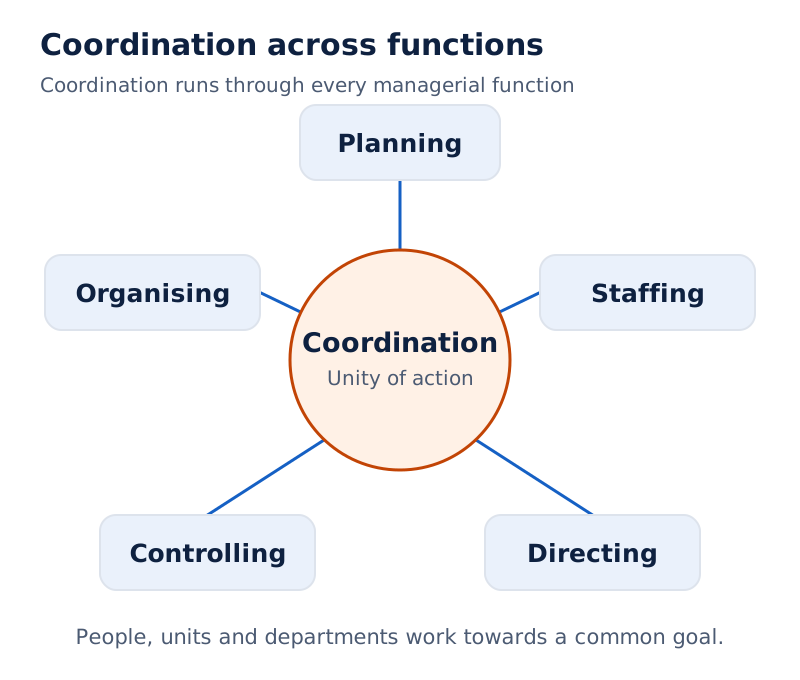
Place coordination in a central circle and connect it to planning, organising, staffing, directing and controlling. The links show that coordination is present in each function.
Drawn by One Young India.
Coordination is sometimes discussed as a separate function, but its role is wider. Every manager contributes to it while performing the other functions. It is the continuing link that gives unity of action to interdependent work.
What are the characteristics of coordination?
Coordination integrates group efforts by giving diverse activities a shared focus. It also ensures unity of action: departments aim their work towards the same organisational purpose. In the candle business, sales and production need to align their work with market demand.
It is a continuous process, beginning with planning and continuing through controlling. A collection planned for a festival needs timely arrangements for people, production and promotion, followed by checks on progress. Coordination does not end when the plan is written.
Coordination is all pervasive because interdependence exists across levels and departments. Purchasing, production and sales depend on one another. If inputs do not meet production requirements, later activities can suffer.
It is also the responsibility of all managers. Top managers coordinate with subordinates to carry out overall policies. Middle managers connect top and first-line management. Operational managers coordinate the work of the people they supervise.
Finally, coordination is a deliberate function. A manager consciously aligns efforts; goodwill alone does not arrange tasks, timing and direction. People may willingly cooperate yet duplicate work or move in different directions if their activities are not coordinated.
Note: Cooperation means a willingness to work together. Coordination gives that willingness a common direction. Cooperation without coordination may waste effort; coordination without cooperation may cause dissatisfaction.
These characteristics explain why coordination is more than a single meeting or instruction. It connects people and activities throughout the organisation and throughout the management process.
Why does the need for coordination increase as organisations grow?
The basic reason is interdependence. Departments and individuals rely on one another for information and resources. Managers have to reconcile differences in timing, approach, effort and interest while linking personal goals to organisational goals.
How do size, departments and specialists increase the need?
Growth in size brings more employees with different backgrounds, habits and goals. Coordination helps their efforts serve a common purpose. Functional differentiation divides work among departments whose own objectives can conflict. Specialisation brings expert knowledge but can also create differences of opinion between specialists and others.
For example, a marketing department may propose a discounts to increase sales by 10 per cent, while finance may object because discounts reduce revenue. A manager has to link the departments' activities to the organisation's shared objective instead of allowing each to decide in isolation.
Worked example 2. Marketing proposes discounts to increase sales by 10 per cent, but finance objects to the revenue effect. Answer: The target of increasing sales by 10 per cent reflects a different immediate priority from the finance department's revenue concern. Coordination is needed to reconcile their approaches and decide how their work can support the common organisational goal.
The Mumbai dabbawallas illustrate interdependent work. One person collects a lunch box, another sorts it at a railway station, another travels with it and another delivers it near the destination. The service depends on timing and orderly links between these tasks.
Coordination matters even where individual units perform their own tasks well. If one unit's timing, materials or information do not fit another's needs, the whole effort can suffer. Management therefore brings the separate activities together in a planned sequence.
How can effectiveness, efficiency and coordination be applied to a business situation?
When assessing a situation, first identify the intended goal. Then ask whether it was achieved, which tests effectiveness. Next compare the resources used with the planned or available resources, which tests efficiency. Finally, identify which people or departments depend on one another and whether their efforts are coordinated.
The bracelet order illustrates the difference between effectiveness and efficiency. Two workers were each asked to produce 500 bracelets within four days at a cost of Rs 100 per bracelet. One met the quantity and time target but spent more than the assigned total cost; the other spent less per bracelet but produced fewer than required.
Worked example 3. Ashita produces her assigned 500 bracelets within 4 days but spends Rs 55,000 against a planned Rs 100 per bracelet. Answer: Ashita is effective because she meets the 500-bracelet target on time. She is not efficient against the assigned cost, since Rs 55,000 exceeds the Rs 50,000 total implied by the cost target.
Worked example 4. For an order due within 4 days, Lakshita produces 450 of her assigned 500 bracelets at Rs 90 per bracelet rather than Rs 100. Answer: Lakshita uses a lower cost per bracelet, so she is efficient on that measure. She is not effective because she misses the 500-bracelet production target.
The conclusion should name the measure used. A lower unit cost does not by itself prove that the assigned production goal was achieved. Likewise, reaching a quantity target does not prove that resources were used at the planned cost.
For departmental questions, identify the missing link between activities. If production and marketing blame one another for weak sales and unsuitable goods, coordination is needed so information and actions are aligned. This applies the same idea that connects planning, staffing, directing and controlling throughout management.
Glossary
- Management — The process of getting work done to achieve organisational goals effectively and efficiently through related managerial functions.
- Effectiveness — Completing the right task and achieving the goal or intended end result of an activity.
- Efficiency — Completing a task correctly while using resources carefully and keeping the cost of the result low.
- Organisational objectives — Goals concerning the organisation's economic purpose, including survival, profit and long-term growth.
- Social objectives — Goals that create benefits for society through an organisation's activities and responsibilities.
- Personnel objectives — Goals linked to employees' financial, social and personal development needs within an organisation.
- Art — The skilful, personal and creative application of existing knowledge to achieve desired results.
- Science — A systematised body of knowledge explaining general truths or laws through principles and evidence.
- Profession — Work based on specialised knowledge, regulated entry and conduct, and service to clients.
- Planning — Deciding in advance what is to be done, who will do it and how goals will be achieved.
- Organising — Assigning duties, grouping tasks, establishing authority and arranging resources to put a plan into action.
- Staffing — Finding, placing and developing suitable people for the jobs needed by an organisation.
- Directing — Leading, communicating with, motivating and supervising people as they carry out assigned tasks.
- Controlling — Comparing actual performance with standards and taking corrective action when deviations are found.
- Coordination — The deliberate synchronising of interdependent efforts to achieve unity of action towards a common goal.
Common errors and misconceptions
- Misconception: Meeting a target proves that management was efficient. Correct: Meeting the target shows effectiveness; efficiency also requires careful use of resources and cost.
- Misconception: A lower cost proves that management was effective. Correct: Effectiveness depends on whether the intended goal was achieved.
- Misconception: Management is required only in businesses. Correct: Schools, hospitals and other organisations also need management.
- Misconception: Art and science are mutually exclusive descriptions of management. Correct: Organised principles and their skilful application complement each other.
- Misconception: A manager must hold a specific management degree. Correct: Management training is desirable, but appointment as a manager is not generally restricted by such a degree.
- Misconception: Coordination begins only after work has gone wrong. Correct: It begins with planning and continues through controlling.
- Misconception: Willing cooperation automatically coordinates work. Correct: A manager must deliberately align tasks, timing and direction.
Exam-style questions with model answers
Q1. Distinguish between effectiveness and efficiency. [2 marks]
- Effectiveness concerns doing the right task and reaching the intended goal. A production target is met when the required output is completed.
- Efficiency concerns doing that task correctly with minimum cost and resources. A target can be reached without efficiency if its completion requires excessive inputs.
Q2. State three objectives of management and explain one of them. [3 marks]
- Management seeks organisational, social and personnel objectives.
- Organisational objectives concern the organisation's economic purpose, including survival, profit and growth. Survival requires revenue to cover costs, profit supports continued operation and covers risks, and growth strengthens long-term prospects.
- Social objectives benefit society, while personnel objectives address the financial, social and developmental needs of employees. Management works to reconcile these interests.
Q3. Explain why management is considered an art. [4 marks]
- Art rests on theoretical knowledge. Management has a body of knowledge in areas such as finance, marketing and human resources.
- Art involves personalised application. Different managers can apply shared principles differently to suit a particular situation.
- Art develops through practice and creativity. Managers use observation, experience, imagination and initiative to solve problems.
- Thus a manager's knowledge becomes useful through skilful application in actual organisational work. Practice can improve that skill over time.
Q4. Explain the three levels of management. [5 marks]
- Top management consists of senior executives. It integrates departments, analyses the environment, sets overall goals and strategies, and is responsible for the organisation's survival and impact on society.
- Middle management links top management to first-line managers. It interprets policies, implements plans, arranges personnel, assigns responsibilities, motivates employees and cooperates across departments.
- Supervisory or operational management directly oversees the workforce. Supervisors and foremen pass on instructions, maintain quality, minimise wastage and help maintain safety standards.
- The three levels differ in authority and scope of work, yet each depends on the others to carry overall goals into actual operations.
Q5. Why is coordination called the essence of management? [5 marks]
- Coordination synchronises activities of interdependent people and departments to secure unity of action towards a common goal.
- It begins with planning: departmental plans must fit the organisation's overall purpose. Organising and staffing then arrange tasks, authority, resources and people in support of those plans.
- Directing aligns day-to-day efforts, while controlling compares results with plans and prompts corrective action.
- Coordination therefore runs through every managerial function. It links activities such as purchasing, production, sales and finance, giving their efforts suitable timing, sequence and direction.
- It is the essence of management because it binds these functions together and helps the organisation achieve its goals with less conflict.
Q6. A worker meets a production target but exceeds the assigned cost. Is the worker effective and efficient? Explain. [2 marks]
- The worker is effective because the required production target has been met. The worker is not efficient against the assigned cost, because achieving the output used more resources than planned. Both the target and the cost must be considered when judging the result.
Q7. Explain why management does not meet every criterion of a full-fledged profession. [4 marks]
- Management has a systematic body of knowledge and is taught through books and specialised institutions.
- Unlike some established professions, appointment as a manager does not generally require a specific degree or examination, so entry to managerial work is not restricted.
- Associations such as the All India Management Association have codes of conduct, but membership is not compulsory and the association does not have statutory backing over all managers.
- Management therefore has professional features without meeting all the strict criteria of a profession.
Key takeaways
- Management guides individual and group efforts towards organisational goals through related functions performed effectively and efficiently.
- Effectiveness asks whether the goal was achieved; efficiency asks how carefully resources were used to achieve it.
- The seven characteristics include goal orientation, pervasiveness, multiple dimensions, continuity, group activity, dynamism and an intangible presence.
- Management aims to meet organisational, social and personnel objectives while considering the interests of several groups.
- Management is an art in its skilful application and an inexact science in its organised but situation-dependent principles.
- Management has professional features, but managerial appointments do not require a specific degree or compulsory professional membership.
- Top, middle and operational managers differ in authority and responsibilities, yet their work is connected.
- Coordination synchronises interdependent efforts, runs through every management function and becomes more important as organisations grow.
Test yourself
What makes a manager effective?
A manager is effective when the right task is completed and the intended organisational goal is achieved. This judgement focuses on the result.
What are the three dimensions of management?
They are management of work, management of people and management of operations. The three dimensions are connected in producing a product or service.
Name the three organisational objectives of a business.
They are survival, profit and growth. Survival requires enough revenue to cover costs, while profit and growth support continued and longer-term operation.
Why is management an inexact science?
It studies and guides human behaviour, so results of organisational observation and experimentation cannot be predicted or repeated with complete accuracy.
Which management level directly oversees workers?
Supervisory or operational management directly oversees the workforce. Supervisors and foremen pass on instructions and help maintain quality and safety.
Which five functions do managers perform?
Managers perform planning, organising, staffing, directing and controlling. These functions are interrelated and often overlap in everyday managerial work.
What is the difference between cooperation and coordination?
Cooperation is willingness to work together. Coordination is the deliberate alignment of activities, timing and direction towards a common goal.
Why can functional differentiation create a need for coordination?
Departments can have their own objectives and ways of working. Coordination links their activities and reconciles differences so they serve the organisation's common purpose.