
Nobel Prize in Chemistry 2010: Palladium-Catalysed Cross Coupling Reactions
On this page
What was the Nobel Prize in Chemistry 2010 awarded for?
The Nobel Prize in Chemistry 2010 was awarded jointly to three chemists "for palladium-catalyzed cross couplings in organic synthesis". This is the official citation, and it describes a family of chemical reactions that use the metal palladium as a helper to join two carbon atoms together.
In plain words: carbon atoms are the building blocks of all living things and of most medicines, plastics and electronic materials, but carbon atoms do not easily react with each other on their own.
The laureates found a way to use palladium as a kind of meeting point. Two separate carbon-containing fragments attach themselves to a palladium atom, and because they are now sitting right next to each other, they link up into a new carbon-carbon bond.
Palladium itself is not used up in the process; it works as a catalyst, meaning it speeds up and enables the reaction without becoming part of the final product.
The official name of this award is the Nobel Prize in Chemistry, given by the Royal Swedish Academy of Sciences.
Who are the laureates?
Richard F. Heck
Richard F. Heck was born on 15 August 1931 in Springfield, MA, USA, and died on 9 October 2015 in Manila, Philippines.
At the time of the award he was affiliated with the University of Delaware, USA, where he held the rank of Willis F. Harrington Professor Emeritus. He received one third of the prize.
Heck began his work on palladium chemistry in the late 1960s and published a modified, catalytic version of his reaction in 1972, which became known as the Heck reaction.
It links an organic halide to an olefin (a carbon compound with a double bond) using palladium.
Ei-ichi Negishi
Ei-ichi Negishi was born on 14 July 1935 in Changchun, China, and died on 6 June 2021 in Indianapolis, IN, USA. At the time of the award he was the Herbert C.
Brown Distinguished Professor of Chemistry at Purdue University, West Lafayette, IN, USA. He received one third of the prize.
In 1977 Negishi introduced organozinc compounds as the reactive partner in the palladium-catalysed coupling, giving the Negishi reaction, which tolerated many functional groups better than earlier methods.
Akira Suzuki
Akira Suzuki was born on 12 September 1930 in Mukawa, Japan. At the time of the award he was Distinguished Professor Emeritus at Hokkaido University, Sapporo, Japan. He received one third of the prize.
In 1979 Suzuki reported that organoboron compounds could act as the coupling partner on palladium, giving the mild, boron-based Suzuki reaction, now widely used because boron compounds are far less toxic than earlier reagents.
What problem was this work solving?
Organic chemistry is built on carbon-carbon bonds, the links that hold together the skeletons of molecules found in medicines, plastics, flower pigments, snake poison and antibiotics such as penicillin.
To make these complex molecules in the laboratory, chemists must join separate carbon-containing pieces, but carbon atoms are chemically stable and resist bonding to one another.
This stability comes from how electrons are arranged. Chemists picture the electrons around an atom's nucleus as layered clouds, and for small atoms central to organic chemistry, such as carbon, the outermost layer is "satisfied" once it holds eight electrons.
A carbon atom on its own has only four electrons in that outer layer, so it shares electrons with other atoms, for example four hydrogen atoms in the simple molecule methane, to complete the layer.
Once a carbon atom inside a small building-block molecule already shares its electrons this way, it is stable and has little reason to react further with a carbon atom in another molecule, which is exactly the obstacle chemists faced when trying to link small molecules into larger ones.
Before this work, chemists activated carbon atoms using reactive reagents such as the Grignard reagent, which couples a carbon atom to magnesium to make it unstable enough to react.
Victor Grignard, who won the Nobel Prize in Chemistry in 1912, found that magnesium, with two electrons it would rather give up, pushes its electrons onto a bonded carbon atom, creating an imbalance that leaves the carbon unstable and eager to bond elsewhere.
This approach worked for simple molecules, but as the Nobel Prize's own account explained, when chemists tried to build larger, more complex molecules this way, the reaction became unpredictable and produced "too many unwanted by-products in their test tubes".
The importance of carbon-carbon bond chemistry to the Nobel Prize in Chemistry is shown by the fact that, including this award, the prize has recognised it five times: the Grignard reaction (1912), the Diels-Alder reaction (1950), the Wittig reaction (1979) and olefin metathesis (2005), before palladium-catalysed cross coupling in 2010.
Interest in palladium itself had grown from the 1950s, when the German company Wacker Chemie AG used a palladium-catalysed reaction to convert ethylene into acetaldehyde, an important industrial raw material used in paint binders, plastic softeners and acetic acid production.
Organic chemistry as a field is far older than this prize. The German chemist Hermann Kolbe made one of the first carbon-carbon bonds, producing the simple molecule ethane, in 1845, roughly 150 years before scientists could build molecules as complex as palytoxin.
How does palladium-catalysed cross coupling work?
The key idea is that palladium acts as a meeting point for two carbon fragments.
Rather than making a carbon atom wildly reactive as the Grignard method did, the reaction brings two mildly activated carbon groups close together on a single palladium atom, so a controlled reaction can occur with far fewer unwanted side products.
In general, a palladium-catalysed cross coupling proceeds through a repeating catalytic cycle. A typical sequence, runs like this:
- An active palladium catalyst reacts with an organic halide (a carbon compound carrying a halogen atom such as bromine), attaching an organic group to the palladium. This step is called oxidative addition.
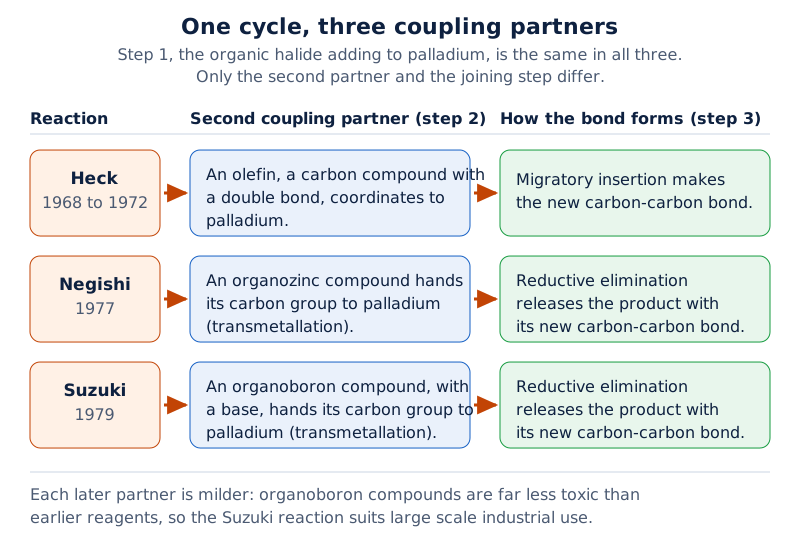
- A second carbon-containing partner then joins the same palladium atom. In the Heck reaction this partner is an olefin that simply coordinates to palladium; in the Negishi and Suzuki reactions it is an organometallic compound (built on zinc or boron) that transfers its organic group onto palladium in a step called transmetallation.
- With both organic groups now sitting on the same palladium atom, they are close enough to join. In the Heck reaction this happens through a migratory insertion, and in the Negishi and Suzuki reactions through a reductive elimination, which releases the new carbon-carbon bonded product.
- Palladium is regenerated in its original form at the end of the cycle, ready to catalyse another round of coupling, which is why only a small amount of palladium is needed even for large reactions.
Diagram
the cross-coupling cycle
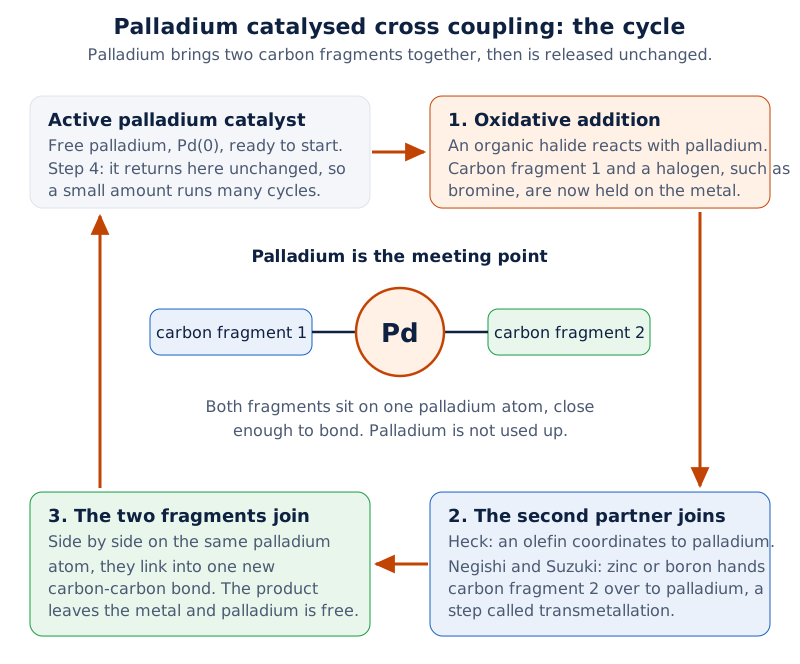
Draw a central palladium atom. Show an organic halide fragment attaching to it on one side (oxidative addition), a second carbon-containing fragment attaching on the other side (via an olefin for Heck, or via zinc/boron transfer for Negishi/Suzuki), an arrow showing the two fragments joining into one new carbon-carbon bond, and the palladium atom being released unchanged at the end, ready to repeat the cycle.
Drawn by One Young India.
The three reactions differ mainly in their second, nucleophilic partner: Heck used olefins directly; Negishi used organozinc compounds, introduced in 1977; and Suzuki used organoboron compounds, reported in 1979.
Each successive variant used a milder, less toxic partner, which is one reason the Suzuki reaction became especially popular for large-scale industrial use.
What are the three named reactions?
| Reaction | Laureate and year reported | Coupling partner used |
|---|---|---|
| Heck reaction | Richard F. Heck, 1968 to 1972 | Olefin (a carbon compound with a double bond) |
| Negishi reaction | Ei-ichi Negishi, 1977 | Organozinc compound |
| Suzuki reaction | Akira Suzuki, 1979 | Organoboron compound |
Heck's early experiments in the late 1960s used palladium compounds to add an organic group onto an olefin.
One famous early example joined a ring of carbon atoms to a smaller carbon piece to make styrene, a building block of the plastic polystyrene.
In 1972 he refined the method into the catalytic version that became the standard Heck reaction, now used, for example, in the large-scale production of the anti-inflammatory drug naproxen and the asthma drug montelukast.
Negishi's 1977 breakthrough was to replace less selective organometallic reagents with organozinc compounds, which gave higher yields and tolerated many more functional groups than earlier methods.
Negishi's variant was later used as a central step in artificially producing the natural substance discodermolide, a potential cancer-fighting compound originally found only in tiny amounts in a Caribbean marine sponge.
Suzuki's 1979 discovery used boron-based compounds together with a base. Because organoboron compounds are mild and much less toxic than earlier reagents, the Suzuki reaction became especially suited to industrial and pharmaceutical use, including the large-scale (thousands of tons) commercial synthesis of a compound that shields farm crops from fungal disease.
Each reaction follows a similar mechanism but uses a different coupling partner, so chemists speak of a shared palladium-catalysed cross-coupling family rather than three unrelated methods.
Before Negishi settled on organozinc compounds, he first tried organozirconium and organoaluminium coupling partners, working his way towards a milder and more selective reagent.
Suzuki's work built on earlier boron chemistry: in 1975 Heck himself, together with H. A. Dieck, had already used vinyl boronic acids as coupling partners in stoichiometric reactions, before Suzuki made the process catalytic and practical.
Other chemists contributed related findings around the same period. Other researchers, I. Moritani and Y. Fujiwara, found in 1967 that benzene can react with olefins to form styrenes, and once Heck's 1968 and 1969 papers appeared they realised the reaction goes through an organopalladium intermediate. In 1971, chemist T. Mizoroki, building on this earlier work, reported that a related aryl halide could arylate alkenes with a palladium catalyst.
How did the discovery unfold?
| Year | Event |
|---|---|
| 1950s | Wacker Chemie AG develops a palladium-catalysed industrial process converting ethylene to acetaldehyde, sparking chemist interest in palladium catalysis. |
| 1968 | Richard Heck publishes a series of papers showing that organopalladium compounds add to olefins at room temperature, producing compounds such as styrene. |
| 1972 | Heck reports a catalytic version of his reaction using an organic halide and palladium(0), which becomes the standard Heck reaction protocol. |
| 1976 to 1977 | Ei-ichi Negishi explores organozirconium and organoaluminium coupling partners, then introduces organozinc compounds as a milder, more selective nucleophilic partner. |
| 1979 | Akira Suzuki and co-workers report that organoboron compounds, activated by a base, can serve as coupling partners with vinyl and aryl halides in palladium-catalysed cross coupling. |
| 1994 | Scientists use the Suzuki reaction, among other methods, to artificially recreate the large natural molecule palytoxin in the laboratory. |
| 6 October 2010 | The Royal Swedish Academy of Sciences announces the Nobel Prize in Chemistry for Heck, Negishi and Suzuki, "for palladium-catalyzed cross couplings in organic synthesis". |
Why does this discovery matter?
Palladium-catalysed cross coupling gave chemists a far more precise and efficient tool for building complex organic molecules than earlier methods, because the reaction can be carried out under mild conditions while producing fewer unwanted by-products.
The Nobel Prize's press release described organic chemistry as having "developed into an art form" thanks to such tools, benefiting society "in the form of medicines, ever-more precise electronics and advanced technological materials".
In medicine, the reactions have been used to synthesise or modify natural products with therapeutic promise, including discodermolide (investigated as a cancer treatment), diazonamide A (tested against colon cancer cells) and dragmacidin F (tested against herpes virus and HIV).
Chemists have also used cross coupling to modify the antibiotic vancomycin, first isolated from a Borneo soil sample in the 1950s, so that it works against resistant bacteria such as MRSA.
In electronics, palladium-catalysed cross coupling has helped optimise the blue light produced by organic light-emitting diodes (OLEDs), used in very thin display screens only a few millimetres thick.
In industry, the Heck reaction has been used in the large-scale manufacture of drugs such as naproxen and montelukast, while the Suzuki reaction has been used to produce agricultural fungicides on a multi-ton scale.
The reactions also help chemists verify the structure of newly discovered natural molecules, since re-creating a molecule artificially and comparing it with the natural sample is often the only reliable way to confirm how its atoms are arranged.
More than forty years after Heck's first experiments, these reactions were still being refined and extended, for example by attaching palladium to new solid materials to run reactions in water.
How does this connect to what you study?
If you study chemistry at school, cross coupling connects directly to topics on catalysts and organic reaction mechanisms.
A catalyst, as taught in basic chemistry, speeds up a reaction without being consumed, exactly how palladium behaves here: it brings two carbon fragments together and is released unchanged at the end of the cycle.
The idea of an atom having a stable, "satisfied" outer electron arrangement, central to why carbon atoms resist bonding directly to each other, is the same idea taught in lessons on chemical bonding and the octet rule.
Understanding why carbon needs to be "activated" before it reacts also helps explain why organic synthesis in industry (making drugs, plastics and agrochemicals) requires carefully designed multi-step routes rather than one simple reaction.
How have other scientists extended these reactions?
The Heck reaction alone has been used in more than a hundred different syntheses of natural products and biologically active compounds since the 1970s.
In the synthesis of the cancer drug Taxol, chemists used the Heck reaction to close a difficult eight-membered carbon ring that forms part of the drug's rigid structure.
A related intramolecular Heck-type coupling has also been used to build the carbon skeleton of morphine, which is then converted to the finished molecule in a few further steps.
The Negishi reaction has played a similar role elsewhere: it was used in the total synthesis of pumiliotoxin A, a toxic substance found on the skin of frogs in the Dendrobatidae family, which the frogs use to defend themselves.
The Suzuki reaction, for its part, has supplied a key carbon-carbon bond-forming step in the synthesis of the potent natural antitumour agent dynemicin A, while the Negishi reaction was used in building the antiviral compound hennoxazole A and the Suzuki reaction in building the antiviral compound dragmacidin F.
Beyond the laboratory, these reactions scale up readily for industrial manufacturing. The herbicide Prosulfuron, developed by the company Ciba-Geigy, is produced on a large scale using a Heck reaction in which a diazonium salt generates the reactive palladium intermediate.
The anti-inflammatory drug naproxen and the asthma drug marketed as Singulair have both been manufactured industrially using Heck-reaction chemistry, and the fungicide Boscalid has been produced industrially using a Suzuki coupling.
Chemists continue to refine the underlying tool. In spring 2010, researchers reported attaching palladium atoms to the material graphene, the same year that graphene itself was recognised by the Nobel Prize in Physics, and used the resulting solid material to carry out a Suzuki reaction in water rather than in an organic solvent.
These later developments show that, although Heck's first experiments date back to the late 1960s, chemists worldwide were still finding new ways to make palladium-catalysed cross coupling more efficient and more widely applicable by the time of the 2010 award.
Quick facts for exams
The Nobel Prize in Chemistry 2010 was awarded jointly to Richard F. Heck, Ei-ichi Negishi and Akira Suzuki for palladium-catalysed cross couplings in organic synthesis.
It was announced on 6 October 2010 by the Royal Swedish Academy of Sciences, and each laureate received one third of the prize. Heck was affiliated with the University of Delaware, USA;
Negishi with Purdue University, USA; and Suzuki with Hokkaido University, Japan. The three reactions, named the Heck, Negishi and Suzuki reactions, use palladium as a catalyst to join carbon atoms that would otherwise not react easily, enabling efficient synthesis of medicines, agricultural chemicals and electronic materials.
| Fact | Detail |
|---|---|
| Prize | Nobel Prize in Chemistry 2010 |
| Citation | "for palladium-catalyzed cross couplings in organic synthesis" |
| Date announced | 6 October 2010 |
| Awarding body | The Royal Swedish Academy of Sciences |
| Laureates | Richard F. Heck, Ei-ichi Negishi, Akira Suzuki |
| Country of birth | Heck: USA; Negishi: China; Suzuki: Japan |
| Country of affiliation at award | Heck: USA (University of Delaware); Negishi: USA (Purdue University); Suzuki: Japan (Hokkaido University) |
| Shares | One third each |
| Prize amount | 10,000,000 Swedish kronor |
Note: Source. The prize facts in this note are from the Nobel Prize's official site, nobelprize.org.
Glossary
- Catalyst — a substance that speeds up or enables a chemical reaction without itself being permanently changed or consumed by it.
- Cross coupling — a reaction that joins two different carbon-containing fragments together to form a new carbon-carbon bond.
- Palladium — a transition metal element used as the catalyst in the Heck, Negishi and Suzuki reactions.
- Olefin — an organic compound containing a carbon-carbon double bond, used as the coupling partner in the Heck reaction.
- Organozinc compound — an organic molecule bonded to a zinc atom, used as the coupling partner in the Negishi reaction.
- Organoboron compound — an organic molecule bonded to a boron atom, used as the coupling partner in the Suzuki reaction.
- Oxidative addition — the step where an organic halide reacts with palladium, attaching an organic group to it and changing palladium's oxidation state.
- Transmetallation — the step where an organic group is transferred from zinc or boron onto the palladium atom.
- Reductive elimination — the final step in the Negishi and Suzuki cycles, where the two organic groups join and leave palladium as a new molecule.
- Organic chemistry — the branch of chemistry dealing with carbon-based compounds, the basis of living matter.
- Grignard reagent — an older carbon-magnesium compound used to activate carbon atoms for bonding, developed by Victor Grignard.
- Discodermolide — a substance first found in a Caribbean marine sponge, investigated as a possible cancer treatment and later made artificially using the Negishi reaction.
Common errors and misconceptions
- Misconception: Palladium becomes part of the final product molecule. Correct: Palladium acts only as a catalyst; it facilitates the reaction and is released unchanged afterwards.
- Misconception: The Heck, Negishi and Suzuki reactions are three unrelated discoveries. Correct: They share the same basic principle of bringing two carbon fragments together on palladium, differing mainly in the second coupling partner used (olefin, organozinc or organoboron).
- Misconception: Carbon atoms readily bond to each other without help. Correct: Carbon is chemically stable and carbon atoms do not easily react with one another, which is exactly the problem cross coupling solves.
- Misconception: This prize is only about laboratory chemistry with no real-world use. Correct: The reactions are used industrially to manufacture medicines such as naproxen and montelukast, agricultural fungicides and materials for electronic displays.
- Misconception: All three laureates worked at the same time on the same reaction. Correct: Heck's key work came in 1968 to 1972, Negishi's in 1977 and Suzuki's in 1979, each building on the idea of palladium catalysis.
- Misconception: The Suzuki reaction uses the same reagent type as the Negishi reaction. Correct: The Negishi reaction uses organozinc compounds, while the Suzuki reaction uses organoboron compounds, which are milder and less toxic.
Exam-style questions with model answers
Q1. For what citation was the Nobel Prize in Chemistry 2010 awarded? [2 marks]
- It was awarded "for palladium-catalyzed cross couplings in organic synthesis".
- The prize was shared equally among Richard F. Heck, Ei-ichi Negishi and Akira Suzuki.
Q2. Name the three laureates of the Nobel Prize in Chemistry 2010 and their affiliations at the time of the award. [2 marks]
- Richard F. Heck was at the University of Delaware, USA; Ei-ichi Negishi was at Purdue University, USA; and Akira Suzuki was at Hokkaido University, Japan.
Q3. Explain why chemists needed a new method to join carbon atoms before the 1960s. [3 marks]
- Carbon atoms are chemically stable and do not easily react with one another, so simply mixing two carbon compounds does not form a new bond.
- Earlier methods, such as the Grignard reagent, activated a carbon atom by attaching it to a reactive metal like magnesium, making it unstable enough to bond.
- This worked for simple molecules, but for larger, more complex molecules it produced too many unwanted by-products, limiting the usefulness of the method for advanced synthesis.
Q4. Describe the basic steps of a palladium-catalysed cross coupling. [4 marks]
- An organic halide reacts with palladium in an oxidative addition, attaching an organic group to the palladium atom.
- A second carbon-containing partner (an olefin, or a zinc or boron compound) joins the same palladium atom.
- The two organic groups, now close together on palladium, join to form a new carbon-carbon bond, through migratory insertion in the Heck reaction or reductive elimination in the Negishi and Suzuki reactions.
- Palladium is released in its original form, ready to catalyse the next cycle, which is why only a small amount is needed.
Q5. Distinguish between the Heck, Negishi and Suzuki reactions. [4 marks]
- All three use palladium as a catalyst to form a new carbon-carbon bond between an organic halide and a second carbon-containing partner.
- The Heck reaction, developed by Richard Heck between 1968 and 1972, uses an olefin as the second partner.
- The Negishi reaction, introduced by Ei-ichi Negishi in 1977, uses an organozinc compound, which is milder and tolerates more functional groups than earlier reagents.
- The Suzuki reaction, reported by Akira Suzuki in 1979, uses an organoboron compound, which is even milder and less toxic, making it especially suitable for large-scale industrial use.
Q6. Discuss the significance of palladium-catalysed cross coupling for medicine and industry. [5 marks]
- Palladium-catalysed cross coupling gave chemists a precise and efficient way to build complex carbon-based molecules under mild conditions, producing far fewer unwanted by-products than earlier carbon-activation methods.
- In medicine, the reactions have been used to synthesise or test promising natural compounds such as discodermolide (investigated against cancer), diazonamide A (tested on colon cancer cells) and dragmacidin F (tested against herpes virus and HIV).
- The reactions have also been used to modify the antibiotic vancomycin so that it remains effective against resistant bacteria such as MRSA.
- Industrially, the Heck reaction has been used to manufacture drugs such as naproxen and montelukast, while the Suzuki reaction is used to produce agricultural fungicides on a large scale.
- In electronics, the reactions have helped optimise the blue light in organic light-emitting diodes used in thin display screens, showing the wide reach of this chemistry across medicine, agriculture and technology.
Q7. What role does palladium play in these reactions, and why is this described as "catalytic"? [3 marks]
- Palladium acts as a meeting point where two separate carbon-containing fragments can come close enough together to react and form a new carbon-carbon bond.
- It facilitates each step of the reaction cycle, including oxidative addition and either migratory insertion or reductive elimination.
- Because palladium is released unchanged at the end of each cycle, only a small amount is needed to drive many reaction cycles, which is why the process is called catalytic.
Q8. When was the Nobel Prize in Chemistry 2010 announced, and how was the prize shared? [1 mark]
- It was announced on 6 October 2010, with each of the three laureates receiving one third of the prize.
Key takeaways
- The Nobel Prize in Chemistry 2010 went to Richard F. Heck, Ei-ichi Negishi and Akira Suzuki for palladium-catalysed cross couplings.
- Palladium acts as a catalyst, bringing two carbon fragments together so they can bond, without becoming part of the final product.
- Earlier carbon-activation methods, such as the Grignard reagent, caused too many unwanted by-products in complex molecules.
- The Heck reaction (olefins), Negishi reaction (organozinc) and Suzuki reaction (organoboron) each use a different, progressively milder coupling partner.
- Heck's key papers appeared in 1968 and 1972, Negishi's in 1977 and Suzuki's in 1979.
- The reactions are used to make medicines, agricultural chemicals and electronic materials, including drugs like naproxen and montelukast.
- Carbon-carbon bond-forming chemistry has now won five separate Nobel Prizes in Chemistry, including this one.
Test yourself
What is the official citation for the Nobel Prize in Chemistry 2010?
The citation reads "for palladium-catalyzed cross couplings in organic synthesis", shared equally by Heck, Negishi and Suzuki.
Where was Richard F. Heck affiliated at the time of the award?
Richard F. Heck was affiliated with the University of Delaware in the USA at the time of the award.
What role does palladium play in these reactions?
Palladium acts as a catalyst, bringing two carbon fragments together so they can bond, and is released unchanged afterwards.
Which coupling partner does the Negishi reaction use?
The Negishi reaction uses an organozinc compound, introduced by Ei-ichi Negishi in 1977.
Which coupling partner does the Suzuki reaction use?
The Suzuki reaction uses an organoboron compound, reported by Akira Suzuki in 1979.
Why did earlier methods like the Grignard reagent struggle with complex molecules?
They made carbon atoms too unpredictable, so building complex molecules produced too many unwanted by-products.
Name one medicine manufactured industrially using the Heck reaction.
The anti-inflammatory drug naproxen is manufactured industrially using the Heck reaction.
Where was Akira Suzuki affiliated at the time of the award?
Akira Suzuki was affiliated with Hokkaido University in Sapporo, Japan, at the time of the award.