
Nobel Prize in Economics 2007: Mechanism Design Theory and Its Laureates
On this page
This note covers the Nobel Prize in Economics 2007: who won it, what mechanism design theory is, how it explains auctions, public goods and regulation, how the idea developed from the 1960s onward, why it matters for real-world institutions, and quick facts for exams.
What was the Nobel Prize in Economics 2007 awarded for?
The Royal Swedish Academy of Sciences gave the prize to three economists "for having laid the foundations of mechanism design theory". This is the exact wording of the official citation, shared equally among the three laureates.
In plain words, the laureates built a toolkit for designing the rules of economic games, such as auctions, voting systems, or regulations, so that people who hold private information are still encouraged to act in ways that produce good outcomes for everyone.
The prize's official name is the Sveriges Riksbank Prize in Economic Sciences in Memory of Alfred Nobel, commonly called the Nobel Prize in Economics.
The central puzzle the theory tackles is this: markets work beautifully under ideal conditions, but real buyers, sellers, regulators and voters often hide what they truly know or want.
Mechanism design theory gives a rigorous way to ask which set of rules, among all conceivable ones, best achieves a goal such as efficiency or revenue, once you accept that people will act in their own self-interest with whatever private information they hold.
Who are the laureates?
Leonid Hurwicz
Leonid Hurwicz was born on 21 August 1917 in Moscow, Russia, and died on 24 June 2008 in Minneapolis, MN, USA.
At the time of the award he was affiliated with the University of Minnesota, Minneapolis, MN, USA, as Regents Professor Emeritus of Economics. He received one third of the prize.
Hurwicz is credited as the founder of the field. In 1960 he defined a mechanism as a system in which participants exchange messages with each other or to a "message center", and a pre-set rule turns those messages into an outcome, such as who gets what good.
In 1972 he introduced the crucial idea of incentive compatibility, the requirement that a mechanism should make honest reporting the best strategy for each participant.
He also proved an important negative result: under weak assumptions, no mechanism that is both incentive-compatible and allows voluntary participation can always reach a fully efficient outcome when information is private.
Eric S. Maskin
Eric S. Maskin was born on 12 December 1950 in New York, NY, USA. At the time of the award he was affiliated with the Institute for Advanced Study, Princeton, NJ, USA. He received one third of the prize.
Maskin studied mathematics at Harvard University and later taught at MIT, Harvard and Princeton. His major contribution, from a 1977 paper, was implementation theory: a way of designing mechanisms so that every possible equilibrium of the game produces an optimal outcome, not just the intended one.
This solved the problem of mechanisms that technically work but also allow bad outcomes to occur if players coordinate on the wrong equilibrium. He also contributed to auction theory, monopoly pricing and social choice.
Roger B. Myerson
Roger B. Myerson was born on 29 March 1951 in Boston, MA, USA. At the time of the award he was affiliated with the University of Chicago, Chicago, IL, USA. He received one third of the prize.
Myerson completed his Ph.D. in applied mathematics at Harvard in 1976 and conducted much of his prize-winning research at Northwestern University.
He developed the revelation principle in its most general form, extended mechanism design to situations of incomplete information (where parties do not know each other's goals or costs), and applied the theory to optimal auction design and to the regulation of monopolies, notably in work with David Baron.
What problem were the laureates trying to solve?
Adam Smith's idea of the "invisible hand" says that markets, under ideal conditions, allocate scarce resources efficiently even though each person is pursuing only their own interest.
The committee's press release noted that in practice conditions are "usually not ideal": competition is rarely fully free, buyers often lack complete information, and private decisions can create costs or benefits for others that the market does not capture.
Many transactions also happen outside open markets altogether, inside firms, in bargaining between two parties, or through government rules. Economists wanted to know how well such different institutions perform, and what the optimal mechanism would be to achieve a goal such as social welfare or a seller's profit.
The deep difficulty is that information about what people want, and what resources or costs are involved, is scattered across many separate individuals, each of whom might misrepresent that information to gain an advantage.
A seller might claim high costs to charge more; a person sharing the cost of a joint project might claim low benefit to pay less; an insured worker might falsely claim illness.
Before mechanism design theory existed, economists mostly studied only how markets behaved and when markets alone would be efficient, under very strict assumptions.
Mechanism design widened the question to: given any set of realistic constraints, what is the best possible institution, market-based or not?
How does mechanism design theory actually work?
Mechanism design treats an economic institution as a kind of game with specific rules. Participants send "messages" (which may or may not be truthful), and a pre-specified rule turns those messages into an outcome.
The theory predicts the equilibrium outcome of any such game and then compares different possible mechanisms to find the best one for a chosen goal.
A key simplifying insight is the revelation principle, first formulated by Allan Gibbard in 1973 and later generalised by Myerson.
It says that when searching for the best mechanism, researchers only need to consider "direct mechanisms", where each participant is simply asked to report their private information truthfully, because any outcome achievable by a complicated mechanism can also be achieved by a well-designed direct mechanism that respects incentive compatibility.
A general method for designing and evaluating a mechanism follows the prize committee's presentation speech, which describes the method in three steps, with the equilibrium check (addressed by implementation theory) discussed as part of the hardest, final step:
- Predict, using game theory, how participants will behave under a proposed set of rules.
- Evaluate the resulting allocation (such as who gets which goods, or how costs are shared) against the chosen goal.
- Search among feasible mechanisms, using the revelation principle to restrict the search to incentive-compatible direct mechanisms, for the one that best meets the goal.
- Check that the mechanism does not also permit inferior, unwanted equilibria alongside the intended optimal one, the concern addressed by implementation theory.
The theory distinguishes two broad settings: dominant-strategy mechanisms, where truth-telling is each person's best choice no matter what others do, and Bayesian mechanisms, where truth-telling only needs to be best on average given beliefs about others.
Dominant-strategy mechanisms for public goods, such as the Clarke-Groves mechanism, make honesty optimal but often fail to balance the budget, so the tax collected does not exactly cover costs.
Bayesian mechanisms relax this requirement and allow more positive results, at the cost of only working "on average" rather than in every single case.
What does the bilateral trade example show?
The popular science page from the academy illustrates the theory with a simple story. Suppose Erika owns a piano worth x to her, and a prospective buyer, Peter, values it at y.
Trade should ideally occur whenever y is greater than x, since that is when both sides can gain. But neither party knows the other's true valuation.
If Erika makes a take-it-or-leave-it offer, she will set her price above her own true value, risking no sale even when Peter would have been willing to pay more than Erika's true value.
The same problem arises in reverse if Peter makes the offer. A double auction, where both sides state a price simultaneously and trade happens at a price in between if Peter's bid exceeds Erika's, seems promising, but each side still has an incentive to misstate their true valuation: Erika bids above her value and Peter bids below his.
The result is that trade only happens in equilibrium when Peter's valuation exceeds Erika's by a certain margin (in the specific uniformly-distributed example worked through in the source, by one quarter), not whenever any gain from trade exists.
Myerson and Satterthwaite (1983) proved this gap is unavoidable: no incentive-compatible mechanism that also allows voluntary participation can guarantee that trade occurs exactly whenever there are gains from trade.
The double auction, however, achieves the best possible outcome among all such mechanisms for this kind of bilateral trade.
Diagram
the bilateral trade triangle
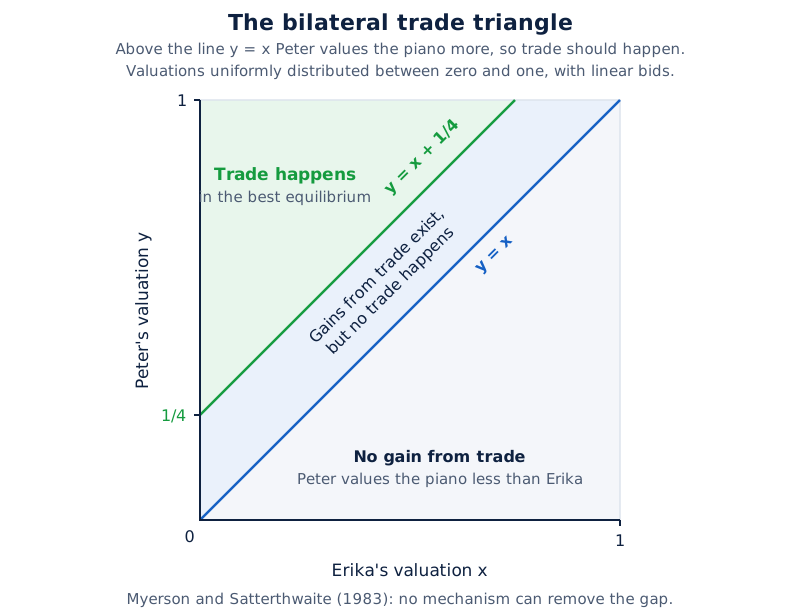
Draw a square with Erika's valuation x on the horizontal axis and Peter's valuation y on the vertical axis, both running from 0 to 1.
Shade the whole triangle above the diagonal line y = x to show where trade would be ideal.
Then shade a smaller triangle further from the diagonal (separated by a gap of about a quarter) to show where trade actually occurs under the best achievable double-auction equilibrium.
Drawn by One Young India.
Where else is mechanism design applied?
The theory's reach goes well beyond a single piano sale. The committee's background material lists several major applications, summarised below.
| Application area | What mechanism design explains |
|---|---|
| Auction design | Why double auctions can efficiently aggregate private information about valuations, and what reserve price maximises a seller's expected revenue |
| Public goods | Why unanimous or consensual decision rules often fail to fund worthwhile joint projects, and why taxation-based funding can do better |
| Monopoly pricing | How a seller who does not know buyers' tastes should design quantity discounts and quality-based pricing to maximise revenue |
| Regulation | How a regulator who cannot observe a monopolist's true costs should design an optimal scheme balancing efficiency against rent extraction, following Baron and Myerson (1982) |
| Voting and social choice | How implementation theory addresses coordination problems among voters, such as the risk of "wasting one's vote" on a candidate seen as unlikely to win |
Edward Clarke (1971) and Theodore Groves (1973) had shown earlier that under certain conditions, a mechanism exists in which truthful revelation of willingness to pay for a public good is each person's dominant strategy, and the resulting level of the public good maximises total social surplus.
The drawback, as the source notes, is that such mechanisms generally do not balance the budget exactly.
How did the discovery unfold?
| Year | Event |
|---|---|
| 1960 | Leonid Hurwicz defines a mechanism as a message-based system that turns private reports into an allocation outcome. |
| 1972 | Hurwicz introduces the concept of incentive compatibility and proves an impossibility result for fully efficient, voluntary-participation mechanisms. |
| 1973 | Allan Gibbard formulates the first version of the revelation principle. |
| 1977 | Eric Maskin gives the first general solution to the implementation problem, founding implementation theory. |
| 1979 | Myerson, and separately Dasgupta, Hammond and Maskin, extend the revelation principle to Bayesian Nash equilibrium; Laffont and Maskin prove an impossibility result for bilateral trade. |
| 1981 | Myerson publishes his seminal analysis of optimal auction design. |
| 1982 | Baron and Myerson develop the optimal regulatory mechanism for a monopolist with hidden costs. |
| 1983 | Myerson and Satterthwaite establish the precise upper bound on gains from trade achievable in bilateral trade under private information. |
| 2007 | The Royal Swedish Academy of Sciences awards the prize jointly to Hurwicz, Maskin and Myerson, announced on 15 October 2007. |
Why does this discovery matter?
Mechanism design theory gave economists, and later political scientists, a rigorous way to design and compare institutions rather than simply describe them.
It explains, for instance, why a government auctioning radio spectrum should think carefully about reserve prices and auction format to raise revenue or to ensure the asset goes to whoever values it most.
It also explains why consensus-based decision rules can fail to fund worthwhile shared projects, giving a rigorous foundation to Paul Samuelson's older conjecture that people have an incentive to understate their true interest in a collective good.
This has informed thinking about taxation as a way to fund public goods when voluntary, unanimous agreement would not work.
The theory remains central to regulation design, corporate finance, auction markets (including modern online and spectrum auctions) and voting theory.
The presentation speech observed that the theory's relevance has grown "due to globalization and growing internet trade", phenomena that place new demands on older institutions.
Open questions remain in extending results to settings with multiple dimensions of private information and to dynamic, repeated settings.
Quick facts for exams
The Sveriges Riksbank Prize in Economic Sciences in Memory of Alfred Nobel 2007 was awarded jointly to Leonid Hurwicz, Eric S. Maskin and Roger B. Myerson,
Myerson, each receiving one third of the prize, for laying the foundations of mechanism design theory. The award was announced on 15 October 2007 by the Royal Swedish Academy of Sciences.
All three laureates were based in the United States at the time: Hurwicz at the University of Minnesota, Maskin at the Institute for Advanced Study in Princeton, and Myerson at the University of Chicago.
Mechanism design theory explains how to design rules for auctions, regulation, voting and public-goods provision that account for people's self-interest and private information, and it remains influential across economics and political science today.
| Fact | Detail |
|---|---|
| Prize | Sveriges Riksbank Prize in Economic Sciences in Memory of Alfred Nobel 2007 |
| Date announced | 15 October 2007 |
| Laureates | Leonid Hurwicz, Eric S. Maskin, Roger B. Myerson |
| Country of birth | Hurwicz: Russia (Moscow); Maskin: USA (New York); Myerson: USA (Boston) |
| Affiliation at award | Hurwicz: University of Minnesota, USA; Maskin: Institute for Advanced Study, Princeton, USA; Myerson: University of Chicago, USA |
| Share | One third each |
| Citation | "for having laid the foundations of mechanism design theory" |
| Prize amount | 10,000,000 Swedish kronor |
Note: Source. The prize facts in this note are from the Nobel Prize's official site, nobelprize.org.
Glossary
- Mechanism design — the branch of economic theory that designs the rules of an economic game to achieve a chosen goal, given self-interested participants with private information.
- Incentive compatibility — a property of a mechanism where honest reporting of private information is each participant's best strategy.
- Revelation principle — the result that any mechanism's outcome can be replicated by a direct, incentive-compatible mechanism in which participants simply report their information.
- Implementation theory — the part of mechanism design concerned with ensuring that every equilibrium of a mechanism, not just the intended one, produces an optimal outcome.
- Direct mechanism — a mechanism in which each participant's only action is to report their private information to a central decision rule.
- Double auction — a trading mechanism where both buyer and seller simultaneously announce prices, and trade occurs at a price between the two if the buyer's bid exceeds the seller's ask.
- Pareto efficiency — an allocation where no other feasible allocation could make one party better off without making another worse off.
- Private information — facts, such as one's own valuation or cost, known only to one participant and not observable by others.
- Public good — a good whose consumption by one person does not reduce its availability to others, such as clean air or national defence.
- Private good — a good whose consumption by one person precludes consumption by another, such as food.
- Bayesian Nash equilibrium — an equilibrium concept for games where players have incomplete information and choose strategies that are optimal given their beliefs about others.
- Dominant strategy — a strategy that is a player's best choice regardless of what other players do.
- Reserve price — the lowest price at which a seller in an auction is willing to sell an item.
Common errors and misconceptions
- Misconception: Mechanism design theory says markets are always the best institution. Correct: The theory shows markets perform well under some conditions but can be outperformed by other institutions, especially for public goods, as stated in the committee's materials.
- Misconception: The revelation principle means real-world institutions actually ask people to simply state the truth. Correct: Direct mechanisms are an analytical tool; researchers translate the optimal direct mechanism back into a more realistic institution.
- Misconception: Incentive-compatible mechanisms always achieve full efficiency. Correct: Hurwicz and later Myerson-Satterthwaite showed that incentive compatibility combined with voluntary participation can make full classical efficiency unattainable.
- Misconception: Hurwicz, Maskin and Myerson each worked entirely separately on unrelated topics. Correct: The citation credits all three jointly for building mechanism design theory, with Hurwicz founding the field and Maskin and Myerson developing it further.
- Misconception: This prize is called "the Nobel Prize in Economics" officially. Correct: Its official name is the Sveriges Riksbank Prize in Economic Sciences in Memory of Alfred Nobel, though it is commonly called the Nobel Prize in Economics.
- Misconception: All three laureates were Russian or European by nationality. Correct: Hurwicz was born in Moscow but all three laureates were U.S. citizens and based at U.S. institutions at the time of the award.
Exam-style questions with model answers
Q1. State the exact citation for the Nobel Prize in Economics 2007. [2 marks]
- The citation reads "for having laid the foundations of mechanism design theory", awarded jointly to Leonid Hurwicz, Eric S. Maskin and Roger B. Myerson.
Q2. Name the three laureates of the 2007 prize and their affiliations at the time of the award. [2 marks]
- Leonid Hurwicz was at the University of Minnesota, Eric S. Maskin was at the Institute for Advanced Study in Princeton, and Roger B. Myerson was at the University of Chicago.
Q3. Explain what the revelation principle allows economists to do. [4 marks]
- The revelation principle states that any equilibrium outcome achievable through a complicated mechanism can also be achieved through a direct, incentive-compatible mechanism, where participants simply report their private information.
- This matters because it lets researchers restrict their search for an optimal mechanism to this small, mathematically tractable subclass of direct mechanisms, rather than searching among all conceivable institutional designs.
- Once the best direct mechanism is identified, it can be translated back into a more realistic, practical institution, such as a specific auction format or regulatory rule.
Q4. Using the bilateral trade example of Erika and Peter, explain why full efficiency cannot be achieved when valuations are private information. [4 marks]
- Erika values the piano at x and Peter at y; efficient trade should occur whenever y exceeds x, since both could gain.
- Because neither party knows the other's true valuation, each has an incentive to misstate it: Erika gains by bidding above her true value and Peter gains by bidding below his.
- Under the best achievable double-auction equilibrium, trade only happens when Peter's valuation exceeds Erika's by a sufficient margin, not whenever any gain from trade exists.
- Myerson and Satterthwaite proved mathematically that no incentive-compatible mechanism respecting voluntary participation can guarantee trade whenever gains from trade exist, so this gap is unavoidable.
Q5. Discuss the contributions of each of the three 2007 laureates and how their work built on each other. [6 marks]
- Leonid Hurwicz founded the field in 1960 by defining a mechanism as a system where participants send messages that jointly determine an outcome, and in 1972 he introduced the concept of incentive compatibility, the requirement that honest reporting should be each participant's best strategy.
- Hurwicz also proved an important impossibility result: under weak assumptions, no incentive-compatible mechanism respecting voluntary participation can always achieve full Pareto efficiency when information is private.
- Eric Maskin extended the theory through implementation theory, which he founded in a 1977 paper, addressing the problem that a mechanism might have several possible equilibria, only some of which are optimal; he showed conditions, including "Maskin monotonicity", under which every equilibrium of a mechanism can be made optimal.
- Maskin also contributed to auction theory, monopoly pricing with Riley, and social choice theory.
- Roger Myerson developed the revelation principle in its most general form, covering situations with hidden actions and multiple stages, and applied mechanism design to optimal auction design in his 1981 paper, and with David Baron, to the regulation of monopolies with unknown costs.
- Together with Mark Satterthwaite, Myerson also established the precise theoretical upper limit on the gains from trade achievable in bilateral trading situations, building directly on Hurwicz's and Maskin's foundational concepts.
Q6. What problem does mechanism design theory solve for public goods provision? [3 marks]
- Mechanism design theory addresses the tendency of individuals to understate their true willingness to pay for a public good, in order to reduce their own contribution to its cost.
- It shows that consensual or unanimous decision rules for funding joint projects are often incompatible with economic efficiency.
- The theory thus helps justify government financing of public goods through taxation rather than relying purely on voluntary, consensus-based funding.
Key takeaways
- The 2007 Nobel Prize in Economics went jointly to Leonid Hurwicz, Eric S. Maskin and Roger B. Myerson for founding mechanism design theory.
- The theory analyses how to design the rules of economic institutions so self-interested participants with private information still produce good outcomes.
- Hurwicz founded the field in 1960 and introduced incentive compatibility in 1972.
- Maskin founded implementation theory in 1977, ensuring all equilibria of a mechanism are optimal, not just the intended one.
- Myerson generalised the revelation principle and pioneered optimal auction design and the economics of regulation.
- The bilateral trade example shows that private information makes full classical efficiency unattainable even with the best possible mechanism.
- Applications span auctions, public goods funding, monopoly regulation, and voting systems.
- The prize amount was 10,000,000 Swedish kronor, shared equally among the three laureates.
Test yourself
What does "mechanism design theory" allow economists to compare?
It allows economists to compare how well different institutions, or allocation mechanisms, perform in achieving a chosen goal given private information and self-interest.
Who introduced the concept of incentive compatibility, and when?
Leonid Hurwicz introduced incentive compatibility in 1972, as part of his foundational work on mechanism design theory.
What is a "direct mechanism"?
A direct mechanism is one where each participant's only action is to report their private information truthfully to a central rule that decides the outcome.
Why does a double auction between Erika and Peter not always realise all gains from trade?
Because each party has an incentive to misstate their true valuation, Erika bidding above hers and Peter below his, so trade only happens when their valuations differ by enough.
Which laureate founded implementation theory, and in which year?
Eric S. Maskin founded implementation theory in 1977, addressing the problem of unwanted inferior equilibria in a mechanism.
At which university was Roger B. Myerson based when he received the prize?
Roger B. Myerson was at the University of Chicago, Chicago, IL, USA, at the time of the award.
What did Myerson and Satterthwaite's 1983 result establish?
They established a precise upper limit on the gains from trade achievable by any mechanism in bilateral trading situations with private information.