
Physical Quantities and Measurement | ICSE Class 8 Physics Notes
On this page
Try an idea before you read. Let's apply your understanding of measurement concepts and accuracy to practical physics scenarios! Explore →

This note covers physical quantities, standard units, mass and volume, correct use of balances and measuring cylinders, density of regular and irregular solids, density of liquids, relative density, floating and sinking, and the effects of temperature and pressure on density.
What does measuring a physical quantity involve?
A physical quantity is a measurable property, such as length, mass, time or volume. Measurement compares that quantity with an accepted reference called a unit. A complete measurement therefore contains both a number and a unit.
The number tells us how many units are involved. The unit tells us what reference has been used. Writing a number without its unit leaves a measurement incomplete: a length expressed in metres has a different meaning from the same number expressed in centimetres.
Why are standard units needed?
A handspan can be used to compare lengths, but it is not a standard unit. Different people have different handspans, so they may obtain different numerical measurements for the same object. An agreed standard makes measurements easier to compare and communicate.
The International System of Units, abbreviated SI, provides internationally accepted units. The SI unit of length is metre, symbol m. The SI unit of mass is kilogram, symbol kg. The SI unit of time is second, symbol s.
| Quantity | SI unit | Symbol |
|---|---|---|
| Length | metre | m |
| Mass | kilogram | kg |
| Time | second | s |
| Volume | cubic metre | m³ |
| Density | kilogram per cubic metre | kg/m³ |
How do base and derived units differ?
Length, mass and time have base units. Other units are formed by combining base units. For example, a volume unit combines three length units. A density unit combines a mass unit with a volume unit through division.
The SI unit of volume is cubic metre. The SI unit of density is kilogram per cubic metre. These are derived units, because they are built from base units rather than introduced as separate base standards.
Write unit symbols carefully. The length symbols m, cm and mm use lower-case letters and do not take a plural ending. Leave a space between a numerical value and its unit. The unit remains part of the result throughout a calculation.
How are length and volume measured in suitable units?
Choose an instrument that suits the measurement. A short ruler is useful for a pencil, while a measuring tape is more suitable for the girth of a tree. A flexible tape can follow a curved surface that a rigid ruler cannot follow directly.
Place a ruler along the object's length and in contact with it. View the reading directly from above the relevant mark. When a ruler has a broken end, use another clear mark as the starting point and subtract that reading from the final reading.
L = final reading − initial reading
Here, L is the length of the object.
For readings of 1.0 cm and 10.4 cm, the length is 10.4 cm − 1.0 cm = 9.4 cm. The final reading alone would include the unused distance before the starting point.
Which conversions should be remembered?
| Quantity | Equivalent units | Use |
|---|---|---|
| Length | 1 km = 1000 m | Expressing a long distance in metres |
| Length | 1 m = 100 cm | Changing metres to centimetres |
| Length | 1 cm = 10 mm | Reading small ruler divisions |
| Volume | 1 L = 1000 mL | Changing litres to millilitres |
| Volume | 1 mL = 1 cm³ | Expressing displaced water as solid volume |
Volume means the space occupied by an object or substance. A cubic metre is the volume of a cube with each side one metre long. Small solid volumes are conveniently expressed in cm³, while liquid volumes are commonly expressed in litres or millilitres.
Derivation: How are cubic metres and cubic centimetres related?
- Begin with the length conversion: 1 m = 100 cm.
- A cube of side 1 m has volume 1 m × 1 m × 1 m.
- Replace each length by 100 cm, giving 100 cm × 100 cm × 100 cm = 1,000,000 cm³.
1 m³ = 1,000,000 cm³
The conversion must act on all three dimensions. Multiplying by the length conversion only once would convert a length, not a volume. This distinction matters when mass is in kilograms and a measured volume is initially in cubic centimetres.
How can mass be measured without including the container?
Mass is the quantity of matter in an object. A balance is used to measure it. A digital weighing balance displays the result in a mass unit, usually grams or kilograms, so read the displayed unit as well as the number.
Weight has a different meaning: it is the gravitational force acting on the object. Weight is measured in newtons. Mass remains the same from place to place, whereas weight can change when the gravitational pull changes.
What does taring a balance do?
A stone may be placed on a watch glass, and a liquid needs a container such as a beaker. The container contributes its own mass. Taring resets the display with the empty container in place, allowing the subsequent reading to show the sample's mass.
- Switch on the digital balance and check its initial reading.
- If necessary, press the tare or reset button to obtain zero.
- Place a clean, dry watch glass or other suitable empty container on the pan.
- Press tare again so that the container is included in the zero setting.
- Add the sample carefully and record the mass and its unit.
What the figure shows
Taring and weighing a stone
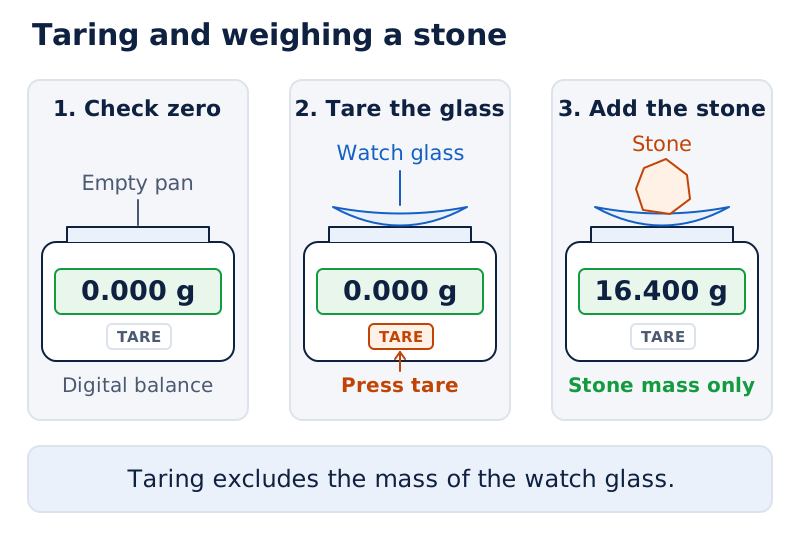
Three views show a digital balance, a watch glass on the balance while its tare button is pressed, and a stone resting on the watch glass. The last display gives the stone's mass.
Drawn by One Young India.
In this procedure, a stone has a displayed mass of 16.400 g. That reading belongs to the stone after the watch glass has been tared. It must not be interpreted as the combined mass of the stone and watch glass.
For a liquid, replace the watch glass with a suitable beaker, tare the balance with the empty beaker, and then pour in the liquid. The display then supplies the liquid mass needed for its density calculation.
Note: Use mass, not weight, in the density formula. A balance reading in grams or kilograms is suitable; a force reading in newtons is a different physical quantity.
How should a measuring cylinder be read?
A measuring cylinder is a transparent vessel with volume markings. Its maximum marked volume indicates its capacity, while the spacing and value of the divisions determine the smallest change that can be read from its scale.
Do not assume that every cylinder has the same divisions. Inspect the actual instrument. A large capacity can be useful, but it does not automatically mean that small volumes can be read as carefully as on a smaller cylinder.
How is the smallest division found?
c = (V₂ − V₁)/n
Here, c is the volume represented by one small division, V₁ and V₂ are the neighbouring numbered volume marks, and n is the number of equal spaces between them.
Find the difference between two numbered marks and divide it by the number of equal spaces between them. On a cylinder with ten equal divisions between 10 mL and 20 mL, each small division represents (20 mL − 10 mL) ÷ 10 = 1 mL.
For measuring 70 mL, a 50 mL cylinder cannot hold the whole amount in one measurement. A 100 mL cylinder can. Larger cylinders may also hold it, but their coarser divisions can make the reading less precise.
What is a meniscus?
The curved surface of a liquid inside a cylinder is its meniscus. For water, read the bottom of that curved surface. The eye should be level with the bottom of the meniscus, rather than looking down from above or up from below.
- Stand a clean measuring cylinder on a flat surface.
- Pour water slowly towards the required volume mark.
- Add or remove a little water with a dropper if adjustment is needed.
- Bring the eye level with the bottom of the water meniscus.
- Read the corresponding scale mark and record the volume in mL.
What the figure shows
Reading a water meniscus
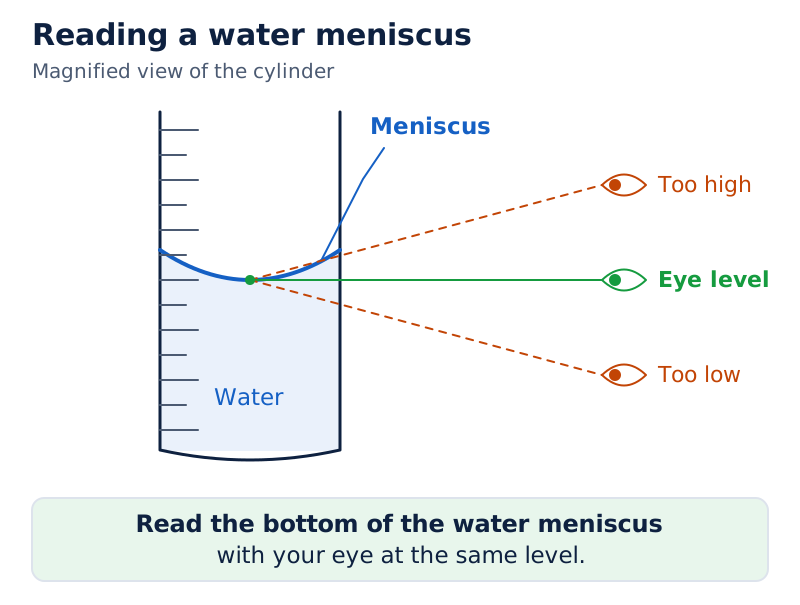
A magnified cylinder scale shows a curved water surface labelled meniscus. Three eye positions are drawn beside it. The middle eye is level with the meniscus; the other sight lines slope towards the scale.
Drawn by One Young India.
The reading depends on both the scale and the viewing position. Correctly identifying a division is not enough if the liquid surface is viewed at an angle. Use the same careful eye position for initial and final readings in a displacement experiment.
How are the volumes of regular and irregular solids found?
The method depends on the object's shape. A regular solid, such as a cuboid, has dimensions that can be measured and combined using a geometrical formula. An irregular stone does not have one simple set of dimensions suitable for the same calculation.
How is a cuboid's volume calculated?
Measure its length, width and height. Express all three in the same length unit before multiplying. If each dimension is in centimetres, multiplying the three measurements produces a volume in cubic centimetres.
V = l × w × h
Here, V is the cuboid's volume, l is its length, w is its width and h is its height.
Worked example 1. A notebook has length 25 cm, width 18 cm and height 2 cm. Calculate its volume, treating it as a cuboid.
Formula: V = l × w × h.
Substitute: V = 25 cm × 18 cm × 2 cm.
Answer: V = 900 cm³.
How does displacement measure an irregular solid?
When a suitable stone is lowered into water, it occupies space and the cylinder reading rises. The increase in the volume reading gives the volume of water displaced. With the stone completely submerged, this is the stone's volume.
- Put water in a measuring cylinder and record its initial reading.
- Tie the stone with a thread and lower it gently into the water.
- Ensure that the stone is completely under the water.
- Read the final water level using the same meniscus-reading method.
- Subtract the initial reading from the final reading.
V = V₂ − V₁
In this displacement formula, V is the completely immersed solid's volume, V₁ is the initial cylinder reading and V₂ is the final cylinder reading after immersion.
What the figure shows
Water displacement by a stone
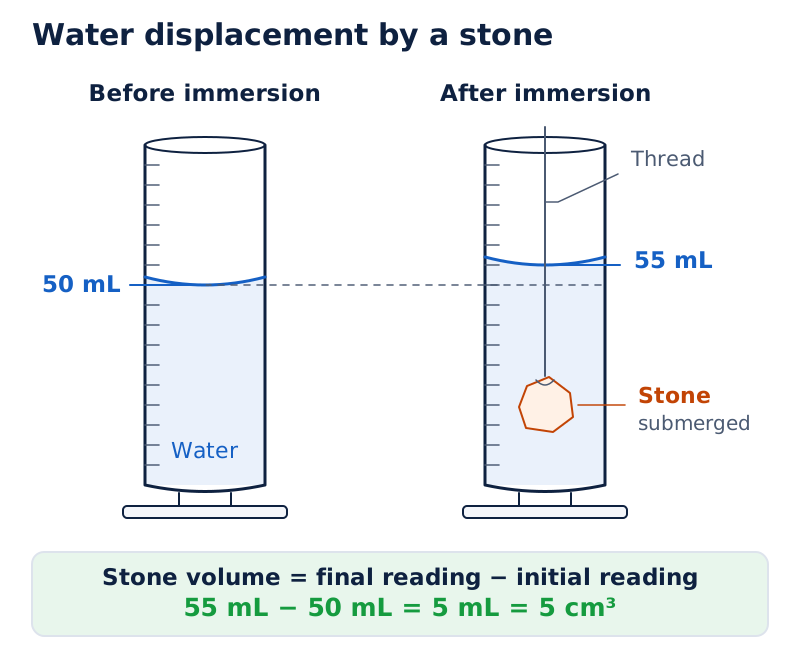
Two cylinders show water before and after a stone is lowered on a thread. In the second cylinder the stone is below the water surface and the water level is higher.
Drawn by One Young India.
For readings of 50 mL and 55 mL, the displaced volume is 55 mL − 50 mL = 5 mL. Since 1 mL = 1 cm³, the stone's volume is 5 cm³. The final reading of 55 mL is not the stone's volume.
For this straightforward method, choose a solid that does not dissolve in or absorb the liquid. Avoid trapped air bubbles and loss of water, because the change in the reading should represent only the immersed solid's volume.
What is density, and how are its units obtained?
Definition: Density is the mass present in a unit volume of a substance. It connects how much matter is present with the space that matter occupies.
d = m/V
Here, d represents density, m represents mass and V represents volume. Density is found by division, not multiplication. The phrase per unit volume is the clue: the total mass is shared across the measured volume.
A larger mass alone does not prove that an object is denser. Its volume must also be considered. For equal volumes, the object with greater mass is denser. For unequal volumes, calculate each mass-to-volume ratio before deciding.
How do the units follow the formula?
If mass is expressed in kilograms and volume in cubic metres, the density unit is kg/m³. If mass is in grams and volume in cubic centimetres, the unit is g/cm³. For liquids, g/mL is also convenient.
| Mass unit | Volume unit | Density unit |
|---|---|---|
| kg | m³ | kg/m³ |
| g | cm³ | g/cm³ |
| g | mL | g/mL |
Derivation: How is g/cm³ converted into kg/m³?
- Use 1 kg = 1000 g, so 1 g = 0.001 kg.
- Use 1 m³ = 1,000,000 cm³, so 1 cm³ = 0.000001 m³.
- Divide the converted mass by the converted volume: 1 g/cm³ = 0.001 kg ÷ 0.000001 m³.
1 g/cm³ = 1000 kg/m³
This conversion changes the numerical value and unit together, while the physical density stays the same. A value written in kg/m³ should not be compared directly with one in g/cm³ until the units have been made consistent.
Density can also be used to find a missing mass or volume. Rearranging the same relationship gives m = d × V and V = m/d. These are different forms of one definition, rather than separate physical laws.
How is the density of a solid calculated and compared?
Measure the solid's mass with a balance and its volume by the appropriate method. Then divide mass by volume. A regular shape may permit a dimensional calculation; an irregular stone is suited to a displacement measurement.
How are two measurements combined?
Worked example 2. A stone has mass 16.400 g. On complete immersion, the cylinder reading rises from 50 mL to 55 mL. Find the stone's volume and density. Use 1 mL = 1 cm³.
Formula: V = V₂ − V₁; d = m/V.
Substitute: V = 55 mL − 50 mL = 5 mL = 5 cm³. Then d = 16.400 g ÷ 5 cm³.
Answer: The volume is 5 cm³ and the density is 3.28 g/cm³.
The subtraction must come before the density division. Dividing by 55 mL would use the water-plus-stone reading; dividing by 50 mL would use the initial water volume. Neither is the volume required by the density formula.
Can a smaller mass belong to a denser object?
Worked example 3. Object A has mass 200 g and volume 40 cm³. Object B has mass 240 g and volume 60 cm³. Which is denser?
Formula: d = m/V for each object.
Substitute: Density of A = 200 g ÷ 40 cm³ = 5 g/cm³. Density of B = 240 g ÷ 60 cm³ = 4 g/cm³.
Answer: A, at 5 g/cm³, is denser than B, at 4 g/cm³, although A has the smaller mass.
This comparison separates total mass from mass per unit volume. Object B contains more matter overall, but that matter occupies a larger volume. Object A contains more mass in each cubic centimetre.
How can density give an unknown volume?
Worked example 4. An iron block has mass 600 g and density 7.9 g/cm³. Calculate its volume.
Formula: V = m/d.
Substitute: V = 600 g ÷ 7.9 g/cm³.
Answer: V ≈ 75.95 cm³, or approximately 76 cm³.
The result is a volume, so the final unit must be cubic centimetres. Multiplying the mass by the density would neither rearrange the definition correctly nor give the required volume unit.
How can the density of a liquid be measured?
The same density formula applies to a liquid. The challenge is to obtain the mass of the liquid alone and the volume of that same liquid. A container is necessary for weighing, but its mass must not be counted as part of the sample.
What measurements are required?
- Place a clean, dry beaker on a balance and tare the reading.
- Measure a suitable volume of the liquid using a measuring cylinder.
- Transfer the measured liquid carefully to the tared beaker.
- Record the mass displayed in grams and the measured volume in millilitres.
- Divide the liquid's mass by its volume to obtain density in g/mL.
The procedure combines two observations. Taring deals with the container's mass; reading the cylinder deals with the liquid's volume. Neither operation replaces the other. A balance reading alone cannot determine density without the corresponding volume.
Take care during transfer. If liquid is spilled or left behind, the mass weighed may no longer belong to the volume originally measured. The two values used in the formula must describe the same quantity of liquid.
How is a package's mass and volume information used?
Worked example 5. An oil sample has volume 1 L and mass 910 g. Find its density in g/mL. Use 1 L = 1000 mL.
Formula: V = 1 × 1000 mL; d = m/V.
Substitute: V = 1000 mL; d = 910 g ÷ 1000 mL.
Answer: The oil's density is 0.91 g/mL.
At room temperature, 1 mL of water has a mass close to 1 g. Its density is therefore approximately 1 g/mL. The oil in the example has less mass in each millilitre than water, so it is less dense.
This does not mean that any container of oil has less mass than any container of water. The comparison concerns equal volumes. Density makes that comparison possible even when the actual samples have different total volumes.
How does relative density help explain floating and sinking?
Relative density with respect to water compares a substance's density with the density of water at the stated temperature. It tells us how many times the substance is as dense as water, rather than giving a mass per volume directly.
Relative density = density of substance/density of water
Express both densities in the same units before dividing. Their units cancel, leaving a number without a unit. Relative density is therefore different from density, even when their numerical values happen to match in a particular unit system.
How is the comparison calculated?
Worked example 6. An aluminium block has mass 27 g and volume 10 cm³. Find its density and its relative density with respect to water, taking water's density as 1 g/cm³. Let R denote relative density and dw denote water's density.
Formula: d = m/V; R = d/dw.
Substitute: d = 27 g ÷ 10 cm³ = 2.7 g/cm³. Then R = 2.7 g/cm³ ÷ 1 g/cm³.
Answer: The density is 2.7 g/cm³ and the relative density is 2.7, without a unit.
Why can shape matter when an object floats?
A liquid exerts an upward buoyant force on an immersed object, while the object's weight acts downwards. An object floating at rest has these forces balanced. If its weight exceeds the upward force available, it sinks.
Density comparisons help predict the behaviour of compact solids. However, the material's density alone does not explain every shaped or hollow object. A glass bowl can float although glass is denser than water; the whole object's arrangement matters.
Worked example 7. A stone sculpture has mass 225 g and volume 90 cm³. Find its density and predict its behaviour in water. Take water's density as 1 g/cm³ and treat the sculpture as a compact solid.
Formula: d = m/V.
Substitute: d = 225 g ÷ 90 cm³ = 2.5 g/cm³.
Answer: Its density is 2.5 g/cm³. It is denser than water and sinks.
Oil floating on water and ice floating on liquid water are familiar density comparisons. They also show why words such as “heavy” need care: the relevant question is the mass associated with a given volume, not simply the total mass.
Why can density change with temperature or pressure?
The density of a substance is independent of its shape or sample size when its condition is unchanged. However, temperature and pressure can affect its volume. Because density depends on volume as well as mass, these changes can alter density.
What usually happens during heating?
Generally, heating makes particles spread farther apart, increasing the volume occupied by the sample. For a fixed mass, dividing by a larger volume gives a smaller density. Cooling generally has the opposite effect.
Hot air rises because it is less dense than the cooler air around it. This is also the principle behind a hot-air balloon. The explanation connects an observable movement with a change in the volume occupied by a given mass of air.
The word generally matters. Water has its highest density at 4 °C. When it freezes, its structure occupies more space. The resulting ice is less dense than liquid water and floats, so density does not follow a simple universal heating or cooling rule.
Why are gases more affected by pressure?
Increasing pressure can bring gas particles closer together, reducing their volume. For the same mass, a smaller volume means greater density. Liquids are nearly incompressible, so pressure has a much smaller effect on their density.
Solids are even less affected by ordinary pressure changes because their particles are closely packed. Their density changes due to pressure are usually negligible in the simple situations considered here.
| Change | Volume behaviour | Density consequence |
|---|---|---|
| General heating of a fixed mass | Volume usually increases | Density usually decreases |
| Compression of a fixed mass of gas | Volume decreases | Density increases |
| Water freezing into ice | Volume increases | Density decreases |
Keep comparisons fair by considering the conditions as well as the material. A change of shape alone should not be confused with expansion or compression. Each explanation should identify whether mass, volume, or both have changed before predicting the density.
Glossary
- Physical quantity — A measurable property of an object or system, expressed using a number and a unit.
- Unit — An accepted reference standard used when measuring and comparing a physical quantity.
- SI — The International System of Units, providing internationally accepted units for physical measurements.
- Mass — The quantity of matter present in an object, commonly measured in grams or kilograms.
- Weight — The gravitational force acting on an object, measured in the unit called the newton.
- Volume — The space occupied by an object or substance, with cubic metre as its SI unit.
- Density — The mass present in a unit volume of a substance under the stated conditions.
- Relative density — The ratio of a substance's density to water's density at the stated temperature, without a unit.
- Taring — Resetting a balance to zero with a container present so its mass is excluded.
- Measuring cylinder — A transparent vessel with a graduated scale used to measure volumes of liquids.
- Meniscus — The curved surface formed by a liquid inside a measuring cylinder or similar vessel.
- Displacement — The movement of liquid from space occupied by an object immersed in that liquid.
- Buoyant force — The upward force exerted by a liquid on an object placed in it.
- Derived unit — A unit obtained by combining base units to express a related physical quantity.
Common errors and misconceptions
- Misconception: A measurement is complete when its number is written. Correct: A measurement requires both the number and its unit.
- Misconception: The final cylinder reading gives an immersed stone's volume. Correct: Subtract the initial reading from the final reading to obtain the displaced volume.
- Misconception: Mass and weight mean the same thing. Correct: Mass measures the quantity of matter; weight is a gravitational force.
- Misconception: The object with greater total mass must be denser. Correct: Compare mass per unit volume; the objects may occupy different volumes.
- Misconception: Relative density is measured in g/cm³. Correct: Relative density is a ratio of densities in matching units, so it has no unit.
- Misconception: The container's mass can be included when calculating a liquid's density. Correct: Tare the balance with the empty container so the reading represents the liquid alone.
- Misconception: Every object made of material denser than water must sink. Correct: Shape and hollow spaces can affect the whole object's floating behaviour, as with a glass bowl.
- Misconception: Heating and cooling affect all substances in exactly the same way. Correct: Density usually decreases on heating, but water's maximum density at 4 °C shows that exceptions matter.
Exam-style questions with model answers
Q1. Define density and state its SI unit. [2 marks]
- Density is the mass present in a unit volume of a substance. It is calculated by dividing mass by volume.
- Its SI unit is kilogram per cubic metre, written kg/m³.
Q2. Distinguish between mass and weight, giving the meaning and SI unit of each. [3 marks]
- Mass is the quantity of matter present in an object. Its SI unit is kilogram, written kg. The mass of an unchanged object remains the same from place to place.
- Weight is the gravitational force acting on the object. Its SI unit is newton, written N. Weight can change when gravitational pull changes, so it is a different physical quantity from mass.
Q3. A measuring cylinder has ten equal divisions between 10 mL and 20 mL. Calculate its smallest division and explain how to read the volume of water correctly. [3 marks]
- The volume difference between the numbered marks is 20 mL − 10 mL = 10 mL. Dividing by ten equal divisions gives 1 mL per division.
- Place the cylinder on a flat surface. Water forms a curved surface called a meniscus.
- Bring the eye level with the bottom of that meniscus and read the corresponding scale mark. Record the reading in millilitres.
Q4. A stone has mass 16.400 g. It is completely immersed in a measuring cylinder, raising the water reading from 50 mL to 55 mL. Describe how to obtain its mass and volume, calculate its density, and give two precautions. Use 1 mL = 1 cm³. [5 marks]
- Place a clean, dry watch glass on a digital balance and tare it. Add the stone and record its mass as 16.400 g. Taring excludes the watch glass from the sample's mass.
- Record the initial cylinder reading as 50 mL. Lower the stone gently on a thread until it is completely submerged, then record the final reading as 55 mL.
- The stone's volume is the increase: 55 mL − 50 mL = 5 mL = 5 cm³.
- Density = mass ÷ volume = 16.400 g ÷ 5 cm³ = 3.28 g/cm³.
- Read the bottom of the water meniscus at eye level and avoid spilling water during immersion. Both precautions help ensure that the difference represents the stone's volume.
Q5. An oil sample has mass 910 g and volume 1 L. Calculate its density in g/mL and compare it with water of density 1 g/mL. Use 1 L = 1000 mL. [3 marks]
- Convert the oil volume first: 1 L = 1000 mL. The mass and volume are now in the units needed for a density in g/mL.
- Density = mass ÷ volume = 910 g ÷ 1000 mL = 0.91 g/mL.
- The oil is less dense than water because 0.91 g/mL is less than 1 g/mL. Equal volumes of this oil and water would therefore have different masses.
Q6. An aluminium block has mass 27 g and volume 10 cm³. Calculate its density and relative density with respect to water of density 1 g/cm³. Explain why only one result has a unit. [4 marks]
- Density = mass ÷ volume = 27 g ÷ 10 cm³ = 2.7 g/cm³. This result has a unit because it expresses mass per unit volume.
- Relative density = density of aluminium ÷ density of water = 2.7 g/cm³ ÷ 1 g/cm³ = 2.7.
- The two matching density units cancel in the ratio. Relative density is therefore unitless and means that aluminium is 2.7 times as dense as the stated water sample.
Q7. Object A has mass 200 g and volume 40 cm³. Object B has mass 240 g and volume 60 cm³. Calculate both densities and explain why comparing masses alone gives the wrong density ranking. [4 marks]
- Density of A = 200 g ÷ 40 cm³ = 5 g/cm³.
- Density of B = 240 g ÷ 60 cm³ = 4 g/cm³.
- Object A is denser because it has more mass per cubic centimetre. Object B has greater total mass, but it also occupies a greater volume. Density requires the ratio of mass to volume, so the mass values alone do not establish the ranking.
Q8. Explain how heating usually affects the density of a fixed mass, why compression affects a gas strongly, and why ice floats on water. [5 marks]
- Density is mass divided by volume. On heating, particles generally spread farther apart and the sample expands. With its mass unchanged, the larger volume gives a smaller density.
- Gas particles have considerable space between them. Compression brings them closer, reducing the volume occupied by the same mass and therefore increasing density.
- Liquids are nearly incompressible and solids are closely packed, so ordinary pressure changes affect their densities much less.
- Water is an important exception to a simple cooling rule. Its density is highest at 4 °C. When water freezes, its structure occupies more space. Ice is consequently less dense than liquid water and floats on its surface.
Key takeaways
- A measurement contains a number and a unit; standard units make measurements comparable between different people and places.
- Mass and weight are different quantities: density uses mass, while weight describes the gravitational force on an object.
- Tare a balance with the empty container in place before adding a sample whose mass is required.
- Read the bottom of a water meniscus at eye level and check the cylinder's smallest division.
- Find an irregular solid's volume from the final cylinder reading minus the initial reading, with complete immersion.
- Density equals mass divided by volume, so greater total mass alone does not establish greater density.
- Relative density compares two densities expressed in matching units and therefore has no unit of its own.
- Temperature and pressure can change density by changing volume; water's behaviour during freezing requires particular care.
Test yourself
Why is a handspan unsuitable as a standard unit?
Different people have different handspans, so the same object may receive different numerical measurements.
What does taring a balance with an empty beaker accomplish?
It excludes the beaker's mass so the later reading gives the mass of the added liquid.
What is the volume of a stone that raises a cylinder reading from 50 mL to 55 mL? Use 1 mL = 1 cm³.
The displaced volume is 55 mL − 50 mL = 5 mL, equivalent to a stone volume of 5 cm³.
Why must the eye be level with the water meniscus?
Looking from above or below can give a different apparent alignment with the cylinder's scale marks.
An object has mass 400 g and volume 40 cm³. What is its density?
Density equals mass divided by volume: 400 g ÷ 40 cm³ = 10 g/cm³.
Why does relative density have no unit?
It divides two densities expressed in identical units, so those units cancel in the ratio.
How does compressing a fixed mass of gas affect its density?
Compression reduces the gas volume, so its unchanged mass occupies less space and its density increases.
Does a change of shape alone change a substance's density?
No. If mass, volume and physical conditions remain unchanged, reshaping alone does not change the density.
Try it
ICSE Class 8 Physics: Physical Quantities and Measurement
Let's apply your understanding of measurement concepts and accuracy to practical physics scenarios!
1A student measures a metal block with a known true mass of 50 kg. Their weighing machine gives repeated readings of 42.1 kg, 42.2 kg, and 42.1 kg. How would you describe these measurements?
Accuracy means how close the measurement is to the true value. Since the readings (around 42.1 kg) are not close to the true value of 50 kg, they are not accurate.
The text states precision means how close repeated measurements are to each other, while accuracy is how close they are to the true value. These readings are close to each other (precise) but far from the true value (not accurate).
The readings are precise because they are close to each other, but they are not accurate because they are far from the true value of 50 kg.
2A student measures the length of a notebook as 20 cm. They need to record this in the standard SI system. How should this be recorded and what happens to the physical length?
The text explains that the SI unit for length is the metre (m). As shown in the worked example, converting 20 cm to 0.20 m changes the number, but the physical length remains the same.
The text shows that 20 cm equals 20/100 m, which is 0.20 m. The number must change when the unit changes in order to keep the physical length the same.
While length is a fundamental quantity, the text specifies that the widely used SI unit for length is the metre (m), so it should be converted for SI standard recording.
Great job! You successfully applied the concepts of precision, accuracy, and SI unit conversions to practical measurement scenarios.