
Sound | ICSE Class 8 Physics Notes
On this page
Watch & explore
Start with a few high-quality watches, then dive into the notes below.
Try an idea before you read. Test your understanding of sound propagation and wave characteristics with these scenarios. Explore →

This note covers the production of sound by vibrations, musical instruments, the human voice, transmission through different materials, hearing, amplitude, frequency, time period, loudness, pitch, audible sounds, noise pollution and ways to reduce it.
How do vibrating objects produce sound?
Sound is a form of energy that helps us become aware of our surroundings and communicate. A ringing school bell, a knock at the door and footsteps are familiar sources. A source is the object producing the sound.
A vibration is the to and fro, or back and forth, motion of an object. This motion is also called an oscillation. A vibrating object produces sound. When a plucked, stretched rubber band stops vibrating, it stops producing sound.
How can vibrations be detected?
Some vibrations are easily visible. In most cases, however, their amplitude, meaning the extent of the vibration, is so small that we cannot see them. We can nevertheless feel them. A sounding bell can therefore provide evidence even when its movement is difficult to see.
Definition: Vibration is the repeated to and fro motion of an object. The vibration of a sound-producing object connects its movement with the sound we hear.
- Hang a metal plate or pan so that it does not touch a wall.
- Strike it with a stick and listen to the sound.
- Touch it gently with a finger to feel its vibrations.
- Strike it again, then hold it firmly to stop its vibrations and compare the sound.
The important comparison is between the same object while it vibrates and after its vibrations stop. Merely naming the pan is insufficient: the observation that its sound stops when its vibrations are stopped supplies the link between motion and sound.
Figure: Striking a pan. The photograph shows a suspended metal pan and a child striking it with a stick. The pan hangs freely, allowing it to vibrate after being struck.
What does the rubber-band activity show?
Stretch a rubber band around the longer side of a pencil box. Insert two pencils between the box and the band, then pluck the band near its middle. Watch and listen together: the band vibrates while producing sound.
A dish containing water offers another observation. Striking its edge with a spoon produces sound and waves on the water surface. Holding the dish stops its vibration. The water movement helps make the effect of the vibrating dish visible.
Which parts of musical instruments vibrate?
Musical instruments produce sound through vibrating parts. A stretched string is a tightly drawn string that can vibrate when plucked. A membrane is a thin sheet, such as the stretched surface of a tabla. Air inside a hollow instrument can also vibrate.
Identify the part that starts vibrating rather than simply the material from which an instrument is made. The veena provides a string example, the tabla a membrane example, and the flute an example involving air inside a hollow pipe.
| Instrument | Vibrating part | Connection with sound |
|---|---|---|
| Veena | Stretched string | Vibration of the string produces sound. |
| Tabla | Stretched membrane | The membrane vibrates when struck. |
| Sitar | Plucked string and the instrument body | The whole instrument is forced to vibrate. |
| Mridangam | Struck membrane and the instrument body | The sound includes vibration of the whole body. |
| Flute | Air inside the hollow pipe | Blowing makes this air vibrate. |
Why does the whole instrument matter?
When a sitar string is plucked, the sound heard is not only that of the string. The whole instrument is forced to vibrate. Similarly, striking a mridangam membrane produces sound involving the instrument body as well as the membrane.
This distinction prevents an incomplete explanation. Naming the string or membrane identifies a vibrating part, but it does not mean the rest of the instrument makes no contribution. In most musical instruments, more than one vibrating part is involved in producing sound.
How can bowls produce musical sounds?
A jaltrang can be made using six to eight bowls or tumblers filled with water to different levels. Arrange the water levels so that they increase gradually from one end to the other. Strike the bowls gently with a pencil in succession.
The sequence produces pleasant sounds. Other familiar instruments, including manjira and ghatam, are played by beating or striking them. Across these examples, the useful question remains the same: what is vibrating when the sound is produced?
How do humans produce their voice?
In humans, sound is produced by the voice box, also called the larynx. It lies at the upper end of the windpipe, the passage carrying air towards and from the lungs. A hard bump in the throat seems to move when we swallow.
Two vocal cords, muscular flaps that can vibrate, stretch across the larynx. They leave a narrow slit between them for air to pass through. When air from the lungs is forced through this slit, the cords vibrate and produce sound.
What is the sequence of voice production?
- The lungs force air towards the voice box.
- The air passes through the narrow slit between the vocal cords.
- The vocal cords vibrate as the air passes through.
- The vibrating cords produce sound; muscles adjust how tight or loose the cords are.
Place a hand gently on the throat while speaking, singing or buzzing like a bee. The vibrations felt there connect the human voice with the same principle demonstrated by the pan and the rubber band: a vibrating part produces sound.
What the figure shows
Voice box in humans
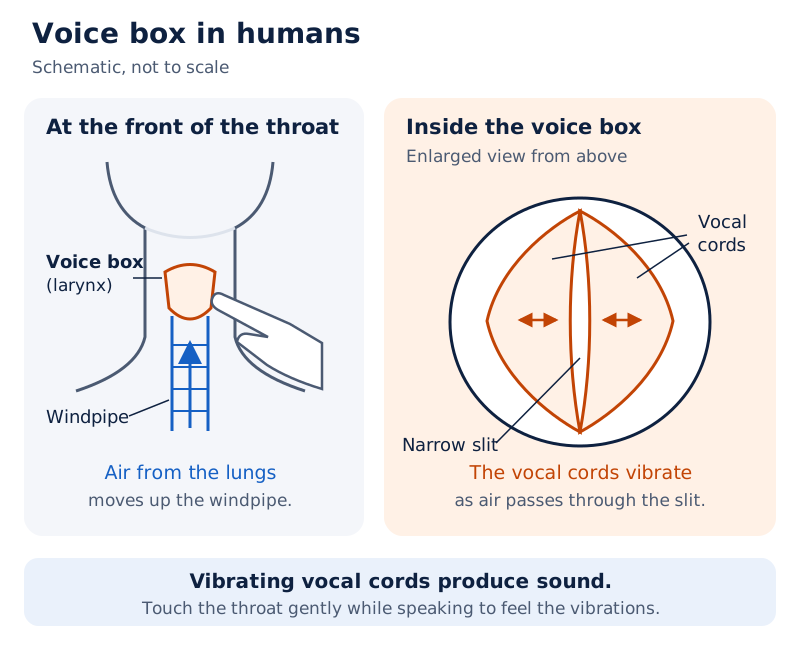
The drawings show a finger touching the front of the throat and a separate view of the voice box. The separate view shows the narrow opening between the vocal cords.
Drawn by One Young India.
Why do voices differ?
Muscles attached to the vocal cords can tighten or loosen them. Tight, thin cords produce a different type or quality of voice from loose, thick cords. The tongue, lips, mouth and nasal cavity help convert the sound into speech or music.
A millimetre, abbreviated mm, is a unit of length equal to one thousandth of a metre. Men’s vocal cords are about 20 mm long, whereas women’s are about 15 mm long. Children have very short vocal cords. Differences in the cords help explain differences between their voices.
Two stretched rubber strips with a gap between them provide a simple model. Blowing air through the gap produces sound. The model illustrates how moving air can make stretched material vibrate; it is not a complete model of all the parts involved in speech.
Why does sound need a medium to travel?
A medium is the material through which sound travels. Propagation means travelling or spreading from one place to another. Sound is carried through a medium in all directions from a vibrating source. The medium may be a gas, a liquid or a solid.
Air carries a voice from a speaker to a listener. Sound can also travel through water, wood, metal and strings. Air is therefore a familiar sound-carrying medium, but it is not the only one.
What happens without a material medium?
A vacuum is a space from which air or other material medium is absent. Sound cannot travel through a vacuum. A vibrating source and a path through a medium are separate requirements: producing a vibration does not by itself provide a material path to a listener.
Removing air from a vessel containing a ringing phone makes the sound fainter. If all the air could be removed, sound would not travel through that empty space. This illustrates the role of air in carrying sound rather than in creating the phone’s vibration.
Note: Do not confuse the source with the medium. Vocal cords produce a voice, while the surrounding air carries the sound towards another person’s ears.
How can liquids and solids carry sound?
A small bell shaken inside water can be heard. The bell must not touch the bucket or tub during the observation, so that contact with the container does not replace the intended water path. Take care that water does not enter the ear.
For a solid, hold one end of a metre scale or long metal rod near an ear while another person gently scratches or taps the other end. Sound travels through the scale or rod. A wooden or metallic table provides a similar demonstration.
| Medium | Example | What it demonstrates |
|---|---|---|
| Gas | Air between a speaker and listener | Sound travels through air. |
| Liquid | Water around a ringing bell | Sound can travel through a liquid. |
| Solid | A scratched wooden table or metal rod | Sound can travel through a solid. |
| No material medium | A vacuum | Sound cannot travel through it. |
A toy telephone provides another solid-path example because sound can travel through its string. Together, these observations rule out the mistaken idea that sound transmission requires air in every situation.
What sound feature is associated with Golconda fort?
Golconda fort, near Hyderabad, has a water-supply system among its engineering features. Perhaps more astonishing is a dome near the entrance. A handclap at a particular point beneath it can be heard at the highest point of the fort, about a kilometre away.
The clap reverberates, meaning that sound persists as it repeatedly bounces off surfaces. This arrangement was devised as a warning system. A guard who saw suspicious movement outside the fort could clap at that particular point to alert the army inside.
A handclap at a particular point under the entrance dome can be heard at the highest point of the fort, about a kilometre away.
How do the ears enable us to hear?
The outer part of an ear has a funnel-like shape. Sound entering it travels down the ear canal, the passage leading to the eardrum. At the canal’s end is the eardrum, a thin, stretched membrane that vibrates when sound reaches it.
The eardrum is compared with a stretched rubber sheet. Sound vibrations make it vibrate, and it passes vibrations to the inner ear, the internal part of the ear involved in passing the hearing signal onwards. From there, a signal reaches the brain.
What is the pathway of hearing?
- Sound enters the funnel-shaped outer part of the ear.
- It travels through the ear canal towards the eardrum.
- The eardrum vibrates and passes the vibrations to the inner ear.
- A signal goes from the inner ear to the brain, enabling hearing.
What the figure shows
Human ear
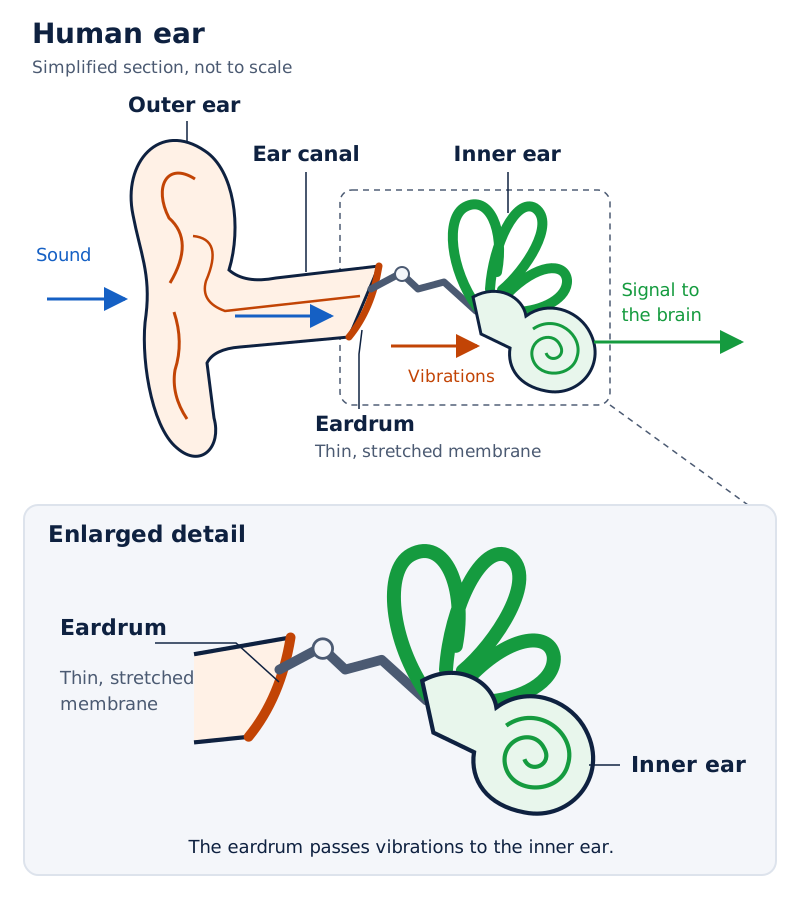
A sectional drawing shows the outer ear, the passage leading inward and the internal structures. An enlarged inset identifies the eardrum and inner ear. These labels locate the parts used in the hearing sequence.
Drawn by One Young India.
What does a stretched-rubber model demonstrate?
A plastic or tin can with both ends removed can model part of this process. Stretch balloon rubber across one end and secure it with a rubber band. Put four or five dry cereal grains on the stretched rubber.
When someone speaks into the open end, the grains jump because the rubber vibrates. The grains make the vibration visible. In this model, the stretched rubber represents the eardrum’s response to incoming sound, rather than the complete hearing pathway.
Ear care matters because damage to the eardrum can impair hearing. Never put a sharp, pointed or hard object into an ear. The eardrum’s role explains why protecting it is essential: it receives sound vibrations and passes them further into the ear.
What do amplitude, frequency and time period describe?
Three quantities help describe a vibrating object. Amplitude describes the extent of its vibration. Frequency counts how many complete oscillations occur in one second. Time period is the time taken to complete one oscillation.
These quantities answer different questions. Amplitude concerns the size of the movement. Frequency concerns how often it repeats. Time period concerns how long one repetition takes. A large vibration and a rapidly repeated vibration are therefore different descriptions. Pitch means the high or low character of a sound, while loudness distinguishes loud and feeble sounds.
What units are used?
Frequency is expressed in hertz, with the symbol Hz. One hertz means one oscillation per second. Time period is expressed in the second, with the symbol s. A count of oscillations is a number, not a duration.
Definition: 1 Hz = 1 oscillation per second. Thus, frequency tells us how many complete oscillations occur during each second, rather than the time required for one oscillation.
| Quantity | Meaning | Use in explaining sound |
|---|---|---|
| Amplitude | Extent of vibration | Helps explain loudness. |
| Frequency | Number of oscillations per second | Determines pitch. |
| Time period | Time taken for one oscillation | Describes the duration of a complete vibration. |
How are frequency and time period calculated?
Let N mean the number of complete oscillations, t the total time in seconds, f the frequency in hertz, and T the time period in seconds. Define these quantities before substituting numerical values.
and .
Frequency and time period are inversely related: a shorter time period corresponds to a higher frequency. The formula for frequency divides the oscillation count by the time. The formula for time period reverses this division because it asks for the time per oscillation.
Keeping the meaning beside the calculation helps avoid an answer with the wrong unit. A result in hertz must describe a frequency; a result in seconds must describe a duration. The numerical answer and its unit belong together.
How are vibration calculations solved step by step?
Begin by identifying whether a problem asks for a count, a frequency or a time period. Write down the given information, choose the matching relationship, substitute the values and attach the correct unit. Do not exchange frequency and time period simply because both describe repetition.
How is a frequency found from an oscillation count?
Worked example 1. An object completes 20 oscillations in one second. Find its frequency.
Answer: Given 20 oscillations in 1 s. Formula: . Substitute: . The frequency is 20 Hz, meaning 20 complete oscillations occur each second.
The count and the frequency have the same numerical value in this example because the counting interval is exactly one second. If the observation lasts longer, the total count must first be divided by the number of seconds.
How are both frequency and time period found?
A pendulum is an object suspended so that it can swing to and fro.
Worked example 2. A pendulum completes 40 oscillations in 4 seconds. Find its frequency and time period.
Answer: Given 40 oscillations in 4 s. Formula: ; . Substitute: ; . The frequency is 10 Hz and the time period is 0.1 s.
The answer says that ten complete swings occur each second and that each complete swing takes one tenth of a second. These statements are consistent with each other.
A sound wave is a travelling disturbance in a medium. In air, it involves repeating changes in density, the mass of material in a given volume.
Worked example 3. At a fixed position, ten complete sound-wave oscillations occur in 2 seconds. Find the frequency and time period.
Answer: Given 10 oscillations in 2 s. Formula: ; . Substitute: ; . The frequency is 5 Hz and the time period is 0.2 s.
In a sound wave, an oscillation at a fixed position can be counted through these repeating density changes. Here the calculation uses the supplied number of complete oscillations, without needing to measure their size.
How is the time period found from frequency?
Worked example 4. A mosquito produces sound by vibrating its wings at an average rate of 500 vibrations per second. Find the time period.
Answer: The average frequency is 500 Hz. Formula: . Substitute: . The corresponding time period is 0.002 s.
The word average must be retained: the supplied rate is an average rate. It does not state that every individual wing vibration has an identical duration. The reciprocal calculation gives the period corresponding to that stated rate.
How many oscillations occur in one minute?
Worked example 5. An oscillating piston in a long tube filled with air produces a sound wave of frequency 20 Hz. How many oscillations does the piston complete per minute?
Answer: The frequency is 20 Hz and one minute is 60 s. Formula: . Substitute: . The piston completes 1200 oscillations in one minute.
How is frequency found by counting compressions?
Worked example 6. If 20 compressions pass a point in 4 seconds, find the frequency of the sound wave.
Answer: A compression is a region of higher density. Count the compressions passing the point in the given 4 s interval. Formula: . Substitute: . The frequency is 5 Hz.
How do loudness and pitch differ?
Loudness describes whether a sound is loud or feeble. It depends on amplitude: a larger amplitude produces a louder sound, whereas a smaller amplitude produces a feebler sound. Pitch describes how shrill or low a sound is and depends on frequency.
A higher frequency produces a higher-pitched, shriller sound. A lower frequency produces a lower-pitched sound. Two sounds can therefore be equally loud yet differ in pitch. Similarly, a high-pitched sound need not be a loud sound.
What does striking a tumbler demonstrate?
Strike a metallic tumbler gently with a spoon, then strike it harder. The harder strike produces a louder sound. Suspend a small thermocol ball so that it touches the rim. Its movement provides a visible measure of the tumbler’s amplitude of vibration.
Compare the ball’s displacement after the gentle and harder strikes. Greater displacement corresponds to a greater amplitude in this activity. The comparison links the observed motion to the louder sound rather than treating the strength of the strike as the definition of loudness.
Worked example 7. Using the square relationship between loudness and vibration amplitude, find the factor by which loudness increases when amplitude doubles.
Answer: The amplitude factor is 2. Squaring this factor gives . Loudness increases by a factor of 4 under this relationship.
The unit used to express sound level is the decibel, written dB. The square relationship above concerns the amplitude comparison; it should not be read as an instruction to multiply a decibel reading by four.
Which examples separate pitch from loudness?
| Comparison | Observation | Meaning |
|---|---|---|
| Drum and whistle | A drum has lower-frequency vibrations; a whistle has higher-frequency vibrations. | The whistle produces the higher pitch. |
| Bird and lion | A bird’s sound is high-pitched but quite feeble; a lion’s roar is low-pitched but very loud. | High pitch does not imply greater loudness. |
| Women’s and men’s voices | Usually a woman’s voice has a higher frequency than a man’s. | This is a usual difference, not an absolute rule. |
Keep the determining quantity attached to the correct property. Amplitude controls loudness in these comparisons, while frequency determines pitch. Describing a sound as “high” without saying whether it is louder or higher-pitched can confuse two distinct observations.
Which sounds can humans hear?
An audible sound is one that can be heard. An inaudible sound cannot be heard by the listener being considered. Human ears do not detect every vibration: the frequency must fall within a range to which human hearing responds.
For humans, the range of audible frequencies is roughly 20 to 20,000 Hz. Frequencies below about 20 Hz cannot be detected by the human ear. Frequencies above about 20,000 Hz are also inaudible to humans. These are approximate boundaries, not exact limits for every person.
What does the unit kilohertz mean?
The prefix kilo means one thousand. A kilohertz, written kHz, is one thousand hertz. Thus, 20 kHz and 20,000 Hz express the same frequency. Changing the unit does not change the sound or bring it into the human hearing range.
| Frequency | Human hearing description |
|---|---|
| Below about 20 Hz | Too low in frequency for human hearing. |
| Roughly 20 to 20,000 Hz | The approximate audible range for humans. |
| Above about 20,000 Hz | Too high in frequency for human hearing. |
Do animals have the same hearing range?
Some animals can hear frequencies above 20,000 Hz. Dogs have this ability. High-frequency whistles used by the police can therefore be heard by dogs while remaining inaudible to humans. “Inaudible” must be related to the listener, rather than treated as a universal property.
Ultrasound refers to sound above 20,000 Hz. Equipment used to investigate and track medical problems works at these high frequencies. The inability of human ears to hear ultrasound does not mean that it is not sound or that no vibration is present.
How do noise and noise pollution affect us?
Noise is unwanted or unpleasant sound. Musical sound is pleasing to the ear. A harmonium or a sitar can produce musical sound, while construction work and the horns of buses and trucks can produce unpleasant sounds.
Music can become noise when it is too loud or unwanted. The instrument’s name alone does not decide whether a sound is welcome. The presence of excessive or unwanted sounds in the environment is called noise pollution.
Where does noise pollution come from?
Major sources include vehicles, explosions, bursting crackers, machines and loudspeakers. Inside homes, televisions and radios at high volumes, some kitchen appliances, desert coolers and air conditioners can contribute. Noise pollution is therefore not restricted to factories or roads.
Consider the choice between a house on the roadside and one three lanes away. Traffic is a source of noise pollution, so the house away from the roadside is the preferable choice on that basis. This reasoning concerns noise, rather than every possible feature of either house.
What harm may excessive noise cause?
Noise pollution may cause lack of sleep, anxiety and hypertension, meaning high blood pressure. Continuous exposure to loud sound may cause temporary or even permanent hearing impairment, meaning reduced ability to hear. These are possible effects, not inevitable outcomes of every sound.
Total hearing impairment is rare and is usually present from birth. Partial hearing disability is generally the result of disease, injury or age. People with impaired hearing may communicate effectively through sign language, and technological devices can improve their quality of life.
How can noise pollution be reduced?
| Source or situation | Control measure |
|---|---|
| Aircraft engines, transport vehicles and machinery | Install silencing devices. |
| Noisy industries and operations | Locate them away from residential areas. |
| Automobile horns | Minimise unnecessary use. |
| Televisions and music systems | Keep the volume low. |
| Roads and buildings | Plant trees to reduce sound reaching residents. |
Noise control starts with the source of noise. Reducing the sound produced by a machine, lowering an appliance’s volume and separating noisy operations from homes all address the problem before the sound reaches people nearby.
Trees planted along roads and around buildings help cut down the sound reaching residents. This measure complements control at the source. It does not justify leaving horns, machinery or loudspeakers unnecessarily loud.
When explaining a control measure, link it to the problem it addresses. Low television volume tackles a domestic source; silencing devices tackle engine or machine noise; placing industry away from homes reduces exposure in residential surroundings.
Glossary
- Vibration — The repeated to and fro motion of an object, also called oscillatory motion.
- Amplitude — The extent of a vibration, associated with how loud or feeble the produced sound is.
- Frequency — The number of complete oscillations made in one second, expressed in hertz.
- Hertz — The unit of frequency, with one hertz meaning one complete oscillation per second.
- Time period — The time taken to complete one oscillation, expressed in seconds.
- Medium — The material through which sound travels, which may be solid, liquid or gas.
- Vacuum — A space without a material medium through which sound could travel.
- Larynx — The voice box at the upper end of the windpipe, containing the vocal cords.
- Vocal cords — Muscular flaps inside the voice box that vibrate when air passes between them.
- Eardrum — The thin, stretched membrane at the end of the ear canal that responds to sound vibrations.
- Loudness — The property distinguishing loud and feeble sounds, associated with vibration amplitude.
- Pitch — The high or low character of a sound, determined by its frequency.
- Ultrasound — Sound with frequencies above 20,000 hertz, beyond the upper limit of human hearing.
- Noise pollution — The presence of excessive or unwanted sounds in the surrounding environment.
- Hearing impairment — A reduced ability to hear, which may be temporary or permanent.
Common errors and misconceptions
- Misconception: An object must have visibly large movements to produce sound. Correct: In most cases, the amplitude is too small to see, although vibrations may be felt.
- Misconception: Air is the only medium that carries sound. Correct: Sound can travel through gases, liquids and solids, but cannot travel through a vacuum.
- Misconception: Frequency is the time taken for one vibration. Correct: That is time period. Frequency is the number of complete vibrations per second.
- Misconception: A high-pitched sound must be loud. Correct: Pitch depends on frequency; loudness depends on amplitude. A bird can produce a high-pitched but feeble sound.
- Misconception: Every woman’s voice has a higher frequency than every man’s. Correct: The comparison is usual, not an absolute rule about all individuals.
- Misconception: Every human has precisely the same hearing limits. Correct: The range of 20 to 20,000 Hz is rough, with boundaries stated as about these frequencies.
- Misconception: Music cannot be noise. Correct: Music that is too loud or unwanted can become noise and contribute to noise pollution.
- Misconception: Noise inevitably causes permanent hearing loss. Correct: Continuous loud sound may cause temporary or permanent impairment; the effect is stated as a possibility.
Exam-style questions with model answers
Q1. Define vibration and name the vibrating parts that produce the human voice. [2 marks]
- Vibration is the repeated to and fro motion of an object.
- In humans, the vocal cords inside the voice box vibrate to produce sound.
Q2. Explain how a freely suspended metal pan can demonstrate that sound is produced by vibration. Include the effect of stopping its motion. [3 marks]
- Strike the freely suspended pan with a stick and listen. The pan produces sound after it has been struck.
- Touch the sounding pan gently with a finger. The vibrations felt connect the sound with movement of the pan.
- Strike it again and hold it firmly. Stopping its vibrations stops the sound, showing the connection between vibration and sound production.
Q3. A pendulum completes 40 oscillations in 4 seconds. Calculate its frequency and time period, giving the formula and unit for each. [4 marks]
- Frequency is the oscillation count divided by the total time. Here the count is 40 and the time is 4 seconds.
- The frequency is therefore 40 ÷ 4 = 10 Hz, meaning ten oscillations per second.
- Time period is total time divided by the number of complete oscillations, so use 4 ÷ 40.
- The time period is 0.1 s, meaning that one complete oscillation takes one tenth of a second.
Q4. A mosquito’s wings vibrate at an average rate of 500 vibrations per second. Find the corresponding time period and state its unit. [2 marks]
- The average frequency is 500 Hz; the corresponding time period is the reciprocal of this frequency.
- Time period = 1 ÷ 500 = 0.002 s. The unit is the second.
Q5. Explain how humans produce sound and how another person hears it, from the lungs forcing air to the signal reaching the brain. [6 marks]
- The lungs force air towards the larynx, or voice box, which lies at the upper end of the windpipe.
- The air passes through the narrow slit between the vocal cords and makes them vibrate, producing the voice.
- The surrounding air acts as a medium and carries the sound from the speaker towards the listener.
- Sound enters the listener’s funnel-shaped outer ear and travels down the ear canal towards the thin, stretched eardrum.
- Incoming sound vibrations make the eardrum vibrate. It passes these vibrations onwards to the inner ear.
- From the inner ear, a signal reaches the brain. This completes the pathway through which the listener hears the sound.
Q6. A bird makes a high-pitched but feeble sound, while a lion makes a low-pitched but loud roar. Explain these differences using frequency and amplitude. [3 marks]
- Pitch depends on frequency. The bird’s higher pitch corresponds to a higher vibration frequency than the lion’s lower-pitched roar.
- Loudness depends on amplitude. The lion’s loud roar corresponds to a larger vibration amplitude than the bird’s feeble sound.
- The comparison shows that pitch and loudness describe different properties: a sound may be high-pitched without being loud, or loud without being high-pitched.
Q7. Define noise pollution, state two possible health effects and explain two ways to reduce noise in residential surroundings. [5 marks]
- Noise pollution is the presence of excessive or unwanted sounds in the environment, including those produced by vehicles, machines or loudspeakers.
- Excessive noise may disturb sleep. This is a possible harmful effect of noise in the surroundings, rather than a necessary result of every sound.
- Continuous exposure to loud sound may cause temporary or even permanent hearing impairment, reducing a person’s ability to hear.
- Keep television and music-system volumes low. This directly reduces noise produced by common sources inside homes.
- Locate noisy industries and operations away from residential areas. Separating these sources from homes reduces the noise reaching residents.
Q8. State the approximate human hearing range and explain why a high-frequency police whistle can be heard by a dog but not by a human. [3 marks]
- The human audible range is roughly 20 to 20,000 Hz. These figures describe approximate limits, not exact boundaries for every individual.
- Sounds with frequencies higher than about 20,000 Hz are not audible to human ears, even though they are sound vibrations.
- Dogs can hear some frequencies above 20,000 Hz. A suitable high-frequency police whistle can therefore be heard by a dog while remaining inaudible to a human.
Key takeaways
- Sound is produced by vibrating objects; in most cases the vibrations are too small to see, although they may be felt.
- Musical instruments use vibrating strings, membranes or air, and in most instruments more than one part contributes to the sound.
- Human vocal cords vibrate as air from the lungs passes through the slit between them inside the larynx.
- Sound requires a material medium and travels through gases, liquids and solids, but cannot travel through a vacuum.
- The eardrum responds to sound vibrations and passes them to the inner ear, from which a signal reaches the brain.
- Frequency counts oscillations per second, while time period measures the time taken for one complete oscillation.
- Amplitude helps determine loudness, whereas frequency determines pitch; a loud sound need not have a high pitch.
- Human hearing covers roughly 20 to 20,000 Hz, while some animals can hear sounds above this range.
- Excessive or unwanted sounds create noise pollution, which may harm health and should be controlled at its sources.
Test yourself
What happens when a plucked rubber band stops vibrating?
When the stretched rubber band stops vibrating, it stops producing sound.
Why is it incomplete to say that only a sitar’s string produces its sound?
The plucked string forces the whole instrument to vibrate, so the sound heard involves the instrument body too.
What produces sound inside the human voice box?
The vocal cords vibrate as air from the lungs passes through the narrow slit between them.
What does one hertz mean?
One hertz means that one complete oscillation occurs in one second.
Ten oscillations occur in two seconds. What is the frequency?
Divide the oscillation count by the time: 10 ÷ 2 = 5 Hz.
Which property distinguishes a shrill sound from a low-pitched sound?
Their frequencies differ: a shrill sound has a higher frequency than a low-pitched sound.
Can a sound be inaudible to humans but audible to dogs?
Yes. Dogs can hear some frequencies above 20,000 Hz that human ears cannot detect.
How can trees help reduce noise pollution?
Trees planted along roads and around buildings help reduce the sound reaching residents.
Try it
ICSE Class 8 Physics: Complete Conceptual Guide to Sound
Test your understanding of sound propagation and wave characteristics with these scenarios.
1You are observing an electric bell ringing inside a sealed glass jar. As a pump removes the air from the jar, the sound grows progressively fainter until it is completely inaudible, even though you can still see the hammer striking the gong. Why does the sound disappear?
The text states the hammer can still be seen striking the gong. The sound disappears because sound relies on particle collisions to transfer energy and strictly requires a material medium, meaning it cannot travel through a vacuum.
Correct! As the text explains, sound energy propagates as a longitudinal wave through particle collisions, so it strictly requires a material medium and cannot travel through a vacuum.
The sound becomes inaudible not because the frequency changes, but because sound requires a material medium to travel and cannot propagate through a vacuum.
2You hear two different voices: an adult male's voice and a child's voice. Both voices are speaking at the exact same volume. According to the text, what physical property of the sound waves explains why the child's voice sounds sharp and shrill compared to the adult's flat, grave voice?
Amplitude determines loudness, and both voices are at the same volume. The difference in shrillness (pitch) depends strictly on frequency.
Correct! The text states that pitch (shrillness) depends strictly on frequency. A higher frequency produces a higher pitch, such as a child's voice, while a lower frequency produces a lower pitch, like an adult male's voice.
Waveform determines quality or timbre (distinguishing different instruments). The difference between a shrill sound and a grave sound is pitch, which depends strictly on frequency.
Great job! You've successfully applied the concepts of sound propagation and wave characteristics.