
Force and Pressure | ICSE Class 8 Physics Notes
On this page
Watch & explore
Start with a few high-quality watches, then dive into the notes below.
Try an idea before you read. Apply core principles of thrust, area, and hydrostatic pressure to solve practical engineering and fluid mechanics scenarios. Explore →

This note covers force and its effects, contact and non-contact forces, friction, magnetic and electrostatic forces, gravity, mass and weight, spring balances, buoyancy, pressure and area, pressure calculations, liquid pressure and atmospheric pressure.
What is a force, and what can it do?
Definition: A force is a push or pull arising from the interaction of one object with another. An interaction means that the objects act on each other.
Moving a cardboard box involves pushing, pulling or lifting it. Lifting is an upward pull. These actions look different, but each involves applying a force. At least two objects must interact for a force to come into play.
When a hand pushes a table, the hand and table are the interacting objects. The table also exerts a force on the hand. When that interaction ends, the forces associated with it end too.
The SI unit of force is newton, represented by the symbol N. SI means the International System of Units. The unit name begins with a small letter, while its symbol is a capital letter.
How can force affect movement and shape?
Rest means being stationary, while motion means moving. Speed describes how fast an object moves, and direction describes where it is moving. A force may affect movement, shape, or more than one of these properties together.
- A force may make an object start moving from rest.
- It may change the speed of an object that is already moving.
- It may change the direction of motion.
- It may change the shape of an object.
- It may produce some or all of these effects.
| Action | Push or pull | Effect |
|---|---|---|
| A friend holds a moving bicycle from behind | Pull | The bicycle slows or stops |
| A bat hits a moving ball | Push | The ball changes direction |
| Someone presses an inflated balloon | Push | The balloon changes shape |
Other examples include stretching a rubber band, opening a drawer, stopping a ball and rolling a chapati. Identify the object receiving the force and the change produced, rather than assuming every force must produce the same effect.
Note: An object at rest can have forces acting on it. Those forces can balance one another, so rest does not by itself show that forces are absent.
What are contact forces and muscular forces?
A contact force acts when objects have physical contact. Contact can be direct, as when a hand pushes an object, or indirect through something such as a rope or stick. Pulling through a rope still involves physical contact.
Muscular force is the force produced by the action of muscles. It is used in walking, running, lifting, pushing, jumping and stretching. Muscles contract and elongate during physical activity, enabling the body to exert forces.
Where do living things use muscular force?
Animals, birds, fish and insects use muscular force for movement and survival. Humans have also used the muscular force of animals to help perform tasks. The source of the force is the action of the animal's muscles.
Muscular force works inside the body too. It helps in chewing and in moving food through the alimentary canal, the passage through which food travels during digestion. Expansion and contraction of heart muscles allow blood to circulate.
Classifying a force requires asking how it acts. A child lifting a school bag uses muscular force. The hand contacts the bag, while the force comes from the muscles. This connects the physical contact with the source of the force.
| Question to ask | Muscular-force example |
|---|---|
| What produces the force? | Action of muscles |
| What contact transmits it? | The hand touches the school bag |
| What can the force do? | Lift the bag |
Muscular force is one example of a contact force. Friction, the force opposing movement or attempted movement between surfaces, is another. The two belong to the same broad category, but their causes are different.
Why do moving objects slow down because of friction?
A ball rolling on flat ground eventually stops. A bicycle slows and stops on a flat road when pedalling stops. No applied push may be visible, but a force is acting: friction opposes the motion.
Definition: Friction comes into play when an object moves or tries to move over another surface. It acts opposite to the direction in which the object moves or tries to move.
How can a sliding box demonstrate friction?
- Place an empty lunch box, geometry box or notebook on a table or floor.
- Push it gently and observe that it stops after travelling some distance.
- Push it in the opposite direction and observe that it again comes to rest.
- Relate the stopping to the force acting between the object and the surface in contact.
In each trial, friction opposes the object's motion. Changing the direction of the push changes the direction of motion, and friction opposes that new direction. Friction is a contact force because the two surfaces touch.
What produces friction between surfaces?
Even apparently smooth surfaces have tiny irregularities, or uneven parts. When two surfaces touch, these irregularities lock into one another and resist one surface moving over the other. The nature of the surfaces therefore affects friction.
Repeating the sliding activity on glass, cloth, wood, ceramic tile and sand gives different stopping distances. Friction is greater on rough surfaces. This also explains why a bicycle stops sooner on a rough road than on a smoother road.
Air, water and other liquids exert friction on objects moving through them too. Aeroplanes, ships, boats and high-speed trains have particular shapes that reduce friction from the surrounding air or water. Friction is therefore not restricted to movement over solid ground.
How does magnetic force act without contact?
A non-contact force can act between objects without their touching. Magnetic force is one example. A magnet can act on another magnet or on a magnetic material from a distance, so direct physical contact is not necessary.
Magnetic materials are materials attracted by magnets. A magnet has north and south poles. Attraction is a pull towards another object; repulsion is a push away. Both attraction and repulsion are effects of force.
| Poles facing each other | Relationship | Effect |
|---|---|---|
| North and north | Like poles | Repulsion |
| South and south | Like poles | Repulsion |
| North and south | Unlike poles | Attraction |
What do two ring magnets demonstrate?
Place a ring magnet around a vertical wooden stick. Insert another above it with like poles facing. The upper magnet remains separated from the lower magnet. Gently pressing it down lets you feel the repulsive magnetic force.
What the figure shows
Two separated ring magnets
A vertical wooden stick passes through two grey ring magnets. A visible gap separates the upper ring from the lower one.
The important observation is the force between the magnets across the gap. The wooden stick positions the rings, but the magnets do not need to touch each other to repel. This demonstrates why magnetic force is classified as non-contact.
Magnetic force can be attractive or repulsive between magnets. Do not extend this into a claim that a magnet attracts every material. Its attraction to materials concerns magnetic materials.
What is electrostatic force, and how can it be observed?
Rubbing together objects made of certain materials can build up electrical charges on their surfaces. These are called static charges because they do not move by themselves. An object that acquires such charges is a charged object.
The two kinds of static charge are called positive and negative. Objects charged in the same way can acquire similar charges. Like charges repel, while unlike charges attract. Both the rubbing object and the rubbed object become charged, with opposite kinds of charge.
How does a rubbed plastic scale attract paper?
- Take a plastic scale or straw, a piece of polythene and small pieces of paper.
- Rub the scale or straw vigorously with the polythene.
- Avoid touching the rubbed part with fingers or a metal object.
- Bring the rubbed object close to the paper pieces without first touching them.
The paper pieces are attracted and can stick to the scale or straw. A charged object can attract uncharged objects made of certain materials, such as these paper pieces. Attraction therefore does not require both objects to have been rubbed beforehand.
What happens when two balloons are rubbed?
Inflate and suspend two balloons so they do not touch. Rub both with woollen cloth, avoiding touching the rubbed surfaces. They move apart. Since both were charged in the same way, their repulsion demonstrates the effect of similar charges.
Bring the woollen cloth used for rubbing near one balloon. The cloth and balloon attract because they acquired opposite kinds of charge. These observations distinguish attraction from repulsion without requiring the objects to touch.
What the figure shows
Balloons before and after charging
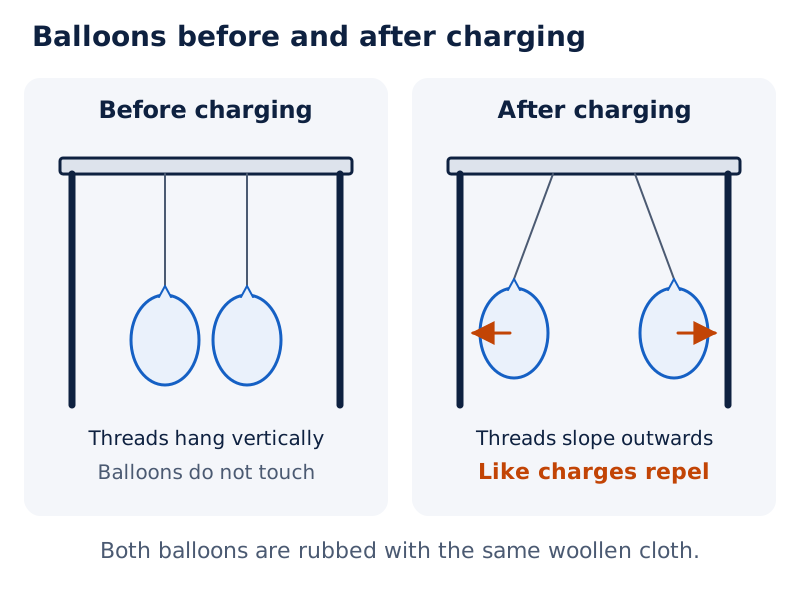
Two balloons hang beneath a table. In drawing (a), their threads hang vertically. In drawing (b), the threads slope outwards and the balloons are farther apart.
Drawn by One Young India.
Electrostatic force is the force exerted by a charged object on another charged or uncharged object. It is a non-contact force. Attraction to uncharged objects depends on their material; the paper activity does not show that every uncharged object will be attracted.
Why do objects fall towards the Earth?
The Earth attracts objects towards itself. This attraction is called gravitational force. The gravitational force exerted by the Earth is also called the force of gravity, or simply gravity. It can act without contact with the object.
Dropping a ball, or throwing it vertically upwards, demonstrates gravity. Vertical means the straight up-and-down direction. A dropped object travels vertically downwards. An object thrown vertically upwards slows, stops momentarily at the top and then falls.
How does gravity affect upward and downward motion?
During the upward journey, the object's speed decreases. At the top, it stops for a moment and changes direction. During its downward journey, its speed increases. This movement under gravity in the vertical direction is called vertical motion.
Throwing the ball upwards harder does not remove the Earth's attraction. The ball still comes back down. Nor should the momentary stop at the top be mistaken for the disappearance of gravity.
| Force | Contact needed? | Attraction or repulsion? |
|---|---|---|
| Gravitational force | No | Always attractive |
| Magnetic force between magnets | No | Attractive or repulsive |
| Electrostatic force between charged objects | No | Attractive or repulsive |
This comparison separates two ideas: whether contact is needed, and whether the force attracts or repels. All three are non-contact forces, but gravitational force is always attractive. Sharing a category does not mean having identical effects.
How do mass, weight and a spring balance differ?
Mass is the amount of matter in an object. It is measured in grams, symbol g, or kilograms, symbol kg. Mass remains the same at every place. Weight is the gravitational force with which the Earth or another planet pulls an object.
The SI unit of weight is newton, N, because weight is a force. Gravitational force can vary very slightly between places on Earth and can differ greatly between planets. Weight can therefore change while mass remains unchanged.
An object's weight remains almost the same everywhere on Earth. For practical purposes, weighing can therefore be used to find mass. This does not make the terms identical: a bag described scientifically as having a mass in kilograms has a weight measured in newtons.
How does a spring balance measure weight?
A spring balance measures weight using the extension of a spring. The spring is fixed at one end and has a hook at the other. Hanging an object from the hook stretches the spring, and a marked scale indicates its weight.
Usually, another scale gives corresponding mass values in grams. That scale assumes the balance is used on Earth. The range is the span of weights the instrument can measure; the smallest division is the smallest weight interval its scale indicates.
What the figure shows
Spring balance and enlarged scale
The balance has a suspension ring above and a hook below. The enlarged scale shows grams on the left and newtons on the right, with a red indicator.
Worked example 1. A spring balance has a range of 0 to 10 N. Adjacent large marks differ by 1 N, and the gap contains five equal small divisions. Find the value of one small division.
Answer: Divide the interval by the number of divisions. Smallest division = 1 N ÷ 5 = 0.2 N. Each small division represents 0.2 N.
Inspect the particular balance before using it: another instrument may have a different range and division size. Do not hang an object heavier than the maximum weight the balance can measure, because this may damage it.
Suspend objects one at a time, read the weight scale carefully and record the measurements. A pencil box and a partially filled water bottle can be measured this way. Their readings must be observed, not guessed from their names or appearance.
Why do some objects float while others sink?
An empty bottle with its lid tightly closed gives a useful demonstration. Push it into a bucket of water and feel the upward push. On release, it bounces back towards the surface. Water is exerting an upward force on it.
Definition: Upthrust, also called buoyant force, is the upward force exerted by a liquid on an object placed in it.
Two forces must be distinguished: gravity acts downwards, while the liquid's buoyant force acts upwards. An object sinks when its downward gravitational force exceeds the buoyant force. It floats when those two forces are equal.
What does Archimedes' principle state?
Archimedes' principle, associated with the Greek scientist Archimedes, applies to an object fully or partly immersed in a liquid. Immersed means placed within the liquid. The upward force equals the weight of the liquid displaced, or moved aside, by the object.
If the displaced liquid weighs less than the object, the object sinks. If the displaced liquid's weight equals the object's weight, the object floats. This connects the upward force with displaced liquid rather than treating floating as an absence of gravity.
A mug used to take water from a bucket feels lighter while it is in the water because of the upward force. The Earth continues pulling it downwards. The additional upward force explains the changed experience without requiring the mug's mass to change.
What is pressure, and why does contact area matter?
Pressure is force per unit area. Area is the extent of the surface over which the force acts. For these calculations, consider forces perpendicular to the surface, meaning forces acting at right angles to it.
Use P for pressure, F for perpendicular force and A for the area on which that force acts. The SI unit of force is newton, N. The SI unit of area is square metre, written m².
P = F ÷ A. The SI unit of pressure is newton per square metre, N/m². This unit is called the pascal, symbol Pa. Thus, 1 Pa = 1 N/m².
How do broad straps reduce pressure?
Compare bags of equal weight with broad and narrow straps. Broad straps spread the force over more shoulder area. Narrow straps spread the same force over less area. The broader straps therefore produce lower pressure and feel more comfortable.
For a fixed force, increasing the contact area decreases pressure. Decreasing the area increases pressure. Do not confuse the total force with its concentration over a surface: equal forces can produce different pressures if their contact areas differ.
| Example | Area involved | Effect on pressure |
|---|---|---|
| Broad bag straps | Larger area over the shoulders | Lower pressure for the same weight |
| Broad bucket handle | Larger area in contact with the hand | Lower pressure while carrying the load |
| Round cloth beneath a head load | Larger area supporting the load | Reduced pressure on the head |
| Pointed end of a nail | Small area against the wood | Higher pressure for the same force |
| Sharp knife edge | Small area against the apple | Higher pressure makes cutting easier |
People often place a round piece of cloth under pots or vegetable baskets carried on their heads. Increasing contact area reduces pressure. Conversely, a pointed nail and a sharp knife deliberately concentrate force into a smaller area.
Activities involving nails or knives should be performed under adult supervision. Their usefulness comes from the pressure produced at a small contact area, which also explains why their sharp parts require care.
How are pressure problems solved using all the given data?
Begin by identifying the perpendicular force and the full area supporting it. Use force in newtons and area in square metres to obtain pressure in pascals. If several equal contact areas support the load, find their total area first.
What pressure does a force produce on cardboard?
Worked example 2. A force of 100 N acts perpendicularly on cardboard over an area of 2 m². Find the pressure.
Answer: Using pressure P, force F and area A, P = F ÷ A = 100 N ÷ 2 m² = 50 N/m² = 50 Pa. The force is distributed over the stated two-square-metre area.
The number 100 represents force, not pressure. Dividing it by the area gives the force acting per unit area. Keep the unit in the answer: a pressure result written simply as 50 does not identify the physical quantity completely.
How is the elephant's total contact area found?
Worked example 3. An elephant weighing 20,000 N stands on four feet. Each foot covers 0.25 m². Find the pressure exerted on the ground.
Answer: Total contact area is A = 4 × 0.25 m² = 1 m². Pressure is P = 20,000 N ÷ 1 m² = 20,000 Pa.
The given weight is the force exerted on the ground. The elephant stands on all four feet, so the required area is the combined contact area. Using the area of one foot with the whole weight would give the wrong pressure.
Which boat has greater pressure from its passengers?
Worked example 4. Boat A has a base area of 7 m² and carries five people. Boat B has a base area of 3.5 m² and carries three people. Each person weighs 700 N. Compare the pressure due to the passengers' weight spread over each base.
Answer: The passengers in boat A exert 5 × 700 N = 3,500 N, giving 3,500 N ÷ 7 m² = 500 Pa. Those in boat B exert 3 × 700 N = 2,100 N, giving 2,100 N ÷ 3.5 m² = 600 Pa. Boat B's pressure is greater by 600 Pa − 500 Pa = 100 Pa.
Although boat A carries more people, its larger base spreads their weight over more area. Compare both force and area. These calculations concern the stated passenger loads, so no unstated boat weight is required.
How do liquids exert pressure on their containers?
Liquid pressure acts at the bottom and on the sides of a container. In fact, liquids exert pressure in all directions. The pressure produced by a water column depends on its height, as experiments with pipes and balloons demonstrate.
What happens with equal heights of water?
- Take two transparent pipes about 25 centimetres long, but with different diameters. A centimetre is a unit of length, written cm; diameter means the width across the pipe's circular opening through its centre.
- Attach a good-quality rubber balloon to one end of each pipe.
- Clamp the pipes vertically and fill them to the same water level, about halfway.
- Compare the extent to which the balloons bulge at the lower ends.
The balloons bulge equally even though the pipes contain different weights of water. Equal heights of water produce equal pressure in this comparison. The total amount of water alone therefore does not determine the pressure at the bottom.
What the figure shows
Equal water-column heights
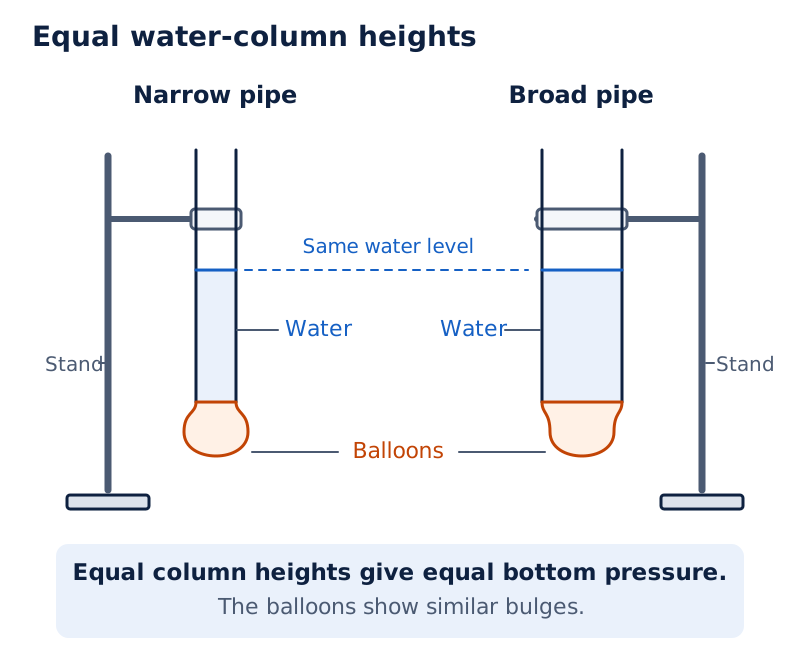
A narrow pipe and a broad pipe are clamped to stands. Water reaches the same height in both. Balloons attached at their lower ends show similar bulges. Labels identify the pipes, water, balloons and stand.
Drawn by One Young India.
What changes when the water column becomes higher?
Add water to one pipe. Its balloon bulges more as the water column becomes higher. Greater column height produces greater pressure at the bottom. Overhead tanks are placed high to increase pressure at taps and provide a good stream of water.
What the figure shows
Increasing the water-column height
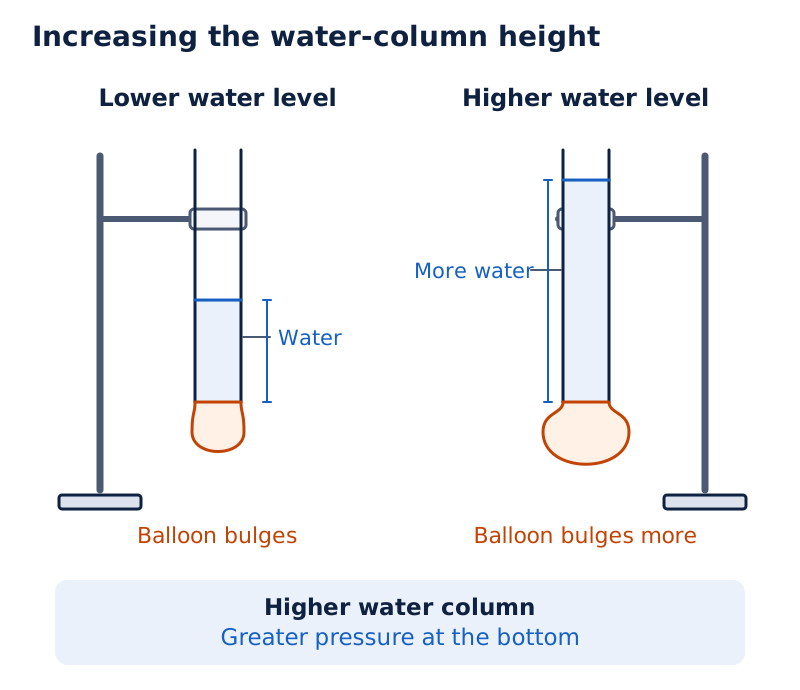
Two pipe arrangements compare a lower water level with a higher one. The balloon under the higher column is more swollen; labels distinguish water, more water and the different bulges.
Drawn by One Young India.
Water also escapes through holes made around the sides of a filled bottle. This shows that it presses sideways as well as downwards. Water spurting from holes or leaking pipe joints is another effect of pressure on container walls.
A dam's base is broader than its top partly to withstand the large horizontal water pressure near the bottom. The broader base also supports the structure. Greater depth below the water surface means a taller water column above that level.
What is atmospheric pressure, and how does a rubber sucker work?
The atmosphere is the envelope of air around the Earth. It extends many kilometres above the surface. Air contains nitrogen, oxygen, argon, carbon dioxide and other gases. Atmospheric pressure is the pressure exerted by the air around us.
What evidence shows that air exerts pressure?
Air blown into a balloon presses against its walls, expanding it in all directions. A paper-plate activity also demonstrates air pressure. An inverted paper plate is fitted with a stick and covered with chart paper through which the stick passes.
Lifting the plate takes more effort with an unfolded sheet than with an identical sheet folded twice. The unfolded sheet presents more area, although its weight is unchanged. The air exerts a larger force over the larger area.
Why does a rubber sucker stick?
- Press a good-quality rubber sucker firmly against a smooth, flat surface.
- Most of the air between the cup and the surface is pushed out.
- The pressure inside falls below the pressure of the surrounding air.
- The higher outside pressure holds the sucker against the surface.
What the figure shows
A rubber sucker on a surface
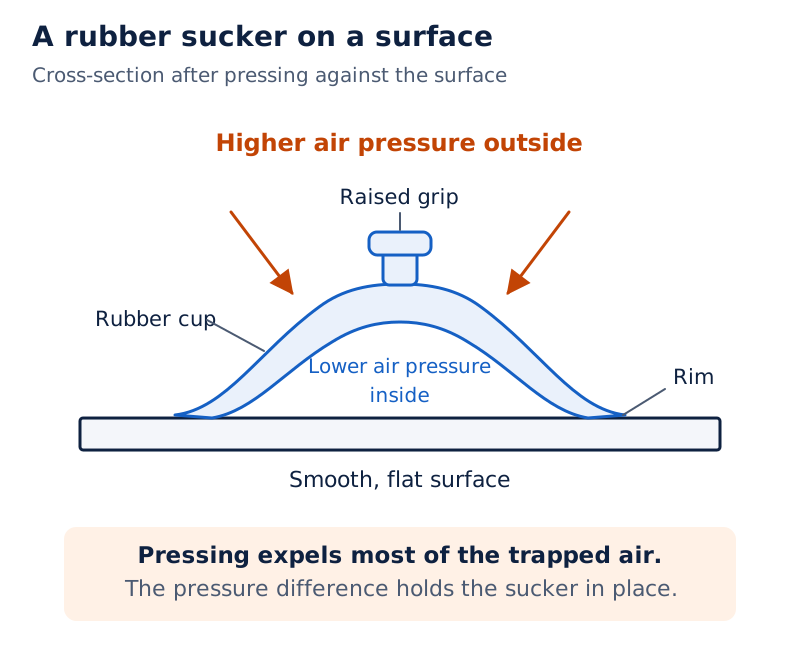
The drawing shows a cup-shaped sucker resting with its broad circular rim on a flat brown surface and a small raised grip above.
Drawn by One Young India.
Pulling it away requires enough force to overcome the effect of the pressure difference. Say most of the air is expelled, not all of it. The explanation requires lower pressure inside, rather than a claim that the cup contains no air.
How large is atmospheric pressure?
Over an area measuring 15 cm by 15 cm, the force exerted by the atmospheric air column is nearly equal to the gravitational force on a 225 kg object, or 2,250 N. This is an approximate comparison, rather than an exact equality for every situation.
We are not crushed because pressure inside our bodies balances the atmospheric pressure outside. Movement of fluids and gases in tissues and organs produces the internal pressure. The comparison concerns opposing pressures, not an absence of atmospheric force.
Air moves from higher pressure towards lower pressure. This explains air escaping from an open inflated balloon or a punctured bicycle tube. A pressure difference can therefore cause movement as well as hold a sucker against a surface.
Glossary
- Force — A push or pull on an object arising from its interaction with another object.
- Contact force — A force requiring physical contact, either directly or through something such as a rope.
- Muscular force — Force produced by the action of muscles during movement and other bodily activities.
- Friction — Force opposing an object's movement or attempted movement over another surface in contact.
- Non-contact force — A force whose effects can be experienced without the interacting objects touching each other.
- Magnetic force — Force exerted by a magnet on another magnet or on a magnetic material.
- Electrostatic force — Force exerted by a charged object on another charged object or an uncharged object.
- Gravity — The attractive gravitational force exerted by the Earth on objects around it.
- Mass — The amount of matter in an object, remaining unchanged when its location changes.
- Weight — The gravitational force with which the Earth or another planet pulls an object.
- Spring balance — An instrument using a spring's extension and a marked scale to measure weight.
- Buoyant force — The upward force exerted by a liquid on an object placed in it.
- Pressure — Force per unit area, calculated here for force acting perpendicular to the surface.
- Pascal — The unit of pressure equal to one newton of force per square metre.
- Atmospheric pressure — Pressure exerted on objects by the air surrounding them in the Earth's atmosphere.
Common errors and misconceptions
- Misconception: A stationary object has no forces acting on it. Correct: Forces may act and balance one another while the object remains at rest.
- Misconception: Force can change speed but cannot change shape. Correct: Pressing an inflated balloon changes its shape; force may affect motion, shape or both.
- Misconception: Friction occurs only while an object is moving. Correct: Friction also acts when an object tries to move over a surface.
- Misconception: Every force requires touching. Correct: Magnetic, electrostatic and gravitational forces can act without contact between the interacting objects.
- Misconception: Mass and weight are interchangeable scientific terms. Correct: Mass measures the amount of matter; weight is gravitational force and is measured in newtons.
- Misconception: A larger contact area creates more pressure for the same force. Correct: Increasing the contact area reduces pressure when the force stays the same.
- Misconception: Liquids press only downwards. Correct: They exert pressure in all directions, including against the sides of their containers.
- Misconception: A pressed rubber sucker contains no air. Correct: Most air is expelled, reducing the inside pressure below the surrounding atmospheric pressure.
Exam-style questions with model answers
Q1. Define force and name its SI unit with its symbol. [2 marks]
- A force is a push or pull on an object resulting from its interaction with another object.
- The SI unit of force is the newton, represented by the capital-letter symbol N.
Q2. Explain three possible effects of force using a friend holding a moving bicycle from behind, a bat hitting a moving ball and someone pressing an inflated balloon. [3 marks]
- The friend's pull can slow or stop the moving bicycle. This shows that applying a force can change an object's speed.
- The bat pushes the moving ball and can change its direction. A force therefore need not act solely to increase or decrease speed.
- Pressing the balloon changes its shape. This demonstrates a further effect of force, distinct from changes in the movement of the object.
Q3. Two suspended balloons are rubbed with the same woollen cloth and released without touching their rubbed surfaces. Explain their movement, what happens when the cloth approaches one balloon, and the type of force involved. [3 marks]
- The balloons acquire similar charges through rubbing in the same way. They repel each other and move farther apart because like charges repel.
- The cloth and a rubbed balloon attract each other. Rubbing gives them opposite kinds of charge, and unlike charges attract.
- Electrostatic force causes these effects. It is a non-contact force because the charged objects can interact before touching one another.
Q4. A spring balance reads from 0 to 10 N. Two neighbouring large marks differ by 1 N and have five equal small divisions between them. State its range, calculate one small division and give a precaution about the load. [3 marks]
- The range is 0 to 10 N. The maximum weight this balance can measure is therefore 10 N.
- One small division represents the interval between the large marks divided by five: 1 N ÷ 5 = 0.2 N.
- Do not suspend a load heavier than 10 N from this balance, because exceeding its maximum measurable weight may damage the instrument.
Q5. An elephant weighing 20,000 N stands on four feet, each covering 0.25 m². Calculate its total contact area and the pressure on the ground, showing the pressure formula. [3 marks]
- All four feet support the elephant, so the total area is 4 × 0.25 m² = 1 m². Using only one foot's area would be incorrect.
- Pressure is perpendicular force divided by contact area. The elephant's weight supplies the stated force of 20,000 N on the ground.
- Pressure = 20,000 N ÷ 1 m² = 20,000 N/m², or 20,000 Pa. The final answer includes the pressure unit.
Q6. Boat A has a base area of 7 m² and five passengers. Boat B has a base area of 3.5 m² and three passengers. Each passenger weighs 700 N. Calculate each passenger load and its pressure spread over the whole base, then compare the pressures. Consider passenger weights only. [5 marks]
- The total passenger load in boat A is 5 × 700 N = 3,500 N. This is the force used for boat A's calculation.
- Dividing boat A's passenger load by its base area gives 3,500 N ÷ 7 m² = 500 Pa of pressure due to the passengers.
- The total passenger load in boat B is 3 × 700 N = 2,100 N. No additional boat weight is required by this question.
- Dividing boat B's passenger load by its base area gives 2,100 N ÷ 3.5 m² = 600 Pa of pressure due to its passengers.
- Boat B has greater pressure by 600 Pa − 500 Pa = 100 Pa. Its smaller base produces greater pressure despite its lower passenger load.
Q7. Two vertical transparent pipes of different diameters have balloons attached at their lower ends and contain water to the same height. Explain their initial balloon bulges, the result of adding water to one pipe, and two applications of liquid pressure. [5 marks]
- The balloons initially bulge equally because the water columns have equal heights. The different pipe diameters do not make their bottom pressures different in this comparison.
- The broader pipe contains more water, yet the equal bulges show that total water weight alone does not determine pressure at the bottom.
- Adding water to one pipe raises its column and increases its bottom pressure. Its balloon therefore bulges more than it did before.
- Overhead water tanks are placed at a height to increase water pressure at taps. This helps provide a good stream of water.
- A dam has a broad base partly to withstand the greater horizontal water pressure near its bottom. The base also supports the structure.
Q8. Describe how to make a rubber sucker stick to a smooth, flat surface and explain why removing it requires force. Include what happens to the trapped air and compare the inside and outside pressures. [4 marks]
- Press a good-quality rubber sucker firmly against the smooth, flat surface so that its cup is pushed against the surface.
- This pushes out most of the air between the cup and the surface. It does not require all the air to be removed.
- The air pressure inside becomes lower than the surrounding air pressure. The greater outside pressure holds the sucker against the surface.
- Pulling it off requires sufficient force to overcome the effect of this pressure difference between the inside and the outside.
Key takeaways
- A force is a push or pull arising from interaction, and it may change speed, direction or shape.
- Muscular force and friction require contact, while magnetic, electrostatic and gravitational forces can act without touching.
- Like magnetic poles and like electrical charges repel; unlike poles and unlike charges attract each other.
- Mass remains unchanged with location, while weight is gravitational force and can change between places.
- A spring balance measures weight; inspect its range and smallest division before taking any reading.
- Liquid upthrust acts upwards, opposing downward gravity; floating occurs when these two forces are equal.
- Pressure equals perpendicular force divided by area, so increasing contact area reduces pressure for the same force.
- Liquids exert pressure in all directions, and a higher water column produces greater pressure at its bottom.
- A rubber sucker is held by higher outside air pressure after most trapped air has been expelled.
Test yourself
Can forces act on an object that remains at rest?
Yes. Forces may balance one another, allowing the object to remain at rest even though forces act.
Why is pulling an object with a rope an example of contact?
The rope provides physical contact through which the pull is transmitted to the object.
What happens when like poles of two magnets face each other?
The magnets repel each other, and this force can act while they remain separated.
Why can a rubbed plastic scale attract small paper pieces before touching them?
Rubbing charges the scale, allowing electrostatic force to attract suitable uncharged objects such as the paper pieces.
What changes when an object is moved to a place with different gravitational attraction?
Its weight can change because weight is gravitational force, while its mass remains unchanged.
Why are broad straps more comfortable for carrying bags of equal weight?
Broad straps spread the same force over a larger shoulder area, producing lower pressure.
What does water flowing from holes in a bottle's sides demonstrate?
It demonstrates that water exerts pressure on the container's sides, not just at its bottom.
Why is “most air is expelled” important when explaining a sucker?
The sucker needs lower inside pressure than outside pressure; its cup does not have to be completely empty of air.
Try it
Mastering Force and Pressure: Applied Mechanics Challenge
Apply core principles of thrust, area, and hydrostatic pressure to solve practical engineering and fluid mechanics scenarios.
1An engineering team needs to prevent a heavy vehicle from sinking into soft, deformable ground. Based on the relationship between thrust, area, and pressure, which modification should they implement?
Correct! Pressure is inversely proportional to contact area ($P = \text{Thrust} / \text{Area}$). Spreading the vehicle's weight over a larger area reduces the pressure exerted on the soft ground, preventing it from sinking.
Incorrect. Thrust is the total perpendicular force (the vehicle's weight) and does not decrease by using narrower wheels. In fact, decreasing the contact area increases the pressure, making the vehicle sink faster.
Incorrect. Reducing the contact area concentrates force and increases pressure, which is useful for cutting tools like knives and nails, but causes heavy vehicles to sink into soft ground.
2Civil engineers are constructing a deep water storage dam. Why must the base of the dam wall be built significantly thicker than the top section?
Incorrect. Unlike solids, liquids exert hydrostatic pressure on both the bottom and the side walls of their container in all directions.
Correct! Liquid pressure is directly proportional to the depth ($h$) below the free surface. As depth increases, hydrostatic pressure against the side walls increases steadily, requiring a thicker base to withstand the force.
Incorrect. Liquid pressure is independent of the shape or surface area of the container; it depends solely on vertical depth, liquid density, and gravitational acceleration.
Well done! You have mastered how contact area governs solid pressure ($P = \text{Thrust}/\text{Area}$) and how vertical depth governs hydrostatic pressure in liquids ($P = h \times \rho \times g$).