
Work and Energy | CBSE Class 9 Science Notes
On this page
Watch & explore
Start with a few high-quality watches, then dive into the notes below.
Try an idea before you read. Test your understanding of work and energy concepts! Explore →

This note covers work by a constant force, positive and negative work, energy and its forms, the work-energy theorem, kinetic and potential energy, conservation of energy, power, pulleys, inclined planes, levers and mechanical advantage.
What does work mean in science?
A force is a push or pull acting on an object. Displacement describes its change of position in a specified direction. Work depends on both the force and the displacement it brings about, rather than simply on how tiring a task feels.
Definition: Work done on an object by a constant force equals the force multiplied by the displacement in the direction of that force.
Let W represent work done, F the constant force and s displacement in the direction of the force. A constant force remains unchanged during the displacement considered.
W = F × s
How do force and displacement affect work?
Consider a wheat bag of mass 5 kilograms (kg) lifted slowly through 1 metre (m). Here mass measures the quantity of matter in the bag. Its weight, the gravitational force on it, acts downwards. To lift it slowly, an equal upward force is applied.
Writing mass as m and acceleration due to gravity as g, the weight is mg. Acceleration is the rate of change of velocity; velocity describes motion with both speed and direction. Gravity is the attraction between the Earth and the bag.
Lifting three identical bags individually through the same height requires three times the work. Lifting them together also requires three times the work because the applied force is three times as large. Lifting one bag through 3 m instead of 1 m likewise triples the work.
What units express work?
The International System of Units, abbreviated SI, supplies the units used here. The SI unit of force is the newton (N). The SI unit of displacement is the metre (m). The SI unit of work is the joule (J).
1 J = 1 N × 1 m
One joule is the work done when a constant force of one newton displaces an object one metre in the force's direction. Kilogram, gram, centimetre and second have symbols kg, g, cm and s respectively. A unit symbol must be distinguished from a quantity symbol in a formula.
Note: Identify both the force doing the work and the object receiving it. The same event can involve different forces doing different amounts or signs of work.
What the figure shows
Work from a force-displacement graph
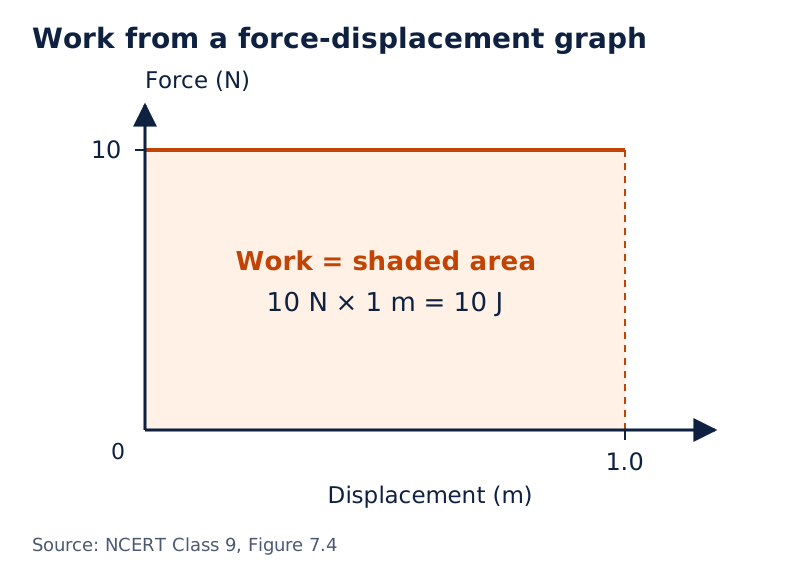
Force in newtons is plotted vertically and displacement in metres horizontally. The shaded rectangle extends to 10 N and 1.0 m. Its area gives 10 N × 1 m = 10 J.
Drawn by One Young India. See Fig. 7.4 in your NCERT textbook
The area under a force-displacement graph between the initial and final positions also gives work when the force varies. The constant-force rectangle is a particularly simple case of this method.
When is work positive, negative or zero?
Positive work occurs when displacement is in the direction of the applied force. Negative work occurs when displacement is opposite to the force. Force and displacement have directions, but work has no direction; its value can have a positive or negative sign.
| Situation | Force and displacement | Work by the specified force |
|---|---|---|
| Pushing a wheelchair forwards | The push and displacement have the same direction. | Positive work by the person on the wheelchair |
| A goalkeeper stopping a ball | The stopping force opposes the ball's displacement. | Negative work by the goalkeeper on the ball |
| Pushing a rigid wall without moving it | Force acts, but displacement is zero. | Zero work on the wall |
| Carrying a box horizontally at a fixed height | The supporting force is upward; displacement is horizontal. | Zero work by that upward force on the box |
Why can a person feel tired without doing work on an object?
When a rigid wall does not move, its displacement is zero, so work done on it is zero. Nevertheless, the person's muscles repeatedly expand and contract and use internal energy. Feeling tired therefore does not establish that work has been done on the wall.
Work is also zero if the force is zero. If force and displacement are perpendicular, meaning at right angles, there is no displacement in the force's direction. This explains the zero work by the upward supporting force on a horizontally carried box.
Worked example 7.1. A girl lifts a dumbbell and slowly lowers it. Identify the sign of her work.
Answer: Her force on the dumbbell is upward. During lifting, displacement is upward, so her work is positive. During lowering, displacement is downward, opposite to her force, so her work is negative.
Worked example 7.2. A goalkeeper applies 200 N opposite to a ball's motion while her hand moves back 15 cm as she stops it. Find her work on the ball.
Formula: W = F × s. Substitute: The displacement along the force is −0.15 m, so W = 200 N × (−0.15 m).
Answer: W = −30 J. The negative sign identifies work done against the ball's displacement.
How are work, energy and energy transfer related?
Energy is the capacity to do work. A moving cricket ball can knock down wickets, while a raised flowerpot can damage an object beneath it if it falls. The ball gains energy from the fielder's work; the pot gains energy from work done in raising it.
Definition: The work-energy theorem states that work done on an object equals the change in its energy. It also applies to a system of objects and to forces that are not constant.
A system is the object or collection of objects considered together. Positive work supplies energy to an object; the object can subsequently transfer energy by exerting a force that displaces another object. The SI unit of energy is the joule.
Which forms can energy take?
| Form | Meaning |
|---|---|
| Mechanical energy | Energy associated with the motion or position of objects |
| Thermal energy | Energy that makes things warm or hot |
| Light energy | Energy that allows us to see |
| Sound energy | Energy of vibrations of air or other molecules |
| Electrical energy | Energy related to the position or motion of electric charges |
| Chemical energy | Energy stored in food and fuels in chemical bonds between atoms |
| Nuclear energy | Energy stored in the nuclei of atoms |
Energy conversion means a change from one form of energy to another. A bulb converts electrical energy into light; an electric water heater transfers energy to water as thermal energy. Food supplies chemical energy for muscular activity, and a ringing bell converts mechanical energy into sound.
Worked example 7.3. In a carrom shot, a moving striker hits a white coin, which then hits a black coin. Describe the work and energy changes at the collisions.
Answer: The striker does positive work on the white coin, increasing its energy. The white coin does negative work on the striker, decreasing its energy. Next, the white coin does positive work on the black coin, while the black coin does negative work on the white coin.
Work is one way to transfer energy. Energy transfers as heat from a hotter object to a colder one when they contact each other. Radiation transfers the Sun's energy to Earth without direct contact. Energy is also transferred through electric circuits and sound waves.
The joule is named after James Prescott Joule. His study of the relationship and conversion between mechanical and thermal energy helped develop a unified understanding of energy.
How is kinetic energy calculated and derived?
Kinetic energy is the energy an object possesses because of its motion. A moving bicycle and a rolling ball possess kinetic energy. An object at rest is assigned zero kinetic energy. Kinetic energy has no direction, and its SI unit is the joule.
Use K for kinetic energy, m for mass, u for initial velocity, v for final velocity and a for acceleration. For the following derivation, the applied force is constant, so acceleration is constant as well.
Derivation: Kinetic energy from work
- The equation of motion is v² = u² + 2as. Rearranging gives s = (v² − u²)/(2a).
- Newton's second law relates force, mass and acceleration: F = ma.
- Substitute in W = F × s to obtain W = ma × (v² − u²)/(2a) = ½m(v² − u²).
- For motion starting from rest, u = 0. The work done equals the gain in kinetic energy, giving K = ½mv².
K = ½mv²
W = ½m(v² − u²)
How does changing speed affect kinetic energy?
Worked example 7.4. A vehicle's velocity doubles in magnitude. Compare its new kinetic energy with its original value.
Answer: For unchanged mass m, the original value is ½mv². At velocity 2v, the value is ½m(2v)² = 4 × ½mv². Its kinetic energy becomes four times the original value.
Worked example 7.5. An Indian cricketer delivers a ball of approximate mass 0.2 kg at about 154.8 km h⁻¹. Calculate its kinetic energy. Here km h⁻¹ means kilometres per hour; m s⁻¹ means metres per second.
Formula: K = ½mv². Substitute: v = 154.8 × 1000/3600 = 43 m s⁻¹; K = ½ × 0.2 × 43².
Answer: The calculated kinetic energy is 184.9 J using the stated approximate measurements.
Worked example 7.6. A 15000 kg jet is stopped over 100 m by an approximately constant backward wire force of 367500 N. Find its velocity before the wire catches its hook.
Formula: W = F × s; K = ½mv². The wire's work equals final kinetic energy minus initial kinetic energy.
Substitute: −367500 × 100 = 0 − ½ × 15000 × v². Thus v² = 4900 m² s⁻².
Answer: v = 70 m s⁻¹, or 252 km h⁻¹, towards the aircraft carrier.
What is potential energy and why does height matter?
Potential energy is energy stored through an object's deformation or through the relative positions of objects in a system. Deformation means a change in shape. A stretched rubber band, bent bow and compressed spring can store energy even while motionless.
Work done while stretching or compressing a spring is stored in its deformed state. On release, the spring returns towards its original shape and can transfer energy to an object touching it. That object gains kinetic energy.
Potential energy also belongs to interacting systems. Separating unlike magnetic poles requires work; on release, they move towards each other. A raised ball and Earth likewise form an interacting system with stored energy due to their relative positions.
Derivation: Gravitational potential energy
Gravitational potential energy, written U, is stored energy associated with relative position under gravitational attraction. Let h be height above the ground, chosen as the position where U is zero. The following calculation applies near Earth's surface, where g can be treated as constant.
- Consider an object of mass m initially on the ground, with its potential energy defined as zero.
- Raise it gradually through height h by applying an upward force equal to its weight, mg.
- The work done by this lifting force is W = mg × h = mgh.
- This work appears as a gain in the potential energy of the Earth-object system, so U = mgh.
U = mgh
Earth is much more massive than the ball and hardly moves towards it. The stored energy of the Earth-ball system is therefore often simply called the ball's gravitational potential energy. The SI unit of potential energy is the joule.
Note: U = mgh is valid only near Earth's surface. Further away, gravitational acceleration decreases. In the following discussion, potential energy usually refers to gravitational potential energy.
Worked example 7.7. A fielder throws a 200 g cricket ball about 10 m above the ground. Find its potential energy at maximum height, taking g = 10 m s⁻², meaning ten metres per second squared.
Formula: U = mgh. Substitute: m = 0.2 kg, so U = 0.2 × 10 × 10.
Answer: U = 20 J relative to the ground.
How is mechanical energy conserved during motion?
The sum of an object's kinetic and potential energy is its mechanical energy. Let E represent this total. For an object moving under gravity with no other external forces acting, mechanical energy remains the same. An external force is one exerted from outside the system being considered.
E = K + U
What happens to an object in free fall?
Free fall is motion under gravitational force alone. Consider an object of mass m released from rest at height h. Its initial kinetic energy is zero, potential energy is mgh, and total mechanical energy is mgh.
After elapsed time t, its downward velocity is v = gt. If h′, read as h prime, denotes its remaining height above the ground, then h′ = h − ½gt². The distance fallen is h − h′.
- Initially, K = 0 and U = mgh, so E = mgh.
- During the fall, U = mgh′ = mgh − ½mg²t².
- At the same instant, K = ½mv² = ½mg²t².
- Adding the two energies cancels the equal decrease and increase, leaving E = mgh.
What the figure shows
An object falling freely
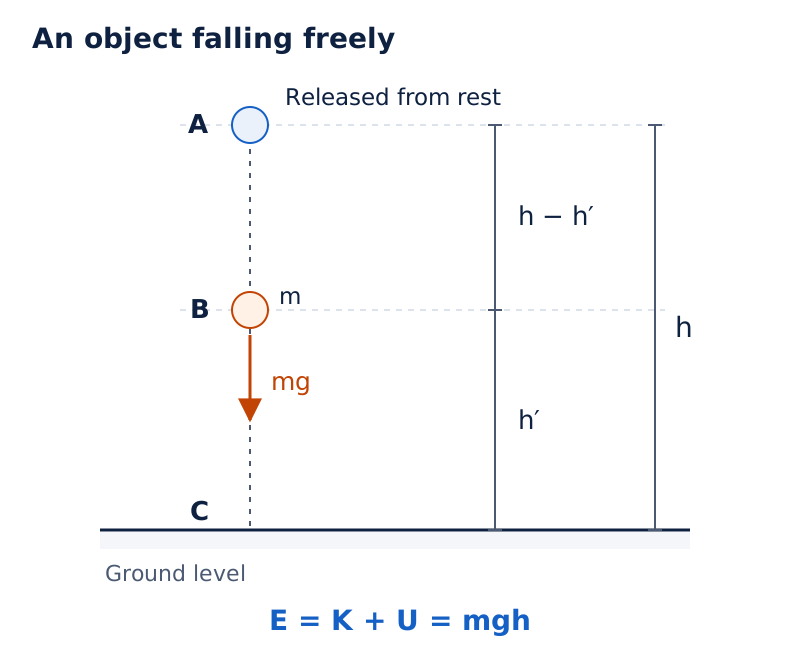
The object starts at A, passes B and approaches C at ground level. Labels show total height h, height h′ remaining below B, distance h − h′ above B and the downward gravitational force mg.
Drawn by One Young India. See Fig. 7.19 in your NCERT textbook
What does a pendulum demonstrate?
A simple pendulum has a suspended bob that swings to and fro. At an extreme position, its kinetic energy is zero and it has potential energy. At the lowest point, potential energy measured from that point is zero and kinetic energy is present.
As the bob rises on the other side, kinetic energy changes back into potential energy. In the first couple of oscillations, it reaches almost the same height. In real life it slows and eventually stops because of friction, a resisting interaction at the support, and air resistance, the resisting force of air on its motion.
What the figure shows
Energy changes in a pendulum
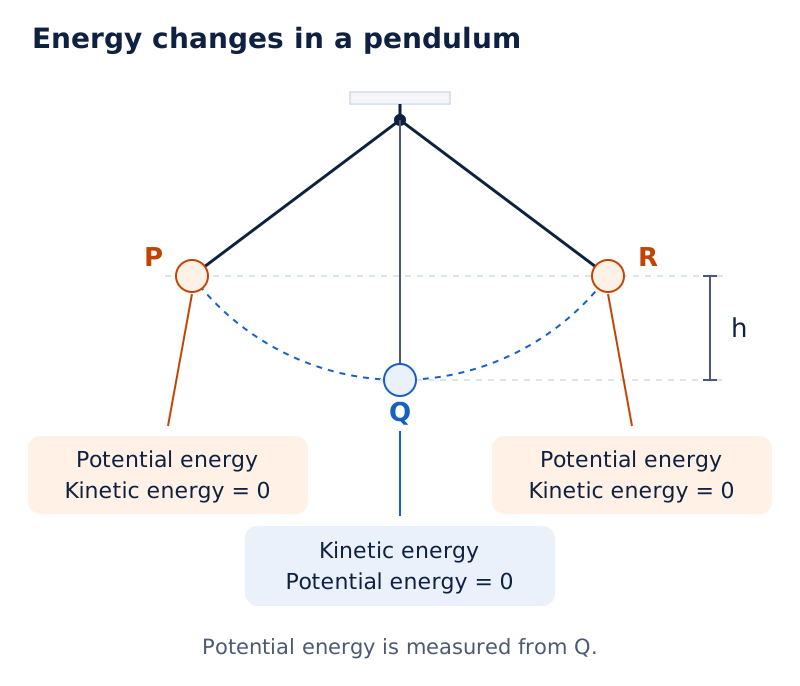
P and R mark the extreme positions, labelled with potential energy and no kinetic energy. Q is the lowest position, labelled with kinetic energy and no potential energy. The height h is measured above Q.
Drawn by One Young India. See Fig. 7.20 in your NCERT textbook
The law of conservation of energy concerns total energy across its forms. Energy changes form; a decrease in mechanical energy does not mean energy has disappeared. The total energy of a system not acted upon by external forces remains constant.
How can energy methods solve slide and escape-ramp problems?
Energy methods connect initial and final states without requiring every intermediate detail of motion. First identify kinetic energy, potential energy and any work done by another force. Include the work done by friction when its effect is specified.
What speed does a child reach at the bottom of a slide?
Worked example 7.8. Find the magnitude of velocity of a child reaching the bottom of a slide of height h. Take the child to start from rest and neglect friction.
Answer: The child's potential energy mgh becomes kinetic energy ½mv². Equating these gives ½mv² = mgh and therefore v = √(2gh). The symbol √ denotes the square root.
For these conditions, the result depends on height and gravitational acceleration. The mass cancels from both sides of the equation. At the same location, the slide's shape and the child's mass should not matter for this predicted final speed.
How does a sand-filled ramp stop a truck?
An escape ramp is an inclined surface filled with sand or gravel that can stop a truck after brake failure. The truck gains height while sand opposes its movement. Both effects must be included; mechanical energy is not conserved for this motion with resistance.
Worked example 7.9. A 10000 kg truck moving at 72 km h⁻¹ enters a 30° escape ramp. Sand exerts 50000 N opposite to motion. Take g = 10 m s⁻². For every 2 m travelled along this incline, the truck rises 1 m. Find the minimum stopping length.
Formula: K = ½mv²; U = mgh; work by sand = change in mechanical energy. Let d denote distance travelled along the ramp, so h = d/2.
Substitute: v = 20 m s⁻¹. Initial energy = ½ × 10000 × 20² = 2000000 J, taking initial potential energy as zero. At rest, final energy = 10000 × 10 × d/2 = 50000 N × d.
The sand's work is −50000 N × d. Therefore −50000 N × d = 50000 N × d − 2000000 J.
Answer: 100000 N × d = 2000000 J, so the minimum ramp length is d = 20 m.
What is power and how is it calculated?
Power is the rate of doing work. Carrying the same bag up the same stairs in one minute or five minutes involves the same work, but different power. Completing a fixed amount of work more quickly requires greater power.
Let P denote average power, W the work done and t the time taken. Average power compares the total work with the entire time interval.
P = W/t
The SI unit of power is the watt, symbol W. One watt means one joule of work done per second. The letter W used as a unit symbol means watt, while W as a quantity in the formula means work.
1 W = 1 J s⁻¹
Horsepower, abbreviated hp, is another unit used especially for engines and pumps. One horsepower equals 746 W. The watt honours James Watt, who invented an efficient steam engine capable of generating rotational motion and moving wheels.
How do lifting and acceleration determine required power?
Worked example 7.10. A weightlifter raises a 75 kg mass through 2 m in 5 s. Find the required average power, using g = 10 m s⁻².
Formula: W = mgh; P = W/t. Substitute: W = 75 × 10 × 2 = 1500 J; P = 1500/5.
Answer: The required average power is 300 W.
Worked example 7.11. A 1000 kg car starts from rest and reaches 72 km h⁻¹ in 10 s. Calculate the engine's average power for this increase in kinetic energy.
Formula: W = ½m(v² − u²); P = W/t. Substitute: u = 0 and v = 20 m s⁻¹, so W = ½ × 1000 × 20² = 200000 J.
Answer: P = 200000 J/10 s = 20000 W.
How do simple machines and pulleys make work easier?
Simple machines are devices that change the magnitude or direction of the force needed for a task. They make tasks easier or more convenient without reducing the total work. A pulley, inclined plane and lever are three examples.
The effort is the force applied to the machine. The load is the force to be overcome. Mechanical advantage compares the load with the effort and indicates how the machine changes the magnitude of the required force.
Mechanical advantage = load/effort
What does a fixed pulley change?
A pulley is a grooved wheel that guides a rope. A fixed pulley is attached at a fixed position. Pulling its rope down can raise a flag or load upward, making the action more convenient.
A fixed pulley changes the direction of effort without reducing its magnitude. Because load and effort are equal in magnitude, its mechanical advantage is 1. Greater convenience does not necessarily mean a reduction in force.
What the figure shows
Lifting directly and with a pulley
Panel (a) shows a person pulling upward to lift a load. Panel (b) shows a pulley fixed above the person, with the effort directed downward and the load on the other end of the rope.
See Fig. 7.24 in your NCERT textbook
How do movable pulleys differ?
A movable pulley moves with the load attached to it. One rope end is fixed and the other is available for applying effort. Movable pulleys or pulley systems can have mechanical advantage greater than 1 and lift heavier loads with smaller effort.
Pulleys are used in elevators and cranes because of the convenience they provide. Their operation does not create energy. Ignoring friction, input work equals useful work on the load, consistent with conservation of mechanical energy.
Why does an inclined plane reduce the effort required?
An inclined plane is a sloping surface used to move a load to a higher or lower level. A smooth plank permits a heavy box to be pushed up to a platform using a smaller force than a direct vertical lift.
The force acts over a larger distance along the plank. A shallower incline decreases the required force but increases the travel needed to reach the same height. The work required to raise the load is unchanged when friction is ignored.
How is its mechanical advantage derived?
Let L be the length of the incline, h its vertical height and F′, read as F prime, the effort along it. The load is mg. Move the object at constant speed and ignore friction.
- Work done along the incline is F′ × L.
- The increase in gravitational potential energy is mgh.
- Equating work and energy gain gives F′ × L = mgh.
- Rearranging gives load/effort = mg/F′ = L/h.
Mechanical advantage = L/h
Since the slope length is greater than the vertical height, mechanical advantage is greater than 1. Increasing the incline's length for the same height further reduces effort. This explains the use of gentle slopes for roads winding around hills.
Worked example 7.12. A ramp raises an object over a step 30 cm high. Its horizontal width is 40 cm. Find its mechanical advantage, ignoring friction.
Formula: L² = 30² + 40² for the right-angled cross-section; mechanical advantage = L/h. Substitute: L = 50 cm and h = 30 cm.
Answer: Mechanical advantage = 50/30 = 1.67, using the 50 cm ramp length.
What the figure shows
Dimensions of a ramp
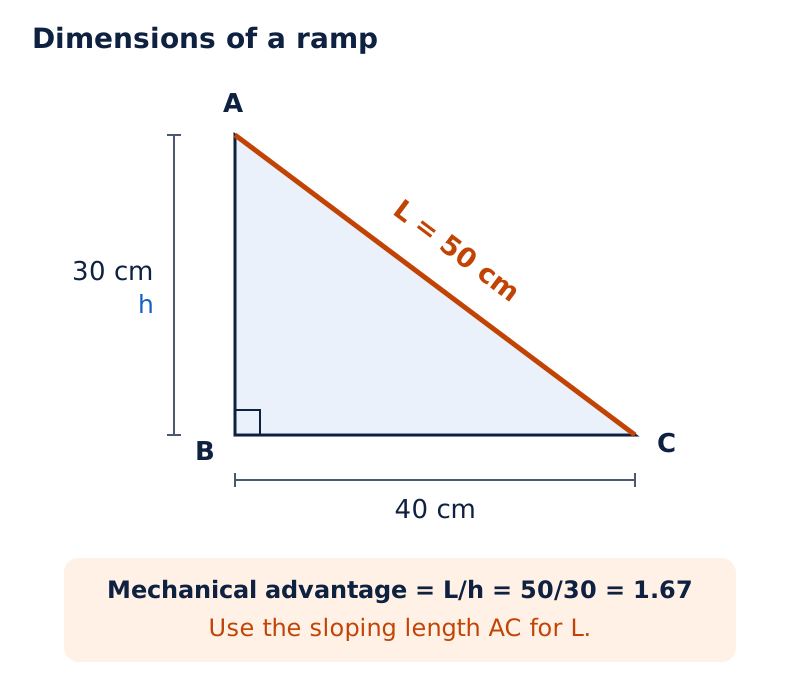
The right-angled triangle has vertical side AB labelled 30 cm, horizontal side BC labelled 40 cm and sloping side AC labelled 50 cm. The slope, rather than the horizontal width, supplies L in L/h.
Drawn by One Young India. See Fig. 7.29 in your NCERT textbook
How do levers balance loads and provide mechanical advantage?
A lever is a rigid bar that rotates about a fixed point called the fulcrum. Its other essential parts are effort and load. The effort arm is the distance from the fulcrum to the effort; the load arm is the corresponding distance to the load.
In a lever giving a larger output force, the smaller effort moves through a larger distance. Let F₁ be effort, F₂ the force on the load, d₁ the effort's displacement and d₂ the load's displacement. Ignoring friction, the work transferred satisfies:
F₁ × d₁ = F₂ × d₂
What is the condition for balance?
Effort × effort arm = load × load arm
Mechanical advantage = effort arm/load arm
Increasing the effort arm reduces the effort required for the same load. The effort required with a lever is generally smaller, but it moves through a larger distance. Reducing force does not reduce total work.
Worked example 7.13. A seesaw has seats A, B, D and E, with fulcrum C between B and D. AC = EC = 2 m and BC = DC = 1 m. Choose seats for children of masses 15 kg and 30 kg to balance it.
Formula: Effort × effort arm = load × load arm. Place the 15 kg child at A and let L be the other child's distance on the opposite side. The common gravitational acceleration cancels from the balance equation.
Substitute: 15 kg × 2 m = 30 kg × L.
Answer: L = 1 m, so the 30 kg child sits at D.
How are the three classes of lever distinguished?
| Class | Part in the middle | Examples |
|---|---|---|
| Class I | Fulcrum between load and effort | Tongs, scissors, crowbar, pliers, balance scale, seesaw |
| Class II | Load between fulcrum and effort | Lemon squeezer, wheelbarrow, bottle opener |
| Class III | Effort between fulcrum and load | Tongs, tweezers, broom, hammer, oar |
Which activities and applications demonstrate these ideas?
How can height and effort be investigated?
- For the sand activity, take a heavy ball and a large container of loose sand.
- Drop the ball from about 1 m and observe the depression.
- Raise it to 2 m and release it at a slightly different position so the depressions do not overlap. Repeat the release.
- Compare the depths. The greatest release height produces the deepest depression because the ball had more gravitational potential energy.
For an incline investigation, attach a spring balance, an instrument used to measure force, to a toy cart. Compare its reading while lifting the cart slowly and steadily with the reading while pulling it up a smooth plank.
The setup uses a plank about 1.5 m long and a raised surface about 0.5 m above the floor. A less steep plank reduces the pulling force, but reaching the same height requires applying that force through a larger distance.
What does a ruler balance show?
Suspend a scale of 50 cm or longer from its midpoint and hang paper cups at its ends. Identical coins supply the loads. One coin on each side balances at equal distances. Adding coins to one side requires moving that heavier pan towards the centre.
Try 2, 4 and then 8 coins on the heavier side while keeping one coin on the other side. Measure the distances needed for balance. The results connect load and distance to the lever balance condition.
How does a Himalayan watermill use energy?
A gharat or panchakki is a traditional watermill used to grind grain in the Himalayan region. These mills can still be found in hilly regions. Water flowing downhill converts potential energy into kinetic energy.
The moving water turns a wheel connected to a grinding stone. In modern dams, stored water's potential energy is similarly converted into kinetic energy to generate electricity. These applications illustrate how energy transfers between objects and changes form during useful work.
Glossary
- Work — Force multiplied by displacement in its direction, for a constant force acting on an object.
- Energy — The capacity of an object or system to do work.
- Joule — Work done by one newton through one metre in the force's direction.
- Work-energy theorem — The relationship equating work done on an object with its change in energy.
- Kinetic energy — Energy an object possesses due to its motion, calculated as half its mass times velocity squared.
- Potential energy — Energy stored through deformation or through the relative positions of interacting objects in a system.
- Mechanical energy — The sum of the kinetic energy and potential energy of an object.
- Power — The rate of doing work, with average power calculated by dividing work by elapsed time.
- Watt — The SI unit of power, equivalent to one joule of work per second.
- Mechanical advantage — The ratio of the load to the effort applied to a machine.
- Effort — The force applied to a machine to carry out a task.
- Load — The force that must be overcome when using a simple machine.
- Fulcrum — The fixed point about which the rigid bar of a lever rotates.
- Inclined plane — A sloping surface used to move a load between higher and lower levels.
- Pulley — A grooved wheel that guides a rope when raising or moving a load.
Common errors and misconceptions
- Misconception: Feeling tired proves work was done on the object. Correct: Pushing an unmoving wall does zero work on it, even though muscles consume energy.
- Misconception: Work is positive whenever a force acts. Correct: Opposite force and displacement produce negative work; zero displacement gives zero work.
- Misconception: Doubling a vehicle's speed doubles its kinetic energy. Correct: With mass unchanged, doubling speed makes kinetic energy four times as large.
- Misconception: A motionless stretched rubber band has no energy. Correct: It can store potential energy through deformation despite having no kinetic energy from motion.
- Misconception: U = mgh applies equally far from Earth. Correct: This expression applies near Earth's surface; gravitational acceleration decreases further away.
- Misconception: A real pendulum keeps swinging at the same height forever. Correct: It reaches almost the same height initially, then slows because of friction and air resistance.
- Misconception: Work and power measure the same thing. Correct: Work measures energy transferred by a force; power measures how quickly work is done.
- Misconception: Simple machines reduce total work. Correct: They change force magnitude or direction; ignoring friction, input work equals useful work on the load.
Exam-style questions with model answers
Q1. Define work done by a constant force and define one joule. [2 marks]
- Work equals the constant force multiplied by displacement in the direction of that force.
- One joule is done when a force of one newton displaces an object one metre in its direction.
Q2. A girl pushes a rigid wall that does not move. Explain why work on the wall is zero although she feels tired. [2 marks]
- The wall's displacement is zero, so the force multiplied by displacement gives zero work on the wall.
- Her muscles repeatedly expand and contract, using her body's internal energy, so she can feel tired.
Q3. A goalkeeper stops a ball by exerting 200 N opposite to its motion. The ball and her hand move back 15 cm during stopping. Calculate her work on the ball and explain its sign. [3 marks]
- The displacement is opposite to the goalkeeper's force. Therefore displacement measured in the force's direction is negative, and her work on the ball is negative.
- Convert the given displacement to metres: 15 cm = 0.15 m. Thus the displacement used in the work calculation is −0.15 m.
- Work equals force times displacement in its direction: 200 N × (−0.15 m) = −30 J.
Q4. A jet of mass 15000 kg is brought to rest over 100 m by an approximately constant backward wire force of 367500 N. Using the wire's work as the change in kinetic energy, find the jet's initial speed. [4 marks]
- The backward wire force opposes displacement, so its work is negative: W = −367500 × 100 = −36750000 J.
- The jet stops, making its final kinetic energy zero. Let v represent initial speed; initial kinetic energy is ½ × 15000 × v².
- The work-energy relation gives −36750000 = 0 − ½ × 15000 × v².
- Rearranging gives v² = 4900 m² s⁻², so the initial speed was 70 m s⁻¹.
Q5. A 10000 kg truck enters a 30° escape ramp at 72 km h⁻¹. Sand exerts 50000 N opposite to its motion. Take g = 10 m s⁻². The truck rises 1 m for every 2 m along the ramp. Find the minimum distance along the ramp needed to stop it, taking entry potential energy as zero. [5 marks]
- The entry speed is 72 × 1000/3600 = 20 m s⁻¹. Initial kinetic energy is ½ × 10000 × 20² = 2000000 J, which is also its initial mechanical energy.
- Let d be the stopping distance along the ramp. From the given incline relationship, the vertical height gained is d/2.
- At rest, final kinetic energy is zero. Final potential energy is 10000 × 10 × d/2 = 50000 N × d.
- Sand does negative work of −50000 N × d. Equating this with the change in mechanical energy gives −50000 N × d = 50000 N × d − 2000000 J.
- Hence 100000 N × d = 2000000 J, giving a minimum stopping distance of 20 m.
Q6. A weightlifter raises a 75 kg mass through 2 m in 5 s. Take g = 10 m s⁻². Calculate the work and average power, and state what the power value means. [3 marks]
- The work done in raising the mass equals its gain in gravitational potential energy: W = mgh = 75 × 10 × 2 = 1500 J.
- Average power is work divided by time, so P = 1500 J/5 s = 300 W.
- This power means that the weightlifter does an average of 300 joules of work per second during the five-second lifting interval.
Q7. A smooth ramp has vertical height 30 cm and horizontal width 40 cm. Its cross-section is a right-angled triangle. Ignoring friction, calculate its mechanical advantage and explain why its effort is smaller than the load when moving at constant speed. [3 marks]
- The sloping length is found from the right-angled triangle: its square is 30² + 40² = 2500 cm², so the ramp length is 50 cm.
- Mechanical advantage equals slope length divided by vertical height: 50/30 = 1.67.
- This is greater than one, so the effort is smaller than the load. The effort acts through the longer sloping distance, preserving the work needed to raise the load.
Q8. A seesaw has seats A, B, D and E in that order, with fulcrum C between B and D. AC = EC = 2 m and BC = DC = 1 m. A 15 kg child sits at A. Where should a 30 kg child sit to balance it? Define the fulcrum and explain your calculation. [5 marks]
- The fulcrum is the fixed point about which a lever rotates. Here the seesaw rotates about C, so distances for the balance calculation are measured from C.
- A balanced lever satisfies effort × effort arm = load × load arm. The children must occupy opposite sides of the fulcrum.
- The 15 kg child is 2 m from C at A. Let x be the required distance of the 30 kg child on the other side.
- Both weights contain the same gravitational acceleration, which cancels, leaving 15 × 2 = 30 × x. Therefore x = 1 m.
- Seat D is 1 m from C on the opposite side to A, so the 30 kg child should sit at D.
Key takeaways
- Work by a constant force equals force multiplied by displacement in the direction of that force.
- The work-energy theorem connects work done on an object with the resulting change in its energy.
- Kinetic energy depends on mass and velocity squared; doubling speed at fixed mass makes it four times greater.
- Potential energy can be stored through deformation or relative position; near Earth, gravitational potential energy equals mgh.
- In free fall, lost potential energy becomes kinetic energy, while their sum remains constant under the stated conditions.
- Power measures the rate of doing work, so the same work completed faster requires greater average power.
- A fixed pulley changes effort direction, while an inclined plane can reduce force by increasing the distance travelled.
- A lever balances when effort times effort arm equals load times load arm, with both distances measured from its fulcrum.
Test yourself
Why does an upward supporting force do no work on a box carried horizontally?
The supporting force is perpendicular to displacement, so there is no displacement in that force's direction.
What happens to kinetic energy if a vehicle's speed doubles and its mass stays unchanged?
Its kinetic energy becomes four times as large because kinetic energy depends on the square of speed.
Which energy is stored in a motionless compressed spring?
The spring stores potential energy because work has been done to deform its shape.
Why must the condition “near Earth's surface” accompany U = mgh?
The expression uses gravitational acceleration as constant; further from Earth's surface, gravitational acceleration decreases.
Why does a real pendulum eventually stop?
Friction at its support and air resistance reduce its mechanical energy, slowing the oscillations.
What does a power of one watt mean?
One watt means work is done at a rate of one joule per second.
Which ramp dimension belongs in the numerator of mechanical advantage = L/h?
L is the length along the slope, while h is the vertical height gained.
How does increasing a lever's effort arm affect the effort needed for the same load?
Increasing the effort arm reduces the required effort when the load and its arm remain unchanged.
Try it
Work and Energy - Class 9 Science Notes
Test your understanding of work and energy concepts!
1A student holds a heavy backpack above their head for 10 minutes, feeling exhausted from the effort. According to the scientific definition in the text, is work being done on the backpack?
Incorrect. Mental or physical exertion, no matter how exhausting, does not count as work in a scientific sense. The text states: 'Mental exertion, no matter how exhausting, does not count as work in a scientific sense.'
Correct! For work to be done, two conditions must be met: a net force must act AND the object must be displaced in the direction of the force. The text lists this as an example of Zero Work where d = 0.
Incorrect. The weight of the backpack doesn't matter here. Even with a heavy force applied, if there's no displacement (d = 0), no scientific work is done. This matches the text's example: 'Holding a heavy suitcase while standing still.'
2A truck and a motorcycle are both moving at the same speed. If the truck's mass doubles and the motorcycle's speed doubles, what happens to their kinetic energies?
Incorrect. While the truck's mass doubles (which doubles KE linearly), the motorcycle's speed doubles (which quadruples KE because it increases with the square of velocity). They won't have the same KE.
Correct! The text states: 'while kinetic energy increases linearly with mass, it increases with the square of the velocity.' Doubling mass → KE doubles. Doubling speed → KE quadruples (2² = 4).
Incorrect. This would only be true if both simply doubled their mass. The text emphasizes that velocity has a squared relationship with KE: 'if you double the speed of the car, its kinetic energy quadruples.'
Great job reviewing work and energy!