
Stakeholders in Commercial Organisations | ICSE Class 10 Commercial Studies Notes
On this page
This note covers the meaning of a stakeholder, the two types of stakeholders, the meanings of shareholders, employees, employers, suppliers, creditors, the government and society, the differences between internal and external stakeholders, and what each group expects from a commercial organisation, including how conflicting expectations are balanced.
What is a stakeholder in a commercial organisation?
Definition: A stakeholder is any person, group or institution that has an interest in a commercial organisation and is affected by, or can affect, what the organisation does.
A commercial organisation is a unit that carries on business. Business is an economic activity involving the production and sale of goods and services, undertaken with a motive of earning profit by satisfying human needs in society. A shop, a factory and a company are examples.
Every such organisation depends on many people. Some put in capital, which is the money invested in a business. Some work in it, supply materials to it or lend funds to it, and others are affected by what it does.
Each group has a stake, meaning something it gains or loses according to how the organisation is run.
Why does a commercial organisation have stakeholders?
Society permits a business enterprise to carry on industrial or commercial activities and thereby earn profits. No business can be done in isolation from society, and it is society that permits business to exist and grow.
Profit is found to be a leading objective of business but not the only one. A business obsessed with profit may neglect its responsibilities towards customers, employees, investors and society at large. The affected people may then offer non-cooperation or even opposition.
For this reason, management has to achieve its objectives while considering the interest of all stakeholders, including shareholders, employees, customers and the government.
What are the types of stakeholders?
Seven groups are studied here: shareholders, employees, employers, suppliers, creditors, the government and society. They are classified by their position relative to the organisation. Internal stakeholders are those within the organisation: shareholders, employees and employers. External stakeholders are those outside it: suppliers, creditors, the government and society.
| Stakeholder | Type | Link with the organisation |
|---|---|---|
| Shareholder | Internal | Owns shares in a company, so is a part-owner and has put capital into it |
| Employee | Internal | Works for the organisation and receives salary or wages |
| Employer (owners and managers) | Internal | Owns and runs the organisation and hires people to work in it |
| Supplier | External | Provides raw materials, goods or services to the organisation |
| Creditor | External | Has lent money to the organisation or allowed it credit, and expects repayment |
| Government | External | Makes and enforces laws and collects taxes |
| Society | External | The community and environment in which the organisation works |
Diagram
Stakeholders of a commercial organisation
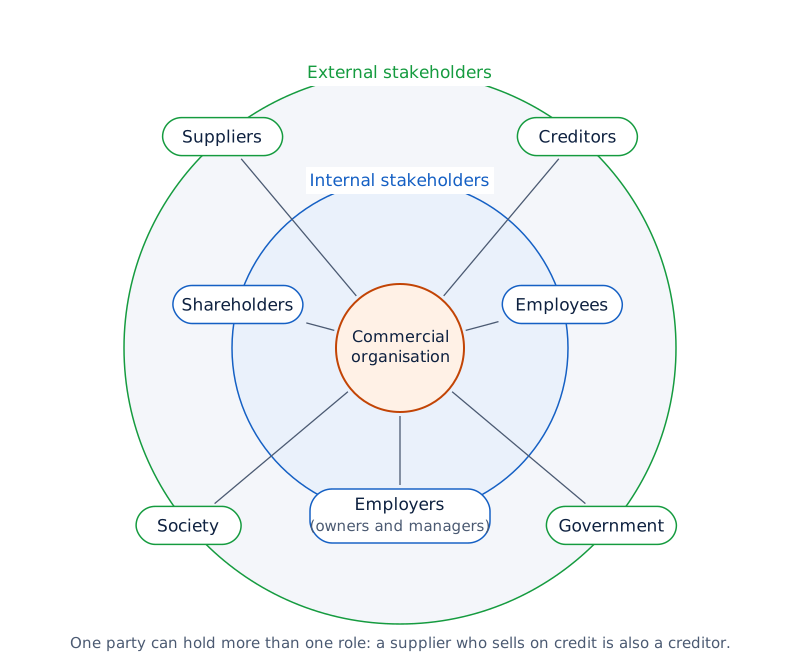
Draw a small circle labelled "Commercial organisation" at the centre. Around it draw a ring labelled "Internal stakeholders" with three labels: shareholders, employees and employers (owners and managers).
Draw a larger outer ring labelled "External stakeholders" with four labels: suppliers, creditors, government and society. Join each label to the centre with a line.
Drawn by One Young India.
Can one person belong to more than one group?
Yes. People can be consumers, investors, employees or owners, so one person or party can hold more than one role. A supplier who sells goods on credit is also a creditor, as the section on external stakeholders shows.
Who are the internal stakeholders?
Internal stakeholders are the shareholders, the employees and the employers. Each is part of the organisation's ownership, management or workforce, so the organisation's performance directly affects each of them.
Who is a shareholder?
Definition: A shareholder is a person or body that owns one or more shares of a company. The capital of a company is divided into smaller parts called shares, and the shareholders are the owners of the company.
A company normally issues two types of shares: equity shares and preference shares. Equity shares represent the ownership of a company, so the money raised by them is known as ownership capital or owner's funds.
Equity shareholders do not get a fixed dividend. A dividend is the part of a company's profit paid to its shareholders.
Equity shareholders are paid on the basis of the company's earnings, and they are called residual owners because they receive what is left after all other claims on the company's income and assets have been settled.
They enjoy the reward as well as bear the risk of ownership.
Preference shareholders receive a fixed rate of dividend before any dividend is declared for equity shareholders. They receive their capital after the claims of the company's creditors have been settled, when the company is wound up, which means closed by a legal procedure. They generally do not enjoy voting rights.
Who is an employee?
Definition: An employee is a person who works for an organisation under an appointment letter and service agreement, and receives salary or wages in return.
An employee performs work as per a service contract or rules of service. The qualification and training required are those prescribed by the employer. Pay is fixed and regular, with no or little risk, and no capital is needed.
Who is an employer?
Definition: An employer is the person or body that hires people to work and pays them. For this classification, employers are the owners and managers of the organisation.
The employer prescribes the qualification and training for a job and lays down the norms of behaviour to be followed. In a company, the owners are the shareholders, and the Board of Directors is the chief managing body elected by them.
The Board of Directors appoints the top management officials for running the business. Owners and managers are both treated as employers.
Diagram
Control in a company
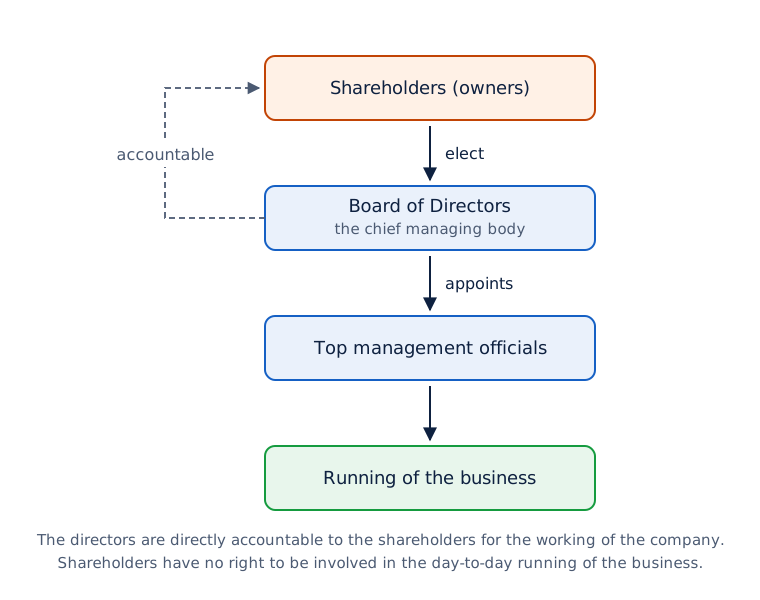
Draw four boxes in a vertical chain. The top box is "Shareholders (owners)". An arrow labelled "elect" leads to "Board of Directors".
An arrow labelled "appoints" leads to "Top management officials", and a last arrow leads to "Running of the business". Draw a dotted arrow from the Board of Directors back up to the shareholders labelled "accountable".
Drawn by One Young India.
How much control do shareholders have?
Usually, the owners exercise an indirect control over the business. The directors are directly accountable to the shareholders for the working of the company. The shareholders, however, do not have the right to be involved in the day-to-day running of the business.
Through their right to vote, equity shareholders have a right to participate in the management of the company. In most large organisations with a very large number of shareholders, though, the owners have minimal influence in controlling or running the business.
Who are the external stakeholders?
External stakeholders are outside the organisation. They deal with it through contracts, loans, laws or life in the same community, and they are affected by what the organisation does.
Who is a supplier?
Definition: A supplier is a person or firm that provides raw materials, goods or services to the organisation.
Trade credit is the credit extended by one trader to another for the purchase of goods and services, so that supplies can be bought without immediate payment. It is commonly used by business organisations as a source of short-term financing.
Such credit appears in the records of the buyer as sundry creditors or accounts payable. A supplier who allows trade credit is therefore also a creditor of the buying firm.
Who is a creditor?
Definition: A creditor is a person or institution to which the organisation owes money, for example because it has lent funds or allowed goods to be bought on credit.
Debenture holders are termed creditors of the company. A debenture is an acknowledgment that the company has borrowed a certain amount of money, which it promises to repay at a future date. It carries a fixed rate of interest, the sum paid for the use of borrowed money.
Commercial banks also lend money to firms as loans. Public deposits are deposits raised by organisations directly from the public, and the organisation issues a deposit receipt as acknowledgment of the debt, so these depositors are creditors too.
The creditors of a company can use only the assets of the company to settle their claims, since it is the company and not the members that owes the debt.
What is the role of the government?
Definition: The government is the authority that makes and enforces the laws of the country and collects taxes. Taxes are compulsory payments made to the government.
Democratically elected governments are expected to act as welfare states, that is, to take care of all sections of society. Where business institutions operate in a socially irresponsible manner, action is taken to regulate them for safeguarding people's interest.
Business is regulated through laws and regulators. The company form of organisation is governed by the Companies Act, 2013. As per section 2(20) of the Act, a company means a company incorporated under that Act or any other previous company law. The partnership form of organisation is governed by the Indian Partnership Act, 1932. The acceptance of public deposits is regulated by the Reserve Bank of India (RBI).
Who is meant by society?
Definition: Society means the community and the public at large among whom the organisation works, including the people who live near it and are affected by its activities.
Business organisations use resources which belong to society. They thus have a responsibility to supply products and render services which are in public interest.
The environment is the totality of man's surroundings, both natural and man-made. Pollution harms human life and the life of other species, so people near a business are affected by how it treats the environment.
How do internal and external stakeholders differ?
The difference lies in the stakeholder's position and in the link with the organisation. The table sets out the main points.
| Basis | Internal stakeholders | External stakeholders |
|---|---|---|
| Position | Part of the organisation: they own it, manage it or work in it | Outside the organisation: they deal with it or are affected by it |
| Groups | Shareholders, employees and employers (owners and managers) | Suppliers, creditors, government and society |
| Link with the organisation | Ownership, management or employment | Supply of goods, lending of money, law and taxation, or life in the community |
| Main interest | Return on capital, pay and security of work, profit and growth | Payment and repayment on time, compliance with laws, protection of the community and environment |
| Way of influencing the organisation | Through ownership, decisions and work | Through contracts, loans, laws, taxes and public opinion |
What do employers (owners and managers) expect from the organisation?
Employers, that is, owners and managers, expect the organisation to achieve its economic objectives of survival, profit and growth. Owners also look for a fair return on their capital, and managers for rewards and growth in their careers.
What do owners expect?
A business enterprise has the responsibility to provide a fair return to the shareholders or owners on their capital investment and to ensure the safety of such investment. A company must also provide shareholders with regular, accurate and full information about its working as well as schemes of future growth.
- A fair return on the capital invested. Shareholders want higher returns in the form of dividends and an increase in the value of their shares.
- Safety of the investment. The management safeguards the capital investment by avoiding speculative activity, meaning risky dealings for quick gains, and undertaking only healthy business ventures which give good returns.
- Regular, accurate and full information about the working of the company and its plans for growth.
What do owners and managers expect the organisation to achieve?
The main objective of any organisation should be to use human and material resources to the maximum possible advantage, that is, to fulfil the economic objectives of a business. These are survival, profit and growth.
- Survival: an organisation must earn enough revenues, meaning money received from sales, to cover its costs.
- Profit: mere survival is not enough. Profit provides a vital incentive for the continued operation of the enterprise and is essential for covering costs and risks.
- Growth: a business needs to add to its prospects in the long run. Growth can be measured by an increase in sales volume, number of employees, number of products or capital investment.
Profit is also a source of income for business persons, a source of finance for expansion, a sign of efficient working, a sign of society's approval of the utility of business, and a builder of reputation.
What do managers expect?
People become part of an organisation to satisfy their diverse needs. These vary from financial needs such as competitive salaries and perks (extra benefits besides salary), to social needs such as peer recognition, and higher-level needs such as personal growth and development.
- Competitive salary and perks for the work they do.
- Status. The authority, responsibility, rewards, recognition, perquisites and prestige of the job indicate the status given to a person holding a managerial position.
- Career advancement through skill development programmes and a sound promotion policy.
- The cooperation of workers, which a firm tries to win by creating the right kind of working conditions.
How is the limited liability of a shareholder calculated?
Liability means the amount a person can be asked to pay towards debts or losses. The liability of the members of a company is limited to the extent of the capital contributed by them, which reduces the risk borne by an investor.
Worked example 1. Akshay is a shareholder in a company. He holds 2,000 shares of Rs. 10 each (Rs. means rupees), and he has already paid Rs. 7 per share. How much can he be asked to pay towards the company's losses or debts if the company fails to pay its debts?
Answer: 1. Unpaid amount per share = Rs. 10 minus Rs. 7 = Rs. 3. 2. Unpaid amount on 2,000 shares = 2,000 × Rs. 3 = Rs. 6,000.
3. His liability is therefore only up to Rs. 6,000, the unpaid amount of his share capital. Beyond this, he is not liable to pay anything towards the debts or losses of the company.
What do employees expect from the organisation?
Employees contribute their time, skill and effort. In return they expect fair treatment and a working life that is secure and meaningful. Management is responsible for providing opportunities for meaningful work and for creating the right kind of working conditions, so that it can win the cooperation of workers.
| Expectation | What it means |
|---|---|
| Fair wages | Pay that gives employees at least a reasonable standard of living and is within the paying capacity of the company |
| Meaningful work | Opportunities for meaningful work, including jobs with greater variety, more autonomy (freedom to decide how to do the work) and more responsibility |
| Good working conditions | The right kind of working conditions, including protection of their health and physical conditions |
| Job security | Stability about future income and work |
| Recognition | Acknowledgment with a show of appreciation for work done |
| Career advancement | Opportunities to improve skills and to be promoted to higher-level jobs |
| Participation | Involvement in decisions on issues related to them |
What is a fair wage?
The overall pay and compensation should be fair to both employees and the organisation. Employees should be paid fair wages, which should give them at least a reasonable standard of living, while the pay stays within the paying capacity of the company.
In other words, remuneration, which means the overall pay and compensation, should be just and equitable. This will ensure a congenial atmosphere and good relations between workers and management, and the working of the company would be smooth.
Why do employees want job security and career growth?
Employees want their job to be secure. They want certain stability about future income and work, so that they do not feel worried about these aspects and work with greater zeal.
There is a negative side to job security: when people feel that they are not likely to lose their jobs, they may become complacent. Employees also want to grow to higher levels, and promotion works as a tonic that encourages improved performance.
Employees should also be kept at their post for a minimum fixed tenure. Without it, employees feel unstable and insecure, so they would tend to leave, and then recruitment, selection and training costs will be high.
What is the right to form unions?
The enterprise must respect the democratic rights of the workers to form unions. A trade union is an association of workers formed to protect and promote their common interests.
The labour movement has become very powerful. This has forced business enterprises to pay due regard to the welfare of workers instead of following a policy of hire and fire, under which they could deal with workers at their will.
The worker must also be ensured of a fair wage and a fair deal from the management.
What do creditors and suppliers expect?
Creditors and suppliers have both given something to the organisation. Suppliers have given goods or services, often without immediate payment. Creditors have given money. They expect to be paid what they are owed, in the way and at the time agreed.
What do creditors expect?
Debenture holders are paid a fixed stated amount of interest at specified intervals, say six months or one year.
For redeemable debentures, which are repayable on a specified date, the company has to make provisions for repayment on that date, even during periods of financial difficulty.
A bank loan is repaid either in lump sum, which means in a single payment, or in instalments.
- Repayment of the amount lent on the due date.
- Interest at the agreed rate and at the agreed intervals.
- Security. The borrower is required to provide some security, meaning an asset offered as a guarantee, or to create a charge on the assets of the firm, which gives the lender a claim on them, before a commercial bank sanctions a loan.
- Financial soundness. Banks make a detailed investigation of the company's affairs and financial structure, and a public issue of debentures has to be rated by a credit rating agency on aspects such as track record, profitability and debt servicing capacity, which is the ability to pay interest and repay what is owed.
- Priority over owners. Equity capital stands last in the list of claims, so it provides a cushion for creditors when a company is wound up. Preference shareholders receive their capital only after the claims of creditors have been settled.
| Creditor | How it is a creditor | What it expects |
|---|---|---|
| Commercial bank | Lends money to the firm as a loan | Repayment in lump sum or in instalments, interest, and security on the assets of the firm |
| Debenture holder | Holds an acknowledgment that the company has borrowed money | Fixed interest at specified intervals and repayment at a future date |
| Public depositor | Deposits money directly with the organisation and receives a deposit receipt | Interest, and repayment of the debt acknowledged by the receipt |
| Supplier on credit | Sells goods or services without immediate payment | Payment as per the terms of the trade credit |
What do suppliers expect?
Suppliers who sell on credit expect payment as per the terms of the trade credit.
The volume and period of credit extended depends on factors such as the reputation of the purchasing firm, the financial position of the seller, the volume of purchases, the past record of payment and the degree of competition in the market.
- Payment on time as per the agreed terms of credit.
- A good record of payment, since the past record of payment is one of the factors in the credit allowed.
- Regular orders, so that the supplier has continued business with the firm.
- Fair dealing, with clear terms of supply, so that both sides know what is to be delivered and paid for.
What do the government and society expect?
Government and society are the two outer groups. The government expects obedience to its laws and payment of its taxes. Society expects the organisation to act in ways that serve it and do not harm it.
What does the government expect?
An enterprise must respect the laws of the country and pay taxes regularly and honestly. It must behave as a good citizen and act according to the well accepted values of the society. It must also protect the natural environment.
| Expectation of the government | What the organisation should do |
|---|---|
| Respect for the laws of the country | Operate within the laws of the land, since a law-abiding enterprise is a socially responsible enterprise |
| Taxes | Pay taxes regularly and honestly, because not paying taxes that are due is a socially undesirable practice |
| Good citizenship | Act according to the well accepted values of society |
| Environmental protection | Comply with the laws and regulations enacted by the government for prevention of pollution |
| Cooperation in public programmes | Take part in government programmes on the management of hazardous substances, clearing up of polluted rivers, planting of trees and checking deforestation |
Laws enacted for environmental protection include the Wildlife Protection Act, 1972, the Water (Prevention and Control of Pollution) Act, 1974, the Air (Prevention and Control of Pollution) Act, 1981, the Environment (Protection) Act, 1986, the Forests (Conservation) Act, 1980 and the Hazardous Wastes (Management and Handling) Rules, 1989.
Note: There is no single universally accepted definition of corporate social responsibility (CSR). The European Commission defines CSR as the responsibility of enterprises for their impacts on society. In India, CSR is governed by the Companies Act, 2013.
The Act encourages companies to spend at least 2% of their average net profit in the previous three years on CSR activities. Net profit means profit remaining after expenses. Activities meant exclusively for employees and their families do not qualify under CSR.
The CSR provisions of the Companies Act, 2013 are applicable to companies with an annual turnover of Rs. 1,000 crore and more, or a net worth of Rs. 500 crore and more, or a net profit of Rs. 5 crore and more. The rules, applicable from the fiscal year 2014-15 onwards, also require companies to set up a CSR committee consisting of board members, including at least one independent director.
What does society expect?
A business enterprise should do business and earn money in ways that fulfil the expectations of society. It is obligatory on the enterprise not to do anything that is undesirable from society's point of view.
- Socially undesirable practices may increase profit but harm society: manufacture and sale of adulterated goods, deceptive advertisements, not paying taxes that are due, polluting the environment and exploiting workers.
- Socially desirable practices improve the image of enterprises and also make them profitable: supplying good quality goods, creating healthy working conditions, honestly paying taxes, installing pollution devices in the factory and sincerely attending to customer complaints.
Business ethics also matters to society. Examples of business ethics are charging fair prices from customers, using fair weights for measurement of commodities, giving fair treatment to workers and earning reasonable profits.
Which laws protect consumers from unfair trade practices?
Consumers are part of the society that a business serves. With growing competition, manufacturers, sellers and service-providers may be tempted to engage in unscrupulous, exploitative and unfair trade practices such as defective and unsafe products, adulteration, false and misleading advertising, hoarding and black-marketing.
Under the Consumer Protection Act, 2019, the Government of India has conferred legal protection to safeguard the interests of a consumer. The Act seeks to protect and promote the consumers' interest through speedy and inexpensive redressal of their grievances. It extends to the whole of India and is applicable to all types of businesses, whether a manufacturer or a trader and whether supplying goods or providing services, including e-commerce firms. It has replaced the Act of 1986 and seeks to widen its scope in addressing consumer concerns.
The Indian legal framework for consumer protection consists of a number of laws. These include the Indian Contract Act, 1872 and the Sale of Goods Act, 1930, besides the Prevention of Food Adulteration Act, 1954 and the Standards of Weights and Measures Act, 1976, which have since been replaced by the Food Safety and Standards Act, 2006 and the Legal Metrology Act, 2009.
What kinds of responsibility does a business have?
Social responsibility of business refers to its obligation to take those decisions and perform those actions which are desirable in terms of the objectives and values of society. It can broadly be divided into four categories.
| Kind | Meaning |
|---|---|
| Economic | Produce goods and services that society wants and sell them at a profit; there is little discretion in performing this responsibility |
| Legal | Operate within the laws of the land |
| Ethical | Behaviour expected by society but not written into law, such as respecting the religious sentiments and dignity of people while advertising a product; it involves an element of voluntary action |
| Discretionary | A purely voluntary obligation that the enterprise assumes, such as charitable contributions to educational institutions or helping people affected by floods or earthquakes |
Social responsibility is broader than legal responsibility. Legal responsibility may be fulfilled by mere compliance with the law, whereas social responsibility involves an element of voluntary action by business people for the benefit of society.
What does society expect about the environment?
Industry is a major generator of waste in terms of both its quantity and toxicity. Many business enterprises have been responsible for causing air, water, land and noise pollution. Pollution is the injection of harmful substances into the environment.
It is the social responsibility of every business to take steps not only to check all sorts of pollution but also to protect environmental resources, for example through a definite commitment by top management and compliance with the laws on prevention of pollution.
Why should organisations meet stakeholders' expectations, and what makes it hard?
Meeting the expectations of stakeholders serves both the stakeholders and the organisation. It is not easy, because the stakeholders do not all want the same things.
What are the advantages of meeting stakeholders' expectations?
The following arguments for social responsibility also support meeting stakeholders' expectations.
- Justification for existence and growth: the prosperity and growth of business is possible only through continuous service to society.
- Long-term interest of the firm: a firm and its image stand to gain maximum profits in the long run when its highest goal is service to society. When an increasing number of members of society, including workers, consumers, shareholders and government officials, feel that the business enterprise is not serving its best interest, they will tend to withdraw their cooperation.
- Avoidance of government regulation: it is believed that businessmen can avoid the problem of government regulations by voluntarily assuming social responsibilities, which helps to reduce the need for new laws.
- Maintenance of society: laws cannot be passed for all possible circumstances, and people who feel that they are not getting their due may resort to anti-social activities that harm the business itself.
What are the limitations and conflicts of interest?
There may be a conflict of interest among the various stakeholders of a company. Employees, for example, may be interested in higher salaries. Consumers desire higher quality products at lower prices. The shareholders want higher returns in the form of dividends and an increase in the value of their shares.
These demands pose problems in managing the company, as it often becomes difficult to satisfy such diverse interests. Excessive ploughing back of profit, meaning keeping profit in the business instead of paying it out, may cause dissatisfaction among shareholders, since they would get lower dividends.
There are also arguments against social responsibility.
- Violation of the profit maximisation objective: business exists only for profit maximisation, that is, earning the greatest possible profit, so any talk of social responsibility goes against it.
- Burden on consumers: costly responsibilities such as pollution control are likely to be shifted to consumers by charging higher prices.
- Lack of social skills: businessmen do not have the necessary understanding and training to solve social problems.
- Lack of broad public support: the public in general does not like business involvement or interference in social programmes.
In reality, part of the realisation of social obligations is not genuine and takes the form of lip service. At the same time, private business does partly realise that it has to meet the challenge of a democratic society.
How are individual demands and group interests balanced?
The interests of the group or company will supersede the interest of any one individual, since the larger interests of the workers and stakeholders are more important than the interest of any one person.
The interests of the various stakeholders cannot be sacrificed for one individual or a small group who want to exert pressure on the company.
Business is no longer a mere occupation. It is an economic institution that has to reconcile its short-term and long-range economic interests with the demands of the society in which it functions.
How are stakeholders identified in a situation?
Situations often describe a firm and a party, and ask who the stakeholder is and what it expects. A fixed sequence of steps makes the answer reliable.
- Identify the party in the situation, such as a lender, a worker, a trader, a tax office or a local resident.
- Decide whether it is inside the organisation (shareholder, employee or employer) or outside it (supplier, creditor, government or society).
- Name the link: capital, work, goods, money lent, law and tax, or the community.
- State the expectation that goes with that link, using the points in the earlier sections, and repeat the steps for any second party.
Worked example 2. Classify each of the following as an internal or an external stakeholder: (a) a person who holds equity shares, (b) a bank that has given a loan, (c) a worker paid a monthly salary, (d) the local community, (e) the tax authorities, (f) the manager who runs the firm, (g) a trader who sells raw materials to the firm.
Answer: 1. Equity shareholder: internal. 2. Bank: external, as a creditor. 3. Worker: internal, as an employee.
4. Local community: external, as part of society. 5. Tax authorities: external, as part of the government. 6. Manager: internal, as an employer (owner or manager). 7. Trader: external, as a supplier.
Worked example 3. A manufacturer buys raw materials on credit from a trader and does not pay by the due date. Which stakeholder is affected, is it internal or external, and which expectation has not been met?
Answer: 1. The trader is a supplier, and is also a creditor because goods were bought on credit. 2. The trader is an external stakeholder, being outside the manufacturing firm.
3. The unmet expectation is payment as per the terms of the trade credit. 4. Delay may also spoil the firm's past record of payment, which affects the credit it is allowed later.
Worked example 4. A factory releases waste into a river and the people living along the river fall ill. Which stakeholders are affected, and what do they expect?
Answer: 1. Society, an external stakeholder, is affected, because pollution harms human life. 2. Society expects the factory to protect the environment and not to pollute it.
3. The government, also external, expects the factory to comply with the laws on prevention of pollution. 4. The factory should therefore install suitable pollution control devices, which also reduce the risk of liability.
Glossary
- Stakeholder — Any person, group or institution with an interest in a commercial organisation, affected by or able to affect its activities.
- Internal stakeholder — A stakeholder within the organisation: a shareholder, an employee or an employer (owner or manager).
- External stakeholder — A stakeholder outside the organisation: a supplier, a creditor, the government or society.
- Shareholder — A person or body that owns shares of a company and is therefore one of its owners.
- Employee — A person who works for an organisation under an appointment letter and service agreement, for salary or wages.
- Employer — The person or body that hires and pays people to work; here, the owners and managers.
- Supplier — A person or firm that provides raw materials, goods or services to the organisation.
- Creditor — A person or institution to which the organisation owes money, such as a bank, a debenture holder or a supplier selling on credit.
- Trade credit — Credit extended by one trader to another for the purchase of goods and services without immediate payment.
- Dividend — The part of a company's profit that is paid to its shareholders.
- Debenture — An acknowledgment that a company has borrowed money, which it promises to repay at a future date with fixed interest.
- Social responsibility — The obligation of business to take decisions and perform actions that are desirable in terms of the objectives and values of society.
Common errors and misconceptions
- Misconception: Shareholders run the company day to day. Correct: The Board of Directors is the chief managing body, elected by the shareholders. Owners usually exercise only indirect control and have no right to be involved in day-to-day running.
- Misconception: A supplier and a creditor are always different parties. Correct: A supplier who sells on credit is also a creditor, because the credit appears in the buyer's records as sundry creditors or accounts payable.
- Misconception: Profit is the only thing a business owes anyone. Correct: Profit is a leading objective but not the only one. A business also has responsibilities towards customers, employees, investors and society at large.
- Misconception: Employees care only about wages. Correct: They also expect job security, recognition, career advancement, participation in decisions, meaningful work and good working conditions.
- Misconception: Meeting social responsibility means only obeying the law. Correct: Social responsibility is broader than legal responsibility and involves an element of voluntary action for the benefit of society.
- Misconception: All stakeholders want the same thing from the organisation. Correct: There may be conflicts of interest. Employees seek higher salaries, consumers want better products at lower prices, and shareholders want higher dividends.
Exam-style questions with model answers
Q1. Define the term stakeholder. [2 marks]
- A stakeholder is any person, group or institution that has an interest in a commercial organisation.
- Such a party is affected by, or can affect, what the organisation does. Shareholders, employees, suppliers, creditors, the government and society are examples.
Q2. Name the internal stakeholders and the external stakeholders of a commercial organisation. [2 marks]
- The internal stakeholders, who are within the organisation, are the shareholders, the employees and the employers (owners and managers).
- The external stakeholders, who are outside it, are the suppliers, the creditors, the government and society.
Q3. State any three differences between internal and external stakeholders. [3 marks]
- Position: internal stakeholders are part of the organisation, as they own it, manage it or work in it, while external stakeholders are outside it.
- Examples: internal stakeholders are shareholders, employees and employers, while external stakeholders are suppliers, creditors, the government and society.
- Main interest: internal stakeholders look for return on capital, pay, security of work and growth, while external stakeholders look for payment and repayment on time, compliance with laws and protection of the community.
Q4. Explain any four expectations of employees from a commercial organisation. [4 marks]
- Fair wages: pay should give at least a reasonable standard of living and be within the paying capacity of the company, so that it is just and equitable.
- Job security: employees want stability about their future income and work, so that they can work with greater zeal.
- Career advancement: employees want opportunities to improve their skills and to be promoted to higher-level jobs.
- Good working conditions: management should create the right kind of working conditions, so that it can win the cooperation of workers.
Q5. Who are creditors? State two expectations that creditors have from a commercial organisation. [3 marks]
- Creditors are persons or institutions to which the organisation owes money, for example banks, debenture holders and suppliers who sell on credit.
- They expect repayment of the amount lent on the agreed date, in lump sum or in instalments.
- They expect the agreed interest, for example a fixed stated amount of interest at specified intervals on debentures.
Q6. A manufacturer buys raw materials on credit from a trader and keeps postponing payment after the due date. Identify the trader's stakeholder category, state whether the trader is internal or external, and explain two expectations of the trader that are not being met. [4 marks]
- The trader is a supplier of the manufacturer, and also a creditor because the goods were bought on credit.
- The trader is an external stakeholder, as the trader is outside the manufacturing organisation.
- The first unmet expectation is payment as per the terms of the trade credit, that is, by the agreed due date.
- The second unmet expectation is a good record of payment. The past record of payment is a factor in the credit a seller extends, so continued delay may lead to less credit in future.
Q7. Explain any five expectations of the government and society from a commercial organisation. [5 marks]
- The government expects the organisation to respect the laws of the country, since a law-abiding enterprise is a socially responsible enterprise.
- The government expects taxes to be paid regularly and honestly, because not paying taxes that are due is a socially undesirable practice.
- The government expects compliance with the laws and regulations enacted for the prevention of pollution.
- Society expects the organisation to supply good quality goods and to avoid adulterated goods and deceptive advertisements.
- Society expects the organisation to protect the natural environment, since pollution harms human life and the life of other species.
Q8. Explain three expectations of owners and three expectations of managers from a commercial organisation. [6 marks]
- Owners expect a fair return on their capital investment, which shareholders want in the form of dividends and an increase in the value of their shares.
- Owners expect the safety of their investment, which the management safeguards by avoiding speculative activity and undertaking only healthy business ventures.
- Owners expect regular, accurate and full information about the working of the company and its schemes of future growth.
- Managers expect competitive salaries and perks for the work they do.
- Managers expect status, shown by the authority, responsibility, rewards, recognition, perquisites and prestige of the job given to a person holding a managerial position.
- Managers expect career advancement, through skill development programmes and a sound promotion policy.
Key takeaways
- A stakeholder is any person, group or institution with an interest in a commercial organisation, affected by it or able to affect it.
- Internal stakeholders are shareholders, employees and employers (owners and managers). External stakeholders are suppliers, creditors, the government and society.
- In a company, shareholders are the owners, but they usually exercise only indirect control. The Board of Directors that they elect is the chief managing body.
- Owners expect a fair return on capital, safety of investment and regular, accurate and full information. The economic objectives of the organisation are survival, profit and growth.
- Employees expect fair wages, meaningful work, good working conditions, job security, recognition, career advancement and the right to form unions.
- Creditors expect repayment, interest and security. Suppliers selling on credit expect payment as per the terms of trade credit and also count as creditors.
- The government expects obedience to laws and honest payment of taxes. Society expects goods of good quality, protection of the environment and ethical conduct.
- Stakeholders may have conflicting interests, but meeting their expectations serves the long-term interest of the organisation.
Test yourself
Name the three internal stakeholders of a commercial organisation.
The three internal stakeholders are the shareholders, the employees and the employers, who are the owners and managers of the organisation.
Why are debenture holders called creditors of a company?
A debenture is an acknowledgment that the company has borrowed money, which it promises to repay at a future date, so the holders are lenders and therefore creditors.
Who manages a company on behalf of its shareholders?
The Board of Directors, elected by the shareholders, is the chief managing body. Shareholders usually exercise only indirect control over the business.
What should fair wages give employees at least?
Fair wages should give employees at least a reasonable standard of living, while staying within the paying capacity of the company.
Why may excessive ploughing back of profit upset shareholders?
Because the company keeps more profit in the business, shareholders get lower dividends, which may cause dissatisfaction among them.
Can creditors claim the personal property of shareholders to settle a company's debts?
No. The creditors can use only the assets of the company to settle their claims, since the company and not the members owes the debt. A shareholder can be asked to pay only the unpaid amount on the shares held.
Name the four kinds of social responsibility of business.
The four kinds are economic responsibility, legal responsibility, ethical responsibility and discretionary responsibility.
Write about it
Turn a question from this chapter into a paper.
The Writing Studio has a structure guide, a rubric and citation tools for 15 formats, from essays to research papers. Drafting is free with an account. Learnacy Essential adds feedback from an AI writing coach and submission to The OYI Review.
Learnacy Essential is ₹1,499 for the year. Publication depends on review and is not guaranteed.