
The Judiciary | ICSE Class 8 History & Civics Notes
On this page
Watch & explore
Start with a few high-quality watches, then dive into the notes below.
Try an idea before you read. Test your understanding of the Indian Judiciary's structure and powers with these scenarios. Explore →
The judiciary, law and justice, judicial independence, the hierarchy of courts, the Supreme Court, High Courts, subordinate courts, tribunals, Fundamental Rights, Public Interest Litigation, alternative methods of resolving disputes, and digital access to justice.
What are justice and the judicial system?
Justice enables people to live with equality and dignity. It is essential for peace and harmony in society. The Preamble to the Constitution promises Indian citizens social, economic and political justice.
The judiciary is the institution that decides disputes fairly according to law. Through the judicial system, people can complain about a grievance and present their point of view. Decisions must remain within the framework of the law and the Constitution.
How are laws connected with justice?
Laws are general rules made by the government to regulate people's activities. They also provide consequences for breaking those rules. Depending on the matter, consequences may include a fine, compensation to an affected person, or imprisonment.
A society contains many personal and professional relationships. Disagreements can arise within these relationships. Some are resolved through discussion or mediation, while others require adjudication by courts. The judicial system provides an organised way of addressing such disputes.
Definition: The judicial system provides a means for people to bring grievances, present their views and seek justice within the law and the Constitution.
Can a law itself be unjust?
A rule does not become fair simply because it is called a law. The Criminal Tribes Act, 1871, labelled certain communities as criminals by birth. The Vernacular Press Act, 1878, restricted freedom of the press. Both have been repealed.
These examples show why law must be considered alongside equality, dignity and the principles of a democratic republic. The judiciary has a vital role in checking that laws made by the legislature remain within the Constitution.
How do substantive justice and procedural justice differ?
Justice concerns both the result of a dispute and the way that result is reached. These aspects are called substantive justice and procedural justice. Understanding both helps explain why a court must consider fairness at more than one stage.
What does substantive justice mean?
Substantive justice asks whether the final decision is fair, just and reasonable. Its focus is the outcome. A person who has suffered a wrong may seek compensation or believe that the person responsible should face consequences.
What does procedural justice mean?
Procedural justice requires every person involved to receive a full opportunity to be heard before the court decides. A person accused of wrongdoing must have the chance to explain what happened. As a rule, a person is presumed innocent until proved guilty.
| Point of comparison | Substantive justice | Procedural justice |
|---|---|---|
| Main concern | The fairness of the final result | The fairness of the opportunity to be heard |
| Central question | Is the decision just and reasonable? | Could each person present their position before the decision? |
| Focus when considering a dispute | The outcome reached | The hearing given to the people involved |
What the figure shows
Aspects of justice
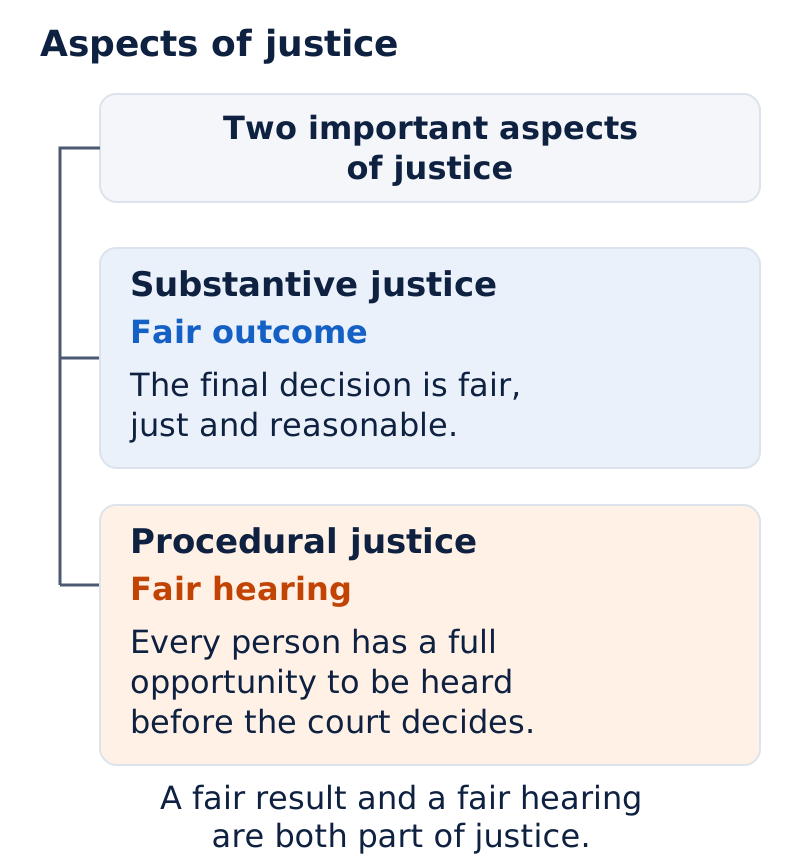
A central box labelled “Two important aspects of justice” connects to “Substantive justice” on the left and “Procedural justice” on the right. A gavel is drawn inside the central box.
Drawn by One Young India.
The distinction does not make either aspect unimportant. A fair result and a fair hearing are both part of justice. An accusation therefore needs examination through a fair process before it becomes a finding of guilt.
Why must the judiciary be independent?
The judiciary is one of the three pillars of government, alongside the legislature and the executive. Judicial independence means that it remains independent of these other organs. This independence is essential for deciding disputes fairly and justly.
How does separation of powers support justice?
The Constitution provides for a separation of powers among the legislature, executive and judiciary. The judiciary checks whether laws passed by the legislature fit within the Constitution. It also checks that the executive does not go beyond its constitutional role.
These responsibilities require the judiciary to examine the actions of other organs of government. Its independence supports that examination. Courts must be able to decide a dispute according to law and constitutional principles while giving the parties a fair hearing.
| Organ | Connection with the judicial role |
|---|---|
| Legislature | Passes laws whose consistency with the Constitution is examined by the judiciary |
| Executive | Must act within its constitutional role, which the judiciary helps safeguard |
| Judiciary | Adjudicates disputes fairly and remains independent of the other organs |
Why does this matter to people?
People approach the judicial system to seek justice and protect their rights. Independent adjudication supports a fair consideration of their grievances. The judiciary's role therefore connects the organisation of government with people's everyday need for fair treatment.
Judicial independence also belongs within the wider idea of constitutional government. Laws, executive actions and judicial decisions operate within a constitutional framework. Independence enables courts to fulfil their own role in that framework while protecting justice and fairness.
How is the court system in India organised?
India has a unified judicial system organised as a hierarchy. The Supreme Court stands at its apex, High Courts operate at the State level, and subordinate courts operate below them at the district level. These levels form the basic structure of the system.
What are the main levels?
| Level | Court | Main position in the structure |
|---|---|---|
| National apex | Supreme Court of India | Highest court of law in the country |
| State | High Court | Highest court at the State level |
| Below the High Court | Subordinate courts | Courts through which the judiciary comes into close contact with people |
What the figure shows
Hierarchy of courts
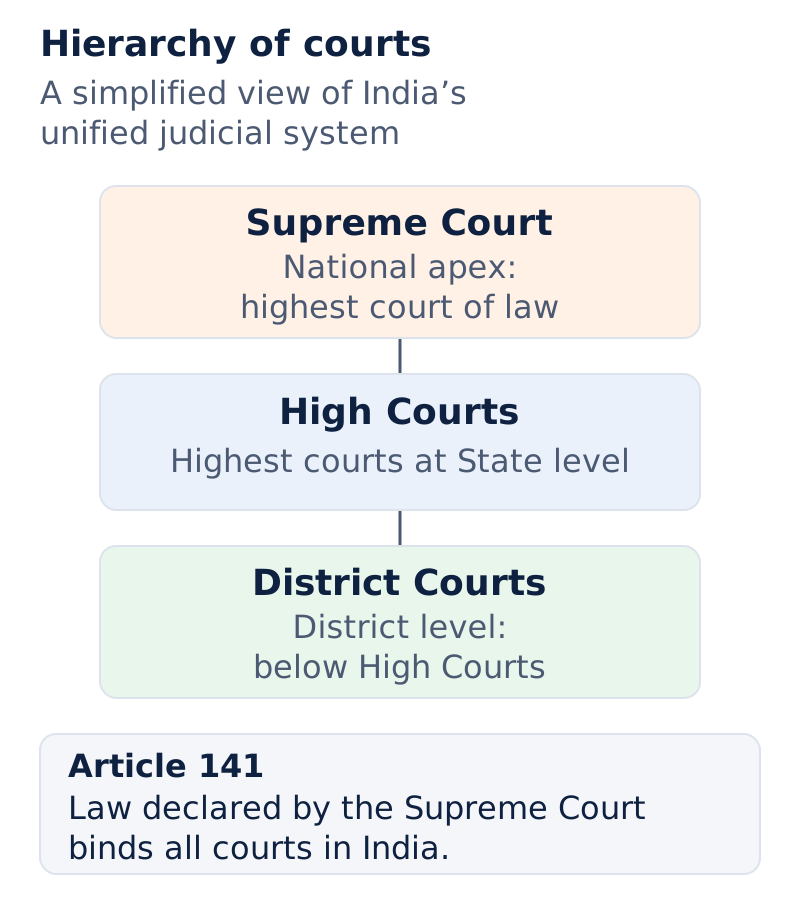
A triangular diagram has three coloured bands. “Supreme Court” appears in the blue top band, “High Courts” in the green middle band, and “District Courts” in the orange bottom band.
Drawn by One Young India.
How are the levels connected?
A High Court hears appeals against decisions of subordinate courts in civil and criminal matters. It also supervises subordinate courts within its territorial limits. The Supreme Court hears appeals within the conditions governing its appellate powers.
Article 141 makes the law declared by the Supreme Court binding on all courts within India. The hierarchy therefore involves more than placing courts at different levels. It also connects them through appeals, supervision and the authority of the Supreme Court's interpretation of law.
The diagram is a simplified guide to this hierarchy. Subordinate courts include several types of court, and specialised tribunals deal with particular categories of disputes. These details help explain how the system handles different kinds of legal matters.
What are the position and composition of the Supreme Court?
The Supreme Court of India is the country's highest court of law and the final interpreter of the Constitution. It came into existence on 26 January 1950, when the Constitution took effect. It is seated in New Delhi.
Article 124 provides for the Supreme Court's establishment. The Chief Justice of the Supreme Court is designated the Chief Justice of India. The President of India appoints judges of the Supreme Court.
Who can become a Supreme Court judge?
A person must be a citizen of India and satisfy one of the following additional qualifications. The alternatives concern judicial experience, experience as an advocate, or distinction as a jurist.
- The person has been a judge of a High Court, or of High Courts, for five years.
- The person has been an advocate of a High Court, or of more than one High Court, for ten years.
- The person is a distinguished jurist in the opinion of the President of India.
A Supreme Court judge retires at the age of 65 years. Citizenship is a common requirement; the three professional qualifications are alternatives. They should not be combined into a claim that every judge must fulfil all three.
Why is its constitutional position significant?
As the final interpreter of the Constitution, the Supreme Court has a central place in explaining constitutional meaning. Its law is binding on courts throughout India under Article 141. This gives its decisions a significance extending beyond the parties in an individual dispute.
The Court's role includes several kinds of jurisdiction. Its position at the apex does not mean that every legal matter follows the same route to it. Different constitutional provisions explain the different powers it exercises.
What types of jurisdiction does the Supreme Court exercise?
Jurisdiction concerns a court's authority to deal with legal matters. The Supreme Court exercises several forms of jurisdiction, including original, appellate, advisory and writ jurisdiction. Understanding the reason a matter comes before the Court helps distinguish these powers.
How do original and appellate jurisdiction differ?
Under Article 131, the Supreme Court has exclusive original jurisdiction over specified legal disputes involving the Centre and States. These include disputes between the Centre and a State, between States, or between the Centre and a State on one side and another State on the other.
Appellate jurisdiction concerns appeals from decisions already made. Articles 132, 133 and 134A deal with certified appeals involving constitutional interpretation or substantial questions of law. Articles 134 and 134A concern specified criminal appeals.
The Supreme Court also hears appeals from specialised tribunals such as the National Green Tribunal and the National Company Law Appellate Tribunal. Appeals must be understood through the relevant conditions, rather than as an unrestricted right to take every dispute directly to the Supreme Court.
What are advisory jurisdiction and special leave?
Under Article 143, the President may seek the Supreme Court's opinion on a question of law or fact of public importance. Such matters are heard by a Constitution Bench of at least five judges. This is its advisory jurisdiction.
Article 136 gives the Supreme Court an extraordinary discretionary power to grant special leave to appeal. This power addresses matters of general public importance or the need to do substantive justice between parties.
| Power | Central idea |
|---|---|
| Original jurisdiction | Deciding specified Centre-State or inter-State legal disputes |
| Appellate jurisdiction | Hearing appeals against decisions under the relevant conditions |
| Advisory jurisdiction | Giving an opinion sought by the President on a matter of public importance |
| Special leave to appeal | Granting permission to appeal through an extraordinary discretionary power |
What other constitutional powers support the Court?
Article 142 empowers the Court to pass orders necessary for complete justice. Article 144 requires civil and judicial authorities to act in its aid. Writ jurisdiction under Article 32 provides a route for enforcing Fundamental Rights.
What are the composition and powers of High Courts?
A High Court is the highest court at the State level. Article 214 provides for a High Court in each State. However, States and Union Territories may share a common High Court, so each does not necessarily have a separate High Court.
For example, the Punjab and Haryana High Court serves Punjab, Haryana and Chandigarh. The Gauhati High Court serves Assam, Nagaland, Mizoram and Arunachal Pradesh. These examples show why the territory served by a High Court may cover more than one State.
How are High Court judges appointed?
A High Court consists of a Chief Justice and other judges. The number of judges varies between High Courts. The President of India appoints its judges in consultation with the Chief Justice of India, the State Governor and the Chief Justice of the High Court concerned.
Under Article 217(2), a person must be an Indian citizen and have held judicial office in India for ten years, or have been an advocate of a High Court or High Courts for ten years. High Court judges retire at 62 years.
What powers does a High Court exercise?
- It exercises writ jurisdiction under Article 226.
- It hears appeals from subordinate courts in civil and criminal matters, as well as from certain tribunals.
- It supervises subordinate courts within its territorial limits.
- Under Article 227, it has superintendence over courts and tribunals within its territorial jurisdiction.
Superintendence helps ensure that subordinate courts and tribunals remain within their authority. This supervisory power is exercised sparingly. Writ jurisdiction and supervisory jurisdiction are recognised as part of the Constitution's basic structure.
Note: Supreme Court judges retire at 65, while High Court judges retire at 62. The President appoints judges of both courts; District Judges are appointed by the Governor in consultation with the High Court.
How do subordinate courts and tribunals serve people?
Subordinate courts operate below High Courts. They are an important part of the judicial system because they bring the judiciary into close contact with people. They broadly include District Courts, Sessions Courts, Revenue Courts and Small Causes Courts.
Articles 233 to 237 contain provisions concerning their organisation and independence. Under Article 233, the Governor appoints District Judges in consultation with the High Court. Each High Court must uphold the honour and integrity of the subordinate judiciary in its territory.
What is a tribunal?
A tribunal is a body established to decide certain types of disputes. Specialised tribunals are established under laws and are quasi-judicial in nature. Their work focuses on particular subjects, rather than treating every category of dispute as the same.
| Body | Type of dispute |
|---|---|
| Consumer fora | Consumer disputes |
| National Green Tribunal | Environmental issues |
| Central Administrative Tribunal | Service matters of government employees |
| Armed Forces Tribunal | Disputes relating to the Armed Forces |
| Appellate Tribunal for Electricity | Electricity disputes |
| National Company Law Tribunal | Corporate civil and commercial disputes, including insolvency and bankruptcy |
What the figure shows
Tribunals and their jurisdiction
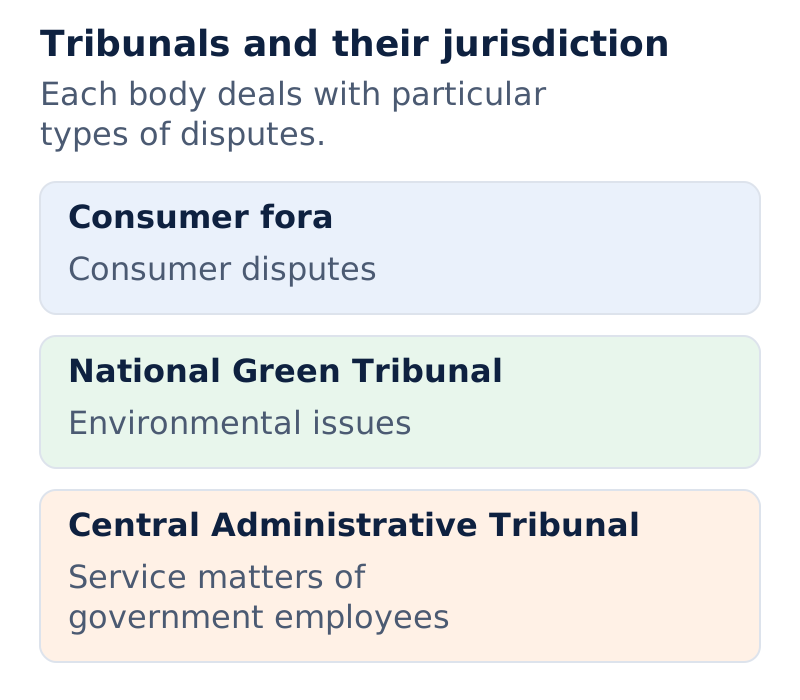
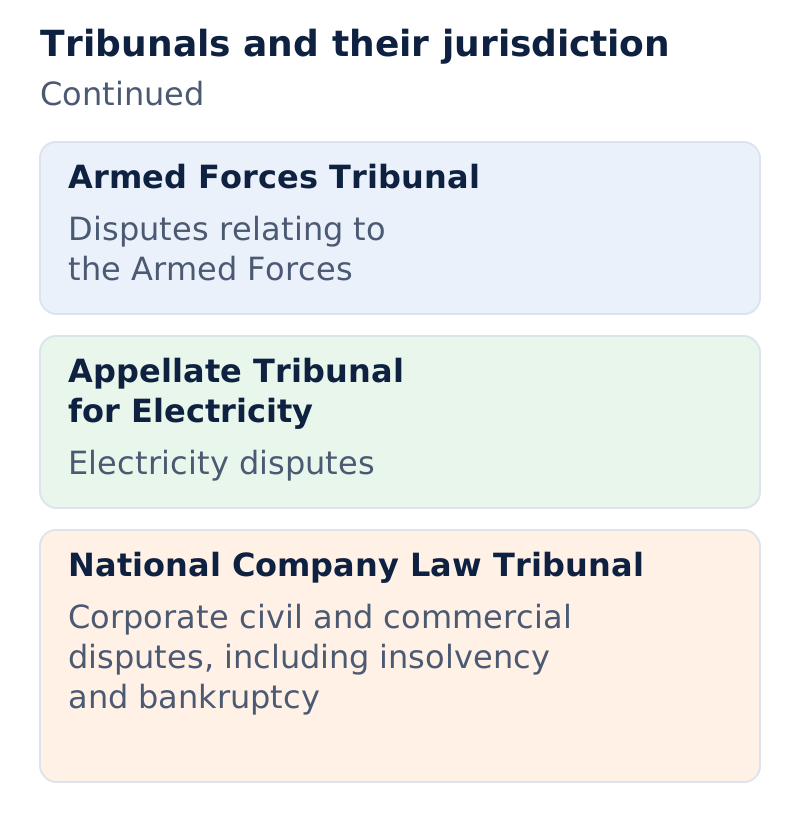
A central blue circle containing a gavel has arrows pointing towards six surrounding symbols. Their labels identify consumer, environmental, government service, Armed Forces, electricity, and corporate disputes with their respective bodies.
Drawn by One Young India.
The court hierarchy and the specialised tribunal system help explain how legal work is distributed. A High Court hears appeals from certain tribunals and has supervisory powers within its territory. The Supreme Court also hears appeals from specified specialised tribunals.
When identifying a tribunal's function, connect its name to its subject. For example, environmental matters belong to the National Green Tribunal's area of work, while government employees' service matters belong to the Central Administrative Tribunal's area.
How do writ petitions and Public Interest Litigation protect rights?
Fundamental Rights are protected by the Constitution. They include rights relating to equality, liberty, life, speech and religion. Constitutional courts exercise writ jurisdiction to enforce these rights, connecting constitutional promises with a means of seeking judicial protection.
What is a writ petition?
A person may file a writ petition for enforcement of Fundamental Rights before the Supreme Court under Article 32 or before a High Court under Article 226. A High Court exercises its powers within its territorial limits.
Public Interest Litigation, or PIL, is an innovation introduced by the Supreme Court to address matters of public concern. PIL under Articles 32 and 226 has also helped give meaning to the Right to Life under Article 21.
What do important PIL examples show?
Kapila Hingorani, a lawyer, read reports about undertrial prisoners in Bihar who had remained in prison longer than the punishment they could have received if found guilty. She filed a writ petition seeking their release.
The Supreme Court ordered the release of such prisoners and issued guidelines for releasing undertrial prisoners across India. The example shows how a matter brought to the Court's attention could concern the rights of many people facing a similar problem.
In M.C. Mehta v. Union of India, the Supreme Court took up environmental issues, including cleaning the River Ganga and protecting the Taj Mahal. This illustrates the use of PIL for concerns extending beyond an individual private dispute.
In Vishaka and Others v. State of Rajasthan, the Supreme Court laid down guidelines against workplace sexual harassment in 1997. The Government later enacted the Sexual Harassment of Women at Workplace (Prevention, Prohibition and Redressal) Act, 2013.
These examples connect access to justice with personal liberty, environmental protection and workplace safety. Citizens can help the judicial system by bringing social concerns affecting rights to its attention.
What does the consumer dispute about an unfinished flat teach us?
A consumer dispute shows how a legal body hears opposing parties and provides a remedy. In 2011, a builder planned a complex of flats. A family agreed to buy a flat and paid an advance of almost ₹65 lakhs.
The family visited the site regularly. Even after four years, there was no sign of the building in which their flat was supposed to be constructed. This was a breach of their agreement with the builder.
How did the complaint proceed?
- The family paid an advance towards the proposed flat.
- After four years without construction, the family found that the agreement had been breached.
- The family complained to the National Consumer Commission.
- The Commission listened to both parties before deciding the matter.
- It ordered the builder to return the money with interest and pay the cost of the litigation.
How does the case connect with the two aspects of justice?
The hearing given to both parties illustrates procedural justice. The family could state its grievance, and the builder could present its position. The Commission did not reach its decision without listening to the parties involved.
The order to return the amount with interest and pay litigation costs concerns the outcome. It can be examined through substantive justice, which asks whether the final decision is fair, just and reasonable.
This example also shows the role of a body dealing specifically with consumer disputes. The important sequence is the grievance, the complaint, the hearing and the decision. The amount and delay describe this particular case; they are not general conditions for every consumer complaint.
How can disputes be resolved through alternative methods?
Courts encourage alternative dispute resolution to strengthen the justice system and reduce its burden. Methods include arbitration, mediation, conciliation, negotiation and Lok Adalats. These approaches differ in who helps the parties and how the outcome is reached.
How does arbitration work?
In arbitration, parties agree to refer their dispute to an independent arbitrator or panel of arbitrators. An arbitrator may be a retired judge, a lawyer or an expert. The arbitrator must act fairly and impartially and let each party present its case.
The arbitrator's decision is legally binding on the parties and enforceable by a court. Arbitration in India is conducted under the Arbitration and Conciliation Act, 1996. The independent adjudicator's role is therefore to reach a decision after a fair process.
How is mediation different?
In mediation, a neutral mediator helps disputing parties reach a mutual settlement. The mediator cannot make the decision for them or impose a view. Mediation is governed by the Mediation Act, 2023.
| Feature | Arbitration | Mediation |
|---|---|---|
| Neutral person's role | An arbitrator acts as an independent adjudicator | A mediator helps the parties find agreement |
| Outcome | The arbitrator makes a legally binding decision | The parties arrive at a mutual settlement |
| Power to impose a decision | The arbitrator decides the dispute | The mediator cannot impose a decision |
| Governing law | Arbitration and Conciliation Act, 1996 | Mediation Act, 2023 |
What are Lok Adalats and Gram Nyayalayas?
Lok Adalats are special fora for amicable settlement of disputes. They may deal with cases already pending before courts. In some cases, parties can approach them before going to court. Their statutory recognition comes from the Legal Services Authorities Act, 1987.
They function as people's courts, promoting access to justice and helping reduce the backlog of cases. Their emphasis is on amicable resolution without the rigours of formal adjudication.
Gram Nyayalayas, established under the Gram Nyayalayas Act, 2008, are mobile courts at village level. They decentralise the judicial system and reduce pressure on regular courts. They adjudicate disputes through simplified procedures without technicalities.
Note: A mediator helps the parties agree; an arbitrator decides. A Gram Nyayalaya is a village-level court. These institutions and methods should not be treated as identical simply because they help improve access to justice.
How does digital technology improve access to the judiciary?
Digital technology helps make the judicial system more accessible and transparent. Litigants can check information about their cases directly, rather than depending entirely on their lawyers for those details. Court orders and judgments are also made freely available to the public.
What information can people access?
Online case details help people follow matters in which they are involved. Public access to orders and judgments allows people to read the decisions of courts. Availability in multiple languages helps more people understand court proceedings and judgments.
A litigant is a person involved in a legal case. The person bringing a case and the person against whom it is brought are both litigants. Direct access to information is therefore useful to people on either side of a dispute.
What digital initiatives have courts introduced?
- e-Filing is one of the digital initiatives used by courts.
- Hybrid hearings are another initiative intended to make the system more user-friendly.
- Live streaming makes court proceedings available through digital means.
- Judgments are translated into multiple Indian languages.
- The National Judicial Data Grid provides access to judicial data.
A Virtual Justice Clock display at the Supreme Court's entrance provides access to real-time judicial data. It supports the Court's commitment to transparency, accountability and access to information.
Digital access, alternative dispute resolution and specialised bodies address different aspects of the justice system. Technology improves access to information, while alternative methods help resolve disputes and reduce the burden on courts. Together, these measures support a system that is easier for people to use.
Glossary
- Judiciary — The institution responsible for deciding disputes fairly according to law and ensuring just treatment.
- Judicial system — The system through which people present grievances and seek justice within law and the Constitution.
- Substantive justice — Justice concerned with whether a final decision is fair, just and reasonable.
- Procedural justice — Justice requiring a full opportunity for each person involved to be heard before a decision.
- Judicial independence — The judiciary's independence from the legislature and executive when fulfilling its constitutional role.
- Jurisdiction — The authority of a court to deal with particular legal matters.
- Appellate jurisdiction — A court's authority to hear appeals against decisions under the conditions governing those appeals.
- Writ petition — A petition to a constitutional court seeking enforcement of Fundamental Rights.
- Public Interest Litigation — A judicial innovation addressing issues of public concern and giving meaning to constitutional rights.
- Tribunal — A body established to settle particular categories of disputes within its area of authority.
- Litigant — A person involved in a legal case, whether bringing the case or being sued.
- Arbitration — Dispute resolution in which parties refer their disagreement to an independent adjudicator for a binding decision.
- Mediation — Dispute resolution in which a neutral person helps the parties reach their own mutual settlement.
- Lok Adalat — A special forum that promotes amicable settlement of disputes and access to justice.
- Gram Nyayalaya — A mobile village-level court that uses simplified procedures to adjudicate disputes.
Common errors and misconceptions
- Misconception: Justice concerns only the final result. Correct: Substantive justice concerns a fair outcome, while procedural justice requires a full opportunity for the people involved to be heard before a decision.
- Misconception: An accusation establishes guilt. Correct: As a rule, a person is presumed innocent until proved guilty. An accused person must have the opportunity to present their position.
- Misconception: Every State must have an entirely separate High Court. Correct: Some States and Union Territories share a common High Court, as Punjab, Haryana and Chandigarh do.
- Misconception: Supreme Court and High Court judges retire at the same age. Correct: Supreme Court judges retire at 65, while High Court judges retire at 62.
- Misconception: A mediator decides the dispute for the parties. Correct: A mediator helps them reach agreement but cannot impose a decision. An arbitrator acts as an independent adjudicator.
- Misconception: Advisory jurisdiction is an appeal against a lower court. Correct: It concerns an opinion sought by the President on a question of law or fact of public importance.
- Misconception: Only the person who brings a case is a litigant. Correct: Both the person bringing the case and the person being sued are litigants.
Exam-style questions with model answers
Q1. A court hears every party before deciding a dispute. The final decision is fair and reasonable. Identify the two aspects of justice illustrated by these facts. [2 marks]
- Hearing every party before deciding illustrates procedural justice, because each party receives an opportunity to present its position.
- A fair and reasonable final decision illustrates substantive justice, which concerns the outcome.
Q2. The Constitution separates the legislature, executive and judiciary. Courts check whether legislation fits the Constitution and whether the executive stays within its constitutional role. Explain why judicial independence is necessary for these functions and for fair dispute resolution. [3 marks]
- Judicial independence allows courts to perform their role separately from the legislature and executive. This supports a fair and just consideration of disputes.
- Courts examine laws passed by the legislature against the Constitution. Independence supports that examination of another organ's work.
- Courts also examine whether the executive stays within its constitutional role. Their independence helps them fulfil this responsibility while deciding according to law and constitutional principles.
Q3. India's unified system places the Supreme Court at the apex, High Courts at State level and subordinate courts below them. High Courts hear subordinate-court appeals and supervise those courts. Article 141 makes Supreme Court law binding on all courts. Explain three connections within this hierarchy. [3 marks]
- The three levels belong to one unified judicial system. The Supreme Court is at the apex, with High Courts and subordinate courts at the other levels.
- High Courts connect with subordinate courts through appeals and supervision. These powers allow them to examine decisions and oversee functioning within their territory.
- Article 141 connects every court to the Supreme Court's legal authority because the law it declares binds courts throughout India.
Q4. Supreme Court judges must be Indian citizens and qualify through five years as a High Court judge, ten years as a High Court advocate, or distinction as a jurist in the President's opinion. The President appoints them, and they retire at 65. Explain the requirements and distinguish common requirements from alternatives. [4 marks]
- Indian citizenship is required of every person appointed as a Supreme Court judge. It is a common requirement, not one of the alternative professional qualifications.
- The person must additionally satisfy one of three alternatives: five years as a High Court judge, ten years as a High Court advocate, or being a distinguished jurist in the President's opinion.
- The President of India makes the appointment. The alternatives do not mean that the person must possess all three kinds of qualification.
- A Supreme Court judge retires on reaching the age of 65 years.
Q5. In 2011, a family paid almost ₹65 lakhs towards a flat. After four years, construction had not begun. The family complained to the National Consumer Commission, which heard both parties and ordered repayment with interest and litigation costs. Explain the grievance, the process and the two aspects of justice illustrated. [5 marks]
- The family had paid a substantial advance for a flat, but four years passed without construction. The failure to build represented a breach of the agreement and created the grievance.
- The family took its complaint to the National Consumer Commission, a body dealing with consumer disputes.
- The Commission heard both the family and the builder before deciding. This illustrates procedural justice because both parties could present their positions.
- The order required the builder to return the payment with interest and cover litigation costs. This was the remedy provided in the case.
- Substantive justice concerns whether that final outcome was fair, just and reasonable. It focuses on the decision, whereas procedural justice focuses on the opportunity to be heard.
Q6. In arbitration, parties choose an independent adjudicator who hears them fairly and makes a binding decision. In mediation, a neutral person helps them reach a mutual settlement but cannot impose a decision. Arbitration is governed by the Arbitration and Conciliation Act, 1996; mediation by the Mediation Act, 2023. Compare the two methods. [4 marks]
- Arbitration gives an independent arbitrator or panel the task of deciding the dispute. Mediation gives a neutral mediator the task of helping the parties find agreement.
- An arbitrator must act fairly and allow both parties to present their case. The resulting decision is legally binding.
- A mediator cannot impose a view or decide for the parties. The settlement must be reached by the parties themselves.
- The methods have different governing laws: the Arbitration and Conciliation Act, 1996, and the Mediation Act, 2023.
Q7. PIL addresses public concerns under Articles 32 and 226. Kapila Hingorani sought release of undertrials held longer than their possible punishment; the Supreme Court ordered releases and issued wider guidelines. M.C. Mehta v. Union of India concerned the Ganga and Taj Mahal. Vishaka v. State of Rajasthan produced workplace harassment guidelines in 1997, followed by legislation in 2013. Explain how these examples connect PIL with rights. [5 marks]
- PIL provides a way to bring matters of public concern before constitutional courts under Articles 32 and 226. Its significance extends beyond a single private disagreement.
- The undertrial example concerns people kept in prison longer than the punishment they might receive if convicted. Hingorani's petition brought their situation before the Supreme Court.
- The Court ordered releases and issued wider guidelines. Judicial action therefore addressed the position of prisoners sharing a serious problem.
- The M.C. Mehta example connects PIL with environmental concerns, including the River Ganga and the Taj Mahal.
- The Vishaka example connects judicial action with protection against workplace sexual harassment. Guidelines were issued in 1997, and legislation followed in 2013. Together, the examples show the range of rights-related public concerns addressed through PIL.
Q8. Litigants can check case details online, and courts make judgments available in several languages. Give one benefit of each measure. [2 marks]
- Online case details allow litigants to obtain information directly instead of relying entirely on their lawyers.
- Judgments in several languages help more people read and understand court decisions and proceedings.
Key takeaways
- The judiciary resolves disputes according to law and supports equality, dignity and the constitutional promise of justice.
- Substantive justice concerns a fair outcome; procedural justice requires a full opportunity for each person involved to be heard.
- Judicial independence allows courts to perform their constitutional role separately from the legislature and the executive.
- India's unified court hierarchy places the Supreme Court above High Courts and subordinate courts; Supreme Court law binds all courts.
- Supreme Court judges retire at 65, while High Court judges retire at 62; the President appoints judges of both courts.
- Writ petitions and Public Interest Litigation connect constitutional rights with judicial action on individual grievances and public concerns.
- Tribunals handle specialised disputes, including consumer, environmental, government service, electricity, Armed Forces and corporate matters.
- An arbitrator decides a dispute, while a mediator helps parties reach a settlement without imposing a decision.
- Lok Adalats, Gram Nyayalayas and digital initiatives support access to justice and help the judicial system serve people.
Test yourself
What does substantive justice ask about a court's decision?
It asks whether the final outcome is fair, just and reasonable.
What is the basic requirement of procedural justice?
Every person involved must have a full opportunity to be heard before the court decides.
Which article makes the law declared by the Supreme Court binding on all courts in India?
Article 141 makes the Supreme Court's declared law binding on all courts within India.
Who appoints District Judges, and which court is consulted?
The State Governor appoints District Judges in consultation with the High Court under Article 233.
What distinguishes the Supreme Court's advisory jurisdiction?
Under Article 143, it gives an opinion sought by the President on a question of law or fact of public importance.
Which tribunal deals with government employees' service matters?
The Central Administrative Tribunal deals with service matters of government employees.
Why can a mediator not simply impose a settlement?
A mediator helps the parties reach their own agreement and has no power to impose a decision.
What are Gram Nyayalayas intended to do?
These mobile village-level courts decentralise justice, use simplified procedures and reduce the burden on regular courts.
Try it
Understanding the Indian Judiciary System
Test your understanding of the Indian Judiciary's structure and powers with these scenarios.
1Two Indian states are in a legal dispute over a shared river boundary. According to the Indian judicial structure, which court has the authority to resolve this dispute?
The text states that if two Indian states are fighting over a river boundary, only the Supreme Court has the authority to resolve it under its Original Jurisdiction.
The text explains that Original Jurisdiction covers cases that must start directly in the Supreme Court, such as disputes between two Indian states over a river boundary.
District Courts handle local civil cases, but disputes between State Governments fall under the Original Jurisdiction of the Supreme Court.
2A local resident wants to file a lawsuit regarding a broken business contract and a property dispute. At the district level, which court should they approach?
The text specifies that Sessions Courts handle criminal cases involving offenses against society, like theft or assault, not contracts.
According to the text, District Courts handle civil cases, which involve disputes over property, contracts, marriage, or money.
While the Supreme Court has Appellate Jurisdiction, a local property and contract dispute must start at the district level in a District Court, not directly in the Supreme Court.
Great job! You've successfully applied your knowledge of the Supreme Court's jurisdiction and the division of district-level courts.