
The Union Legislature | ICSE Class 8 History & Civics Notes
On this page
Try an idea before you read. Step into the role of a legislative consultant to determine how bills and parliamentary accountability work in India's bicameral system. Explore →
This note covers the Union Legislature, representation in Parliament, the Lok Sabha and Rajya Sabha, presiding officers, parliamentary sessions, legislative and financial powers, the passage of bills, control over the executive, and citizens' participation in lawmaking.
Why does India need a Union Legislature?
The Union Legislature is Parliament, the lawmaking institution at the national level. It provides a place where representatives discuss public concerns, consider proposed laws and question the government. Its work connects the decisions taken for the country with the people those decisions affect.
Definition: A legislature is a representative institution that makes laws and holds the executive accountable. India's national legislature is called Parliament or Sansad.
How does representation give people a voice?
India follows representative democracy. Citizens elect representatives who discuss and decide public matters on their behalf. People directly elect members of the Lok Sabha. A majority party or coalition forms the government, while Parliament as a whole examines and guides its work.
Universal adult franchise gives adult citizens the right to vote without discrimination based on social or economic background, gender, race or religion. It expresses the principle that political participation belongs to citizens generally, rather than to a privileged group.
Representation involves more than choosing rulers. Members bring the needs of different regions and social groups into national discussions. They can ask ministers for explanations, question policies and examine how public money is used. Through these activities, Parliament makes government answerable to representatives of the people.
Why are elections alone insufficient?
Between elections, the government continues to make decisions and implement policies. Accountability requires it to explain this continuing work. Parliamentary questions, debates and committees provide opportunities to examine decisions while they are being made or carried out.
The legislature therefore has responsibilities beyond passing laws. It is a forum for discussion, a means of checking executive power and an institution through which citizens' concerns reach the government. An active Parliament makes representative democracy work between one election and the next.
What makes up the Parliament of India?
The Parliament of India consists of the President, the Lok Sabha and the Rajya Sabha. The Lok Sabha is the House of the People, also called the Lower House. The Rajya Sabha is the Council of States, also called the Upper House.
A legislature with two Houses is called bicameral. The expression refers to the two legislative chambers. The President is a constituent part of Parliament, but is not a third House. Presidential assent is an important step in turning a bill passed by Parliament into an Act.
| Constituent | Place in Parliament | Main connection with parliamentary work |
|---|---|---|
| President | Constituent part of Parliament | Summons Parliament and gives assent to bills |
| Lok Sabha | House of the People | Represents people through direct elections and holds the Council of Ministers collectively responsible |
| Rajya Sabha | Council of States | Represents states and participates in examining and passing legislation |
Why are there two Houses?
India is a large and diverse country. The two Houses provide different bases of representation. The Lok Sabha links the national legislature directly to voters, while the Rajya Sabha gives the states a place in national lawmaking. This arrangement reflects the principle of federalism.
A second House also allows proposed laws to receive further consideration. A proposal approved by one House can be discussed again in the other. Further examination creates an opportunity to identify difficulties, suggest changes and reconsider decisions that might otherwise be taken too hastily.
Both Houses are important, but their powers are not identical. The Lok Sabha has a stronger position over Money Bills and the survival of the government. The Rajya Sabha still contributes to legislation, debate, constitutional amendments and scrutiny of ministers.
How is the Lok Sabha formed and why is it important?
Members of the Lok Sabha are directly elected by the people. For these elections, the country is divided into territorial constituencies. Each constituency elects one representative, who becomes a Member of Parliament, or MP. A constituency is therefore an electoral area, not a political party.
What do voters choose?
India uses the First-Past-the-Post system for Lok Sabha elections. The candidate receiving the most votes in a constituency wins. The election of an MP and the formation of a government are connected, but they are different steps.
After the results, the distribution of seats among parties shows which party or coalition can command a majority. The President appoints the leader of the majority party or coalition in the Lok Sabha as Prime Minister. The Prime Minister heads the Council of Ministers.
A coalition brings two or more parties together. It allows parties to combine their support when a single party does not have the majority needed to form the government. A party with the largest number of seats does not necessarily have a majority by itself.
How long does the House last?
The normal term of the Lok Sabha is five years. It can be dissolved before the end of this period, leading to fresh elections. Dissolution ends the life of that Lok Sabha; it does not mean that India's parliamentary system has ended.
The 2024 Lok Sabha elections were held for 543 constituencies. This should be distinguished from the constitutional maximum of 550 elected members. A figure describing seats contested in an election and a constitutional maximum answer different questions.
Note: MPs represent constituencies in the national Parliament. Members of Legislative Assembly, or MLAs, represent constituencies in state legislative assemblies. The two offices belong to different levels of government.
The Lok Sabha is especially important because the Council of Ministers must retain its confidence. This makes the directly elected House central both to government formation and to the continuing accountability of the government.
How does the Rajya Sabha differ from the Lok Sabha?
The Rajya Sabha represents the states in Parliament. Its elected members are chosen indirectly. The elected members of state legislative assemblies elect representatives to the Rajya Sabha, so the public does not directly vote for these MPs in the same way as for Lok Sabha MPs.
How are membership and continuity arranged?
The President nominates twelve members to the Rajya Sabha from people distinguished in literature, science, art and social service. Thus, its membership combines elected representatives with nominated members who bring experience from these fields.
A Rajya Sabha member's full term is six years. One-third of its members retire every two years. The House is not dissolved as a whole, so it is called the Permanent House. Individual members serve limited terms even though the institution continues.
States do not all receive an equal number of Rajya Sabha seats. Population is taken into account in their allocation. The purpose of representing states should therefore not be confused with a rule giving every state exactly the same number of members.
| Basis of comparison | Lok Sabha | Rajya Sabha |
|---|---|---|
| Other name | House of the People | Council of States |
| Election | Members are directly elected by voters | State representatives are indirectly elected by elected MLAs |
| Term | Normally five years for the House | Six years for a member's full term |
| Dissolution | Can be dissolved before its normal term ends | Not dissolved as a whole |
| Presiding officer | Speaker elected by its members | Vice-President of India as Chairperson |
| Money Bills | Can introduce and pass them | Can recommend changes within the prescribed period |
| Government's survival | Can remove the government through a successful no-confidence motion | Can question and criticise ministers, but cannot remove the government by a no-confidence motion |
Why is the Permanent House useful?
Continuity means that the Rajya Sabha remains in existence when the Lok Sabha is dissolved. Its continuing membership preserves parliamentary experience. This feature works alongside its role in representing states and providing a second examination of proposed legislation.
The descriptions Upper House and Lower House do not establish that the Rajya Sabha has greater power in every matter. A comparison must identify the particular power involved, especially whether the matter concerns ordinary legislation, money or confidence in the government.
Who conducts parliamentary business and when does Parliament meet?
Parliament needs rules and presiding officers because many representatives with different opinions must take part in the same proceedings. Orderly discussion allows members to state their views, question proposals and reach decisions. Without it, the House can lose time needed for legislation and scrutiny.
What do the presiding officers do?
The members of the Lok Sabha elect the Speaker. The Speaker conducts its sessions, allows members to speak, maintains discipline and ensures that the rules are followed. The office concerns the orderly working of the House, rather than the day-to-day administration of government departments.
The Vice-President of India presides over the Rajya Sabha as its Chairperson. Each House therefore has its own presiding officer. The Speaker is not the presiding officer of both Houses, and the Prime Minister does not preside over the Lok Sabha merely by heading the government.
How do sessions and sittings differ?
Parliament typically meets in three sessions during a year: the Budget Session, Monsoon Session and Winter Session. A session contains sittings during which the Houses conduct business. The President summons Parliament, while the presiding officers conduct proceedings within the respective Houses.
During sittings, members consider proposed laws, discuss public matters and seek explanations from ministers. The value of a sitting depends on the work carried out, including careful debate and questioning. Merely having a scheduled meeting does not guarantee effective scrutiny.
Absenteeism, repeated disruptions and poor-quality debate can weaken this work. Disruption of Question Hour reduces opportunities to question ministers. The requirement of discipline therefore serves a democratic purpose: it helps representatives use parliamentary time to examine decisions and raise people's concerns.
Parliamentary committees support the Houses by studying issues in greater detail. They help manage work that requires sustained attention beyond the time available for discussion in the full House.
What are the main powers and functions of Parliament?
Lawmaking is a central function of Parliament, but it is not its only responsibility. Parliament also represents people, debates public issues, controls government finances and checks the executive. These functions support one another because making a law is closely connected with its implementation and funding.
On which subjects does it make laws?
The Constitution divides legislative subjects into the Union List, State List and Concurrent List. Parliament makes laws on Union List and Concurrent List subjects. State legislatures make laws on State List and Concurrent List subjects.
Education is a Concurrent List subject. This allows both Union and state legislation within the constitutional arrangement. The lists explain why the national Parliament and state legislatures have distinct responsibilities even though both make laws.
| Function | What Parliament does | Democratic purpose |
|---|---|---|
| Legislative | Discusses, amends and passes proposed laws | Subjects lawmaking to representative consideration |
| Financial | Approves and examines government finances | Checks how public resources are raised and spent |
| Control of the executive | Questions ministers and examines government policies | Makes the executive explain its actions |
| Representation and debate | Brings diverse concerns into national discussion | Gives different groups and regions a voice |
| Constitutional | Considers constitutional amendments and participates in constitutional elections | Performs responsibilities assigned by the Constitution |
What are its constitutional responsibilities?
Parliament can amend the Constitution through the prescribed procedure. Constitutional amendments require approval by a special majority in each House. This is different from treating a constitutional change as an ordinary decision of a single House.
Parliament also participates in the election of the President and Vice-President and in constitutional procedures for removal from certain high offices. These responsibilities must be distinguished from the everyday work of deciding policies and administering departments, which belongs to the executive.
Parliament's authority operates within the Constitution. Its representative character gives it great responsibility, but does not place its laws beyond constitutional examination by the judiciary.
How does an ordinary bill become a law?
A bill is a draft of a proposed law. Introducing it begins parliamentary consideration; introduction does not itself make the proposal law. An ordinary bill can be introduced in either House. Money Bills follow a different procedure and can be introduced only in the Lok Sabha.
A bill introduced by a minister is a government bill. One introduced by a member who is not a minister is a private member's bill. The distinction identifies who introduces it, rather than deciding whether the proposal needs parliamentary examination.
What are the main stages?
- Introduction: The proposed law is introduced in either House and made available for parliamentary consideration.
- Examination: Members discuss the proposal. It may be referred to a committee for detailed study and recommendations.
- Detailed consideration: The House considers its clauses and proposed amendments. A clause is a particular part of the bill.
- Voting: The House votes on the bill. Approval in the first House is followed by consideration in the other House.
- Other House: The second House examines and votes on the proposal. Ordinary legislation requires approval by both Houses; certain deadlocks can be addressed through a joint sitting.
- Presidential assent: After parliamentary passage, the bill is sent to the President. Assent turns the bill into an Act.
- Official publication: The process includes Gazette notification. The Gazette is an official government publication for legal documents and official information.
Why is committee examination useful?
A standing committee is a continuing parliamentary committee, although its members can change. It examines government activity, makes recommendations and asks questions. Detailed study can identify problems that a short discussion in the full House might overlook.
Not every bill is referred to a committee. A committee's report also does not replace the authority of Parliament to decide on the bill. Examination and final passage are separate parts of the process.
What the figure shows
From bill to Act
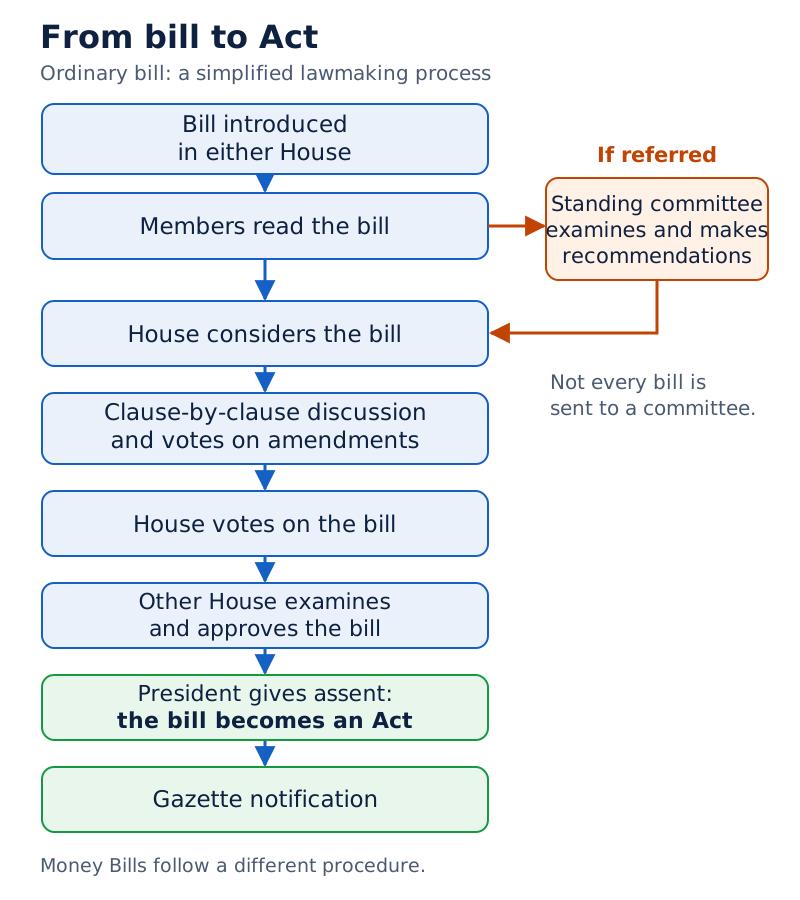
Nine boxes are connected by arrows across three rows. They run from introduction and reading through committee referral, consideration, clause-by-clause discussion and voting, then the other House, presidential assent and Gazette notification. A note states that not all bills go to committees.
Drawn by One Young India.
How does Parliament control money and government expenditure?
The government needs resources to implement policies, but decisions about public money require parliamentary control. Parliament examines how revenue will be raised and how it will be spent. This is known as financial accountability, and it connects government programmes with public oversight.
What is the role of the budget?
The annual budget presents the government's financial plans. Parliament approves and monitors expenditure, including the allocation of funds to ministries. The government must provide information so that representatives can examine its requests and the use of resources.
Financial scrutiny is not simply a check on arithmetic. A decision to provide funds supports a policy or programme. Asking why money is required therefore also examines the government's priorities. Parliament can investigate whether funds have been misused and question ministers about expenditure.
How is a Money Bill treated differently?
A Money Bill concerns specified financial matters, including taxation and government borrowing. It can be introduced only in the Lok Sabha, with the President's prior recommendation. Article 109 provides the special procedure for Money Bills.
After the Lok Sabha passes a Money Bill, it goes to the Rajya Sabha. The Rajya Sabha can recommend changes, but the Lok Sabha may accept or reject those recommendations. The Rajya Sabha cannot use rejection to block the Money Bill.
The Rajya Sabha has fourteen days to return it. If it takes no action within that period, the bill is deemed to have been passed by both Houses in the form passed by the Lok Sabha. Presidential assent is still part of enactment.
| Point | Ordinary bill | Money Bill |
|---|---|---|
| House of introduction | Either House | Lok Sabha only |
| Role of Rajya Sabha | Examines and votes on legislation requiring both Houses' approval | Makes recommendations that the Lok Sabha may accept or reject |
| Special time limit described here | The Money Bill's fourteen-day rule does not apply | Rajya Sabha must return it within fourteen days |
These rules explain why the Lok Sabha is particularly powerful in financial matters. The Rajya Sabha participates in scrutiny, but its role in a Money Bill differs from its role in ordinary legislation.
How does Parliament keep the executive accountable?
The executive implements laws and runs the administration. At the Union level it includes the President, Vice-President and Council of Ministers headed by the Prime Minister. Ministers direct the work of government, while civil servants help implement policies and maintain the functioning of departments.
The Council of Ministers is collectively responsible to the Lok Sabha. It must retain the support of that House. This relationship is a central feature of the parliamentary system and explains why the legislature can do more than offer advice to ministers.
What happens during Question Hour?
During Question Hour, MPs ask ministers about government policies and activities. Ministers must explain actions and decisions. Questions can draw attention to shortcomings, seek information and bring the problems of constituencies before the government.
Question Hour in the Lok Sabha is typically the first hour of a sitting. Its democratic importance lies in requiring answers from those who administer public affairs. MPs do not need to be ministers to contribute to government accountability.
How do debate, committees and confidence work?
Parliament debates policies and decides whether to approve proposed laws. Committees examine activities more closely and require ministries to explain their work. Financial discussions provide another opportunity to check government priorities and the use of public resources.
A no-confidence motion tests whether the government retains the confidence of the Lok Sabha. If the motion succeeds, the government must resign. The Rajya Sabha can question and criticise the government, but cannot remove it through this mechanism.
The Opposition consists of parties outside the ruling party or coalition. It highlights problems in policies, challenges government explanations and offers alternative views. Its participation matters because accountability requires examination, not merely agreement with the executive.
Control is most effective when members attend, prepare for discussion and use the available procedures. Persistent disruption can reduce the time for questioning. The existence of parliamentary powers is therefore important, but their careful use is equally necessary.
How do people's concerns become laws?
Lawmaking begins with public needs as well as formal procedures. Citizens, organisations and public debate can draw attention to problems. Parliament then has to consider proposals, examine their effects and decide how the law should respond. Public participation continues during this process.
What does the education law illustrate?
The 86th Amendment in 2002 inserted Article 21A, providing for free and compulsory education for children aged six to fourteen. This constitutional step and the later law were connected, but they were not the same event.
The Right of Children to Free and Compulsory Education Act, 2009, commonly called the RTE Act, developed through parliamentary consideration. The bill was introduced in the Rajya Sabha and examined by a committee. Discussions included the resources needed for schools, infrastructure and teachers.
It was passed in the Lok Sabha and received presidential assent in August 2009. The example shows why a public goal requires detailed legislation and consideration of implementation. Recognising an objective does not remove the need to discuss how it will be achieved.
How did women's organisations influence legislation?
The Protection of Women from Domestic Violence Act, 2005 illustrates the contribution of organised public participation. Women's groups drew attention to the need for protection from violence, security in a shared household and relief for affected women.
In 1999, Lawyers Collective prepared a draft after consultations. A bill was introduced in Parliament in 2002. Women's organisations and the National Commission for Women made submissions to the Parliamentary Standing Committee, seeking changes to the proposal.
The committee submitted its recommendations in December 2002. A new bill was introduced in 2005, passed by both Houses and sent for presidential assent. The Act came into effect in 2006. This sequence distinguishes an Act's year from the year it began operating.
Meetings, public hearings, petitions and committee submissions helped bring experiences into the lawmaking process. The example also separates legislation from implementation: after passage, the government still had to enforce the law. Passing a law is a major step, but effective protection requires action afterwards.
What limits Parliament's power and strengthens its work?
Parliament has extensive powers, but those powers operate within the Constitution. The judiciary checks whether laws and executive actions follow constitutional principles. This forms part of the system of checks and balances between the legislature, executive and judiciary.
How do the three organs differ?
| Organ | Principal responsibility | Connection with the other organs |
|---|---|---|
| Legislature | Makes laws and scrutinises government | Questions the executive and approves public expenditure |
| Executive | Implements laws and administers government | Explains its decisions and actions to the legislature |
| Judiciary | Interprets and applies laws | Examines whether laws and executive action respect the Constitution |
Separation of powers means these functions are distinguished. In the parliamentary system, ministers can also be MPs. This connection does not remove the distinction between making a law, carrying it out and examining its constitutional validity.
What can citizens do between elections?
Citizens can follow parliamentary work, raise questions, share views in public discussions and communicate concerns to representatives. Newspapers and other media help people learn what MPs and ministers are doing. Public scrutiny can encourage representatives to address matters affecting their constituents.
A law can be unpopular even when it is constitutionally valid. People can criticise it, hold public meetings and campaign for change. Constitutional validity and public approval are therefore different questions. Courts examine constitutional issues; Parliament can respond to public concerns through legislative change.
Effective parliamentary work requires informed debate, attendance, constructive disagreement and sufficient time for scrutiny. Democratic participation does not end when a ballot is cast. Representatives must continue to answer questions, and citizens can continue to examine how the powers entrusted to those representatives are used.
Glossary
- Union Legislature — The national lawmaking institution, called Parliament, which also scrutinises the executive and government finances.
- Bicameral legislature — A legislature with two Houses, allowing different forms of representation and further examination of proposed laws.
- Lok Sabha — The House of the People, directly elected by voters and central to the government's continuing confidence.
- Rajya Sabha — The Council of States, a permanent House whose members serve terms rather than remaining members for life.
- Constituency — An electoral area whose voters choose a representative to a legislative body.
- Universal adult franchise — The principle giving adult citizens voting rights without discrimination based on social or economic background, gender, race or religion.
- Coalition — An alliance of two or more political parties working together, including to form and support a government.
- Bill — A draft of a proposed law submitted for legislative consideration before it can become an Act.
- Presidential assent — The President's approval of a bill after its parliamentary passage, making it an Act.
- Money Bill — A bill concerning specified financial matters, introduced only in the Lok Sabha with the President's prior recommendation.
- Question Hour — A period of parliamentary business in which members question ministers about government policies, actions and activities.
- Standing committee — A continuing parliamentary committee that examines issues, scrutinises government activity and makes recommendations, though its membership can change.
- No-confidence motion — A motion in the Lok Sabha testing whether the government still has the confidence of that House.
- Accountability — The obligation to explain and justify decisions and actions to those entitled to scrutinise them.
- Opposition — Parties outside the ruling party or coalition that examine policies, question the government and present alternative views.
Common errors and misconceptions
- Misconception: Parliament consists only of the Lok Sabha. Correct: Parliament comprises the President, Lok Sabha and Rajya Sabha.
- Misconception: The President is a third House of Parliament. Correct: The President is a constituent of Parliament, while its two Houses are the Lok Sabha and Rajya Sabha.
- Misconception: Rajya Sabha members remain in office for life. Correct: A member's full term is six years, with one-third retiring every two years; the House itself is permanent.
- Misconception: Every parliamentary bill starts in the Lok Sabha. Correct: Ordinary bills can begin in either House, while Money Bills can begin only in the Lok Sabha.
- Misconception: The Rajya Sabha can reject a Money Bill permanently. Correct: It can recommend changes within fourteen days, and the Lok Sabha decides whether to accept them.
- Misconception: Parliament's sole function is making laws. Correct: It also debates public issues, represents people, controls finances and scrutinises the executive.
- Misconception: The Rajya Sabha can remove the government through a no-confidence motion. Correct: The Council of Ministers is collectively responsible to the Lok Sabha, which exercises this power.
- Misconception: Committee approval alone makes a bill law. Correct: Committee examination supports scrutiny; the necessary parliamentary passage and presidential assent must still follow.
Exam-style questions with model answers
Q1. Name the three constituents of the Parliament of India and identify its two Houses. [2 marks]
- Parliament consists of the President, the Lok Sabha and the Rajya Sabha.
- Its two Houses are the Lok Sabha, or House of the People, and the Rajya Sabha, or Council of States.
Q2. Explain why the Rajya Sabha is called the Permanent House, referring to members' terms and retirement. [3 marks]
- The Rajya Sabha is called the Permanent House because it is not dissolved as a whole.
- A member serves a full term of six years, so permanence does not mean membership for life.
- One-third of the members retire every two years. This staggered retirement allows the House to continue while its membership is renewed, including during a period when the Lok Sabha has been dissolved.
Q3. Distinguish the Lok Sabha from the Rajya Sabha on four bases: election, term, presiding officer and power over government survival. [4 marks]
- Lok Sabha members are directly elected by voters, whereas state representatives in the Rajya Sabha are elected indirectly by elected MLAs.
- The Lok Sabha normally lasts five years; a Rajya Sabha member's full term is six years, and that House is not dissolved.
- The Lok Sabha is presided over by its elected Speaker; the Vice-President chairs the Rajya Sabha.
- The Lok Sabha can remove the government through a successful no-confidence motion, while the Rajya Sabha cannot.
Q4. Trace an ordinary bill from introduction to enactment, explaining the role of committees and the two Houses. [5 marks]
- An ordinary bill is a draft law that can be introduced in either the Lok Sabha or the Rajya Sabha. Introduction begins consideration and does not make it law.
- Members discuss the proposal. It may be referred to a committee for detailed examination and recommendations, although not every bill follows this route.
- The House considers the clauses and proposed amendments, then votes on the bill.
- After passage in the first House, the other House considers and votes on it. Ordinary legislation requires both Houses' approval; certain deadlocks may be resolved through a joint sitting.
- After parliamentary passage, presidential assent turns the bill into an Act. Gazette notification provides official publication.
Q5. Explain four ways in which Parliament holds the executive accountable. Include the specific House responsible for a no-confidence motion. [4 marks]
- During Question Hour, MPs seek information and require ministers to explain government policies and actions.
- Parliamentary debates and committee examinations scrutinise decisions, raise problems and seek explanations from ministries.
- Financial scrutiny examines the government's requests for resources and how public funds are used through the budget and related review.
- The Lok Sabha can pass a no-confidence motion. Since the Council of Ministers is collectively responsible to that House, a successful motion requires the government to resign.
Q6. A Money Bill must be introduced in the Lok Sabha with the President's prior recommendation. After passage there, the Rajya Sabha has fourteen days to return it with recommendations; the Lok Sabha can accept or reject them. Using these rules, explain why the Rajya Sabha cannot permanently block this bill and state what happens if it takes no action for fourteen days. [3 marks]
- The Rajya Sabha's role is to recommend changes rather than impose changes or reject the Money Bill permanently.
- The Lok Sabha has the authority to accept or reject those recommendations, so the final decision on them belongs to the directly elected House.
- If the Rajya Sabha takes no action within fourteen days, the bill is deemed passed by both Houses in the form passed by the Lok Sabha.
Q7. Consider this sequence: Lawyers Collective prepared a draft after consultations in 1999; a domestic violence bill was introduced in 2002; women's organisations and the National Commission for Women made committee submissions; recommendations followed in December 2002; a new bill passed both Houses in 2005 and received presidential assent; the Act took effect in 2006. Explain five lessons about lawmaking and public participation from this sequence. [5 marks]
- Public needs can influence legislation before a bill reaches Parliament. The consultations preceding the 1999 draft show that lawmaking can begin with people's concerns.
- Introducing a bill does not settle its content. The later submissions demonstrate that organisations could seek changes while Parliament considered the proposal.
- Committees provide a channel for detailed examination. The recommendations in December 2002 followed representations about the proposed law.
- Public campaigning does not replace formal enactment. The new bill still needed passage through both Houses and presidential assent.
- Passage and operation can occur in different years. The legislation passed in 2005 took effect in 2006, showing why these stages must be distinguished.
Q8. Explain why India has two Houses of Parliament. Give three reasons connected with representation and scrutiny. [3 marks]
- The Lok Sabha provides direct representation because citizens elect its members from territorial constituencies.
- The Rajya Sabha represents the states, reflecting India's federal structure and bringing state concerns into national legislative work.
- Consideration in a second House allows further examination of proposed laws. Members can identify difficulties and suggest changes, providing an opportunity to reconsider a decision made in the first House.
Key takeaways
- Parliament is the Union Legislature and consists of the President, Lok Sabha and Rajya Sabha.
- The Lok Sabha is directly elected and normally lasts five years, although it can be dissolved earlier.
- The Rajya Sabha is permanent; members serve six-year terms, with one-third retiring every two years.
- Ordinary bills can begin in either House and require parliamentary passage followed by presidential assent.
- Money Bills begin only in the Lok Sabha, while the Rajya Sabha can recommend changes within fourteen days.
- Parliament questions ministers, examines policies and controls finances, making the executive answerable for its work.
- The Council of Ministers is collectively responsible to the Lok Sabha and must retain its confidence.
- Citizens, organisations, parliamentary committees and informed public debate can influence the content and consideration of proposed laws.
- The judiciary checks constitutional validity, while citizens can scrutinise representatives and campaign for legislative change.
Test yourself
What does bicameral mean?
It means having two legislative Houses, as in India's Lok Sabha and Rajya Sabha.
Who elects the Speaker of the Lok Sabha?
The members of the Lok Sabha elect the Speaker to conduct the House's proceedings.
Who presides over the Rajya Sabha?
The Vice-President of India presides over the Rajya Sabha as its Chairperson.
Does every bill have to go to a committee?
No. Committee examination can provide detailed scrutiny, but not every bill is referred to a committee.
How does a government bill differ from a private member's bill?
A minister introduces a government bill. A member who is not a minister introduces a private member's bill.
Why is Question Hour important?
It lets MPs seek information, identify shortcomings and require ministers to explain government actions and policies.
Which House can remove the government through a no-confidence motion?
The Lok Sabha exercises this power because the Council of Ministers is collectively responsible to it.
What educational provision does Article 21A contain?
It provides for free and compulsory education for children aged six to fourteen years.
How are lawmaking and implementation different?
Lawmaking establishes legal provisions through the legislature. Implementation puts them into effect through executive action and administration.
Try it
Navigating the Union Legislature
Step into the role of a legislative consultant to determine how bills and parliamentary accountability work in India's bicameral system.
1A newly proposed tax reform bill (a Money Bill) is introduced and passed in the Lok Sabha. When sent to the Rajya Sabha, several members disagree with its provisions and propose major modifications. How must the legislative process proceed under parliamentary rules?
Incorrect. Joint sittings are summoned by the President to resolve deadlocks on ordinary bills, not Money Bills.
Correct. For a Money Bill, the Rajya Sabha can only discuss and suggest changes within 14 days; it cannot reject the bill, and the Lok Sabha is free to accept or ignore its suggestions.
Incorrect. The Lok Sabha holds the purse strings; the Rajya Sabha cannot reject a Money Bill, ensuring the directly elected house has the final say.
2Later in the session, members of the Lok Sabha believe the ruling government has lost its majority and is failing to govern effectively. What constitutional mechanism can the Lok Sabha use to hold the executive accountable?
Correct. If the Lok Sabha passes a Vote of No-Confidence, the entire Council of Ministers must immediately resign, serving as the ultimate tool for executive accountability.
Incorrect. The Rajya Sabha represents states and cannot dissolve the government or the Lok Sabha; executive accountability through a Vote of No-Confidence rests with the Lok Sabha.
Incorrect. The Speaker maintains order and certifies Money Bills, but ministers are held accountable collectively by the Lok Sabha through motions like a Vote of No-Confidence.
Well done! You have demonstrated a clear understanding of parliamentary procedures, the unique powers over Money Bills, and how the Lok Sabha exercises executive accountability.