
Medieval India: The Mughal Empire | ICSE Class 9 History & Civics Notes
On this page
This note covers Mughal origins, historical sources, the sequence of rulers, Babur’s battles, Akbar’s relations with Rajput rulers, religious integration, social and educational reforms, the rank-based service system, revenue arrangements and Mughal monuments.
What was the background to the Mughal Empire?
The Mughal Empire brought a large and culturally diverse territory under one ruling house. From the later sixteenth century, the Mughals expanded from Agra and Delhi. By the seventeenth century, their authority extended over nearly all of the Indian subcontinent.
Family origins and political identity
The Mughals traced their ancestry to Genghis Khan through their mother’s side and to Timur through their father’s side. Timurid means connected with Timur and his descendants. The rulers took pride in this Timurid connection.
They disliked being called Mughal or Mongol because Genghis Khan’s memory was associated with massacres and with their Uzbeg competitors. Timur’s capture of Delhi in 1398 added prestige to their claim of descent. Royal pictures linked successive emperors with him.
Babur’s route to power
Babur, the first Mughal emperor, inherited the throne of Ferghana in 1494 when he was twelve. An Uzbeg invasion forced him to leave it. After years of wandering, he captured Kabul in 1504 and later turned towards northern India.
His victory over Ibrahim Lodi at Panipat in 1526 brought Delhi and Agra under his control. Establishing an empire still required further victories and arrangements for government. Winning a capital and securing lasting authority over different rulers were related but separate tasks.
Definition: A dynasty is a succession of rulers belonging to the same family. Mughal history combines the history of this ruling family with the institutions through which it governed.
What do the historical sources reveal about Mughal rule?
A historical source is evidence used to study the past. Written accounts can describe administration and events; buildings preserve evidence of construction, royal patronage and public life. The Ain-i-Akbari, Taj Mahal, Jama Masjid and Red Fort provide different kinds of evidence.
The Ain-i-Akbari and its contents
Abul Fazl, Akbar’s friend and court historian, wrote the Akbar Nama, a history commissioned by Akbar. Its first volume concerns Akbar’s ancestors; the second records his reign. The third is the Ain-i-Akbari, a compilation of imperial regulations and information about the empire.
Completed in 1598 after five revisions, the Ain-i-Akbari describes the royal household, army, administration, revenue and provinces. It also records people’s cultural and religious traditions. Its information on crops, yields, prices and wages makes it valuable beyond the history of battles.
| Source | Kind of evidence | Main use |
|---|---|---|
| Ain-i-Akbari | Written administrative account | Understanding Akbar’s government, resources and society |
| Taj Mahal | Royal tomb complex at Agra | Studying royal commemoration and architectural decoration |
| Jama Masjid | Congregational mosque in Delhi | Studying a building intended for collective Muslim worship |
| Red Fort | Fort and imperial residence in Delhi | Studying the architectural setting of royal power |
How should written evidence be assessed?
The Ain-i-Akbari presents society from the viewpoint of the imperial court. Its author sought to show harmony under a strong ruling class. It therefore cannot simply be treated as the peasants’ own account of their experiences.
Its figures also have limitations. Some totals contain minor errors, and information was not collected uniformly across provinces. Detailed prices and wages mainly concern Agra and its surroundings. These limits do not remove the work’s considerable historical value.
Later translations helped readers study this evidence. Henry Blochmann’s English translation of the first volume appeared in 1873; H. S. Jarrett translated the other two volumes, published in 1891 and 1894. These are translation dates, not dates of Akbar’s rule.
What timeline places the Mughal rulers in chronological order?
Chronological order means arranging events from earlier to later. The principal Mughal rulers in sequence were Babur, Humayun, Akbar, Jahangir, Shah Jahan and Aurangzeb. Humayun’s reign was interrupted, so the sequence must not be mistaken for uninterrupted Mughal control.
| Ruler | Reign | Place in the sequence |
|---|---|---|
| Babur | 1526 to 1530 | Established Mughal rule in northern India |
| Humayun | 1530 to 1540; 1555 to 1556 | Lost power and later recovered it |
| Akbar | 1556 to 1605 | Expanded and consolidated the empire |
| Jahangir | 1605 to 1627 | Succeeded Akbar |
| Shah Jahan | 1628 to 1658 | Succeeded Jahangir |
| Aurangzeb | 1658 to 1707 | Succeeded Shah Jahan |
Which events anchor the sequence?
| Year | Event |
|---|---|
| 1494 | Babur inherited Ferghana |
| 1504 | Babur captured Kabul |
| 1526 | Babur defeated Ibrahim Lodi at Panipat |
| 1527 | Babur defeated Rana Sanga at Khanwa |
| 1529 | Babur defeated the Afghan opposition at Ghaghra |
| 1530 | Humayun succeeded Babur |
| 1540 | Humayun lost his empire to Sher Shah |
| 1555 | Humayun recovered Delhi |
| 1556 | Akbar succeeded Humayun |
| 1605 | Jahangir succeeded Akbar |
| 1628 | Shah Jahan began his reign |
| 1658 | Aurangzeb began his reign |
| 1707 | Aurangzeb’s reign ended |
Succession means the transfer of the ruler’s position to a successor. The Mughals did not accept primogeniture, the rule that the eldest son inherited his father’s estate. They followed coparcenary inheritance, the division of inheritance among all sons.
Note: Humayun’s two periods of rule belong to the same ruler. Also, 1707 marks the end of Aurangzeb’s reign, not the immediate disappearance of Mughal emperors.
Why were Babur’s three battles important for consolidation?
Consolidation means making newly acquired power more secure. Babur’s conquests brought him into conflict with different opponents. The battles of Panipat, Khanwa and Ghaghra should be connected with their opponents and outcomes rather than remembered as an isolated list of dates.
Panipat, 1526
At the First Battle of Panipat, Babur defeated Ibrahim Lodi, the Sultan of Delhi. A sultan was a Muslim ruler. This victory brought Delhi and Agra into Babur’s hands and laid the foundation of Mughal rule in northern India.
Babur used cannons effectively at Panipat. A cannon is a large gun used in warfare. Its use belongs to the military explanation of his victory; the capture of Delhi and Agra belongs to the explanation of its political result.
Khanwa, 1527
At Khanwa, Babur defeated Rana Sanga of Mewar and his allies. This checked a major Rajput challenge to Babur’s position. Panipat had defeated the Delhi Sultan; Khanwa addressed another powerful opponent whose resistance could threaten the new Mughal state.
Ghaghra, 1529
At Ghaghra, Babur defeated Afghan forces associated with Mahmud Lodi. This strengthened his position in the east against Afghan opposition. The three victories therefore concerned different political challenges, rather than three encounters with the same enemy.
| Battle | Principal opponent | Significance |
|---|---|---|
| Panipat, 1526 | Ibrahim Lodi | Delhi and Agra came under Babur’s control |
| Khanwa, 1527 | Rana Sanga and his allies | A major Rajput challenge was defeated |
| Ghaghra, 1529 | Afghan forces associated with Mahmud Lodi | Babur’s position against eastern Afghan opposition strengthened |
These successes established and strengthened Babur’s rule. They did not mean that every part of the subcontinent had been conquered. The empire’s later territorial expansion and administrative consolidation continued under his successors, especially Akbar.
How did Akbar’s Rajput policy combine cooperation and resistance?
Rajputs were groups that included ruling houses such as those of Amber, Marwar and Mewar. Akbar’s Rajput policy helped bring regional rulers into the Mughal political system. It combined alliances, high appointments and marriage connections with military action against resistance.
Alliances and service
Many Rajput rulers joined Mughal service and received high positions. Many also married their daughters into Mughal families. Such relationships linked regional ruling houses with the imperial family and made cooperation part of the empire’s political structure.
Jahangir’s mother was a Kachhwaha princess, the daughter of the ruler of Amber, in the region of modern Jaipur. Shah Jahan’s mother was a Rathor princess from Marwar, or Jodhpur. These examples show the continuing connection between Mughal rulers and Rajput families.
Resistance and accommodation
Many Rajputs resisted as well. The Sisodiya Rajputs of Mewar refused to accept Mughal authority for a long time. Rajput responses therefore varied: cooperation by one ruling house does not prove acceptance by every other house.
When defeated, the Sisodiyas were honourably treated by the Mughals and given their lands back as assignments. Here, watan means their ancestral lands, and watan jagir means those lands held as an assignment within the imperial arrangement.
The balance between defeating opponents and avoiding their humiliation helped the Mughals extend influence over kings and chiefs. It was difficult to maintain this balance all the time. Rajput policy must therefore be understood as a continuing political relationship, not a single agreement.
Note: The later accommodation of the Sisodiyas should not be used to claim that Akbar personally secured the submission of every Rajput ruler. Many cooperated, while many resisted.
How did Akbar’s policies encourage integration across religious communities?
Integration here means drawing different regions and communities into a shared political system. Akbar governed people with different religions, customs and languages. His policies sought cooperation across these differences rather than making imperial service depend on membership of one religious community.
Religious discussion and universal peace
In 1575, Akbar established the Ibadat Khana, or House of Worship, at Fatehpur Sikri. Religious discussions there eventually involved representatives of different faiths. These debates formed part of his interest in examining religious ideas and the basis of good government.
Sulh-i kul means universal peace. It expressed an ideal of tolerance towards people of different religious beliefs. Jahangir’s account of Akbar’s rule praised the place available to followers of different creeds and his opposition to intolerance.
The policy’s political importance lay in governing a diverse population without treating religious difference itself as grounds for exclusion. It connected the emperor’s religious outlook with the wider problem of securing support from people across his territories.
Removal of discriminatory taxes
Akbar abolished the pilgrimage tax, a levy on pilgrims visiting sacred places, in 1563. In 1564 he abolished jizya, a tax imposed on non-Muslim subjects. These measures removed particular financial burdens associated with religious identity and practice.
| Measure | Connection with integration |
|---|---|
| Rajput alliances and high appointments | Brought regional ruling groups into imperial service |
| Abolition of pilgrimage tax and jizya | Removed particular religiously differentiated burdens |
| Discussion among religious thinkers | Encouraged engagement with different beliefs |
| Sulh-i kul | Provided an ideal of peace across religious differences |
Religious tolerance did not mean that the Mughal state stopped collecting revenue. Taxes on agricultural production remained central to its income. The abolition of a named religious tax must be distinguished from the much broader question of how the empire financed its government and army.
What social and educational reforms are associated with Akbar?
Akbar’s reforms extended beyond military expansion. Social reforms are efforts to change accepted practices in society; educational reforms concern what people study and how learning is supported. These measures belong alongside his attempts to govern a population with varied customs.
Marriage and the position of women
Akbar discouraged child marriage, marriage at a very young age. He supported widow remarriage, allowing a woman whose husband had died to marry again. These policies challenged restrictions that could limit women’s choices within family life.
He also opposed forced sati, the burning of a widow on her husband’s funeral pyre. Opposition to compulsion is the important distinction: it should not be restated as a claim that Akbar completely ended the practice throughout the empire.
A reform policy and its complete enforcement are different things. Naming a measure tells us what the ruler encouraged or discouraged. It does not, by itself, establish that every community immediately changed its practice or that every affected person experienced the same result.
A broader course of study
Akbar encouraged a broader curriculum, meaning the subjects included in a course of study. Alongside religious learning, he promoted useful subjects such as arithmetic, geometry, astronomy, agriculture, history and ethics. Ethics concerns ideas about right conduct.
Arithmetic and geometry develop numerical and spatial understanding; astronomy studies heavenly bodies. Agriculture concerned cultivation, while history concerned the past. The inclusion of such subjects illustrates an interest in learning that extended beyond religious instruction alone.
Akbar also encouraged translation of Sanskrit works into Persian, including the Mahabharata. Translation makes a work available in another language. Such projects enabled Persian readers at court to encounter important Indian literary and intellectual traditions.
These educational activities can be connected with integration through greater acquaintance with different traditions. They should not be described as universal compulsory schooling or modern equality of educational access. Those would be much larger claims than the reforms themselves establish.
How did the mansabdari system organise imperial service?
A mansab was a position or rank, and a mansabdar was its holder. The mansabdari system graded officers in Mughal service. It connected a person’s place in the official hierarchy with salary and military responsibilities.
Rank, salary and cavalry
Zat was the numerical rank that determined status and salary. A higher zat meant a more prestigious position at court and a larger salary. A noble with a zat of 5,000 ranked above one with a zat of 1,000.
Sawar means a cavalryman, or soldier who fights on horseback; the sawar component of an officer’s rank indicated his cavalry obligation. Zat and sawar therefore addressed different aspects of service. Personal status should not be confused with the number of mounted soldiers to be maintained.
A mansabdar had to maintain a specified number of cavalrymen. The troops were reviewed and registered, and their horses were branded. Branding means applying an identifying mark, here to the horses presented for service.
- The mansabdar maintained the required body of cavalrymen.
- He brought those cavalrymen before the authorities for review.
- The men were registered and their horses were branded.
- He received money with which to pay their salaries.
Pay through revenue assignments
Mansabdars received salaries through jagirs, assignments of revenue from specified territories. Revenue means income collected by the state, including taxes. A jagir provided access to that income; it did not simply turn an officer into the independent ruler of its territory.
Most mansabdars did not actually reside in or administer their jagirs. Their servants collected the assigned revenue while the mansabdars served elsewhere. Under Akbar, the assignments were carefully assessed so that their revenues were roughly equal to the officers’ salaries.
Diagram
Rank, duty and payment
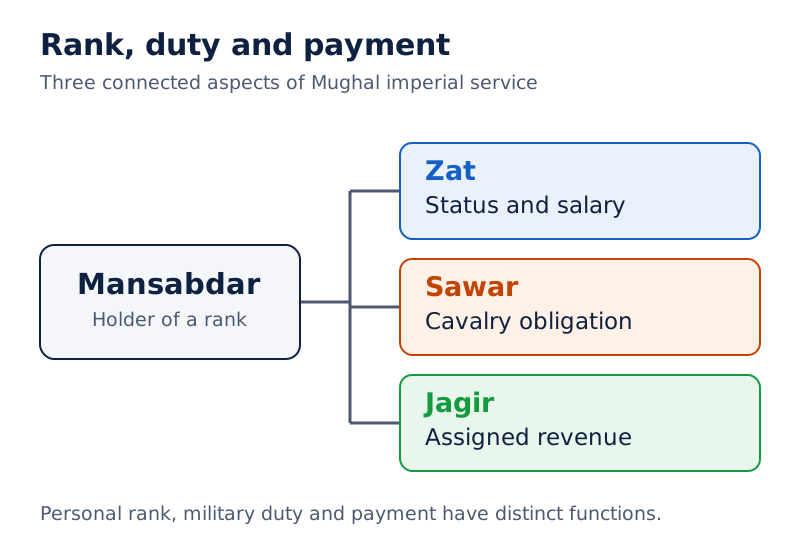
Draw a central box labelled “Mansabdar”. Connect it to three boxes: “Zat: status and salary”, “Sawar: cavalry obligation” and “Jagir: assigned revenue”. Keep the three functions distinct.
Drawn by One Young India.
The system helped organise service by a diverse body of officers. Its operation depended on both military supervision and the collection of sufficient revenue. Rank, troops and payment formed connected parts of administration rather than separate lists of technical words.
How did mansabdars, jagirdars and zamindars differ?
A jagirdar held a jagir, or revenue assignment. A zamindar was a rural intermediary, such as a local headman or powerful chief, involved in relations between cultivators and the state. An intermediary acts between other parties.
These terms identify different functions. Mansab concerns rank in imperial service, jagir concerns assigned revenue, and zamindar concerns local landed authority and revenue collection. Treating them as interchangeable hides how Mughal administration connected officials with resources in the countryside.
| Term | Central meaning | Administrative connection |
|---|---|---|
| Mansabdar | Holder of an imperial rank | Status, salary and military service |
| Jagirdar | Holder of a revenue assignment | Access to the income assigned from a territory |
| Zamindar | Rural headman, chief or landed intermediary | Local power and collection of revenue |
How was revenue assessed?
The main source of Mughal income was tax on peasant produce. Peasants were agricultural cultivators. In most places they paid taxes through rural elites, meaning locally powerful people such as village headmen or chiefs.
Akbar’s revenue minister, Todar Mal, surveyed crop yields, prices and cultivated areas for the ten-year period 1570 to 1580. On this basis, tax on each crop was fixed in cash. Revenue circles had their own schedules of crop rates.
This system was called zabt. It operated where officials could survey land and maintain careful accounts. Such arrangements were not possible in provinces such as Gujarat and Bengal. Zabt must not be presented as a uniform system applied everywhere.
The phrase “roughly equal” matters when comparing jagir income with a mansabdar’s salary under Akbar. It describes an assessed relationship, not a guarantee that receipts matched a salary exactly in every case.
How did different social groups participate in the empire?
Mughal rule depended on relationships among the emperor, officers, regional rulers and producers. These groups did not have identical interests. Looking at their separate roles explains why a strong administrative system could coexist with negotiations, unequal power and resistance.
Nobles and regional ruling groups
Nobles were high-ranking people in imperial service. Recruitment expanded from a small body of Turkish nobles to include Iranians, Indian Muslims, Afghans, Rajputs, Marathas and other groups. This widened the social and regional base of the service.
Regional rulers could cooperate with the emperor and receive positions, or resist imperial authority. Rajput examples show both responses. An alliance could give a ruling family a place within the empire while also extending the emperor’s influence.
Zamindars and local power
Zamindars connected the state with rural society, but some possessed considerable independent local influence. Their role cannot be reduced to that of obedient tax collectors. Sometimes zamindars and peasants of the same caste joined in rebellion against Mughal authority.
Peasants and artisans
Artisans were skilled makers of goods. Peasants and artisans supplied produce and goods purchased by emperors and nobles. Such spending benefited suppliers, yet heavy revenue collection left very little for investment in the hands of primary producers.
The poorest lived from hand to mouth, with hardly enough resources to invest in additional tools and supplies. Wealthier peasants and artisans occupied a different position. Descriptions of imperial wealth should therefore not be extended automatically to every social group.
What do the Taj Mahal, Jama Masjid and Red Fort show about Mughal architecture?
Mughal monuments served different purposes: burial, worship, residence and government. Patronage means support given to a work or activity by a powerful sponsor. Royal patronage brought together materials, skilled labour and designs that expressed the ruler’s wealth and authority.
The Taj Mahal at Agra
Shah Jahan built the Taj Mahal as a mausoleum, or monumental tomb, for his wife Mumtaz Mahal. Work began in 1632 and took nearly twenty years, involving 20,000 specialised workers.
The tomb stands at the northern end of a chahar bagh, a garden divided into four parts by intersecting channels. Paths, pools and fountains organise the grounds. Its placement takes advantage of the river bank rather than locating the tomb in the garden’s centre.
The marble-faced tomb contrasts with surrounding red sandstone structures. Four tapering minarets, or tall towers, stand at the terrace corners. A dome and four smaller domed pavilions complete the main skyline. Marble for the building came from Makrana in Rajasthan.
Pietra dura is decorative inlay using semi-precious stones. Other decoration includes carved flowers, jalis, or perforated ornamental screens, and calligraphy, decorative writing. Quranic verses appear in jasper inlay against white marble.
The Jama Masjid in Delhi
Shah Jahan commissioned Delhi’s Jama Masjid, a large congregational mosque, meaning a mosque for collective worship. Construction ran from 1650 to 1656. Its religious purpose differs from the Taj Mahal’s commemorative purpose.
The mosque has a large open courtyard and a prayer area on the western side. The mihrab is the prayer niche indicating the direction of Mecca. An imam leads the congregation in prayer; these features connect architectural arrangement with worship.
What the figure shows
Plan of Jama Masjid
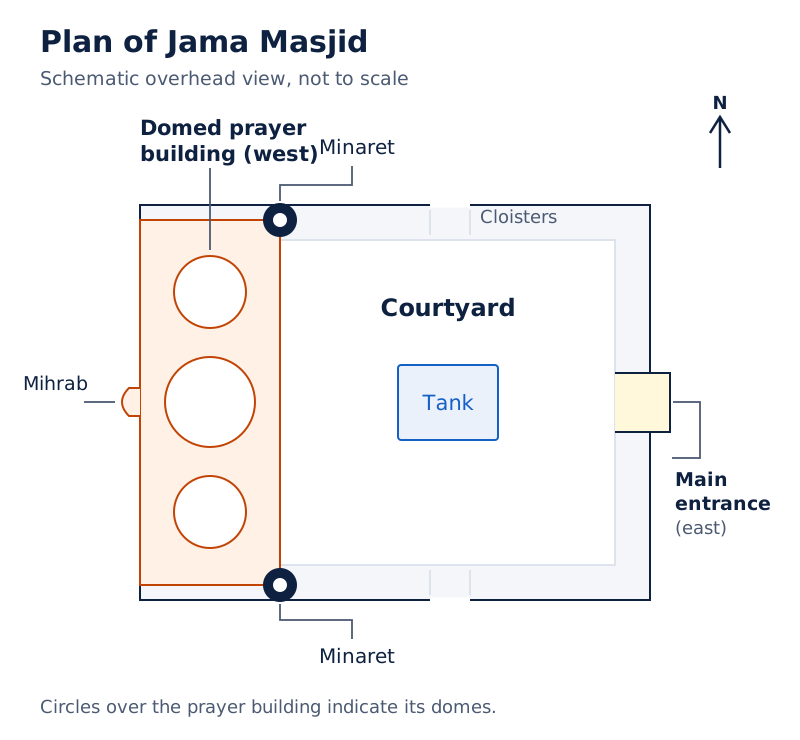
The drawing labels the main entrance, courtyard and central tank. It places the domed prayer building along one side, with labels for the mihrab and minarets. A photograph above shows the mosque’s arched front and domes.
Drawn by One Young India.
The Red Fort in Delhi
Shah Jahan built the Red Fort in Delhi between 1638 and 1648. It served as an imperial residence and centre of royal government. Its defensive walls and palace spaces connect the need for protection with the public display of kingship.
The Diwan-i-Am was the hall of public audience, where the emperor appeared before a wider audience. The Diwan-i-Khas was the hall of private audience. Their different functions illustrate the organisation of access to the ruler.
Photograph: The Red Fort. The photograph shows a long red wall with projecting fortified sections and a central entrance structure. Trees and buildings appear behind it, with a busy open area in front.
Together, these monuments show why architectural evidence is useful. Their layouts, materials and functions illuminate royal life and public activity. They also require careful identification: a mosque, a tomb and a fortified palace complex are not interchangeable kinds of building.
What were the main consequences and legacy of Mughal consolidation?
The legacy of a state means the influence it leaves after its strongest period has passed. Mughal administration and ideas of government outlasted the empire’s political strength. Its monuments also preserved visible evidence of royal patronage and skilled craftsmanship.
How did different policies work together?
Babur’s victories established and strengthened a territorial base. Akbar’s alliances and integration policies widened cooperation. The mansabdari system organised officers, while revenue arrangements connected their salaries and military obligations with the resources of the empire.
These developments should be connected without treating any single policy as a complete explanation. Military power, cooperation with ruling groups and administrative organisation supported one another. Rajput resistance shows that the process remained contested even while the empire expanded.
What limits remained?
Under Akbar, jagir revenues were assessed to be roughly equal to officers’ salaries. By Aurangzeb’s reign, actual collections were often less than the granted sums. More mansabdars also meant longer waits for assignments, contributing to shortages of jagirs.
Many jagirdars tried to extract as much revenue as possible while they held an assignment. The peasantry suffered tremendously in the later years of Aurangzeb’s reign, when he was unable to control these developments. Administrative arrangements could therefore create strains as well as support imperial power.
As central authority weakened, imperial servants emerged as regional centres of power. Provinces such as Hyderabad and Awadh developed independent political identities while continuing to recognise the emperor in Delhi. This helps explain why weakening central power did not erase Mughal influence immediately.
Glossary
- Dynasty — A succession of rulers from the same family, such as the Mughal ruling house.
- Consolidation — The process of strengthening newly acquired power and making political control more secure.
- Ain-i-Akbari — Abul Fazl’s compilation of imperial regulations and information about Akbar’s administration, resources and society.
- Primogeniture — A rule of inheritance under which the eldest son inherits his father’s estate.
- Coparcenary — A system of inheritance in which the inheritance is divided among all the sons.
- Sulh-i kul — Universal peace, an ideal associated with tolerance towards followers of different religious beliefs.
- Jizya — A tax imposed on non-Muslim subjects, which Akbar abolished in the year 1564.
- Mansabdar — A holder of an imperial rank associated with status, salary and military responsibilities.
- Zat — The numerical rank that determined a mansabdar’s position at court and the size of his salary.
- Sawar — A cavalryman; the sawar component of rank indicated the officer’s obligation to maintain mounted soldiers.
- Jagir — An assignment of revenue used to pay an imperial officer rather than an independent kingdom.
- Zamindar — A rural intermediary, such as a village headman or powerful chief, involved in revenue collection.
- Zabt — A revenue assessment system using surveyed crop yields, prices and cultivated areas to fix cash rates.
- Chahar bagh — A garden divided into four parts by intersecting channels, associated with Mughal architectural settings.
- Pietra dura — Decorative inlay work using semi-precious stones, found among the embellishments of the Taj Mahal.
Common errors and misconceptions
- Misconception: Babur fought Ibrahim Lodi in all three major battles. Correct: Panipat involved Ibrahim Lodi, Khanwa involved Rana Sanga and his allies, and Ghaghra involved Afghan forces associated with Mahmud Lodi.
- Misconception: Humayun ruled continuously from 1530 to 1556. Correct: His rule was interrupted between 1540 and 1555, and the two periods must be shown separately.
- Misconception: Every Rajput ruler willingly accepted Mughal authority. Correct: Many cooperated, but many resisted; the Sisodiyas of Mewar resisted for a long time.
- Misconception: Zat and sawar mean the same thing. Correct: Zat determined status and salary, while sawar concerned cavalry obligations.
- Misconception: All mansabdars lived in and directly governed their jagirs. Correct: Most did not reside in or administer those assignments; servants collected their revenue while they served elsewhere.
- Misconception: Abolishing jizya meant abolishing all taxes. Correct: It removed a particular tax on non-Muslims; agricultural revenue remained central to Mughal income.
- Misconception: The Ain-i-Akbari gives an equally complete account of every region. Correct: Information was unevenly collected, and its detailed prices and wages mainly concern Agra and surrounding areas.
- Misconception: The Taj Mahal, Jama Masjid and Red Fort had the same purpose. Correct: They were respectively a royal tomb complex, a congregational mosque and a fortified imperial residence.
Exam-style questions with model answers
Q1. Evidence: Abul Fazl wrote the Ain-i-Akbari as the third volume of the Akbar Nama; it records administration, the army, revenues, crops, prices and wages. Identify its author and explain one historical use. [2 marks]
- Its author was Abul Fazl, who placed it within the larger Akbar Nama.
- Its administrative and economic information helps historians study how Akbar’s empire was organised and supported.
Q2. Evidence: Babur defeated Ibrahim Lodi at Panipat in 1526 and captured Delhi and Agra; he defeated the Rajput ruler Rana Sanga and his allies at Khanwa in 1527; he defeated Afghan forces associated with Mahmud Lodi in the east at Ghaghra in 1529. Explain three stages in his consolidation. [3 marks]
- Panipat in 1526 defeated Ibrahim Lodi and brought Delhi and Agra under Babur’s control, providing a territorial base for Mughal power.
- Khanwa in 1527 defeated Rana Sanga and his allies, checking a major Rajput challenge to that newly established position.
- Ghaghra in 1529 defeated Afghan forces associated with Mahmud Lodi, strengthening Babur’s position against opposition in the east.
Q3. Evidence: Many Rajput rulers joined Mughal service, received high positions and formed marriage alliances; many others resisted. The Sisodiyas of Mewar resisted for a long time and, when defeated, received honourable treatment and their lands back as assignments. Explain four features of Mughal relations with Rajputs. [4 marks]
- Imperial service offered cooperating Rajput rulers high positions, drawing regional ruling groups into the Mughal political system.
- Marriage alliances linked some Rajput ruling families with the imperial family and provided another form of cooperation.
- Cooperation was not universal: many resisted, and the Sisodiyas of Mewar continued their opposition for a long time.
- Honourable treatment and restoration of lands as assignments helped accommodate defeated rulers without treating defeat as a reason for complete humiliation.
Q4. Evidence: A mansabdar held an imperial rank; zat determined status and salary; sawar concerned cavalry obligations; cavalrymen were reviewed and registered and horses branded; jagirs supplied assigned revenue; most officers served away from their jagirs while servants collected the revenue. Explain six features of the service system. [6 marks]
- A mansabdar held a position within the imperial ranking system, so service was organised through recognised grades of office.
- Zat determined personal standing and salary, connecting an officer’s numerical rank with his position within the official hierarchy.
- Sawar concerned cavalry obligations, distinguishing the duty to maintain mounted soldiers from the officer’s personal standing and salary.
- Reviewing and registering cavalrymen and branding horses provided checks on the military resources presented by the officer for service.
- A jagir supplied assigned revenue for payment, linking the officer’s remuneration with income collected from a specified territory.
- Most officers served elsewhere while servants collected the assigned revenue, so holding a jagir did not require residence within it.
Q5. Evidence: Akbar abolished pilgrimage tax, a levy on visits to sacred places, in 1563 and jizya, a tax on non-Muslims, in 1564; he encouraged religious discussions at the Ibadat Khana, established in 1575; sulh-i kul meant universal peace across religious differences. Explain four measures associated with integration. [4 marks]
- Abolition of pilgrimage tax in 1563 removed a particular financial burden attached to visits to sacred places.
- Abolition of jizya in 1564 removed a tax that distinguished non-Muslim subjects on the basis of religion.
- Religious discussions at the Ibadat Khana, established in 1575, encouraged engagement with the ideas of different religious thinkers.
- Sulh-i kul provided an ideal of universal peace, connecting the government of a diverse population with tolerance across religious differences.
Q6. Evidence: Akbar discouraged child marriage, supported widow remarriage and opposed forced sati, the burning of a widow on her husband’s funeral pyre. Explain these three social reforms without claiming complete enforcement. [3 marks]
- Discouraging child marriage challenged the practice of marrying people at a very young age, but does not establish that the practice disappeared.
- Supporting widow remarriage allowed women whose husbands had died to marry again, challenging a restriction on their family choices.
- Opposing forced sati challenged compulsion in the burning of widows; it should not be described as the complete elimination of sati.
Q7. Evidence: Shah Jahan built the Taj Mahal at Agra for Mumtaz Mahal; work began in 1632 and took nearly twenty years; the tomb stands at the northern end of a four-part garden beside the river; the tomb’s white marble contrasts with surrounding red sandstone; four minarets stand at the terrace corners; decoration includes semi-precious stone inlay, carved screens and calligraphy. Describe six features. [6 marks]
- The Taj Mahal was a royal mausoleum commissioned by Shah Jahan at Agra to commemorate his deceased wife, Mumtaz Mahal.
- Construction began in 1632 and continued for nearly twenty years.
- The tomb occupies the northern end of its four-part garden, using the river-bank setting instead of a central garden position.
- The white marble of the tomb contrasts with surrounding red sandstone, making different materials part of the overall architectural effect.
- Four minarets stand at the terrace corners, forming a clearly arranged set of towers around the main tomb building.
- Stone inlay, carved screens and calligraphy provide distinct forms of decoration, combining patterned surfaces, ornamental openings and decorative writing.
Q8. Evidence: The Ain-i-Akbari describes administration and supplies economic figures, but presents the court’s viewpoint rather than peasants’ own testimony; information is uneven across provinces, and detailed prices and wages mainly concern Agra and its surroundings. Give one value and two limitations. [3 marks]
- Its administrative descriptions and economic figures help reconstruct the organisation and resources of Akbar’s empire beyond the sequence of political events.
- Its court-centred viewpoint means that it cannot simply be read as the direct testimony of peasants about their own lives.
- Uneven provincial coverage and the concentration of price and wage information around Agra limit how confidently those details can be applied elsewhere.
Key takeaways
- Babur established and strengthened Mughal power through Panipat in 1526, Khanwa in 1527 and Ghaghra in 1529.
- The principal sequence is Babur, Humayun, Akbar, Jahangir, Shah Jahan and Aurangzeb, with an interruption in Humayun’s rule.
- Akbar’s Rajput policy combined alliances and high appointments with military action against resistance and accommodation of defeated rulers.
- Sulh-i kul expressed universal peace; abolishing pilgrimage tax and jizya removed particular burdens connected with religious identity.
- Akbar’s social and educational reforms included opposition to forced sati, support for widow remarriage and encouragement of broader learning.
- Zat determined an officer’s status and salary, sawar concerned cavalry obligations, and jagir meant an assignment of revenue.
- The Ain-i-Akbari offers rich administrative evidence, but its court-centred viewpoint and uneven regional information require careful interpretation.
- The Taj Mahal, Jama Masjid and Red Fort illustrate different royal purposes: commemoration, collective worship and imperial residence.
Test yourself
Who defeated Ibrahim Lodi, and what did the victory bring under his control?
Babur defeated Ibrahim Lodi at Panipat in 1526 and captured Delhi and Agra.
Which three rulers followed Akbar in the principal Mughal sequence?
Jahangir followed Akbar, Shah Jahan followed Jahangir, and Aurangzeb followed Shah Jahan.
Why is “all Rajputs accepted Mughal authority” inaccurate?
Many Rajput rulers cooperated, but many resisted; the Sisodiyas of Mewar resisted for a long time.
What does sulh-i kul mean?
It means universal peace, expressing tolerance towards followers of different religious beliefs.
How did zat differ from sawar?
Zat determined personal status and salary, while sawar concerned the officer’s obligation to maintain cavalry.
Did most mansabdars personally administer their jagirs?
Most did not reside in or administer them; servants collected revenue while they served elsewhere.
What distinguishes a mausoleum from a congregational mosque?
A mausoleum is a monumental tomb; a congregational mosque provides space for collective Muslim worship.
Why must the Ain-i-Akbari be read critically?
It reflects the imperial court’s viewpoint, contains some minor errors and offers uneven information across regions.
Write about it
Turn a question from this chapter into a paper.
The Writing Studio has a structure guide, a rubric and citation tools for 15 formats, from essays to research papers. Drafting is free with an account. Learnacy Essential adds feedback from an AI writing coach and submission to The OYI Review.
Learnacy Essential is ₹1,499 for the year. Publication depends on review and is not guaranteed.