
The State Legislatures | ICSE Class 9 History & Civics Notes
On this page
This note covers State Legislatures, the Legislative Assembly and Legislative Council, unicameral and bicameral systems, membership, composition, terms of office, law-making, financial powers, control over ministers, electoral functions and constitutional responsibilities.
What is a State Legislature, and how is it organised?
A legislature is the organ of government that makes laws and holds the government accountable. A State Legislature performs these functions at the State level. The Constitution, India's fundamental framework of government, determines its structure and powers.
India has a federal system, in which the Constitution divides governing powers between the Union government for the country and State governments. Parliament is the Union legislature. A State Legislature is a separate institution with responsibility for matters within its constitutional authority.
What does a House mean?
A House, or chamber, is an organised body of legislators that meets to conduct legislative business. A unicameral legislature has one House. A bicameral legislature has two Houses. These terms count legislative chambers, rather than every constitutional component of the legislature.
The Legislative Assembly, also called the Vidhan Sabha, exists in every State. A Legislative Council, also called the Vidhan Parishad, exists in States with two Houses. The Assembly is commonly called the lower House and the Council the upper House.
Under Article 168, the State Legislature includes the Governor and the House or Houses. An Article is a numbered provision of the Constitution. The Governor is the constitutional head of the State and is not a member of either House.
The Sarkaria Commission, appointed in 1983 to examine relations between the Centre and States, recommended that appointments of Governors should be strictly non-partisan. It submitted its report in 1988.
Definition: Unicameral means one legislative chamber; bicameral means two legislative chambers. Including the Governor as part of the legislature does not add another chamber.
| Arrangement | Constitutional components | Number of Houses |
|---|---|---|
| Unicameral State Legislature | Governor and Legislative Assembly | One |
| Bicameral State Legislature | Governor, Legislative Assembly and Legislative Council | Two |
The two Houses do not possess identical powers. The Assembly has the stronger position, especially in controlling public money and determining whether the ministry, the team of State ministers, can remain in office. The Council contributes discussion and reconsideration within defined limits.
How is the Legislative Assembly composed and elected?
The Legislative Assembly represents the people of the State through direct election: voters choose their representatives themselves. A person elected to it is a Member of the Legislative Assembly, abbreviated to MLA. The plural abbreviation is MLAs.
How do constituencies provide representation?
A territorial constituency is a geographical area that elects a representative. For Assembly elections, the State is divided into territorial constituencies of roughly equal population. One representative is elected from each constituency.
Universal adult franchise means that adult citizens have the right to vote, subject to legal eligibility conditions. In India, the voting age is 18 years. The right to vote and the qualification to become an Assembly member have different age requirements.
Direct election gives Assembly members a clear link with voters in their constituencies. Members can raise public concerns in debates and question ministers about government action. Representation therefore continues after the election through the work carried out inside the House.
How large is the Assembly?
Article 170 gives the general range of 60 to 500 elected members for a State Assembly. Special constitutional arrangements permit smaller Assemblies in certain States. Consequently, the lower limit must be stated with this qualification, rather than treated as an exceptionless rule.
Assembly seats are reserved under constitutional provisions for Scheduled Castes and Scheduled Tribes, communities recognised for constitutional safeguards. In such reserved constituencies, all eligible voters can vote, while candidature is restricted to the relevant category.
The range describes the general limits on the size of an Assembly. It does not mean every State has the same number of members. Assembly composition and Council composition follow different rules, so their numerical limits must be learnt separately.
The Speaker is the Assembly's presiding officer, who conducts its proceedings and maintains order. Under Article 178, the Assembly chooses its Speaker and Deputy Speaker from among its members. The Deputy Speaker assists in performing the presiding functions.
Note: A voter chooses an Assembly representative directly. That same direct electoral method does not describe the entire membership of a Legislative Council, which combines different methods of selection.
How is the Legislative Council composed?
The Legislative Council brings together members chosen through different channels. Indirect election means that a defined electoral body chooses representatives instead of the entire ordinary electorate voting directly for them. Nomination means appointment to membership by an authorised constitutional authority.
Under Article 171, a Council's total membership cannot exceed one-third of the total membership of the State's Assembly. Its membership cannot be fewer than 40. These are limits on its size, not the proportions for each category of members.
Who chooses Council members?
The Constitution specifies proportions for the elected categories using the qualification as nearly as may be. This matters because seats are whole numbers. The remainder consists of members nominated by the Governor, conventionally described as about one-sixth of the Council.
Local authorities are institutions administering local areas. A graduate is someone who has completed a university degree; the electoral rules also recognise prescribed equivalent qualifications. The co-operative movement concerns organisations through which people jointly meet common economic or social needs.
| Share of Council membership | Method of selection | Relevant qualification of the electors or nominees |
|---|---|---|
| As nearly as may be, one-third | Elected by members of specified local authorities | Electors belong to local bodies such as municipalities and district boards |
| As nearly as may be, one-twelfth | Elected by graduates' constituencies | Electors reside in the State and have held the prescribed degree or equivalent qualification for at least three years |
| As nearly as may be, one-twelfth | Elected by teachers' constituencies | Electors reside in the State and have taught for at least three years within the preceding six years in prescribed institutions within the State, not lower than secondary level |
| As nearly as may be, one-third | Elected by Assembly members | Those elected through this category are not members of the Assembly |
| The remainder, about one-sixth | Nominated by the Governor | Special knowledge or practical experience in literature, science, art, the co-operative movement or social service |
How should these categories be understood?
The teachers' and graduates' qualifications describe the people entitled to vote in those constituencies. They should not be confused with the general constitutional minimum age for Council membership. Similarly, nomination is a separate route from election by Assembly members.
The Council chooses a Chairman and Deputy Chairman from among its members under Article 182. These are its presiding officers. The title Chairman belongs to the Council, while Speaker belongs to the Assembly.
What qualifications are required for membership of the two Houses?
Qualifications for membership are the conditions a person must satisfy to become a legislator. Under Article 173, a person must be a citizen of India and satisfy the prescribed age requirement, make the required oath or affirmation (a formal undertaking), and possess qualifications laid down by parliamentary law.
The constitutional undertaking for a candidate includes allegiance to the Constitution and upholding India's sovereignty and integrity. Sovereignty means supreme independent authority; integrity here concerns the unity and territorial wholeness of the country.
How do the minimum ages differ?
| Requirement | Legislative Assembly | Legislative Council |
|---|---|---|
| Citizenship | Indian citizenship | Indian citizenship |
| Minimum age | 25 years | 30 years |
| Constitutional undertaking | Required oath or affirmation | Required oath or affirmation |
| Other legal conditions | Qualifications prescribed by parliamentary law | Qualifications prescribed by parliamentary law |
The age requirement is a minimum, not a normal term of office or a retirement age. A person eligible to vote at 18 does not thereby qualify for either House. The Assembly and Council impose their own higher thresholds for membership.
Why is age alone insufficient?
For election to either House, a candidate must be registered as an elector, a person entitled to vote, in an Assembly constituency of that State, subject to applicable statutory conditions. A person nominated to the Council must ordinarily reside in the State.
Disqualification means a legal condition that makes someone ineligible to hold membership. Meeting the age threshold does not remove other legal requirements. Citizenship, the constitutional undertaking and applicable statutory conditions must also be satisfied.
A person is disqualified for holding a disqualifying office of profit, a government position carrying financial benefit unless legally exempted; being declared of unsound mind by a competent court; or being an undischarged insolvent, someone legally insolvent without discharge from that status.
How can defection affect membership?
The 52nd Amendment in 1985 introduced the anti-defection provisions, restricting legislators elected on one party's ticket from defecting to another party. The 91st Amendment subsequently modified these provisions.
The presiding officer of the House decides defection cases. A member found to have defected loses membership of the House and is also disqualified from holding political office such as a ministerial post.
Keep three questions separate when studying membership: who may vote, who may become a member, and how members are selected. The Council's special electoral categories answer the selection question. The ages of 25 and 30 answer the membership question.
The two Houses share the requirement of Indian citizenship but differ in minimum age and composition. A comparison should therefore identify the particular condition being discussed instead of describing one House as simply older or more qualified than the other.
How long do the Houses last, and how do they conduct business?
A term is the period for which an institution or member normally holds office. Article 172 distinguishes the duration of the Assembly from the continuing character of the Council. The term of a House and the term of an individual member are different ideas.
What is the Assembly's normal term?
The Assembly normally lasts five years from the date appointed for its first meeting, unless dissolved sooner. Dissolution ends the life of the Assembly, requiring a new Assembly to be elected. Five years is therefore its normal duration, not a guaranteed uninterrupted period.
During a National Emergency, a constitutionally proclaimed emergency on grounds of war, external aggression or armed rebellion, Parliament may extend an Assembly's term by law for up to one year at a time. Such an extension cannot continue beyond six months after the emergency has ceased to operate.
Why is the Council called a permanent House?
The Council is not subject to dissolution. Its members normally serve six-year terms, with approximately one-third retiring every second year. Retirement here means completion of a member's term, allowing the seat to be filled again.
The staggered retirement system preserves continuity while renewing membership. Permanent describes the continuing House, not lifelong membership for its legislators. Dissolving the Assembly does not dissolve the Council.
What is a legislative session?
A session is a period during which a House is summoned to conduct business. Under Article 174, no more than six months may intervene between its last sitting in one session and the date appointed for its first sitting in the next.
Prorogation ends a session, while adjournment suspends a sitting for a time. Neither term means the same as dissolution. The Speaker or Chairman regulates proceedings so that questions, debates and votes can be conducted in an orderly manner.
Note: Remember the three separate Council facts together: the House continues, a member normally serves six years, and approximately one-third of members retire every two years.
On which subjects can a State Legislature make laws?
Legislative powers are powers to make laws. They operate within the Constitution's division of subjects between the Union and States. A State Legislature does not have an unrestricted power to legislate on every matter merely because a matter affects its residents.
What are the State and Concurrent Lists?
The State List groups subjects on which normally only the State Legislature can make laws. These include agriculture, police, public health and local government. The word normally is essential because the Constitution provides circumstances in which Parliament can legislate on State subjects.
The Concurrent List groups subjects on which both Parliament and State Legislatures can make laws. Education, forests and trade unions are examples. A trade union is an organisation of workers formed to protect and advance their common employment interests.
The Union List includes subjects such as defence, foreign affairs and railways. These belong to Parliament's legislative field. Subjects not included in any of the three Lists fall under residuary powers, which belong to the Union.
| List | Examples | Legislative authority |
|---|---|---|
| State List | Agriculture, police, public health | Normally the State Legislature |
| Concurrent List | Education, forests, trade unions | Both Parliament and State Legislatures |
| Union List | Defence, foreign affairs, railways | Parliament |
What limits State law-making?
Assent means formal constitutional approval of a bill, which is a proposed law. The President is the constitutional head of India. The Governor may reserve a State bill for the President's consideration, so every bill does not follow an identical final route.
A State law must comply with the Constitution. Where State and Union laws on a Concurrent subject conflict, the Union law generally prevails. A State law reserved for and receiving the President's assent can prevail within that State, subject to Parliament's power to override it later.
The State Legislature's authority is therefore both substantial and defined. Understanding the Lists explains what it can legislate about; understanding the bill procedure explains how it exercises that authority.
How does an ordinary bill pass through a State Legislature?
An ordinary bill is a proposed law following the ordinary legislative procedure, as distinct from the special procedure for a Money Bill. A Money Bill deals only with constitutionally specified financial matters, such as taxation, State borrowing and appropriation of money from the State's Consolidated Fund, together with incidental provisions.
Appropriation means legal authorisation to withdraw public money for specified purposes. The Consolidated Fund is the State's principal public account. Incidental provisions are provisions directly connected with the specified financial matters.
What are the main stages?
- Introduction: An ordinary bill is introduced in a House. In a bicameral State, it may originate in either the Assembly or the Council.
- Examination: Members discuss its principles and provisions. It may be referred to a committee, a smaller group of members appointed to examine business in detail.
- Decision: Members consider amendments, meaning proposed changes to the text, and vote on the bill. Passage means that the House has approved it.
- Second House: In a bicameral State, the other House considers the bill. The Assembly has a special power to overcome the Council's obstruction under the prescribed procedure.
- Assent: A bill passed through the required legislative process is presented to the Governor. It becomes law after the constitutionally required assent.
What happens when the two Houses disagree?
Under Article 197, if the Council rejects an Assembly-passed ordinary bill, proposes unacceptable amendments or leaves it pending for more than three months, the Assembly may pass it again and send it back to the Council.
On this second passage, Council rejection, unacceptable amendments or delay beyond one month allows the bill to be treated as passed in the Assembly's form, including any Council amendments accepted by the Assembly. The two waiting periods are three months and one month.
These are limits on Council delay, not a promise that the entire law-making process takes four calendar months. The Assembly must act again. There is no provision for a joint sitting of the two State Houses to settle this disagreement.
If an ordinary bill originates in the Council, the Assembly can reject it. The Council cannot use the Assembly's overriding procedure in reverse. This difference makes the Assembly stronger in ordinary legislation too.
Under Article 200, a non-Money Bill may be returned for reconsideration. A bill may also be reserved for the President's consideration. Passage by a House and the final constitutional assent are separate stages.
How does the Assembly control State finances?
Financial control means legislative supervision over how public money is raised and spent. The budget is the annual statement of estimated government receipts and expenditure. Receipts are money expected to come in; expenditure is money expected to be spent.
Debating the budget allows representatives to examine the government's priorities. Members can question why money is sought and how earlier funds were used. Financial scrutiny connects government programmes with the requirement to account for public resources.
What is special about Money Bills?
Article 199 defines State Money Bills. A bill does not become a Money Bill merely because it has some connection with money. Its provisions must fall within the constitutionally specified categories and matters incidental to them.
A Money Bill can be introduced only in the Legislative Assembly, with the Governor's recommendation. The Assembly's Speaker certifies whether a bill is a Money Bill. Its procedure differs from the ordinary-bill route, particularly in the Council's limited role.
What can the Council do?
Under Article 198, an Assembly-passed Money Bill goes to the Council for recommendations. The Council must return it within 14 days. The Assembly may accept or reject any of those recommendations; Council agreement is not an equal requirement for passage.
If the Council does not return the bill within 14 days, it is deemed passed by both Houses in the form approved by the Assembly. Deemed passed means treated as passed under the constitutional rule even without a matching Council vote.
The Council cannot use the three-month and one-month ordinary-bill procedure to delay a Money Bill. The relevant limit is 14 days. After the legislative procedure, the bill still requires the constitutionally required assent.
The Assembly votes on demands for grants, which are requests for approval of government spending. Charged expenditure is expenditure made a charge on the State's Consolidated Fund by the Constitution or law. It can be discussed but is not submitted to a vote.
Note: The budget, a demand for a grant and a Money Bill are related financial concepts, but they are not interchangeable names for the same document or decision.
How does the legislature hold the State executive accountable?
The executive is the organ of government that administers the State and implements laws and policies. At State level, it includes the Governor, Chief Minister and Council of Ministers. The Chief Minister heads the ministers who conduct the State government's political work.
The Council of Ministers is the team of ministers responsible for government departments and policy. It is distinct from the Legislative Council. One is an executive body; the other is a legislative House.
What does collective responsibility mean?
Under Article 164, the Council of Ministers is collectively responsible to the Legislative Assembly. Collective responsibility means that ministers stand together as a government accountable to that House. They must retain its confidence, meaning support for their continuance in office.
A no-confidence motion is a formal proposal that the House no longer supports the ministry. If the Assembly passes it, the Council of Ministers must resign. The Legislative Council cannot compel the ministry's resignation through a no-confidence motion.
What other methods support accountability?
- Questions: Members seek information from ministers and ask them to explain actions within their departments.
- Debates: Discussion brings public concerns into the House and allows government policies to be examined and criticised.
- Legislative scrutiny: Members examine proposals before granting the government the laws it seeks.
- Financial scrutiny: Discussion of revenue and expenditure requires ministers to explain their use of public money.
The Council can participate in questions and debates even though it cannot remove the ministry. Scrutiny and removal are different powers. A House can examine and criticise executive action without possessing the final power to withdraw the government's authority to remain in office.
Accountability depends on members using these opportunities effectively. Asking for information, considering replies and discussing policies are continuing tasks. The Assembly's power over the ministry gives particular force to its scrutiny, while the Council adds another forum for examination.
What other functions distinguish the Assembly and the Council?
Beyond ordinary legislation, finance and executive control, State Legislatures participate in electoral and constitutional functions. Electoral functions concern choosing constitutional representatives or office-holders. Constitutional amendment means a formal change to the Constitution through its prescribed procedure.
What electoral and constitutional roles do they perform?
Elected Assembly members participate in electing the President of India. They also elect their State's representatives to the Rajya Sabha, the Council of States and one of Parliament's two Houses. Membership of a State Council does not confer either of these electoral roles.
Certain constitutional amendments require ratification, meaning formal approval, by the legislatures of at least half the States after passage by Parliament. This does not mean a State Legislature can independently amend the Constitution or that every amendment requires State ratification.
Under Article 169, Parliament can create or abolish a State's Legislative Council after the Assembly passes the required resolution. A resolution is a formal expression of a House's decision. The Assembly's resolution starts this constitutional route but does not itself create or abolish the Council.
The resolution requires a majority of the Assembly's total membership and at least two-thirds of the members present and voting. Both conditions must be satisfied. The Council's permanent character therefore means freedom from dissolution, not protection from constitutional abolition.
How do the Houses compare?
| Basis | Legislative Assembly | Legislative Council |
|---|---|---|
| Popular representation | Directly elected by the people | Different electoral categories and nominated members |
| Normal duration | Five years unless dissolved sooner | Continuing House; members normally serve six years |
| Minimum membership age | 25 years | 30 years |
| Ordinary legislation | Can overcome Council disagreement through the prescribed procedure | Can examine and delay Assembly-passed bills within constitutional limits |
| Money Bills | Exclusive introduction and final legislative decision | Recommendations within 14 days |
| Executive responsibility | Can require the ministry to resign through loss of confidence | Can scrutinise but cannot remove the ministry through no-confidence |
Diagram
State legislative structure
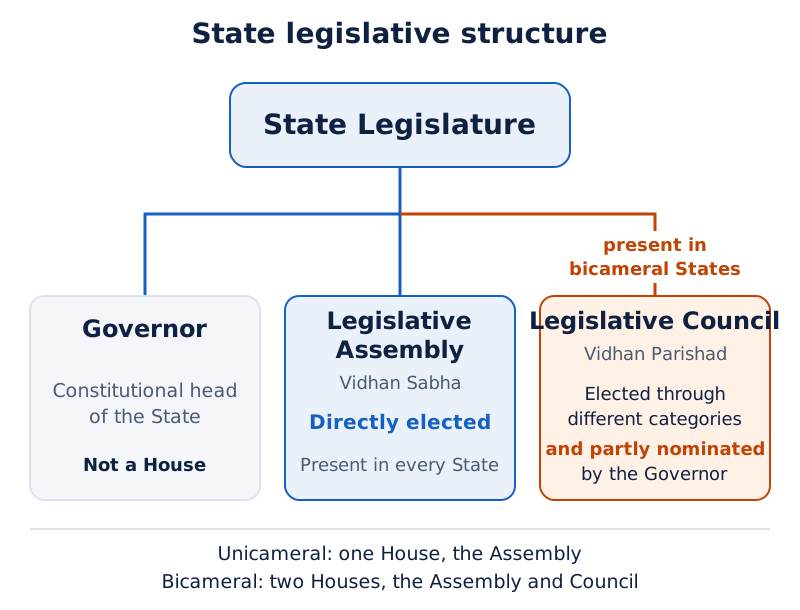
Draw a box labelled State Legislature. Below it show Governor and Legislative Assembly; add Legislative Council on a separate branch labelled present in bicameral States. Label the Assembly as directly elected and the Council as elected through different categories and partly nominated.
Drawn by One Young India.
The Council's purpose as a revising and deliberating chamber is compatible with the Assembly's stronger authority. Having two Houses adds an opportunity for scrutiny; it does not make their constitutional powers equal.
Glossary
- State Legislature — The State's law-making institution, comprising the Governor and its legislative House or Houses.
- Unicameral legislature — A legislature with one chamber, which at State level is the Legislative Assembly.
- Bicameral legislature — A legislature with two chambers, which at State level are the Assembly and Council.
- Legislative Assembly — The directly elected State House to which the Council of Ministers is collectively responsible.
- Legislative Council — A continuing second State House combining members from different electoral categories and Governor's nominees.
- Constituency — An electoral area or defined group of electors that chooses a representative.
- Nomination — Appointment to legislative membership by a constitutional authority rather than selection through election.
- Dissolution — The ending of an Assembly's life, after which a new Assembly must be elected.
- Ordinary bill — A proposed law following ordinary legislative procedure rather than the special Money Bill procedure.
- Money Bill — A bill confined to specified constitutional financial matters and provisions incidental to those matters.
- Assent — Formal constitutional approval required after a bill completes the relevant legislative procedure.
- Collective responsibility — The obligation of the ministry as a whole to retain the Legislative Assembly's confidence.
- No-confidence motion — A formal proposal that the Assembly no longer supports the ministry continuing in office.
- Ratification — Formal approval by State Legislatures where the constitutional amendment procedure requires their agreement.
Common errors and misconceptions
- Misconception: The Governor forms a third House in a bicameral State. Correct: The Governor is a constitutional component of the legislature but not a legislative chamber.
- Misconception: Every State has a Legislative Council. Correct: Every State has an Assembly; only bicameral State Legislatures have a Council.
- Misconception: A Council member holds office permanently. Correct: The House continues, but members normally serve six years and approximately one-third retire every two years.
- Misconception: Every Council member is chosen by Assembly members. Correct: Council membership combines several electoral categories and Governor's nominees.
- Misconception: The Council can block a Money Bill indefinitely. Correct: It has 14 days to return recommendations, which the Assembly may accept or reject.
- Misconception: Ordinary-bill disagreement between State Houses leads to a joint sitting. Correct: The Constitution provides an Assembly overriding procedure, not a joint sitting of the State Houses.
- Misconception: The Legislative Council and Council of Ministers are the same body. Correct: The former is a legislative House; the latter is the executive team collectively responsible to the Assembly.
- Misconception: An Assembly resolution alone abolishes the Council. Correct: The prescribed Assembly resolution enables Parliament to legislate for abolition.
Exam-style questions with model answers
Q1. A unicameral State Legislature contains the Governor and Legislative Assembly. A bicameral State Legislature contains the Governor, Assembly and Council. Identify the number of Houses in each arrangement and explain why the Governor is not counted as another House. [2 marks]
- A unicameral legislature has one House, the Assembly; the Governor is a constitutional component rather than a chamber.
- A bicameral legislature has two Houses, the Assembly and Council; including the Governor does not create a third chamber.
Q2. The minimum membership ages are 25 years for the Assembly and 30 for the Council. Both require Indian citizenship, the prescribed oath or affirmation, and qualifications laid down by parliamentary law. State three conclusions about eligibility using these rules. [3 marks]
- The Assembly and Council have different minimum age requirements: a candidate must be at least 25 for the Assembly and at least 30 for the Council.
- Indian citizenship is a shared requirement, so the difference between the Houses' age thresholds does not change their common citizenship condition.
- Age and citizenship alone are insufficient: the person must also make the prescribed oath or affirmation and satisfy qualifications laid down by parliamentary law.
Q3. Council members are chosen, as nearly as may be, in these proportions: one-third by local-authority members, one-twelfth by graduates, one-twelfth by teachers, and one-third by Assembly members from outside the Assembly. The Governor nominates the remainder, about one-sixth, for knowledge or experience in literature, science, art, the co-operative movement or social service. Explain the five channels of membership. [5 marks]
- Members of specified local authorities elect approximately one-third of the Council, providing a channel of representation through institutions that administer local areas.
- Graduates' constituencies elect approximately one-twelfth of the membership, providing a distinct electoral channel rather than selection by all ordinary voters together.
- Teachers' constituencies elect approximately one-twelfth of the Council, making this another separate category within its mixed system of representation.
- Assembly members elect approximately one-third from people who are not Assembly members; selection by legislators is different from direct election by the ordinary electorate.
- The Governor nominates the remainder, about one-sixth, from the specified fields of literature, science, art, the co-operative movement or social service, adding a non-elective channel.
Q4. The Assembly normally lasts five years from its first meeting unless dissolved sooner. The Council is not dissolved; its members normally serve six years, and approximately one-third retire every two years. Explain four features of the duration of these Houses and the renewal of their membership. [4 marks]
- The Assembly has a normal five-year life measured from its first meeting, so its duration is linked to the life of that elected House.
- The Assembly may be dissolved before five years have elapsed, meaning its normal term is not a guaranteed uninterrupted period.
- The Council continues without dissolution, but its members normally serve six-year terms; permanence belongs to the House rather than to individual membership.
- Approximately one-third of Council members retire every two years, renewing membership gradually while allowing the institution itself to continue.
Q5. An ordinary bill passed by the Assembly encounters Council rejection, unacceptable amendments or delay beyond three months. The Assembly may pass it again. On its second passage, Council rejection, unacceptable amendments or delay beyond one month allows deemed passage in the Assembly's form, including Council changes it accepts. No joint sitting is provided. Explain the procedure in four points. [4 marks]
- The first Council disagreement or delay beyond three months permits the Assembly to reconsider and pass the ordinary bill again.
- The Assembly must take that further legislative step and send the bill back to the Council; initial passage does not itself complete the overriding procedure.
- After the second passage, Council rejection, unacceptable amendments or delay beyond one month permits deemed passage in the Assembly's form, including Council changes accepted by it.
- The Council therefore cannot block this Assembly-passed bill indefinitely, and the disagreement is not resolved through a joint sitting of the State Houses.
Q6. A Money Bill is introduced only in the Assembly with the Governor's recommendation, and the Speaker certifies its status. After Assembly passage, the Council has 14 days to return recommendations. The Assembly may accept or reject them; non-return within 14 days means deemed passage in the Assembly's form. Assent is still required. Explain six features of this procedure. [6 marks]
- Introduction belongs exclusively to the Assembly and requires the Governor's recommendation, so the Council cannot originate a Money Bill under this procedure.
- The Speaker certifies the bill's Money Bill status, identifying it as a proposal governed by this special financial procedure.
- Once the Assembly passes the bill, the Council receives it for recommendations and must return it within the stated 14-day period.
- The Assembly can accept or reject the Council's recommendations, so the Council does not have an equal final legislative decision.
- If the Council does not return it within 14 days, the Constitution treats the bill as passed in the Assembly's approved form.
- Completion of this legislative procedure does not remove the requirement for assent, which remains a separate constitutional stage before enactment.
Q7. Ministers are collectively responsible to the Assembly and must resign if it passes a no-confidence motion. Members can also question ministers, debate policies and scrutinise financial proposals. The Council can question and debate but cannot remove the ministry through no-confidence. Explain four ways these rules establish accountability. [4 marks]
- Collective responsibility makes the ministry answerable as a team to the Assembly, which can require its resignation by passing a no-confidence motion.
- Questions require ministers to provide information and explanations, allowing members to examine government action instead of merely accepting its decisions.
- Debates and financial scrutiny enable members to examine policies and proposed spending, connecting public decisions with legislative supervision.
- The Council contributes questions and debate, but its scrutiny differs from the Assembly's stronger power to remove the ministry through loss of confidence.
Q8. Parliament can create or abolish a Legislative Council after an Assembly resolution supported by a majority of its total membership and at least two-thirds of members present and voting. Explain the two distinct constitutional steps. [2 marks]
- The Assembly first passes a resolution meeting both specified majority requirements, initiating the constitutional process.
- Parliament then legislates for creation or abolition; the Assembly's resolution alone does not complete the change.
Key takeaways
- A State Legislature includes the Governor and either the Assembly alone or the Assembly together with a Council.
- The Assembly is directly elected, whereas Council membership combines different electoral categories with members nominated by the Governor.
- The minimum membership age is 25 for the Assembly and 30 for the Council, alongside other constitutional and legal qualifications.
- The Assembly normally lasts five years unless dissolved sooner; the Council continues with staggered retirement of its members.
- State Legislatures normally legislate on State List subjects and share legislative authority with Parliament on Concurrent List subjects.
- The Assembly can overcome Council obstruction of ordinary bills through the prescribed procedure; State Houses do not resolve such disagreements through joint sittings.
- Money Bills originate in the Assembly, and the Council's recommendations must be returned within 14 days.
- The ministry is collectively responsible to the Assembly; the Council can scrutinise the government but cannot remove it through no-confidence.
- Elected Assembly members participate in presidential and Rajya Sabha elections; certain constitutional amendments also require ratification by State Legislatures.
Test yourself
How many chambers does a State Legislature with a Governor, Assembly and Council contain?
It contains two chambers, the Assembly and Council. The Governor is a constitutional component, not another chamber.
Why should the Council not be described as wholly elected by Assembly members?
Assembly members choose approximately one-third. Other electoral categories choose further members, and the Governor nominates the remainder.
What does permanent mean when describing the Legislative Council?
The Council is not subject to dissolution. Its members normally serve six years, with approximately one-third retiring every two years.
Who presides over the Assembly, and who presides over the Council?
The Speaker presides over the Assembly, while the Chairman presides over the Council. Each House chooses its own presiding officers.
Can the Council's Money Bill recommendations bind the Assembly?
No. The Assembly may accept or reject them, and the Council must return the bill within 14 days.
What is the difference between the Legislative Council and Council of Ministers?
The Legislative Council is a legislative chamber. The Council of Ministers is the executive team collectively responsible to the Legislative Assembly.
Does a Council's rejection of an ordinary bill lead to a joint sitting?
No. The State Houses have no joint-sitting procedure for this disagreement. The Assembly can use the prescribed overriding procedure.
Can an Assembly resolution abolish a Legislative Council by itself?
No. The required Assembly resolution initiates the process, after which Parliament must legislate to abolish the Council.
Take this further
How does India make policy?
The Model NITI Aayog self-paced course: 41 chapters, about 19 hours of study, on how India makes policy, from the policy cycle and writing a white paper to the economy, the Union Budget and governance. It comes with Learnacy Essential.
Learnacy Essential is ₹1,499 for the year. It also adds feedback from an AI writing coach, submission to The OYI Review, World 101’s member tools and the 3D labs. Publication is not guaranteed. See what a year includes
Or create a free account to draft in the Writing Studio, explore World 101’s map and open the 2D version of every lab. Create a free account