
The Mauryan Empire | ICSE Class 9 History & Civics Notes
On this page
Watch & explore
Start with a few high-quality watches, then dive into the notes below.
Try an idea before you read. Step into the Mauryan Empire and test your understanding of its administrative strategies and governance. Explore →

This note covers the rise of the Mauryan Empire, the order of its principal rulers, sources of Mauryan history, central and provincial administration, the army and economy, the Kalinga war, Ashoka’s Dhamma, public welfare and the significance of the Sanchi Stupa.
What background explains the rise of the Mauryan Empire?
An empire brings several territories or kingdoms under a powerful ruler. Governing such an extensive area involves collecting resources, maintaining an army, organising officials and keeping routes of communication open. The Mauryan Empire grew out of the earlier power of Magadha.
Why was Magadha well placed to expand?
Magadha, in present-day Bihar, became especially powerful between the sixth and fourth centuries BCE. BCE means Before Common Era; dates with larger numbers come earlier. Magadha’s rise depended on geographical advantages as well as the policies of rulers and their ministers.
- Productive agriculture: fertile land supported food production and provided resources for a growing state.
- Iron resources: accessible deposits in present-day Jharkhand supplied material for tools and weapons.
- Forests: elephants from the region were an important part of the army, while forests also supplied timber.
- River communication: the Ganga and its tributaries offered cheap and convenient routes for movement and exchange.
The capital initially stood at Rajagaha, present-day Rajgir, a fortified settlement among hills. During the fourth century BCE, the capital moved to Pataliputra, present-day Patna. Its position helped it command communication routes along the Ganga.
How did Chandragupta use this background?
Between approximately 334 BCE and 331 BCE, Alexander campaigned against and conquered the Persian Empire. His empire extended across three continents, and Greek cultural influence spread. These conquests preceded his campaign in northwestern India between approximately 327 BCE and 325 BCE.
In approximately 324 BCE to 323 BCE, Alexander faced rebellions and political turmoil back in Persia. He fell ill and died in Babylon aged 32. His generals and provincial governors, called satraps, then divided his empire and established their own kingdoms.
Alexander of Macedon campaigned in northwestern India approximately between 327 BCE and 325 BCE. After his withdrawal, Chandragupta Maurya founded the Mauryan Empire around 321 BCE. He overthrew the Nandas, took control of Magadha and made Pataliputra his capital.
Chandragupta inherited an established economic system and flourishing trade. He defeated the Greek governors left in the northwest and expanded his rule. His control extended as far northwest as Afghanistan and Baluchistan. A strong regional kingdom had become the base of a much larger empire.
Kautilya, also called Chanakya, is traditionally associated with Chandragupta as his adviser and minister. Accounts of their partnership connect political strategy with the organisation of resources. The formation of the empire therefore involved both conquest and the ability to sustain government over conquered territories.
What timeline places Mauryan kings and their surviving evidence in order?
Chronological order means arranging people or events from earlier to later. The principal Mauryan rulers to remember are Chandragupta Maurya, Bindusara and Ashoka. A dynasty is a succession of rulers belonging to the same family. Ashoka was Chandragupta’s grandson.
Chandragupta established the empire around 321 BCE. Bindusara, his son, succeeded him; Ashoka was Bindusara’s son and successor. Ashoka’s reign is conventionally dated here from 268 BCE to 232 BCE. The empire continued for about half a century after his death.
| Time or order | Development | Historical importance |
|---|---|---|
| Sixth to fourth centuries BCE | Magadha rose in power. | Resources and communication supported the growth of a strong state. |
| Approximately 334 BCE to 331 BCE | Alexander conquered the Persian Empire. | His conquests preceded his advance into northwestern India. |
| Approximately 327 BCE to 325 BCE | Alexander campaigned in northwestern India. | Greek governors remained in the region after his withdrawal. |
| Approximately 324 BCE to 323 BCE | Alexander faced turmoil in Persia, then fell ill and died in Babylon. | His empire broke into kingdoms ruled by generals and satraps. |
| Around 321 BCE | Chandragupta founded the Mauryan Empire. | Magadha became the centre of expanding Mauryan rule. |
| After Chandragupta, before Ashoka | Bindusara ruled. | He links Chandragupta and Ashoka in the dynastic succession. |
| 268 BCE | Ashoka’s reign began. | He inherited an extensive empire. |
| After eight years of Ashoka’s rule | Kalinga was conquered. | Ashoka expressed remorse over the suffering caused by conquest. |
| 232 BCE | Ashoka’s reign ended. | The empire continued under his successors. |
| Around 185 BCE | The Mauryan Empire ended. | Successors had been unable to keep the empire together. |
| 1818 | Sanchi was rediscovered. | A surviving monument could be investigated in its original setting. |
| 1838 | James Prinsep deciphered Ashokan Brahmi, a writing system. | Scholars could read important early inscriptions, or writings engraved on hard surfaces. |
| 1877 | Alexander Cunningham published Ashokan inscriptions. | The published collection supported further study of the records. |
The last three entries concern the modern recovery and study of evidence, not events during Mauryan rule. The order of rulers should remain distinct from their achievements. Chandragupta founded the empire; Ashoka is especially associated with Kalinga and Dhamma, his principles of moral conduct. Calling Ashoka the founder confuses the expansion and administration of an existing empire with its establishment.
Note: The Mauryan Empire did not cover the entire subcontinent, and administrative control within it was not uniform. A large area under one dynasty does not imply identical government in every region.
What do the sources reveal about Mauryan history?
The main sources, or evidence used to reconstruct Mauryan history, include the Arthashastra, Indika, Ashokan Edicts and Sanchi Stupa. Written accounts, official messages and material remains answer different questions. Their strengths become clearer when their purposes and limitations are compared.
How do literary and archaeological sources differ?
| Source | Nature and information | Point to remember |
|---|---|---|
| Arthashastra | A work on governance and economics, including administration, defence, justice and welfare. | Parts were probably composed by Kautilya, traditionally believed to be Chandragupta’s minister. |
| Indika | Megasthenes’ account of India, including descriptions of officials and military organisation. | The original work is lost; excerpts survive in later Greek writings. |
| Ashokan Edicts | Official declarations engraved on rocks and pillars. | They communicate royal orders, moral principles and Ashoka’s representation of his rule. |
| Sanchi Stupa | A Buddhist monument with architecture, sculpture and inscriptions. | Its surviving form includes construction and contributions from different periods. |
Megasthenes was a Greek ambassador at Chandragupta’s court. His position makes his account valuable for studying government. However, a surviving extract is not the complete original work, and descriptions must be considered alongside other evidence.
The Arthashastra sets out detailed recommendations for administering a state. Such recommendations reveal ideas about good government. They should not automatically be treated as proof that every instruction was implemented everywhere in the Mauryan Empire.
How did these sources become readable evidence?
Epigraphy is the study of inscriptions, writings engraved on hard surfaces such as stone or metal. James Prinsep’s decipherment of Ashokan Brahmi is dated to 1838. Alexander Cunningham published a collection of Ashokan inscriptions in 1877. These developments helped scholars investigate early political history.
Sanchi was rediscovered in 1818, when three gateways remained standing and the fourth lay where it had fallen. Its preservation allowed architecture, sculpture and inscriptions to be studied together. Evidence retained at its original site preserves relationships that scattered objects can lose.
The study of Sanchi also developed through publications. Cunningham’s Bhilsa Topes appeared in 1854. Shahjehan Begum’s account of Bhopal, translated by H.D. Barstow in 1876, describes Cunningham examining the ruins, drawing them, deciphering an inscription and boring shafts into the domes.
John Marshall and Alfred Foucher published The Monuments of Sanchi in 1914. Marshall’s Conservation Manual followed in 1923. These publications belong to the modern investigation and preservation of ancient monuments, distinct from the period when the stupas were built.
Inscriptions are durable, but they can be damaged or incomplete. They almost invariably reflect the perspective of those who commissioned them. Historians therefore compare royal claims with other evidence instead of assuming that an engraved statement gives a complete account of society.
How do Ashokan Edicts communicate the ruler’s ideas?
An edict is an official declaration issued by an authority, here the king. Ashoka had messages engraved on natural rocks and polished stone pillars for his subjects and officials. These records connect the ruler’s moral concerns with his instructions about government.
What is the difference between language and script?
A language is a means of expression; a script is the writing system used to record it. Prakrit was a language used in most Ashokan inscriptions. Brahmi was the script used for most of those Prakrit inscriptions.
Some Prakrit inscriptions in the northwest used Kharosthi, another script. Aramaic and Greek also occur in the northwest; their scripts were used for inscriptions in Afghanistan. The distribution of languages and scripts shows why it is incorrect to describe every edict as identical in form.
Royal titles also help identify the ruler. Devanampiya is often translated as “beloved of the gods”. The name Ashoka appears in some inscriptions alongside titles found elsewhere. Similarities in content, language and writing help connect these records with the same ruler.
What do the messages tell us?
Ashoka’s messages encouraged respect for elders, generosity towards religious people and kindness towards slaves and servants. They also expressed respect for traditions other than one’s own. Officials received instructions concerning the treatment of people and the reporting of public affairs.
What the figure shows
Distribution of Ashokan inscriptions
The map distinguishes major rock edicts with red triangles, minor rock edicts with purple squares and pillar inscriptions with blue circles. Labelled locations include Kandahar, Girnar, Sanchi, Sarnath and Pataliputra. It is a sketch map, not to scale.
The geographical spread of inscriptions demonstrates the reach of royal communication. It does not by itself establish equally strong administrative control at every location. Nor does the existence of an order prove that every person understood it or complied with it.
Most people were probably not literate. Questions about who read, heard or followed an inscription therefore matter. A declaration of a royal aim and evidence that the aim was fully achieved are different kinds of historical information.
How was the Mauryan Empire administered?
Administration means the organisation through which a ruler manages territories, resources and public affairs. Mauryan government involved a capital, provincial centres, officials, communication routes and military support. Its arrangements responded to the practical difficulties of governing an extensive and varied territory.
What were the major political centres?
There were five major political centres: Pataliputra and the provincial centres of Taxila, Ujjayini, Tosali and Suvarnagiri. A province is a territorial division within a larger state. These centres are mentioned in Ashokan inscriptions.
| Centre | Administrative significance |
|---|---|
| Pataliputra | The imperial capital and a centre of government. |
| Taxila | A provincial centre situated on important long-distance trade routes. |
| Ujjayini | A provincial centre situated on important long-distance trade routes. |
| Tosali | One of the major provincial political centres. |
| Suvarnagiri | A provincial centre possibly important for accessing Karnataka’s gold mines. |
It is likely that control was strongest around the capital and provincial centres. Regions differed greatly, from Afghanistan’s hilly terrain to the coast of Kalinga. A single, uniform system throughout all these areas is unlikely.
How did officials and communication support government?
Land and river routes linked the centre with distant regions. Journeys could take weeks, if not months. Travellers needed provisions and protection; the army helped provide security. The ability to move reports, people and supplies was therefore essential to administration.
Megasthenes describes officials who supervised rivers, measured land and inspected arrangements for distributing canal water. They collected taxes and supervised occupations connected with land, including woodcutting, carpentry, blacksmithing and mining. Taxes are payments collected by the government to support its activities.
Ashoka instructed pativedakas, meaning reporters, to bring him information about the people’s affairs at all times. Their role was administrative reporting to the king. The term should not be confused with the modern occupation of a newspaper reporter.
What principles guided the ideal ruler?
Kautilya’s saptanga means the seven parts of a kingdom. These were the king; councillors, ministers and high officials; territory and population; fortified towns; the treasury or state wealth; forces of defence and law and order; and allies, meaning supporting partners.
These parts were to sustain a secure and prosperous kingdom through warfare or peaceful alliances as circumstances required. Kautilya linked the ruler’s interests with people’s welfare. The countryside mattered because it supplied the economic activity on which royal power depended.
How did different social groups support the economy and army?
An empire needed more than orders from its ruler. Its officials and soldiers depended on food, equipment, transport and revenue, meaning the income collected by the state. Cultivators, artisans, traders and people working with forest resources contributed to this material support.
Cultivators and the countryside
Cultivators were people who grew crops. Agriculture employed a substantial part of the population and supplied important revenue. Food production supported both everyday life and those engaged in government, warfare or specialised crafts. Productive land was therefore an administrative concern as well as an economic resource.
The supervision of canals illustrates this connection. Officials described by Megasthenes checked the outlets through which water passed from main canals into branches, with the aim of ensuring an equal supply. Measuring land and collecting taxes connected farming with the state’s income.
Artisans and traders
Artisans, or skilled craft workers, included blacksmiths, carpenters, potters and jewellers. Guilds were associations of people such as traders or craftspeople. Production and trade helped generate the resources that a large administrative and military establishment required.
The need to equip soldiers linked crafts with military organisation. Transport required carts; soldiers needed food; horses and elephants needed fodder, meaning animal feed. Protecting communication routes also supported the movement of traded goods across the empire.
Soldiers and military support workers
Megasthenes describes a military committee with six subcommittees. A subcommittee is a smaller group assigned part of a larger committee’s work. The division of duties shows that maintaining an army involved organised services as well as fighting forces.
| Subcommittee | Responsibility |
|---|---|
| First | Navy, the forces operating on water. |
| Second | Transport and provisions, including equipment, food and fodder. |
| Third | Foot-soldiers. |
| Fourth | Horses. |
| Fifth | Chariots. |
| Sixth | Elephants. |
The transport subcommittee arranged bullock carts, procured supplies and recruited servants and artisans to assist soldiers. The Arthashastra’s instructions for capturing elephants involve forest guards, handlers, forest inhabitants and people who nurse elephants. They describe tracing herds from urine and dung and using five or seven female elephants to help tether wild ones. This illustrates specialised knowledge and cooperation.
Greek accounts give figures of 600,000 foot-soldiers, 30,000 cavalry, meaning mounted soldiers, and 9,000 elephants. Some historians consider these accounts exaggerated. These are reported estimates, not figures that should be presented as an unquestioned count of the Mauryan army.
Why was the Kalinga war a turning point for Ashoka?
Kalinga lay in the coastal region of present-day Odisha. Ashoka inherited a vast empire and expanded it further. His reign, dated here from 268 BCE to 232 BCE, is particularly associated with his reflections on conquest and the responsibilities of a ruler.
What suffering did Ashoka describe?
In his account of Kalinga, Ashoka states that the country was conquered after he had ruled for eight years. The inscription reports 150,000 people deported, 100,000 killed and many more dead. Deportation means forcibly removing people from their home territory.
These figures belong to the ruler’s account of the conquest. They convey the enormous scale of suffering described in the inscription. Keeping their connection with that account is more accurate than treating them as a modern, independently verified casualty survey.
Ashoka expressed remorse over the killing, death and forced removal of people that accompanied conquest. His statement links the capture of Kalinga with an intense interest in Dhamma and a desire to instruct people in moral conduct.
What changed in his approach?
- Ashoka conquered Kalinga during the earlier part of his reign.
- He recognised the death, destruction and displacement associated with conquest.
- He expressed repentance and strengthened his commitment to Dhamma.
- He sought, to the greatest extent possible, to follow the path of peace and non-violence taught by the Buddha.
Ashoka sought to follow the Buddha’s path of peace and non-violence to the greatest extent possible; this did not mean that every form of coercion or punishment disappeared from government.
The inscription expressing his anguish has not been found in the conquered region of Odisha, although other Ashokan inscriptions have. This does not erase the message; it shows why historians consider the location and audience of a royal statement alongside its words.
What were the principles of Ashoka’s Dhamma?
Dhamma is the Prakrit form of dharma. In this context, it concerns moral law and ethical duties towards others. Ashoka promoted principles intended to guide conduct across a population with different beliefs and traditions. Their emphasis was on behaviour in everyday relationships.
Which duties did Ashoka emphasise?
| Principle | Meaning in conduct |
|---|---|
| Respect for elders | Treat older people with consideration and respect. |
| Generosity | Support Brahmanas, members of the priestly social category, and people who had given up household pursuits for religious living. |
| Kindness to dependants | Treat slaves and servants kindly. |
| Respect for other traditions | Show regard for religions and customs different from one’s own. |
| Concern for living beings | Reduce cruelty and attend to the welfare of people and animals. |
| Fair official conduct | Expect administrators to act impartially and avoid rash decisions. |
Brahmanas were members of the priestly social category. Those who renounced worldly life gave up ordinary household pursuits for religious living. Ashoka encouraged generosity towards both groups as part of Dhamma, alongside respect for other religious traditions.
Religious tolerance means respecting beliefs and practices different from one’s own. Ashoka claimed to encourage different sects, or schools of religious thought, to study and accept one another’s best teachings. This sought cooperation among people who did not share the same beliefs.
How did Dhamma relate to Buddhism?
Ashoka embraced Buddhist teachings, but his public concern extended across religious groups. His officers of Dhamma worked with the Buddhist community, Brahmanas, followers of the Ajivika tradition, Jains and other sects. The Ajivikas and Jains were distinct religious communities of the period.
It is therefore misleading to reduce his instructions to support for one community alone. Respect for other traditions and kindness to dependants were intended to have wider application. His religious interests and his obligations towards a diverse population must be considered together.
Ashoka also described the people as his children and expressed a desire for their welfare in this world and the next. This presented kingship as a responsibility towards subjects. The connection between moral conduct and government was central to his public message.
Dhamma addressed relationships at several levels: between young and old, masters and dependants, religious communities, and officials and the people they governed. Its principles thus concerned both personal behaviour and the exercise of public authority.
How was Dhamma spread, and what was its impact?
Ashoka used official communication and appointed officers to carry his message across the empire. Dhamma mahamattas were special officials responsible for spreading Dhamma. Ashoka also tried to use these principles to hold together people living under the same imperial authority.
How did the message reach different communities?
- Rocks and pillars: engraved declarations made royal instructions publicly available at many locations.
- Special officers: dhamma mahamattas worked to spread the message and attended to matters involving different religious groups.
- Administrative instructions: orders addressed the behaviour of officers and city magistrates, officials responsible for local administration and justice.
- Emissaries: people sent on special missions carried Buddhist teachings to regions including Sri Lanka, Thailand and Central Asia.
Ashoka’s edict on officials called for impartiality, meaning fairness without favouring one side. He wanted officials to be even-tempered and not rash. He instructed them to prevent imprisonment or torture without good reason and proposed inspection tours by an officer every five years.
What welfare measures did he report?
Ashoka claimed to provide medical care for people and animals, including beyond his empire. He said that he had established rest houses and wells along main roads and had fruit and shade trees planted. These claims associated government with public welfare.
He prohibited hunting and cruelty to animals and ordered treatment for animals when necessary. However, his declarations should not all be taken literally as proof of complete implementation. They demonstrate attention to welfare and an effort to reach subjects while also projecting a compassionate royal image.
How should the consequences be assessed?
The impact of Dhamma included making moral conduct a subject of royal communication, assigning officials to promote it and expressing concern for people across religious boundaries. The policy sought social harmony, welfare and cohesion within a diverse empire.
These aims should be distinguished from a claim that all conflict ended. The empire continued for about half a century after Ashoka’s death in 232 BCE, but his successors could not hold it together. Smaller kingdoms became independent, and Mauryan rule ended around 185 BCE.
The empire’s later break-up does not, by itself, prove that Dhamma caused its decline. A defensible account separates what Ashoka attempted, what his inscriptions claim and what is known about the inability of later rulers to maintain political unity.
What is the significance of the Sanchi Stupa?
A stupa is a mound associated with sacred relics, meaning bodily remains or objects connected with a revered person. Buddhist stupas became objects of reverence through their association with the Buddha and Buddhism. Sanchi is an important example of this architectural tradition.
How did the monument develop?
The original Great Stupa at Sanchi was built of bricks and later enlarged using stone. Ashoka is said to have constructed many such monuments. The Buddhist text Ashokavadana associates him with distributing the Buddha’s relics and ordering stupas to be built over them.
By the second century BCE, stupas at Sanchi, Bharhut and Sarnath had been built. The surviving complex at Sanchi therefore needs to be understood as a monument with a history of development. Its later additions must not all be assigned to Ashoka.
What are the main structural features?
| Feature | Meaning or function |
|---|---|
| Anda | The rounded mound forming the main body of the stupa. |
| Harmika | A balcony-like structure above the mound, representing the abode of the gods. |
| Yashti | A mast rising from the harmika. |
| Chhatri | An umbrella-like feature often placed above the mast. |
| Railing | An enclosure separating sacred space from the secular world of ordinary life. |
| Gateways | Richly carved entrances at the four cardinal directions: north, south, east and west. |
Worshippers entered through the eastern gateway and walked clockwise around the mound, keeping it to their right. This circular movement in worship is called pradakshina. Architecture organised how devotees approached and moved around the sacred monument.
What the figure shows
Plan and elevation of the Great Stupa
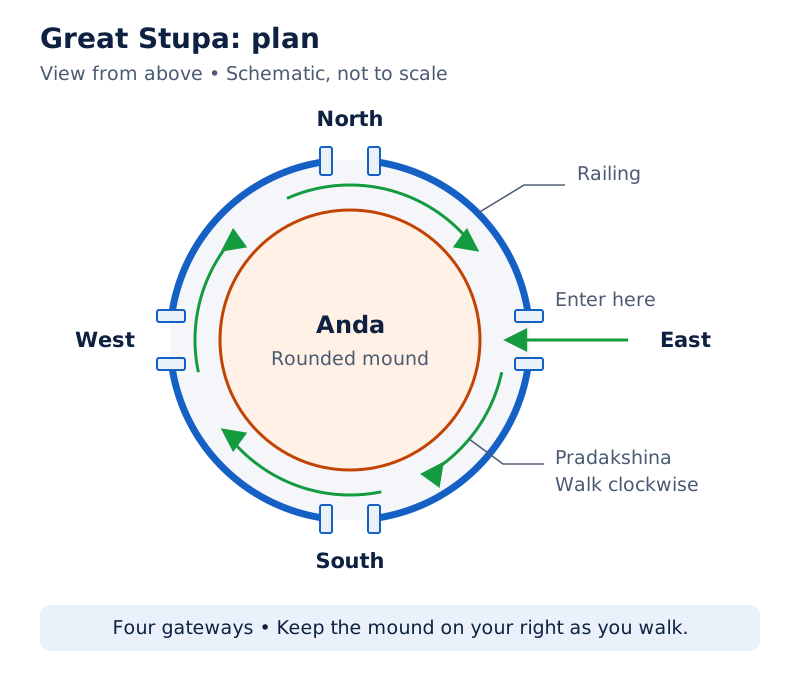
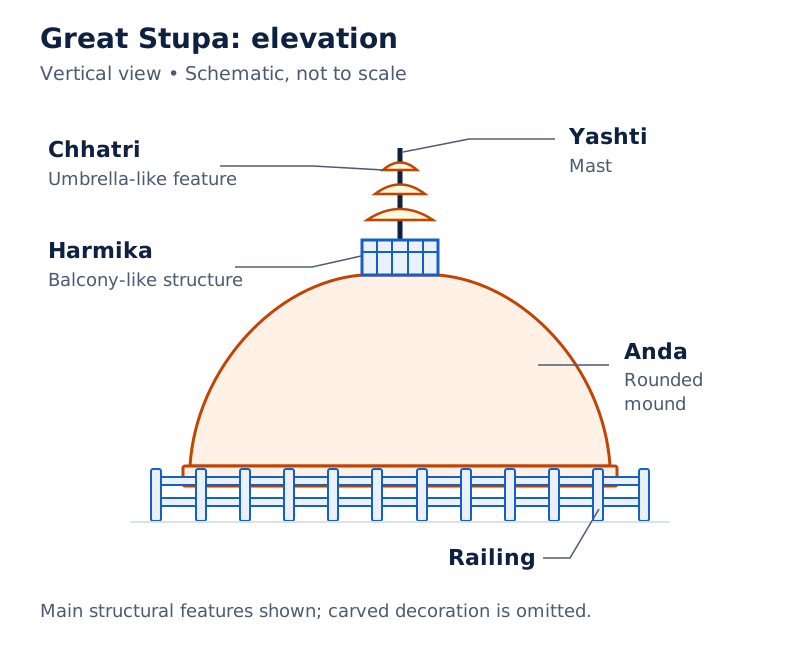
The plan, a view from above, shows circular outlines with gateways around them. The elevation, a vertical view, shows the rounded mound rising above the surrounding railing and the structure at its summit.
Drawn by One Young India.
Photograph: The Great Stupa at Sanchi. The photograph shows the large rounded mound, stone railing, a carved gateway and steps approaching the monument. Trees partly obscure the structure. This is a photograph of the surviving monument.
What do donations and preservation reveal?
Inscriptions on stupas record contributions from kings, guilds, women, men, Buddhist monks and nuns. Ivory workers financed part of a gateway at Sanchi. Such records show that support for Buddhist monuments extended beyond the royal court.
Shahjehan Begum and Sultan Jehan Begum, rulers of Bhopal, supported Sanchi’s preservation. Original gateways remained at the site while plaster-cast copies satisfied demands for display elsewhere. The preserved monument allows architecture and inscriptions to be interpreted in their setting.
Shahjehan Begum ruled Bhopal from 1868 to 1901. Her successor Sultan Jehan Begum funded Sanchi’s museum, Marshall’s guesthouse and the publication of his volumes. Patronage therefore supported both the physical preservation of the site and the recording of its history.
Which dates trace Sanchi’s rediscovery and conservation?
| Year | Development in study or preservation |
|---|---|
| 1818 | Sanchi was rediscovered with three gateways standing, the fourth fallen and the mound in good condition. |
| 1854 | Alexander Cunningham published Bhilsa Topes, an early work on Sanchi. |
| 1880 | H.H. Cole was appointed Curator of Ancient Monuments. He advocated keeping original sculptures at their sites and supplying museums with plaster casts. |
| 1914 | John Marshall and Alfred Foucher published The Monuments of Sanchi. |
| 1923 | John Marshall published the Conservation Manual. |
| 1989 | Sanchi was declared a World Heritage Site. |
Glossary
- Empire — An extensive political formation bringing several territories or kingdoms under a powerful ruler or ruling authority.
- Dynasty — A succession of rulers from the same family, such as the Mauryan ruling family.
- Arthashastra — A work on governance and economics whose subjects include administration, defence, justice and public welfare.
- Indika — Megasthenes’ account of India, now surviving through excerpts quoted by later Greek writers.
- Edict — An official declaration issued by an authority, such as Ashoka’s messages engraved on rocks and pillars.
- Epigraphy — The study of inscriptions, including writings engraved on stone, metal and other hard surfaces.
- Script — A writing system used to represent a language, such as Brahmi used for Prakrit inscriptions.
- Dhamma — The Prakrit form of dharma, used for moral principles and ethical duties promoted by Ashoka.
- Dhamma mahamattas — Special officers appointed by Ashoka to spread Dhamma and attend to matters involving religious communities.
- Pativedaka — A reporter who brought information about the affairs of the people to the king.
- Guild — An association of people such as traders or craftspeople who organised aspects of their economic activity.
- Saptanga — Kautilya’s concept of seven constituent parts that together sustain a secure and prosperous kingdom.
- Stupa — A sacred mound associated with relics and venerated as an emblem of the Buddha and Buddhism.
- Pradakshina — Walking around a sacred monument in worship, keeping the object of reverence on the right.
Common errors and misconceptions
- Misconception: Ashoka founded the Mauryan Empire. Correct: Chandragupta founded it around 321 BCE; Ashoka was his grandson.
- Misconception: Bindusara ruled after Ashoka. Correct: The principal sequence is Chandragupta, Bindusara and then Ashoka.
- Misconception: Prakrit and Brahmi are both languages. Correct: Prakrit is a language; Brahmi is a script used to write it.
- Misconception: Every part of the empire was governed identically. Correct: Uniform administration is unlikely; control was likely strongest near major political centres.
- Misconception: Every royal claim proves a policy was fully implemented. Correct: Edicts communicate orders and intentions; their practical effects need separate assessment.
- Misconception: Ashoka’s concern extended only to Buddhists. Correct: His Dhamma promoted respect for other traditions, and his officers worked with several religious communities.
- Misconception: The entire surviving Sanchi monument was built at one time by Ashoka. Correct: Its original brick structure was later enlarged in stone, with contributions from different donors.
- Misconception: The whole Arthashastra was certainly written by Chandragupta’s minister. Correct: Parts were probably composed by Kautilya, whose ministerial role is traditionally believed.
Exam-style questions with model answers
Q1. Prakrit is a language and Brahmi is a writing system. Most Ashokan inscriptions use Prakrit, and most Prakrit inscriptions use Brahmi. Define language and script, giving the example of each used in Ashokan inscriptions. [2 marks]
- A language is a means of expression; Prakrit is the language used in most Ashokan inscriptions.
- A script records a language in written signs; Brahmi was used to write most Prakrit inscriptions.
Q2. Chandragupta founded the Mauryan Empire around 321 BCE. His son Bindusara succeeded him, followed by Bindusara’s son Ashoka. Arrange these rulers chronologically and identify each ruler’s place in the succession. [3 marks]
- Chandragupta Maurya comes first. He founded the Mauryan Empire around 321 BCE and began the sequence of rulers described in the information.
- Bindusara comes second. He was Chandragupta’s son and successor, placing him between the founder of the empire and the later ruler Ashoka.
- Ashoka comes third. He was Bindusara’s son and successor, and therefore Chandragupta’s grandson, rather than the founder of the Mauryan Empire.
Q3. Compare these sources: the Arthashastra gives administrative recommendations and parts were probably composed by Kautilya; Indika records Megasthenes’ observations but survives only in later excerpts; Ashokan Edicts communicate royal messages; Sanchi contains architecture and inscriptions from different periods. Give one use and associated caution for each source. [4 marks]
- The Arthashastra helps explain ideas about administration. Its recommendations should not automatically be treated as descriptions of actual practice, and its attribution to Kautilya remains qualified.
- Indika supplies observations associated with Megasthenes. Since it survives in later excerpts, the material available is not the complete original account.
- Ashokan Edicts reveal royal messages and instructions. They show what the ruler communicated, which does not by itself prove complete implementation.
- Sanchi supplies architectural and inscriptional evidence. Its remains belong to different periods, so the whole surviving monument should not be attributed to one building phase.
Q4. Pataliputra was the capital; Taxila, Ujjayini, Tosali and Suvarnagiri were provincial centres. Taxila and Ujjayini lay on trade routes, and Suvarnagiri possibly served Karnataka’s gold mines. Land and river journeys could take weeks or months and required supplies and protection. Control was likely strongest near major centres. Explain five features of Mauryan administration using this information. [5 marks]
- Pataliputra served as the capital, giving the empire a principal centre of government from which affairs across a much wider territory could be addressed.
- Taxila, Ujjayini, Tosali and Suvarnagiri acted as provincial centres. Their existence shows that government depended on important regional centres as well as the imperial capital.
- The location of centres mattered economically. Taxila and Ujjayini were on trade routes, while Suvarnagiri was possibly useful for access to Karnataka’s gold mines.
- Communication required practical support. Long journeys along land and river routes made the provision of supplies and protection essential for people travelling through the empire.
- Administrative control was uneven. It was likely strongest around the main centres, so these arrangements do not establish identical government throughout every imperial region.
Q5. Ashoka’s Kalinga inscription places the conquest after eight years of his rule. It reports 150,000 people deported, 100,000 killed and many more dead, expresses repentance, and links the conquest to increased devotion to Dhamma. Explain three ways this evidence makes Kalinga a turning point. [3 marks]
- The account presents conquest as a cause of enormous suffering: deportation, killing and further deaths. It therefore directs attention to the human cost of military expansion.
- Ashoka expresses repentance for that suffering. His response goes beyond recording a victory and shows a change in how he publicly judged the consequences of conquest.
- The inscription connects the conquest with increased devotion to Dhamma. Moral instruction became part of his response to the suffering described in the account.
Q6. Ashoka promoted respect for elders, generosity towards religious people, kindness to slaves and servants, respect for other traditions and fair conduct by officials. He appointed Dhamma officers, issued edicts and claimed welfare measures such as wells and medical care. Explain six aspects of this policy, distinguishing royal claims from proven results. [6 marks]
- Respect for elders made consideration within personal relationships part of the conduct Ashoka encouraged. Dhamma therefore concerned everyday behaviour as well as the actions of rulers.
- Generosity towards religious people encouraged support for those engaged in religious life. It connected moral conduct with concern for people outside one’s immediate household.
- Kindness to slaves and servants addressed the treatment of dependants. It made the behaviour of people with power over others an explicit moral concern.
- Respect for other traditions promoted tolerance, while fairness by officials applied moral expectations to government. Both principles concerned relationships across differences of belief or authority.
- Dhamma officers and edicts provided organised means of spreading the message. The policy used appointments and public communication to promote its principles across the empire.
- Claims about wells and medical care show a declared concern for welfare. They do not alone demonstrate that every promised measure was completely implemented everywhere.
Q7. At Sanchi, the original brick stupa was later enlarged in stone. Its rounded mound is the anda; above it are the harmika and mast or yashti. Railings enclose sacred space, and devotees walk clockwise with the mound on their right. Explain four features of the monument using these details. [4 marks]
- The use of brick followed by enlargement in stone shows that Sanchi developed through different building phases rather than being completed in a single operation.
- The anda is the rounded mound forming the principal body of the stupa. It provides the central structure around which the other described features are arranged.
- The harmika stands above the mound, with the yashti or mast rising from it. These features belong to the upper part of the monument.
- Railings enclose the sacred area, while clockwise movement keeps the mound on the devotee’s right. The monument therefore organises both sacred space and worshippers’ movement.
Key takeaways
- Magadha’s productive agriculture, accessible iron, elephants and river routes supported the growth of a powerful state and then an empire.
- The principal dynastic sequence is Chandragupta Maurya, Bindusara and Ashoka; Chandragupta founded the empire around 321 BCE.
- The Arthashastra, Indika, Ashokan Edicts and Sanchi provide different kinds of evidence that need to be compared critically.
- Mauryan administration relied on a capital, provincial centres, officials, communication routes and military support, with uneven control across regions.
- The Kalinga account associates conquest with immense suffering, Ashoka’s repentance and his growing commitment to Dhamma.
- Dhamma emphasised moral conduct, kindness, religious tolerance and fair administration; special officers and edicts helped spread its message.
- Ashoka’s welfare declarations reveal royal priorities, but statements of intention should remain distinct from evidence of complete implementation.
- Sanchi preserves a developing Buddhist monument whose architecture and donor inscriptions reveal religious practices and support beyond the royal court.
Test yourself
Who founded the Mauryan Empire, and approximately when?
Chandragupta Maurya founded the Mauryan Empire around 321 BCE, with Pataliputra as his capital.
Where does Bindusara fit in the principal dynastic sequence?
Bindusara succeeded his father Chandragupta Maurya and was followed by his son Ashoka.
Why should the authorship of the Arthashastra be described cautiously?
Parts were probably composed by Kautilya, who is traditionally believed to have been Chandragupta’s minister.
What were the five major political centres of the empire?
They were the capital Pataliputra and the provincial centres of Taxila, Ujjayini, Tosali and Suvarnagiri.
What did the second military subcommittee organise?
It managed transport and provisions, including bullock carts, soldiers’ food, animal fodder and the recruitment of support workers.
What were dhamma mahamattas appointed to do?
They were special officials appointed to spread Dhamma and attend to matters involving different religious communities.
What is the distinction between Prakrit and Brahmi?
Prakrit is a language, while Brahmi is a script used to write most Prakrit Ashokan inscriptions.
How did worshippers move around the stupa at Sanchi?
They entered through the eastern gateway and walked clockwise, keeping the mound on their right.
Try it
The Mauryan Empire: Administration and Governance
Step into the Mauryan Empire and test your understanding of its administrative strategies and governance.
1Imagine you are an advisor to Chandragupta Maurya planning to expand the empire. Based on the text's logic for sustainable expansion, what is the most crucial administrative step to take alongside building your military?
Correct! The text states that expansion becomes sustainable when the centre can pay armies, control routes, and ensure stable administration, showing that empire-building requires organization, not just battle.
Incorrect. While Chandragupta used power vacuums, the text emphasizes that his rule shows an empire is built through organization and a system to maintain order, not just military battle.
2You are an archaeologist mapping the locations of Ashoka's edicts. You find them spread across multiple distant regions. According to the text, what does this widespread network of edicts tell you about the Mauryan state?
Incorrect. The text notes that Ashoka shifted away from aggressive expansion toward moral governance (dhamma) after the Kalinga war.
Correct! The text explains that placing messages in public spaces across many locations implies the ruler wanted people to understand his policies, proving the empire's communication reach and wider administrative presence.
Great job! You've successfully applied the historical logic behind Mauryan administrative planning and Ashoka's communication strategies.