
The Vedic Period | ICSE Class 9 History & Civics Notes
On this page
Try an idea before you read. Step into the shoes of an elder living through the dramatic transitions of the Vedic Age... Explore →

This note covers the Vedic setting, the four Vedas and epics, family life, kings and assemblies, social divisions, the position of women, economic changes, the four stages of life and education.
What is the historical setting and timeline of the Vedic Period?
The Vedic Period takes its name from the Vedas, ancient collections of religious compositions. The word Veda comes from the Sanskrit root vid, meaning knowledge. Sanskrit is the language in which these compositions were preserved.
The Rigveda, the oldest of the four Vedas, contains hymns, meaning prayers expressed as poems or songs. Its language is an early form of Sanskrit. The other three collections are the Yajur Veda, Sama Veda and Atharva Veda.
How should the chronology be understood?
BCE means Before Common Era; CE means Common Era. The abbreviation c. means circa, or approximately. A date range for a collection concerns its composition or compilation, rather than the lifetime of a single author.
| Approximate period | Development |
|---|---|
| c. 1500 to 1000 BCE | Compilation of the Rigveda and the early Vedic tradition associated with it. |
| c. 1000 to 500 BCE onwards | Some sacrifices, rituals involving offerings to deities (gods or goddesses), were performed by household heads; elaborate sacrifices were associated with chiefs and kings. |
| c. 1000 BCE | A marriage mantra expressing the hope for sons was probably inserted into the Rigveda. |
| c. 1000 BCE onwards | Gotra classification, especially among Brahmanas, associated groups with descent from Vedic seers. |
| c. sixth century BCE onwards | The Upanishads, philosophical texts, explored life, death, rebirth (being born again) and ultimate reality, meaning the underlying truth of existence. |
| c. 500 BCE onwards | Social norms were compiled in the Dharmasutras and Dharmashastras, Sanskrit texts prescribing conduct. |
| c. 500 BCE onwards | The Mahabharata developed over about a thousand years, preserving stories and social teachings. |
| c. 200 BCE to 200 CE | The Manusmriti was compiled as a work prescribing social conduct. |
| c. 200 BCE to 200 CE | A further phase of Mahabharata composition coincided with the growing importance of Vishnu worship and the identification of Krishna with Vishnu. |
| c. 200 CE to 400 CE | Large instructional sections resembling the Manusmriti were added to the Mahabharata. This was a later stage in the epic's development. |
These stages overlap. The later development of an epic should not be mistaken for a date when every incident in its story happened. Similarly, a change in religious practice need not have occurred everywhere at the same moment.
Early Vedic society was organised into janas, or clans, meaning larger groups of people. The Rigveda names over thirty janas, including the Bharatas, Purus, Kurus and Yadus. Each was associated with a particular region in the northwestern subcontinent.
Note: The exact date of the Rigveda's composition is difficult to establish. Scholarly proposals range from the fifth to the second millennium BCE. The approximate compilation range above must not be treated as a universally agreed date of first composition.
What do the Vedas reveal as literary sources?
A literary source is a text used to investigate the past. The Vedas provide evidence about prayers, values, occupations and collective life. Their purpose was religious and cultural, so they do not present a continuous account of political events.
Which are the four Vedas?
| Veda | Main character | Historical use |
|---|---|---|
| Rig Veda | A collection of hymns addressed to deities, meaning gods and goddesses. | Evidence for early beliefs, prayers, clans and social life. |
| Yajur Veda | Formulas and directions connected with sacrificial rituals. | Evidence for the organisation and performance of rituals. |
| Sama Veda | Chants used in worship, drawing largely on Rigvedic verses. | Evidence for the musical recitation of sacred compositions. |
| Atharva Veda | Hymns and spells concerned with matters including health and everyday wellbeing. | Evidence for concerns extending into domestic and daily life. |
Oral transmission means passing knowledge through speech and memory. Vedic hymns were recited rather than originally written down. Rigorous training preserved their wording with hardly any alterations over many generations. Oral preservation therefore involved disciplined learning, not casual retelling.
The composers included rishis, male seers or sages, and rishikas, female seers. Hymns addressed deities such as Agni, associated with fire, and Indra. Prayers for cattle, sons, health and long life help explain the concerns of those performing sacrifices.
How do the different texts fit together?
The Rigveda's compilation is placed at c. 1500 to 1000 BCE. By contrast, the Mahabharata developed from c. 500 BCE onwards over about a thousand years. These dates distinguish an early hymn collection from the extended formation of an epic.
An epic is a long narrative about major characters and events that also conveys social and moral ideas. The Ramayana and Mahabharata belong to this category. They are important literary sources alongside the Vedas, but they are not additional Vedas.
Texts communicate both experiences and ideals. A prayer shows what its composer desired; it does not prove that everyone possessed what was requested. A rule shows expected behaviour; it does not by itself prove that all people followed it.
Why are the epics important for understanding society?
The Ramayana and Mahabharata preserve narratives about families, rulers, duties and conflicts. Their importance extends beyond the sequence of events in their stories. They show how people discussed proper conduct and relationships within households and political communities.
The Ramayana is traditionally associated with Valmiki and centres on Rama. The Mahabharata is traditionally attributed to Vyasa. Traditional attribution should be distinguished from the historical process through which a long text developed and acquired additions.
What does the Mahabharata illustrate?
The central conflict involves the Kauravas and Pandavas, two related groups within the Kuru ruling family. Their struggle concerns land and power. The Pandavas emerge victorious in the narrative, which reinforces the importance attached to succession through the male line.
Patriliny means tracing descent from father to son and grandson. Under this arrangement, sons could claim their father's resources after his death. For a ruling family, those resources could include the throne. This helps explain why family disputes became political struggles.
The epic contains both narrative, meaning storytelling, and didactic material, meaning instruction about conduct. These categories overlap: the narrative often contains a social message, and the didactic sections include stories.
In one episode, Gandhari urges her son Duryodhana to seek peace with the Pandavas. Her advice connects good kingship with control over greed and anger. His refusal makes the episode useful for considering the relationship between personal conduct and political consequences.
What are the limits of epic evidence?
The Mahabharata was composed over about a thousand years from c. 500 BCE onwards. Some stories may have circulated earlier. The present work therefore contains material from different stages rather than a single unchanged account of one period.
Between c. 200 BCE and 200 CE, another phase of composition coincided with growing worship of Vishnu and the identification of Krishna with him. Between c. 200 CE and 400 CE, large didactic sections resembling the Manusmriti were added.
Whether a real war lies behind its central story remains uncertain. Some historians think it preserves the memory of an actual conflict among relatives; others point to the absence of corroborating evidence for the battle. Corroborating evidence means independent evidence supporting a claim.
The epics are thus valuable for studying social ideas, family relationships, kingship and moral obligations. Their narratives should be read carefully, without assuming that each episode is a directly verified historical event or that every prescribed rule was universally practised.
How were the family and the early Vedic king organised?
The family was an important unit of early Vedic social life. The Sanskrit term kula denotes a family. Larger networks of relatives connected households, while the jana provided a wider collective identity associated with a region.
What was the position of the household head?
The household was generally patriarchal, meaning that its head was usually male and authority was centred on men. The head of the family supervised household affairs. Family life included economic work, the sharing of resources and religious responsibilities.
Patriarchy and patriliny describe related but different things. Patriarchy concerns authority; patriliny concerns descent. Keeping them separate helps explain how a society could favour male leadership and also attach importance to sons continuing the family line.
Rigvedic marriage prayers reveal concern for sons. One marriage verse, probably inserted around c. 1000 BCE, connects the bride's movement from her father's household to her husband's household with the hope for sons. The word probably is essential to its dating.
What was expected of the rajan?
Sacrificial practice also changed. Sacrifices were initially collective. Later, from c. 1000 BCE to 500 BCE onwards, some were performed by household heads for domestic wellbeing. Chiefs and kings performed elaborate rituals such as the rajasuya and ashvamedha, depending on Brahmana priests.
The rajan was a king or ruler. In the early Vedic setting, he is best understood as a leader associated with a people or clan. He should not automatically be pictured as the ruler of a large, centrally administered empire.
Protection of the people and their cattle, leadership in warfare and the maintenance of order were important royal responsibilities. The king worked within a society that also recognised assemblies. His position was therefore connected with collective institutions as well as personal leadership.
Bali was a contribution or offering made to the ruler. In the early Vedic context, it is commonly described as a voluntary contribution. It should be distinguished from the more regular revenue arrangements associated with developed territorial states.
Religion also mattered to political authority. Chiefs and kings later performed elaborate sacrifices with the assistance of Brahmana priests, members of a social group associated with religious learning and rituals. These ceremonies connected leadership with ritual status, while ordinary household rites concerned the wellbeing of the domestic group.
How did Sabha, Samiti and Vidhatha support collective life?
Sabha and Samiti are Vedic terms for collective gatherings or assemblies. Vidhatha, also spelt Vidatha, was another early gathering associated with collective activities. These institutions show that early Vedic public life involved more than the actions of the ruler alone.
How can the three assemblies be distinguished?
| Assembly | Broad character | Role to remember |
|---|---|---|
| Sabha | A relatively select council, commonly associated with elders. | Deliberation and advice on community affairs. |
| Samiti | A broader gathering of the people. | Discussion of matters affecting the community and its leadership. |
| Vidhatha | A gathering with social, religious and military associations. | Participation in collective activities, including ritual concerns. |
The distinction between a select council and a broader gathering is useful, but it should not be converted into a detailed modern constitution. The terms do not establish a fixed number of members, a modern electoral system or identical arrangements in every clan.
The existence of assemblies suggests consultation in public affairs. A ruler's leadership operated alongside the community's gathering and deliberation. Deliberation means considering and discussing matters before deciding what should be done.
What caution is necessary?
Not much is known of how the early janas governed themselves. The words for a ruler and assemblies provide clues, but they do not supply a complete account of procedures. Precise claims about universal membership or fixed legal powers would go beyond those clues.
Women are associated with participation in Vidhatha. This supports a more varied picture of early public life than the assumption that every collective activity excluded women. It does not establish equal participation by all women in every assembly or community.
Remember the names together, while retaining their different emphases: Sabha for a select gathering, Samiti for a broader gathering, and Vidhatha for collective social, religious and military activity. None should simply be equated with a present-day parliamentary chamber.
How did different social groups contribute to Vedic society?
Varna refers to one of the four broad social categories described in Vedic and later traditions. These were Brahmanas, Kshatriyas, Vaishyas and Shudras. Their descriptions connected social roles with knowledge, protection, production and other forms of work.
From c. 500 BCE, Brahmanas compiled social norms in the Dharmasutras and Dharmashastras. The Manusmriti was compiled between c. 200 BCE and 200 CE. These later prescriptions help distinguish changing ideals of social conduct from evidence of how people actually lived.
What roles were associated with Brahmanas?
Brahmanas, also called Brahmins, were associated with preserving and teaching knowledge and performing rituals. Later prescriptive texts, writings setting out expected conduct, describe studying and teaching the Vedas, conducting sacrifices, and giving and receiving gifts among their expected activities.
What roles were associated with Kshatriyas?
Kshatriyas were associated with rulership, warfare and the protection of society. Prescriptive texts also linked them with administering justice and maintaining social order. Their responsibilities were therefore broader than fighting alone.
What roles were associated with Vaishyas and Shudras?
Vaishyas were expected to increase society's wealth through agriculture, pastoralism and trade. Pastoralism means keeping and tending livestock. These productive activities supported both households and the wider community.
Shudras were associated with work as artisans, craftspeople, workers or servants. Prescriptive accounts expected them to assist the other three groups in the functioning of society. A prescribed role expresses an expectation rather than a complete description of every individual's occupation.
Were occupational roles completely fixed?
In early Vedic society, there appears to have been flexibility and mobility in occupational roles. A Rigvedic hymn gives the example of a poet whose father is a physician and whose mother grinds grain. Different family members thus perform different work.
Jati refers to a community associated with a particular occupation and livelihood. It should not be used as an exact synonym for varna. The fourfold varna scheme is a broad classification, whereas occupational communities could be numerous and develop their own customs.
Over time, the wider social system became more rigid and produced inequalities. This long development should not be compressed into a claim that every occupation was fixed by birth throughout the whole Vedic Period. Both changing practices and prescribed ideals matter.
How did the position of women compare in early and later Vedic society?
Women's position involved several aspects: household responsibilities, access to learning, religious participation and public activity. These aspects did not necessarily change together. A careful comparison recognises both the generally stronger early position and evidence of learned women in later traditions.
What opportunities existed in the early period?
Rishikas composed Vedic hymns alongside male rishis. Their contribution provides direct evidence that women participated in the preservation and expression of sacred knowledge. The history of Vedic learning therefore cannot be described as exclusively male.
Women could participate in religious life, and their participation is associated with Vidhatha. Nevertheless, the family was generally patriarchal and prayers expressed a preference for sons. Participation in learning or ritual should not be equated with complete equality in every sphere.
| Aspect | Early Vedic society | Later Vedic society |
|---|---|---|
| Learning | Female seers contributed hymns and participated in intellectual life. | Women's access became more restricted, though learned women remained important. |
| Public participation | Women are associated with collective gatherings such as Vidhatha. | Their general position became more restricted. |
| Family | Male authority and concern for sons existed alongside women's participation. | Rules concerning marriage and family identity became more developed. |
Why is Gargi an important example?
Gargi is a woman thinker in the Brihadaranyaka Upanishad, a philosophical text. At King Janaka's court she questioned the sage Yajnavalkya about the world and ultimate reality. Her example prevents the mistaken claim that later women had no intellectual role.
Yajnavalkya initially asked her to stop questioning, but later Gargi resumed her questions and he continued the discussion. The episode presents questioning as part of learning and shows a woman participating in a public philosophical exchange.
A gotra was a group regarded as descended from a Vedic seer. A Brahmanical practice, meaning one associated with Brahmana traditions, evident from c. 1000 BCE onwards expected women to adopt their husband's gotra after marriage; members of the same gotra were not supposed to marry.
These were social prescriptions. They should not be treated as proof that every household followed identical rules. The safest comparison describes a broad decline in women's general position while retaining evidence of participation, learning and variation.
Why did the economy change between the early and later Vedic periods?
An economy consists of the activities through which people produce, exchange and use goods and services. In the early Vedic economy, cattle rearing was especially important, while agriculture was also practised. Later, cultivation acquired greater importance alongside continuing pastoral and craft activities.
What characterised the early economy?
Cattle were an important form of wealth. Prayers for cattle indicate their value to households and communities. The importance of cattle also helps explain why protecting herds formed part of the ruler's responsibilities.
Early society should not be described as having no cultivation or crafts. Vedic texts mention agriculturists, weavers, potters, builders, carpenters and healers. The coexistence of these occupations shows that economic life involved several kinds of useful work.
Barter, meaning the direct exchange of goods without money, was an important form of exchange. The early economy should not be pictured as depending on the developed coinage and urban markets of subsequent periods.
How did later developments alter production?
As settlement expanded in the Ganga plains, agriculture gained importance. The growth of cultivation, access to iron and the formation of new trade networks are possible reasons for the concentration of larger states in the Ganga plains. These developments belong to a gradual transition.
Iron tools improved people's ability to work the land and undertake other productive tasks. Greater agricultural production could support people engaged in crafts, exchange and administration. This relationship helps explain how changes in farming affected activities beyond the fields.
| Aspect | Early Vedic economy | Later Vedic economy |
|---|---|---|
| Main emphasis | Cattle rearing was especially important, with agriculture also present. | Agriculture acquired greater importance in an increasingly settled economy. |
| Resources | Cattle were an important form of wealth. | Cultivated land and agricultural output became increasingly important. |
| Crafts | Occupations included weaving, pottery and carpentry. | Craft activity developed alongside agricultural growth and wider exchange. |
| Exchange | Barter played an important role. | Expanding trade networks connected settlements and developing states. |
A janapada was a territory where a people had settled. The growth of janapadas linked communities more closely with defined areas. Trade networks helped connect these territories and contributed to their growth.
The comparison concerns a change in emphasis, not the replacement of one occupation by another. Later agricultural growth did not make cattle irrelevant, just as early pastoral importance did not mean that farming, craft production or exchange were absent.
What were the four ashramas and their responsibilities?
An ashrama, in this context, means an ideal stage of life with particular duties. The four stages were Brahmacharya, Grihastha, Vanaprastha and Sannyasa. The scheme connected education and family responsibilities with later withdrawal and spiritual reflection.
How did the stages form a sequence?
| Stage | Meaning | Expected responsibility |
|---|---|---|
| Brahmacharya | The stage of studentship. | Study with a teacher, develop discipline and practise self-control. |
| Grihastha | The stage of household life. | Marry, maintain a household, earn a livelihood and fulfil family and social duties. |
| Vanaprastha | The stage of withdrawal from household responsibilities. | Reduce attachment to worldly affairs and devote more attention to reflection. |
| Sannyasa | The stage of renunciation. | Give up worldly attachments and concentrate on spiritual liberation. |
Renunciation means giving up worldly attachments and claims. Spiritual liberation, or moksha, means release from the cycle of rebirth. These ideas explain the direction of the later stages without turning them into ordinary occupations.
The sequence begins with learning because a student is expected to acquire knowledge and discipline. Household life then brings responsibilities towards family and society. Withdrawal and renunciation turn attention increasingly towards spiritual concerns.
Was this a description of everybody's life?
The fourfold arrangement was an ideal, not a record proving that every person completed all four stages. It was especially associated with men of the first three varnas in Brahmanical prescriptions. Access and actual practice were not uniform.
Varna and ashrama answer different questions. Varna concerns a broad social category and its associated roles. Ashrama concerns a stage in an individual's ideal life. A list of four varnas must therefore not be substituted for the four ashramas.
Diagram
Four ashramas
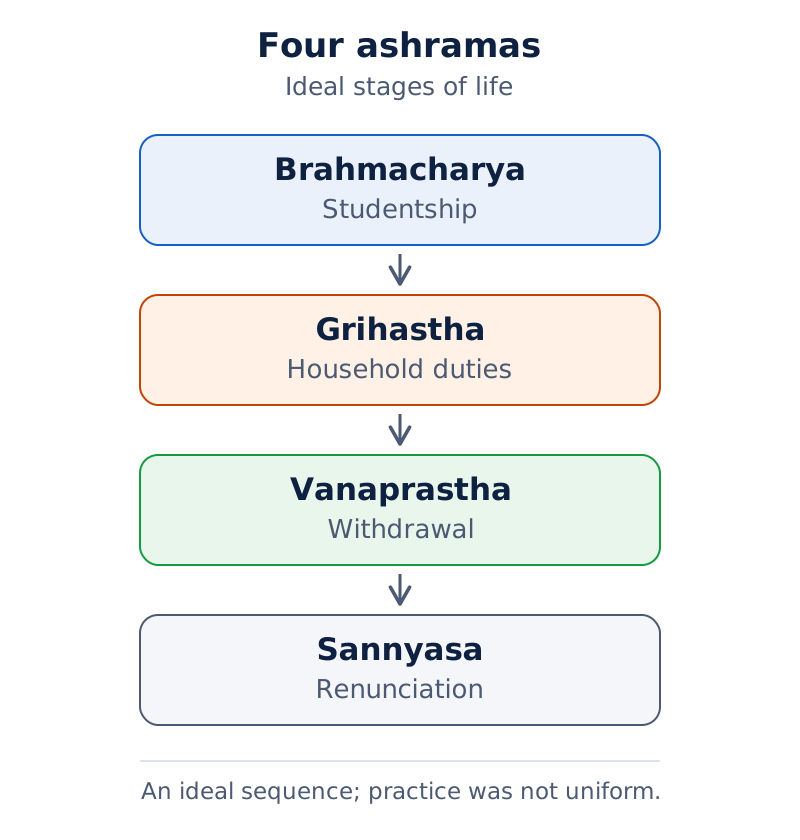
Draw four boxes in sequence: Brahmacharya, Grihastha, Vanaprastha and Sannyasa. Beneath them write studentship, household duties, withdrawal and renunciation. Label the sequence “ideal stages of life”, since it does not describe universal practice.
Drawn by One Young India.
How did education work, and what was its cultural significance?
Education preserved knowledge, trained memory and encouraged reflection on human life. A guru was a teacher; a gurukula was a setting in which pupils lived and learnt under a teacher's guidance. The teacher-pupil relationship was central to this tradition.
How was knowledge learnt and preserved?
Recitation means speaking a learnt passage aloud. Students listened, repeated and memorised compositions. Careful oral training helped preserve the Vedas with hardly any alterations. Accurate wording mattered because the compositions were passed from one generation to the next through memory.
Life under a teacher involved study and discipline. The studentship stage, Brahmacharya, expressed this connection between learning and self-control. Education should therefore be understood as training in conduct as well as the acquisition of remembered material.
The Upanishads are philosophical texts that explore questions about the self, life and ultimate reality. Their stories show the importance of questioning, whether questions came from men, women or children. Memorisation and inquiry were both part of the intellectual tradition.
What does Shvetaketu's story teach?
In the Chandogya Upanishad, Uddalaka Aruni sends his son Shvetaketu to a gurukula to learn the Vedas. Shvetaketu returns after twelve years, proud of his learning. His father then asks questions that the son cannot answer.
The questions concern brahman, the divine essence understood in this teaching as underlying everything. Uddalaka uses the example of a banyan seed: although its interior seems empty when opened, it contains the possibility of the future tree.
He also uses the example of different pots made from the same clay. These examples explain how varied things can arise from one underlying essence. The story distinguishes possessing remembered knowledge from understanding the ideas to which it points.
How did questioning extend beyond formal study?
In the Katha Upanishad, Nachiketa persistently asks Yama, the god of death, what happens after the body dies. Yama eventually explains the atman, or self, as neither born nor dying. This is presented as a philosophical teaching.
Gargi's questions at Janaka's court provide another example of inquiry. Together, these stories show that discussion, illustration and persistent questioning had a place alongside oral preservation. They do not establish that everyone enjoyed equal access to education.
The cultural significance of this educational tradition lies in the preservation of ancient compositions and the development of questions about knowledge, conduct and existence. Its emphasis on learning and reflection connects the Vedas, the ideal of studentship and later philosophical debate.
Glossary
- Veda — An ancient collection of sacred compositions; the name derives from a Sanskrit root meaning knowledge.
- Hymn — A prayer expressed as a poem or song, addressed in Vedic compositions to deities.
- Oral transmission — The passing of knowledge through spoken teaching, recitation and memory across generations.
- Jana — A clan or larger group of people associated with a particular region in early Vedic society.
- Rajan — A king or ruler associated with the leadership of a people or community.
- Sabha — A Vedic assembly, commonly understood as a relatively select gathering associated with community elders.
- Samiti — A broader Vedic gathering concerned with matters affecting the community and its leadership.
- Vidhatha — An early gathering associated with collective social, religious and military activities within the community.
- Patriliny — The tracing of descent through fathers, sons and grandsons across successive generations.
- Varna — One of four broad social categories associated with different roles in Vedic and later traditions.
- Pastoralism — An economic activity centred on keeping and tending livestock as a means of livelihood.
- Ashrama — An ideal stage of life associated with duties such as learning, household responsibility or renunciation.
- Gurukula — A setting where pupils lived and learnt under the guidance of a teacher.
- Upanishads — Philosophical texts exploring questions about the self, existence and the nature of ultimate reality.
- Didactic — Intended to instruct, particularly by presenting ideas about proper behaviour or social duties.
Common errors and misconceptions
- Misconception: The Ramayana and Mahabharata are two of the Vedas. Correct: They are epics; the four Vedas are Rig, Yajur, Sama and Atharva.
- Misconception: The Vedas were preserved originally as written books. Correct: They were transmitted orally through disciplined recitation and memory.
- Misconception: Every epic episode is a verified historical event. Correct: Epics preserve stories and social ideas; the historical basis of the Mahabharata war remains uncertain.
- Misconception: Sabha and Samiti were identical to modern parliamentary chambers. Correct: They were assemblies, but their existence does not establish modern membership rules or electoral procedures.
- Misconception: Women had no part in Vedic learning. Correct: Rishikas composed hymns, and Gargi participated in philosophical debate.
- Misconception: Early pastoral life excluded farming and crafts. Correct: Agriculture and occupations such as weaving, pottery and carpentry existed alongside cattle rearing.
- Misconception: Varna and ashrama mean the same thing. Correct: Varna concerns social categories; ashrama concerns ideal stages of life.
- Misconception: Every occupation was completely fixed throughout the Vedic Period. Correct: Early occupational roles appear to have allowed flexibility; the poet's family illustrates different work within one household.
Exam-style questions with model answers
Q1. A record describes hymns learnt by listening and reciting, then passed to the next generation through memory. Using this information, identify the method of preservation and explain how knowledge was passed on. [2 marks]
- The method was oral transmission, since the hymns were preserved through speech and memory.
- Each generation learnt the compositions by listening and reciting, then taught them orally to the next generation.
Q2. Use these descriptions to distinguish the four Vedas: Rig contains hymns to deities; Yajur contains sacrificial formulas and directions; Sama contains chants used in worship; Atharva includes hymns and spells concerning health and everyday wellbeing. Give one explained point for each. [4 marks]
- The Rig Veda is distinguished by hymns addressed to deities. It therefore expresses religious praise through poetic compositions.
- The Yajur Veda concerns sacrificial formulas and directions. Its description connects it with the performance of rituals.
- The Sama Veda contains chants used in worship. Its distinctive emphasis is therefore on sacred chanting.
- The Atharva Veda includes hymns and spells about health and everyday wellbeing, connecting religious concerns with daily life.
Q3. Sabha is described as a relatively select council associated with elders that discusses and advises on community affairs; Samiti as a broader gathering discussing community affairs; Vidhatha as a gathering with social, religious and military associations. Explain these three descriptions without equating them with modern parliamentary chambers. [3 marks]
- Sabha was a relatively select body associated with elders. Its description suggests a council for discussing and advising on matters affecting the community.
- Samiti was a broader gathering. Its concern with community affairs linked collective discussion with questions affecting the people and their leadership.
- Vidhatha covered social, religious and military activities. Its functions therefore extended across several aspects of collective life rather than a single narrowly defined activity.
Q4. Consider five statements: female seers composed Vedic hymns; women participated in religious life; early households generally centred male authority; women's general position became more restricted later; Gargi debated with Yajnavalkya at Janaka's court. Using these statements, give five points comparing women's position and explaining why complete exclusion is an inaccurate description. [5 marks]
- Female seers contributed to Vedic hymn composition. Their contribution shows that women could participate in the intellectual and religious work of preserving sacred knowledge.
- Women's participation in religious life means they were not absent from that sphere. Religious activity formed one part of their recognised social role.
- Early households nevertheless generally centred male authority. Participation in learning or religion therefore should not be taken as proof of complete equality within family life.
- The later period brought greater general restrictions on women's position. This establishes a broad contrast with their stronger participation in the early period.
- Gargi's debate provides evidence of a learned woman in the later tradition. It prevents the broad decline from being described as complete intellectual exclusion.
Q5. Compare the economies using these four paired observations: early cattle rearing was especially important, while later agriculture gained importance; early farming existed, while later cultivation expanded; crafts existed early and developed later; barter was important early, while later trade networks connected growing settlements. Give four explained comparisons. [4 marks]
- The economic emphasis shifted from the especially important role of cattle rearing towards a greater role for agriculture, without implying that livestock disappeared.
- Farming was already present early. Later expansion therefore represents growth in cultivation rather than the first appearance of agriculture.
- Crafts existed in both periods. Their later development indicates an expansion of activity, not a complete absence of early craft work.
- Early barter involved direct exchange, while later networks connected growing settlements. The comparison shows widening economic connections between communities.
Q6. Brahmacharya is studentship and learning, Grihastha is household life and its duties, Vanaprastha is withdrawal from household responsibilities, and Sannyasa is renunciation of worldly attachments. Explain the four stages in this order, using their stated meanings. [4 marks]
- Brahmacharya is the period of studentship. Learning and preparation come first in this ideal sequence of the stages of life.
- Grihastha is household life. The individual takes on the responsibilities associated with maintaining a household and fulfilling its duties.
- Vanaprastha involves withdrawal from household responsibilities. The emphasis shifts away from direct involvement in everyday household affairs.
- Sannyasa is renunciation. The final stage involves giving up worldly attachments rather than continuing the responsibilities associated with household life.
Q7. An epic develops over a long period, contains both stories and instructions about conduct, and lacks independent confirmation for every narrated event. Explain three reasons for using it cautiously as historical evidence. [3 marks]
- Development over a long period means the text can preserve material from different stages. Its contents should not all be assigned to one moment.
- Instructions describe how people were expected to behave. They do not automatically establish how every individual or community actually behaved.
- The lack of independent confirmation prevents every narrated event from being treated as verified history. Stories remain useful evidence for ideas without necessarily proving particular events.
Q8. Shvetaketu returned proud after twelve years learning the Vedas. His father Uddalaka asked questions he could not answer and used a banyan seed and pots made from clay to explain one underlying essence. From this account, identify four features of the teaching method. [4 marks]
- Learning involved an extended period of study, shown by Shvetaketu's twelve years devoted to the Vedas.
- The teacher used questions to test understanding, revealing that pride in learning did not guarantee the ability to explain ideas.
- The banyan seed supplied an example through which the teacher could explain an underlying possibility that was not immediately visible.
- The clay pots provided another illustration: different forms could share the same underlying substance, making an abstract idea easier to understand.
Key takeaways
- The Rig, Yajur, Sama and Atharva Vedas are four distinct collections preserved through disciplined oral transmission.
- The epics illuminate family relationships, kingship and moral ideas, but their narratives require careful historical interpretation.
- Early Vedic public life involved a ruler and assemblies; incomplete evidence limits detailed claims about their procedures.
- The four varnas described broad social roles, while early occupational life appears to have allowed flexibility.
- Women's general position became more restricted later, yet female seers and Gargi demonstrate important intellectual participation.
- The economy shifted towards greater agricultural importance while retaining cattle rearing, craft work and exchange.
- The four ashramas arranged learning, household duties, withdrawal and renunciation into an ideal sequence of life.
- Education combined oral preservation with discipline and inquiry, as illustrated by Shvetaketu, Nachiketa and Gargi.
Test yourself
Which four collections are called the Vedas?
The four are the Rig Veda, Yajur Veda, Sama Veda and Atharva Veda.
How does patriliny differ from patriarchy?
Patriliny traces descent through fathers and sons; patriarchy describes a social arrangement in which authority is centred on men.
What does the term jana mean?
It means a clan or larger group of people, associated in early Vedic society with a particular region.
What does the poet's family reveal about occupations?
The poet, his physician father and his grain-grinding mother illustrate different occupations within one family and apparent flexibility in early social roles.
Why does Gargi matter when comparing women's position?
Her philosophical questioning shows that a broad decline in women's general position did not eliminate women's intellectual participation.
Did agriculture begin only in the later Vedic Period?
No. It existed earlier; the later development was its greater importance and expansion alongside other economic activities.
Name the four ashramas in order.
Brahmacharya, Grihastha, Vanaprastha and Sannyasa represent studentship, household life, withdrawal and renunciation respectively.
What is the lesson of Shvetaketu's return from study?
Remembered learning and pride do not necessarily amount to understanding; questioning and concrete illustrations can develop deeper insight.
Try it
ICSE Class 9 History: The Vedic Period
Step into the shoes of an elder living through the dramatic transitions of the Vedic Age...
1Imagine you are an elder statesman. In your youth, you sat on the Sabha and helped check the tribal chieftain's power. Now, the ruler is performing an extravagant Ashvamedha sacrifice and ignoring the assembly. Based on the text, what political shift has occurred in your lifetime?
The text explains that in the Early Vedic period, the king's power was checked by assemblies like the Sabha. In the Later Vedic period, the king assumed autocratic powers, claimed divine sanctions through sacrifices like the Ashvamedha, and the assemblies lost their power.
This is backwards. The text states the transition went from Early Vedic tribal assemblies (Sabha and Samiti) to Later Vedic centralized monarchies and territorial realms (Janapadas).
The text states that both the Sabha and Samiti lost their representative power in the Later Vedic period, replaced by a new bureaucratic network of officials like the Bhagadugha (tax collector) and Senani (commander-in-chief).
2In this new era, your neighbor, a skilled farmer (Vaishya), wishes for his son to become a warrior (Kshatriya) because the boy is strong and brave. However, the village elders forbid it, stating his class is now fixed. How does this contrast with the society of your youth?
The text defines Ashramas as the four stages of life (student, householder, retirement, renunciation), not the social class system. The social class system is the Varna hierarchy, which shifted from occupational to birth-based.
The text notes that the Early Vedic Varna system allowed fluidity and social mobility based on occupation. By the Later Vedic phase, it hardened into a rigid, birth-based fourfold hierarchy, preventing a Vaishya from becoming a Kshatriya.
The Vedic Period was a time of massive transformation. As society shifted from the Early to the Later Vedic Age, flexible tribal structures and occupational mobility were replaced by autocratic territorial monarchs and a rigid, birth-based Varna hierarchy.