
Jainism and Buddhism | ICSE Class 9 History & Civics Notes
On this page
Watch & explore
Start with a few high-quality watches, then dive into the notes below.
Try an idea before you read. Step into the 6th century BCE spiritual revolution and navigate the practical choices faced by seekers of Jainism and Buddhism. Explore →
This note covers the background and rise of Jainism and Buddhism, Angas, Tripitakas and Jatakas, Mahavira and the Buddha, Jain doctrines of the Tri-ratnas, karma, equality and moksha, Buddhist teachings on suffering, the Eight-fold Path and Nirvana, and the communities that preserved these traditions.
What was the historical context of Jainism and Buddhism?
A changing world in the Ganga valley
The sixth century BCE was a period of religious enquiry and social change in northern India. New kingdoms and cities were developing in the Ganga valley. Thinkers considered both the meaning of human existence and the changing world around them.
The Rigveda, compiled around 1500 to 1000 BCE, preserves hymns praising deities and prayers for cattle, children and health. From around 1000 to 500 BCE onwards, some sacrifices were performed by household heads. Elaborate royal sacrifices depended on Brahmana priests.
Alongside these practices, people asked questions about death, rebirth and the consequences of actions. The Upanishads expressed some of these enquiries. Other teachers developed answers outside the authority of the Vedas. Religious thinking therefore involved both continuity and disagreement.
A shared setting, distinct teachings
Mahavira and Gautama Buddha belonged to this wider world of discussion. Their teachings questioned Vedic authority and stressed the possibility of liberation through personal effort. A person's spiritual progress need not be explained simply by inherited social position.
Travelling teachers discussed their ideas with other teachers and ordinary people. Debates took place in groves and meeting places. Followers could change their allegiance when persuaded by a different explanation. Ideas spread through conversation as well as through organised communities.
Jainism and Buddhism should therefore be studied as distinct traditions within a common historical setting. Their concern with suffering, conduct and liberation connected them to wider questions of the period, but their answers and disciplines were not identical.
Note: BCE and BC refer to the same era before the Common Era. The sixth century BCE is a broad historical period; it does not supply an exact birth year for either teacher.
Why did Jainism and Buddhism gain followers?
Questions about ritual and social position
One reason for their appeal was dissatisfaction with existing religious practices. Some people questioned whether sacrifices and ritual performance answered the problems of suffering, death and rebirth. Teachings that connected liberation with conduct offered a different focus for religious life.
Both Mahavira and the Buddha challenged the authority of the Vedas. Their emphasis on individual effort gave people a way to think about liberation beyond the claim that birth into a particular social group determined their spiritual possibilities.
This emphasis did not mean that ancient society suddenly became equal. It meant that religious teachers offered an alternative measure of worth: a person's actions and discipline. In Buddhism, the importance attached to conduct rather than superiority by birth helped attract followers.
Change, communication and compassion
Rapid changes in social and economic life also created uncertainty. New cities and kingdoms formed part of this background. People sought explanations that made sense of their experiences and offered a practical response to worldly troubles.
Oral teaching made discussion central to the spread of ideas. The Buddha's teachings were communicated through stories and conversation in language ordinary people understood. Jain teachings were also preserved in stories that could appeal to ordinary listeners.
Buddhist stress on compassion and fellow feeling was another attraction. Care for people who were weaker or younger gave ethical teaching a direct social meaning. Religion involved how people treated others, alongside questions about liberation.
Several factors therefore worked together: religious questioning, changing social conditions, emphasis on personal conduct, and effective communication. These are connected explanations, rather than a claim that every follower joined for the same reason.
The growth of communities helped sustain interest after a teaching was first heard. Monks and nuns practised and communicated the doctrines, while supporters outside monastic life helped maintain the religious community.
What do literary and archaeological sources reveal about these traditions?
Angas, Tripitakas and Jatakas
The Angas are important Jain canonical texts associated with the preservation of Mahavira's teachings. They belong to the literary evidence through which Jain religious ideas and discipline can be studied. They should not be confused with Buddhist collections.
The Tripitakas, also called Tipitaka, are Buddhist collections whose name means three baskets. The Buddha taught orally. His teachings were collected by followers after his death, transmitted orally, and eventually written down. Their later written form must be distinguished from the original teaching events.
| Collection | Principal subject | Historical use |
|---|---|---|
| Vinaya Pitaka | Rules governing the monastic community | Understanding the discipline of monks and nuns |
| Sutta Pitaka | The Buddha's teachings and discourses | Studying religious ideas and advice about conduct |
| Abhidhamma Pitaka | Philosophical matters | Understanding the analysis of Buddhist ideas |
The Jatakas tell stories about the Buddha's former births. They communicate Buddhist values through narrative. Their value as sources includes what they reveal about the ideals that followers wished to teach, rather than treating every narrated event as independently verified history.
How should religious texts be read?
A hagiography is a biography of a saint or religious leader. Such works often praise their subject and preserve followers' beliefs. Accounts of the Buddha's life were written down after his lifetime, so historical reading requires attention to their purpose.
Jain scholars produced literature in Prakrit, Sanskrit and Tamil. Manuscripts were preserved in temple libraries. Buddhist texts were preserved in monasteries and translated as the tradition spread. This transmission helped teachings survive across generations and regions.
Photograph: A Buddhist manuscript in Sanskrit, c. twelfth century. Two long, narrow manuscript leaves carry dense horizontal lines of writing. Cords pass through holes in the leaves. The photograph shows a physical form in which a text could be preserved.
The distinction between teaching, oral transmission and manuscript preservation is useful. An old teaching and a surviving copy of that teaching need not have the same date. The age of a manuscript alone cannot establish when an idea first arose.
Inscriptions and records of Buddhist monuments
Donative inscriptions on stupa railings and pillars record gifts from kings, guilds, monks, nuns and other women and men. Names, occupations, places of origin and family relationships help identify the people who financed Buddhist monuments.
Shahjehan Begum, ruler of Bhopal from 1868 to 1901, described Sanchi and Cunningham's investigations in her history of Bhopal. H.D. Barstow's translation appeared in 1876. Her account records nineteenth-century interest in the remains, rather than their original construction.
Archaeological publications include Cunningham's Bhilsa Topes (1854), Rajendra Lala Mitra's Buddha Gaya: The Heritage of Sakya Muni (1878), and Marshall and Foucher's The Monuments of Sanchi (1914). These works belong to the later study of Buddhist sites.
Who was Mahavira and what was his place in Jainism?
Vardhamana and the search for knowledge
Vardhamana, later known as Mahavira, was born near Vaishali in present-day Bihar in the early sixth century BCE. He came from a royal family. At the age of thirty, he left home to seek spiritual knowledge.
He followed a demanding ascetic discipline and attained supreme wisdom after twelve years. The name Mahavira means great hero. It refers to spiritual achievement, while the related Jain idea of conquest concerns overcoming ignorance and attachment rather than conquering territory.
Jain philosophy had roots before Mahavira. According to Jain tradition, he was preceded by twenty-three tirthankaras, making him the twenty-fourth. A tirthankara is a spiritual guide who helps people cross the difficulties of worldly existence.
Teaching and disciplined living
Mahavira taught that non-injury and rigorous self-discipline were central to spiritual progress. His message connected the treatment of living beings with the problem of bondage to repeated birth. Religious life required changes in conduct and attachment.
Asceticism means a disciplined life involving restraint and the renunciation of ordinary pleasures. Jain monastic life placed strong demands on those seeking liberation. Its emphasis on penance is an important point of comparison with Buddhist moderation.
Photograph: An image of a tirthankara from Mathura, c. third century CE. The stone figure sits with crossed legs and hands resting together in the lap. The head and upper body face forward.
The distinction between Mahavira's historical teaching and the longer Jain tradition prevents a common mistake. His importance does not require treating Jainism as an entirely new set of ideas with no earlier teachers or beliefs.
How do the Tri-ratnas, karma and moksha explain the Jain path?
The three jewels
The Tri-ratnas, or three jewels of Jainism, are right faith, right knowledge and right conduct. Together they describe the direction of spiritual life: accepting the path, understanding it correctly, and putting it into practice.
| Jewel | Meaning | Connection with spiritual progress |
|---|---|---|
| Right faith | Faith in the truth of the Jain teaching | Gives a person confidence in the path towards liberation |
| Right knowledge | Correct understanding of reality and the teaching | Replaces mistaken understanding with informed judgement |
| Right conduct | Living in accordance with that understanding | Expresses the teaching through restraint and ethical behaviour |
These jewels belong together. Knowledge is not a substitute for conduct, and simply claiming belief does not complete the path. The doctrine requires a relationship between understanding and the way a person lives.
Karma and release
In Jain teaching, karma binds the soul to the cycle of birth and rebirth. Actions therefore matter beyond their immediate visible results. Spiritual discipline aims at release from this bondage rather than merely gaining comfort or status within worldly life.
Moksha means liberation from karmic bondage and repeated birth. It is the goal towards which the three jewels direct a person. It should not be confused with wealth, political success or ordinary happiness.
Penance, self-restraint and renunciation are important in this path. Jain monastic life requires giving up attachments and observing a demanding discipline. A simple statement that good intentions are enough would miss the importance given to practice.
- Recognise the problem: worldly existence involves the continuing cycle of birth and rebirth.
- Understand the cause of bondage: karma shapes this cycle and makes conduct spiritually significant.
- Follow the three jewels: connect right faith and knowledge with right conduct.
- Seek liberation: pursue release through restraint, penance and renunciation.
This sequence is an outline of the relationship between the doctrines. It does not give a timetable for liberation. The important connection is that the Jain goal and the Jain discipline form parts of one account of spiritual freedom.
What do ahimsa and equality mean in Jain teaching?
Non-injury as a principle of life
Ahimsa means non-injury or non-violence. Jain teaching gives life a very wide scope, extending beyond human beings and animals to plants and even elements such as water. Care towards living beings is therefore central, rather than a minor rule.
This is a religious understanding of the world. It explains why avoiding injury has such importance within Jain discipline. The moral responsibility of a person does not end with their relationships to other human beings.
Ahimsa also includes restraint in thought. Harbouring hostility is different from developing a disposition of care. Attention to one's thoughts and actions connects non-injury with the broader discipline of overcoming attachment and harmful impulses.
The vows and spiritual equality
Jain monks and nuns took five vows. These vows connected non-violence with truthfulness, restraint and renunciation. They show that religious discipline governed several aspects of life, rather than a single action.
- Abstain from killing or injuring living beings.
- Abstain from stealing.
- Abstain from lying.
- Observe celibacy.
- Abstain from possessing property.
Equality concerns the rejection of inherited status as the sole measure of spiritual worth. Mahavira's emphasis on personal effort challenged the idea that birth alone determined a person's prospects of liberation. Conduct and discipline became central to the spiritual path.
This principle should not be turned into an unsupported claim that every social inequality disappeared. A teaching about spiritual effort and the actual organisation of ancient society are different matters. The principle explains an ideal and its challenge to inherited privilege.
Aparigraha, or non-possession, reinforces this discipline through detachment from material possessions. Together, non-injury, restraint and reduced attachment explain why the Jain path asks for a transformation of life rather than ritual performance alone.
How did Siddhartha become the Buddha?
Encountering suffering
Siddhartha Gautama was born at Lumbini, in present-day Nepal, and belonged to the Sakya clan. Traditional accounts describe his early life as sheltered. His encounters with suffering form an important part of the story of his religious search.
He saw an old man, a sick man and a corpse. These sights confronted him with ageing, illness and death. He also saw an ascetic who appeared peaceful, suggesting that a different way of life might offer an answer to suffering.
These are remembered as part of the traditional account of his life. Their central meaning is the contrast between a protected existence and the difficulties that affect human beings. Siddhartha left palace life to search for understanding.
Enlightenment and moderation
His search included severe bodily hardship. After finding such extremes unsatisfactory, he abandoned them. Meditation beneath a pipal tree at Bodh Gaya, in present-day Bihar, led to enlightenment. He then became known as the Buddha, the Enlightened One.
The teaching that followed emphasised a path of moderation between self-indulgence and severe penance. This Middle Way is a key difference from the demanding ascetic emphasis associated with Jain liberation.
The Buddha taught dhamma, the path of righteous living. He sought to communicate through reason, discussion and stories that people could understand. His teaching addressed both the problem of suffering and the conduct of people towards one another.
The movement from sheltered life to enquiry, enlightenment and teaching gives the story its structure. Memorising places without these connections would miss why the Buddha's search is closely related to the content of his doctrines.
What are the Four Noble Truths?
Understanding suffering and its cause
The Four Noble Truths explain the problem of suffering and the possibility of release from it. They form a connected argument. The teaching identifies a problem, explains its cause, affirms that the cause can end, and sets out a path.
- The truth of suffering: human existence involves suffering and dissatisfaction.
- The cause of suffering: craving and attachment sustain suffering.
- The ending of suffering: suffering can cease when craving is overcome.
- The path to its ending: the Eight-fold Path provides the discipline through which this freedom is pursued.
The word dukkha expresses the problem of suffering. The teaching does not stop at noticing illness or death. It asks why people remain caught in dissatisfaction and how their relationship to desire and attachment can change.
Why the truths form a sequence
The second and third truths are directly connected. If craving helps sustain suffering, overcoming craving makes release possible. The fourth truth then makes the teaching practical by connecting understanding with a disciplined way of living.
Calling Buddhism simply pessimistic ignores this movement towards liberation. The acknowledgement of suffering is followed by the possibility of ending it. The purpose is to guide a response to suffering, rather than merely describe its presence.
Impermanence is also important. The world is continually changing, and attachment cannot make changing things permanent. This helps explain why the Buddha linked suffering with the way people cling to worldly experiences and possessions.
Diagram
The Four Noble Truths
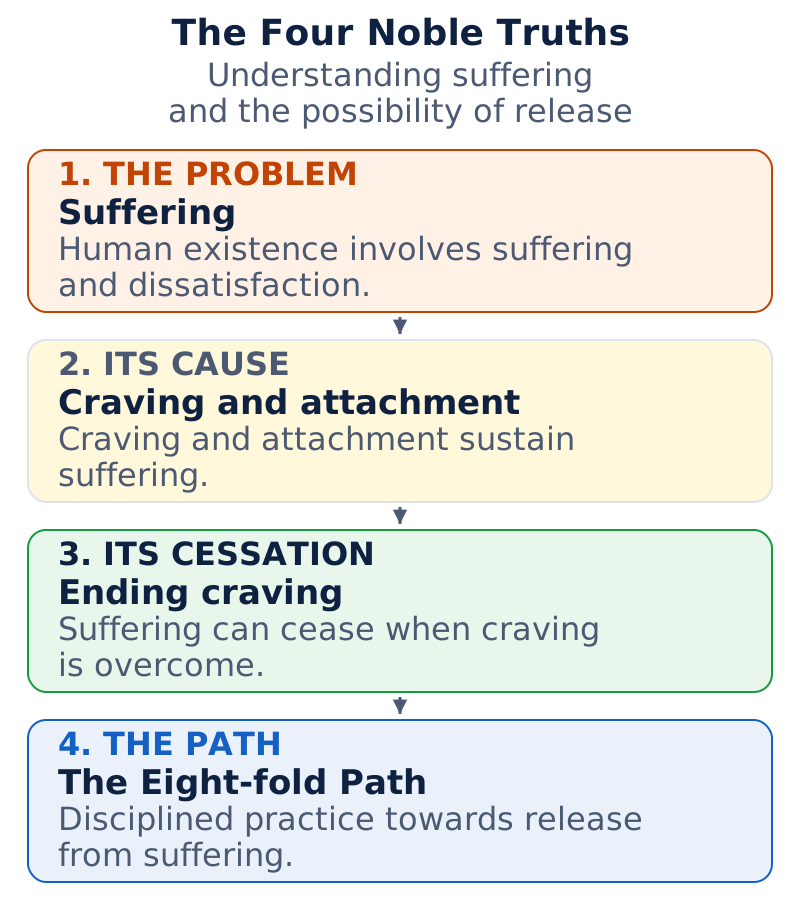
Draw four linked boxes labelled suffering, craving and attachment, ending craving, and the Eight-fold Path. Use arrows to show the connection between the problem, its cause, its cessation and the path.
Drawn by One Young India.
How do the Eight-fold Path and Nirvana complete Buddhist teaching?
The eight connected aspects of practice
The Eight-fold Path joins understanding, ethical conduct and mental discipline. Its parts support one another. It should not be treated as eight unrelated rules or as a set of stages completed once and then left behind.
| Aspect | Meaning in practice |
|---|---|
| Right understanding | Understand suffering, its causes and the possibility of liberation. |
| Right intention | Cultivate intentions of renunciation, goodwill and non-harm. |
| Right speech | Avoid false and harmful speech, and speak truthfully. |
| Right action | Act ethically and refrain from harmful conduct. |
| Right livelihood | Earn a living in ways consistent with ethical conduct. |
| Right effort | Work to prevent harmful mental states and develop wholesome ones. |
| Right mindfulness | Maintain attentive awareness of the body, feelings and mind. |
| Right concentration | Develop a focused mind through meditative discipline. |
Understanding and intention concern the direction of a person's life. Speech, action and livelihood concern conduct. Effort, mindfulness and concentration concern mental training. These groupings show how the path links thought, behaviour and disciplined attention.
The goal of Nirvana
Nirvana, also called nibbana, is liberation associated with the extinguishing of desire and ego and the ending of suffering and rebirth. It is a spiritual goal, rather than a place of material reward.
Personal effort matters throughout this account. The Buddha stressed righteous action and the responsibility of individuals for their own liberation. Hearing a teaching or belonging to a community is not a replacement for practising it.
The Middle Way describes the character of the discipline: neither self-indulgence nor extreme bodily torment. Moderation does not mean the absence of effort. It means following a purposeful discipline without treating suffering inflicted on the body as an end in itself.
The Four Noble Truths, Eight-fold Path and Nirvana therefore belong together. The truths explain the problem and possibility of release; the path explains the practice; Nirvana names the goal. Separating these ideas would obscure the logic connecting them.
Which social groups participated in the Buddhist community?
Monks and nuns
The Buddha established the sangha, a community whose members practised and taught dhamma. Monks, called bhikkhus, lived simply and received food as alms. Their discipline was governed by rules preserved in the Vinaya Pitaka.
Women were admitted after the sangha had initially consisted of men. Buddhist tradition credits Ananda with helping secure their admission. The Buddha's foster mother, Mahapajapati Gotami, became the first woman ordained as a bhikkhuni.
Many nuns became respected teachers. Their experiences show that women participated in the religious community as practitioners and teachers. The Therigatha, a collection of verses by Buddhist nuns, preserves valuable evidence of their social and spiritual lives.
Rulers and prosperous householders
The Buddha's followers included kings, wealthy people and substantial householders. Supporters outside monastic life helped sustain those who had renounced ordinary household life. This relationship connected religious communities with the wider society around them.
The Buddha also addressed the ethical responsibilities of householders. Advice to Sigala included assigning workers tasks suited to their strength, providing food and wages, caring for them when ill, sharing good food and allowing leave.
Workers, craftspeople and people of low status
Workers, craftspeople and enslaved people also appeared among Buddhist followers. The range of participants helps explain the appeal of a teaching that valued conduct over claims of superiority based on birth.
Within the sangha, members were regarded as equal after relinquishing their earlier social identities. Decisions were discussed, and voting could be used when agreement was not reached. These practices linked community life with shared deliberation.
The distinction between the monastic community and its lay supporters is important. Support for Buddhism did not mean that every follower became a monk or nun. Different groups could participate through different forms of religious life and support.
How did the traditions compare, and what was their impact?
Shared concerns and important differences
Jainism and Buddhism shared an emphasis on ethical conduct, personal effort and liberation. Both challenged Vedic authority and gave importance to non-injury. These similarities explain why they are often studied together, but they should not be treated as one tradition.
| Point of comparison | Jainism | Buddhism |
|---|---|---|
| Prominent teacher | Mahavira, the twenty-fourth tirthankara in Jain tradition | Gautama Buddha, the Enlightened One |
| Guide to spiritual practice | Tri-ratnas: right faith, knowledge and conduct | Four Noble Truths and the Eight-fold Path |
| Discipline | Strong emphasis on asceticism, penance and renunciation | Moderation between self-indulgence and severe penance |
| Goal | Moksha, release from karmic bondage and rebirth | Nirvana, release through the ending of desire and suffering |
| Literary evidence | Angas and other Jain religious texts | Tripitakas and Jataka narratives |
A comparison is strongest when it uses the same basis on both sides. Comparing a Jain teacher with a Buddhist text would not explain a meaningful difference. Teachers, doctrines, discipline and goals are distinct categories.
Ethical and cultural consequences
Ahimsa became an enduring influence on Indian thought. The two traditions connected spiritual life with restraint and care towards other beings. Buddhist teachings additionally placed strong emphasis on compassion and fellow feeling as reasons for humane conduct.
Both traditions produced rich bodies of literature. Jain works were composed in several languages and preserved in temple libraries. Buddhist works travelled through teaching, manuscript preservation and translation. Religious communities helped ideas reach new audiences over long periods.
Their growth also gave rise to monastic institutions and artistic expression. Jain tirthankara images and Buddhist manuscripts are examples of surviving material evidence. Such remains help connect religious ideas with the communities that practised and preserved them.
These consequences should be understood alongside differences in doctrine. A shared commitment to non-injury does not erase the distinction between Jain asceticism and the Buddhist Middle Way, or between the Tri-ratnas and the Eight-fold Path.
The preservation of a Buddhist legacy
Sanchi's survival owed much to the rulers of Bhopal. Shahjehan Begum, who ruled from 1868 to 1901, and Sultan Jehan Begum funded preservation. Plaster casts satisfied French and English interest in acquiring its eastern gateway, allowing the original to remain.
Sultan Jehan funded Sanchi's museum, Marshall's guesthouse and the publication of his volumes. Marshall and Foucher published The Monuments of Sanchi in 1914. Sanchi became a World Heritage Site in 1989, marking the continuing importance of this Buddhist centre.
How were Buddhist monuments rediscovered and protected?
Different outcomes at Amaravati and Sanchi
In 1796, a local raja encountered the Amaravati stupa while seeking to build a temple and decided to reuse its stone. In 1854, Walter Elliot removed sculptured panels to Madras. Further removals dispersed the remains and stripped the site of much of its splendour.
When Sanchi was rediscovered in 1818, three gateways still stood and the mound was well preserved. H.H. Cole favoured leaving originals where they were found and supplying museums with plaster casts. This principle of in situ preservation succeeded at Sanchi but not at Amaravati.
Surveys, museums and conservation
The Indian Museum at Calcutta was founded in 1814. Cunningham explored the Sarnath stupa in 1834, and James Fergusson surveyed major archaeological sites from 1835 to 1842. The Government Museum at Madras was established in 1851.
Cunningham's Bhilsa Topes appeared in 1854 as an early study of Sanchi. Mitra's Buddha Gaya: The Heritage of Sakya Muni followed in 1878. Surveys, museums and publications formed part of the growing investigation of ancient monuments.
Cole became Curator of Ancient Monuments in 1880. The Treasure Trove Act of 1888 gave the government the right to acquire objects of archaeological interest. These developments placed the treatment of ancient remains within an administrative and legal framework.
Marshall published his Conservation Manual in 1923. In 1955, Jawaharlal Nehru laid the foundation stone of the National Museum in New Delhi. Conservation and museum development continued alongside the study of the religious past.
What timeline helps connect the main developments?
Broad periods and relative sequence
A useful timeline distinguishes broad historical periods from the order of events within a life. The rise of these traditions belongs to the sixth-century BCE setting, while many details of teaching and transmission are best expressed through relative sequence.
| Period or stage | Development | Significance |
|---|---|---|
| Sixth century BCE | Jainism and Buddhism gain prominence amid religious enquiry. | The traditions belong to a wider setting of debate and change. |
| Mahavira's renunciation | He leaves home at thirty to seek spiritual knowledge. | Renunciation begins a life of sustained ascetic practice. |
| Mahavira's attainment of knowledge | Supreme knowledge follows twelve years of discipline. | He begins preaching what he has realised. |
| Siddhartha's encounters outside the palace | He sees old age, illness, death and a peaceful ascetic. | The contrast prompts questions about suffering and peace. |
| Siddhartha's renunciation | He leaves palace life to search for understanding. | He turns from sheltered life towards spiritual enquiry. |
| Siddhartha's experiments with severe hardship | He tries bodily mortification and then abandons it. | His search moves away from extreme methods. |
| Enlightenment at Bodh Gaya | Meditation leads to enlightenment and the title Buddha. | The search reaches the understanding he will teach. |
| Teaching and establishment of the sangha | The Buddha teaches dhamma and establishes a community of monks. | Organised religious life supports practice and teaching. |
| Admission of women to the sangha | Women enter after the community initially consists of men. | Nuns participate in religious practice and teaching. |
| After the Buddha's lifetime | Followers compile teachings, which are transmitted orally and later written. | Preservation allows teaching to reach later generations. |
Rows about Mahavira and Siddhartha describe each teacher's own sequence; they do not establish an exact order between the two lives. Nor does the later writing of a text mean that its teaching began at that moment.
Historical caution matters here. A broad period is not an exact date, and a traditional life story is not the same kind of evidence as a surviving manuscript. Keeping these distinctions clear supports accurate explanation without false precision.
Dated background and the later history of monuments
The ancient dates concern the religious background. The later dates trace the discovery, study and preservation of monuments, rather than events in the lives of Mahavira and the Buddha.
| Date or period | Development |
|---|---|
| Around 1500 to 1000 BCE | Early Vedic traditions form the background to later religious debate. |
| Around 1000 to 500 BCE | Later Vedic traditions develop. |
| 1796 | A local raja encounters Amaravati and decides to reuse its stone. |
| 1814 | The Indian Museum is founded at Calcutta. |
| 1818 | Sanchi is rediscovered with three gateways standing. |
| 1834 | Cunningham explores the Sarnath stupa; Ram Raja publishes his essay on Hindu architecture. |
| 1835 to 1842 | James Fergusson surveys major archaeological sites. |
| 1851 | The Government Museum is established at Madras. |
| 1854 | Elliot removes Amaravati panels to Madras; Cunningham publishes Bhilsa Topes on Sanchi. |
| 1868 to 1901 | Shahjehan Begum rules Bhopal and supports the preservation of Sanchi. |
| 1876 | Barstow's translation of Shahjehan Begum's history of Bhopal appears. |
| 1878 | Rajendra Lala Mitra publishes Buddha Gaya: The Heritage of Sakya Muni. |
| 1880 | H.H. Cole is appointed Curator of Ancient Monuments. |
| 1888 | The Treasure Trove Act gives the government the right to acquire objects of archaeological interest. |
| 1914 | Marshall and Foucher publish The Monuments of Sanchi. |
| 1923 | Marshall publishes the Conservation Manual. |
| 1955 | Nehru lays the foundation stone of the National Museum in New Delhi. |
| 1989 | Sanchi is declared a World Heritage Site. |
Glossary
- Ahimsa — Non-injury towards living beings, extending to conduct and thoughts rather than merely avoiding physical violence.
- Tirthankara — A spiritual guide in Jain tradition who helps people cross the difficulties of worldly existence.
- Tri-ratnas — The three Jain jewels of right faith, right knowledge and right conduct, followed together towards liberation.
- Karma — Actions and their consequences, which shape the continuing cycle of birth and rebirth.
- Moksha — Liberation from karmic bondage and the cycle of repeated birth in Jain teaching.
- Asceticism — A disciplined way of life involving restraint and the renunciation of ordinary worldly pleasures.
- Angas — Important Jain canonical texts associated with the preservation of Mahavira's teachings and religious discipline.
- Tripitakas — Buddhist collections called three baskets, containing monastic rules, teachings and philosophical discussion.
- Jatakas — Narratives of the Buddha's former births that communicate Buddhist values through accessible stories.
- Dukkha — Suffering or dissatisfaction, the problem addressed by the Buddha's teaching on its causes and cessation.
- Middle Way — The Buddhist path of moderation between self-indulgence and severe bodily penance or self-mortification.
- Nirvana — Liberation through the extinguishing of desire and ego, bringing the cycle of suffering to an end.
- Sangha — The Buddhist monastic community, whose monks and nuns practised and communicated the Buddha's teachings.
- Hagiography — A biography of a religious leader that often praises its subject and reflects followers' beliefs.
Common errors and misconceptions
- Misconception: Mahavira was the first Jain teacher. Correct: Jain tradition places twenty-three tirthankaras before him, making him the twenty-fourth.
- Misconception: The Tri-ratnas are the Four Noble Truths. Correct: The Tri-ratnas are Jain right faith, knowledge and conduct; the Four Noble Truths explain suffering and release in Buddhism.
- Misconception: Jainism and Buddhism prescribe identical disciplines. Correct: Jainism emphasises demanding asceticism and penance, while Buddhism teaches moderation between indulgence and severe penance.
- Misconception: Nirvana means gaining material rewards. Correct: It concerns liberation through ending desire, ego and suffering, rather than accumulating possessions.
- Misconception: The Buddha wrote the Tripitakas during his lifetime. Correct: He taught orally; followers compiled and transmitted his teachings, which were written down later.
- Misconception: Every Buddhist follower belonged to the sangha. Correct: The monastic community also received support from lay followers who continued household life.
- Misconception: Spiritual equality proves that ancient social inequalities disappeared. Correct: A challenge to inherited spiritual privilege does not establish the disappearance of every social hierarchy.
Exam-style questions with model answers
Q1. Jain tradition states that twenty-three tirthankaras preceded Mahavira and that a tirthankara guides people across worldly existence. State Mahavira's position in this line and explain the term tirthankara. [2 marks]
- Mahavira is regarded as the twenty-fourth tirthankara because twenty-three preceded him.
- A tirthankara is a spiritual guide who helps people cross the difficulties of worldly existence.
Q2. Use these facts: new cities and kingdoms were developing; people questioned sacrifices; Mahavira and the Buddha stressed personal effort rather than spiritual status fixed by birth. Explain three reasons why their teachings could attract followers. [3 marks]
- Changing cities and kingdoms formed a setting of social uncertainty in which people could seek fresh explanations of life and suffering.
- Questioning sacrifices created interest in religious paths that placed greater emphasis on individual conduct and discipline.
- The emphasis on personal effort offered an alternative to the view that birth alone determined spiritual possibilities, making liberation a matter of practice.
Q3. The Vinaya Pitaka contains monastic rules, the Sutta Pitaka contains the Buddha's teachings, and the Abhidhamma Pitaka discusses philosophy. The teachings were first oral and were written later. Explain the three collections and one caution when using them as historical evidence. [4 marks]
- The Vinaya Pitaka helps explain rules and discipline within the Buddhist monastic community.
- The Sutta Pitaka preserves teachings and discourses associated with the Buddha.
- The Abhidhamma Pitaka provides philosophical discussion and analysis of religious ideas.
- The date of a surviving written text should not automatically be treated as the date of the original teaching, because oral transmission came before written preservation.
Q4. Jain teaching presents right faith, right knowledge and right conduct as three jewels. Karma binds the soul to rebirth; restraint, penance and renunciation seek release, called moksha. Using this information, explain how the three jewels, karma, discipline and moksha fit together. [5 marks]
- Right faith establishes commitment to the Jain path towards liberation.
- Right knowledge gives the understanding needed to follow that path.
- Right conduct puts faith and knowledge into practice through ethical behaviour.
- Karma explains the problem that the path addresses. It binds the soul to the continuing cycle of birth and rebirth, making actions spiritually significant.
- Restraint, penance and renunciation make the path practical. They require changes in the way a person lives rather than belief alone.
- Moksha is the goal of release from karmic bondage and repeated birth. The jewels guide the practice, while disciplined living is directed towards that liberation.
Q5. The Four Noble Truths identify suffering, craving as its cause, the possibility of ending suffering by ending craving, and the Eight-fold Path as the means. Explain this sequence and why it offers a hopeful response to suffering. [5 marks]
- The first truth recognises suffering as a problem within human existence. It provides the starting point for religious enquiry rather than avoiding the difficulty.
- The second truth identifies craving as a cause. The problem is therefore connected with something that can be addressed through a change in life.
- The third truth states that suffering can end when craving is overcome. This affirms the possibility of release rather than treating suffering as unavoidable forever.
- The fourth truth gives the Eight-fold Path as the means of pursuing release from suffering.
- The sequence offers hope because it connects recognition of suffering with the possibility of ending it and a practical path towards release.
Q6. Classify all eight aspects of the Buddhist path using these descriptions: understanding and intention guide one's outlook; speech, action and livelihood govern behaviour; effort, mindfulness and concentration train the mind. Name the three groups and explain why practising only one group would leave the path incomplete. [4 marks]
- The group concerned with outlook contains right understanding and right intention. These guide the direction of a person's life.
- The ethical conduct group contains right speech, right action and right livelihood. These govern behaviour and dealings with others.
- The mental discipline group contains right effort, right mindfulness and right concentration.
- Following only one group would omit other parts of the complete path, leaving outlook, behaviour and mental training disconnected.
Q7. Compare these supplied teachings: both Jainism and Buddhism emphasise non-injury and individual effort. Jainism prescribes the Tri-ratnas and demanding asceticism towards moksha; Buddhism teaches the Eight-fold Path and moderation towards Nirvana. Give two similarities and three paired differences. [5 marks]
- Both traditions make non-injury an important ethical principle, giving spiritual significance to how a person treats other living beings.
- Both place importance on individual effort, so spiritual progress requires a person's own practice and discipline.
- Their guides differ: Jainism presents the Tri-ratnas, while Buddhism presents the Eight-fold Path. These are distinct sets of teachings rather than interchangeable names.
- Their disciplines differ: Jainism stresses demanding asceticism, while Buddhism advocates moderation. The comparison concerns the manner of practice.
- The named goals also differ: Jain liberation is called moksha, while the Buddhist goal is Nirvana. These terms belong to their respective doctrinal accounts of liberation.
Q8. Buddhist followers included kings, wealthy householders, workers, craftspeople and enslaved people. The sangha included monks and later nuns, who were regarded as equal within the community. Explain the range of participation and distinguish equality within the sangha from equality across society. [3 marks]
- The followers came from a wide social range, including both powerful or wealthy groups and people in humbler or dependent positions.
- The monastic community included monks and later nuns, showing participation by both men and women.
- The statement about equality applies specifically within the sangha. It does not prove that differences of wealth, power or status disappeared throughout the surrounding society.
Key takeaways
- Jainism and Buddhism gained prominence amid religious questioning and social change in the sixth century BCE.
- Angas are Jain sources, while Tripitakas and Jatakas preserve Buddhist teachings, discipline, philosophy and religious narratives.
- Mahavira is the twenty-fourth tirthankara in Jain tradition, which recognises earlier teachers and beliefs.
- The Jain Tri-ratnas connect right faith, knowledge and conduct with the disciplined pursuit of moksha.
- Ahimsa requires care towards living beings, while the emphasis on personal effort challenges inherited spiritual privilege.
- The Four Noble Truths connect suffering, its cause, its cessation and the path towards release.
- The Buddhist Eight-fold Path combines understanding, ethical conduct and mental discipline in the pursuit of Nirvana.
- The sangha and lay supporters helped preserve and communicate teachings, while Jain and Buddhist literature extended their influence.
Test yourself
What distinguishes the Angas from the Tripitakas?
The Angas are Jain canonical texts, while the Tripitakas are Buddhist collections of rules, teachings and philosophy.
What are the three Jain jewels?
They are right faith, right knowledge and right conduct, followed together as the Tri-ratnas.
Why does karma matter in the Jain path?
Karma shapes bondage to birth and rebirth, so conduct and discipline are central to the pursuit of liberation.
How are the second and third Noble Truths connected?
The second identifies craving as a cause of suffering; the third says suffering can end when craving is overcome.
What does the Middle Way avoid?
It avoids both self-indulgence and severe bodily penance while maintaining purposeful spiritual discipline.
Why is the Vinaya Pitaka useful for understanding the sangha?
It preserves rules and regulations governing the discipline and everyday conduct of the Buddhist monastic community.
What is the difference between a monk and a lay supporter?
A monk has entered monastic life; a lay supporter may continue household life while supporting the religious community.
Why should a surviving manuscript not automatically date the origin of a teaching?
The teaching may have circulated orally for generations before the surviving written copy was produced.
Try it
The Rise of Jainism and Buddhism: ICSE Class 9 History Notes
Step into the 6th century BCE spiritual revolution and navigate the practical choices faced by seekers of Jainism and Buddhism.
1Imagine you are an ancient seeker who has committed to following Vardhamana Mahavira's Five Vows, taking the vow of Ahimsa (non-violence) to its absolute standard. Which livelihood must you choose to align with your vows, and why?
The text explains that early Jains actually turned away from agriculture because plowing fields would inevitably kill soil-dwelling earthworms and insects, violating the absolute vow of Ahimsa.
The text states that Ahimsa was taken to an absolute extreme based on the belief that every living creature possesses a soul and feels pain. Consequently, early Jains chose trade and commerce over agriculture to avoid killing earthworms and insects while plowing.
Jainism emerged in opposition to complex, expensive Vedic rituals and animal sacrifices, rejecting the authority and mediation of Brahmin priests.
2Seeking an end to human suffering, you subject yourself to intense fasting and extreme physical penance until you are near death, yet spiritual truth eludes you. According to Gautama Buddha's realization, how should you proceed?
The text states that Buddha recognized torturing the body was just as useless as indulging it in luxury; true liberation requires avoiding both extremes.
The text explains that after extreme self-deprivation brought him near death, Buddha realized spiritual liberation required a balanced, mindful approach—the Middle Path. This is practically applied through the Eightfold Path to remove craving (Trishna) and attain Nirvana.
By rejecting extreme Vedic rituals, social inequality, and bodily mortification, both Jainism and Buddhism offered practical, accessible frameworks—Mahavira's strict ethical vows and Buddha's balanced Middle Path—to help ordinary people attain spiritual freedom.