
The Harappan Civilization | ICSE Class 9 History & Civics Notes
On this page
Watch & explore
Start with a few high-quality watches, then dive into the notes below.
Try an idea before you read. Navigate a Harappan city and conduct a trade to test your understanding of their urban planning and economy. Explore →
This note covers the origins and chronology of the Harappan civilisation, archaeological sources, urban planning, the Great Bath, Citadel, granaries, seals and script, the bearded man and dancing girl, Lothal’s dockyard, trade, art and craft, social life, and the decline of urban settlements.
What were the origins and geographical setting of the Harappan civilisation?
The Harappan civilisation, also called the Indus Valley civilisation, takes its name from Harappa, the site where this civilisation was first identified. Its settlements extended well beyond a single city or the immediate valley of the Indus.
The civilisation developed from earlier farming communities dating to around 7000 BCE and regional cultures. Before the mature cities, settlements were generally small. Their remains include distinctive pottery, evidence of agriculture and animal husbandry, and craft activities, with very few large buildings.
How did the early settlements develop into cities?
The Early Harappan phase, approximately 6000 BCE to 2600 BCE, was a formative period. BCE means Before Common Era. The development of cities followed gradual change within these earlier communities, rather than the sudden appearance of a fully formed urban civilisation.
The Mature Harappan phase, approximately 2600 to 1900 BCE, was the flourishing urban period. Planned settlements, distinctive seals, weights, beads and standardised bricks help archaeologists recognise this phase. Decline began around 1900 BCE, followed by the Late Harappan phase, approximately 1900 to 1300 BCE.
Where were the important settlements?
Harappa and Mohenjodaro are in present-day Pakistan. Important sites in India include Dholavira and Lothal in Gujarat, Rakhigarhi in Haryana and Kalibangan in Rajasthan. The civilisation’s distribution does not match modern national boundaries.
Settlements performed different functions. There were large cities, agricultural villages, manufacturing centres and ports. This variety matters because evidence from a major city cannot automatically describe every settlement in the civilisation.
The geographical setting also connected settlements to resources. Coastal locations could provide shell, while settlements near sources of stone and metal supported craft production. Rivers, land routes and coastal routes helped connect communities across a wide region.
Definition: Archaeological evidence consists of surviving material remains, including buildings, tools, pottery, ornaments and other objects, used to reconstruct life in the past.
What do archaeological sources reveal, and how were they recognised?
Knowledge of Harappan life depends chiefly on material remains. The script has not been deciphered, so seals cannot yet be read as complete written accounts. Buildings and artefacts must be studied through their materials, locations, associations and possible uses.
How did the discoveries change historical understanding?
In 1875, Alexander Cunningham reported a Harappan seal but did not recognise the civilisation’s antiquity. His interest in later historical sites made it difficult for him to place this unfamiliar object in its correct context.
Daya Ram Sahni’s discoveries at Harappa and Rakhal Das Banerji’s similar finds at Mohenjodaro suggested a shared archaeological culture. In 1924, John Marshall announced the discovery of the Indus civilisation. Similar seals found in Mesopotamia helped establish its relationship in time with that civilisation.
After becoming Director-General of the Archaeological Survey of India in 1944, R.E.M. Wheeler emphasised following archaeological layers. This protected information about the context of finds, which could be lost when objects from different layers were grouped together.
| Source | What it helps reveal | Limit of the evidence |
|---|---|---|
| Great Bath and Citadel | Construction, planning and buildings probably used for public purposes | The precise activities and authority behind them remain uncertain |
| Seals and script | Craftsmanship, communication and arrangements connected with trade | The inscriptions cannot yet be reliably read |
| Bearded man and dancing girl | Artistic skill, ornament and representations of people | A conventional name does not establish a person’s identity |
| Dockyard and storage structures | Transport, exchange and the organisation of goods | A structure’s function must be interpreted from its context |
| Tools, beads and production waste | Craft techniques and places where objects were manufactured | A finished object alone may have been brought from elsewhere |
Stratigraphy is the study of archaeological layers. Generally, lower layers are older than upper ones. Studying these layers helps place an artefact within a cultural sequence instead of treating all objects from a site as contemporary.
Note: Separate an observation from its interpretation. A large tank is an observed structure; identifying it as a ritual bath is an interpretation supported by its setting and unusual features.
What does the timeline show about the civilisation and its discovery?
Two kinds of dates are relevant: dates for ancient Harappan life and dates for modern archaeological discoveries. An excavation date records when researchers investigated a site. It does not date the construction of the ancient buildings they uncovered.
Which dates organise the evidence?
| Date or period | Development | Why it matters |
|---|---|---|
| Approximately 6000 BCE to 2600 BCE | Early Harappan phase | Formation and development before the mature cities |
| Approximately 2600 to 1900 BCE | Mature Harappan phase | Flourishing planned urban settlements and distinctive crafts |
| Approximately 1900 to 1300 BCE | Late Harappan phase | Transformation after the decline of the urban system |
| 1875 | Alexander Cunningham reports a Harappan seal | An early find whose antiquity was not yet recognised |
| 1921 | Daya Ram Sahni begins excavations at Harappa | Investigation of the site that gave the civilisation its name |
| 1922 | Excavations begin at Mohenjodaro | Another major centre becomes part of the emerging archaeological picture |
| 1924 | John Marshall announces the civilisation’s discovery | Recognition of an ancient civilisation in the Indus region |
| 1944 | R.E.M. Wheeler becomes Director-General of the Archaeological Survey of India | Greater attention to stratigraphy preserves the context of finds |
| 1946 | R.E.M. Wheeler excavates at Harappa | Further investigation of this major settlement |
| 1955 | S.R. Rao begins excavations at Lothal | Investigation of a centre associated with crafts and maritime trade |
| 1960 | B.B. Lal and B.K. Thapar begin excavations at Kalibangan | Expansion of knowledge about Harappan settlements in Rajasthan |
| 1974 | M.R. Mughal begins explorations in Bahawalpur | Exploration extends the investigation of Harappan settlements |
| 1980 | German and Italian archaeologists begin surface explorations at Mohenjodaro | Surface investigation adds to the study of the city |
| 1986 | An American team begins excavations at Harappa | Renewed excavation at the civilisation’s namesake site |
| 1990 | R.S. Bisht begins excavations at Dholavira | Further exploration of urban planning in Gujarat |
| 1997 | Amrendra Nath starts excavations at Rakhigarhi | Further investigation of a major settlement in Haryana |
| 2013 | Vasant Shinde begins archaeogenetic research at Rakhigarhi | Ancient DNA becomes another line of investigation |
The phase boundaries are approximate. They organise a long process of development and change; they do not imply that every settlement began or ended on the same date. Regional differences are essential to understanding the civilisation.
The modern discoveries also explain why historical interpretations can change. New sites provide additional evidence, while improved methods allow old conclusions to be reconsidered. The history of archaeological investigation is therefore different from, but connected with, the history of the Harappans themselves.
How did archaeological investigation develop over time?
How did isolated finds become a recognised civilisation?
Cunningham’s report of a seal in 1875 did not establish its antiquity. Excavations begun at Harappa in 1921 and Mohenjodaro in 1922 provided the setting for recognising related finds from different sites.
Marshall’s announcement in 1924 connected these discoveries with a previously unrecognised civilisation. Comparable seals from Mesopotamia helped establish that the two civilisations were contemporary. Recognition depended on relating objects to other evidence, rather than viewing each find in isolation.
How did methods and areas of investigation expand?
Wheeler’s appointment in 1944 brought greater attention to archaeological layers; he excavated at Harappa in 1946. Following stratigraphy helped preserve the cultural sequence that Marshall’s uniform horizontal excavation units had sometimes obscured.
Investigations widened with S.R. Rao’s excavations at Lothal in 1955, B.B. Lal and B.K. Thapar’s at Kalibangan in 1960, and M.R. Mughal’s explorations in Bahawalpur in 1974.
International work included German and Italian surface explorations at Mohenjodaro beginning in 1980 and American excavations at Harappa beginning in 1986. Surface exploration and detailed analysis of material remains supplemented excavation.
R.S. Bisht began excavating Dholavira in 1990, and Amrendra Nath began at Rakhigarhi in 1997. Vasant Shinde’s archaeogenetic research at Rakhigarhi began in 2013, extending investigation to ancient DNA recovered from skeletal remains.
How did urban planning organise the Citadel, houses and drainage?
Mohenjodaro provides detailed evidence of planned urban construction. Its smaller, higher section is called the Citadel, while the larger, lower section is called the Lower Town. Mud-brick platforms raised the Citadel above its surroundings.
The Citadel was walled and physically separated from the Lower Town, which was also walled. Platforms served as foundations for buildings. Once these were constructed, building activity had to fit the space available, suggesting planning before construction.
How did streets and houses fit together?
Streets followed an approximate grid pattern, meeting at right angles. Streets and drains appear to have been laid out before houses. A house needed a wall beside a street so that its wastewater could enter the street drain.
Many houses had a central courtyard with rooms around it. The courtyard probably supported activities such as cooking and weaving. Main entrances did not directly expose the courtyard or interior, and ground-level street walls lacked windows, suggesting concern for privacy.
Bathrooms had brick paving and drains leading through walls. Some houses contained staircases, indicating access to an upper storey or roof. Many had wells, often in rooms accessible from outside the house.
How was wastewater managed?
- Water from a household bathroom entered its drain.
- The house drain first discharged into a sump or cesspit, where solid matter settled.
- Wastewater flowed onwards into the street drainage system.
- Removable drain covers and sumps along long channels allowed cleaning.
Standardised bricks offer another sign of coordination. Their length was four times their height, and their breadth was twice their height. Both baked and sun-dried bricks followed this proportion across Harappan settlements.
What the figure shows
A courtyard house
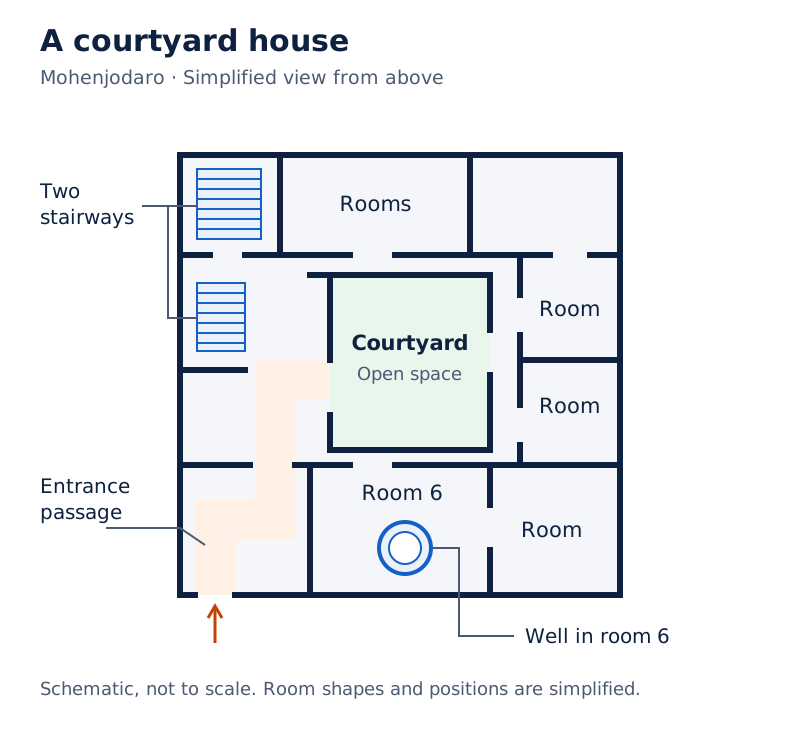
The drawing shows a house with rooms around an open central space, stairways and an entrance passage. The well is identified in room 6.
Drawn by One Young India.
Town plans were not identical everywhere. At Dholavira and Lothal, the whole settlement was fortified and internal divisions existed. Lothal’s raised Citadel was not separately enclosed by a wall. These variations qualify any claim that every city followed one exact plan.
Why are the Great Bath and granaries important architectural sources?
The Great Bath at Mohenjodaro is a major example of specialised construction on the Citadel. It consisted of a rectangular tank in a courtyard, surrounded on all four sides by a corridor. Its careful construction makes it particularly significant.
What were the Great Bath’s main features?
Flights of steps on its northern and southern sides led into the tank. Bricks set on edge and gypsum mortar helped make it watertight. Rooms stood on three sides, and one contained a large well. A large drain carried water away.
Its unusual form and location among distinctive Citadel buildings suggest a special ritual bath. This is a possible explanation of its function, rather than a deciphered statement left by its builders. The exact rituals and the identity of participants remain uncertain.
What the figure shows
The Citadel’s buildings
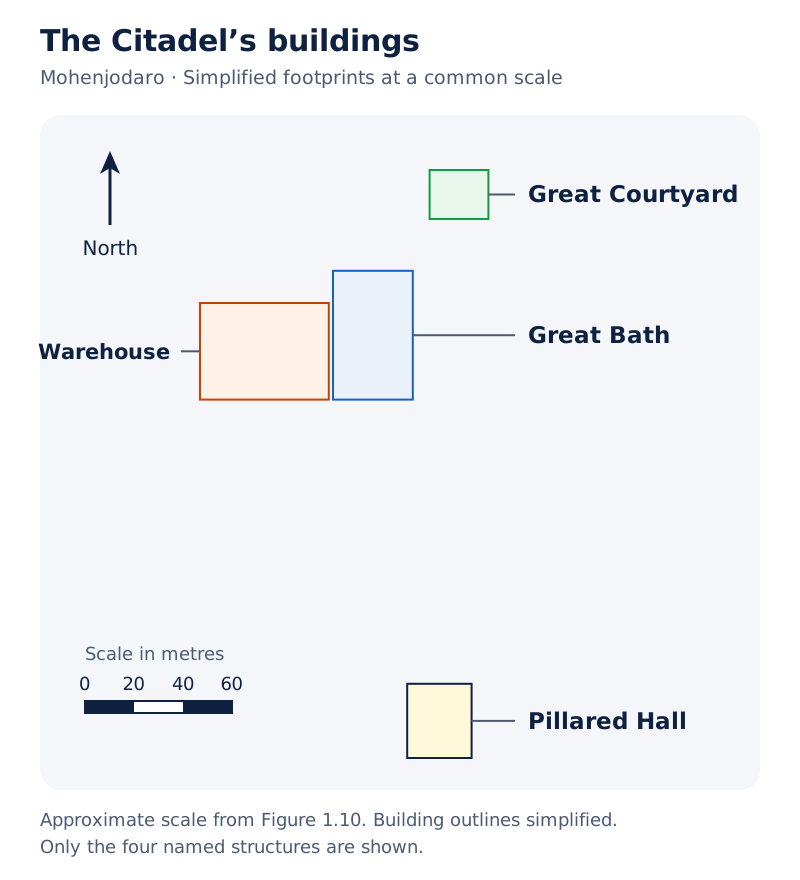
The plan labels the Great Bath, Warehouse, Great Courtyard and Pillared Hall. A north arrow and scale help the reader relate the buildings to one another.
Drawn by One Young India.
What can storage buildings tell us?
Granaries are buildings used for storing grain. Large structures at Harappa and Mohenjodaro have traditionally been described as granaries. Treat that description as an interpretation of their function, rather than proof that every surviving chamber contained grain.
At Mohenjodaro, the Citadel includes a massive building described as a warehouse. Its lower brick portions survive; the upper part, probably made of wood, has decayed. It supplies evidence of large-scale construction, although the surviving structure cannot reveal every detail of its original use.
These buildings should be connected with the organisation of an urban settlement. Constructing raised platforms and substantial public structures required coordinated labour. Their existence supports an argument for organised activity, but does not by itself identify the officials who directed it.
The Great Bath and storage structures serve different lines of enquiry. The former raises questions about bathing and ritual; the latter concerns storage and collective organisation. Both reveal the importance of studying a building together with its wider setting.
How did seals, script and weights support communication and exchange?
Seals are among the most recognisable Harappan artefacts. Most were made from steatite, a soft stone. They commonly carry animal motifs and a short inscription. Their craftsmanship makes them evidence for art as well as for communication and commerce.
How did a seal differ from a sealing?
A sealing is the impression produced when a seal is pressed into soft material such as clay. Seals and sealings helped identify senders and protected goods during movement between settlements.
- A bag containing goods was closed and its mouth tied with rope.
- Wet clay was placed over the knot.
- A seal was pressed into the clay to leave an identifiable impression.
- An intact sealing on arrival indicated that the bag had not been opened or tampered with.
What is known about the script?
The Harappan script remains undeciphered. Most inscriptions are short, with the longest containing about 26 signs. The number of signs, approximately 375 to 400, suggests that this was not an alphabet in which each sign represented a vowel or consonant.
The script appears to have been written from right to left. Some seals show greater space on the right and crowded signs on the left. Writing occurs on seals, copper tools, jar rims, tablets, jewellery and other objects.
Neither the language nor the exact meaning of animal motifs can be confidently read from these inscriptions. A suggested owner’s name or title remains an interpretation. The existence of writing does not establish how widely literacy was distributed.
How were exchanges measured?
Weights, usually made of chert, were generally cubical and unmarked. Smaller denominations followed a binary series, including 1, 2, 4, 8, 16 and 32. These numbers express relative weight denominations, not a stated modern unit of mass.
Higher denominations followed a decimal system. Small weights were probably used for jewellery and beads, and metal scale-pans have also been found. Together, seals, sealings and weights indicate organised arrangements for identifying and measuring traded goods.
How did trade connect Harappan settlements, and why was Lothal important?
Harappan crafts required materials from several regions. Clay could often be obtained locally, but suitable stone, timber and metals had to be brought from elsewhere. Trade and other forms of contact linked manufacturing centres, resource areas and major cities.
Which materials came from different regions?
| Material | Associated source or centre | Evidence or connection |
|---|---|---|
| Shell | Nageshwar and Balakot | Coastal settlements specialising in shell objects |
| Carnelian | Bharuch in Gujarat | A stone source accessible from Lothal |
| Lapis lazuli | Afghanistan | Shortughai stood near an important source of this blue stone |
| Copper | Khetri region of Rajasthan | Possible procurement through contact with local communities |
| Copper | Oman | Traces of nickel suggest a connection between Omani copper and Harappan objects |
Terracotta models of bullock carts suggest transport over land. Rivers and coastal routes were probably used too. Finished beads and shell objects could move from specialist workshops to cities such as Harappa and Mohenjodaro.
What does Lothal’s dockyard show?
Lothal, in Gujarat, combined access to craft materials with connections to maritime trade. Its large basin, identified as a dockyard, measures approximately 217 metres long and 36 metres wide. A dockyard receives and sends boats involved in transporting goods.
Photograph: The huge dockyard at Lothal. The photograph shows a long rectangular basin containing water, bordered by masonry edges and surrounding ground. It illustrates the substantial size and built boundaries of the basin.
What evidence links the Harappans with distant lands?
Mesopotamian texts mention contacts with Dilmun, probably Bahrain; Magan, perhaps Oman; and Meluhha, possibly the Harappan region. Products associated with Meluhha included carnelian, lapis lazuli, copper, gold and varieties of wood.
Harappan seals, weights and beads found beyond the region support evidence of distant contact. A distinctive Harappan jar has also been found in Oman. These discoveries support exchange, but do not establish the contents of every vessel or a complete list of all imports and exports.
What do the bearded man and dancing girl reveal about Harappan art?
The urban civilisation flourished approximately between 2600 and 1900 BCE. Its surviving sculptures show skill in representing human forms in stone, metal and terracotta. The bearded man and dancing girl are especially useful for studying artistic technique and represented ornament.
What is distinctive about the bearded man?
The bearded man is a stone bust made of soapstone. A shawl passes beneath the right arm and covers the left shoulder. It carries trefoil patterns. The face has a carefully shaped beard, moustache and elongated, partly closed eyes.
A band passes around the head. Details of the shawl and ornament make the sculpture evidence for the artist’s skill and the appearance represented. They do not prove that every Harappan person dressed in the same manner.
The conventional name “priest-king” is uncertain. Archaeologists drew comparisons with other ancient societies, but the figure’s political or religious office is not established. There is no deciphered inscription identifying this person as either a priest or a ruler.
Photograph: A “priest-king”. The image shows a bust with a patterned garment crossing one shoulder, a neatly represented beard, a headband and partly closed eyes. These visible features should be distinguished from the uncertain title “priest-king”.
What is distinctive about the dancing girl?
The Dancing Girl from Mohenjodaro is a small cast-metal figure, approximately four inches high. Her right hand rests on her hip, while the other arm extends downwards. Bangles cover much of the left arm, and a necklace is represented.
Her pose gives the figure a lively quality. The sculpture demonstrates the ability to model the body and ornaments in a small casting. Its conventional title identifies the familiar artefact; it cannot establish a detailed biography of the person represented.
These two objects illustrate different artistic choices. The bearded bust emphasises the face and patterned clothing; the dancing figure emphasises stance, limbs and ornament. Together they provide material evidence of sophisticated workmanship without supplying a complete account of government or society.
How did craftspeople make pottery, beads and metal objects?
Craft production was diverse and often specialised. Chanhudaro was particularly associated with bead-making, shell-cutting, metal-working, seal-making and weight-making. Craft work also took place in large cities, so manufacturing was not confined to small specialist settlements.
How can a workshop be identified?
Archaeologists look for raw materials, tools, unfinished objects, rejected pieces and production waste. Waste is especially useful: small fragments left after cutting stone or shell indicate manufacture at that location, whereas a finished object could have arrived through exchange.
Beads were made from carnelian, jasper, crystal, quartz, steatite, shell, metals, faience and terracotta. Different materials required different techniques. Soft steatite could be shaped more easily than hard stones; some beads were moulded from a paste of steatite powder.
What was involved in making carnelian beads?
Heating yellowish raw material and beads at different stages helped produce carnelian’s red colour. Stone nodules were chipped into rough shapes and finely flaked. Grinding, polishing and drilling completed production. Specialised drills have been found at Chanhudaro, Lothal and Dholavira.
How did lost-wax casting work?
Bronze is produced by adding tin to copper and is harder than copper. Harappan bronze-casting used the lost-wax technique to reproduce a model in metal.
- A wax figure was covered with clay, which was allowed to dry.
- Heating melted the wax, which drained through a small opening.
- Molten metal filled the hollow space left inside the clay mould.
- After the metal cooled, the clay covering was removed to expose the casting.
What were the main pottery and terracotta products?
Most pottery was wheel-made, and plain pottery was more common than painted ware. Painted vessels often carried black geometric or animal designs on a red surface. Household vessels appeared in many shapes and sizes.
Terracotta, or baked clay, was used for figurines, toy carts, rattles, birds and animals. Stone carving, metal casting, bead production and pottery show both practical needs and artistic choices. The variety of products also depended on access to suitable raw materials.
Which social groups supported urban life, and what can we know about authority?
Harappan cities depended on several kinds of work. These occupational groups can be reconstructed from crops, animal remains, tools, workshops and trade objects. They should not be turned into a fully documented caste system or a known hierarchy of political offices.
Farmers and animal rearers
Farmers produced wheat, barley, lentils, chickpeas and sesame. Millet remains occur at sites in Gujarat, while rice finds are relatively rare. Animal bones indicate the keeping of cattle, sheep, goats, buffaloes and pigs.
Terracotta plough models occur at Banawali and sites in Cholistan. At Kalibangan, a field associated with Early Harappan levels had two sets of furrows crossing at right angles, suggesting that two different crops were grown together.
Craftspeople
Craftspeople transformed raw materials into tools, vessels, ornaments and seals. The combination of specialised drills, unfinished beads and production waste indicates skilled work. Shell-working centres such as Nageshwar and Balakot supplied objects to other settlements.
Traders and those organising exchange
Traders connected settlements and resource areas. Seals, sealings and standardised weights reveal mechanisms that helped identify and measure goods. Transport involved land and water routes, linking local craft production with wider networks of exchange.
What evidence suggests social differences and coordinated authority?
Archaeologists compare ordinary objects with rare, costly or technically difficult products. Luxury objects tend to be concentrated in large settlements. Burials sometimes differ in construction and associated goods, although such differences do not establish a complete social ranking.
Authority is harder to identify directly. Standardised bricks and weights, planned settlements, major platforms and the movement of raw materials suggest coordinated decisions. The evidence does not securely identify named rulers or a precise system of government.
Some archaeologists argue that Harappan society had no rulers and everybody enjoyed equal status. Others propose several rulers, with separate rulers at Mohenjodaro and Harappa, while another interpretation favours a single state. The secure conclusion is that substantial activities were organised. Their exact political structure remains open to investigation.
Why did the cities decline, and what were the consequences?
Urban decline began around 1900 BCE. By approximately 1800 BCE, most Mature Harappan sites in areas such as Cholistan had been abandoned. At the same time, populations expanded into new settlements in Gujarat, Haryana and western Uttar Pradesh.
What changed in settlements and material culture?
At continuing settlements, distinctive seals, weights and special beads disappeared. Writing, long-distance trade and craft specialisation disappeared at these continuing settlements. House construction deteriorated, and large public structures were no longer built in the earlier manner.
These changes point towards a more rural way of life in Late Harappan or successor cultures. The end of the urban system should not be confused with the disappearance of every community. People continued to live and adapt in different regions.
What explanations have been proposed?
| Proposed cause | Possible connection with decline | Necessary qualification |
|---|---|---|
| Climatic change | Changes in conditions supporting settlements | One explanation among several, not a complete answer for every region |
| Deforestation and overuse of the landscape | Pressure on the environmental resources of settled life | Its importance may have varied between settlements |
| Excessive flooding | Damage and disruption at affected settlements | A local explanation cannot automatically explain the whole civilisation |
| Shifting or drying rivers | Changes in the conditions around established settlements | Different river systems and settlements require separate examination |
| Loss of a unifying organisation | Breakdown of shared standards and urban coordination | The exact nature of that organisation is itself uncertain |
No single proposed cause explains the entire transformation. The disappearance of shared artefacts and the replacement of standard weights by local ones suggest the weakening of connections that had helped hold the urban system together.
In 1925, sixteen skeletons with ornaments were found in the same part of Mohenjodaro. In 1947, Wheeler linked this evidence with the Rigveda to argue for violent destruction. These were modern discoveries and interpretations, not dates for the city’s fall.
George Dales challenged the massacre interpretation in his 1964 article. The skeletons belonged to different periods, and there was no destruction layer covering the city’s latest period. Reconsidering the archaeological context weakened the claim of a single final massacre.
Note: An invasion should not be presented as a proven single cause. Re-examination showed that the skeletons used to support a massacre at Mohenjodaro did not all belong to the same period, undermining that interpretation.
The consequences were therefore both material and organisational: cities declined, specialised production contracted, long-distance links weakened and settlement patterns changed. A careful explanation connects these changes while preserving uncertainty about their causes.
What is the civilisation’s significance, and how do its features compare?
The Harappan civilisation is significant for the scale and organisation of its urban life. Planned streets, drainage, specialised crafts, shared standards and distant contacts reveal communities capable of coordinating many activities across settlements with different resources and functions.
How do the Citadel and Lower Town compare?
| Feature at Mohenjodaro | Citadel | Lower Town |
|---|---|---|
| Relative size and height | Smaller and higher | Larger and lower |
| Construction | Buildings raised on mud-brick platforms | Several buildings also rested on constructed platforms |
| Boundary | Walled and physically separated | Also enclosed by a wall |
| Important evidence | Great Bath and warehouse | Residential houses, courtyards, bathrooms and wells |
| Main historical insight | Structures probably serving special public purposes | Organisation of domestic life within the planned settlement |
The comparison does not establish that one section housed every ruler and the other every worker. The buildings provide stronger evidence for the organisation of space than for a complete classification of residents.
What connects planning, craft and trade?
Standardisation connects these topics. Bricks followed shared proportions, weights regulated exchange, and seals helped communication. Skilled production depended on materials obtained through wider contacts. Urban life therefore involved relationships between construction, work, resources and movement.
The evidence also shows regional variation. Lothal is important for its dockyard and crafts; Mohenjodaro for detailed evidence of houses, drainage and public buildings; and specialist settlements for particular forms of production. A civilisation can share features without every settlement being identical.
Finally, the Harappan case demonstrates the importance of careful interpretation. A sculpture is not a named ruler, an undeciphered inscription is not a readable political record, and a possible cause of decline is not a universal explanation. Strong historical understanding preserves these distinctions.
Glossary
- Archaeology — The study of material remains to investigate past societies and the ways in which people lived.
- Artefact — An object made or used by people, studied as evidence of past activities and material culture.
- Citadel — The smaller, raised section of Mohenjodaro, separated by walls and containing distinctive buildings with probable public functions.
- Lower Town — The larger, lower section of Mohenjodaro, containing important evidence of residential buildings and domestic life.
- Granary — A building used for storing grain; the label applied to ancient structures requires archaeological interpretation.
- Dockyard — A structure used to receive and send boats engaged in transporting goods between different places.
- Sealing — An impression made by pressing a seal into material such as wet clay, helping identify and secure goods.
- Undeciphered script — A writing system whose signs and meanings have not yet been reliably interpreted and read.
- Steatite — A soft stone used by Harappan craftspeople to manufacture seals and different kinds of beads.
- Terracotta — Baked clay used to make objects including figurines, toy carts, beads and representations of animals.
- Lost-wax casting — A metal-casting technique in which melted wax leaves a hollow clay mould that is filled with molten metal.
- Stratigraphy — The study of archaeological layers to establish the sequence of occupation and the context of finds.
Common errors and misconceptions
- Misconception: Harappan civilisation means only the city of Harappa. Correct: Harappa gives the civilisation its name, but its settlements extended across a large region in present-day India, Pakistan and beyond.
- Misconception: Every city had exactly the same plan. Correct: Shared features existed alongside differences, including variation in fortifications, internal divisions and the arrangement of raised areas.
- Misconception: The Great Bath was certainly used for a known religious ceremony. Correct: Ritual bathing is an interpretation based on its unusual construction and setting; the exact ceremony is unknown.
- Misconception: The bearded man proves that a priest-king ruled the civilisation. Correct: “Priest-king” is a conventional label, and the figure’s office has not been established.
- Misconception: Harappan seals can be translated into complete accounts of their owners. Correct: The script remains undeciphered; suggested names, titles and meanings cannot be treated as secure readings.
- Misconception: The decline of cities meant that every Harappan community vanished. Correct: Settlement patterns changed, and more rural Late Harappan or successor cultures continued.
- Misconception: One proven invasion explains the end of every Harappan city. Correct: The massacre interpretation was challenged, and several environmental and organisational explanations remain under discussion.
Exam-style questions with model answers
Q1. A carved seal is pressed into wet clay placed over the tied mouth of a bag. The bag arrives with the clay impression intact. Distinguish the seal from the sealing and explain what the intact impression indicates. [2 marks]
- The seal is the carved object; the sealing is its impression in the clay.
- The intact sealing indicates that the tied bag has not been opened or tampered with during its journey.
Q2. At Mohenjodaro, streets meet approximately at right angles, house drains connect to street drains, and drain covers can be removed. Explain three ways these features indicate urban planning. [3 marks]
- The streets form an approximate grid, indicating an organised arrangement of routes rather than unrelated paths between buildings.
- Connections between house drains and street drains show that individual buildings fitted into a wider system for removing wastewater.
- Removable covers provided access for cleaning. Planning therefore addressed the maintenance of drains as well as their initial construction.
Q3. A tank on Mohenjodaro’s Citadel has steps at its northern and southern ends, watertight brickwork, surrounding rooms, a nearby well and a large outlet drain. Its unusual form suggests ritual bathing. Identify the structure, explain two construction features and state one limit of the interpretation. [4 marks]
- The structure is the Great Bath, located on the Citadel at Mohenjodaro.
- The flights of steps allowed people to enter and leave the tank, while watertight brickwork helped retain water.
- The well and outlet drain formed part of arrangements for supplying and removing water.
- Ritual bathing is a suggested use. The architectural evidence does not identify the exact ceremony or establish who participated in it.
Q4. A soapstone bust has a beard, partly closed eyes and a patterned shawl covering one shoulder. It is conventionally called the “priest-king”, but no deciphered inscription identifies its office. What does this evidence support, and what does it not establish? [3 marks]
- The bust provides evidence of skilled stone carving through the treatment of the beard, eyes and patterned garment.
- It shows the appearance and clothing represented by the artist, making it useful for studying Harappan art.
- The conventional name does not prove that the person was a priest, a king or both. Without an established identification, a particular religious or political office remains uncertain.
Q5. A craft area contains stone nodules, specialised drills, partly finished carnelian beads and small cutting fragments. Carnelian production involved heating, rough shaping, fine flaking, grinding, polishing and drilling. Explain how this evidence identifies a workshop and reconstruct the main production stages. [5 marks]
- The stone nodules provide evidence of raw material being present before manufacture. Their association with unfinished beads suggests that production occurred at the location.
- Specialised drills are tools suitable for bead manufacture, while cutting fragments are waste left by working stone. Together these strengthen the workshop interpretation beyond the discovery of finished beads alone.
- Nodules were chipped into rough shapes and then finely flaked towards the intended form.
- Grinding and polishing refined the bead, while drilling produced the opening needed for threading.
- Heating occurred at stages of production and helped develop carnelian’s red colour. The evidence connects raw materials, tools, intermediate products and waste within one manufacturing process.
Q6. Lothal in Gujarat has a basin approximately 217 metres long and 36 metres wide, interpreted as a dockyard for receiving and sending boats. Harappan trade used land, rivers and the sea; seals identified goods, and weights regulated exchange. Explain four connections between this evidence and organised trade. [4 marks]
- The dockyard interpretation links Lothal’s large basin with the arrival and departure of boats carrying goods.
- The use of land, river and sea routes indicates that exchange depended on more than one means of transport.
- Seals helped identify goods, supporting communication between the people sending and receiving them.
- Weights provided a way to measure exchanges. Together, transport facilities, identification and measurement point to organised arrangements for trade rather than the movement of unrecorded objects alone.
Q7. After about 1900 BCE, some settlements lost distinctive seals, standard weights and specialised crafts. Large public buildings ceased to be constructed, while populations expanded into settlements elsewhere. Proposed causes include climatic change, floods, shifting or drying rivers and loss of shared organisation. Explain three consequences and two cautions about causes. [5 marks]
- The loss of distinctive seals and standard weights indicates a weakening of shared practices that had connected settlements and organised exchange.
- The decline of specialised crafts shows a contraction in the urban system of production and the range of activities associated with it.
- The end of major public construction, together with movement to other settlements, indicates changes in urban life and settlement patterns. It does not mean that the entire population disappeared.
- Climatic change, flooding and river changes are proposed explanations. Their importance may have differed from one settlement to another.
- The loss of shared organisation is also an interpretation. The evidence does not justify selecting one proposed cause as a proven explanation for every part of the civilisation.
Q8. A wax model is covered in clay and dried. Heating removes the wax through an opening. Molten metal fills the resulting hollow, cools, and the clay is removed. Name the technique and explain why it reproduces the model’s form. [2 marks]
- This is lost-wax casting.
- The melted wax leaves a hollow matching the model’s shape. Metal fills that space and retains the form after cooling and removal of the clay mould.
Key takeaways
- The Harappan civilisation developed through early, mature and late phases, with its urban period approximately between 2600 and 1900 BCE.
- Archaeological remains provide the main evidence because the script has not been deciphered into reliably readable accounts.
- Mohenjodaro’s platforms, street grid, courtyard houses and connected drainage demonstrate extensive planning and coordinated construction.
- The Great Bath’s construction is observable, while its precise ritual purpose and the identity of its users remain uncertain.
- Seals, sealings and standardised weights helped identify, secure and measure goods within systems of communication and exchange.
- Lothal’s dockyard, regional resource connections and finds in distant lands provide evidence for extensive trading contacts.
- The bearded man, dancing girl, pottery and beads demonstrate artistic skill, but their interpretation requires caution.
- Urban decline involved changing settlements and reduced specialisation; no single proposed cause explains every region equally.
Test yourself
Why is the civilisation called Harappan?
It takes its name from Harappa, the site where this ancient civilisation was first identified.
What raised the Citadel at Mohenjodaro?
Its buildings stood on mud-brick platforms, which raised this part of the settlement above the Lower Town.
Why were removable drain covers useful?
They allowed access to the drainage channels so that accumulated material could be removed during cleaning.
What is the difference between a seal and a sealing?
A seal is the carved object pressed into soft material; a sealing is the impression it leaves.
Why is production waste strong evidence for a workshop?
Small discarded fragments indicate that material was worked at the site, whereas finished objects could have arrived through exchange.
Why should “priest-king” be treated cautiously?
The name is an archaeological interpretation. The bearded figure’s identity and its supposed political or religious office are not established.
What was the likely role of Lothal’s large basin?
It is identified as a dockyard, used for receiving and sending boats involved in transporting goods.
Why does urban decline not mean complete disappearance?
People continued in some settlements or moved to others, while Late Harappan cultures reflected a more rural way of life.
Try it
The Harappan Civilization: Planning and Trade
Navigate a Harappan city and conduct a trade to test your understanding of their urban planning and economy.
1Imagine you are a traveling craftsman arriving at a Mature Harappan city for the first time. As you enter the city to find the craftsmen's district, what kind of street layout will you need to navigate?
Correct! The text explains that Mature Harappan cities used a grid-like layout with straight roads and houses arranged in blocks, showing systematic town planning and shared civic engineering skills.
Incorrect. The text specifically contrasts Harappan planning with random patterns, noting that excavations show planned towns with straight roads and regular intersections that divide the city into sections.
2You find a merchant from a distant town who wants to trade raw metals for your finished pottery. How can you ensure that the amount of metal you receive is fair and consistent with what you would get in your home city?
Incorrect. The text notes that the Harappan script is 'not yet fully understood' and 'undeciphered.' Instead, fairness in trade was maintained through physical tools rather than translated written contracts.
Correct! The text states that standardized weights and measures found at different sites allowed traders to follow common standards. This consistency reduced cheating and confusion, making long-distance trade reliable.
Great job! By understanding their systematic grid-like city planning and their use of standardized weights for trade, you can see how the Harappans maintained a highly organized and complex urban civilization.