
Understanding Markets | CBSE Class 7 Civics Notes
On this page
This note covers markets and prices, buying and selling, different types of markets, the movement of goods, Surat's textile trade, the social role of markets, government regulation, product labels and ways of judging quality.
What is a market, and why do people use it?
Definition: A market is a place where people buy and sell goods. It can be a physical place or an online setting, and makes goods and services available to individuals, households and businesses.
Goods are products, such as vegetables, clothes and furniture. Services are activities provided for people, such as tailoring and online classes. A buyer purchases a product or service, while a seller offers it for sale.
People use markets because they need goods and services that they cannot produce themselves. Markets help meet both needs, which are essential for survival, and wants, which are desired but not essential for survival. Food, water, clothing and shelter are needs.
Trade means buying, selling or exchanging goods and services between people or countries. Markets are also called bazaar and haat in Hindi, and mārukatté in Kannada. They connect people with products and also bring together traditions and ideas.
What does Hampi Bazaar show about earlier markets?
Hampi Bazaar in Karnataka was a prosperous market in the Vijayanagara Empire during the 16th century. Located opposite the Virupaksha temple, it formed part of a flourishing centre of trade. Foreign travellers described the city's abundance and variety of products.
The Portuguese traveller Domingos Paes described trade in grains, seeds, milk, oil and silk. Animals such as cows, rabbits and horses, and birds such as quails and partridges, were also traded. His account shows the wide range of things available to buyers.
Another Portuguese traveller, Fernao Nuniz, described craftsmen at work and the sale of jewellery, precious stones and cotton cloth. These accounts show that markets supplied everyday requirements as well as valuable goods. Buying and selling were already important parts of city life.
How do buyers and sellers arrive at a price?
A transaction is an act of buying and selling. A kilogram is a unit used to measure the quantity of goods such as fruit; prices below are in Indian rupees. To complete it, a buyer and a seller need to agree on a price: the amount at which the buyer is willing to buy and the seller is willing to sell particular goods or services.
Buyers and sellers often negotiate and bargain, meaning that they discuss the price to reach an acceptable amount. A buyer may consider a price too high. A seller may reject a lower offer because selling at that amount would not be profitable.
Profit is the gain from selling after meeting costs; a loss occurs when the amount received does not cover costs. The buyer's willingness to pay and the seller's willingness to accept payment both matter. If they cannot agree, the transaction may not take place.
What happens in the guava example?
A seller initially wants 80 rupees per kilogram of guavas. The buyer may not be willing to pay this amount. The three illustrated situations compare a very high price, a very low price and a price acceptable to both sides.
| Price of guavas | Situation illustrated | What to notice |
|---|---|---|
| 80 rupees per kilogram | The price is very high. | The cart is heaped with guavas while people walk past. |
| 20 rupees per kilogram | The price is very low. | The cart has no guavas left, and the seller holds money. |
| 40 rupees per kilogram | The price is acceptable to buyer and seller. | Customers and the seller exchange guavas and money. |
What the figure shows
Guava prices and buyers
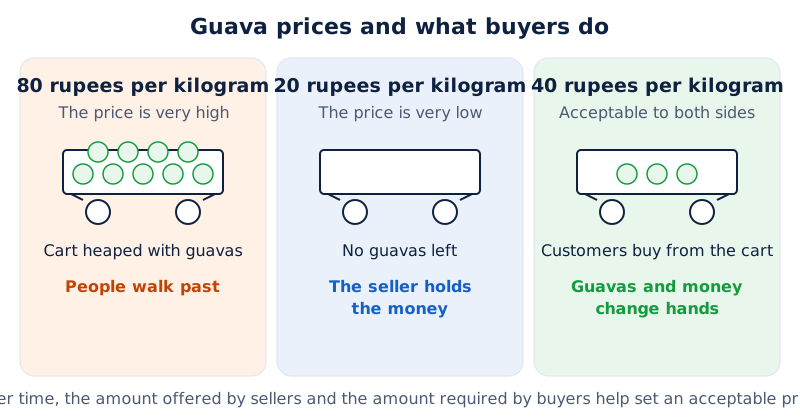
These illustrations show the same kind of fruit cart under three price situations. The displayed prices are 80, 20 and 40 rupees, respectively; the amount of fruit left and the customers' activity differ.
Drawn by One Young India. See Figs. 12.5, 12.6 and 12.7 in your NCERT textbook
Demand is the quantity consumers are willing and able to buy at a particular price at a given time. Supply is the quantity sellers are willing and able to sell at a particular price at a given time. Consumers are the final users of goods or services.
Over time, the amount offered by sellers and the amount required by buyers help determine an acceptable price. The guava seller can assess approximately how much buyers need and offer that quantity in future. These prices belong to this example, not to every guava market.
How do physical and online markets differ?
In a physical market, buyers meet sellers in person and purchase goods or services in exchange for money. This is the most common type of market. Weekly markets, local shops, haats and malls are examples, although their size and surroundings differ.
A vendor is a seller. Vendors at weekly markets and haats sell vegetables, essential items and handicrafts, objects made by hand, from carts. Local markets include shops and sellers of street food and other small items. Malls are large, multi-storey buildings containing stores in cities and towns.
In an online market, buyers and sellers need not necessarily meet in person. They can transact from convenient locations, even thousands of kilometres apart, through shopping applications, called apps, or websites on phones and computers.
| Feature | Physical market | Online market |
|---|---|---|
| Contact | Buyers meet sellers physically. | Buyers and sellers can transact without meeting in person. |
| Setting | Examples include weekly markets, local shops and malls. | Businesses provide shopping apps and websites. |
| Access to products | Buyers purchase at the physical market. | Ordered goods can be delivered to the buyer's doorstep. |
| Services | Some services, such as tailoring, require in-person contact. | Services such as online classes can be accessed from home. |
Who uses online markets?
Households can order books, clothes, furniture, groceries and electronic items. They can also obtain online classes and make payments online. However, some services require in-person contact. The availability of online shopping does not remove the need for physical markets.
A manufacturer is a person or company that makes goods for sale. Manufacturers can also buy components online. These are inputs for production: materials or resources used to produce goods and services. Online markets therefore serve businesses as well as household buyers.
How do domestic and international markets differ?
A domestic market operates within a country's geographical boundaries. Buyers and sellers trade goods or services within that country. For example, paper used to print a book can be bought from large paper mills located across India, with the transaction taking place within India.
An international market involves trade across national boundaries. Sellers in one country supply buyers in another. The important distinction is the movement of trade across countries, rather than whether the buyer uses a physical shop or an online website.
An import is a purchase of goods or services from another country, brought into one's own country. An export is a sale of goods or services produced in one country to a buyer in another country.
What kinds of goods and services cross borders?
India's international trade includes both goods and services. Examples of exports include software services to North America, chemical products to South America, pharmaceuticals to Africa, engineering goods to Europe and refined petroleum products to West Asia.
Pharmaceuticals are medicines. Engineering goods in the examples include machinery used in food processing and boilers. Imports include aircraft and components from North America, mineral ores such as copper from South America, diamonds from Africa and electrical equipment from Europe.
Other import examples include crude petroleum and fertilisers from West Asia, and vegetable oils from South East Asia. These examples show how producers and buyers in different regions are connected through markets.
Note: India was the world's largest importer of vegetable oils such as palm, sunflower and soybean oil in 2024. Most of the palm oil is imported from Malaysia, Indonesia and Thailand. This trade links buyers in India with producers beyond its borders.
How do wholesalers, distributors and retailers move goods?
A wholesaler buys goods in large quantities from producers or manufacturers. A producer is someone who produces goods, including a farmer growing crops. Wholesalers purchase grains, vegetables and fruits directly from farms and help move them towards the shops where households buy them.
The produce is stored in large warehouses, also called godowns. Warehouses are buildings used for storing goods. For perishables, goods that can spoil, these warehouses may also have cold storage facilities. The goods are then brought to markets called mandis.
Cold storage means storage at specific low temperatures to preserve perishable goods. Wholesale markets are not limited to farm produce. They also exist for chemicals, electronic items and components, construction materials and automotive parts.
A retailer sells goods in smaller quantities to final consumers. These products are intended for consumption rather than resale. Retailers include shops and stores near households. Retail services also include salons, movie theatres and restaurants.
Where do distributors fit into the chain?
Distributors are people or businesses supplying goods from manufacturers and wholesalers to retailers. In some cases, distances and terrain make it difficult for wholesalers to reach many retailers. Distributors help bridge this gap and make the products available nearer to consumers.
Raw materials are materials from which goods are made. Finished goods are products ready to be sold after production.
What the figure shows
Movement of physical goods
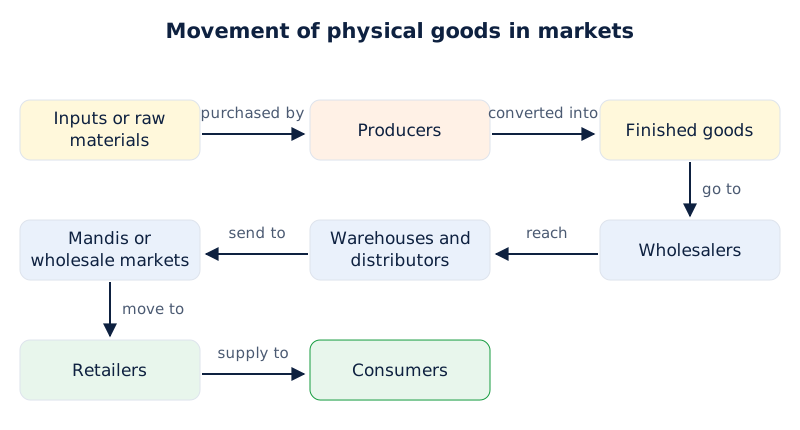
Arrows connect inputs or raw materials, producers, finished goods, wholesalers, warehouses and distributors, mandis or wholesale markets, retailers, and consumers. Follow the arrows across each row and down to the next row.
Drawn by One Young India. See Fig. 12.11 in your NCERT textbook
- Producers purchase inputs or raw materials, the materials from which goods are made.
- They convert these materials into finished goods, meaning products ready to be sold.
- The goods go to wholesalers and reach warehouses and distributors.
- Goods move through mandis or wholesale markets to retailers.
- Retailers supply the goods to final consumers.
Wholesale and retail describe different roles in this flow. The wholesaler handles bulk quantities, while the retailer serves the final consumer in smaller quantities. Both help connect production with the households that need the products.
How does an online distribution channel work?
A distribution channel is the route through which goods reach buyers. Online distribution differs from the physical market chain. Manufacturers send bulk quantities of their products to the warehouse of a business that sells through online apps.
An aggregator is a website or mobile application that brings together offers from multiple sellers and sells to consumers in one place. The business allows buyers to select products through a website or mobile app rather than visiting each seller in person.
What happens between manufacture and delivery?
- The manufacturer supplies products in bulk to the warehouse of the business selling online.
- The consumer uses the website or mobile application to select and buy a product.
- The aggregator packs the product ordered by the consumer.
- The aggregator delivers the packed product to the online buyer.
Warehousing, or storing goods in a warehouse, is still part of this arrangement. A purchase made on a screen involves physical goods that must be stored, packed and delivered. The online option changes how the buyer places the order and how the business supplies it.
This arrangement brings offers from different sellers together for the consumer. It also connects manufacturers with people who buy online. The process explains how a product selected through an app can reach a household, while services such as online classes can be accessed online themselves.
The distinction is between the channels used to arrange and fulfil the transaction. In physical markets, wholesalers, distributors and retailers link producers with consumers. In the online arrangement described here, the aggregator's warehouse, ordering system, packing and delivery perform the connecting role.
How does Surat's textile market connect different stages of production?
Textiles are fabrics used for products such as clothing. Surat in Gujarat is a textile hub, a centre where textile production and trade are concentrated. Its market includes thousands of factories manufacturing cotton and synthetic textiles, or fabrics made using manufactured fibres.
For cotton textiles, raw cotton reaches Surat through cotton mandis. Supplies arrive from nearby states such as Maharashtra and from other parts of Gujarat. Markets therefore connect the cotton-producing areas with the factories that process the cotton.
How does cotton become a product for sale?
The cotton is transformed into finished fabric or garments through various processing stages. These include weaving on power looms, machines used to weave fabric, and dyeing, the process of colouring fabric, in processing units. Garments are finished articles of clothing.
Products move between stages through markets for woven fabric, dyed fabric and finished products. Sarees and ready-made garments are examples of finished products. The supply chain therefore involves markets before a garment reaches the shop where a household buys it.
Manufacturing units trade the finished products in the wholesale market. Wholesalers oversee their distribution to small shopkeepers and large retail stores across the country and internationally. They connect the production centre with markets beyond Surat itself.
Why does information from retailers matter?
Wholesalers also assess how much product retailers require. This helps manufacturers maintain their stock, the supply of products they hold, and helps ensure an uninterrupted supply to final consumers. The chain carries information about requirements as well as goods.
Surat's trade flourished from the 16th century onwards. Its west-coast location led to the development of ports and road networks that remain important. Skilled communities have passed their expertise across generations, contributing to the city's flourishing trade.
Alongside textiles, Surat has a large diamond industry. Approximately 1.5 million artisans work in activities such as cutting and polishing diamonds. Artisans are skilled craftspeople. The word “approximately” matters because the figure is an estimate, rather than an exact count.
How do markets affect people's economic and social lives?
Markets connect producers and consumers, helping households and businesses obtain things they need but cannot produce themselves. Farmers bring rice, wheat, dal, vegetables and fruits to markets. Textile producers obtain cotton and other inputs through markets.
A ready market is not equally easy to find for every product. Aakriti, a professional artist making oil paintings on canvas, finds that appreciation of her paintings does not automatically bring buyers. She worries about where to sell them and what price to ask.
Unlike guavas, artwork has fewer local buyers and sellers in her example. This makes it difficult for Aakriti to connect with buyers. The example highlights why access to a market matters to people who want to earn from what they produce.
How can buyers influence what producers make?
When many consumers ask for refrigerators that use less electricity, producers receive an indication of what people would buy. They produce energy-efficient refrigerators, meaning refrigerators that use less electricity. Society benefits from the availability of these products.
Markets also have a non-economic role: a significance beyond earning and spending money. Interactions often extend beyond questions about products and bargaining. Relationships between buyers and sellers often continue across generations, including trusted relationships with tailors, jewellers and doctors.
Many families in India keep an account with their local grocer and settle it at the end of the month. These continuing relationships show that market interactions can involve familiarity and trust as well as individual transactions.
What does Ima Keithal illustrate?
Ima Keithal, meaning Mother's Market in the Meitei language, is in Imphal, Manipur. About 3000 women own and run all its shops. They sell vegetables, traditional Manipuri clothing, handloom products made on hand-operated looms, handicrafts, local produce and daily essentials.
The market provides employment and income for thousands of families. It also brings people from different communities together to exchange ideas and enjoy shared traditions. Its economic and cultural roles exist together in the same place.
Why does the government sometimes control prices?
Markets function through the interaction of demand and supply. However, this may not work very well in some situations. The government monitors interactions between producers and consumers and the fair determination of prices. Its role includes protecting buyers, sellers and employees.
The government controls the prices of certain goods. An upper price limit is the maximum price a seller can charge. Several essential goods and services, including lifesaving drugs, have such limits. Their purpose is to protect buyers from excessively high prices.
How are producers and workers protected?
A minimum price is a lower price limit. The government sets minimum prices for essential agricultural products such as wheat, paddy and maize to protect farmers from losses. Paddy means rice in its unhusked form.
The government also sets minimum wages, the minimum payments for work done by employees, so that employers make fair payments. This concerns the payment for work rather than the price paid for a packet or quantity of goods.
| Government action | Example | Protective purpose |
|---|---|---|
| Maximum price | Lifesaving drugs | Limits what the seller can charge the buyer. |
| Minimum agricultural price | Wheat, paddy and maize | Protects farmers from losses. |
| Minimum wage | Work done by employees | Helps ensure fair payment by employers. |
Why must price limits be implemented carefully?
A limit that is too low removes producers' motivation to produce. A price that is too high disadvantages consumers. Careful implementation is therefore necessary: the government must consider both the people making goods and the people needing to buy them.
Note: Government involvement does not mean that every market price is directly fixed by the government. Demand and supply generally determine prices, while controls apply to certain goods and particular situations requiring protection.
How else does the government help markets function fairly?
Regulation means rules and oversight used to guide how markets operate. Besides prices, the government is concerned with product quality, safety, fair quantities and effects beyond the immediate sale. These tasks protect consumers and support fair market practices.
How are quality and quantity checked?
Manufacturers must follow required quality and safety standards, the conditions products and services are expected to meet. For medicines, the government sets approval procedures and tests samples to check whether the drugs produced meet quality standards.
The government also puts systems in place to monitor the weights and measures of packaged products. These checks concern net quantity, the amount of product inside the package. Checking quantity is another part of protecting consumers from unfair practices.
Why do effects outside the sale matter?
External effects are consequences beyond the immediate buying and selling. Markets sometimes have significant effects of this kind. Factories making goods could pollute the environment, so the effect of production may extend beyond the producer and the customer.
Manufacturing certain items, such as single-use plastics, can pollute the environment and pose health risks. Single-use plastics are plastic items intended for use once. The government intervenes through strict regulations to reduce these negative effects.
Why does the government provide public goods?
Public goods are goods or services accessible to all members of society, whose present use does not diminish their availability for future use. Public parks, roads and policing are examples of public goods and services provided by the government.
Producers make and sell goods and services to earn a profit. However, they do not expect to make a profit from some goods and services such as these. The government provides them, alongside its responsibility towards citizens' welfare provisions.
The government's role therefore goes beyond controlling individual transactions. It includes providing shared services and addressing harmful effects. However, too many rules can make it difficult for markets to function properly, so the amount of regulation also matters.
How can a buyer examine a product and its package?
Consumers need to assess the quality, or useful characteristics and standard, of what they buy. A low price is not the only consideration. The qualities that matter depend on the product and what the consumer intends to use it for.
Consider buying marbles for a neighbourhood competition with 150 rupees saved. The relevant features include their price, size, strength and attractive colours. Comparing those features helps the buyer consider the product as well as the money available.
What information does a food package provide?
A packet of gram flour gives another way to think about a purchase. Gram flour is flour made from gram. Instead of looking only at the product name, a buyer can examine the details printed on the package.
The date of manufacture identifies when the product was made. A best-before date indicates the period of expected best quality. The batch number identifies the production batch, and the manufacturer's name and address identify the business responsible for making the product.
The ingredients list names what the product contains. The nutrition facts panel gives nutritional information. An allergen declaration identifies ingredients that can cause allergic reactions. These details serve different purposes and should not be confused with the price.
MRP means maximum retail price. Along with net quantity, it gives the buyer information about price and amount. The package also carries a food-safety mark and licence number. Certification marks are identifying marks showing that a product meets required standards. They provide another way to assess a purchase.
What the figure shows
Information on a food package
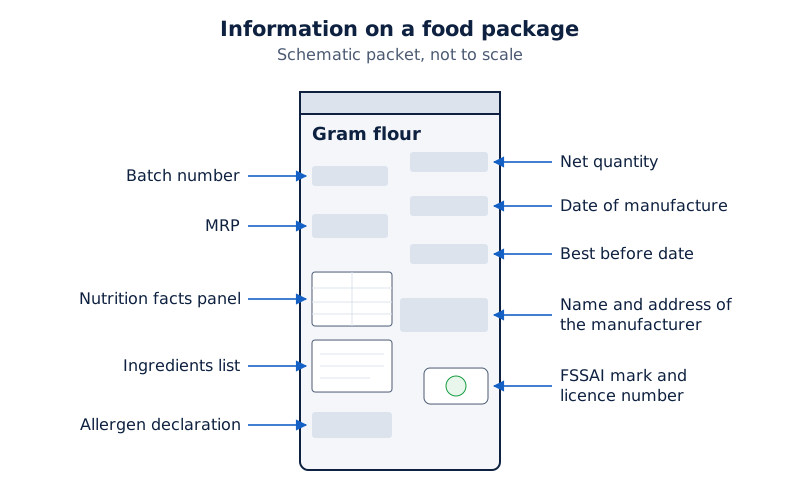
Photograph: The package has labelled arrows pointing to net quantity, date of manufacture, best-before date, manufacturer details, food-safety identification, batch number, price, nutrition information, ingredients and an allergen declaration.
Drawn by One Young India. See Fig. 12.29 in your NCERT textbook
How do certification marks, reputation and reviews guide consumers?
Certification marks are identifying marks showing that a product meets the required standards. Government agencies provide certifications that help consumers assess quality. The presence of these marks on products or packages confirms that minimum quality standards have been fulfilled.
FSSAI stands for Food Safety and Standards Authority of India. Its mark on food packets and cartons provides an indication of food safety for consumers. It is a food-related mark, rather than a measure of an appliance's electricity use.
What do the different marks indicate?
| Mark or rating | Meaning and examples | Information for the buyer |
|---|---|---|
| FSSAI | Food Safety and Standards Authority of India; shown on food packets and cartons. | Indicates food safety. |
| ISI | Indian Standards Institution Mark; generally found on electrical appliances, construction materials, automotive tyres and paper. | Indicates quality and safety in use. |
| AGMARK | A certification mark for agricultural products; “Ag” refers to agriculture. | Applies to products such as vegetables, fruits, cereals, pulses, spices and honey. |
| BEE Star rating | Bureau of Energy Efficiency rating; appears on electronic items such as televisions, laptops and air conditioners. | Higher stars indicate that the appliance uses less energy and electricity. |
The BEE Star rating connects buying decisions with energy use. Higher stars indicate lower energy and electricity use, benefiting consumers through lower electricity bills and also benefiting the environment. This information serves a different purpose from a food-safety mark.
What can other consumers tell us?
A product's reputation, the opinion people develop about it, also influences purchases. Reputation can spread through word of mouth, meaning recommendations passed between people. Friends or relatives may suggest a product based on their experience.
In online shopping, reviews and feedback are comments from other consumers about products and services. They help buyers decide whether to buy. Certification marks and consumer experiences thus provide different kinds of information for making a purchase decision.
Assessing a purchase brings several questions together: what the product is, whether its quality is suitable, what its label shows, and what other buyers report. Markets offer variety, while these sources of information help consumers judge the goods and services available.
Glossary
- Market — A physical or online setting through which people buy and sell goods and services.
- Needs — Things essential for survival, including food, water, clothing and shelter.
- Wants — Things a person desires but does not require for survival.
- Price — The amount at which a buyer is willing to buy and a seller is willing to sell.
- Demand — The quantity consumers are willing and able to purchase at a particular price at a given time.
- Supply — The quantity sellers are willing and able to sell at a particular price at a given time.
- Domestic market — A market where goods and services are bought and sold within a country's geographical boundaries.
- International market — A market involving trade in goods or services across the boundaries of countries.
- Import — Buying goods or services from another country and bringing them into one's own country.
- Export — Selling goods or services produced in one country to a buyer in another country.
- Wholesaler — A trader who buys goods in large quantities from producers or manufacturers and supplies retailers.
- Retailer — A seller supplying smaller quantities to final consumers for consumption rather than resale.
- Distributor — A person or business supplying goods from manufacturers and wholesalers to retailers.
- Aggregator — A website or mobile application combining offers from multiple sellers for consumers in one place.
- Cold storage — Storage facilities maintaining specific low temperatures to preserve goods that can spoil.
Common errors and misconceptions
- Misconception: A market must be a street or building where people meet. Correct: Markets can also operate online, with buyers and sellers transacting without meeting in person.
- Misconception: A seller's stated price automatically completes a sale. Correct: The buyer and seller need an acceptable price; if they cannot agree, the transaction may not take place.
- Misconception: Demand means simply wanting something. Correct: Demand includes willingness and ability to purchase a particular quantity at a particular price and time.
- Misconception: Wholesalers and retailers perform the same task. Correct: Wholesalers handle large quantities, while retailers sell smaller quantities to final consumers for consumption rather than resale.
- Misconception: All goods sold in a market must come from the same country. Correct: International markets connect countries through imports and exports of goods and services.
- Misconception: The government directly fixes every market price. Correct: Demand and supply generally determine prices. The government controls certain prices and also oversees quality, safety and fair practices.
- Misconception: More rules necessarily make a market work better. Correct: Rules protect consumers, but too many rules can make it difficult for markets to function properly.
- Misconception: Every quality mark tells the buyer the same thing. Correct: Food safety, agricultural certification, general product safety and energy efficiency are different kinds of information.
Exam-style questions with model answers
Q1. What is a market? State one reason people use markets. [2 marks]
- A market is a physical or online setting where people buy and sell goods and services.
- People use markets to obtain goods and services they need or want but cannot produce themselves.
Q2. A guava seller asks 80 rupees per kilogram, but a buyer considers it too high. The seller rejects an offer that would not be profitable. Explain the role of bargaining, the condition for completing the transaction, and what may happen if agreement is impossible. [3 marks]
- Bargaining allows the buyer and seller to discuss the price. The buyer seeks an affordable amount, while the seller seeks a price that makes selling worthwhile.
- The transaction can be completed when both reach a mutually agreeable price, meaning an amount the buyer will pay and the seller will accept.
- If no mutually agreeable price is reached, the transaction may not take place. The seller's initial demand alone does not ensure a sale.
Q3. Identify and explain the market type in each description: buyers meet sellers in person; buyers order through websites without meeting sellers; paper is traded between buyers and mills within India; goods are sold across national borders. [4 marks]
- The first is a physical market because the buyer meets the seller in person to make a purchase.
- The second is an online market because a website enables the transaction without requiring buyer and seller to meet physically.
- The third is a domestic market because the purchase and sale occur within India's geographical boundaries.
- The fourth is an international market because sellers and buyers trade across the boundaries of different countries.
Q4. Manufacturers send bulk goods to wholesalers. Warehouses store the goods, distributors help reach distant retailers, and retailers sell smaller quantities to final consumers. Explain the five roles: manufacturer, wholesaler, warehouse, distributor and retailer. [5 marks]
- The manufacturer makes goods for sale. Manufacturing begins the supply of the finished products that will move through the market towards consumers.
- The wholesaler handles goods in bulk, purchasing large quantities from the manufacturer and helping supply the shops that serve consumers.
- The warehouse provides a place to store the goods. Storage forms part of the movement of products between production and their eventual sale.
- The distributor helps bridge the distance between suppliers and retailers. This role is useful where wholesalers find it difficult to reach many retailers.
- The retailer sells smaller quantities to final consumers. These purchases are intended for consumption, completing the connection between the manufacturer and the user.
Q5. Aakriti makes oil paintings on canvas. People appreciate them, but she struggles to find buyers and decide where and at what price to sell. Her local artwork market has fewer buyers and sellers than the guava market. Explain three difficulties shown here. [3 marks]
- Appreciation of Aakriti's paintings does not automatically lead to purchases. She still has to find people willing to buy the work she produces.
- Fewer local buyers and sellers mean that she lacks the ready market available for a product such as guavas in this comparison.
- She faces connected decisions about where to sell and what price to offer. Access to buyers is therefore important alongside the creation of the paintings.
Q6. Consider these government actions: limiting the price of lifesaving drugs; setting minimum prices for wheat, paddy and maize; setting minimum wages; checking medicine samples against quality standards; and providing public parks where producers do not expect a profit. Explain the purpose of each action. [5 marks]
- A maximum price for lifesaving drugs limits the amount sellers can charge. It protects buyers who need these essential goods from excessively high prices.
- Minimum prices for the specified agricultural products protect farmers from losses. This action addresses the seller's need for a price that supports production.
- Minimum wages help ensure that employers make fair payments to employees for their work. This protection concerns payment for labour.
- Testing medicine samples checks whether produced drugs meet quality standards. The purpose is to protect consumers' health through safe, good-quality medicines.
- Providing public parks makes a shared service available even when producers do not expect a profit. Government provision meets this public need.
Q7. A buyer sees an FSSAI mark on food, an ISI mark on an electrical appliance, AGMARK on an agricultural product and a BEE Star rating on an appliance. Explain what each marking helps the buyer assess. [4 marks]
- FSSAI, the Food Safety and Standards Authority of India mark, helps the buyer assess food safety on packets and cartons.
- The ISI, or Indian Standards Institution, Mark indicates product quality and safety in use, including for electrical appliances.
- AGMARK is a certification mark for agricultural products. It helps identify products meeting the required agricultural quality standards.
- The BEE, or Bureau of Energy Efficiency, Star rating indicates energy efficiency. Higher stars show that the appliance uses less energy and electricity.
Q8. About 3000 women own and run all the shops at Ima Keithal in Imphal. They sell local produce, clothing, handicrafts and daily essentials. The market provides family income and brings different communities together to exchange ideas and traditions. Explain three roles of this market. [3 marks]
- The market supplies goods such as local produce, clothing and daily essentials, helping people in the city and surrounding areas meet their requirements.
- It creates employment and provides income for families. The women who own and run its shops participate directly in this economic activity.
- It has a social and cultural role because people from different communities meet, exchange ideas and enjoy shared traditions alongside buying and selling.
Key takeaways
- Markets connect buyers and sellers and make goods and services available to individuals, households and businesses.
- A transaction requires a mutually acceptable price; buyers and sellers often bargain to reach agreement.
- Demand and supply include willingness and ability to buy or sell at a particular price and time.
- Physical and online markets differ in how people transact; domestic and international markets differ in their geographical reach.
- Manufacturers, wholesalers, distributors and retailers help goods reach consumers, while aggregators organise the online distribution arrangement described here.
- Markets provide livelihoods and goods, but also support relationships, exchanges of ideas and shared cultural traditions.
- The government regulates certain prices, quality, safety and quantities, addresses harmful effects, and provides public goods and services.
- Product labels, certification marks, energy ratings, recommendations and online reviews help consumers assess what they buy.
Test yourself
How does a need differ from a want?
A need is essential for survival, such as food or shelter. A want is desired but is not essential for survival.
Why might a transaction fail even when a buyer wants the product?
The buyer and seller may not agree on a price acceptable to both. In that situation, the transaction may not take place.
What separates a domestic market from an international market?
Domestic trade takes place within a country's boundaries. International trade involves buyers and sellers trading across national boundaries.
What is the difference between a wholesaler and a retailer?
A wholesaler buys in large quantities from producers or manufacturers. A retailer supplies smaller quantities to final consumers for consumption rather than resale.
Why may warehouses for perishable goods have cold storage?
Cold storage maintains specific low temperatures to preserve perishable goods, helping protect products that can spoil.
What does an online aggregator do after the consumer buys a product?
The aggregator packs the purchased product and delivers it to the online buyer from its distribution arrangement.
Why must government price limits be implemented carefully?
Prices set too low remove producers' motivation to produce, while prices set too high disadvantage consumers.
What does a higher BEE Star rating indicate?
A higher Bureau of Energy Efficiency Star rating indicates that an appliance uses less energy and electricity.
Write about it
Turn a question from this chapter into a paper.
The Writing Studio has a structure guide, a rubric and citation tools for 15 formats, from essays to research papers. Drafting is free with an account. Learnacy Essential adds feedback from an AI writing coach and submission to The OYI Review.
Learnacy Essential is ₹1,499 for the year. Publication depends on review and is not guaranteed.