
Units and Measurement | CBSE Class 11 Physics Notes
On this page
Watch & explore
Start with a few high-quality watches, then dive into the notes below.
This note covers measurement and units, the SI system, plane and solid angles, significant figures, scientific notation, rounding, uncertainty in calculations, dimensions, dimensional formulae, dimensional consistency, and the use and limitations of dimensional analysis.
What does it mean to measure a physical quantity?
Measurement compares a physical quantity with an accepted reference standard. The reference is called a unit. A complete measurement therefore includes both a numerical value and a unit: the number tells us how many times the chosen standard is represented.
Definition: A unit is a basic, arbitrarily chosen but properly standardised reference used to measure a physical quantity.
For example, a measured length of contains a numerical measure and the centimetre as its unit. Giving the number alone would leave the length unspecified. The unit supplies the standard against which the numerical value is interpreted.
How do base and derived units differ?
Base quantities form the starting set for describing physical quantities. Their units are called base or fundamental units. Other quantities are related to these base quantities, so their units can be expressed using combinations of base units.
Derived units belong to quantities obtained from such combinations. Volume involves three lengths, speed involves length and time, and mass density involves mass and volume. This is why a limited set of base units can describe a much larger range of physical quantities.
A system of units includes both base and derived units. The distinction is about how units are related, rather than about whether a quantity is useful or frequently measured. Derived quantities remain physical quantities with definite meanings and measurable values.
| System | Length unit | Mass unit | Time unit |
|---|---|---|---|
| CGS | centimetre | gram | second |
| FPS | foot | pound | second |
| MKS | metre | kilogram | second |
Comparisons such as “large” and “small” require a reference when applied to dimensional quantities. A numerical measurement with an identified unit makes that reference explicit. Comparing quantities with a common standard is central to quantitative physics.
Which quantities and units form the SI system?
The International System of Units, abbreviated SI, is the internationally accepted system for scientific, technical, industrial and commercial measurement. Its decimal structure makes conversions between multiples and submultiples convenient. SI contains seven base quantities with agreed unit names and symbols.
| Base quantity | SI base unit | Symbol |
|---|---|---|
| Length | metre | |
| Mass | kilogram | |
| Time | second | |
| Electric current | ampere | |
| Thermodynamic temperature | kelvin | |
| Amount of substance | mole | |
| Luminous intensity | candela |
The SI unit of length is the metre. The SI unit of mass is the kilogram. The SI unit of time is the second. These three base units are especially important when expressing the derived quantities used in mechanics.
The SI unit of electric current is the ampere. The SI unit of thermodynamic temperature is the kelvin. The SI unit of amount of substance is the mole, and the SI unit of luminous intensity is the candela.
What do the modern definitions specify?
The base units are defined through fixed values of physical constants. The metre uses the speed of light in vacuum, the kilogram uses the Planck constant, and the second uses the caesium transition frequency. The ampere and kelvin use the elementary charge and Boltzmann constant respectively.
The mole contains exactly elementary entities. The entities must be specified: they may be atoms, molecules, ions, electrons, other particles or specified groups of particles. An amount of substance is incomplete without identifying what is being counted.
Some derived SI units have special names. For example, the SI unit of energy is the joule, with . Such names do not make these units additional base units; their connection to the base units remains definite.
Certain units outside SI remain in general use. Examples include the minute, hour, litre and tonne. Their values can be expressed in SI units, such as and .
How are plane angle and solid angle measured?
A plane angle is defined using an arc of a circle and its radius. If the arc length is and the radius is , the angle subtended at the centre is their ratio. Arc length and radius must use compatible length units.
The unit is the radian, symbol . Because both numerator and denominator have dimensions of length, their dimensions cancel. A plane angle is therefore dimensionless, although its named unit is useful when reporting the angle.
What the figure shows
Plane angle
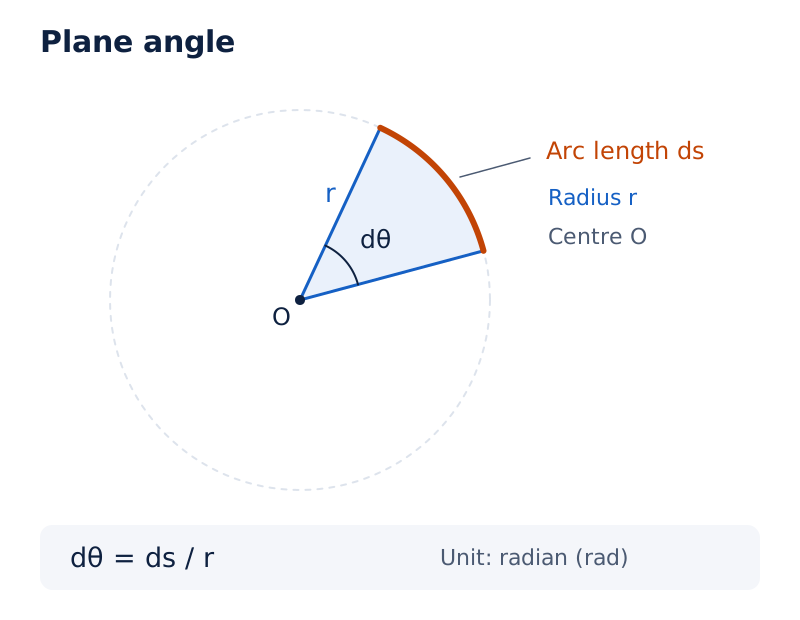
Two radii extend from the point labelled O to a curved arc. The drawing labels the radius , the arc , and the angle between the radii.
Drawn by One Young India. See Fig. 1.1(a) in your NCERT textbook
How does a solid angle extend this idea?
A solid angle uses a patch of a spherical surface rather than a circular arc. The sphere is centred at the apex. If the intercepted area is and the radius is , the ratio uses the square of the radius.
What the figure shows
Solid angle
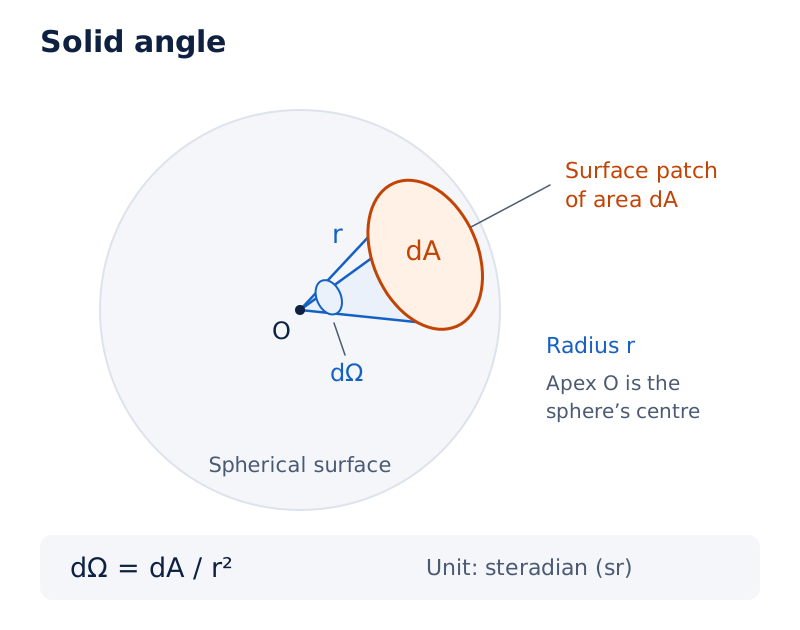
Lines spread from the apex O towards a curved surface patch. The drawing marks , the intercepted area , and the solid angle near the apex.
Drawn by One Young India. See Fig. 1.1(b) in your NCERT textbook
The solid-angle unit is the steradian, symbol . Area and squared radius both have dimensions of area, so this ratio is also dimensionless. Radians and steradians do not add further independent base dimensions to the seven-dimensional framework.
The two definitions should be kept distinct. Plane angle compares arc length with radius; solid angle compares spherical area with squared radius. Their dimensionless character comes from these ratios, not from the absence of any geometric meaning.
How do significant figures express measurement precision?
Significant figures are the reliably known digits in a measured result together with the first uncertain digit. They indicate the precision conveyed by the measurement. Writing additional calculator digits does not create additional experimental information.
For a pendulum period reported as , the digits 1 and 6 are reliable and the last digit, 2, is uncertain. The measurement has three significant figures. A length reported as similarly has four significant figures.
Which zeros should be counted?
| Rule | Example | Interpretation |
|---|---|---|
| Non-zero digits are significant | Four significant figures | |
| Zeros between non-zero digits are significant | Four significant figures | |
| Leading zeros do not count | Four significant figures | |
| Trailing decimal zeros count | Four significant figures | |
| Trailing zeros without a decimal can be ambiguous | Use scientific notation to preserve the stated precision |
Leading zeros locate the decimal point but do not record additional measured digits. A zero between significant digits is different: it contributes to the value and precision being reported. Its significance does not disappear merely because the decimal point moves.
Trailing zeros after a decimal point indicate retained precision. Thus the two zeros in matter. Reporting the measurement as would communicate fewer significant figures even though the numerical magnitudes are equal.
Note: A change of units cannot change the precision of the original measurement. If a converted number makes its significant figures unclear, use scientific notation instead of guessing from the final zeros.
The least count of a measuring instrument is connected with the precision of measurement. Significant figures communicate that precision in the reported result. They should be chosen from the measurement information, rather than from the number of digits available on a calculator display.
Why are scientific notation and exact numbers useful?
In scientific notation, a number is written as a coefficient multiplied by a power of ten. The coefficient carries the significant digits, while the power locates the scale. This is especially useful for very large or very small physical quantities.
Here is the positive number being represented, is its coefficient, and is an integer exponent. The exponent does not determine how many significant figures are present. Zeros written at the end of the coefficient do contribute to its precision.
A length can therefore be converted without losing the original precision:
All four forms retain four significant figures. This presentation removes the ambiguity of a converted value written with trailing zeros but no decimal point. The physical length and the measurement precision remain the same throughout the conversion.
What is an order-of-magnitude estimate?
An order of magnitude describes a quantity using an approximate power of ten. The coefficient is rounded to one when it is at most five, and to ten when it is greater than five. The resulting exponent identifies the order.
The Earth's diameter, , is of order . The hydrogen atom's diameter, , is of order . The two diameter scales differ by seventeen orders of magnitude.
Do exact factors limit significant figures?
Exact numbers do not carry the uncertainty of a measured value. For example, the factor two relating diameter and radius is exact. An exact count of oscillations in the period calculation is also different from a measured time interval.
In these relations, is the radius, the diameter, the period of one oscillation, the total measured time for oscillations, and the dimensionless count of oscillations. Exact factors are treated as having unlimited significant figures and do not impose a rounding limit.
How should significant figures be handled in calculations?
A calculated answer should reflect the precision of its measured inputs. Two different rules are needed: multiplication and division depend on significant figures, while addition and subtraction depend on decimal places. Applying the wrong rule misrepresents the measurement information.
How are products and quotients reported?
For multiplication or division, retain as many significant figures as the input with the fewest significant figures. The units must also be multiplied or divided. In a density calculation, mass divided by volume produces a mass-per-volume unit.
Worked example 1. Calculate the density of an object with mass and volume .
Formula: , where mass is , volume is , and density is .
Substitute:
Answer: . The volume has three significant figures, so the quotient is reported to three significant figures.
Worked example 2. Find the density when occupies .
Formula: .
Substitute:
Answer: . The two significant figures in the measured volume limit the final answer, despite the three figures in the mass.
How are sums and differences reported?
For addition or subtraction, retain the fewest decimal places available among the measurements, after expressing them in a common unit. The last retained place is controlled by the least precise decimal place, rather than by the smallest significant-figure count.
Worked example 3. Add masses , , and .
Formula: , where is the total mass and , , and are the measured masses , , and , respectively.
Substitute:
Answer: . Retain one decimal place because the second mass is reported only to tenths of a gram.
Worked example 4. Subtract from .
Formula: , where and are the measured lengths and is their difference.
Substitute:
Answer: , or . Both measurements extend to three decimal places. The difference has only one significant figure; subtraction can reduce the number of significant figures.
Writing the last difference with three significant figures would imply extra decimal precision. In the mass sum, rounding to three significant figures would instead discard a decimal place that the original measurements support. Operation type determines the appropriate rule.
How should uncertain digits be rounded in a multistep calculation?
Rounding removes digits that the precision of the data does not justify. If the first discarded digit is greater than five, increase the preceding digit by one. If it is less than five, leave the preceding digit unchanged.
When the discarded digit is exactly five in the stated examples, use the even-digit convention. Leave an even preceding digit unchanged; increase an odd preceding digit by one. This gives a consistent way to handle the tie.
| Original number | Three significant figures | Reason |
|---|---|---|
| Discarded digit exceeds five | ||
| Discarded digit is below five | ||
| Preceding digit is even | ||
| Preceding digit is odd |
Why retain an extra digit during working?
In a complex calculation, keep one more significant digit in intermediate results than the least precise measurement requires. Then round the final answer appropriately. Premature rounding introduces additional numerical error that can affect later operations.
Worked example 5. Each side of a cube measures . Calculate its total surface area and volume with appropriate significant figures.
Formula: and , where is the side length, the surface area, and the volume.
Substitute:
Answer: and . Both answers have four significant figures because the measured side has four. The exact factor six does not limit the surface-area precision.
Diagram
Cube dimensions
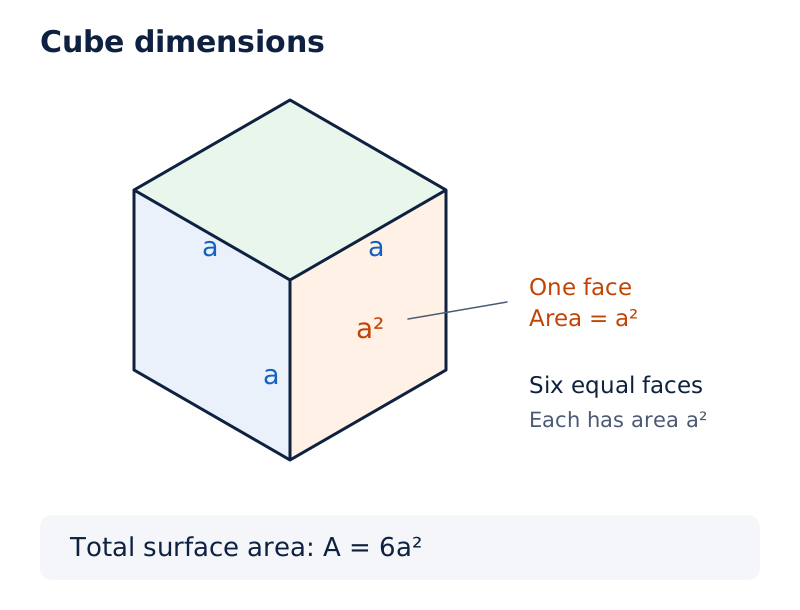
Draw a cube and label three edges meeting at one corner with the side length . Mark one face as having area , and identify the six equal faces used in the total surface-area calculation.
Drawn by One Young India.
Area and volume require different powers of the length unit. Squaring the side gives square metres; cubing it gives cubic metres. Carrying the unit through each substitution helps check that a geometrical calculation produces the intended physical quantity.
Worked example 6. Calculate one light-year using light speed and a year of .
Formula: , where is distance, is light speed, and is elapsed time.
Substitute:
Answer: , to three significant figures. The time has five significant figures, but the supplied speed has three. A light-year is a distance, with its result expressed in metres.
How does uncertainty affect a calculated result?
Uncertainty accompanies a measured value and must be considered when measurements are combined. The number of significant figures gives useful information, but equal significant-figure counts do not necessarily mean equal relative errors. The magnitude of the measured number also matters.
How do absolute and relative uncertainty differ?
An absolute uncertainty is expressed in the same unit as the measured quantity. A relative uncertainty compares that uncertainty with the measured value. The ratio is dimensionless and can be expressed as a percentage.
For masses and , each with uncertainty , the percentage uncertainties are:
- For the smaller mass, .
- For the larger mass, .
Both masses contain three significant figures and the same absolute uncertainty. Nevertheless, the smaller mass has the larger relative uncertainty. The uncertainty must be considered in relation to the measured value, not merely by counting its digits.
How is the uncertainty in a product reported?
Worked example 7. A thin rectangular sheet has length and breadth . Find its area and estimated uncertainty.
Formula: and . Here is the sheet length, its breadth, and its area; , , and are the corresponding absolute uncertainty magnitudes. The product rule is an approximate combination of the relative uncertainties.
Substitute:
- Calculate the area: .
- Combine the percentage uncertainties: .
- Calculate the area uncertainty before rounding: .
- Round the uncertainty and the area consistently: and .
Answer: . The uncertainty is ; it refers to area, not to either of the individual measured lengths.
Subtraction can reduce significant figures substantially. For example, , reported as . Although both original numbers have three significant figures, the result is limited to one decimal place.
What are dimensions, dimensional formulae and dimensional equations?
The dimensions of a quantity are the powers of the base quantities needed to represent it. A dimensional description identifies the nature of a quantity without specifying its numerical magnitude or committing to a particular system of measurement units.
In mechanics, the relevant base dimensions are mass , length , and time . Square brackets around a quantity indicate that its dimensions are being considered. Unit symbols and dimensional symbols serve different purposes and should not be interchanged.
How do dimensional formulae describe derived quantities?
A dimensional formula shows which base dimensions are present and their powers. A dimensional equation equates the dimensions of a quantity to that formula. A zero exponent indicates independence from that base dimension, not a zero physical value.
| Quantity | Dimensional equation | SI unit |
|---|---|---|
| Volume | ||
| Speed or velocity | ||
| Acceleration | ||
| Force | ||
| Mass density |
Volume contains three powers of length and zero powers of mass and time. Mass density contains one power of mass and minus three powers of length. Negative powers express division by the corresponding base quantity.
Derivation: Dimensions of force
- Write the relation between physical quantities: , where is mass and is acceleration.
- Replace mass and acceleration by their dimensions: and .
- Multiply the dimensions: .
Result: Force has mass exponent one, length exponent one, and time exponent minus two. The corresponding SI combination is .
Initial velocity, final velocity, average velocity, change in velocity and speed all share the same dimensional formula. Dimensions do not distinguish these physical meanings. A common dimensional formula therefore does not establish that two quantities are identical.
How can dimensional analysis test an equation?
The principle of dimensional homogeneity requires every term added or subtracted in a physical equation to have the same dimensions. Both sides must also match. Velocity cannot be added to force merely because both quantities have numerical values.
How is the equation for uniformly accelerated motion checked?
For motion along a line with constant acceleration, let be the position at elapsed time , the initial position, the initial velocity, and the acceleration. The position relation is .
- The position dimensions are .
- The velocity-time term has dimensions .
- The acceleration-time term has dimensions , because the numerical factor is dimensionless.
- Every term has dimensions of length, so the equation passes the dimensional consistency test.
The test is independent of whether length is expressed in metres or centimetres. This avoids unnecessary unit conversions while testing the structure of an equation. Units themselves may also be manipulated algebraically, with identical units cancelled between numerator and denominator.
Why does passing the test not prove correctness?
A dimensionally inconsistent equation must be wrong. A dimensionally consistent equation may still have an incorrect numerical coefficient or an incorrect physical interpretation. Dimensional analysis tests a necessary requirement, rather than supplying a complete proof of the relation.
| Proposed kinetic-energy expression | Dimensional result | Decision |
|---|---|---|
| Reject: does not match energy | ||
| Passes the dimensional test | ||
| Reject: force dimensions | ||
| Passes the dimensional test | ||
| Unlike dimensions are added | Reject: sum is not homogeneous |
Here is kinetic energy, mass, speed, and acceleration. Energy has dimensions . Dimensional reasoning cannot choose between the two expressions proportional to mass times speed squared; the correct coefficient requires physical information.
The arguments of trigonometric, logarithmic and exponential functions must be dimensionless. Pure numbers and ratios of similar quantities are dimensionless. Refractive index, expressed as a ratio of two light speeds, illustrates how a meaningful physical quantity can have no dimensions.
How is the pendulum relation obtained by dimensional analysis?
Dimensional analysis can suggest a product relation when the relevant dependencies are known. For a simple pendulum, assume that its period depends on string length, bob mass and acceleration due to gravity. The method determines the powers of these assumed variables.
Let the period be , the length , the bob mass , and gravitational acceleration . Their SI units are second, metre, kilogram and metre per second squared respectively. The unknown constant is dimensionless.
Derivation: Dependence of pendulum period on length and gravity
- Assume the product form , where , , and are unknown powers.
- Substitute dimensions: .
- Collect powers of the same base dimensions: .
- Equate the independent exponents: , , and .
- Solve for the powers: , , and .
- Substitute the powers into the assumed relation: .
Result: The assumed product relation gives . Bob mass has exponent zero, so it does not appear in this result. The dimensional method does not determine the constant .
What information remains beyond the dimensional calculation?
The usual small-oscillation pendulum relation is . The factor needs information beyond dimensional analysis. The small-oscillation condition is also a physical condition, rather than something established by matching dimensions.
The method requires the relevant variables and a suitable product-type dependence to be assumed. Omitting a relevant dependency cannot be repaired merely by balancing exponents. Dimensionless factors and distinctions between quantities sharing dimensions remain outside what the exponent equations can settle.
Dimensional analysis is therefore useful for checking consistency and deducing possible dependencies. Its result should be read with its assumptions: the variables chosen, the form assumed, and any physical conditions needed for the final relation.
Glossary
- Measurement — Comparison of a physical quantity with an accepted reference standard of the same kind.
- Unit — A properly standardised reference used to express the numerical measure of a physical quantity.
- Base unit — A unit assigned to a fundamental quantity from which other units can be derived.
- Derived unit — A unit expressed through a combination of the units of base quantities.
- System of units — A complete set containing the base units and the derived units formed from them.
- Significant figures — The reliably known digits of a measured value together with its first uncertain digit.
- Scientific notation — A representation using a coefficient carrying significant digits multiplied by a power of ten.
- Order of magnitude — The exponent of ten used to describe the approximate scale of a quantity.
- Absolute uncertainty — The uncertainty magnitude expressed in the same unit as the measured physical quantity.
- Relative uncertainty — The dimensionless ratio of an absolute uncertainty to the magnitude of its measured value.
- Dimensions — The powers of base quantities required to represent the nature of a physical quantity.
- Dimensional formula — An expression showing the base dimensions and their powers for a particular physical quantity.
- Dimensional homogeneity — The requirement that terms added or subtracted in a physical equation have matching dimensions.
Common errors and misconceptions
- Misconception: Changing metres to millimetres increases significant figures. Correct: Unit conversion preserves measurement precision; scientific notation makes the retained significant figures explicit.
- Misconception: Every zero is insignificant. Correct: Zeros between non-zero digits and trailing zeros in a decimal measurement are significant; leading zeros are not.
- Misconception: Every operation uses the fewest-significant-figures rule. Correct: Addition and subtraction use decimal places; multiplication and division use significant figures.
- Misconception: Every discarded five requires rounding upwards. Correct: In the exact-five tie, retain an even preceding digit and increase an odd preceding digit.
- Misconception: A dimensionless quantity cannot have a named unit. Correct: Plane and solid angles are dimensionless but are expressed in radians and steradians.
- Misconception: Matching dimensions proves an equation correct. Correct: An incorrect dimensionless coefficient can still pass the dimensional test.
- Misconception: Dimensional analysis supplies the full pendulum formula. Correct: It supplies the assumed power dependence but cannot determine the dimensionless coefficient.
Exam-style questions with model answers
Q1. Distinguish between base and derived units, giving an example of each. [2 marks]
- Base units belong to the selected fundamental quantities. The metre is the SI base unit of length.
- Derived units are combinations of base units. The unit of speed, , combines length and time units.
Q2. Explain why plane angle is dimensionless but has a named unit. [2 marks]
- A plane angle is the ratio of an arc length to its radius: .
- The length dimensions cancel. The angle is dimensionless, but its named unit is the radian, represented by .
Q3. Explain how significant figures are preserved when converting a length of to other units. [3 marks]
- The original measurement contains four significant figures. Its two trailing decimal zeros communicate precision and must not be discarded simply because the unit changes.
- Write . Each coefficient retains the same four significant figures.
- The power of ten changes the numerical scale, not the precision. Scientific notation avoids ambiguity in a form such as , whose trailing zeros alone do not clearly state the intended precision.
Q4. A mass of occupies . Calculate the density and justify its precision. [3 marks]
- Density is mass divided by volume: . The mass has three significant figures, while the volume has only two significant figures.
- Substituting with units gives .
- For division, the input with the fewest significant figures limits the result. Therefore report . The remaining calculator digits would imply more precision than the volume measurement supports.
Q5. Derive the pendulum period's dependence on length, bob mass and gravitational acceleration using dimensions. State a limitation. [5 marks]
- Assume . Here is period, length, gravitational acceleration, bob mass, and a dimensionless constant. This assumes a product dependence on the stated variables.
- Replace the physical quantities with dimensions: .
- Equal dimensions require equal powers for each independent base quantity. Thus , , and .
- Solving gives , , and . Therefore , with no mass dependence in the assumed relation.
- Dimensional analysis cannot determine . The usual small-oscillation result uses , which requires additional physical reasoning. Matching dimensions alone establishes neither this numerical coefficient nor the oscillation condition.
Q6. Explain how dimensions test the equation , and state what the test cannot prove. [5 marks]
- The equation describes position for motion with constant acceleration. The symbols and are positions, is initial velocity, is acceleration, and is elapsed time.
- Both positions have dimensions of length: . The velocity-time term gives .
- The remaining term gives , since the numerical coefficient has no dimensions.
- All added terms and the left side therefore have matching dimensions. The equation passes the homogeneity test without requiring a particular choice of length or time units.
- A failure would prove the equation wrong. Passing does not prove its exact physical correctness, because the method cannot establish dimensionless numerical coefficients. The assumed motion conditions must also be respected.
Key takeaways
- A measurement needs both a numerical value and a unit identifying the accepted standard of comparison.
- SI has seven base units; derived quantities use combinations of those units, sometimes with special names.
- Plane and solid angles are dimensionless ratios, expressed respectively using the named units radian and steradian.
- Significant figures include reliable digits and the first uncertain digit; changing units does not change their number.
- Use significant figures for multiplication and division, but use decimal places for addition and subtraction.
- Retain an extra significant digit during intermediate calculations, then round the final answer to the justified precision.
- Dimensional inconsistency proves an equation wrong, whereas dimensional consistency alone cannot establish its exact physical correctness.
- Dimensional analysis can deduce assumed power dependencies, but it cannot determine dimensionless constants or replace physical conditions.
Test yourself
What two elements must accompany a reported measurement?
A numerical measure and a unit are needed to identify the quantity's value relative to a standard.
Which SI base unit measures amount of substance?
The mole measures amount of substance, and the elementary entities being counted must be specified.
Why is the zero in significant?
It lies between non-zero digits, so it contributes to the four significant figures in this measurement.
Does an exact factor of two restrict a calculation to one significant figure?
No. Exact numerical factors have unlimited significant figures and do not limit the precision of measured inputs.
What determines the last retained place in a sum of measured masses?
The measurement with the fewest decimal places determines the final decimal place, after using a common unit.
What does a zero mass exponent in a dimensional formula mean?
It means that the dimensional representation is independent of mass, not that the physical quantity equals zero.
Can dimensional analysis distinguish initial velocity from average velocity?
No. Both have dimensions , although their meanings in a description of motion differ.
Why can dimensional analysis not determine the pendulum coefficient?
The coefficient is dimensionless, so changing its numerical value leaves the dimensions of the relation unchanged.