
Laws of Motion | CBSE Class 11 Physics Notes
On this page
Watch & explore
Start with a few high-quality watches, then dive into the notes below.

Learnacy Labs Try it hands-on: open the Mechanics lab
This note covers inertia, Newton’s three laws of motion, momentum and impulse, conservation of momentum, equilibrium, common forces, static and kinetic friction, free-body diagrams, circular motion on level and banked roads, and worked applications of the laws of motion.
Why does uniform motion not require a net force?
How did Galileo correct Aristotle’s view?
Aristotle’s fallacy was the belief that an external force is necessary to keep a body moving. A toy car seems to support this view: it moves while someone pulls it and stops when the pull is removed.
The missing force in that explanation is friction. While the toy car moves uniformly, the pull balances friction from the floor. When the pull stops, friction remains and slows the car. A force is needed to counter resistance, rather than to maintain uniform motion itself.
Galileo considered motion on smooth inclined planes. A ball speeds up while descending and slows down while ascending. On a frictionless horizontal plane, it would neither speed up nor slow down. Its velocity would remain unchanged.
In a double inclined plane arrangement, a ball released on one side rises nearly to its original height on the other. With friction absent, the heights would be equal. Reducing the second slope makes the ball travel farther before reaching that height.
When the second plane becomes horizontal, the ideal ball cannot regain its original height. It continues moving indefinitely. Real balls stop because friction cannot be completely eliminated. The idealisation reveals the effect that friction conceals in ordinary observations.
What the figure shows
Galileo’s inclined planes
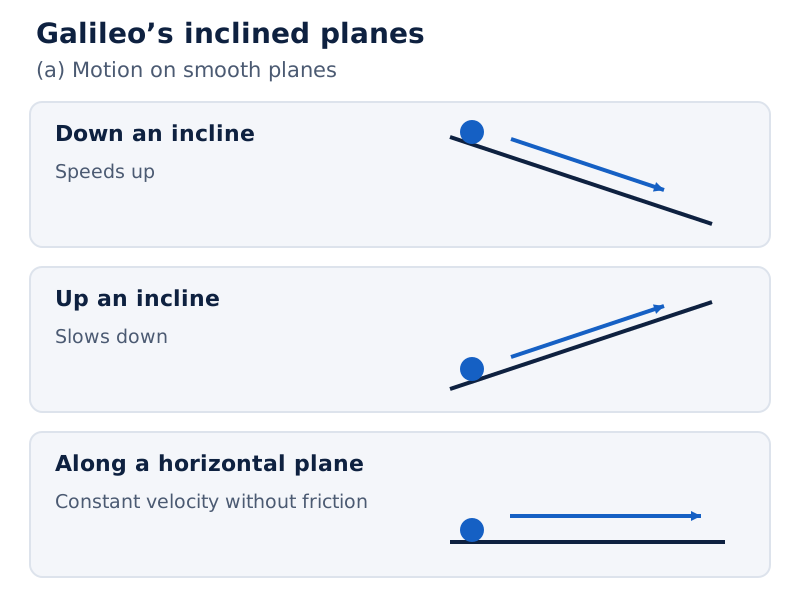
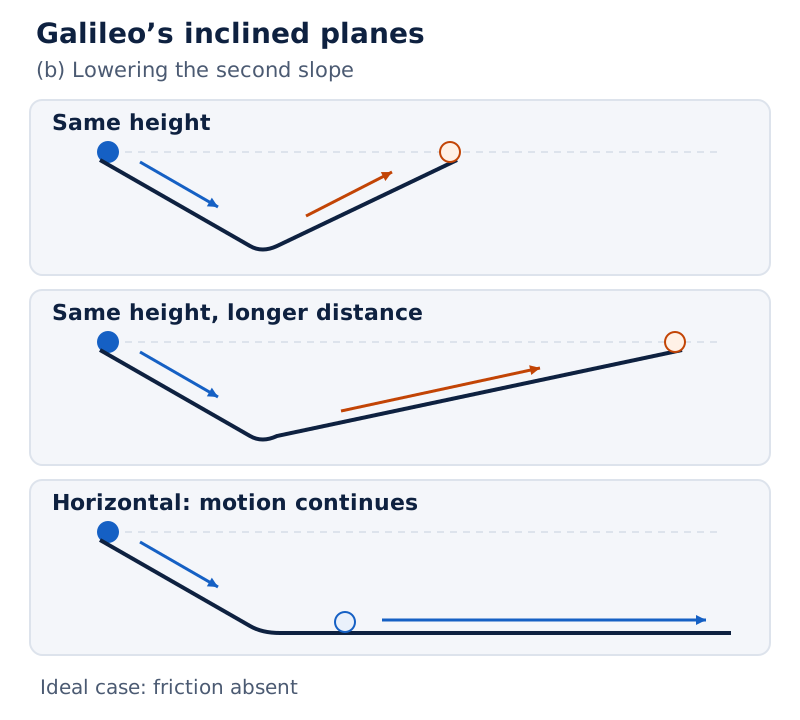
Part (a) shows balls moving down an incline, up an incline and along a horizontal surface. Part (b) shows three double-plane arrangements, with the right-hand slope progressively reduced until it becomes horizontal.
Drawn by One Young India. See Fig. 4.1 in your NCERT textbook
What does inertia mean?
Definition: Inertia is the tendency of a body to resist a change in its state of rest or uniform straight-line motion.
Rest and uniform linear motion therefore have the same force condition: the net external force is zero. Neither requires an unbalanced force. A change in velocity requires a net force, whether the change involves speed, direction or both.
How does Newton’s first law explain familiar motion?
Newton’s first law states that a body remains at rest or continues with uniform velocity in a straight line unless a net external force changes that state. The important condition concerns the resultant of all external forces.
Zero resultant force does not mean that no individual forces act. A book resting on a horizontal table experiences downward weight and an upward normal force. Because the book remains at rest, these two forces must balance.
The observation of rest establishes the force balance. Force balance alone establishes zero acceleration; without information about initial velocity, it does not establish that an object is stationary. A car moving with constant velocity also has zero resultant force.
Why do passengers jerk when a bus starts or stops?
When a stationary bus starts, friction accelerates the passenger’s feet with the floor. The rest of the body initially tends to retain its state of rest. Because the body is deformable, the passenger appears to fall backwards relative to the bus.
When the bus stops suddenly, friction stops the feet with the floor, while the rest of the body tends to continue forwards. Muscular forces subsequently bring the body to rest. These observations illustrate inertia and the role of contact forces.
What happens after contact with an accelerating body ends?
An astronaut separated from a small accelerating spaceship does not retain the spaceship’s acceleration. If gravitational attraction from nearby objects and the spaceship is negligible, the astronaut has no net force and hence no acceleration after separation.
The same reasoning applies to a stone dropped from an accelerating train. Once released, it has no horizontal force if air resistance is neglected. Gravity still produces vertical acceleration. Acceleration depends on the present forces, not on the object’s earlier acceleration.
Note: A ball thrown upwards is momentarily at rest at its highest point, but its weight still acts. Instantaneous zero velocity does not imply zero force or zero acceleration.
How does Newton’s second law connect force and momentum?
Momentum is the product of mass and velocity. It is a vector directed along the velocity: , where is momentum, is mass and is velocity. A heavier body moving at the same velocity has greater momentum.
The force required to change motion depends on how much momentum changes and how quickly it changes. The same momentum change produced in a shorter time requires a greater force. Changes of direction matter even if the speed remains constant.
Definition: Newton’s second law relates the net external force to the rate of change of momentum, with the change directed along that force.
Derivation: the constant-mass form of the second law
- Write momentum as . The second law gives , where is the net external force, is time and is the proportionality constant, whose value depends on the unit of force. The derivative is the instantaneous rate of change of momentum; below denotes acceleration.
- For a fixed mass, take the mass outside the derivative:
- Choose SI force units so that . Substitution gives
Result: uses the net external force and assumes constant mass. The acceleration points along the resultant force, which need not point along the velocity.
The SI unit of force is the newton, defined by . One newton gives a mass of one kilogram an acceleration of one metre per second squared.
The SI unit of momentum is . The SI unit of impulse is . The SI unit of acceleration is . The SI unit of the spring force constant is .
How are vector components used?
The law applies separately along each chosen axis: , and , where are the net external force components and are the acceleration components along the axes, respectively. A force changes the velocity component along its direction. For a projectile under gravity alone, the horizontal velocity component remains constant.
Worked example 1. A bullet of mass , travelling at , stops after penetrating into a heavy wooden block. Find the average resistive force.
Formula: ; , where and are the initial and final velocity components along the bullet’s initial direction, is its stopping displacement, is its acceleration component and is the resistive force component. Treat the retardation as constant for this calculation.
Substitute:
- Convert the stopping distance:
- Choose the initial motion as positive:
- Calculate the force:
Answer: The average resistive force has magnitude , opposite to the initial motion. The actual force during penetration need not be uniform.
What is impulse, and why does stopping time matter?
An impulsive force is a large force acting briefly and producing a finite momentum change. A ball bouncing from a wall changes momentum during its short contact with the wall. The impulse can be found even when the force and contact time are difficult to measure separately.
expresses the impulse-momentum relation. For a constant force, or using its average value over the interval, . Here is impulse, is final momentum minus initial momentum, is the average net force and is the time interval over which it acts. Impulse has direction as well as magnitude.
Why does a cricketer move the hands backwards?
A cricketer catching a ball draws the hands backwards, increasing the stopping time. For a given initial momentum and final rest, the momentum change is fixed. Increasing the time reduces the average force required to stop the ball.
A novice who keeps the hands fixed stops the ball more abruptly and experiences a greater force. The effect follows directly from the rate of momentum change. Impulsive forces obey the same laws as other forces; their short duration does not create a separate law.
Worked example 2. A batsman returns a ball straight towards the bowler without changing its speed of . Its mass is . Calculate the impulse imparted to the ball.
Formula: .
Substitute:
- Choose the direction towards the bowler as positive:
- Subtract the signed velocities:
- Calculate the momentum change:
Answer: The impulse is , directed from the batsman towards the bowler.
The unchanged speed does not make the impulse zero. Velocity reverses direction, so momentum changes. A numerical impulse also does not determine the average force unless the duration of contact is known.
Why do action and reaction not cancel on one body?
Newton’s third law states that interacting bodies exert equal and opposite forces on each other. If means the force on body A by body B and means the force on body B by body A, then .
The two forces act simultaneously. The words action and reaction do not imply that one happens first or causes the other later. Either member of the pair may be called the action.
The forces act on different bodies. When analysing body A, include the force exerted on A by B. Do not add the force exerted on B by A to A’s force diagram. That second force belongs to a different body.
How can equal forces produce different effects?
Earth attracts a falling stone, and the stone attracts Earth with an equal and opposite force. Earth’s very large mass makes its resulting acceleration negligible compared with the stone’s. Equal force magnitudes do not imply equal accelerations for different masses.
| Forces being compared | Bodies acted upon | Interpretation |
|---|---|---|
| Earth’s pull on a stone and the stone’s pull on Earth | Stone and Earth | A gravitational action-reaction pair |
| Table’s force on a book and book’s force on the table | Book and table | A contact action-reaction pair |
| Weight of a resting book and table’s normal force on it | The same book | Balanced external forces, not an action-reaction pair |
If A and B are chosen together as a system, their mutual forces become internal forces. These cancel in the force sum for the combined system. External forces still determine the change in the system’s total momentum.
Note: Identify each force as “force on one body by another body”. This keeps the receiving body and the force-producing agency clear and prevents incorrect action-reaction pairs.
How is conservation of momentum derived?
The total momentum of an isolated system remains constant. Internal interactions can change the momentum of individual particles, but they cannot change the total when the net external force is zero.
A gun and bullet illustrate this principle. Initially both are at rest. During firing, the gun pushes the bullet forwards while the bullet pushes the gun backwards. Their momentum changes are equal and opposite because the mutual forces act for the same interval.
Derivation: momentum conservation during a collision
Consider two interacting bodies A and B with no net external force on their combined system. Use average interaction forces over the common collision interval. Let and be the initial momenta of A and B, and and their final momenta; a prime marks a final value.
- Apply the impulse-momentum relation to A:
- Apply the same relation to B over the same interval:
- Use the third law, , and add the momentum changes:
- Rearrange to compare total final and initial momentum:
Result: provided the net external force on the system is zero, where and are the system’s total final and initial momenta.
What remains conserved in different collisions?
Momentum conservation applies to both elastic and inelastic collisions in an isolated system. An elastic collision has the additional condition that total kinetic energy remains unchanged. Momentum conservation alone does not establish that a collision is elastic.
For the initially stationary gun-bullet system, the total final momentum is zero. Therefore , where is the gun’s final recoil momentum and is the bullet’s final momentum. This requires opposite momenta, rather than equal speeds. The bodies’ different masses must be included when relating their velocities.
System selection is essential. The bullet alone experiences an external force from the gun, so its momentum changes. For the gun and bullet together, the same interaction is internal. The conservation statement refers to the combined system under the stated external-force condition.
How are equilibrium and common forces identified?
A particle is in equilibrium when the vector sum of its external forces is zero. It may remain at rest or move with constant velocity. Equilibrium of a particle concerns zero acceleration, not necessarily zero speed.
For two forces, equilibrium requires equal magnitudes and opposite directions. For three concurrent forces, the resultant of any two must be equal and opposite to the third. The force vectors can be drawn head to tail to form a closed triangle.
Along perpendicular axes, the balance conditions are , and . Each component sum must vanish separately. For an extended body, rotational equilibrium additionally requires zero net external torque.
Which forces appear in mechanics?
| Force | Origin or direction | Important condition |
|---|---|---|
| Weight | Gravitational attraction towards Earth | Acts without contact |
| Normal reaction | Contact component perpendicular to the surfaces | Its magnitude follows from the motion and other forces |
| Friction | Contact component parallel to the surfaces | Opposes actual or impending relative motion |
| Tension | Pull transmitted along a stretched string | Uniform tension is used for a string of negligible mass in the ideal arrangements considered |
| Spring force | Restoring force opposite displacement from the unstretched state | Usually proportional to small extensions or compressions |
The spring relation is , where is the spring force component, is the signed displacement from the unstretched state along the spring’s axis and is the spring force constant. The negative sign indicates restoration towards the unstretched state. Contact forces also include buoyancy, viscous drag and air resistance when a solid interacts with a fluid.
At the microscopic level, ordinary contact forces arise from electrical interactions between charged constituents of matter. Their detailed microscopic calculation is unnecessary for many mechanics problems; their measured macroscopic properties provide the working descriptions.
Do not automatically set the normal reaction equal to weight. That equality holds for a body on a horizontal support when the vertical forces balance and weight and normal reaction are the relevant vertical forces. Acceleration or additional forces can change the relation.
How do static, kinetic and rolling friction differ?
Static friction opposes impending relative motion between surfaces. Consider a block on a horizontal table pushed by a horizontal force. While the block remains at rest, static friction adjusts to balance the applied force, up to a limiting value.
The limiting magnitude is , so the general condition is . Here is the static friction magnitude, its maximum value, the normal reaction magnitude and the coefficient of static friction, which depends on the pair of surfaces. The maximum value should be used only when sliding is just about to begin.
Kinetic friction acts when surfaces slide relative to one another. Its approximate magnitude is , where is the kinetic friction magnitude and is the coefficient of kinetic friction. It is nearly independent of sliding velocity, and the coefficient is usually smaller than the coefficient of static friction.
What the figure shows
Static and sliding friction
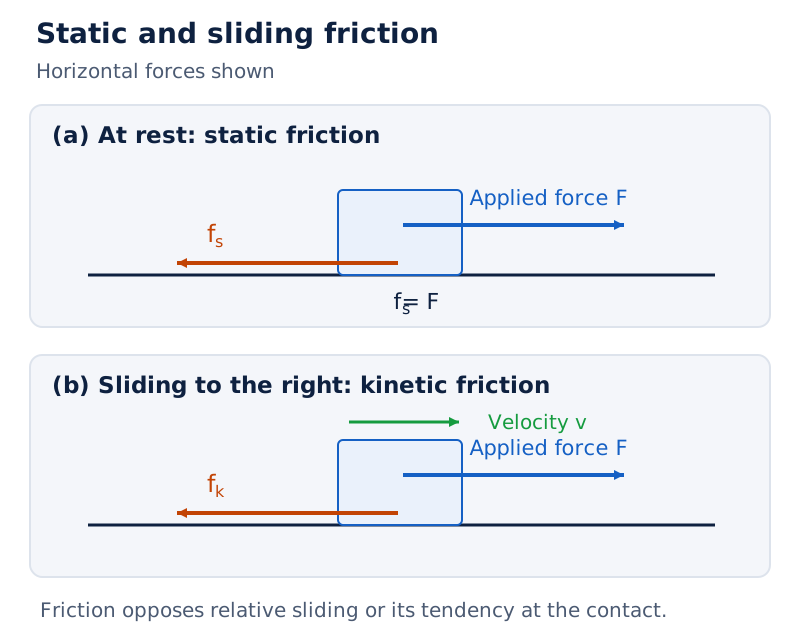
Both drawings show a block on a horizontal surface, with the applied force arrow pointing right. The friction arrow points left. The moving block in part (b) also has a rightward velocity arrow.
Drawn by One Young India. See Fig. 4.10 in your NCERT textbook
What are the limits of these friction laws?
The limiting static friction and kinetic friction are approximately independent of contact area in the stated model. These are empirical relations, rather than fundamental force laws. Their usefulness does not make them exact descriptions under every possible condition.
| Type | Contact behaviour | Role |
|---|---|---|
| Static friction | No actual sliding at the contact | Opposes the tendency to slip and adjusts up to its limit |
| Kinetic friction | Surfaces slide relative to each other | Opposes their actual relative sliding |
| Rolling resistance | Rolling surfaces deform slightly in practice | Provides resistance much smaller than sliding friction for the same weight |
Friction need not oppose a body’s motion relative to the ground. A box moving with an accelerating train needs forward static friction to accelerate with the floor. Friction opposes the box’s tendency to slip backwards relative to that floor.
Rolling resistance arises in practice because contacting surfaces deform. Ball bearings reduce resistance by replacing sliding with rolling. Lubricants reduce kinetic friction, while a thin air cushion can separate surfaces. Friction also enables walking, vehicle acceleration and braking.
Worked example 3. A box rests on a train floor with coefficient of static friction . Find the greatest train acceleration for which the box remains stationary relative to the floor, using , where is the magnitude of acceleration due to gravity.
Formula: ; , where is the greatest train acceleration that avoids slipping.
Substitute:
- For a box of mass , vertical balance gives
- At the slipping threshold, static friction supplies the acceleration:
- Cancel the common mass:
Answer: The maximum acceleration is . A larger acceleration requires more static friction than the contact can provide.
How do free-body diagrams help with inclined planes and connected bodies?
A free-body diagram isolates the chosen system and shows every force exerted on it by its environment. It does not mean that the body is force-free. The system may accelerate, remain at rest or move uniformly.
What is the problem-solving sequence?
- Sketch the complete arrangement, including bodies, supports and connecting strings.
- Select a convenient body or group of bodies as the system.
- Draw only forces acting on that system, including gravity and contact forces from objects outside it.
- Mark known directions and magnitudes. Keep uncertain forces as unknowns instead of assuming their values.
- If another body must be analysed, draw its own diagram and use the third law consistently for their mutual interaction.
For an inclined block, resolve weight parallel and perpendicular to the plane. The normal force is perpendicular to the plane, while friction lies along it. For a block about to slide downwards, static friction points upwards along the plane.
What the figure shows
Forces on an inclined block
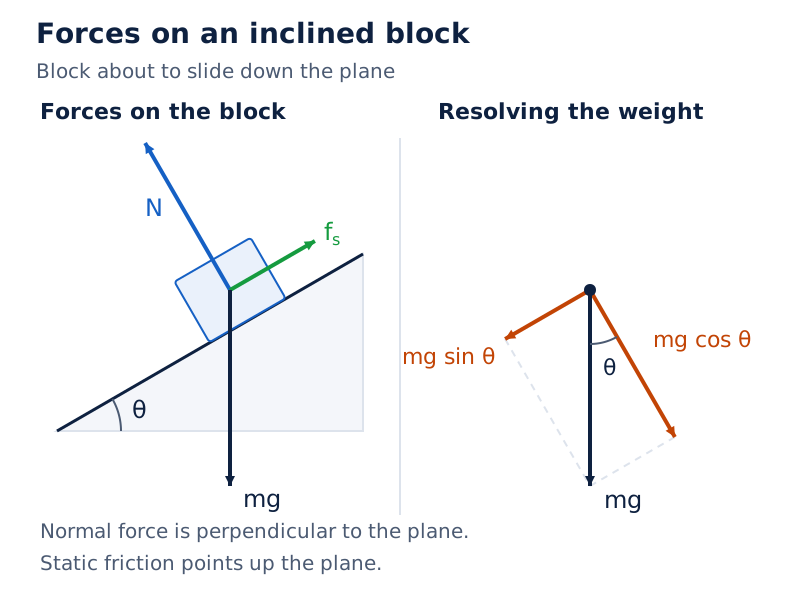
The block lies on a plane inclined at an angle to the horizontal. The diagram labels downward weight , normal force , upward-slope friction , and the components and .
Drawn by One Young India. See Fig. 4.11 in your NCERT textbook
Worked example 4. A block just begins to slide when a plane reaches to the horizontal. Find the coefficient of static friction.
Formula: At limiting equilibrium, and .
Substitute:
- Write the balance parallel to the plane: Here is measured in , so both sides are forces in .
- Substitute the normal force and divide: The force units cancel.
- Evaluate the dimensionless ratio:
Answer: The coefficient is approximately , with no unit. The threshold angle is independent of the block’s mass.
How are coupled equations formed?
Connected bodies can share an acceleration magnitude while experiencing different forces. In the ideal trolley arrangement, an inextensible string passing over a smooth pulley connects a trolley to a hanging block. Draw separate diagrams before combining their equations.
Worked example 5. A trolley slides on a horizontal surface towards a fixed pulley at the edge. A horizontal string segment attached to the trolley passes over the pulley to a hanging block, which moves downwards. The coefficient of kinetic friction between the trolley and the surface is . Find acceleration and tension, using , a smooth pulley and a massless inextensible string.
Formula: ; ; , where is the hanging block’s mass, is the trolley’s mass, is their common acceleration magnitude and is the string tension magnitude.
Substitute:
- Calculate trolley contact forces:
- Take the block’s downward motion and trolley’s rightward motion as positive:
- Add the equations to eliminate tension:
- Use the unrounded acceleration:
Answer: The acceleration is approximately , and the tension is . The block moves downwards and the trolley towards the pulley.
The equal tension magnitudes cancel algebraically when the two scalar equations are added, with rightwards positive for the trolley and downwards positive for the block. The tension forces act in perpendicular directions, so this is not cancellation of an internal action-reaction pair. Each force must still appear in its individual body’s equation.
What supplies the force for circular motion on a level road?
A body moving at constant speed around a circle still accelerates because its velocity changes direction. Its acceleration points towards the centre. The required inward force is called the centripetal force: , where is the inward resultant force magnitude, is the body’s mass, is its speed and is the circle’s radius.
Centripetal force names the role of a force, not an extra interaction. Tension supplies it for a stone whirled by a string, gravity supplies it for a planet, and static friction supplies it for a vehicle turning on a level road.
Derivation: maximum speed on a level road
- With no vertical acceleration and no other vertical forces, balance weight and normal reaction:
- Set the required radial force equal to static friction:
- Substitute the normal force and cancel mass:
- At the limiting speed, take the positive square root:
Result: The maximum non-slipping speed depends on the road-tyre friction coefficient and turn radius. The mass cancels because both the required centripetal force and the maximum available friction are proportional to mass.
Worked example 6. A cyclist takes a level circular turn of radius at . The coefficient of static friction is . Determine whether slipping occurs, using .
Formula: No slipping requires .
Substitute:
- Convert the speed:
- Square the actual speed:
- Evaluate the limit:
Answer: At , the cyclist slips because . Static friction cannot supply the required inward force.
A sharper turn means a smaller radius, which increases the inward force needed at the same speed. Increasing speed also increases the required force. Both changes can make the friction limit insufficient even though the cyclist’s mass remains unchanged.
How does banking help a vehicle negotiate a circular turn?
On a banked road, the normal force tilts towards the centre of the turn. Its horizontal component contributes to the centripetal force. Banking therefore reduces the contribution required from friction at a suitable speed. In the following diagram and equations, is the road’s banking angle to the horizontal and is the static friction magnitude.
For the maximum-speed condition, friction acts down the slope, opposing the tendency to move up it. Its horizontal component points inwards, and its vertical component points downwards. Resolve both normal reaction and friction before applying Newton’s second law.
What the figure shows
Level and banked circular roads
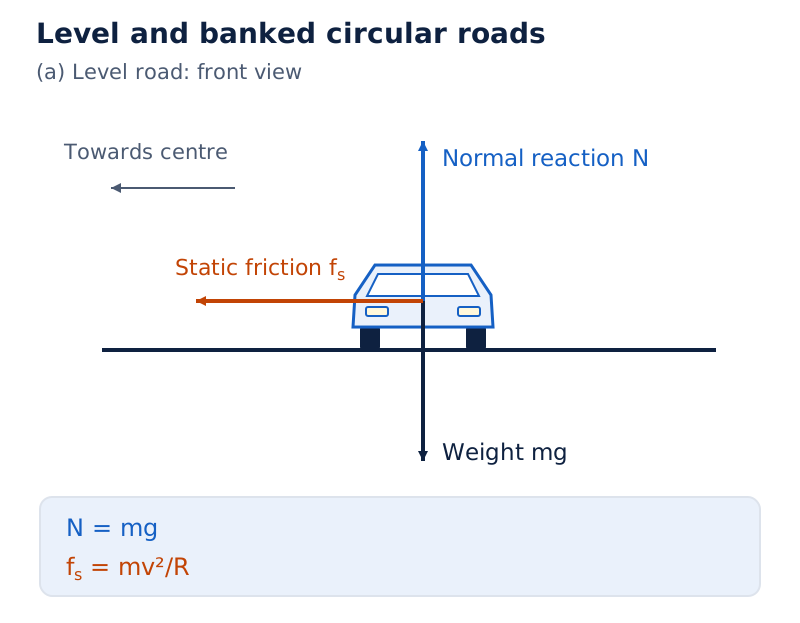
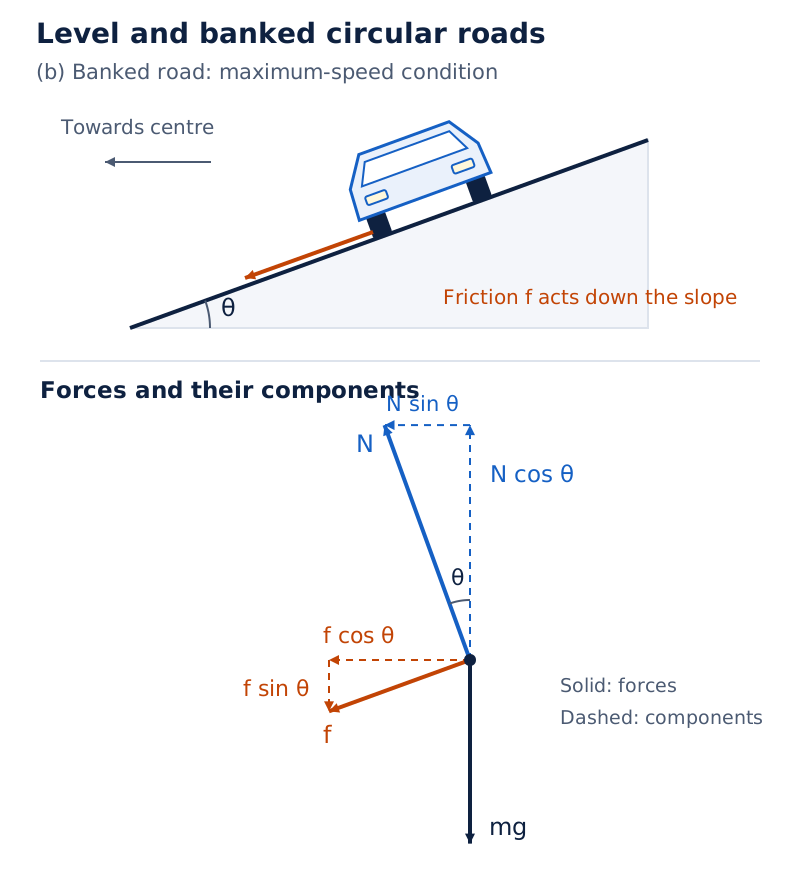
Part (a) shows a level-road car with upward normal reaction, downward weight and inward friction. Part (b) shows a tilted car and force components, including inward and , upward , and downward .
Drawn by One Young India. See Fig. 4.14 in your NCERT textbook
Derivation: maximum and optimum speeds on a banked road
- Use zero vertical acceleration:
- Resolve the forces horizontally towards the centre:
- At the maximum-speed friction limit, substitute :
- Insert this normal force into the radial equation and simplify:
- For the speed requiring no friction, set in the balance equations and divide them:
Result: is the optimum speed at which no friction is needed for the turn. Below this speed, friction acts up the slope. The maximum-speed derivation uses the opposite friction direction.
Worked example 7. A circular racetrack has radius , banking angle , and static friction coefficient . Find the optimum and maximum permissible speeds, taking .
Formula: ; .
Substitute:
- Evaluate the dimensionless trigonometric factor:
- Calculate the optimum speed:
- Include the limiting friction contribution:
Answer: The optimum speed is , and the maximum permissible speed is .
The optimum speed does not mean that the road must have zero friction. It means no frictional force is required at that speed. At the maximum permissible speed, the available static friction has reached its limiting value.
Glossary
- Inertia — The tendency of a body to retain rest or uniform straight-line motion unless an external force changes it.
- Momentum — A vector quantity equal to the product of a body’s mass and velocity.
- Net external force — The vector sum of forces exerted on a chosen system by objects outside that system.
- Impulse — The change in momentum produced by a force acting over a time interval.
- Action-reaction pair — Equal and opposite simultaneous interaction forces that act on two different bodies.
- Isolated system — A system without external force, whose total momentum remains unchanged during internal interactions.
- Equilibrium — The condition in which the resultant external force on a particle is zero.
- Normal reaction — The component of a contact force perpendicular to the surfaces in contact.
- Static friction — The frictional force opposing impending relative motion between surfaces that are not sliding against one another.
- Kinetic friction — The frictional force opposing actual relative sliding between two surfaces in contact.
- Tension — The restoring pull transmitted along a stretched string to the bodies connected to it.
- Centripetal force — The inward resultant force that provides radial acceleration during circular motion.
- Free-body diagram — A diagram of a selected system showing the forces exerted on it by its environment.
Common errors and misconceptions
- Misconception: A moving body needs a net force to keep moving. Correct: Uniform straight-line motion requires zero net force; a net force changes velocity.
- Misconception: Zero velocity means zero acceleration. Correct: A vertically thrown ball has zero velocity at its highest point while gravity still accelerates it downwards.
- Misconception: Force must point along the velocity. Correct: Net force points along acceleration; in uniform circular motion it is perpendicular to velocity.
- Misconception: Action and reaction cancel on a body. Correct: They act on different bodies and cancel as internal forces only when those bodies are included in one system.
- Misconception: Static friction always equals its limiting value. Correct: It adjusts as needed, with , until impending sliding brings it to the limit.
- Misconception: Normal reaction always equals weight. Correct: Its magnitude follows from the force balance or acceleration perpendicular to the surface.
- Misconception: Centripetal force must be added to tension or friction. Correct: Tension, friction or another interaction supplies the inward resultant; centripetal force is its role.
- Misconception: Friction always opposes motion relative to the ground. Correct: It opposes actual or impending relative motion at the contact and can accelerate a box with a train.
Exam-style questions with model answers
Q1. State Newton’s first law and explain the force condition for uniform motion. [2 marks]
- A body remains at rest or in uniform straight-line motion unless a net external force changes that state.
- Uniform motion has zero acceleration and zero resultant external force. Individual forces may act, provided their vector sum is zero.
Q2. Why does a cricketer draw the hands backwards while catching a ball? [2 marks]
- Moving the hands backwards increases the time taken to stop the ball.
- The momentum change remains fixed, so shows that a longer stopping time reduces the average force.
Q3. Derive the constant-mass form of Newton’s second law and define its SI force unit. [3 marks]
- The second law relates net external force to the rate of change of momentum: when SI force units are used.
- Since , for constant mass, . Therefore .
- The SI unit is the newton, with . It is the force that accelerates one kilogram at one metre per second squared. The acceleration follows the resultant force direction.
Q4. Explain why the weight and normal reaction of a resting book are not an action-reaction pair. Identify the correct pairs. [3 marks]
- Weight and normal reaction both act on the book. They balance because the book is in equilibrium, whereas third-law pairs act on different bodies.
- The reaction partner of Earth’s gravitational pull on the book is the book’s gravitational pull on Earth. These forces are equal, opposite and simultaneous.
- The reaction partner of the table’s upward force on the book is the book’s downward force on the table. This is a separate contact interaction.
Q5. Derive conservation of momentum for two colliding bodies and state its condition. [5 marks]
- Choose both colliding bodies as one system. Require zero net external force so that external agencies do not change the system’s total momentum during the interaction.
- Over the common collision interval, the impulse-momentum relation gives , using the average interaction force on A.
- For B, the corresponding relation is . Both interaction forces act over the same time interval.
- Newton’s third law gives . Adding the two momentum changes therefore gives zero.
- Rearrangement yields . Total momentum is conserved for both elastic and inelastic collisions under the external-force condition; kinetic energy conservation is an additional condition for elastic collisions.
Q6. Compare static and kinetic friction, including their laws and directions. [3 marks]
- Static friction opposes impending relative motion between surfaces. It is self-adjusting and obeys , reaching equality only at its limiting value.
- Kinetic friction opposes actual relative sliding and is approximately . The kinetic coefficient is usually smaller than the static coefficient for the same pair of surfaces.
- These empirical laws are approximate and largely independent of contact area. Friction opposes relative motion at the contact, so static friction can accelerate a box forwards with a train.
Q7. Derive the maximum speed of a vehicle on a level circular road and explain the role of friction. [5 marks]
- Model the car as moving around a circle of radius at speed , without vertical acceleration. Its weight and normal reaction balance, giving .
- The required inward acceleration is , so Newton’s second law requires an inward resultant force . This is supplied by static friction between tyres and road.
- Static friction cannot exceed . Therefore .
- Cancel mass and multiply by the radius to obtain . At the limiting speed, .
- The result is independent of mass. A larger speed or sharper turn can demand more friction than is available, causing slipping. Centripetal force is the name for the inward resultant, so no additional force should be added to the friction force.
Q8. Explain the optimum speed on a banked road and distinguish it from the maximum permissible speed. [3 marks]
- Banking tilts the normal reaction, giving it an inward horizontal component that can supply centripetal force.
- At the optimum speed, friction is unnecessary. Resolve the normal force vertically and horizontally to obtain and .
- Divide the horizontal equation by the vertical equation: . Rearranging gives .
- The maximum permissible speed includes the contribution of limiting static friction, acting down the slope. It exceeds the optimum speed when friction is available. Below the optimum speed, friction acts up the slope to oppose the tendency to slide downwards.
Key takeaways
- Uniform straight-line motion and rest both require zero net external force, although individual external forces may still act.
- Newton’s second law connects net external force with momentum change; its constant-mass form connects force with acceleration.
- Impulse measures momentum change, so reversing velocity can produce substantial impulse even when speed stays unchanged.
- Action and reaction are simultaneous forces on different bodies; identify the receiver and source of each force.
- Total momentum remains conserved when the net external force on the selected system is zero.
- Static friction adjusts up to a limit, while kinetic friction opposes actual sliding between contacting surfaces.
- A free-body diagram contains forces on the selected system from its environment, excluding its internal interactions.
- Centripetal force is supplied by an actual interaction; banking allows the normal reaction to contribute to circular motion.
Test yourself
Can a body move when its net external force is zero?
Yes. It can continue with constant velocity in a straight line because zero net force means zero acceleration.
Why can an upward-thrown ball accelerate at its highest point?
Gravity still acts downwards at the highest point, even though the ball’s instantaneous velocity is zero.
Which quantity changes when a ball reverses direction without changing speed?
Its velocity and momentum change direction, so the impulse is non-zero despite the unchanged speed.
When can static friction be set equal to its maximum value?
When relative sliding is impending and static friction has reached its limit, .
What is the reaction partner of the table’s force on a book?
The book’s force on the table is its equal and opposite contact-force partner, acting on a different body.
Why does tension disappear when connected-body equations are added?
In the ideal trolley-and-block arrangement, the tension magnitudes are equal and enter the two scalar equations with opposite signs under the chosen positive directions. They therefore cancel algebraically when those equations are added, although the actual tension forces are perpendicular and do not cancel as vectors.
What provides the centripetal force for a car on a level road?
Static friction between the tyres and road supplies the inward resultant needed for the car’s circular motion.
Does optimum speed on a banked road require a frictionless road?
No. It is the speed at which friction is not needed; the normal reaction’s components supply the required force balance.