
Atomic Structure and Chemical Bonding | ICSE Class 9 Chemistry Notes
On this page
Watch & explore
Start with a few high-quality watches, then dive into the notes below.
Try an idea before you read. Apply your understanding of electron distribution, ion formation, and bonding behavior in this 2-step scenario. Explore →
This note covers the constituents of atoms, discovery of electrons and the nucleus, Rutherford’s and Bohr’s atomic models, atomic and mass numbers, electron distribution, valency, isotopes, the octet rule, electrovalent and covalent bonding, structures of simple compounds, and radical formation.
What is an atom, and which particles does it contain?
An atom is a tiny building block of matter that participates in chemical reactions. In 1808, John Dalton proposed that atoms were indivisible. Later discoveries established smaller components called subatomic particles. The three particles considered here are electrons, protons and neutrons. The nucleus is the small central region containing protons and neutrons.
How do the particles differ?
A proton carries one unit of positive charge. An electron carries an equal amount of negative charge. A neutron has no electrical charge. Relative charge compares these charges using the proton’s charge as +1.
| Particle | Symbol | Relative charge | Position | Mass comparison |
|---|---|---|---|---|
| Electron | e⁻ | −1 | Outside the nucleus | Very small compared with a proton |
| Proton | p⁺ | +1 | Inside the nucleus | Nearly equal to a neutron’s mass |
| Neutron | n⁰ | 0 | Inside the nucleus | Nearly equal to a proton’s mass |
The symbols e⁻, p⁺ and n⁰ stand for an electron, proton and neutron respectively. An electrically neutral atom has equal numbers of protons and electrons. Their charges balance. Most of the atom’s mass comes from the protons and neutrons in its nucleus.
Which units describe atomic sizes and masses?
The SI unit of length is the metre (m). The SI unit of mass is the kilogram (kg). Smaller units are useful for thin objects and small masses: , , and .
The prefixes centi and milli mean one hundredth and one thousandth respectively. Use the same length unit for a sheet’s thickness and an atom’s diameter before dividing them. Atomic masses are conveniently expressed in the unified atomic mass unit, u.
How was the electron discovered?
In 1897, J. J. Thomson studied electric current through gases at very low pressure. He applied a high voltage across two electrodes in a glass tube. An electrode is a conductor through which current enters or leaves the material being studied.
Rays travelled from the negative electrode, the cathode, towards the positive electrode, the anode. These cathode rays were streams of negatively charged particles, later called electrons. Their nature did not depend on the cathode material or gas, indicating that electrons occur in all atoms.
Thomson’s model placed electrons throughout a sphere of positive charge, like seeds in a watermelon. The positive and negative charges balanced. This model explained neutrality, but later scattering evidence required a different arrangement. In 1932, James Chadwick discovered the neutron, helping explain nuclear mass without extra positive charge.
How did Rutherford’s gold foil experiment reveal the nucleus?
In 1911, Geiger and Marsden, working under Ernest Rutherford, directed a narrow beam of alpha particles at an extremely thin gold foil. An alpha particle, represented by α, is positively charged and contains two protons and two neutrons: it is a helium nucleus.
Scattering means deflection from a straight path. Thomson’s spread-out positive charge suggested that alpha particles would pass through the foil or be deflected only slightly. The actual observations showed that the positive charge was concentrated in a very small region.
Which observations support which conclusions?
| Observation | Conclusion |
|---|---|
| Most alpha particles passed through undeflected. | Most of the atom is empty space. |
| Some particles were sharply deflected. | The positive charge is concentrated rather than spread uniformly throughout the atom. |
| A few particles bounced back. | A very small, dense nucleus contains the positive charge and most of the atomic mass. |
Rutherford proposed that electrons revolve around this central nucleus. His nuclear model accounted for the scattering results better than Thomson’s model. Its main achievement was recognising a tiny, dense, positively charged centre within an atom that is mostly empty space.
What the figure shows
Gold foil scattering
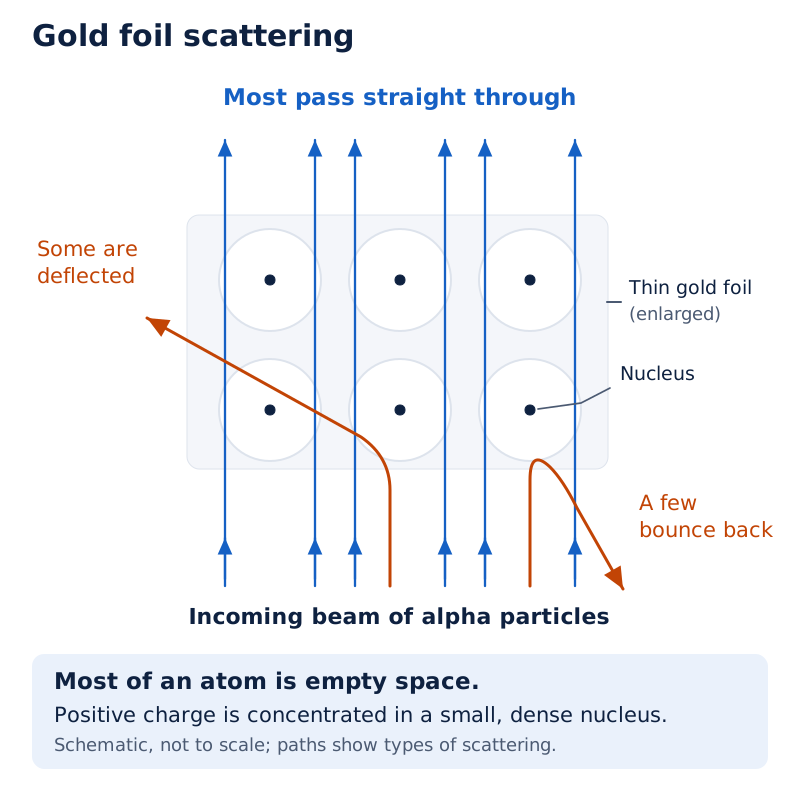
A beam of alpha particles approaches thin gold foil represented by a group of circles with central dots. Many arrowed paths continue straight; other paths change direction, including a path returning towards the incoming side.
Drawn by One Young India.
What was the limitation of Rutherford’s model?
An electron moving in a circular path continually changes direction and therefore accelerates. A moving charged particle undergoing such acceleration should lose energy. The electron should consequently spiral into the nucleus, making the atom collapse. Rutherford’s model could not explain why atoms remain stable.
Worked example 1. A sheet of paper is 0.1 millimetre thick. A millimetre is one thousandth of a metre, so this thickness is 10⁻⁴ metre. If an atom’s diameter is about 10⁻¹⁰ metre, estimate how many atoms would span the thickness.
Answer: Convert the thickness of 0.1 mm to metres: . Divide by the atomic diameter: .
The metre units cancel, leaving a count of about one million atoms. The sign means “approximately equal to”. This is an estimate using the given atomic diameter, rather than an exact count.
How does Bohr’s model explain atomic stability?
In 1913, Niels Bohr proposed that electrons occupy certain permitted circular paths around the nucleus. These paths are called orbits, shells or stationary states. Each has a definite energy, so shells are also called energy levels.
What are the main postulates?
A postulate is a basic assumption accepted as a starting point for an explanation. Bohr introduced the following ideas to account for atomic stability:
- Electrons move in allowed shells around the nucleus, rather than occupying arbitrary paths between them.
- An electron moving in a permitted shell does not lose energy. Its energy remains constant in that stationary state.
- The shells are labelled K, L, M and N, outward from the nucleus. Their shell numbers are represented by n = 1, 2, 3 and 4 respectively.
- The K shell is closest to the nucleus and has the lowest energy. Shell energy increases with distance from the nucleus.
- An electron can change shells by absorbing or releasing a fixed amount of energy equal to the difference between the two energy levels.
What the figure shows
Atomic energy levels
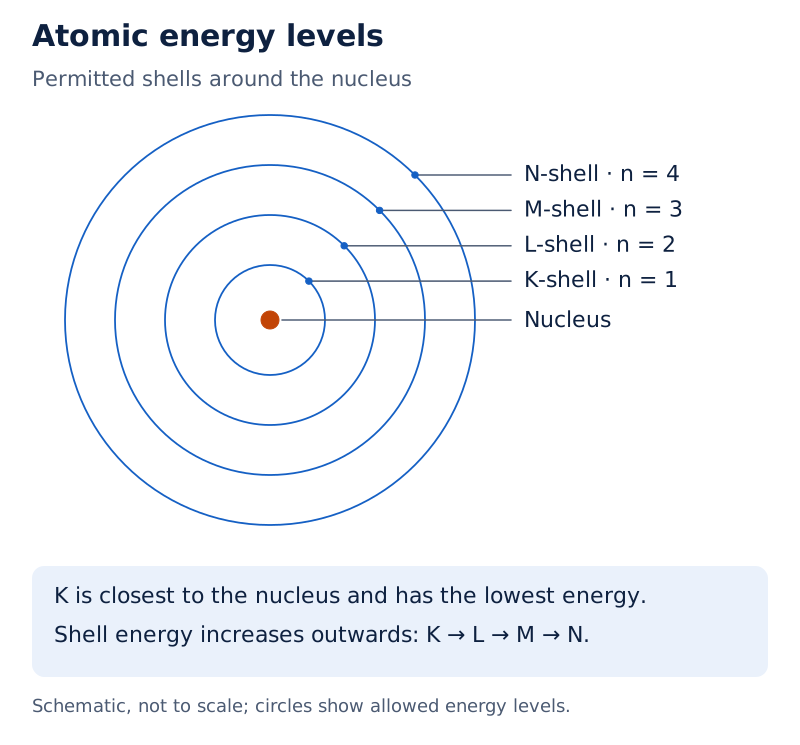
A central dot labelled nucleus is surrounded by four concentric circles. From the inside out, the circles are labelled K-shell, L-shell, M-shell and N-shell, with shell numbers 1, 2, 3 and 4.
Drawn by One Young India.
The crucial distinction from Rutherford’s model is the absence of energy loss in an allowed shell. This prevents the predicted inward spiral. Bohr’s model explained many observations, although it was later found to have limitations. The circular-shell picture is a simplified model of atomic structure.
How are atomic number and mass number used to count particles?
The atomic number, written Z, is the number of protons in an atom’s nucleus. It identifies the element. The mass number, written A, is the total number of protons and neutrons. These nuclear particles are collectively called nucleons.
For counting purposes, let p represent the number of protons, e the number of electrons, and N the number of neutrons. These are particle counts. N here is a counting symbol, distinct from the chemical symbol N for nitrogen introduced later.
Z = p. For a neutral atom, e = Z. Since the nucleus contains protons and neutrons, A = p + N, and therefore N = A − Z.
Derivation: How is the neutron count obtained?
- Mass number counts protons and neutrons together: .
- Atomic number counts protons, so substitute to obtain .
- Subtract the atomic number from both sides: .
Result: . These symbols represent particle counts, so the answer has no mass unit. Electrical neutrality is needed to set the electron count equal to Z, but not to calculate the neutron count.
How is an atom represented?
In ¹²₆C, C is the chemical symbol for carbon. The upper number 12 is its mass number; the lower number 6 is its atomic number. This carbon atom has six protons, six electrons and six neutrons. Mass number counts nucleons; it is not an electron count.
Worked example 2. A neutral atom has atomic number 26 and 56 nucleons. Find its numbers of protons, electrons and neutrons.
Answer: Formula: , for a neutral atom, and . Substitute: , , and .
There are 26 protons, 26 electrons and 30 neutrons. Check: nucleons, agreeing with the given mass number.
Worked example 3. A neutral atom has 11 electrons and mass number 23. Find the number of neutrons.
Answer: Formula: for a neutral atom and . Substitute: , so . The atom therefore contains 12 neutrons. Its 11 protons balance its 11 electrons.
Note: The relation e = Z applies to a neutral atom. An ion is a charged particle formed when an atom or group of atoms loses or gains electrons; its electron count need not equal its proton count.
How are electrons distributed among shells?
Electronic configuration means the distribution of electrons among an atom’s shells. Numbers separated by commas give the populations of successive shells, beginning with K. Thus 2, 8, 1 means two electrons in K, eight in L and one in M.
What does the 2n² rule calculate?
The maximum capacity of a shell is given by Maximum electrons = 2n², where n is the shell number and n² means n multiplied by itself. Capacity is the largest number a shell can hold, rather than the number it must contain in every atom.
| Shell | Shell number | Capacity calculation | Maximum electrons |
|---|---|---|---|
| K | 1 | 2 × 1² | 2 |
| L | 2 | 2 × 2² | 8 |
| M | 3 | 2 × 3² | 18 |
The outermost shell accommodates at most eight electrons in this simplified scheme, except that the first shell holds at most two. For the first eighteen elements, distribute the atom’s electrons by placing up to two in K, then up to eight in L, and then any remaining electrons in M. Hydrogen has only one electron, which occupies K.
This distinction explains why an M shell with eight electrons can be the stable outer shell of argon even though its maximum capacity from 2n² is eighteen. Do not treat the capacity formula as a complete filling sequence for every element.
Which configurations are needed for bonding?
| Element and chemical symbol | Atomic number | Electronic configuration |
|---|---|---|
| Hydrogen, H | 1 | 1 |
| Helium, He | 2 | 2 |
| Carbon, C | 6 | 2, 4 |
| Nitrogen, N | 7 | 2, 5 |
| Oxygen, O | 8 | 2, 6 |
| Neon, Ne | 10 | 2, 8 |
| Sodium, Na | 11 | 2, 8, 1 |
| Magnesium, Mg | 12 | 2, 8, 2 |
| Chlorine, Cl | 17 | 2, 8, 7 |
| Argon, Ar | 18 | 2, 8, 8 |
| Calcium, Ca | 20 | 2, 8, 8, 2 |
Worked example 4. A neutral magnesium atom has atomic number 12 and mass number 24. Find its particle counts and electron distribution.
Answer: It contains 12 protons, 12 electrons and 24 − 12 = 12 neutrons. Place two electrons in K, eight in L and the remaining two in M. The resulting configuration is 2, 8, 2; its shell populations total twelve.
Why do atoms combine, and how is valency related to the octet rule?
The outermost occupied shell is the valence shell, and its electrons are valence electrons. An octet is a group of eight electrons in that shell. A duplet is a complete first shell containing two electrons, as in helium.
Atoms with complete octets, or two outer electrons in helium, are largely unreactive and more stable. Atoms with incomplete valence shells are usually more reactive. Their tendency to acquire a stable outer configuration helps explain their chemical activity.
What is the octet rule?
Definition: The octet rule describes atoms combining by gaining, losing or sharing valence electrons to acquire eight electrons in their valence shells. Hydrogen instead completes its first shell with a duplet.
A chemical bond is the force holding atoms together in a combined structure. Bond formation produces a more stable arrangement with lower total energy than the separate atoms. Electron transfer and electron sharing are two ways of achieving stable configurations.
Valency is an atom’s combining capacity. In this electron-based description, it is the number of electrons lost, gained or shared to achieve a stable configuration. Sodium loses one electron and has valency one; oxygen can gain two and has valency two.
Generally, an atom with fewer than four valence electrons tends to lose electrons. An atom with more than four tends to gain electrons; it may also share them. Carbon, with four valence electrons, cannot easily gain or lose all four, so it shares electrons.
Valency and the number of valence electrons are therefore not interchangeable. Oxygen has six valence electrons but valency two. Carbon has four of each. Some compounds do not follow the usual valency rule, so the octet approach should not be made into an exceptionless statement.
What are isotopes, and why can an atomic mass be fractional?
Isotopes are atoms of the same element with the same atomic number but different mass numbers. Their proton counts are identical, while their neutron counts differ. Neutral isotopes also have equal electron counts and the same electronic configuration.
How do hydrogen, carbon and chlorine illustrate isotopes?
| Element | Isotope | Protons | Neutrons | Electrons in neutral atom |
|---|---|---|---|---|
| Hydrogen | Protium, ¹₁H | 1 | 0 | 1 |
| Hydrogen | Deuterium, ²₁H | 1 | 1 | 1 |
| Hydrogen | Tritium, ³₁H | 1 | 2 | 1 |
| Carbon | Carbon-12, ¹²₆C | 6 | 6 | 6 |
| Carbon | Carbon-13, ¹³₆C | 6 | 7 | 6 |
| Carbon | Carbon-14, ¹⁴₆C | 6 | 8 | 6 |
| Chlorine | Chlorine-35, ³⁵₁₇Cl | 17 | 18 | 17 |
| Chlorine | Chlorine-37, ³⁷₁₇Cl | 17 | 20 | 17 |
The chemical properties of isotopes are similar, because chemical behaviour depends mainly on valence electrons. Their physical properties, such as melting and boiling points, can differ. Protium has no neutron, but the other hydrogen isotopes do; avoid saying that every hydrogen nucleus lacks neutrons.
How is chlorine’s average atomic mass calculated?
The unified atomic mass unit, symbol u, equals one-twelfth of the mass of a carbon-12 atom. Relative abundance describes the proportion of each isotope in a sample. A weighted average gives each isotopic mass a contribution proportional to its abundance.
Derivation: How does isotopic abundance give an average mass?
Let and be the masses of two isotopes, and and their percentage abundances.
- Convert percentage abundances to fractions: and .
- Weight each isotopic mass by its fraction: and .
- Add the contributions: .
Result: The weighted average retains the mass unit of the isotopic masses. For chlorine’s approximate 3:1 mixture, the fractions are and , so the lighter isotope contributes more.
Worked example 5. Chlorine has isotopic masses 35 u and 37 u in an approximate ratio of 3:1, corresponding to about 75% and 25%. Calculate the average atomic mass using these values.
Answer: The abundances are 75 per cent and 25 per cent, giving fractions and . The contributions are and .
Add them: . The result is an average over the mixture, not the mass number of an individual atom.
The unweighted calculation (35 + 37) ÷ 2 = 36 u treats the isotopes as equally abundant. That does not match the given 3:1 ratio. The average lies nearer 35 u because chlorine-35 makes the larger contribution to the sample.
How are other isotope mixtures calculated?
Worked example 6. Bromine has isotopes with mass numbers 79 and 81 and abundances 49.7% and 50.3%. Calculate its average atomic mass using approximate isotopic masses of 79 u and 81 u.
Answer: The abundances of 49.7 per cent and 50.3 per cent give fractions 0.497 and 0.503. The contributions are u and u.
The average is , approximately 80.0 u. It lies slightly nearer 81 u because that isotope is slightly more abundant.
Worked example 7. Carbon-12, carbon-13 and carbon-14 have masses 12 u, 13.00335 u and 14.00317 u, with percentage abundances 98.892%, 1.108% and . Calculate the average atomic mass.
Answer: Convert 98.892 per cent and 1.108 per cent to 0.98892 and 0.01108. Dividing carbon-14’s percentage by 100 gives . These rounded abundances give the contributions below.
u; u; u.
Adding the three contributions gives approximately . Carbon-12 dominates the average because its abundance is much greater.
Worked example 8. A chlorine sample contains one million atoms: 7.5 lakh chlorine-35 atoms and 2.5 lakh chlorine-37 atoms. Find each isotope’s percentage abundance and check the average mass using 35 u and 37 u.
Answer: Chlorine-35 has abundance per cent. Chlorine-37 has abundance per cent. Their total is 100 per cent.
The corresponding fractions are 0.75 and 0.25. Therefore . The sample contains whole atoms of each isotope despite its fractional average mass.
How do ions form an electrovalent bond in sodium chloride?
A cation is a positively charged ion, while an anion is a negatively charged ion. An atom becomes a cation by losing electrons, or an anion by gaining them. Its nucleus remains unchanged during this electron transfer.
Definition: An electrovalent bond, also called an ionic bond, is the electrostatic attraction between oppositely charged ions. Electrostatic attraction is the attraction arising from opposite electric charges.
What happens to sodium and chlorine?
- A sodium atom has eleven electrons arranged 2, 8, 1. It loses its single outer electron, leaving the stable configuration 2, 8.
- The sodium nucleus still contains eleven protons. Ten electrons remain, so the particle has one net positive charge and is written Na⁺.
- A chlorine atom has seventeen electrons arranged 2, 8, 7. It gains the electron lost by sodium, giving the configuration 2, 8, 8.
- Its seventeen protons now accompany eighteen electrons. The resulting chloride ion has one net negative charge and is written Cl⁻.
- The oppositely charged sodium and chloride ions attract, producing sodium chloride, whose formula is NaCl.
The electron bookkeeping is Na → Na⁺ + e⁻ and Cl + e⁻ → Cl⁻. Here → means “forms” or “changes into”; e⁻ denotes the transferred electron. The superscript signs show ion charges, rather than extra atoms.
One sodium ion and one chloride ion have equal and opposite charges, so the simplest ratio is 1:1. The formula NaCl expresses this ratio. Sodium chloride consists of an extended arrangement of ions, rather than separate NaCl molecules.
Worked example 9. Sodium begins with eleven protons and eleven electrons; chlorine begins with seventeen of each. After one electron passes from sodium to chlorine, what charges result?
Answer: Sodium retains eleven protons but has ten electrons: , a positive charge of 1 unit. Chlorine retains seventeen protons but has eighteen electrons: , a negative charge of 1 unit.
Here a charge unit is the magnitude of one proton’s or electron’s charge. The combined charge is . Electron transfer changes electron counts without changing either element’s proton count.
How do magnesium chloride and calcium oxide form?
Some atoms transfer more than one electron. The number accepted by the other atoms determines the ion ratio required for an electrically neutral compound. Count both the electrons transferred and the final charges before writing its formula.
Why does magnesium chloride contain two chloride ions?
A magnesium atom has the configuration 2, 8, 2. Losing two outer electrons produces Mg²⁺, the magnesium ion, with configuration 2, 8. Each chlorine atom, initially 2, 8, 7, accepts one electron to form Cl⁻ with configuration 2, 8, 8.
One magnesium atom therefore supplies electrons to two chlorine atoms. The electron changes are Mg → Mg²⁺ + 2e⁻ and 2Cl + 2e⁻ → 2Cl⁻. A number placed before a symbol counts particles; 2Cl means two chlorine atoms.
One Mg²⁺ ion balances two Cl⁻ ions, giving magnesium chloride, MgCl₂. The lower numeral ₂ specifies two chloride ions for each magnesium ion. The total charge is +2 + 2(−1) = 0, where parentheses group the charge being multiplied.
Why is the formula for calcium oxide CaO?
Calcium begins with configuration 2, 8, 8, 2. It loses two electrons to form Ca²⁺, the calcium ion, with configuration 2, 8, 8. Oxygen begins with configuration 2, 6 and accepts two electrons to form O²⁻, the oxide ion, with configuration 2, 8.
The electron changes are Ca → Ca²⁺ + 2e⁻ and O + 2e⁻ → O²⁻. One calcium ion balances one oxide ion because their charges are equal in size and opposite in sign. The simplest formula is therefore calcium oxide, CaO.
Diagram
Calcium oxide formation
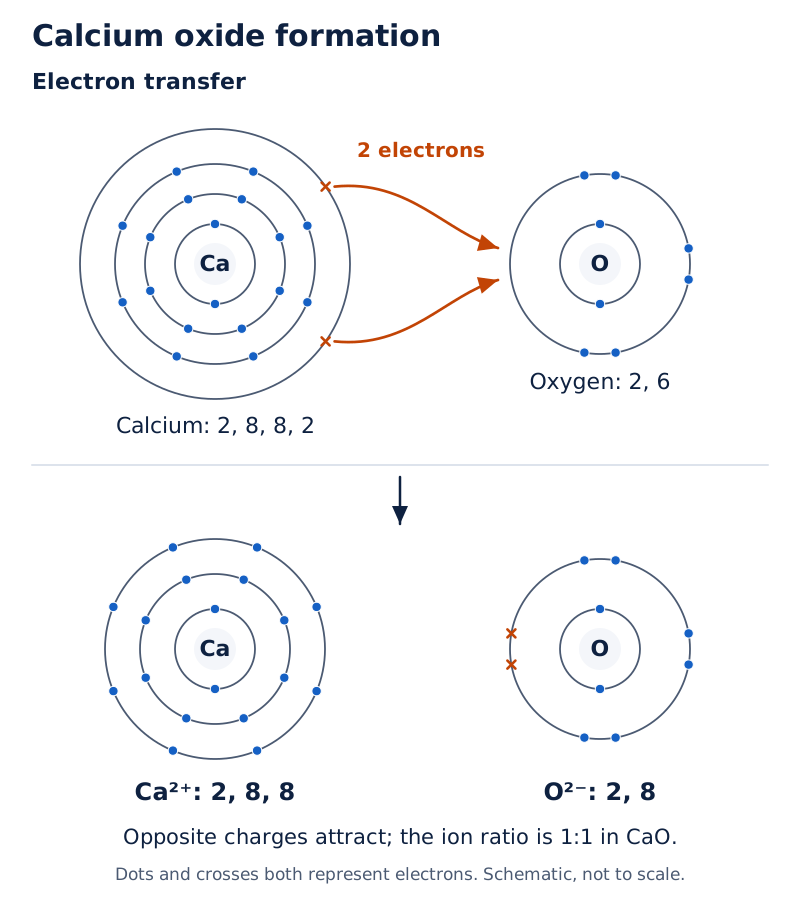
Draw calcium with four shells containing 2, 8, 8, 2 electrons, and oxygen with two containing 2, 6. Show two electrons transferred from calcium to oxygen. Draw the resulting ions separately, labelled Ca²⁺ and O²⁻, with configurations 2, 8, 8 and 2, 8.
Drawn by One Young India.
In both compounds, electron loss exposes a stable occupied shell in the metal ion. Electron gain completes the non-metal ion’s octet. The electrovalent bond is the resulting attraction between ions, rather than the moving electron itself.
How do hydrogen, chlorine, oxygen and nitrogen form covalent molecules?
A covalent bond forms when atoms share an electron pair. The pair contributes to the outer-shell count of both bonded atoms. A molecule is an electrically neutral group of two or more bonded atoms capable of independent existence and retaining the chemical properties of the substance.
In an electron-dot representation, dots show valence electrons. Dots and crosses may distinguish electrons originally supplied by different atoms. They represent the same kind of particle. An unshared pair, or lone pair, is a pair of valence electrons not used in bonding.
How many pairs are shared?
| Molecule | Electrons each atom contributes | Shared pairs | Bond and completed shell |
|---|---|---|---|
| Hydrogen, H₂ | One | One | Single bond; each hydrogen attains a duplet |
| Chlorine, Cl₂ | One | One | Single bond; each chlorine attains an octet |
| Oxygen, O₂ | Two | Two | Double bond; each oxygen attains an octet |
| Nitrogen, N₂ | Three | Three | Triple bond; each nitrogen attains an octet |
Hydrogen has one electron in its first shell. Two hydrogen atoms contribute one electron each to a common pair. Each counts that shared pair towards a two-electron shell. The structural formula H-H uses one line for the single bond.
Each chlorine atom has seven valence electrons and needs one more for an octet. Sharing one pair gives Cl-Cl. Six other outer electrons on each chlorine remain as three lone pairs. Bonding does not require hydrogen to acquire eight electrons.
Each oxygen has six valence electrons. Sharing two pairs supplies an octet around each, represented by O=O; here the two lines indicate a double bond, not an equals sign in a calculation. Each oxygen also retains two lone pairs.
Each nitrogen has five valence electrons. The atoms contribute three electrons each, forming three shared pairs and a triple bond, written N≡N. Each nitrogen retains one lone pair. Count six shared electrons, rather than three, in this bond.
How are the covalent structures of common compounds explained?
Atoms of different elements also share electrons. The number of shared pairs depends on their outer-shell requirements. Count a shared pair for both atoms joined by that bond, while keeping the total number of actual electrons unchanged.
How do hydrogen chloride and water form?
In hydrogen chloride, HCl, hydrogen has one valence electron and chlorine has seven. Each contributes one electron to a single shared pair. Hydrogen attains a duplet and chlorine an octet. The structure is H-Cl, with three lone pairs remaining on chlorine.
What the figure shows
Hydrogen chloride formation
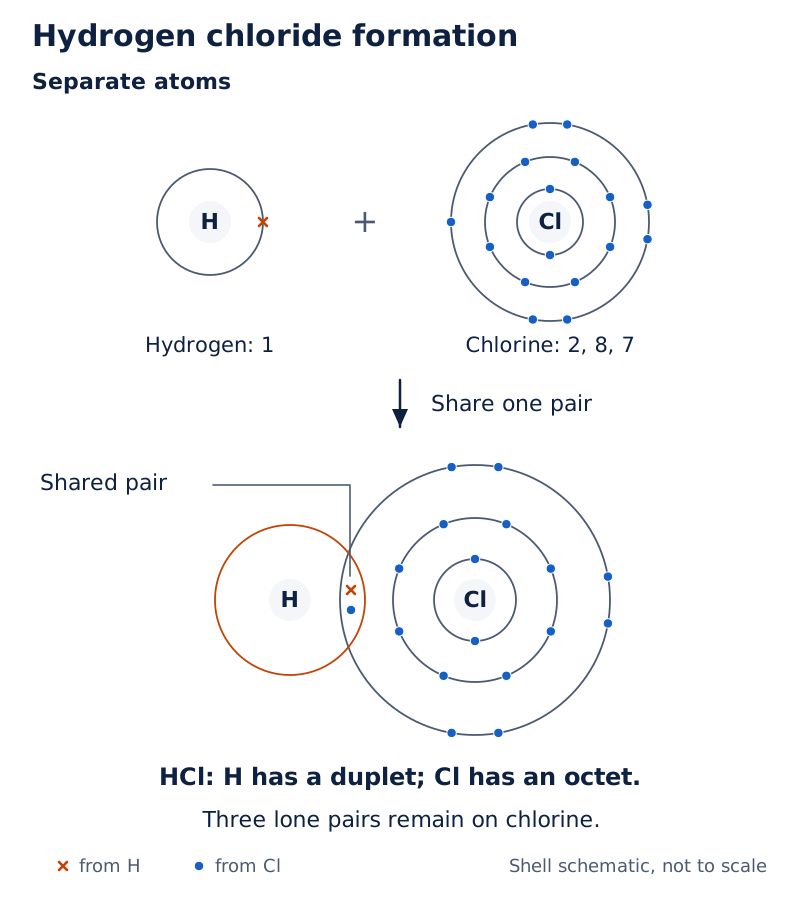
Separate hydrogen and chlorine shell diagrams lead to a combined diagram. Hydrogen’s one shell overlaps chlorine’s outer shell, with two electrons in the overlap. Chlorine’s inner shells remain visible.
Drawn by One Young India.
In water, H₂O, oxygen needs two more electrons for an octet, while each hydrogen needs one for a duplet. Oxygen shares one electron with each of two hydrogen atoms, forming two single bonds. Two lone pairs remain on oxygen.
What the figure shows
Water formation
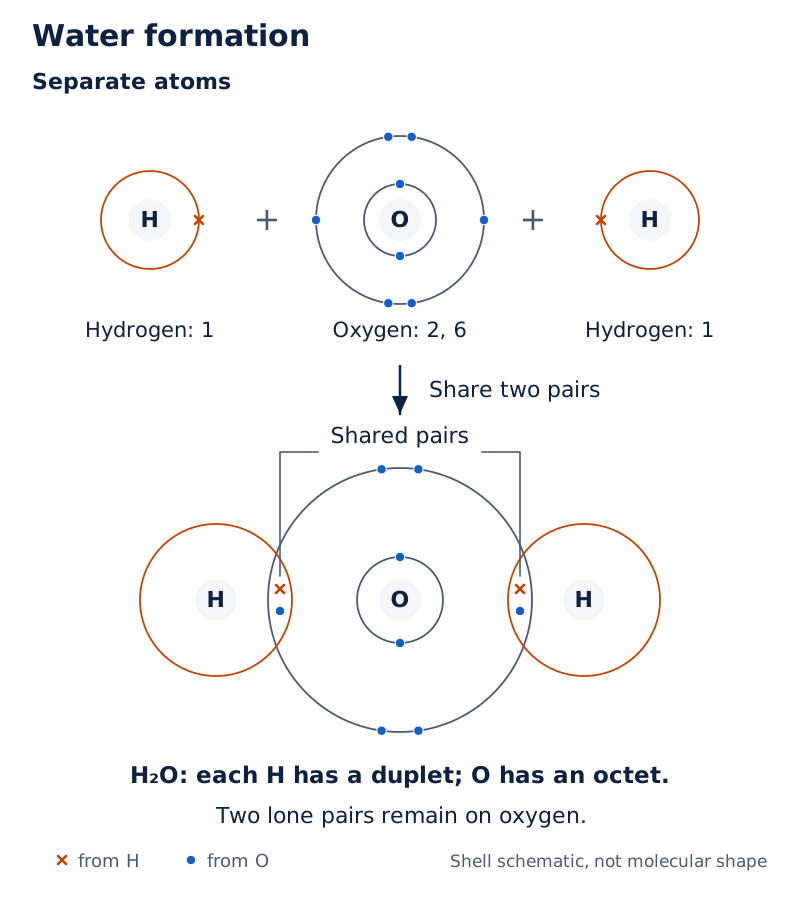
Two separate hydrogen atoms and one oxygen atom are shown before combination. In the water diagram, one hydrogen shell overlaps oxygen’s outer shell on each side. Each overlap contains a shared electron pair.
Drawn by One Young India.
How do ammonia, methane and carbon tetrachloride form?
Ammonia, NH₃, contains one nitrogen and three hydrogen atoms. Nitrogen has five valence electrons and contributes three to three separate shared pairs. Each hydrogen contributes one electron. Nitrogen gains an octet, each hydrogen gains a duplet, and nitrogen retains one lone pair.
Methane, CH₄, contains one carbon and four hydrogen atoms. Carbon shares its four valence electrons separately with four hydrogen atoms. Four single bonds surround carbon, giving it an octet. Each hydrogen has a duplet, and carbon has no lone pair in this structure.
In carbon tetrachloride, CCl₄, carbon shares one electron with each of four chlorine atoms. Each chlorine contributes one electron to its bond with carbon. Four single bonds complete carbon’s octet; each chlorine also has an octet and retains three lone pairs.
How should an orbit structure be checked?
- Write the electronic configuration of every kind of atom in the molecule and identify the valence electrons.
- Place the required atoms around the central atom: oxygen in water, nitrogen in ammonia, or carbon in methane and carbon tetrachloride.
- Draw the shells and place each shared pair in the overlap of the two atoms it joins. Retain the inner shells in an orbit structure.
- Count two electrons around each hydrogen and eight around each other bonded atom in these examples, including shared and unshared electrons.
One shared pair links two atoms. It does not create two separate bonds merely because both atoms use the pair in their outer-shell counts. Formula subscripts count atoms; bond lines count shared pairs between particular atoms.
How can breaking a covalent bond produce radicals?
A free radical is a neutral atom or group of atoms with an unpaired electron. An unpaired electron is one that does not belong to an electron pair. Free radicals can form when a covalent bond breaks and its shared electrons separate.
What happens during equal bond splitting?
In homolytic cleavage, each bonded atom takes one electron from the shared pair. The resulting fragments have unpaired electrons. For chlorine, light or heat can split a chlorine molecule into two chlorine free radicals.
The change is written Cl₂ → 2Cl•, in the presence of light or heat. The dot • denotes an unpaired electron, so Cl• represents a chlorine radical. It does not represent the negative charge shown in Cl⁻, the chloride ion.
Before splitting, the two bonding electrons form one shared pair. Afterwards, one of those electrons remains with each chlorine atom. The atoms are neutral radicals rather than chloride ions. Free radicals are very reactive.
How does this differ from other charged particles?
In heterolytic cleavage, both electrons from a broken covalent bond remain with one fragment, producing oppositely charged fragments. Thus breaking a covalent bond does not necessarily produce free radicals: the distribution of the bonding pair matters.
A polyatomic ion is a charged group of atoms. Examples include hydroxide, OH⁻, and ammonium, NH₄⁺. These charged groups must not be confused with the neutral free radicals formed by equal splitting of a bond. Check whether the notation shows a charge or an unpaired-electron dot.
Glossary
- Atom — A tiny building block of matter that participates in chemical reactions and contains subatomic particles.
- Nucleus — The small central region containing protons and neutrons and most of an atom’s mass.
- Atomic number — The number of protons in an atom’s nucleus, identifying its element.
- Mass number — The total number of protons and neutrons in the nucleus of an atom.
- Electronic configuration — The distribution of an atom’s electrons among its successive occupied shells.
- Valence electrons — Electrons present in the outermost occupied shell of an atom.
- Valency — An atom’s combining capacity, expressed through electrons lost, gained or shared in attaining a stable configuration.
- Octet — A group of eight electrons in the valence shell of an atom.
- Duplet — A complete first shell containing two electrons, as in a helium atom.
- Isotopes — Atoms of the same element with identical atomic numbers but different mass numbers.
- Ion — A charged particle formed when an atom or group of atoms gains or loses electrons.
- Electrovalent bond — The electrostatic attraction holding oppositely charged ions together in an ionic compound.
- Covalent bond — A bond formed when two atoms share an electron pair between them.
- Lone pair — A pair of valence electrons that is not shared in a covalent bond.
- Free radical — A neutral atom or group of atoms possessing an unpaired electron.
Common errors and misconceptions
- Misconception: Most alpha particles bounced back from gold foil. Correct: Most passed undeflected; only a few bounced back, revealing the small, dense nucleus.
- Misconception: Rutherford’s model explained atomic stability. Correct: It predicted that accelerating electrons would lose energy and collapse into the nucleus; Bohr introduced permitted stationary states.
- Misconception: Mass number includes electrons. Correct: It counts protons and neutrons only. The atomic number counts protons.
- Misconception: Every hydrogen atom has no neutron. Correct: Protium has none, deuterium has one and tritium has two.
- Misconception: Gaining an electron makes an atom positive. Correct: Electrons carry negative charge. Gaining them produces an anion; losing them produces a cation.
- Misconception: The M shell must contain eighteen electrons before it can be a stable outer shell. Correct: Eighteen is its maximum capacity; argon has a stable outer octet in the configuration 2, 8, 8.
- Misconception: A double bond contains two shared electrons. Correct: It contains two shared pairs, or four electrons. A triple bond contains three shared pairs.
- Misconception: A chlorine radical and a chloride ion are identical. Correct: Cl• is neutral with an unpaired electron; Cl⁻ has gained an electron and carries a negative charge.
Exam-style questions with model answers
Q1. Define atomic number and mass number. [2 marks]
- Atomic number is the number of protons in an atom’s nucleus and identifies the element.
- Mass number is the total number of protons and neutrons present in that nucleus.
Q2. A neutral magnesium atom has atomic number 12 and mass number 24. Find its numbers of protons, electrons and neutrons, and its electronic configuration. [4 marks]
- The atom contains 12 protons, because atomic number equals the number of protons in its nucleus.
- It contains 12 electrons, because a neutral atom has equal numbers of electrons and protons.
- It contains 24 − 12 = 12 neutrons, found by subtracting atomic number from mass number.
- Its electronic configuration is 2, 8, 2: two electrons occupy K, eight occupy L and the remaining two occupy M.
Q3. In gold foil scattering, most positively charged alpha particles passed undeflected, some were sharply deflected and a few bounced back. Give the three corresponding conclusions, one merit of Rutherford’s model and its stability limitation. [5 marks]
- Most particles passed undeflected, indicating that most of the atom is empty space through which the incoming alpha particles could pass.
- Sharp deflections showed that the positive charge was concentrated, rather than distributed uniformly throughout the entire volume of the atom.
- The few particles returning backwards indicated a very small, dense nucleus containing the atom’s positive charge and most of its mass.
- A merit of Rutherford’s nuclear model was that it explained the scattering observations better than Thomson’s model of spread-out positive charge.
- Its limitation was atomic stability: an accelerating orbiting electron should lose energy and spiral into the nucleus, whereas atoms remain stable.
Q4. Chlorine has two isotopes with atomic number 17, mass numbers 35 and 37, approximate masses 35 u and 37 u, and abundances 75% and 25%. Find their neutron counts, calculate the average atomic mass, and explain the fractional result. [4 marks]
- Chlorine-35 contains 35 − 17 = 18 neutrons, because mass number counts both protons and neutrons.
- Chlorine-37 contains 37 − 17 = 20 neutrons, while its proton count remains seventeen.
- The weighted average atomic mass is (35 × 75 ÷ 100) + (37 × 25 ÷ 100) = 35.5 u.
- The fractional value describes the isotopic mixture. It does not mean that an individual chlorine atom has a mass number of 35.5.
Q5. Magnesium has configuration 2, 8, 2 and chlorine has configuration 2, 8, 7. Explain magnesium chloride formation, covering electron loss, electron gain, final configurations, charge balance and the bond. [5 marks]
- One magnesium atom loses its two outer electrons. It becomes a magnesium ion, Mg²⁺, because it now has two more protons than electrons.
- Two chlorine atoms each accept one of those electrons. Each becomes a chloride ion, Cl⁻, with one more electron than proton.
- The magnesium ion has configuration 2, 8, while each chloride ion has configuration 2, 8, 8. Each resulting ion therefore has an outer octet.
- One Mg²⁺ balances two Cl⁻ ions: +2 + 2(−1) = 0. The simplest ion ratio is 1:2, giving the formula MgCl₂.
- The oppositely charged ions attract through electrostatic forces. This attraction is the electrovalent or ionic bond holding the ions together in the compound.
Q6. Hydrogen has one electron in its first shell; oxygen has configuration 2, 6. Explain the bonding in water, H₂O, including the completed shells. [3 marks]
- Oxygen requires two more electrons for an octet, while each hydrogen requires one more electron to complete its first shell as a duplet.
- Oxygen shares one electron with each of two hydrogen atoms, and each hydrogen supplies one electron, creating two shared pairs and two single covalent bonds.
- Counting the shared pairs gives oxygen eight outer-shell electrons and each hydrogen two. Oxygen’s four remaining valence electrons form two lone pairs.
Q7. Oxygen has six valence electrons and nitrogen has five. Explain why O₂ has a double bond and N₂ has a triple bond, and state the number of electrons shared in each molecule. [4 marks]
- Each oxygen atom needs two electrons to complete its octet, so each contributes two electrons to sharing with the other oxygen atom.
- Four electrons form two shared pairs in O₂. Two shared pairs between the same atoms constitute a double bond.
- Each nitrogen atom needs three electrons to complete its octet, so each contributes three electrons to sharing with the other nitrogen atom.
- Six electrons form three shared pairs in N₂. Three shared pairs between the same atoms constitute a triple bond.
Q8. A chlorine molecule’s single covalent bond splits in light or heat, with each atom retaining one electron from the shared pair. Name the splitting process and describe the products. [2 marks]
- The process is homolytic cleavage: the bonding pair divides equally between the two previously bonded atoms.
- Two neutral chlorine free radicals, Cl•, form, each possessing an unpaired electron. The products are not negatively charged chloride ions.
Key takeaways
- Atoms contain a small nucleus with protons and neutrons, surrounded by electrons; neutral atoms have equal proton and electron counts.
- Rutherford’s scattering experiment established a small, dense, positively charged nucleus and showed that most of an atom is empty space.
- Bohr’s model places electrons in permitted energy levels where they do not lose energy while remaining in the same shell.
- Atomic number counts protons, mass number counts nucleons, and subtracting atomic number from mass number gives the neutron count.
- Isotopes share an atomic number but differ in neutron count; their similar electronic configurations explain their similar chemical properties.
- Electrovalent bonding involves attraction between ions formed by electron transfer; compound formulae express ratios that balance their charges.
- Covalent single, double and triple bonds contain one, two and three shared electron pairs respectively, completing duplets or octets in these examples.
- Equal splitting of a covalent bonding pair produces free radicals with unpaired electrons; a radical dot is different from an ionic charge.
Test yourself
Why is a neutral sodium atom with eleven protons also expected to contain eleven electrons?
Each proton’s positive charge balances one electron’s negative charge. Eleven electrons therefore balance the eleven protons.
What did the passage of most alpha particles straight through gold foil suggest?
It suggested that most of an atom is empty space, allowing most particles to pass undeflected.
For shell number n = 2, what capacity does the 2n² rule give?
The capacity is 2 × 2² = 8 electrons. Shell number two corresponds to the L shell.
Why does helium need only two electrons for a complete outer shell?
Helium’s outer shell is the first shell, whose maximum capacity is two electrons, forming a duplet.
How do neutral carbon-12 and carbon-14 differ if both have atomic number six?
Both have six protons and six electrons. Carbon-12 has six neutrons, while carbon-14 has eight.
Why is one calcium ion, Ca²⁺, sufficient for one oxide ion, O²⁻?
The charges are equal in size and opposite in sign, so a 1:1 ratio is electrically neutral.
How many single bonds surround carbon in methane, CH₄?
Four single covalent bonds surround carbon, each formed by sharing one electron pair with a hydrogen atom.
What does the dot in Cl• mean, and how does it differ from the sign in Cl⁻?
The dot indicates an unpaired electron in a neutral chlorine radical. The minus sign indicates a negatively charged chloride ion.
Try it
ICSE Class 9 Chemistry: Atomic Structure and Chemical Bonding
Apply your understanding of electron distribution, ion formation, and bonding behavior in this 2-step scenario.
1An atom has 2 electrons in the K shell and 5 electrons in the L shell. Based on the rules of electron distribution and stability, how does this atom achieve stability and what ion does it form?
The text states that if an outer shell has 5 electrons, it is missing 3 electrons to reach 8. It tends to gain 3 electrons, giving it an ionic valency of 3 and forming an anion with a charge of -3.
The text explains that atoms with 5, 6, or 7 outer electrons tend to gain electrons to complete the outer shell rather than lose them.
Losing electrons forms a charged ion, not a neutral atom, and atoms adjust their outer shell valence electrons to achieve stability.
2After ions are formed through electron transfer to create an ionic compound such as NaCl, how does its physical state affect its ability to conduct electricity?
According to the text, ionic compounds conduct electricity in the molten/aqueous state because ions are mobile, whereas in the solid state, ions are held in fixed positions.
In the solid state, ions are held in fixed positions and do not conduct electricity; mobility in molten or aqueous states is required.
NaCl forms via ionic bonding (electron transfer creating oppositely charged ions), not electron sharing (covalent bonding), and conducts when molten or aqueous.
You have successfully applied the core concepts of atomic structure, electron transfer, and ionic properties!